10 Best Ways to Make Money in GTA Online

Unlike Grand Theft Auto V, where lots of money is thrown the player’s way all the way to the end of the game, Grand Theft Auto Online isn’t at all like this. Let’s explore the top ways to make money in GTA Online. Before we get started, let’s clarify several issues.
Daily versus In-Game Day
There is some confusion with GTAO using the word, “daily”. The game world has a day that lasts around an hour of real world play time. Then, there’s an actual in-real-life (IRL) day.
The use of the word ‘Daily’ below in the Type area means 24 real world hours must pass before that challenge or event resets in the game world. The challenges do not reset based on the in-game day, but instead reset based on waiting a full 24 clock-on-the-wall hours from the last time you played it.
You can specifically see this timer when you visit the Lucky Wheel at the Casino. However, other events which also require a 24 hour waiting period do not have visible timers. Instead, you must remember the last time you completed that specific event to know when you can play it again.
Costly Purchases
Unfortunately, too many activities in Grand Theft Auto Online require spending significant amounts of GTA$ to unlock access to those missions and areas (i.e., Cayo Perico Island). Once unlocked, you can then run those missions and make whatever money is given. However, the game is severely lopsided with too many of these missions and areas, such as Heists, falling into this category. What this all means? It means that Rockstar requires that you spend millions in GTA$ to gain back only a fraction of that money after completing the missions. This article intends to focus on the easiest ways to make money including ways that are entirely free (no costs involved), which don’t cost too much and/or ways that return a significant or passive amount of GTA$ for any money spent.
Any mission or activity which requires you to become a VIP, CEO or Motorcycle Club President (MCP) means you’ll need to purchase at least one of a VIP organization, an Executive Office (CEO) or a Motorcycle Clubhouse (MCP). All of these require at least GTA$1,000,000, with the VIP option being the worst deal in the game as you get no property out of the deal. If you’re going to pay at least GTA$1 million, you might as well get property out of the deal.
For activities in GTAO which primarily seek to take your GTA$, these are mentioned at the bottom of this article. Though, these activities aren’t worth playing simply to make money and should be avoided for that purpose. These up-front cost missions should only be played for their entertainment value… and only if you have the spare millions of GTA$ needed to unlock them. However, you don’t need to pay to unlock these expensive missions. There are plenty of activities which will yield GTA$ without paying anything.
Update for June 2022
Rockstar has permanently upped the ante for the Nightclub daily payout. Instead of the pittance of GTA$10,000 per in-game day, the game is now paying a whopping GTA$50,000 per day with a maximum safe capacity now at GTA$210,000. Normally, we would only see this kind of bonus as a short term weekly promotion. It seems that Rockstar has upped this payout permanently (or at least as permanently as Rockstar’s payouts can be… which probably means that it was a mistake and once Rockstar notices it, it will go back to GTA$10,000 per day). For now, gain from this while it lasts. So far, it’s lasted quite a while.
Is this update worth buying a Nightclub? Yes. In fact, I definitely recommend this purchase as the first property after purchasing an MC, VIP or CEO property. At GTA$50,000 per in-game day, you could see your Nightclub purchase refunded in around 30 in-game days assuming the Nightclub costs around GTA$1.5 million. In real world time and at 48 minutes IRL per in-game day, that would mean ~24 real life hours to see a GTA$1.5 million payout. If you play 4 hours a day, that’s around 6 days to recoup the cost of the Nightclub. After that, all money is bonus.
Tuners Update — Reduced Payouts
After the Tuners update rolled on July 20th, 2021, many payouts (including the nightclub missions) seem to have been reduced. This article is intended as reference, but know that with every update that Rockstar rolls, Rockstar can reduce payouts on any of what’s documented below without warning, as is the case with Simeon’s request and Nightclub missions. Simeon’s car request formerly offered up GTA$20,000 per car prior to Tuners, but has since been reduced on some cars to GTA$15,000 after this update. Rockstar just can’t seem to get enough of continually screwing us over.
Legend
The legend includes a Difficulty Level that ranges from 1 (Easy) to 5 (Medium) to 10 (Hard). The rest that appear in the legend are self-explanatory.
With these problems clarified, let’s start making some entirely free GTA$ starting with the best first …
⤵
1. Spin the Lucky Wheel

The first way to earn money in GTA online is by spinning the Lucky Wheel every day in the Diamond Casino. This activity costs nothing.
Landing on the GTA$50,000 spot each day for 7 days will net you a cool GTA$350,000 a week. Performing this activity for a full 31 days will net you GTA$1,550,000. How do you land this spot every day? The simplest way is to close the application before the wheel stops spinning. Once you know the wheel is not landing on GTA$50,000 (easy to see), close out, then reload into the game and try spinning again. There are also other money spots on the wheel such as 25,000 casino chips (which can be converted to GTA$), GTA$30,000, GTA$40,000 and others. While the highest is GTA$50,000, landing on any of these money spots is free money. Take advantage.
The best thing about this activity is that you don’t have to spend any money or perform any silly activities to get this free money, but you do have to sometimes restart the app several times before you can land on the exact spot, which takes a bit of time.
Cost: Free
Type: Free Money, Daily, Recurring
Reward: up to GTA$50,000 max depending on which space you land
Difficulty Level: 1 (Easy)
⤵
2. Simeon
This free activity appears once per day. Simeon will send you a text to locate one of several cars from his list. It can take about 30-45 minutes real play time before Simeon’s text pops up. If you’ve waited that long without a text, this likely means it hasn’t been a full 24 hours since the last time you performed this activity. These cars range in cost and only one of those listed cars will reward a maximum of ~GTA$20,000 (some cars reduced to $15k after Tuners update July 20th, 2021). Locate the highest cost car in the list, lose the 2 wanted stars, take it to Los Santos Customs and paint it for free. Then, drop it off at Simeon’s dock warehouse garage to pick up your free ~GTA$20,000 (or whatever you find your car is worth). This one only appears every 24 hours, like spinning the wheel.
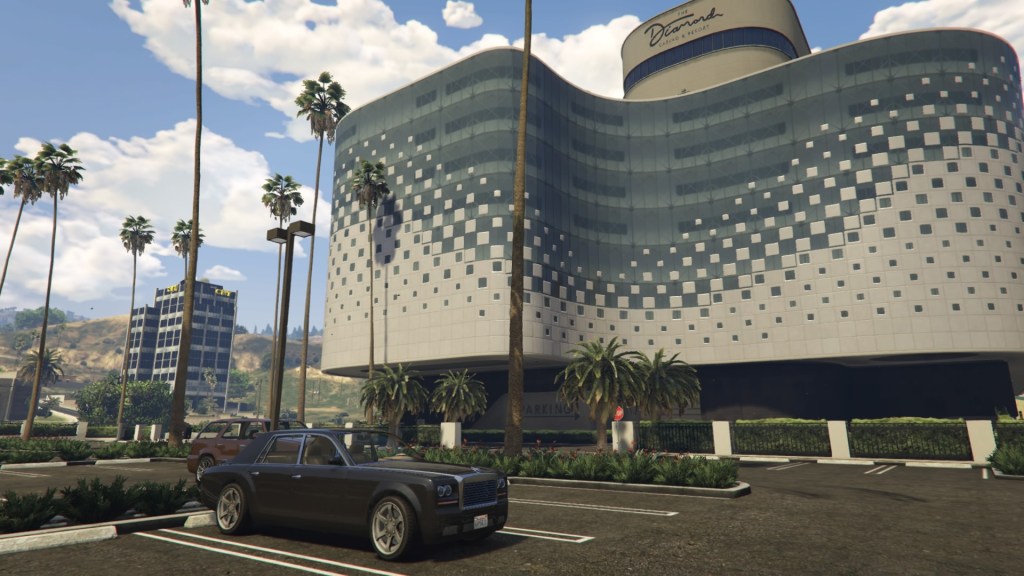
If you do Simeon’s text mission every day, in 31 days you’ll have made GTA$620,000. The challenge with this mission is in finding the car Simeon wants. The biggest hint I can give is try looking at the Diamond Casino parking lot. At least 2 times out of 5, you’ll find his highest priced car parked there, just waiting to steal.
Note, this one can be tricky. The game’s car spawning mechanic doesn’t sync up with this quest and won’t always spawn the cars Simeon wants. This means you can literally spend hours waiting on specific cars to spawn. Sometimes, the cars are readily available at a parking lot, sometimes you can drive around for hours looking. If after driving around for about 5-10 minutes without success, I recommend logging out and logging into a new server and waiting for Simeon to text you his newest list again. Moving to a new server can sometimes make this quest easier and faster. It’s worth noting that whatever it costs to repair the car at Los Santos Customs, after being chased by the cops, will be reimbursed to you upon turning the vehicle in. You don’t need to treat the car with kid gloves when heading over to Los Santos Customs. Once you’ve repaired and painted the car, then yes, you’ll want to be careful when driving over to Simeon’s warehouse at the docks.


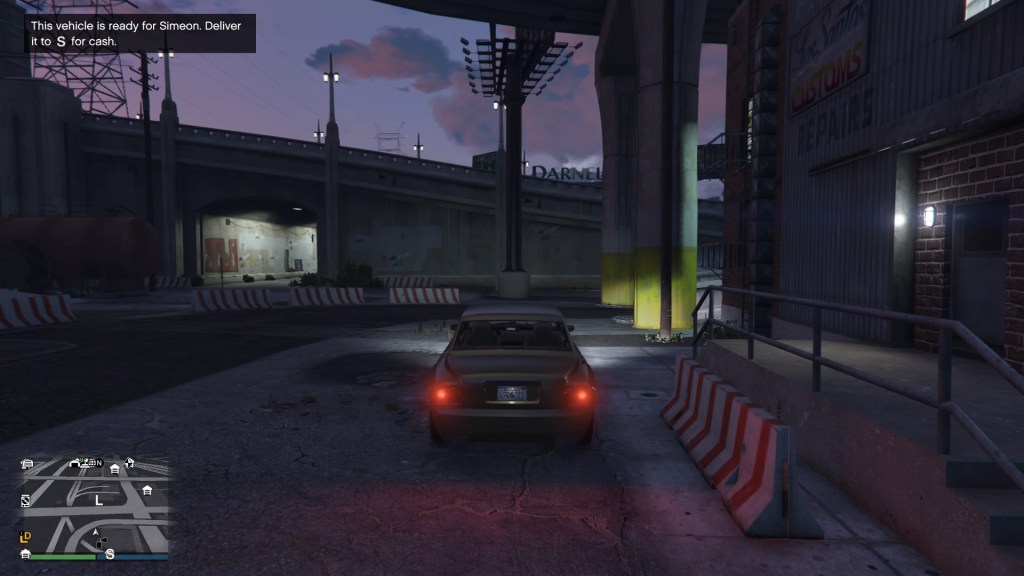


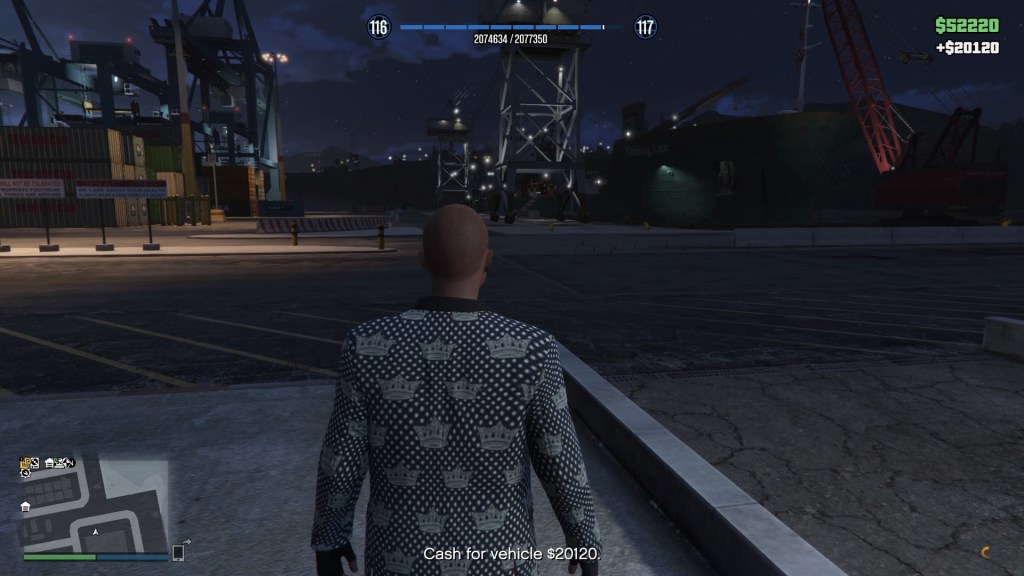
Cost: Free
Type: Active Income, Daily, Recurring
Reward: Max GTA$20,000 + repair costs reimbursed per day, depends on which car you drop off.
Difficulty Level: 3 (Medium… depends on whether cars spawn + must get rid of a 2 star wanted status + must drive car safely to the docks without damage)
Correction: I have since found that even though some cars have had their take reduced to GTA$15,000, some have not. The maximum is still GTA$20,000 + repair costs if you choose the correct car.
⤵
3. Stealing Cars
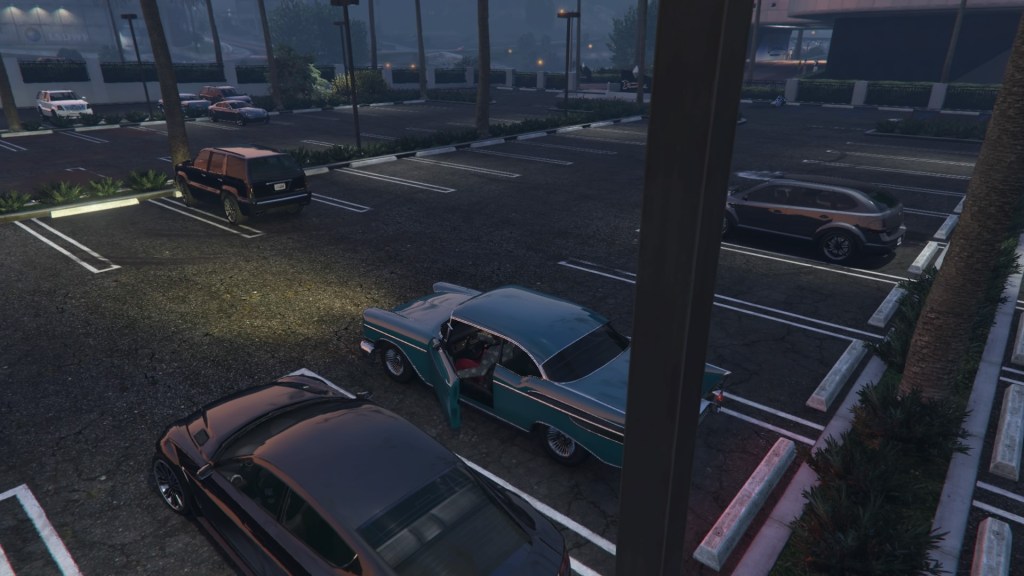
This is a free activity that can be had once per day. As in the game’s name as Grand Theft Auto, stealing random cars off of the street and driving them to Los Santos Customs can net you between GTA$3,000 to GTA$9,000 per car, depending on the car model you sell. You can only sell one car per day. While this isn’t a whole lot of money each time, it’s still enough that it’s worth doing for some quick cash.

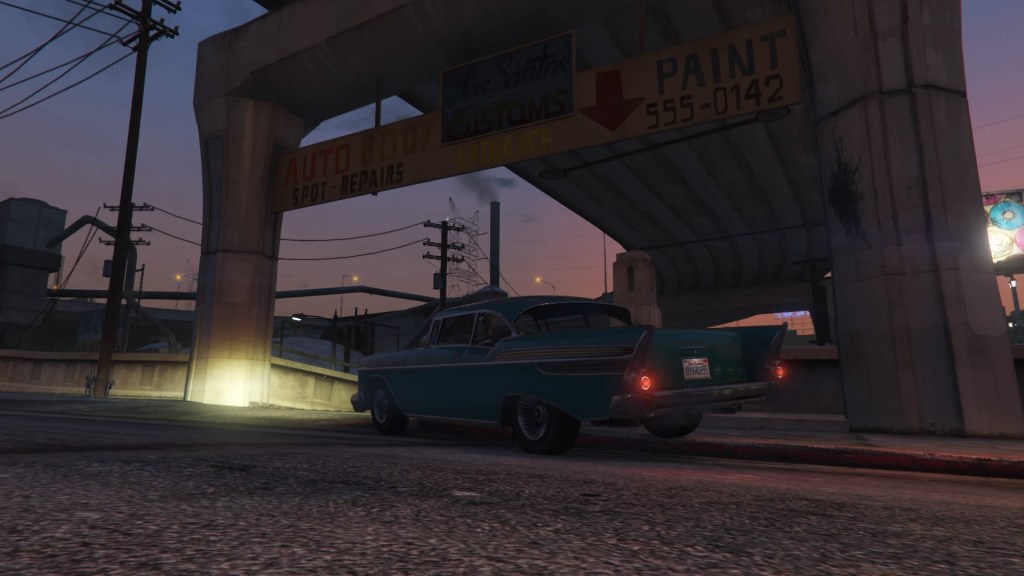


Cost: Free
Type: Active Income, Daily, Recurring
Reward: Up to GTA$9,000 per day depending on which car you drop off
Difficulty Level: 1 (Easy)
⤵
4. Robbing Convenience Marts
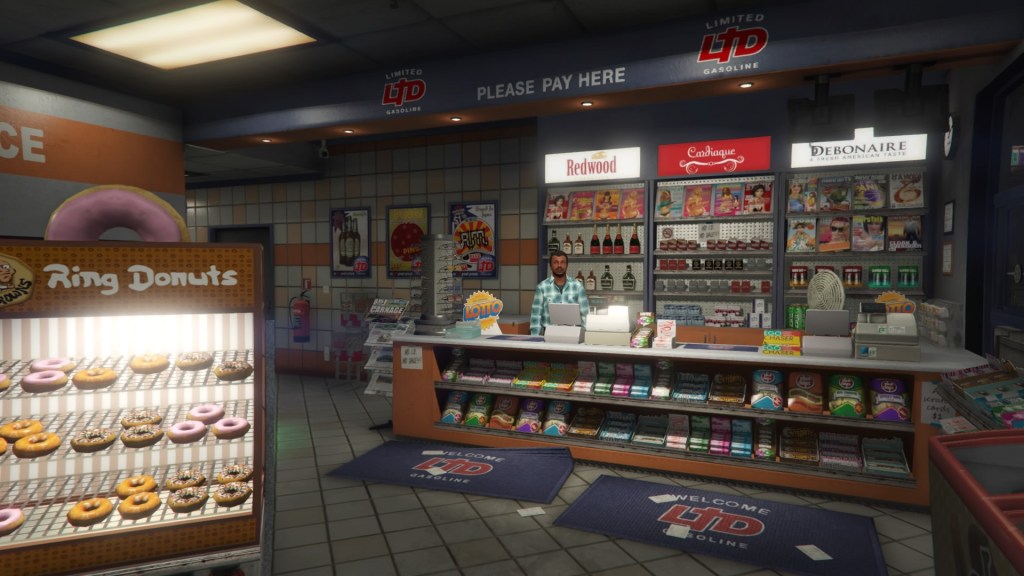
This is a free activity. While this activity can be a bit more on the fun side, it isn’t without its downsides. The difficulty isn’t so much with holding up the store, but that the maximum money you’ll get from each store is maxed at around GTA$1,000. That amount of money almost seems not worth the hassle, except there are 19 stores that you can hit up around the map to net somewhere close to GTA$19,000 per day. Not the best haul in this list, but it’s decent.
Cost: Free
Type: Active Income, Daily, Recurring
Reward: Up to GTA$1,000 per store with 19 stores
Difficulty Level: 3 (Mostly easy, but will need a decent getaway car)
⤵
5. Gang Attacks

Gang attacks appear as a large red circular area on the mini map and full sized map. These activities have you take down a bunch of thugs in that area. Upon successful gang attack completion, you receive 500 RP. Where you make your payout here is looting all of the gang bodies and the weapon crates. Gang members may drop between GTA$20-50 each. Each weapon crate drops GTA$500. Most areas have around 5 crates or more. The crates can total at least GTA$2,500 + whatever money you can loot off of the gang members.
Cost: Free
Type: Active, Daily, Recurring, Multiple map areas, Time Suck
Reward: ~GTA$2,500 + loot + 500 RP * ~36 Gang areas on the map >= GTA$90,000 per day
Difficulty Level: 6-8 (Medium hard, requires ammo, decent shooting skills and persistence)
⤵
6. Visit the Casino Cashier
This one offers free money every day. Visiting the casino cashier allows you to pick up 1000 visitor bonus casino chips every single day. You can cash these chips out to GTA$ at any time. This one is down the list because it doesn’t offer a lot per day, but it is free money with no catch. Like the Lucky Wheel, this one also takes a full 24 hours before it resets. If you do this one just after spinning the wheel, the Lucky Wheel timer can be used to cover both activities.

Cost: Free
Type: Recurring, Daily
Reward: 1000 chips daily or GTA$70,000 every 7 days or GTA$300,000 every 30 days
Difficulty Level: 1 (Easy)
⤵
7. Freemode Events
To participate in Freemode events, you’ll need to play in public servers. Private servers of any type do not spawn Freemode events. These events are random in type and require specific things, like opening a parachute closest to the ground. Whomever does this the best gets first place and the highest prize.
Cost: Free
Type: Multiplayer, Recurring, Random throughout the day
Reward: GTA$18,000+ to a little more than GTA$20,000
Difficulty Level: Depends on the event and how many participate
⤵
8. Hidden Caches

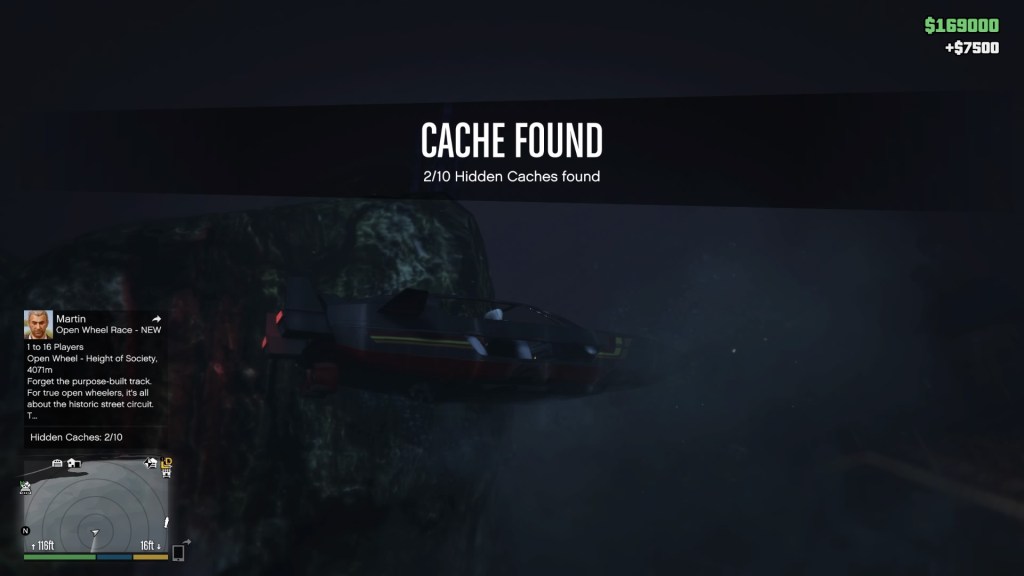
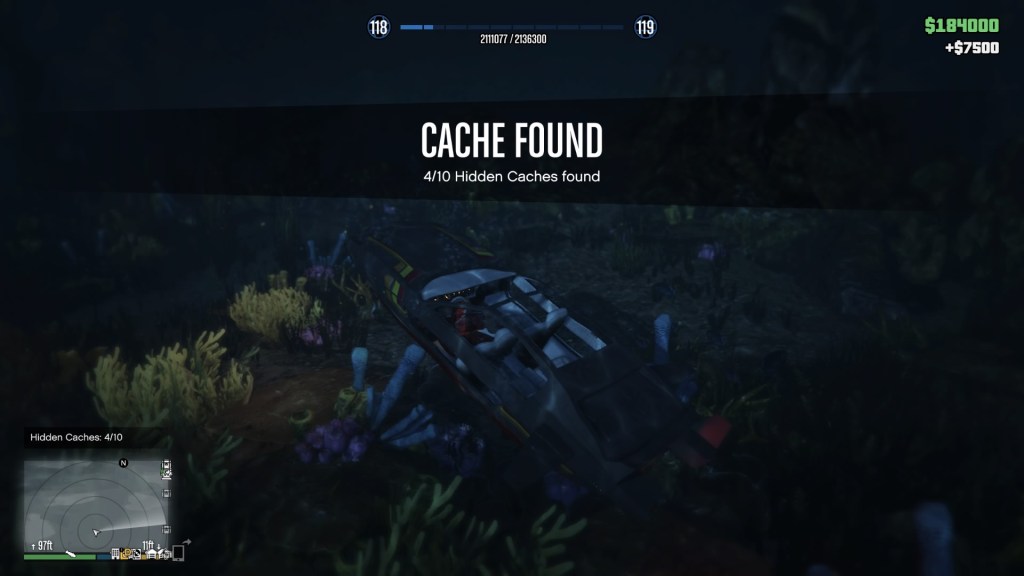
Here’s another treasure hunt that was introduced as part of Cayo Perico. This is similar to the treasure hunt that’s also available on Cayo Perico Island (see below), except this hunt is much, much better for GTA$ and doesn’t require purchasing the expensive Kosatka Submarine. In this case, there are 10 hidden caches to find and because there are so many and because these caches can be found daily, it’s makes the list at spot 8. However, there are 100 locations from which those 10 caches can spawn, making it a medium difficulty event. This means you’ll need to check a lot of different locations to find all 10. The caches can be picked up inside or outside of a vehicle. This means you can use an underwater vehicle, like the Toreador, if you have one or you can use a scuba diving suit, your choice. If your vehicle has a sonar (i.e., you have bought the Kosatka), the sonar will make it somewhat faster to find all 10.
This one rewards GTA$7,500 and 500 RP for each cache found. Finding all 10, you will net GTA$75,000 and 5,000 RP. The caches reset daily, allowing you to pick up that GTA$75,000 each day. In 7 days, that’s GTA$525,000. In 28 days, that’s GTA$2.1 million. That’s a lot of GTA$ to get if you do it every day for a month. In fact this one is far easier than doing the Daily Objectives and awards more GTA$ in 28 days, though less RP at 140,000.




Cost: Free
Type: Daily, Recurring
Difficulty Level: 5 (Medium — must be tenacious)
Reward: GTA$7,500 + 500 RP per cache (10x = $75,000 + 5,000 RP per day)
⤵
Income which requires a purchase….
Here are the final two of our top 10, but these require buying properties to gain a daily income. These final two are included in this top 10 list because these are the only properties you can own in GTA Online that produce truly passive income.
Update: There has been one new property added that also adds passive income, although very little per day at around $500. This new property is the Agency. This is the Franklin Clinton and Partner property. It isn’t included in the top 10 because these two below are still the highest paying for passive income in the game. The Agency’s passive income is too low to be of any real value. The game claims that if you do Security missions that the daily income increases. Unfortunately, I’ve not found that to be the case. I’ve done at least 20-30 of the Security missions and the daily income remains at a low $500 per day.
⤵
9. Nightclub Promotion

As of June 2022, the daily nightclub payout has been increased to GTA$50,000 per day. The safe capacity has also been increased to GTA$210,000. Nightclub ownership activities have now moved into the top spot for residual income from a property purchase.
Because this activity still requires investment, it has moved up one place to 9. However, because of the GTA$50,000 per day income, owning a nightclub is now the #1 activity to do once you can afford this property purchase. In other words, this is the recommended first property to purchase (after buying an executive suite to be CEO) and to milk for cash once you have grinded enough GTA$ from the top free list above. With this new increased in-game daily payout, in 4 hours of play, you can earn GTA$200,000 for mostly doing nothing.
Owning a nightclub is a property type that you must purchase before you can reap the passive monetary rewards. However, this property comes with a catch. To make the maximum money per day (GTA$10,000 now raised to GTA$50,000), you’ll need to complete various Nightclub management missions. These activities promote the nightclub and keep the club full. So long as the nightclub remains full of people and the popularity progress-bar is filled, the nightclub will earn you GTA$50,000 per day doing next to nothing. As the club popularity decreases and the popularity bar dips, so does the income. However, you will also need to invest in the nightclub security to drastically slow down the loss of income each in-game day.
Like arcades, nightclubs cost around GTA$1.5 million depending on the property. However, once you own it, it is guaranteed to generate some amount of passive income. If you do nothing and choose not to promote the club, the club still produces a minimum amount of passive daily income, maybe GTA$1,000 per day or possibly higher.

You’ll also net various amounts of GTA$ from 2,500 to 5,000 for each successful promotion activity completed, such as putting up posters yields GTA$5,000 and a small amount of RP on completion.
Note that to run nightclub missions, you need to become CEO, which also costs GTA$. To become CEO, you’ll need to buy an Executive Office or pick one up in the Criminal Enterprise Starter Pack. Becoming VIP or MC might also work, but these also cost GTA$ to buy into.
Cost: GTA$1-2 million depending on property + GTA$1-2 million for Executive Office to be CEO
Type: Active or Passive Income, Daily, Recurring
Passive Income: GTA$50,000 per day down to GTA$1,000 per day depending on popularity.
Mission Reward: GTA$2,500 to GTA$5,000 + RP depending on promotional activity
Safe Capacity: GTA$210,000
Difficulty Level: 1 (Easy) to 3 (Medium) depending on activity
⤵
10. Arcade

Owning an arcade requires buying it with GTA$. The cost to buy an Arcade is around GTA$1,300,000. However, Rockstar regularly puts properties on heavy discount throughout the game. At a 40-50% discount, you might spend as little as GTA$500,000 to get a property.
Sometimes you can even get some properties included in a bundle or possibly free from Rockstar promotions. Bundles such as in the Criminal Enterprise Starter Pack (CESP), which costs somewhere between USD$10-$20, includes a bunch of properties, weapons, vehicles, outfits and tattoos… including a bonus of GTA$1,000,000. This bundle might also be included with the purchase of certain game versions. Take advantage of freebies included with such bundles if you can afford them.
For example, the CESP bundle includes the following properties:
- Maze Bank West Executive Office — No Garage w/o GTA$
- Paleto Forest Gunrunning Bunker — 1 Car Garage
- Senora Desert Counterfeit Cash Factory (must be a motorclub president)
- Great Chaparral Biker Clubhouse — 17 Bike Garage (10 for you, 1 each for 7 members)
- 1561 San Vitas Street Apartment — 2 Car Garage
- 1337 Exceptionalists Way — 10 Car Garage
However, CESP doesn’t include an Arcade property. Take advantage of the property discounts when they roll around each week, which may include discounts for an Arcade, a Hangar and Nightclub properties.
Keep in mind that owning properties isn’t without cost. Every property you buy has a daily payment that is subtracted at the end of each game world day from your GTA$ (about every hour of play). This means that you won’t make exactly GTA$5,000 per day… it’ll be more like GTA$4,500 after daily expenses are subtracted for that specific property. You will see the full GTA$5,000 deposited into the safe and the daily expenses are subtracted separately.
However, you don’t have to do anything to get that income. It rolls in without even being there and I’m not even sure you have to buy arcade machines either. Just be sure to stop by and pick the money up before the safe fills up. Yes, you must stop by the arcade to pick it up. You also have to remain online for a full in-game day for the money to show up.
Finally, it’s worth noting that unlike GTA V, you cannot own multiple businesses like arcades or nightclubs as you might expect. In GTA Online, you can own one of each type of business property including the executive office, arcade, nightclub, hangar and motorcycle clubhouse. Garages and apartments are the exception which you are allowed to own up to 6, excluding garages attached to businesses like the executive office, casino penthouse, arcades, nightclubs, bunkers and facilities. For completion’s sake, you can also only own one each of these vehicles including the Super Yacht, Kosatka, Mobile Operations Center, Terrorbyte and Avenger.
If you attempt to buy a second “one-only” property or you’ve used up your 6 slots, the game will apply credit from your old property towards your new purchase so that you only pay the diffence in price between the first and second. If the new property is less costly than the old one, you’ll get money back. Note that freebie properties might not offer a trade-in allowance towards a new property.
Cost: Minimum GTA$1,300,000 for Arcade (may be able to get one free)
Type: Passive Income, Daily, Recurring
Passive Income: GTA$5,000 per day
Active Income: None
Difficulty Level: 1 (Easy)
⤵
Runners Up
Here are some other runner up events and activities that didn’t make the top 10 but are well worth considering. Note, the Payphone hit payouts have been reduced from GTA$85,000 per hit to GTA$50,000 per hit after the 2022 Summer update. Rockstar has seen the error of their ways and reinstated the GTA$85,000 per hit reward.
⤵
Franklin’s Quests (First Runner Up)
[Updated 7/26/2022] After the 2022 summer update (July), Rockstar has lowered payouts for Payphone hits to GTA$50,000. The GTA$85,000 reward recently reinstated for payphone hits. This means payphone hits are back to being an excellent money making opportunity in the GTA Online.
I’ve been thinking a lot about this recent addition and I’ve come to the conclusion that this Agency addition is way better than I had originally thought and is pretty much better than any other update for money making purposes. In fact, it’s so great, I would bump The Agency update into the number 10 position if not for one thing (well, a couple). It costs a LOT of cash to buy an Agency plus it costs to buy an Executive Suite and it offers very little passive income in return per day. The passive income isn’t where you make money.
It’s the Payphone Hits which can definitely net a crap ton of GTA$ in very little time. In fact, Payphone Hits can make you so much money so rapidly, that it will pay for the cost of the Agency property in ~30 Payphone Hits (less when they boost the return). After that payback time, it’s all profit. With Payphone Hits, you can make around 6 hits per hour. Meaning, in about 5 hours of doing nothing but Payphone hits all returning $85,000 per pop, these will completely pay for the Agency.
[Updated: 3/11/2022] I’ve been remiss in updating this article, but here’s the 2022 update including Franklin’s new quests. Franklin’s quests cost around GTA$2.2 million because you have to buy into the new Agency property. Like the Auto Shop addition just before this one, you must pay to unlock the Franklin quests by buying a property. For that money and property, however, you will also unlock 20 new garage spaces. If you’re like me, forever running out of new car spaces, getting a new 20 car garage is a pretty sweet deal. However, it also means shelling out around GTA$2 million… a lot of grinding.
The biggest deal unlocked with Franklin’s quests, besides the property, is Dr. Dre’s quests. Though, Dre’s quests aren’t the best way to make money from this update. No, it’s the Payphone Hits!
Dr. Dre
I’m including the Dr. Dre quests here because it’s technically part of Franklin’s quests. Dr. Dre’s quests only unlock after you run at least one Security mission, which requires being a CEO, MC or VIP.
However, know that Dr. Dre’s quest line is like the Heists… effectively one time, but restartable. Yes, you can do them over again, but must start from the beginning. The haul for these quests is decent, but I don’t at all recommend these for ongoing money making opportunities due to the complexities of Dre’s quests. For each mission, you’ll earn GTA$100k. For completing the entire Dr. Dre quests, you’ll earn GTA$1 million. It’s a decent haul, but the missions are not simple and may require trying multiple times if you’re doing it alone. These quests are also easy to fail.
Cost: GTA$2.2 million to buy an Agency PLUS Buying a VIP, CEO or MC property
Type: Not Free, Restartable One-Off
Reward: GTA$100,000 per mission + GTA$1,000,000 for completing them all
⤵
Agency Security Quests
These missions require that you to become a CEO, VIP or MC to complete them. This means you will need to purchase a VIP pass, a Motorcycle Club (MC) or an Executive Suite (CEO) before you can run these. One of these costs around GTA$1 million to GTA$1.5 million depending, but you only need one. This is in addition to cost of purchasing the Agency to get access to Franklin.
Franklin offers your character multiple types of agency Security Missions from protecting supplies, to stealing items, to protecting a person, to stealing vehicles. Each of these missions earns you a random amount of GTA$ decided by the computer system on your Agency desk. Whatever the computer says the mission will earn, that’s what it earns. It typically ranges from about GTA$33k to GTA$64k. It depends on the mission and what the game decides that mission is worth.
The Agency Security Missions are decent hauls, but the missions can sometimes go south easily. If you fail a mission, that mission disappears from the computer and cannot be repeated. It will be replaced with a new mission, usually offering a much smaller haul. Because of the randomness with these agency quests, the complexity of them combined with the ease for which they can fail, I don’t recommend these for ongoing cash grabs in the game. There’s also a cooldown timer between each quest.
You can do them, but know that they aren’t always worth the time and effort for the money return involved. Do them for fun, not for profit.
Cost: GTA$2.2 million to buy an Agency PLUS Buying a VIP, CEO or MC property
Type: Not Free, Recurring
Reward: GTA$33k to GTA$64k
⤵
Payphone Hits
These quests are where the GTA$ are. Not only do Payphone hits not require being a CEO, MC or VIP to run them, when you complete the Bonus, you will get an extra GTA$70,000 for a total of GTA$85,000 for each successful hit completed. You can even run these in Invite Only Sessions to avoid interaction with other players. Because there’s no limit in how many you can do of these in a day, doing 10 will net you GTA$850,000. Doing 12 will earn you, GTA$1,020,000. Keep in mind that it takes a minimum of about 10 minutes per hit, that means it will take you about 120 minutes (2 hours) to earn GTA$1 million. There is a cooldown timer on these hits, but this can be avoided if you save immediately after receiving your cash by changing your outfit, then killing and restarting the game. However, doing this means you have to wait through the very long game restart process (around 4 minutes to load and another 2 minutes to get online). After that, it takes another 4 minutes to complete a hit. That totals right around 10 minutes per restart and Payphone Hit. This means you can complete about 6 per hour netting you $510,000 per hour of play.
Occasionally, Rockstar increases this bonus by 50% earning you GTA$105,000 as Bonus and GTA$22,500 for base fee, for a total of GTA$127,500 per successful hit. This will net you GTA$1 million a whole lot faster (in about an hour).
Hits consists of 5 types:
- The Cofounder — This type of hit requires you visit a motel, wait for him to check out, then perform the action required to take him out such as a sticky bomb on the car or using a scoped weapon to blow the engine.
- The Tech Entrepreneur — This type of hit requires a taxi cab. You pick up a cab at the designated location, then drive the Tech Entrepreneur to the location required and do the deed by drowning or the scrapyard.
- The Judge — This type of hit requires visiting the golf course. You will do away with her by golf club, running her over with a cart or blowing her up with a sticky bomb.
- The Popstar — This type of hit requires you to chase the popstar in the car and take them out with a specific method, like chasing them in a cop car to intimidate them, taking them out Vagos style with a driveby or using a truck cab to ram them into submission.
- The Trolls — The Trolls are 4 hits. You must visit all 4 locations and take out the trolls with various criteria, such as in 7 minutes, using headshots or running them over in a vehicle.
- The CEO — This mission requires taking out a CEO playing construction worker. The mission will require you to use various construction equipment to take him out, like blowing up a gas tank, dropping a container on him or triggering a dozer to run him over.
Two additional missions exists, but only if you are logged in as a CEO or MC and have two people. All of these missions are most easily launched by calling Franklin from the contact on your phone. Though, you can also wait until Franklin randomly launches one. Using the phone makes these missions the fastest to get started, because you don’t need to visit the Agency computer at the office.
Note, for missions that require you to pick up a taxi or police cruiser, you don’t need to wait for the message. Go to the taxi location near the Casino or to the Chili restaurant or similar. For the police cruisers, they will spawn sometimes at a location closest to the Popstar’s car. Though, not always. Once you locate a cruiser, you may find yourself driving all over Los Santos go get to where the Popstar is.
Bugs exist here. If you are using a Deluxo, any Trolls Bonus will fail if you accidentally run them over in that specific car. Meaning, if you are given the criteria to run the Trolls over in a Vehicle, don’t do it in a Deluxo. Choose another car. However, even if you’re running a different Bonus requirement and accidentally run a Troll over in the Deluxo, that bonus will also fail even if unrelated. This bug has been reported. Note, this issue may affect all types of special weapons vehicles like the Toreador and the Stromberg.
Bugs in the GPS leading to the Scrapyard (The Tech Entrepreneur) and the door of the Von Crastenberg Richman (also The Tech Entrepreneur) is inaccurate. If you follow the GPS, it will lead you incorrectly. You will need to find these two locations on your own and remember how to get there when these mission requirements appear.
A bug exists with The Judge missions. All of The Judge missions occur at the golf course. If you fail to change into the Golf Outfit and Golf Club, the mission bonus will automatically fail even if you successfully do what the bonus requires.
A bug exists with The CEO. If you accidentally wander too close to the construction site, this will disrupt The CEO’s walking path. Once this occurs, there’s no way to recover to receive the bonus. He simply won’t resume his walking path once disrupted. In fact, any targets that follow a walking path will fail to recover that walking path if they are disrupted. However, some targets that lose their walking path can still see a successful bonus, it’ll just be a whole lot more difficult. However, The CEO will fail the bonus because he won’t line up with the requirements.
One last thing about these Payphone Hits is that they’re not all equal in time and effort. Some hits are way more complex than others. For example, one of the Popstar hits requires taking him out in drive-by style using a Vagos wagon. Shooting while driving in this game is, at best, a miss affair. While it is possible to do it, it’s not easy nor is it accurate. Another more complicated hit is The Judge hit that requires taking her out with a sticky bomb planted somewhere close to her on the golf course. That’s next to impossible to do. Anytime you get close to her and take out any kind of weapon, her goons start firing on you. That spooks her and she runs away, failing the “sticky bomb” Bonus. If she runs away with either of the other requirements, it is possible to get the bonus. When these overly complex missions appear, I kill the game instantly and try again. There’s no reason to do these complex missions when most of the rest of the missions are straightforward and relatively easy.
Complicated Hit Example
As an example of a complicated and time consuming hit, one of the The Judge hits requires you do it with a sticky bomb at a specific hole on the golf course. This one is so specific about where and how you must do it, you are required to know the golf course like the back of your hand. The one thing Rockstar forgets is that even if you play the golf course through, the game takes control over which hole you’re on and automatically transports you to the next one after completion.
You don’t get the benefit of actually walking from hole to hole yourself. This means that even if you play the golf course, you still don’t get to know the course. You get to know the holes specifically, but not where they are located on the property. To run this specific sticky bomb mission, that means you’ll need to spend time at the golf course learning exactly where each of the holes are, how they are laid out and how to get to each one of them. That’s something you must do on your own, wasting a lot of time in the process. Oh, and once you get onto the property, knowing which hole is which is not terribly easy to determine. As I said above, some hits are way more complicated and time consume than others. I don’t even get why Rockstar would think people could actually perform this hit. Yet, it’s included in the batch of hits. I always drop from this one when it appears. I don’t have the time to scour the golf course to find exactly where hole 3 is or hole 6 or any other hole.
Cost: GTA$2.2 million to buy an Agency (may require VIP, MC or CEO first time to unlock)
Type: Not Free, Recurring
Reward: GTA$22,500 to GTA$85,000 each hit depending on bonus success
The best of all of the above are most definitely the Payphone hits. However, I can’t remember if the game requires completion of at least one Security contract and/or Dr. Dre’s missions to unlock the Payphone Hits. If so, that means you will need to invest in CEO, MC or VIP to unlock these Payphone Hit missions. I’m assuming it does. These expensive investments is why the Franklin missions failed to make the top 10, even though the Payphone Hits net a lot of GTA$ quickly.
For the Payphone Hits alone, however, this is the reason the Franklin section has been placed immediately below #10 as the first runner up.
⤵
Auto Repair Shop + Los Santos Car Meetup

This brand new addition arrived as of July 20th, 2021. Two new features have been introduced into GTAO. The first is the Los Santos Car Meetup. This is a large warehouse building where players can meet and show off their cars, but unfortunately only one car at a time. As you show off and mod your car, your Meetup reputation points will increase. These reputation points are separate from standard RP. There are 32 parking spaces in the warehouse where cars can be parked. There’s also an indoor track that can be raced. The second is the Auto Repair shop, which you have to buy.
To begin this whole deal, once you get inside of the meetup building, you’ll meet with Mimi (the organizer) who introduces you to Sessanta and KDJ. Sessanta and KDJ want to open an auto repair and modification shop with you. However, Rockstar leaves it up to you to buy this new business location in the game. To buy an auto repair shop, you’ll need to visit Maze Bank Foreclosures. Here, you’ll find several locations which you can purchase. As of now and with Prime Gaming, one of the locations (Strawberry) is free to obtain, the rest cost around GTA$1.5 to 1.9 million. If you have Prime Gaming, grab the freebie now before Rockstar kills the promotion. Without Prime Gaming, you’ll have to pay.

Once you own an auto repair shop, like most other Heist operations, there’s a contract job board. To access it, you’ll need to become a CEO. Here’s the expensive catch.
To become CEO, you’ll need to own an Executive Office Suite (~GTA$1,000,000, see below OR ~USD$20 to buy the Criminal Enterprise Starter Pack, see Arcade above). See, I told you that Rockstar gets you to spend massive amounts of GTA$ all over the place in this game.
The first job given by Sessanta is to rescue Sessanta’s car from the impound lot at the police station, the same car you first saw her in at the meetup. This is a fairly difficult mission because you have to mow down a bunch of cops at the impound lot. However, as soon as you arrive there, you get a 3 star wanted rating causing even more cops to swarm. Suffice it to say, you’ll need to grab the car as fast as possible and attempt to lose the wanted status quickly. Once you do this, bring it back to the auto repair shop and the actual jobs begin on the job board.
There are three ways to make money with the auto repair shop. The first is to perform the job board contract jobs. The second is to wait for customers to arrive to have their cars repaired and modded. The third way is to complete one contract to unlock specific wanted cars to jack and return for GTA$, like Simeon’s request above. Here’s where the second way gets convoluted.

Repairing and modding cars forces you to pay out some amount of GTA$ from your own pocket which will get reimbursed by the customer plus their service fee on top. I’ve done two of these. The first one was -GTA$50,000 to repair and +GTA$30,000 as the car repair payment, for a total of +GTA$80,000 once the car is delivered. The second car was -GTA$20,000 to repair and +GTA$20,000 as payment, for a total of +GTA$40,000 once delivered. If the car is delivered damaged, the game reduces the amount you get paid. You’ll need to have at least GTA$100,000 in your account if you intend to run these repair jobs.
However, Rockstar failed us with this new feature because I’d like to have an Open sign that I can turn on and off. If I don’t want the jobs to appear at all, I’d like to turn off the Open sign and prevent Sessanta from calling me with new jobs.
As for the contract jobs, KDJ takes a 10% cut of whatever payment amount is offered. Note that all of the contract jobs are reasonably complicated and difficult to complete when playing solo. However, they can be completed solo, but you’ll have to play them multiple times learning strategies via trial and error. The three jobs that appear for me are as high as GTA$185,000 and as low as GTA$170,000. I have personally confirmed that KDJ’s cut is, in fact, 10%. You definitely will not get the amount listed on the job board. For a GTA$178,000 job, I got GTA$160,200 + another $75,000 about one minute later for some odd reason. Maybe Rockstar is offering up a bonus for the first contract completed? *shrug*
For car repairs and mods, you do get the full amount listed on the job order. You just have to be sure to follow the instructions on the bottom of the screen to do exactly what the customer requests. If you choose to place random mods on the car, the customer likely won’t pay you for them. Also, if you choose not to hire a tech, you’ll have to deliver the cars yourself. If you hire a tech, you’re going to see a higher daily fee to pay the staff at the auto repair garage. These jobs appear several times in the same day. These are not limited to one repair per 24 IRL hours… yet. If you buy a second lift (GTA$650,000), you can repair two cars at the same time and double your income.


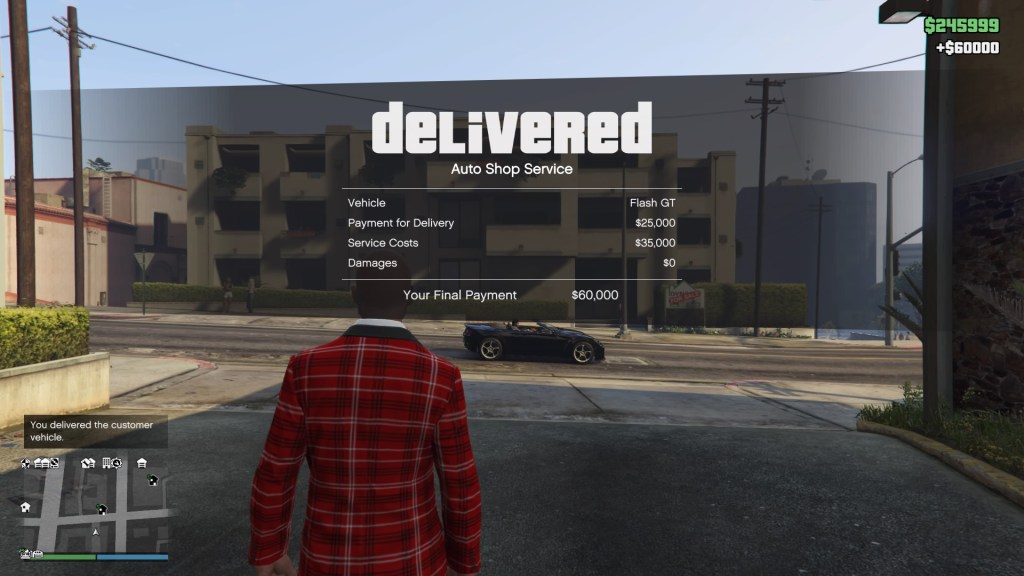

Note that the auto repair shop doubles as a new 10 car garage. Getting a new 10 car garage for free (with Prime Gaming) is a pretty sweet deal. Also note that if you buy any add-on decorations for the auto repair shop, they will not show up until you complete Sessanta’s first mission to rescue Sessanta’s ride from the impound lot (assuming everyone gets this same mission as the first mission).
There’s also one more way to make additional GTA$ from the auto repair shop:
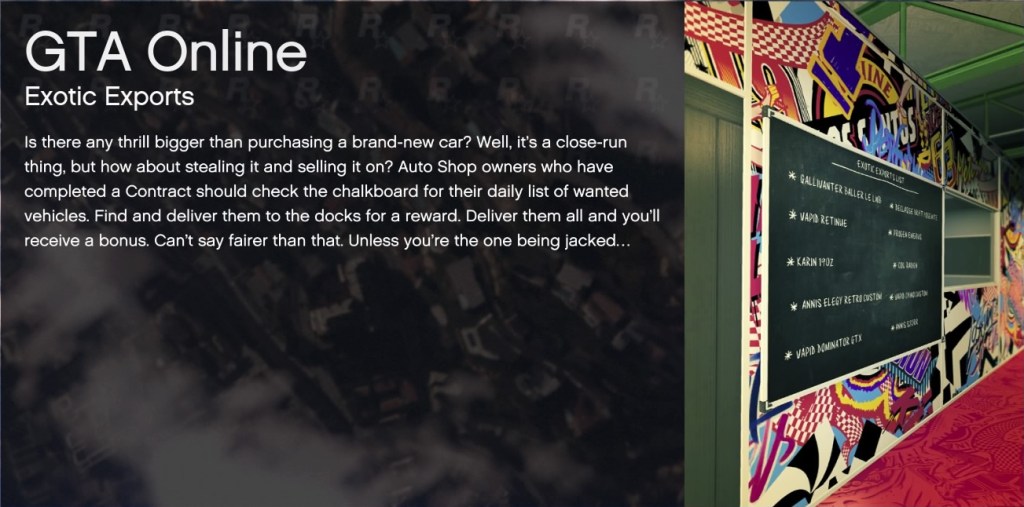
Once you have completed at least one contract from the board, the game unlocks a list of wanted vehicles that can be searched for, jacked and sold in similar form to Simeon. I’m not yet certain what the payouts for these are, but since you’re delivering to the docks, it is likely the same payout (max GTA$20,000 per car) as it is for Simeon… and this is probably the reason Simeon’s payout dropped. In fact, it is the same payout amount (GTA$20,000) as you get from Simeon’s car request. It does say you get a bonus if you deliver all on the board, but this is almost impossible to do. This also illustrates why it’s important to read the loading screens.
Difficulty
Attempting to locate each of the 10 cars each day is about as easy as completing the Daily Objectives for 31 days. Some cars are highlighted with a blue dot on the minimap. Cars that are “standard spawn” must be found and jacked in the normal way. Because of this harem-scarem means to locate the cars, you can’t rely on any one specific method. It also means you have to be super great a spotting specific cars by make, which is tricky enough in itself. Waiting for the blue dots for the ‘special’ cars to show up is near impossible. In fact, because other blue dots show up which aren’t related to this, you can literally spin your wheels doing unrelated tasks. Rockstar has made this task as difficult as possible and only 24 hours in which to complete it.
It’s great that this chalkboard car search is daily in that you the chance to get up to GTA$200,000 (plus bonus if you get all 10) per day doing this, but you can spend many, many hours looking for those 10 cars. Worse, the chalkboard can change out from under you when those 24 hours are up without you knowing… all while searching for a car that’s no longer on the board.
Note also that Simeon’s car quest and the Auto Shop car quest can conflict, requesting the same vehicle. This means you’ll need to make a choice to whom you intend to deliver. It also means that you’ll need to find that same car a second time for whichever one you didn’t fulfill. This is frustrating. Sometimes you find cars for both Simeon and the Auto Shop at the same lot. Again, you’ll have to choose which car to jack and deliver. The problem is, when you come back, the game will have despawned those other cars and respawned something else. That means you’ll have to go looking again. Also frustrating.
Tricks
One trick that sometimes works in finding one of the 10 cars is going in and out of the garage at the casino. When you enter the garage and then exit, the parking lot will respawn with all new cars. Occasionally, a blue dot will spawn there in the parking lot. The blue dot sometimes spawns in a space to the right of the the exit across from Downtown Cab, Co. This is probably the fastest way to get the parking lot to respawn with new cars. That doesn’t mean you’ll get a blue dot, but occasionally you might.
Bugs
There are a number of bugs with the auto repair shop. If you drive a car into the garage, you will be unable to repair a waiting car or even repair your own cars. The controller option never appears. You’ll need to exit the shop by walking out, then reenter to fix this problem. Another bug has just surfaced today, July 24th, 2021. If you attempt to deliver a car and enter the yellow ring, the ending does not complete. With this one, I thought that killing and restarting the game might help. It doesn’t. When I did that, the car was back at the repair shop awaiting delivery again. I tried delivery for a second time that took me to a new location, but the car still wouldn’t deliver. It seems that the game progress gets stuck when you can’t deliver the car.
Not getting jobs? Don’t stay inside of your Auto Repair shop or Sessanta can’t text you to give you car repair jobs. The game seems intent on avoiding refreshing the Auto Repair shop (required to put a car on the lift) with you in it. If you’ve been wondering why you haven’t been called for repair jobs and you’ve been working in the repair shop, that’s why. Also, you can’t cancel contract jobs while inside of the Auto Repair shop. To cancel a contract job, you need exit to call Sessanta. You can only call her outside of the repair shop. If you try to call Sessanta inside of the shop, you’ll get a busy signal.
There’s also some dumb logic when performing repairs… for example, the customer might request Secondary color bumpers or Secondary hood options, yet there’s no way to paint the car with a secondary paint job. All cars currently paint all surfaces the same color even if the car supports primary and secondary paint colors. What’s the point in requesting ‘secondary’ anything if you can’t paint the car with a secondary paint?
Blue dots and chalkboard cars bug. I’ve had this bug happen to me almost every single time I’ve played. I’ve found up to 6 cars on the chalkboard, but as few as one. Yet, after traversing the entire map from top to bottom, the game will not reveal any further cars via blue dots from the board. Even if the remaining cars are specialty cars that require a blue dot, no blue dot ever spawns anywhere on the map. This bug makes it impossible to complete collecting all 10 of the cars on the chalkboard.
Cost: Property is Free (with Prime Gaming) + cost of whatever decorations added to Repair Shop
Type: Mission Based + Intraday Recurring car repair jobs,
Passive Income: None
Active Income: Job based (around GTA$100,000 or so), Car repair (GTA$20,000 to GTA$30,000) per car
Difficulty Level: 3 (Somewhat difficult)
Daily Cost: Minimum GTA$250, more with staff
⤵
Rockstar Newswire and Loading Screens
Each week beginning on Thursday, a new Rockstar Newswire is released offering all of that week’s newest promotions and activities. Many of these activities also appear as messages on the loading screen.
Be sure to read each of these loading screens carefully. For example, the week this article is written, Rockstar is offering 2X GTA$ and RP on new survival map challenges. Participating in these new survival events during this week will earn you 2X GTA$ and RP plus a bonus of GTA$100,000 simply for participating in a Survival. Reading these screens closely can help you nab $100,000 or more simply by doing whatever Rockstar is requesting. Usually, it’s not hard to do what they’re asking you to do.
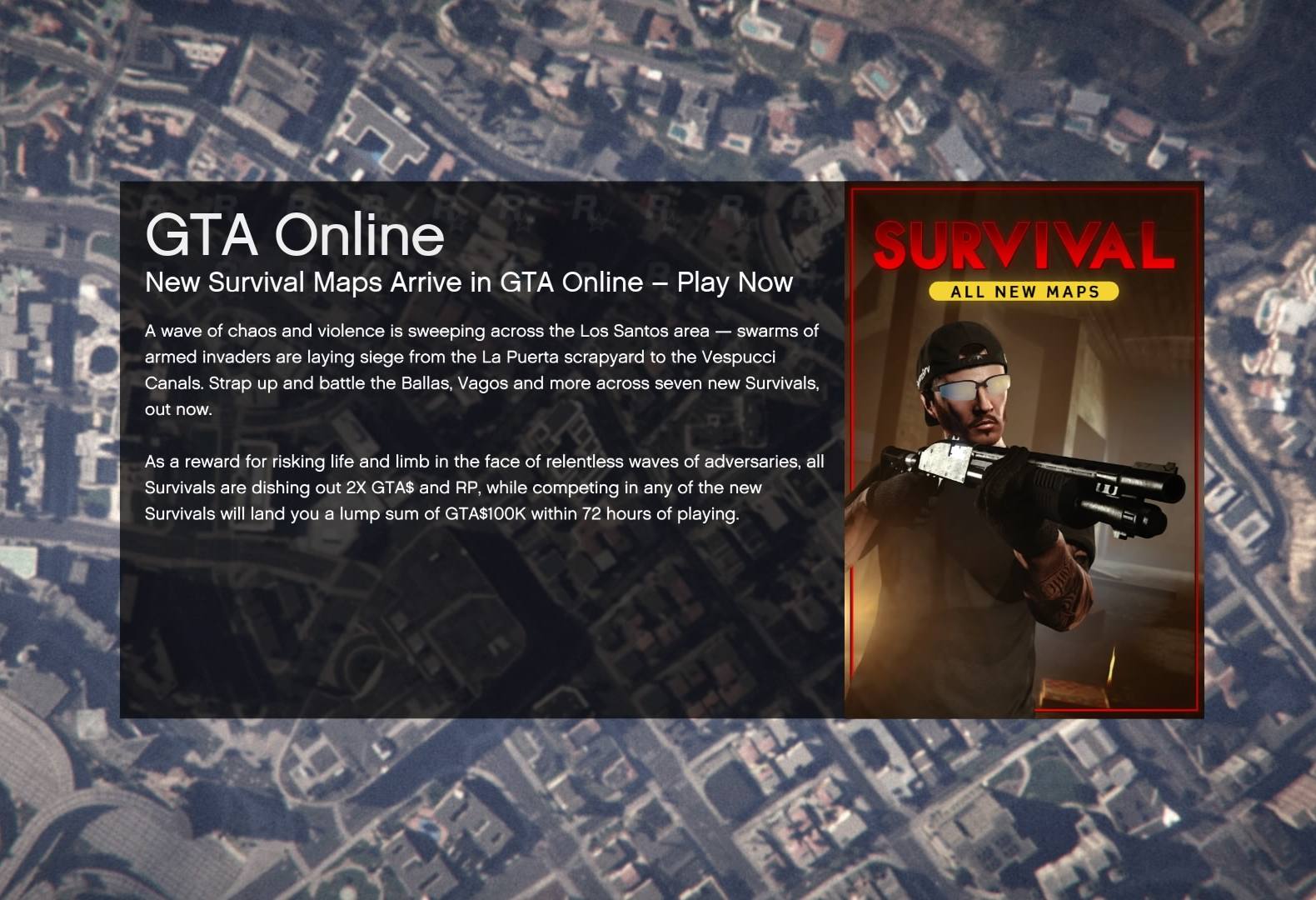
However, sometimes Rockstar might require the purchase of a Mobile Operations Center, a Terrorbyte or an Avenger, which can negate the GTA$ bonus. If you know you don’t have the vehicles needed to get the bonus, then skip it. By simply being required to participate, such as the Survival Challenge above, its easy to nab that GTA$100,000.
Type: Free
Difficulty Level: Depends, usually easy
Reward: Depends
⤵
Daily Objectives
This free activity is just barely a runner up because while the payout is big, it is incredibly difficult and you need to be level 15 or higher. However, you can make some serious bank if you’re tenacious. This one requires performing 3 Daily Objectives for 28 consecutive days. Some of the objectives can be extremely obscure, difficult to do, take a lot of time, dependent on challenges that may not appear and/or require loads of cash to complete (like Complete a Heist Setup). For these complicated reasons, it’s not included in the top 10. If you’re tenacious and willing to attempt the objectives each day, you can earn some serious bank after 28 days. If you miss a day or cannot perform one of the objectives, you lose the streak and must start over. To perform each daily objective, you’ll need to read the objectives closely.
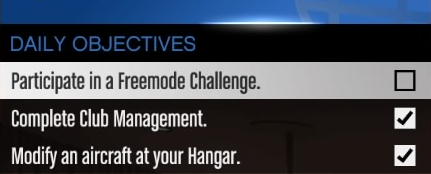
Note that you can effectively change two of your three daily objectives by launching into GTAO, then immediately checking your current objectives in the character menu. The bottom two are not set in stone if it’s a new day. If you don’t like the bottom two objectives, kill the game and restart.
Keep restarting the game until you get two objectives you can perform, like Visit the Casino OR Relax in a hot tub OR Mod a car. Once you’ve got two objectives you like, modify your character’s appearance by wearing glasses. This will force a cloud save and lock the objectives in. Make sure to read the Daily Objectives closely, otherwise you might be stuck with objectives you cannot complete. Don’t hesitate long. You’ll only get a few minutes before the game automatically performs a cloud save and then those objectives are locked in for that day.
The topmost objective is always set in stone for the day by Rockstar. You’ll have to perform this one whether you want to or not. Examples. If you don’t own a hangar, you can’t perform an objective like Modify an aircraft at your hangar. Rockstar might also set the objective as Complete a Heist Setup. If you’re already past all of your setups, the only way to complete that objective is to join another player who hasn’t yet done it.
Progressive Rewards
- 1 day of objectives will earn you GTA$30,000 and 5,000 RP (28x = GTA$840,000 + 140,000 RP)
- 7 days (week) worth will earn you GTA$150,000 and 20,000 RP (4x = GTA$600,000 + 80,000 RP)
- 28 days (month) worth will earn you GTA$500,000 and 50,000 RP
In 28 days, you earn (D) GTA$840,000 + (W) GTA$600,000 + (M) GTA$500,000 = GTA$1.94 million + 270,000 RP
As implied above, some objectives can appear that are impossible to complete either because you can’t afford to buy something or because you’re past that part of the heist. This can cause failure when attempting to do this for 28 days, thus making this challenge quite difficult.
Cost: Free
Reward: GTA$30,000 to GTA$1.94 million depending on how many you perform daily + 5000+ RP
Difficulty Level: 10 (Hard) — requires performing challenges for 28 days straight, though you can still get the daily challenge reward even if you miss a day in between.
Level to Complete: Rank 15 or higher
⤵
Cayo Perico Treasure Hunt Challenge
This is a runner up because it requires significant cash outlay and is not super easy to do. However, it offers okay payout. This means that even though it will cost you a lot to unlock, you can keep doing these treasure hunts daily until you’ve recovered whatever it’s worth to you. Before I get into the hunt, let me explain the costs.
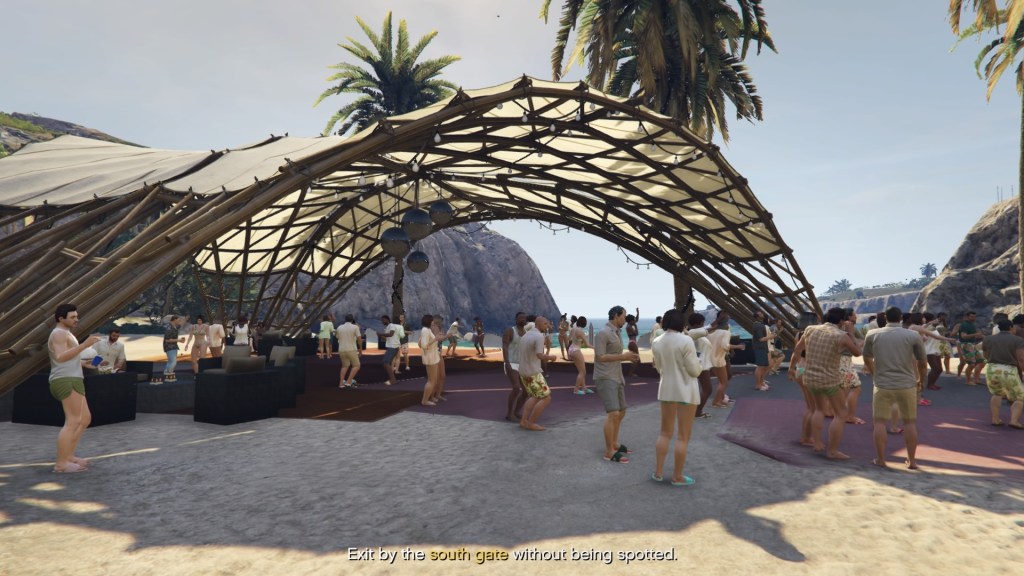
To unlock Cayo Perico Island, you’ll need to buy the Kosatka submarine from Warstock Cache and Carry to launch the mission to take you to this new island. This sub costs GTA$2,200,000 base price. If you wait for Rockstar to slash the price, you can get it for around GTA$1 million, which is what I paid when I bought it on sale. Because of the daily treasure hunt, it’s worth the GTA$1 million (on sale) investment to buy the Kosatka. Buying it for the Heist? Not so much.
Now, onto the treasure hunt. There are 10 possible treasure chest locations across Cayo Perico Island. There are 5 locations on land and 5 underwater, all dotted around the island. You’ll need to check many of the locations until you find the two available treasure chests. You can only open two per day. Opening up both treasure chests yields GTA$15,000 per chest for a maximum of GTA$30,000 per day. That’s a reasonable amount of GTA$ income, which is why it is included here.
Rockstar has even been known to 2X these daily challenges, doubling the GTA$ to 60,000 per day for up to 7 days.
Cost: Kosatka costs around GTA$2.2 million
Type: Active Income, Daily, Recurring, Time Suck Activity
Reward: Up to GTA$30,000 per day or GTA$210,000 every 7 days or GTA$900,000 every 30 days
Difficulty Level: 5 (Medium — must scout many locations to find two) … must be tenacious
⤵
Character Bounties
These are separate from the Bounty Missions described below. This activity costs nothing to the player and is somewhat easy to get. A character bounty is had when you steal a car and someone unknown puts a bounty on you. These are easy money and may be worth trying to get, but they don’t pay much and can be slightly difficult to find…. which is the reason it didn’t make the top 10. A bounty reward can range from GTA$1,000 to GTA$3,000. If you end up with a bounty and want that money, you’ll need to move to a private server so other players don’t try to collect on it. Then wait out one full in-game day on that private server (about an hour of play time). At the end of that day, you’ll be paid the amount of the bounty. You’ll need to play on a private server or with trusted friends until the bounty pays out.
Typically, these bounties will appear when you steal expensive cars parked on the side of a road. One vehicle that always gives up a bounty is the Sprunk Extreme van, which you can’t keep or own. This van is a trap and always issues a bounty. If you see this van, steal it, get the bounty and hide out on a private server for one full in-game day to collect the bounty. Though, there are plenty of other expensive cars which can also turn a bounty. The more expensive the vehicle is, the more likely the owner will put a high bounty on you.
Note that bounties hang around on your character until either another player collects on it in a public server or one full in-game day passes and you get the money. Also note that only one bounty can be active at a time. Can’t get greedy with this one.
Cost: Free
Type: Active, Recurring
Reward: GTA$1,000 to GTA$3,000
Difficulty Level: 1 (Easy, so long as you hang out on a private server until you get paid)
⤵
Good Sport
Here’s another runner up that didn’t make the grade, but is worth realizing that it exists. This one is a periodic GTA$2,000 that is given to the player for keeping up Good Behavior. I’m not completely certain what all triggers ‘bad behavior’ and prevents this award, but I believe it is related to the character’s mental state. If you start mowing down civilians on the sidewalk with your car, for example, this raises the character’s mental state and may forfeit the Good Behavior award. This one doesn’t seem to award once per day. It seems to award the player this money at random times while playing.
Cost: Free
Type: Active, Recurring, Unpredictable
Reward: GTA$2,000
Difficulty Level: depends on how you play GTAO
⤵
Sleeping Bums

This runner up is one that likely only shows up after you have visited Cayo Perico island. This, in turn, means you will need to own the Kosatka Submarine (see above).
How it works. Occasionally, the game will tell you that you have found a small key which is useful on Cayo Perico island. When you see this message, that means there’s a blue dot somewhere near you. Once you find the blue dot on the minimap, go to it and there will be a sleeping drunk bum. Loot the bum and you’ll get some GTA$. I’ve gotten up to GTA$7007 from looting, but the amount varies.
Cost: Requires Kosatka and visiting Cayo Perico island
Type: Random, Recurring
Reward: Varies, but can be up to GTA$8000 or possibly higher
Difficulty Level: 1 (Easy)
⤵
Amazon Prime Gaming
Owning this type of membership offers freebies each and every month. However, to gain this freebie, you’ll need to subscribe to Amazon Prime. If you own this membership, you’ll link your Rockstar account to your Amazon Prime Gaming account once and each month Rockstar will offer various freebies and discounts for this linkage.
For a while, Rockstar was offering up GTA$1,000,000 each month at GTA$200,000 each week with the fourth week culminating in a payment of GTA$400,000. Recently, this has been reduced to GTA$100,000 a week for a total of GTA$400,000 each month. I don’t know if the last week culminates in an extra $100,000 as there has been no mention of this by Rockstar. In fact, there was no mention of the reduction of this Prime Gaming benefit.
Cost: Amazon Prime membership (USD$12.99 a month or USD$119 a year)
Type: Passive only
Reward: Up to GTA$400,000 a month
Difficulty level: N/A
Caveat: This benefit can be discontinued or altered at any time by Rockstar without warning
⤵
Additional ways…
These didn’t make the cut for reasons listed below. However, they are still valid for making at least some money in the game. These events are free to participate, but may require the use of weapons, armor or the purchase of expensive cars (racing), specific ammo or expensive weapons to win.
Survival Events
I hesitate to include these events because they require crap tons of ammo (which you have to buy) and, in the end, net very little in the way of cash. In other words, you may spend more on ammo to win the event than you’ll get back from surviving it. However, I’ve included it because these jobs are open and available all of the time. You can join a survival job at any time. The longer you last, the more money you’ll make, but only to a point. Keep in mind that surviving a long time doesn’t necessarily net you more GTA$ in the way you might think. You’ll get whatever you get from the survival event, which includes both RP and limited GTA$, maybe around GTA$3,500 or so max.
Cost: Free
Type: Multiplayer Active, Recurring, Available all of the time
Reward: Depends on many factors, but usually no more than GTA$3,500 on average.
⤵
Racing

Racing events can net you some GTA$, but typically you’ll need a decently fast car if you hope to win and win max bank. This means either buying an expensive Supercar from Legendary Motorsports or being lucky enough to win one from the Lucky Wheel podium. Racing is included because occasionally Rockstar will introduce a new racing type into the game and to promote it, they will award GTA$100,000 or more simply by participating.
Cost: Dependent on car needed
Reward: Limited GTA$ depending on placing, but probably no more than GTA$5,000
Notes: Sometimes newly introduced events will offer a large award for participating.
⤵
PlayStation 4 Promotion
While Rockstar readies GTA Online for play on the PS5, they are giving GTA$1,000,000 each month to PS4 members who also have PlayStation Plus. In order to play GTA Online, you need PlayStation Plus for the network access. The way to obtain this money changed in April, now requiring each player to head to the PlayStation store to claim the GTA$1,000,000 on the first of each month until the PS5 version of GTAO becomes available.
GTAO on the PS5 may release as soon as August or September 2021, so this promotion may end very soon. This one is only included here now because it’s still active for a limited time. Note, if you’re logged into GTAO when you head to the store and claim it, you’ll have to log out and back in to see your GTA$ update.
Cost: Requires PlayStation Plus subscription and a PS4
Reward: GTA$1,000,000 monthly
⤵
Gambling at the Casino
This one is not included in the top 10 because casino gambling is too risky for several reasons. I didn’t include this one in the ‘avoid’ area below because it is possible to win. It also takes GTA$ converted to Chips to make a bet and you can easily lose it all.

The problem with winning in the casino is that Rockstar monitors large wins coming out of the casino. If Rockstar determines you cheated to win, they can take all of your money away or outright ban you from the game. Be careful when attempting to win large bets in the casino. For this reason, I don’t recommend trying to gamble at the casino other than with the smallest bets (i.e., less than 100 chips). Even then, play only a little, win only a little and walk away. If you press your luck and win a large pot, Rockstar may flag your account for cheating.
Cost: Chips to bet
Type: Recurring
Reward: Whatever you win
Risks: Can be suspected of cheating and lose all money or be banned from the game
⤵
One Off Activities
Rockstar includes a few one-off activities which are worth doing because you can net a decent amount of cash from each of them. These are not included in the top 10 above because they cannot be performed more than once.
Bounty Missions
A random NPC named Maude will ask you to help her with some bounties. As a result, you will receive GTA$300,000 and the Stone Hatchet for returning the bounties to Maude alive. Returning them dead yields less. There are 5 bounties to be had.
Cost: Free
Type: One off
Reward: GTA$300,000 + Stone Hatchet
⤵
Rampage

This next activity requires using the Stone Hatchet that you got from Maude’s quests. Once you kill 25 NPCs while in Rampage mode using the Stone Hatchet, you will receive GTA$250,000. You must do this rampage specifically with the Stone Hatchet. There are other hatchets in the game, but only the Stone Hatchet unlocks this reward. Make sure you have the correct hatchet equipped.
Cost: Free
Type: One off
Reward: GTA$250,000
⤵

Golden Revolver
This is a cross promotion for Red Dead Online. To receive the Golden Revolver, you’ll need to start with a treasure hunt email. This will lead you to 4 different clues which, if correctly decoded, will reveal a chest containing the Golden Revolver.
Once obtained, you can then jump right into the Golden Revolver headshot kills challenge. Once you have killed 25 NPCs with headshots using the Golden Revolver, you’ll receive GTA$250,000.
.
Cost: Free
Type: One off
Reward: Golden Revolver + GTA$250,000
⤵
Radio Signal Jammer
There are 50 radio jammers placed on various tall radio towers and buildings. This is part of the Casino Heist. These look like small black boxes with a red light and an antenna on top. These also beep so you can hear them at a distance. Once you destroy all 50 radio jammers, the game unlocks a person useful to the Casino Heist. That’s not really the money reason to do this challenge. By destroying all jammers you’ll net GTA$150,000 and 50,000 RP.
Cost: Free
Type: One off
Reward: GTA$150,000 + 50,000 RP
⤵
Avoid these activities….
Most of what’s listed below are one-time and/or overly-complex activities. This means that once you complete those specific missions, you either can’t do them again or you must start over from the very beginning and do all steps again. You can also participate as a team member in a friend’s unfinished heist or mission if you need to do a specific step quickly. This top 10 list was designed to include easy and quick money making opportunities that can be repeated every day, which these below most certainly are not. This section isn’t meant to imply that you can’t enjoy these activities for the entertainment value, just don’t do them in hopes of making money in the game.
Heists
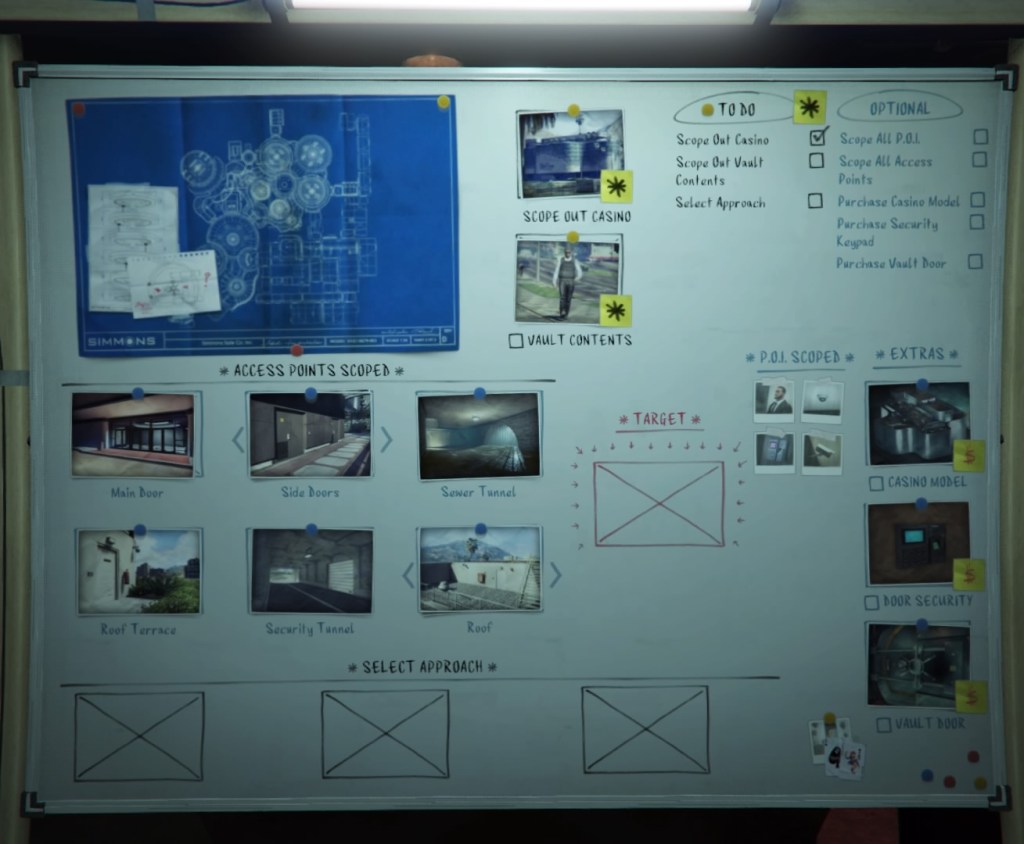
Heists are some of the most expensive and complex ways to make income in the game. Why? Because Rockstar requires that you buy very, very expensive real estate, boats, equipment, personnel and trucks to support the heist. All told, you’ll end up spending GTA$3-5 million (or more) in buying random in-game junk, just to net GTA$300,000 – GTA$500,000 back from the heist. You won’t make back even a fraction of what you spent to buy that boat, truck, warehouse, safecracker tools AND bunker. However, you can do it all again, but you’ll likely have to spend for at least tools, people and random junk running the heist for a second or third time.
Heists, while they may be fun when played in groups, are the worst ways to make money in the game.
Cost: Depends on Heist, but no less than GTA$3-5 million
Passive Income: None
Heist Reward: A paltry GTA$300,000 to GTA$500,000 max.
⤵
Galaxy Super Yacht
The Super Yacht is a waste of money. Sure, the captain of the yacht offers up some missions, but like Heists above, you must sink at least GTA$6,000,000 into the thing to get a couple hundred thousand out of it. Don’t buy this thing for the mission reward money. However, there are six missions which can be performed only once.
Cost: The Super Yacht begins at GTA$6,000,000 and is rarely ever discounted more than 10%
Passive Income: None
Active Income: Around GTA$30,000 per mission
Reward: Captain’s Outfit after completing all 6 missions
Daily Cost: GTA$1,000
⤵
Bunker Missions
Like Heists, you have to first invest in a bunker property, which is costly. Once you do this, you have to keep resupplying the bunker with more and more materials until you max out the products storage area. Then, you can take those products, load them into a crap vehicle and drive them across the map to the delivery location.

The problem is, bunker missions can only be performed in public servers. This means you’ll need to endure other players who are told you are moving goods and basically where you are on the map. Other players can come screw with you and those goods.
Once sold, you’ll get a fraction of the value because, in typical Rockstar fashion, they always skim GTA$ right off the top to keep you from getting as much as it says the goods are worth. Honestly, this one is too much of a hassle and costs too much money simply to net GTA$100,000 (or less). There are easier ways to get that amount of GTA$… see above.
Cost: Bunker cost begins at GTA$2 million, but you may be able to get it included in some bundles
Type: Recurring
Passive Income: None
Active Income: Requires carrying good across the map on a public server.
Reward: Some percentage of the value of the goods, if successful
Daily Cost: GTA$7,800
Note, the maintenance cost for owning a bunker is whopping GTA$7,800 per in-game day, but only if you’re actively CEO. Make sure to ‘retire’ as CEO before the day ends to avoid paying this stupid fee. This is the only maintenance fee you can avoid paying in this way. Also note, moving Bunker goods across the map requires at least two people to drive two separate delivery cars… it cannot be done solo.
⤵
Nightclub Goods

For the same reason as Bunker Missions, moving these goods has the same problem… public server, public announcement and players can screw with you. On top of that, your nightclub manager takes a cut leaving you with 10% less than what the goods are worth.
Cost: Nightclub costs around GTA$2,000,000 to own, plus maintenance costs.
Type: Active, Recurring
Passive Club Income: GTA$10,000 down to GTA$1,000 depending on whether the club is promoted
Reward: Depends on amount of goods sold, less 10% to Tony
Daily Cost: GTA$800 to GTA$2,250
⤵
Simeon Premium Deluxe Repo Cars
These missions are entirely multiplayer missions. If you can get a team of only your friends, it might be fun. If you are matched with randoms, likely there will be one who will torpedo the whole mission.
Cost: Requires multiplayer session with randoms. I’ve tried playing several times and each time the mission fails due to some random torpedoing it.
Type: Multiplayer, Recurring
Reward: Depends, but not as much as you’d hope.
⤵
Casino Penthouse
To own the Casino Penthouse, it costs GTA$1.5 million to GTA$6.5 million depending on which features you choose to buy. However, along with owning the casino penthouse, you’ll unlock missions from Agatha Baker, the casino manager. There are 6 casino missions that, when completed, will reward you with $GTA100,000 and the Enus Paragon R Armored version, which you pick up at the docks.








Cost: GTA$1.5 million to GTA$6.5 million
Type: Once Only
Reward: GTA$100,000 and Enus Paragon R Armored
Daily Cost: GTA$500 to GTA$1,350
⤵
Executive Suite Cargo Missions

Like most money making activities in the GTA Online world, for these you’ll need to invest in an Executive Office Suite, a cargo storage warehouse and probably several other things. All told, you’ll spend at least GTA$3-5 million (probably more) to net maybe GTA$100,000 every week or so. For example, the high value car cargo missions allow you to steal expensive cars, then store in them in the cargo warehouse. You can sell them immediately. The thing is, even though the car may be worth GTA$1.5 million, the maximum you’ll get by selling the best of them is GTA$80,000. In fact, it’s so little money and because it’s a real hassle, it’s not really worth the effort.
Cost: Executive Office (~GTA$1,000,000 or USD$20 for CESP) and Cargo and Crate Warehouse … ~GTA$5-7 million total
Passive Income: None
Active Income: Limited by Rockstar’s stupidity
Daily Cost: GTA$800 to GTA$950
⤵
50 Stunt Jumps
Don’t bother with this activity if you’re looking for GTA$. The only reason to do this one is if you’re trying for the Collectibles trophy. There are 50 stunt jumps all over the map. However, completing each jump only earns a tiny amount of RP. At 1, 5 and 25 jumps, these will unlock paint jobs at Los Santos Customs. This activity rewards no GTA$ at all.
Type: Free
Cost: None
Rewards: Only RP and Unlocked paint jobs
⤵
Stretching your GTA$ farther
As has been hinted all throughout this article, it’s better to wait for Rockstar to put vehicles, properties, weapons, armor and even outfits on sale. Each week, Rockstar chooses various items to discount. Some discounts are given straight up to all players. Extra discounts are given by linking your Amazon Prime account to Rockstar. These discounts never overlap, but do run concurrently with one another. For example, Rockstar typically puts properties or property features on sale regularly and then simultaneously discounts vehicles via the Prime Gaming benefits. However, when Rockstar puts properties on sale, they typically do not discount a property’s sub-features, which is a little frustrating.
For example, when Executive Offices are discounted, the Executive Office garages and the Cargo Warehouses are not discounted. This means, you’ll need to wait for the garages and warehouses to go on sale separately. This means you’ll need to wait until Rockstar puts those specific properties and features on sale, which might occur months apart.
For vehicles such as the Kosatka, Avenger, Terrorbyte and Mobile Operations Center, you’ll also find only one of these on sale at a time. Typically when a vehicle is discounted, its renovation features are not, though rarely they might discount both. You have to check.
When you find one of these vehicles heavily discounted, such as the Kosatka priced around $GTA1 million, you gotta jump on the deal quickly because it won’t come around again for at least 6-12 months.
Reviewing this article, you might notice I have a lot of these very expensive items in the game. I didn’t pay full price for any of them. I’ve been buying all of these items slowly on discount when the discounts occur. Some of the vehicles, I’ve won off of the podium, such as the Toreador, though I paid for the Stromberg, but on sale. However, I have been waiting for some vehicles to go on sale for several years, such as the Vigilante and the Oppressor. This is the only downside to waiting. However, waiting for discounts means you can stretch your GTA$ much, much farther and you get way more for less money.
That’s also how I afforded the Penthouse suite at the Casino. I first waited for the property to go on sale and spent about GTA$1 million. Then, I waited for each of the renovation features to discount and purchased those while also discounted. All told, I spent just over GTA$3 million to unlock all Penthouse features.
I’ve also specifically waited for many of the Super Cars to show up on the Lucky Wheel podium to win rather than spending GTA$2-4 million on each vehicle. Though, when I have occasionally purchased Super Cars, they have also been close to 50% off.
I know it can be difficult to wait, but waiting is far better than spending twice as much for in-game stuff that may never even be used. For example, the Avenger, Terrorbyte and Mobile Operation Center and even the Kosatka vehicles are a major waste of money. It’s a good thing I bought all of them when heavily discounted. In fact, I’ve never even used the Avenger, Terrorbyte or Mobile Operations Center. I also have a lot of vehicles I rarely ever use. My most used vehicle is the Deluxo, which I also won off of the podium.
Winning cars and using Rockstar’s discounts is the best way to stretch your GTA$ much farther. Also, take full advantage of any freebies Rockstar gives, particularly money giveaways for event participation.
⤵
Overall
There are other activities not mentioned above which can yield various amounts of GTA$, like the impossibly stupid flying missions at Los Santos Airport flying school, which yield insulting amounts of GTA$ once each impossibly hard and useless test is completed. Unfortunately, the rest in the game are not really worth mentioning, like RC car races.
One thing Rockstar needed to add to GTAO was way more passive income features from purchasing and owning properties. For example, every owned property should offer some level of passive income… at least enough to cover the daily expenses.
Overall, Rockstar pretty much failed us with Grand Theft Auto Online. While GTA V’s in-game money balance was decent, all of that was removed from GTA Online. What’s left is a basic shell that teases the player by handing out a pittance of money each day here and there. Even the Heists in GTA V offered up a decent sized reward. In GTAO, the Heist rewards are entirely insulting after spending millions buying all of the garbage needed to complete it. The best use of money in GTA Online is buying the cars. However, if you wait long enough you can win most of them off of the Lucky Wheel at the Casino, not pay anything for them… the best way to get most expensive cars in this game.
What you can’t win off of the Lucky Wheel podium are vehicles like the Kosatka, the Mobile Operations Center, the Super Yacht, the Avenger and the Terrorbyte. What’s worse is that the MOC, the Avenger and the Terrorbyte are all effectively the same vehicle, each in a different class. It’s such a waste of GTA$ buying the same thing multiple times.
Worse, these mobile weapon-and-vehicle workshops only work on weaponized vehicles. Even though these mobile workshops allow similar customization features as Los Santos Customs, these mobile workshops can’t modify regular vehicles… thus rendering the convenience of paying for these mobile workshops pointless. Rockstar just doesn’t seem to get that the usefulness of these mobile ‘Los Santos Customs’ workshops is the fact that you can modify your cars anywhere you choose rather than spending time driving the car over to an LSC. As expensive as these mobile workshops are, why wouldn’t you allow us to modify any vehicle in that mobile vehicle workshop?
What difference does it make if we modify our car in our Avenger or at Los Santos Customs? We’re still going to pay the price for each mod.
↩︎
Is Tesla Innovative?

I’ve been confronted with this very question many times on Social Media, specifically Twitter. Many people who own Tesla vehicles vehemently insistent that Elon Musk and Tesla’s products are innovative. But, is Tesla really innovative? In short, no. Let’s explore why.
Innovation
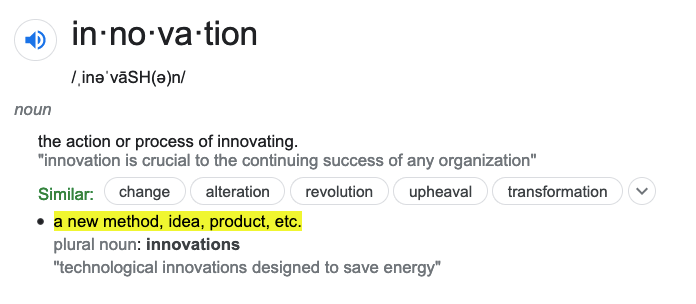
As a first step, we need to define the word, innovation. As you can see from its definition from Oxford Dictionary, it is defined as ‘a new method, idea, product, etc’.
The difficulty with this definition is that it doesn’t go deep enough to explain what the word new actually means in this definition’s context. This definition assumes the reader will understand the subtle, but important distinction of using the word ‘new’ in this definition.
Many people will, unfortunately, conclude that ‘new’ means ‘brand new’ as in a ‘just manufactured’ new model car. Simply because something is brand spankin’ new doesn’t make it innovative. However, a ‘brand new’ car model might contain some innovative elements, but the technology behind a car’s functional design may not be innovative or new at all… contrary to Oxford’s complicated use of the word ‘new’. As an example, both random cars in general and specifically electric vehicles are not new. In fact, mass produced cars have been the norm since 1901 and electric cars have been prototyped since the 1830s. While those electric prototypes weren’t truly cars in the mass produced sense, they were functional prototypes which showed that the electric vehicle technology is possible, functional and, most importantly, feasible.
You might then be thinking that Tesla was the first to create mass produced electric cars. Again, you’d be wrong. In fact, the first mass produced electric car was General Motor’s EV1, produced in 1996. The EV1 appeared 12 years before the first electric vehicle rolled off the assembly line at Tesla… and Tesla’s cars appeared 178 years after the first electric car prototype appeared. That’s a long time… definitely not ‘new’.
Electric vehicle technology was not at all new when Tesla decided to roll out its all electric vehicles. The only claim to fame that Tesla can profess is that they were able to sort-of Apple-ize their car in such a way that it warps the minds of buyers into believing it is ‘the best thing since sliced bread’. Ultimately, that defines an excellent sales strategy… what Elon Musk is actually known for.
To Tesla’s credit, they were the first viable luxury class vehicle to also claim the electric vehicle moniker. That claim doesn’t necessarily make the vehicle innovative. It makes Tesla’s sales and marketing team innovative in that they can make electric vehicle technology ‘sexy’ for the well-to-do crowd. Before Tesla, luxury car brands mostly avoided making electric vehicles. Even then, being able to successfully market and sell a product doesn’t make that product innovative. It simply means you’re good at selling things.
For example, Steve Jobs was the master at selling Apple products. To be fair, Steve Jobs didn’t really have to do much in the way of hard sells. When Jobs was at the helm, many of Apple’s early products were indeed innovative. If you need an example of innovation, Steve Jobs’s products mostly epitomize it.
Tesla, on the other hand, absconded with several key things to produce its Tesla electric vehicles: 1) Luxury car designs (which already existed), 2) electric vehicles (which already existed) and 3) standard off-the-shelf battery technology (which already existed). None of these three ideas were new in 2008. That Tesla successfully married these things together isn’t considered true innovation. It’s considered incremental innovation. Taking already existing pieces and putting them together to make a successful ‘new’ product is common in many industries. This is incremental in that these things already existed and it was only a matter of time before someone put them together in a cohesive way. Is that innovation? No. Why? If Tesla hadn’t done it, Mercedes-Benz, Cadillac, Bentley or another luxury brand would have at some point. Though, Tesla’s early claim to fame wasn’t even luxury, it was sports cars. However, Tesla has dropped the sports car idea in lieu of being a luxury brand.
Product Innovation Types
I’ll circle back around to the above, but let’s take a break here to understand the two primary types of innovation.
The first type of innovation is breakthrough innovation. This rare type of innovation offers a concept the world has never seen and usually results in a paradigm shift. Example: The Wright Brother’s first flight which brought about the paradigm shift into commercial aviation… a whole new industry emerged as a result.
The second type of innovation is incremental innovation. This much more common type of innovation takes existing ideas and marries them into a single new product. Example: The iPhone.
Some might consider both the iPad and the iPhone as breakthrough innovation. Instead, the first Apple computer would be considered breakthrough innovation and ultimately what, in part, lead to the iPhone and iPad. However and to be fair, both the iPad and iPhone products are technically incremental innovation. Prior to the iPad, there had been several tablet style computers (e.g., GRiD and even the Apple Newton) that, for whatever reason, never really took off. Handheld PDAs were actually a form of tablet. Cell phones were very popular long before the iPhone arrived. The iPhone, like the Tesla, successfully married three concepts: a computer, the cell phone and PDA into what became the smartphone.
However, even though incremental, both the iPhone and the iPad were responsible for a technological computing paradigm shift. The primary innovation seen in these devices was not from the marriage of existing technology, but from the speed, size, weight, high res screen and functionality that the devices offered… particularly when combined with the app store and a reasonable price tag. It’s much more convenient and fast to grab a tablet to quickly search the web than sitting down at a desk and powering up a desktop computer. It is the internal functions and features and flexibility that set these devices well apart from their earlier computer brethren which offered slower computing experiences at higher prices.
Steve Jobs was a master at miniaturizing computers into much smaller versions with reasonable price tags and which included high end features. This strategy is what set Apple, then NeXT, then Apple again… apart from the rest of their competitors. That was with Steve Jobs at the helm. Since Jobs’s passing, Apple is still attempting to ride Steve Jobs’s coattails, but those coattails are getting raggedy at this point. If Apple doesn’t come up with something truly breakthrough innovative in the next few years, they’re likely to begin losing sales in larger and larger quantities. Even more than this, another upstart company in similar Tesla form will step in front of Apple and usurp the industry. A business cannot keep selling the same devices over and over and expect success to continue. Apple needs another paradigm shift device to keep its success streak going. I digress.
Tesla’s Innovation
Circling back around to Tesla, we should now be able to better understand why what Tesla includes in its vehicles, while luxurious and technologically interesting, is nothing actually very new. It’s new in the sense of being recently manufactured, yes, but the technology itself is old from an innovation sense. In other words, Tesla had no hand in that technology’s development. An example, Tesla’s choice to place a large touch screen panel in the middle of the dashboard, while interesting, is simply considered luxury as touch screen flat panels are not technologically new. What about the all electric car itself? It’s not new either. Remember the 1830s? Remember the EV1? Not new.
What about the battery that powers the car? That battery technology is not new either. Technologically, it’s simply a standard lithium-ion battery built large enough to support operating a motor vehicle. Tesla didn’t design that technology either. Tesla might have had a hand in requesting the battery’s size, weight and power requirements, but that’s not innovation… that’s manufacturing requirements. The lithium-ion battery technology was created and produced much, much earlier in the 1980s. In fact, Akira Yoshino holds the 1983 patent for what is effectively the lithium-ion battery technology still being produced today… yes, even what’s being used in the Tesla.
You may be asking, “So what is innovative about the Tesla?” That’s a good question. Not very much to be honest. The car body’s design is at least proprietary, but functionally utilitarian just as most car bodies produced today are. The pop out door handles might be considered somewhat innovative, but these are born out of luxury, not out of necessity. They look cool, but don’t really serve a truly functional purpose. In this sense, while the handles might be considered innovative, they’re incremental and don’t serve a true purpose other than for aesthetics. The same statement of aesthetics can be said of a lot of both the interior and exterior of the Tesla. Functionally, the Tesla vehicles are cars.
The Tesla cars are designed to give the owner a luxury driving experience both inside and out. The all electric drive train helps reinforce that luxury function due to its torque, performance and acceleration power. Even the charging stations were built out of sales necessity, not out of innovation. You can’t exactly sell many electric vehicles if you can’t charge them easily. The proliferation of the recharge stations was, as I just said, born of necessity. Yes, this infrastructure is important to all future electric vehicles. However, Tesla built them coast to coast to ensure that Tesla owners could at least make a trip cross country without running out of power.
All of what Tesla has built I actually consider ‘smoke and mirrors’ or the ‘Hollywood Effect’. These luxury inclusions are intended to make the buyer feel better about the high purchase price. That the car acts like a highly paid butler, helping do a lot for the driver while on the road is what buyers see and feel. It’s that very luxury experience and those visual seemingly high-tech aesthetics that lure would be buyers into the brand. Buying a car from Tesla is like buying a new iPhone. It gives buyer that same endorphin rush, being able to say you have one. It’s also affords bragging rights because it’s a car brand that is relatively infrequently encountered and, at least according to Tesla buyers, is highly enviable.
People tend to buy Tesla for the same reason they buy and consume Cristal or Dom Perignon. They purchase these expensive brands not because they’re exceptional quality products, but because they afford a certain level of bragging rights because the item can be afforded. As a side note, Cristal and Dom Perignon are decent sparkling wines, but they are not worth the price tag based solely on taste alone. There are much less expensive Champagne and sparkling wines that are equal or better in taste. I’ll let you make of that statement what you will when it comes to Tesla.
Driver Assist
This leads us into the assisted driving feature. This feature is not innovative either. Driving assistance has been available on cars as far back as 2003 with the IPAS feature available on the Toyota Prius and Lexus models. This feature automatically parallel and reverse parks the vehicle. While this is not true assisted driving while on the road, the IPAS would definitely drive the vehicle into the parking space hands-free. IPAS was an important first step in proving that computer assisted driving could work.
Other driving systems which have contributed towards fully assisted driving is lane change detection, collision avoidance, traction control, distance detection, automatic braking and the backup-camera.
Tesla has taken all of these prior computerized driving innovations and, yet again, combined them into a computerized assisted driving. This technology is markedly different from full autonomous self-driving. Assisted driving utilizes all of the above detection systems to allow the driver to remove hands from the wheel, but not remove the driver from the driver’s seat. The driver must still watch the road and make sure the car’s detection systems do not go awry when the driver must be willing to reassert manual control. Because these limited detection systems aren’t fail proof, a driver is still required to take control over the vehicle should the system fail to detect a specific condition that a driver can see and avoid.
Self-Driving Vehicles
Tesla doesn’t presently offer a fully computerized autonomous self-driving vehicle for its consumers. Only driver assist mode is available. Self-driving vehicles do not require a driver. Self-driving autonomous vehicles have an advanced computer system and radar system mounted on the roof. These vehicles are continually scanning for all manner of conditions constantly. The computer is constantly able to correct for any conditions which arise or at least which have been programmed. Self-driving vehicles are substantially less prone to errors than assisted driving, primarily because of Google’s self-driving vehicle efforts. Self-driving types of vehicles do not need a driver sitting the driver’s seat, unlike assisted driving vehicles which still require a driver.
One might think that Google invented this technology. However, one would be wrong. Self-driving vehicles were introduced in 1939 at the New York World’s Fair using a system that required road modification to keep the vehicle situated.
Google was able to, in 2009, adapt this prior concept by using the then computer, current radar technologies and detection systems to allow the car to function autonomously without the need to modify the road itself. However, even though Google was able to create cars that do function properly and autonomously, this technology has yet to be manufactured into consumer grade vehicles…. mostly out of fear that it will fail in unexplained ways. That and that driving laws (and insurance policies) have not yet caught up to the idea of autonomous driver-free vehicles. For example, if there’s no driver and an autonomous car injures or kills someone, who’s at fault? Laws are slowly catching up, but this question still remains.
Tesla and Driver Assist
Let’s circle back around. The reason Google’s autonomous driving technology, now called Waymo, is mentioned in this article is that it began one year after Tesla began operations in 2008, long before Tesla began including assisted driving in their vehicles. Tesla, once again, adopted an already existing technology into their vehicle designs, likely based in part on Google’s successful autonomous vehicles. They didn’t design this mode. They simply adapted an already existing technology design to be useful in a more limited fashion. Again, this isn’t breakthrough innovation, it’s incremental innovation. There is no paradigm shift involved. It’s a utilitarian luxury inclusion in an attempt to allow Tesla to prove how modern and luxurious their vehicles are compared to other luxury brands. Basically, it’s yet another ‘feather in their cap’.
Innovation is Innovation
Unfortunately, no. It’s far, far easier to adapt existing technologies into a design than it is to build a new idea from scratch. For this reason, nothing of what Tesla has built is truly groundbreaking or ‘breakthrough’ in design. More than this, Tesla is a car. A car is a car is a car.
The point in a car is to transport you from point A to point B and back. You can buy a car that’s $5,000 to perform this function or you can buy a car that’s over a $1 million. Both perform this same basic task. The difference in price is the luxury. Do you want to do this task in a thinly walled, loud, tiny bucket of a car or do you want to do it with every creature comfort using top speed? Comfort and performance are the primary differences in price.
With Tesla, there’s nothing truly innovative included in their cars. Luxurious? Check. Performant? Check. Bells and Whistles? Check. Miles per gallon? Whoops.
Distance Driving
One of the great things about gasoline powered vehicles is the ability to travel great distances without stopping too frequently. When you do need to stop, the existing gas station infrastructure is practically every place where you might travel. Granted, there are some dead stretches of roads were you might need to plan your car’s fillups accordingly, else you might be stranded. For the vast majority of roads in the United States, finding a gas station is quick and easy.
With the Tesla, finding recharge stations fare far worse. While the charging infrastructure is improving and growing around the country, it’s still much more limited than gas stations. That means that when distance driving in a Tesla, it’s even more important to plan your travel routes to ensure you can charge your vehicle all along the way.
You have a Model 3 and you say it charges to 100% in about an hour? Sure, but only if you happen to find a V3 Supercharger. Unfortunately, the vast majority of Superchargers available are V2 chargers or older. Even then, the amount of kilowatts of power available to charge your Tesla may be artificially constrainted. The V3 chargers offer up to 250 kW. The V2 chargers offer around 150 kW. Many random chargers you find (not Tesla branded) may only offer between 6 and 20 kW. Considering that 20 is only a fraction of 250, you’ll spend a whole lot of time sitting at that charger waiting on your Model 3 to charge up. It’s great that Tesla has built the faster V3 charger, but you can’t bank on finding these when you need one most. With gas stations, you can at least get some kind of gas and fill up the tank in minutes. With a Tesla, you could be sitting at a charging station for hours waiting to get to 50%.
Around 60 minute charge times sound great for the Model 3, but only when the infrastructure is there to support it. Currently, the V3 chargers are still not the norm.
What does all of the above mean for distance driving? It means that for long distance road trips while in a Tesla, you’ll need to not only plan each charger stop carefully, you’ll need spend time locating the fastest chargers you can find. This allows you to calculate the amount of time it requires to charge your car to 100% at that charger. If you don’t properly plan for where and how long, you could spend way more time at places than you think.
Run out of charge in the middle of nowhere? With services like triple-A, you won’t find them coming to top up your charge. Oh, no. They’ll come grab your prized Tesla, place it on a flatbed and then you’ll be riding in that tow truck to the nearest charge station… which could be hundreds of miles and one very large tow cost away. Once you get there, you’ll be sitting waiting for the charge to complete… and/or attempting to find a motel. Costly. Even with Tesla’s included roadside assistance, don’t expect miracles and you may even be required to pay for that tow.
If you had been driving a hybrid, triple-A could have given you a few gallons to get you to the nearest station to fill up… and then you’d have been on your way quickly.
What are the charge costs?
Honestly, if you have to ask this question, then a Tesla is probably not the right car to buy. However, for the curious, it’s still worth a deeper dive. Unlike gasoline prices which are clearly and conspicuously visible with large price signs towering high above the gas station, neither Superchargers nor standard electric chargers give you this visibility.
In fact, to find out what it will cost to charge your vehicle, you’ll have to visit the recharger and begin poking your way through the touch screen. There are some apps and web sites you can pick a charger location and review its then electric rate, but you might not want to bank on that if you’re planning a trip. Instead, because electric prices can vary dramatically during seasons and demand, you’ll need to check the pricing just before you reach the charger or, better, directly on the charger when you reach it.
Unlike gas stations which allow you to shop around for the best price, chargers don’t really offer that convenience. You pay what you pay.
For a Supercharger, the prices are based on how the energy is doled out to your car. The two methods are kilowatts or kilowatt-hours. Whichever rate system you choose, the energy will work out to the same cost in the end.
If you choose to charge per minute, it is $0.26 per minute above 60 kW. Under 60 kW, it is only $0.13. If you charge by kWh, it is $0.28 per kWh drawn from the charger.
https://www.motorbiscuit.com/how-much-does-it-cost-tesla-supercharger/
In case you’re wondering… No, it is not free to charge up your Tesla. However, Tesla does sometimes offer free limited time charging incentives at Superchargers when attempting to up quarter sales. You’ll need to discuss these kinds of incentives with Tesla before you sign on the dotted line.
Superchargers and Battery Wear
Battery technologies are finicky. It’s well known that the faster you charge a battery, the faster it wears out. Yes, this goes for Tesla car batteries. What that means is that while visiting a V3 Supercharger is convenient for topping up your battery quickly, it’s not so great on the battery itself. The more you visit these fast charge ports, the quicker your car battery may need to be replaced. This means you should temper your exuberance for fast chargers and utilize much slower overnight charging whenever possible.
How much is a replacement battery pack? Well, let’s hope you bought the extended warranty because here’s where things get really pricey. Obviously, under warranty, there will be no cost. If the warranty has expired or if you have bought a used Tesla without a warranty, you’re on your own. The cost to replace a battery pack can range from $3,000 to over $13,000 sans labor. If you’re considering buying a used Tesla, you should confirm if any existing warranty is transferable to the new owner and confirm how much is left. You shouldn’t confirm this with the seller as they likely can’t tell you much. Instead, confirm this information with Tesla directly by calling and asking.
If no warranty is available, you should contact a third party warranty company (i.e., CarShield) and discuss whether the battery is a covered part under that warranty before you buy the car. Being required to spend $16,000 after buying a used Tesla (or any electric car) is not really a pleasant surprise. You’ll want to make sure you can acquire some kind of warranty that covers that battery part as soon as you buy that Tesla.
Commuter Vehicle
Let’s discuss a situation where Tesla does function decently enough. A Tesla is a reasonable, if not somewhat costly commuter vehicle. It’s great to get around town, drive to work, run errands, pick up the kids and take them to soccer practice. For long distance driving, owning a Tesla is unnecessarily more complicated, particularly if you choose to tour remote areas of the country without access to charge stations. All of this complication can be easily avoided by choosing a gas vehicle or a gas hybrid. As a commuter vehicle, a Tesla is an okay choice. However, I’d suggest there are plenty of other vehicles, gas, hybrid and even hybrid / electric, that suffice for commuting. Many of these choices are not nearly as costly as the purchase of a Tesla. But, of course, you won’t get all of the Tesla niceties with those other vehicles.
A Green Company?
With the recent trend toward companies seeking to being green and offering green technologies, it’s funny (odd) that Tesla chose not to be very green. There are a number of problems that prevent Tesla from being a green all around company. By green, let me define that.
I know, you might thinking, “How can an all-electric vehicle not be green?” Bear with me.
A Green company is a company that implements processes to reduce waste, to offer more compostable materials in packaging and implement processes to reduce its own waste and offer designs which help reduce carbon emissions and other environmental pollutants. Apple is a good example of this. Apple moved from using plastic packaging materials to paper materials which compost more fully. Though, even Apple isn’t all that green considering the eWaste afforded by Apple’s insistence at replacing iPhones every single year.
One might further think, “Well, isn’t Tesla green by using batteries instead of gasoline?” You would think that would be true, wouldn’t you? Let’s examine.
What about those Li-On batteries? The secret involving these batteries is that to manufacture that one battery, it produces 74% more emissions than a standard car does. Once the battery is manufactured, the consumption of greenhouse gasses drops to zero for that specific battery, but the manufacturing of each battery is very dirty. I guess Tesla car buyers don’t really care much about how much of a carbon footprint was required to build that luxury Tesla? It gets worse.
Power Grids derive most of their energy from fossil fuel sources. Up to a max 20% of all grid energy generated is from clean renewables such as Solar, Wind and Water. Nuclear energy further makes up another 20%. The remaining ~60% is still generated from fossil fuel sources including coal, natural gas and burning petroleum products. That means that every time you plug your Tesla into a grid charger, at least 60% of that energy consumed is contributing to greenhouse gasses.
Your Tesla doesn’t have a tailpipe, but it grows one while your Tesla is charging from the grid.
Tesla and the Power Grid
With both California and Texas now experiencing regular power problems due to various politically motivated reasons, it is also becoming obvious that the aging United States power grid infrastructure is in need of a major overhaul. For every plug-in electric car sold (not just Tesla), this puts another car onto the grid to suck even more energy. As more and more all electric cars are manufactured and sold, that only means even more added load to that aging power grid. Tesla is a heavy contributor to this problem due to its much faster (denser) powered requirements for fast charging.
At some tipping point, there will be too many cars charging for the grid to handle. The formerly off-peak hours in the wee morning hours will become the peak hours because that’s when all of the cars will be charging. Eventually, all of these charging electric cars will be drawing more current than homes draw in the middle of the day. This will be compounded by Tesla’s ever more ravenous need to speed charging up. Right now, the V3 chargers pull 250 kW. The V4 chargers will likely want to pull 500kW. V5 chargers maybe 1000kW?
When will this need-for-speed end? This is the same problem that Internet Services faced in the early 2000s. The infrastructure wasn’t designed for 10GB to every home. It still isn’t. That’s why broadband services still don’t offer 10GB home speeds. They barely offer 1GB.. and even if you do buy such a link, they don’t guarantee those speeds (read the fine print).
The point is that the more data that can be pulled in an ever shorter amount of time, the more problems it causes for the ISP over that very short time. The same for energy generation. The more energy consumed over an ever shorter amount of time, the more energy that must be generated to keep up with that load. There is a tipping point where energy generators won’t be able to keep up.

Is Tesla working with the energy generation companies? Highly unlikely. Tesla is most likely designing in a bubble of their own making. Tesla’s engineers assume that energy generation is a problem that the electric companies need to solve. Yet, energy generation has finite limits. Limits that, once reached, cannot be exceeded without expensive additional capacity… capacity that the energy companies must pay to build, not Tesla. Capacity that takes time to build and won’t come online quickly (read years). Capacity costs that will be handed down to consumers in the form of even more rate increases. Yes, all of those Tesla vehicles consuming energy will end up being the source of higher energy rate increases. Thanks, Elon!
It’s highly unlikely that Tesla knows exactly where those energy generation limits are and they probably don’t want to know. It’s also the reason many recharge stations limit power consumption draw current to around 6-10 kW max. Those limits are intentional and are likely not to be lifted any time soon. If Tesla can manage to get even a handful of V3 Superchargers set up around the United States, I’d be surprised. Even then, these rechargers may be artificially limited to significantly less than the 250 kW required for that 60 minute rapid charge in a Model 3. Power companies may simply not be able to provide that charge rate for perhaps hundreds or thousands of rechargers.
Hope meets Reality
The difficulty is that Tesla intends to build these ever faster rechargers, but then may not be able to actually get them functional in the wild due to the overly rapid amount of energy they can consume. This is where reality meets design… all for Tesla to attempt to get close to the 5-8 minutes it takes to fill up a tank of gas. Yes, let’s completely stress our aging power grid infrastructure to the breaking point all for the sake of trying to charge a bunch of Teslas in 5 minutes? Smart. /s
Instead of producing ever faster and faster rechargers, Tesla should be researching and innovating better battery technologies to reduce power consumption and improve driving distance through those improved batteries. How about hiring battery engineers to solve this difficult problem rather than taking the easy route by simply sucking down ever more energy faster from an already overloaded power grid?
With better batteries, instead of Tesla contributing to the problem of global warming by forcing ever more energy generation faster, they could be innovating to reduce this dilemma by making more efficient and faster charging batteries using lower power consumption rates. Building better and more efficient batteries? That’s innovation. Faster recharging by overburdening infrastructure? That’s callous and reckless… all in the name of capitalism. I guess as long as Tesla can make its sales numbers and Wall Street remains happy, it doesn’t matter how non-green Tesla really is.
Pollution
One thing I’ve not yet fully discussed is, you guessed it, pollution. This aspect is part of being a green company. Yet, instead of trying to make Teslas charge faster and drive farther by innovating improved battery technologies, Tesla builds the low-hanging fruit of faster 250 kW rechargers to improve the speed of battery charging by consuming ever more grid energy faster.
Let’s understand the ramification of this. The faster the batteries charge, the more power must be generated at that point in time to handle the load. The more power generated, the more concentration of pollutants that go into the air to support that generation. That doesn’t say ‘green company’. It says callous, reckless, careless, dirty company in it for the money, not for helping the planet.
Overtaxing the power grid is a recipe for disaster, if only from a climate change perspective. There are plenty of other ways to look at this, but this one is the biggest problem against what Tesla is doing. It’s also, again not innovative. In fact, it’s just the opposite.

Renewables
Energy sources like Wind, Solar and Water are great generation alternatives. But, they’re not always feasible. Texas is a very good example of how these renewables can fail. The mass array of Wind Turbines in North Texas and the panhandle were found to be easily damaged by both freezing temperatures and excessive winds. Clearly, these expensive turbines need to be weather proofed and managed accordingly.
For example, to avoid the freezing conditions, the motors needed heaters to keep them from freezing up. It’s not like some of the energy generated from these turbines couldn’t be used and stored locally to keep heaters operating. Additionally, high wind detectors could move the blades into a neutral position so there’s less of a chance of high wind damage. Because Texas apparently didn’t implement either of these two mitigation strategies, that left a large amount of these wind turbines damaged and out of commission. This fact meant the Texas power grid was unable to serve the entire state enough energy… thus, blackouts.
Solar, on the other hand, requires a large amount of land to “farm.” What that means is that land needs to be allocated to set up large amounts of solar panel arrays. Last time I looked, land wasn’t cheap and neither are those solar panels. This means a high amount of expense to draw in solar energy.
Unlike wind, which can potentially blow 24 by 7, if you can get 5-6 hours of solid sunlight in a day, that’s the best you can hope for. This means that a solar panel can only capture a fraction of the amount of energy that a 24 / 7 wind turbine can continuously capture and provide.
Water energy can also be harnessed, but only using large dam systems. This means, once again, specific land and water requirements. For example, the Hoover dam provides about 458,333 kW continuous, which is enough continuous power to operate around 1,559 V3 Superchargers concurrently, taking into account a 15% power loss due to transmission lines and transformers. This also assumes that dam’s power is dedicated to that purpose alone. Hint: it isn’t. Only a fraction of that power would be allowed to be used for that purpose, which means far fewer Superchargers. That power is also combined with other power generation types, which makes up the full power grid supply.
The point here is that renewables, while great at capturing limited amounts of energy, are not yet ready to take over for fossil fuel energy generation. In fact, the lion’s share of energy generation is still produced by burning coal, natural gas and petroleum… all of which significantly impact and pollute the environment.
Dangerous
One thing I’ve not yet discussed is the dangers of owning an electric vehicle. One danger that might not seem apparent is its battery. These lithium-ion batteries can become severe fire hazards once breached. If that Tesla lands in an accident and the battery ruptures, it’s almost assured to turn into a Car-B-Cue. If you’re pinned in the vehicle during that Car-B-Cue, it could turn out horrific. Lithium-ion fires are incredibly dangerous. Though, while gasoline is also highly flammable, a gas tank is much less likely to rupture and catch fire in an accident.
Innovation Circle
To come full circle, it’s now much easier to understand why Tesla is less an innovative car company and more of a sales and marketing gimmick. After all, you could buy plenty of other luxury car brands offering sometimes better bells and whistles. Luxury car brands have been around for years. Tesla is relatively new car company, having started in 2008. It’s just that Tesla has built its brand based on it having “sexy” technology that other brands didn’t have, but have since acquired.
Both gas and hybrid vehicles offer better distance and more readily accessible infrastructure to get you back onto the road when low on fuel. It is this feature that is still a primary motivator for most car buyers. Trying to finagle where and how to charge an electric vehicle can be a real challenge, particularly if you live in a condo or apartment and not a home. It’s worse if you choose to live in the boonies.
Where does Tesla stand?
The question remains, what does a Tesla vehicle do well? As a short distance commuter car, it’s perfectly fine for that purpose. It’s a bit pricey for that use case, but it functions fine. The convenience of being able to plug it in when you get home is appealing, assuming you have a recharge port installed at home. If you are forced to leave it in a random parking lot to charge overnight, that’s not so convenient. How do you get home from there? Walk? Uber? It kinda defeats the purpose of owning an expensive Tesla.
When purchasing a Tesla, you have to consider these dilemmas. What’s the problem with living in a condo or apartment? Many complexes have no intention of setting up rechargers, thus this forces you to leave your car at a parking lot charger perhaps blocks away. If the complex offers garages with 110v circuits, you can use these to charge, but extremely slowly. This means that to own a Tesla, certain things need to line up perfectly to make owning a Tesla convenient. Otherwise, it’s an expensive hassle.
Innovation isn’t just about the product itself, it’s how the product gets used in a wide array of use cases. If the product’s design fails to account for even basic ownership cases, the design wasn’t innovative enough. That’s where the Tesla sits today. That’s why Tesla is still considered niche car and is not generally useful across-the-board.
Calling Tesla and, by extension, Elon, innovative gives that company and Elon way too much credit. Elon’s claim to fame is that he picked a business that happened to receive a lightning strike. This is mostly because he’s an excellent sales person. Some people can sell pretty much anything they are handed. Elon is one of those people. While he’s an excellent salesman, he’s not so much of an excellent innovator. Slapping together a bunch of existing off-the-shelf technologies shouldn’t be considered innovative, particularly when you forget to take into account too many ownership cases where the final product is inconvenient to own and operate.
Home Use
The kind of buyer who can afford to buy into a Tesla is typically affluent enough to afford a home. For these people, more convenience is afforded owning a Tesla. Not only can you spend the money to install a home charging port that charges at whatever rate you can afford, homeowners can choose to park and charge their vehicles at will. This is important to understand.
Homeowners with acreage, can also choose to set up such renewable energy sources as wind turbines and solar panels. These energy generation systems can offset some of the power consumed while charging up an electric vehicle.
About renewables, one residential based wind turbine may produce a maximum of 10 kW of energy during optimal conditions. That’s about the same amount of energy provided by most third-party non-Tesla recharge ports found on parking lots. While it may take 60 minutes to charge a Model 3 using a V3 250 kW recharge port, at 10 kw or 4% of that 250 kW charge rate, it would take many hours to charge. In fact, at that much slower recharge rate, it might take 8-16 hours to fully charge.
To offset that, you would need to buy and install multiple wind turbines to increase the energy generated. Wind turbines are not at all cheap to buy or erect. Having enough land to line them up may be even more of a problem. In other words, you’d probably spend way more than the cost of your Tesla just to build enough infrastructure to support charging that car in anything close to timely. Is it worth it? Depends on the person.
To even approach the 250 kW level of charge rate, you have to rely on the power grid or install a diesel or natural gas generator. However, installing a fossil fuel generator is no better or cheaper than using the power grid.
As I said above, a Tesla grows a tailpipe the moment it begins recharging from fossil fuel sources.
Is a Tesla vehicle worth it?
As a car for car’s sake, it’s fine. It does its job well. It’ll get you from place to place. It has all of the standard amenities needed, such as heating and air conditioning and it keeps you out of the rain. It has luxury bells and whistles also, such as the touch screen panel and assisted driving.
Everyone must decide for themselves what they consider whether a product is “worth it”. Owning specific cars is mostly a subjective experience. Does it feel right when sitting in the driver’s seat? Is it comfortable? Can you see easily out of the windows? Do the mirrors offer safe views all around the vehicle? As a driver, only you can sit in a car an decide if the car is the correct fit for you and your family.
I’ve personally sat in cars that while they appeared roomy from the outside, caused my knees to bang up against the dash or door frame or other areas upon entry, exit or while driving. It’s no fun exiting a vehicle to scraped knees or banged up shins.
Car buying is an experience that can only be described as trying to find a glove that fits. Once you find the right glove, the deal is done. I would never buy a car based on brand alone. I buy cars that fit all manner of criteria, including comfort, budget, safety, warranty, reviews and cost for maintenance. Nothing’s worse than taking your car to the dealer only to be slapped with a $1000 fee each and every time.
I’m not saying that owning a Tesla isn’t “worth it”. It may well be “worth it” for specific reasons. It’s just that the one reason to own a Tesla should not be innovation. The car truly offers few innovative features. Another reason is its alleged zero carbon footprint. Yes, it has a zero carbon footprint as long as you never charge it. Can’t do that and have a functional car. As soon as it begins charging from the power grid, the car is no greener than a gas powered car. Because a Tesla must charge for hours at slower recharge rates, that’s way longer than most 2-4 hour daily commutes to and from work in a gas powered vehicle.
Simply because you don’t see the pollution going into the air out of your car doesn’t mean it’s not happening while that car sits in your garage charging.
Product Innovation
As I said above, you shouldn’t buy a Tesla because you think it’s innovative. It’s not. However, it goes beyond this. I don’t think I’ve ever purchased a car because it was “innovative.” I choose cars based on other more important criteria, such as gas mileage, comfort, warranty, performance, ease of maintenance and other functional criteria. This typically means I’m also not brand loyal. I find the car that fits what I need in the budget that I can afford. That could be a Ford, Chevy, Toyota or whatever car that works best. Every model year yields new cars that offer different features.
Tesla believes that they can craft a brand like Apple, with brand loyal fans also like Apple. Apple is a unique beast. Their brand loyalty goes very, very deep. These brand loyal folks will buy whatever Apple releases, regardless of whether it’s the best value. Likewise, Tesla hopes to build their company based on this same type of year-over-year brand loyalty. Except there’s one problem: who buys a new car every year?
However, Tesla has not proven itself to be an innovative car company. They can make cars, true enough. But, are those cars truly innovative? Not really. Even Apple’s product innovation has come to a standstill. The latest iPad, for example, removed the TouchID home button in favor of FaceID simply to remove the home button from the bezel. So then, along comes COVID-19 and thwarts FaceID by wearing a simple mask. TouchID is a better COVID alternative because you don’t need to cover your fingertips. FaceID seems like a great idea until it isn’t.
Tesla needs to consider more breakthrough innovation and less incremental innovation. Hire people with the chops to build superior battery technology. Hire people who can design and build more efficient drive motors. Hire people to figure out how to embed solar panels into the paint so you can have both an aesthetically pleasing paint job and charge your car while sitting or driving in the sun.
There are plenty of ways to recapture small amounts of energy, such as wind, solar and regenerative braking to extend the driving distance. These don’t need to fully charge the battery, but instead are used to extend the charge of the battery and add distance. Heck, why not install a simple generator that uses gasoline, propane or even natural gas? This generator doesn’t need to charge the battery to 100%. Again, it is simply used to extend the range to get more miles from the car. These are just a few simple, but profound improvement ideas. There are plenty more ideas that can be explored to make the Tesla cars, not just technologically luxurious, but truly innovative.
These more breakthrough innovative designs are missing from the Tesla. These are ideas that would make a Tesla car much more functional in all areas of driving, not simply commute driving. In fact, I’d like to see Tesla build a gasoline powered vehicle. Stop relying on electric and take the dive into building cars based on all fuel types. Does Cadillac keep its car line artificially limited to one type of motor? No. How about Bentley? How about Porsche or Lamborghini? No. These car companies innovate by not artificially constraining themselves to a single type of technology. This gives those car companies an edge that allows them to install whatever technology is best for a specific model vehicle. That Tesla is artificially constraining itself to electric only is a questionable, self-limiting business decision.
↩︎
Brilliant Commercials Series: Doritos Ultrasound
Here’s a Doritos commercial, though not starring Ms. Morris this time. This commercial is both funny and brilliant, though just a touch dumb. Obviously, you have to suspend disbelief to find this setup humorous as this scenario is really not possible. However, it is rather funny and clever. Let’s watch…
Well, she did say, “Any day now”.
Rating: 4.5 out of 5 (brilliant, clever, but a bit dumb all at the same time).
↩︎
Brilliant Commercials Series: Yoplait (2008)
This commercial is a bit older, but again stars Jennifer R. Morris (noticing a trend yet?) This commercial is humorous, clever and brilliant. The seamstress is, well, kind of out of it. She never really catches on. Jennifer’s character keeps trying, nevertheless. Let’s watch…
Rating: 5 out of 5 (clever, brilliant, humorous)
↩︎
Brilliant Commercials Series: Verizon Wireless ‘Dead Zone’
This somewhat older commercial is, like Spectrum’s more recent commercial, brilliant and funny and sells the product in a subtle, yet clever way. The musical score completely sells what’s going on here in just a few notes. The commercial depicts a typical sort of horror setup where a couple moves into a home not knowing what horrors lurk within, but then it’s all debunked in an instant because of Verizon Wireless. The creepy neighbor is perfectly cast. The atmosphere which is set up here is brilliant and amazing, underscored by that brilliant soundtrack. It all comes together in just a few seconds and falls apart to instant humorous effect.
This one also stars Jennifer R. Morris as the ‘wife’. Jennifer can certainly pick these brilliant commercials. Though, her work in Spectrum’s more recent commercial shows exactly how great of an actress she really is.
Rating: 5 of 5 (perfect atmosphere, scary brilliant with a touch of perfect humor)
Brilliant Commercials Series: Spectrum Mobile
Here’s a commercial that is both funny and clever. The humor is spot on. It advertises the Spectrum product in a clever and unique way. The casting is perfect and the humor is timed perfectly. There’s nothing annoying about this commercial. The “genius scientist” (actress Jennifer R. Morris) is brilliant here. Jennifer has done a fair number of commercials in the past, but her work on this commercial is outstanding.
Rating: 5 out of 5 (brilliant and clever)
Part of the Dumb Commercials Series
↩︎
Dumb Commercials Series: Uber Eats
Here’s yet another dumb commercial, but probably not for the reasons you might think. Let’s explore.
What’s wrong with this commercial?
The humor in this commercial stems from Simone’s, “Is that my leotard?” line. Let’s explore this line deeper.
This commercial is not only dumb, it’s disturbing. Here you have a white male wearing Simone Bile’s stolen leotard. Stealing someone’s leotard out of their locker is theft and could also be seen as a form of stalking. Clearly, this guy is trying to be just like Simone. A ‘clone’, if you will. That behavior, in and of itself, is disturbing. Combined with the stolen leotard, him attempting to recreate her routine and the fact that he copied Simone Biles’s Uber Eats order, that’s substantially “clone-ish” behavior. That behavior goes way beyond fan norms into stalker territory.
That Uber Eats decided to create a commercial that appears to depict a stalker showing up at Simone Biles’s practice session is quite disturbing. I’m not even sure how that entire behavior ties into Uber Eats. Is Uber Eats trying to say that it’s perfectly okay to exhibit this behavior towards a notable person?
Being a fan is one thing. Becoming a clone and stealing clothing from your idol crosses the line. That Uber Eats created a commercial that depicts this behavior simply to advertise their food delivery service is questionable. I don’t even see what one has to do with the other.
For the stalker reason alone, this is why this commercial is included in this series. It’s a bad commercial all around. It’s poorly conceived and written. It doesn’t have a point to make. It’s insensitive. However, it is professionally filmed. Regardless of hiring a professional commercial film company, there is really no point being made here that makes me want use Uber Eats to order food delivery. Just the opposite, in fact.
It Doesn’t Stop Here
There is a follow-on to the above commercial that proves that this guy is a stalker… Here, Simone’s, “I guess” line and brow-furrowing look proves that she’s not comfortable with this guy literally hanging around. He appears to have even stolen her leotard again.
Definitely an uncomfortable series of commercials. I’m not even sure why Simone would agree to being in these commercials considering her sexual abuse allegation with Olympics team doctor Larry Nassar.
And then there’s this one…
Rating: 2 out of 5 (depicts stalker behavior in an accepting way)
↩︎
Dumb Commercials Series: Eargo
With this newest series, I will discuss the stupidity of various commercials and call out exactly why they are so stupid, even though it is the stupidity that also makes them somewhat humorous. I will also call out well written and clever commercials. Let’s explore.
This commercial has been recently playing heavily on some networks. I’ve seen it a LOT. Every time I see it, I also think how stupid it is.
American Pie
The commercial resorts to low-brow college humor to get its point across with oddly embarrassing results. The thing is, these two young people cannot possibly be this stupid!
First, why the hell would any couple begin talking about sex in such a blatant way right under their parent’s noses? The answer is, they wouldn’t. Without this, the commercial wouldn’t be nearly as funny. Unfortunately, the writers of this commercial thought that they needed to use this low-brow embarrassment as the basis for humor. There are many ways of crafting humor without resorting to such low-brow schadenfreude means to do it.
Second, who is the person with hearing problems in this commercial? Clearly, it isn’t the father.
To Whom Does This Apply?
The question regarding this commercial’s setup underscores yet another problem. Clearly, the father is wearing Eargo buds. However, her boyfriend/fiance/husband isn’t. If her boyfriend/fiance/husband at that age can’t hear her whispering the word ‘condom’, but her father can mere feet away, then her boyfriend desperately needs an ear exam. She would already know this. Also, if he can’t hear in a relatively quiet environment like that, he really does need a hearing exam. She would also compensate by knowing this fact about him.
In compensation for knowing her boyfriend/fiance/husband can’t hear well, why is she standing feet away trying to whisper-yell at him? It’s like she wants her parents to overhear how well her sex life is going. You’d think she’d walk around that counter, walk directly up to her boyfriend/fiance/husband and whisper it in his ear…. specifically knowing he can’t hear her. Better, wait until they are in the bedroom with the door closed. What’s the all fire hurry to know if he brought condoms right at that very moment? Was she planning on asking Dad for a few if boyfriend/fiance/husband didn’t have them? Ewww…
Unfortunately, this commercial doesn’t end properly by cutting back to the scene with her boyfriend/fiance/husband now wearing a set of Eargo with her whispering again, thus allowing him to hear every word. You know, to prove that Eargo’s technology actually solves that embarrassing problem.
The writers of this commercial lost their way even though it is professionally filmed. The only reason it gets more one more star than it should is solely because it is professionally filmed.
Rating: 3 out 5 (could have been a whole lot more funny and effective)
↩︎


 Random Thoughts - Randocity!
leave a comment