Top 10 gripes for Fallout 76

You’re thinking of buying Fallout 76? You’ve rationalized, “It’s only a game, how bad can it be?” Let’s explore the top 10 gripes for why Fallout 76 may not be the best game purchase in 2019.
Number 10 — It’s not a new game
This game was released over a year ago in October of 2018. It’s over a year old already. Games typically have a 1 year lifespan of relevance before losing steam. The useful lifetime of this game is already waning and the clock is now ticking down on this game. Bethesda knows it, the industry knows it and gamers know this. You could invest your money into this game and find in 5 months that Bethesda has decided to pull the plug. For this reason alone, I’d be cautious in investing time in building a character.
Bethesda RPG-like games usually take months to fully play through. You might not even see all of the endgame content before Bethesda pulls the plug. Though, you can most certainly get through the main quest line before then, as short as the main quest is. Keep in mind, however, that because it’s an online game, there’s no local save file on your computer. If Bethesda pulls the plug, all of your characters and the work you’ve spent building them will disappear.
Number 9 — Multiplayer Game Modes
If you’re solely looking at the purchase of Fallout 76 for its multiplayer player-vs-player (PVP) game modes, you might want to think again. There are only three multiplayer modes in Fallout 76:
- Native (Workshop and Adventure)
- Hunter / Hunted Radio
- Battle Royale
Native PVP
None of the 3 PVP modes are particularly well designed and none of them fit into the Fallout universe and actually make sense. This first mode, “Native”, requires two people to initiate this mode through a handshaking process. One person fires on another. The second person must fire back to complete the PVP handshaking and launch into PVP mode. The problem is, there’s no fun to be had in this PVP mode and it’s rarely, if ever, used. Most players in adventure mode are there to explore and play PVE, not to get into PVP battles. So, be cautious when trying to elicit a PVP action from another player.
The second half of the PVP mode is at Workshops. If you claim a workshop, the handshaking mode is disabled and the entirety of the workshop area becomes an active PVP zone. Once you own a workshop, anyone can come into the workshop and begin PVP with you or your team. It’s the same PVP as the version that requires handshaking, except there is no handshaking.
Speaking of teams, be cautious when teaming up with other players. It only takes one player in a team to begin PVP with another player. Once that happens, the entire team becomes vulnerable to PVP with that player (and anyone on a team with that player). No warnings are issued by the game to other team players when one team member begins PVP activities with another player.
Hunter / Hunted Radio
The second game mode, “Hunter / Hunted Radio” requires you open a radio station on the in-game Pip boy (heads up display giving access to your inventory, weapons, armor, etc). This “radio station” links you into a matchmaking mode that allows up to 4-5 players in a given radius to begin PVP activities. As the name suggest, it’s about hunting for other players all while being hunted yourself. It’s also a sort of ‘Last Man Standing’ mode in that whichever player ends up with the most kills gets the most rewards.
Both of the above listed game modes are effectively “death match” style PVP. That means that it’s solely about player characters killing one another… which then comes down to which player has the best and strongest armor and weapons. Both of these styles rapidly elicit boredom because “death match” is the oldest and weakest type of PVP mode there is and is simply about killing other player characters.
This PVP also makes no sense within Fallout 76 where all of the people who lived in Vault 76 were supposed to remain civil and friendly towards one another. Not even the game setup or later found holotapes reveal any story aspect of people in Vault 76 turning on one another before “Reclamation Day”. If that had been a story element, then perhaps the PVP might have made some sense. But, no. The holotapes found almost ALL tie into the Scorched threat or other similar environmental survival threats (bad water, radiation, etc). None of the holotapes discuss bad blood between the residents within Vault 76. If that had been true, the “Reclamation Day Party” the night before would have ended in bloodshed before the vault even opened.
Nuclear Winter — Battle Royale
The third PVP activity is separated from the above because it arrived much later in 2019. At the same time it is a merely a weak copy of other better implemented Battle Royale games, which are currently “trending” in the game industry. Bethesda added this game mode, not because it made sense to Fallout 76 (or the Fallout universe), but because it is so popular in other popular game franchises, such as Fortnite and Apex Legends. It’s simply Bethesda’s attempt at a cash grab in an industry being inundated by other better Battle Royale based games.
Battle Royale is nothing new. It is a game mode that has been around since the early days of PVP. However, games like Fortnite and Apex Legends have turned this mode into hugely successful franchises. This mode is another “Last Man Standing” mode which is simply an alternative version of “Death Match.” In this death match style game, instead of people picking off one another and continually respawning until the clock runs out, you only get one try to win. This means that once your character has been killed, you can only watch the action unfold for the remaining active players. The point of any Battle Royale mode is to survive as long as you can and possibly become the “last man standing”.
With Fortnite and Apex Legends, it’s not so much about being Battle Royale, it’s more about the game makers crafting the game using interesting characters using gimmicks (building forts) with interesting attack modes. It’s about finding a character who has the “best” attack in the game. This means you can bring in experience earned and weapons owned back into the game to use over and over.
Why is all of this important to Bethesda’s “Battle Royal”? Because Bethesda chooses to allow nothing into its Battle Royale mode. All experience earned is earned explicitly within this game mode. But, even that experience doesn’t matter. Any weapons you may have used or armor you may have found cannot be used in subsequent plays. You must ALWAYS find weapons and armor in the game once it begins. Even then, it’s all random what you find. The chests generate random weapons, armor and loot. It could be good loot or it could be bad. Since you have no idea what you might or might not find, you’re at the mercy of the game to outfit you while you’re in the game. All the while, the clock is ticking.
You’re never given enough time to really outfit your character in a useful fashion. You end up spending inordinate amounts of time hiding from other players and, hopefully, finding decent armor and weapons in the loot chests. Some Battle Royale games offer this “loot chest” idea, like Player Unknown’s Battlegrounds (PUBG). Unfortunately this game concept fails to work in a game like Fallout 76 where the entire point of playing Fallout 76 is to gain experience, weapons and armor over time. Having to “start over fresh” every time you play is, unfortunately, tedious.
Ignoring the nonsensical nature of this game mode even being IN Fallout 76, Nuclear Winter is boring. Even after one playthrough, it’s the same every time. Hide, search, outfit, stay alive. In fact, in this game mode, if you actively attempt to go looking for other players to kill, your character is more likely to be killed. To survive in this game mode, you need to remain hidden until the ever enclosing “ring of fire” gets too small to ignore any other players.
Additionally, any earned experience in “Nuclear Winter” is not carried into the “Adventure Mode” of Fallout 76. Everything in Nuclear Winter is for Nuclear Winter and vice versa. These modes are mutually exclusive.
Considering that Apex Legends and Fortnite are free-to-play, buying Fallout 76 solely to play Bethesda’s Nuclear Winter game mode is a waste of money. Go get the free Fortnite or Apex Legends or buy into Player Unknown’s Battlegrounds which do Battle Royale mode much, MUCH better. Bethesda would have done better to separate Nuclear Winter into a separate, standalone, free-to-play game… not tied to Fallout 76. I might even suggest retheming it either as its own franchise or theme it under a franchise more known for multiplayer games, such as Doom or Wolfenstein.
But… don’t run out and buy Fallout 76 strictly for Nuclear Winter. It’s too expensive for as weak as this game mode’s design is. If you already own the game, then it’s worth trying.
Number 8 — Holotape Hunt
This game has categorically been chastised for its lack of NPCs. And… that criticism is rightly justified. All previous Fallout games have been HEAVILY centered around NPCs and their dilemmas. To yank a mainstay out of a Fallout game means to yank out its very heart-and-soul and its reason to exist. The reason players play Fallout and Skyrim is because of the sometimes heart wrenching stories of its human NPC inhabitants.
In Fallout 76, because there are no human NPCs, save Super Mutants and a bunch of robots, the game is devoid of ANY interactivity with other NPCs. Instead, the game’s primary story sees you hunt down a trail of pre-recorded holotapes to “listen” to a bunch of canned messages and read random text on computer terminals. Worse, many of these holotapes open up quests that you are required to complete, yet the holotapes are way too short to really give the player any sense of urgency. Indeed, the holotape has likely been sitting by a dead body for months, if not years already. How can there be any sense of urgency around listening to something that’s been sitting there that long? In fact, whatever that dead person may have been doing to prompt that tape is likely long over and done.
Worse, sitting around listening to holotapes as a matter of story course, then reading text on a bunch of terminals is entirely boring. Storytelling, particularly in video games, should be done by interactive characters, not by text on a screen or pre-recorded audio tapes. In fact, such a storytelling tactic thwarts the point of even using a video game to tell a story. This isn’t the early 80s when Zork was the best that computers could achieve, it’s the days of Call of Duty when it’s all about realistic cinematic 3D character storytelling. Yet, the best Bethesda can come up with is effectively what we got in a game from the 80s?
Number 7 — Shorter Than Expected
While there are a wide number of side quests, events and tertiary activities, the main quests total 22. Considering that previous Fallout installments had way more than this number for its main quests, this is a sad number for Fallout 76. In fact, if you solely focus on just these 22 quests, you can probably get through all of them within a week or two at most. Note, most of this time is spent grinding up levels and gaining resources to ensure you can complete some of the quests properly and, of course, survive.
Number 6 — Eating, Drinking, Diseases & Weapon and Armor Breakage
To extend the amount of time you play Fallout 76, Bethesda has implemented some, at least they think, clever time extending mechanisms. Mechanisms such as eating, drinking, diseases and then there’s weapon and armor breaking frequently. The point to adding these mechanisms is less about realism and more about making you grind, grind, grind to keep your character from dying. Sure, in real life we do have to eat and drink. We’ll also have to repair armor.
These mechanisms in Fallout 76 are implemented poorly. For example, water consumption is entirely too frequent. You will find you have to consume water and food at least once per hour of play. No one eats food that frequently. You might sip water over the course of the day, but you don’t drink the amount of water they force your character to drink at every interval.
Worse, if water consumption drops too low, the penalty is reduced action points. Action points aren’t even a concept in real life. This is where the realism ultimately ends. It is also where it becomes apparent that the point to why Bethesda added these unnecessary additions comes into play. It’s not about realism, it’s about extending the time it takes you to play the game. Indeed, it can and does slow you down. Instead of actual, you know, questing, you’re not forced to forage for food, water and resources to keep your weapons and armor repaired and keep your character from dying. That’s not survival, that’s stupidity.
Worse, it’s all manual. To eat and drink, you are forced to stop and perform a manual task. There is no perk card that automatically consumes marked favorite foods whenever it gets too low. No, it’s all manual. In the middle of a fight? Too bad, now you have to open a menu and consume some food. Forgot to mark it as a favorite? Now you have deep dive into a bunch of slow menus in the middle of a battle. Yeah, not fun.
Number 5 — Menu System / Lack of Pause
As was discussed immediately above, the menu system is clumsy, cumbersome and dated. As I was talking about Zork from the 80s, that’s how this game feels. Like it was designed in the 80s for an 80s audience. Fallout 76 doesn’t in any way feel modern.
When you’re in the heat of battle (and because this is a multiplayer game that doesn’t allow for pausing), if you want to change weapons or swap armor, it’s a laborious process involving a convoluted set of menus.
Sure, there’s a wheel you can plant your favorites, but that’s limited and must be used for ALL items in the game. This means this small menu wheel is overloaded with food, clothing, aid, armor and weapons. You don’t have separate wheels for weapons, armor and food… which this game desperately needs.
While the PipBoy seems like a great idea, in practice and for a game UI, it really sucks for quick access when in a multiplayer non-pausable environment. For Fallout 4 where pause was a mainstay, thus allowing you time to think and swap, in Fallout 76 the PipBoy’s UI system entirely fails the player and Fallout 76.
Number 4 — Scorched and Broken Canon
With Fallout 76, Bethesda introduces a new enemy into the Fallout universe. The Scorched. However, this enemy addition doesn’t really make any sense at all. Fallout 76 is a prequel to Fallout 4. If the Scorched existed in Fallout 76, they very likely made their way to from Virginia to Boston in Fallout 4. After all, Scorchbeasts fly. This is where Bethesda breaks its own canon and lore simply to create new games.
There are a number of places where Bethesda has broken canon in the Fallout universe, the biggest faux pas being the Scorched. So, let’s focus on the Scorched. Even after you complete the game’s main quest (which is supposed rid Appalachia of the Scorched), the game remains status quo and unchanged with regards to Scorchbeast Queens, Scorchbeasts and even Scorched… which continue to reappear. The player following the Scorched quest line does nothing to resolve the Scorched plague… which doubly means that the Scorched should have made their way to Boston to appear in Fallout 4. Yet, they inexplicably don’t. And, it’s not like Bethesda couldn’t have rolled a Fallout 4 update to apply retroactively continuity to add the Scorched information into Fallout 4 and make the universe consistent. Nope, Bethesda didn’t do this.
So, now we have Fallout 76 which remains with story incongruities by introducing enemies, clothing, items and concepts which have not appeared in games that have chronologically come after Fallout 76.
Number 3 — Grind Grind Grind
While some people might think this is the number 1 problem in the game, it is not. In fact, we will come to the biggest problem in just a few, but let’s grind on with number 3.
While this one is somewhat tied to the number 1 problem, it is separate and unique. But, it is not at all unique to this genre of game. Developers seem to think that grind, grind, grinding your way through the game is somehow fun. It’s a mistaken thought rationale. While grinding does extend the length of time it takes to play the game, we gamers can see right through that charade. We know when game developers have added grinding for the sake of grinding and not for the purposes of general game exploration.
There’s a fine line between grinding to complete a quest and grinding because you have to play the subgame of surprise grab bag to locate the best weapons, armor and loot in the game.
Purveyor Murmrgh is the poster child of everything wrong with not only grinding within Fallout 76, it also bookends and highlights this major industry problem across the RPG genre, but also of video gaming in general.
 Slogging through the same pointless battles over and over just to gain “currency” to play the Loot Bag Lottery is not in any way fun. That’s exactly what Purveyor Murmrgh is to Fallout 76. It is the icing on the grinding cake… but it’s more like Salmonella.
Oh, and believe me, most of the junk given out by Murmrgh is just that, junk. It’s a Junkie’s Meathook dealing 25 damage. It’s a Vampire’s Knuckles dealng 20 damage. It’s an Instigating Shovel dealing 5 damage. It’s a Vanguard’s Pipe Pistol dealing 10 damage. It’s literal junk. The only thing you can do when you’re issued this junk is turn it back in and get at least some Scrip back. Yes, you might get super lucky and get a Two Shot Gauss or a Instigating or Furious Pump Action Shotgun, but it might also take you hundreds of tries (100 Scrip per try) to get it.
Let’s understand exactly how much grinding is needed to gain the 100 Scrip required to “buy” a 3-star randomly generated legendary weapon from Murmrgh. Each 3-star legendary traded in offers 40 scrip. That means it takes three 3-star legendary weapons to gain 120 scrip and top the 100 Scrip mark. That means that it takes at least 3 Scorchbeast Queen kills to gain three 3-star legendary weapons… and that assumes she will even drop a 3-star legendary weapon every time. Hint, she doesn’t. Many 3-star legendary enemies rarely drop 3-star weapons. In fact, most drop 1 or 2 star weapons most commonly.. which you can trade in at a lesser Scrip value (see chart below). Ultimately, this means even more and more grinding just to find those ever elusive 3-star legendary weapons to turn in and gain Scrip.
You also can’t get Scrip in any other way than grinding for and “selling” Legendary loot. You can’t buy Scrip with Caps. You can’t buy Scrip with actual money (although that would be an even bigger problem for Bethesda). You can’t buy Scrip with Atom (because you can buy Atom with real money). You must grind, grind, grind your way into getting Scrip.
Here’s a table of how it all breaks down for Legendary Scrip:
What this table means to a gamer is that you should expect to grind, grind, grind to find 3-star legendary weapons (which you can trade toward Scrip), versus any other type when you’re looking to get a 3 star legendary weapon out of Murmrgh any time soon. That doesn’t mean you won’t happen upon a great 1, 2 or 3-Star legendary weapon or armor along the way while grinding. But, it also means that if you want to play the Scrip Loot Box Lottery game at Murmrgh, you’re going to need to grind your way through a lot of legendary weapon drops before you get enough to visit Murmrgh. Even then, because it’s a Surprise Loot Box, you’re at the mercy of whatever crap it decides to roll the dice and give you.
Ultimately, Fallout 76 is about grinding and Bethesda’s understanding and design of its game constructs are intended for gamers to spend inordinate more amounts of time grinding than questing. Bethesda’s rationale around this is having people grinding on the game is better than not playing it at all. To some degree this may be valid, but only because there are some gamers that actually LIKE grinding. I’m not one of them. Doing forever repetitive tasks over and over is not something I want to do in an RPG, let alone in Fallout. Let’s grind on.
Number 2 — Bugs, bugs and More Bugs
This one goes without saying for Bethesda. The game industry has been in a tailspin in this area for the last 3-5 years. When the N64 was a mainstay in the home gaming, game developers did their level best to provide solid, reliable, robust, well crafted gaming experiences. Literally, these games were incredibly stable. I can’t recall a single N64 game that would randomly crash in the middle of the game. While there were logic problems that might have made games unintentionally unbeatable, the games were still rock stable.
Since then when the N64 console was popular, games have moved more and more towards hardware being driven by Microsoft’s operating systems (and also adopting Microsoft’s idea of stability), the former push towards gaming excellence has severely waned. No longer are developers interested in providing a high quality stable gaming experiences. Today, game developers are more interested in getting product out the door as fast as possible than in making sure the product is actually stable (or even finished). What this has meant to the gaming industry is that gamers have now become unwitting pawns by paying retail prices to become “Beta Testers”. Yes, you now must pay $60 to actually beta test game developer software today. Let’s bring it back to Fallout 76.
Bethesda has never been known for providing particularly stable software products in its past gaming products. Even Fallout 3 had fairly substantial bugs in its questing engine. Obsidian muddied the already murky waters of Fallout with its Fallout New Vegas installment. Obsidian is much more attuned to producing high quality stable products. This meant that many gamers probably conflate the stability imparted by Obsidian’s Fallout New Vegas with Bethesda’s much buggier Fallout 3 as both games were released during a similar time frame. Fallout 4, however, can’t rely on this conflation. Fallout 4 stands on its own, for better or worse, and its bugs were (and are) readily apparent. Fallout 4 even regularly crashes back to the dashboard hard. By extension, so does Fallout 76. Fallout 76 was also born out of Fallout 4 and many bugs in Fallout 4 made their way unfixed into Fallout 76. Some of those Fallout 4 bugs are even still there!
Fallout 76 has, yet again, become an unwitting poster child for this newest trend towards cutting corners. Even though Bethesda has always provided buggy experiences, Fallout 76 is by far Bethesda’s worst. Even The Elder Scrolls Online (ESO) at its worst never fared this bad, even though it was not completely bug free when it first arrived and was still considered fairly beta. Fallout 76, however, was released entirely unfinished and chock full of serious bugs.
Worse, the whole lack of NPCs feels more like cutting corners than it does an active design decision. It’s like they simply couldn’t get the NPCs working day one. So, they cut them out of the mix and quickly threw together a bunch of voiceovers for holotapes and wrote a bunch of terminal entries. The bugginess and being unfinished for Fallout 76 is readily apparent, but what may not be apparent is this lack of design forethought for the (lack of) NPCs. There are even areas of the game that seem as though they were designed to have functional quests on day one, but never had anything attached. For example, Vaults 94, 51, 63 and 96.
Recently, however, Bethesda released add-ons that fill in Vault 94 and Vault 51 (sort of). Vault 51 is still unfinished in the Adventure server portion of Fallout 76, but it exists as Battle Royale (a completely separate game mode). Vault 94 is a raiding vault intended for multiplayer group play. Unfortunately, Vault 94 is entirely a disaster. Not only is the interior one of the worst designed vault interiors I’ve seen, the actual gameplay is so overloaded with unnecessary amounts enemies, it’s a chore to go in there. By ‘chore’, I mean literally. There’s so much stuff being thrown at you, the game engine can’t even properly handle it. It ends up a completely stuttery, herky-jerky gaming mess. If you can even fire your weapon timely, you’re lucky. Most times, you’re so inundated by swarms of enemies, you can’t even properly aim or fire. VATs barely even works in this “dungeon” simply due to the enemy overload.
As for vaults, 63 and 96, there’s still nothing associated with them in Adventure. It is assumed that, like Vault 94, both will become part of later group raids.
Still, there are many, many unfinished quest lines throughout Fallout 76. Not only are there many presidential ballot systems all over the wasteland, including in Harper’s Ferry and Watoga, there is also a locked presidential suite in the Whitespring Enclave bunker. Also, while there are several hand scan locked rooms in the Whitespring villas, there are also many more hand scan locked rooms in the Whitespring Hotel proper. This almost entirely indicates that being General in the Enclave may not have been the end of the road for the Enclave quest line. Instead, it seems the quest may have led the player to becoming President over the Wasteland. With all of the random ballot systems, it seems that you may have had to repair enough of these systems to allow vault residents to vote for you to become President using those ballot systems, thus giving you access to the Enclave’s Presidential suite. It seems Bethesda abandoned this quest idea somewhere along the way. This, in fact, may have been dependent on NPCs which were summarily stripped from the game. Without NPCs to help vote you in as President, there’s no way to actually play this quest… probably the reason it was left out of the game.
In addition to this abandoned quest line, there are the upper floors in the Whitespring hotel. The front desk Assaultron specifically says the hotel is still under refurbishment. This is, yet another, unfinished quest. You don’t build a hotel like Whitespring and then lock off half of the building as “unfinished”. These are self-autonomous robots. They can easily finish this refurbishment process… and should have finished it by now. This Whitespring Hotel part is simply more on top of the vaults that still remain locked. There are likely even more than this in the Wasteland (crashed Space Station with no explanation), but these are the ones that stand out.
And now…
Number 1 — Revisionism of Fallout 76
Here we come to the biggest foible of Fallout 76. Instead of fixing bugs, Bethesda has focused solely on revising Fallout 76. Instead of releasing a complete and functional game, the developers got to about a 45% finished state and Bethesda pushed it out the door. Unfortunately, when something is pushed out unfinished, it never does get finished.
What that means is that like what’s described in #2, too many long standing bugs remain. Instead of Bethesda focusing on knocking out the remaining bugs, they have instead diverted to “value added content”. More specifically, designing shit they can sell in the Atom shop… that and the addition of mostly pointless short term events that haven’t even dropped loot that they should have dropped. Because of all of this, this game hit the game market hard, garnered intensely negative criticism (and still does) and ended up as a huge miss with many Fallout fans. Bethesda, however, has been riding this storm of negativity in hopes they can somehow succeed.
Unfortunately, all of what Bethesda believes to be “better” for Fallout 76 has been merely temporary bandaids, without actually fixing much of the basic underlying problems. There are so many bugs in Fallout 76 from day one that remain unfixed, it’s a surprise the game actually even functions (and in many cases, it doesn’t).
Bethesda has even spent time towards targeting “fixes” for things which haven’t even been problems. For example, Bethesda has reduced the damage output of weapons that in previous Fallout installments have been some of the most powerful weapons in the game. What that means to Fallout 76 is that the game is so heavily nerfed (reduced) that it’s almost no fun to play. You go into Fallout to spend time looking for the best weapons and armor in the game. Since all of these “best” have been so heavily reduced in damage, they are no longer the best. They are, in fact, now some of the worst weapons in the game. For example, they have reduced the Two Shot Gauss rifle’s output damage to no better than a non-legendary shotgun.
This has forced the remaining gamers to perform even more rounds of grind, grind, grinding. Because now you blow through even more armor and ammo… meaning you now have to go repair everything every few plays (yes, even when you have the perk cards equipped).
And here’s even more unnecessary meddling… Bethesda has mucked with how well the perk cards work. Many cards claim up 60%-90% reduction of “whatever”. Yet, if you really do the math, it’s way, way less than that percentage. Sometimes, it’s more likely 10-15%. The cards lie on their face. Many perk cards don’t even function.. AT ALL. You can buy into a perk card stack, but some cards literally do nothing. When the cards do function, they function at much less than what the face value of the card says. The perk cards nearly all lie in some way. They are merely there as “feel good” helpers. Many of them don’t function as intended, if they function at all.
Much of this reduced functionality is because of Bethesda’s revisionism. Instead of leaving well enough alone with the cards, Bethesda has continually felt the need to tweak these cards silently without informing gamers of the changes they are making. The cards are not the only place where they have done this. Silently screwing with VATs seems to be yet another pastime of the Bethesda devs. Yes, Bethesda is sneaking in changes without letting anyone know. But, you don’t have to take my word for it. Simply equip your Perk cards and see if they actually perform at the level they state. This all assumes that you really want to invest in this way less than mediocre game title. It’s these unnecessary changes that make this game less than stellar. It is also why this is the #1 gripe for this game.
The only thing that Bethesda’s revisionism has done for Fallout 76 is turn it into even more of a disaster than it already was. Yes, Fallout 76 is actually worse now than it was when it launched (when most of the game actually functioned as intended). Only after Bethesda began its revisionism has the game turned into junk heap. And, junk heap it is.
Bethesda continues with its revisionism in Fallout 1st (pronounced “first”), Bethesda’s monthly / yearly subscription service. You should be careful investing into this service. Considering the state of Fallout 76 today, it may not have a year of life left before Bethesda cans this game. If you’re considering purchasing a year of 1st, you may find that in 6 months, the game is shut down. How you get half of your $99 back is as yet unknown. If Fallout 76 remains in service for one more year, I’d be surprised.
Bethesda also doesn’t want to listen to what the gamers want. Instead of adding things gamers have actually requested, Bethesda has had its own agenda of questionable add-ons. Add-ons that no one has actually requested or even wanted (Distillery?). Add-ons that have added limited value back to the gamers. For example, Purveyor Murmrgh. No one wants surprise loot-crates. We want to BUY our legendary rifles already outfitted and ready to go. We want to buy legendary module add-ons so we can add legendary effects to our existing weapons and armor. We also want to be able to level our weapons up along with our player. None of this has been provided by Bethesda. All of these requests have gone unfulfilled and unanswered.
As another example of incompleteness in the game, there are 5 star slots on legendary armor and weapons. Yet, the highest amount of stars is still 3? So what gives with that? If you’re only planning to ever have 3 star weapons and armor, then remove the extra 2 unused stars as we’ll never see any 5 star weapons or armor. So many misses in this game, yet Bethesda keeps going without addressing or fixing all of these simple little problems… instead Bethesda has focused on breaking, breaking and more breaking.
The big takeaway here is be cautious with purchasing this game and be doubly cautious if you decide to purchase a 1st subscription. This game is already skating on thin ice as it is. If it lasts another year, call me surprised.
↩︎
Getting the most out of Black Friday
 Black Friday is a quagmire of sales prices across many stores both online and brick and mortar. It can be difficult, if not impossible to navigate your way to the best deal on any specific item. Let’s explore how to find your best deals during Black Friday.
Focus on Specific Products
While you can run to Target or Walmart or Kohl’s looking for random deals, and sometimes this can be great fun just to “see what’s out there”, if you’re looking for the best deal on a specific item, make a list of items you want. Let’s start with the elephant in the room, Electronics.
Electronics Deals
Clearly, electronics or technology items are the biggest sellers in any store during Black Friday. These include the immense flatscreen TVs, earbuds, cell phones, game consoles and even video games themselves. In fact, so many of these deals are really about splitting hairs… and here is where your best deals come.
So, what is it that’s important to you? Do you want instant savings today, this very moment or can you be satisfied with savings on a future order? Here’s where the nuances come into play.
Black Friday deals are no longer about the door buster 50% off deals. Now, many stores throw in store gift cards and additional store coupons to sweeten the deal. Ultimately, it’s not simply just getting a great percentage off, it’s about getting the most savings you can get… so take advantage. Let’s start with Target as an example.
Target’s Deals and Reward Cards
Target is a company that is out to offer savings in many different and subtle ways. If you have a Red Card (credit or debit) store loyalty card with Target, Target will automatically give you 5% off of your total purchase 365 days a year. That’s an amazing savings every single day. Better, this savings stacks with all sales deals which offers you even more savings. This is particularly useful during Black Friday. So, whip out that Red Card and take advantage. Granted, if you’re using a Cash Back or Rewards card, here’s where these savings can get murky.
Unfortunately, you can’t double dip between the Target Red Card and using a Cash Back credit card, so you’ll have to take your pick: 5% discount using Target’s Red Card or ~%1 Cash Back using your credit card. For me, it’s a no brainer, 5% is a better deal. If you really want that cash, go for it. And then there are reward credit cards…
Reward credit cards offer rewards instead of cash back. Here’s where things get a bit more murky. If you’re using a Delta credit card to get miles and you fly a lot, those miles might make a huge difference. This is where you need to decide what’s important to YOU. In the case of flying frequently, miles may be way more important to you than a 5% instant discount using the Red Card. So, choose your rewards carefully when shopping. Of course, when you’re shopping at many stores, you can pick and choose which payment method to use, so you can spread the rewards across many cards if that’s your best option. You will want to examine all rewards systems you have and what’s most important to you during your Black Friday shopping.
When visiting a store that doesn’t offer a discount or reward program (such as Walmart), you’ll want to use any reward cards you have in your wallet. For example, Walmart, while they do offer a wallet pay system, does not offer any rewards for using their wallet. Walmart assumes that their in-store savings should be enough and so they do not offer a loyalty program. Walmart, however, assumes wrong as their prices are typically no better than other discounters who do offer discount systems and loyalty programs, such as Target.
Read Coupon Terms Carefully
Some stores offer in-store savings, coupons and instant rebates. But, read those terms carefully. Many items are not included in the savings even though it appears they should be discounted. Retailers have obligations to their suppliers, such as Apple, Samsung, Haggar and Hanes. Always read the terms of discount coupons carefully as it might not apply to that thing you’re looking to buy.
For example, many discount coupons given almost never apply towards gift cards. They may not even apply towards Apple, LG or Samsung products. You might find that the only things you can buy in the store with added discount coupons is the in-store brand. Be cautious when a store offers you a 20% off coupon good on your next order. It may not be as great a deal as you think… unless you’re willing to make concessions.
Even instant savings coupons found by scanning an item’s barcode in the store can have important limitations. For example, Target’s Circle program (formerly Cartwheel) typically limits the discount to 4 of the item. However, you’ll want to read the Circle small print terms. In those terms it will tell you exactly how many items you can buy discounted… sometimes it may even be just one. You can buy more discounted, but you’ll have to separate the items out across several separate orders at the check-out lane. It might be easier to do multiple orders at self-checkout than when using a staffed register… particularly if you have 3, 4 or more different orders. Target doesn’t limit how many times you can apply a Circle coupon on separate orders… but they do limit how many discounts it will apply on a single order. Don’t bother trying to argue this issue with the Customer Service desk. They’ll look at you like you’re crazy. If you want to buy a large number of items discounted via Circle, be prepared to separate them out into multiple orders at the checkout lane.
Membership Discounts / Loyalty Programs
Target is a store that not only offers sales and instant in-store discounts, it also has a discount program / loyalty program called Target Circle (formerly known as Cartwheel). Circle offers additional savings on in-store items, though items chosen for discounts are almost always Target’s House Brands, such as Up & Up and Market Pantry. It’s rare that Target Circle discounts apply to major brands, but it can happen occasionally. However, they will occasionally apply to soft goods major brands, such as Hanes or Jockey, but more often than not it will apply Target’s house brand, Merona.
If you’re happy using Target’s house brand items, you can rack up fairly substantial savings towards these items. Savings such as 5% Red Card + 20% Circle + 20% Promotional savings coupons. That’s a whopping 45% savings off of whatever price is listed. If it’s also on sale, then that’s likely an additional up to 50% savings. You won’t get the item for free, obviously, but you can reduce the price by up to 80% just by stacking. This stacking almost never applies to major name brands. The best you can do here is typically 5% Red Card + any in-store applicable discounts (perhaps up to 15% off). Don’t expect to run over to Electronics to get that 80% discount, but sometimes it can happen.
I picked up a Vizio 55″ 4K TV for $768 at a time when the full price was around $1200 in-store. That was a mid-summer price, too. It was not during the holidays. This stacked Red Card savings, an in-store electronics coupon and a sale price. All three stacked to give me a whopping $432 instant discount or a 36% discount. Today, a similar TV might sell for $500-600 which is still not far off the discounted price I paid several years ago. With Target, you don’t necessarily have to get your best deals during Black Friday, but it certainly doesn’t hurt.
Free Gift Cards and their Benefits
Another promotional system is offering free gift cards of a certain amount for specific purchases. Here’s where you can get a great deal, if you’re cautious and you are willing to invest in the cost of whatever items are needed to get that card.
For example, Target offers a Black Friday deal that will give you a $400 gift card for the purchase and activation of a modern Samsung Galaxy Note 10+ smart phone. If you’re in the market to buy this specific item, then you can certainly take advantage of this deal. However, be cautious. There are a lot of terms and expenses in buying a smart phone and in being under contract with a carrier. Those terms have fees attached. Fees that you may need to pay for up to 2 years. Even though Target may be willing to hand you a $400 gift card to spend at Target, you may end up spending $5000 over the term of that 2 years. $400 isn’t that great of a deal considering you can only use it at Target and not towards paying down that expensive phone you just purchased.
However, a $400 gift card could be useful towards accessories such as a case, extra charging cables, better earbuds and so on. This is where value to you becomes important. If you’re willing to live with the terms of a new phone contract, then that $400 could come in extra handy during your next shopping trip at Target. And yes, you can use that gift card towards anything in Target (yes, even Apple products).
Gift cards are ways for stores to allow for discounts without restrictions. Looking for deals that offer you gift cards is better than looking for percent off coupons… so long as you’re okay shopping at that specific store. However, I have found that by and large, there are very few deals in Target that offer gift cards for purchase. When they do exist, it’s usually tied to a large purchase, such as a tablet, smart phone, expensive large screens or bulk sized household cleaning supplies (mega size toilet paper rolls, bulk paper towels, monstrous jugs of detergent, etc). Usually, you’ll need to spend at least $30-45 to get a $10 Gift Card.
The downside, however, of buying these items is that if you need to return an item for refund. The store will deduct a portion of the gift card amount from your refund. In fact, some stores may require you to return the gift card in full along with any items in the bundle before they will allow a refund. You’ll need to talk to the customer service desk for details. While the free gift cards are great for purchases you intend to keep, returns can become a problem. Be cautious with these if you have a tendency to frequently return items.
Importance of the Above on Black Friday
Why is all of the above important during Black Friday? It’s important because these are the nuances of the savings you’ll run into. When you go download a cost savings app, these apps are likely not taking into account these above nuances, such as in-store loyalty programs, membership discount programs and so on.
Apps that compare prices between stores are likely comparing discounts without any added loyalty programs. This means that the price comparisons won’t show you any additional discounts which may apply to you.
This means you could be lulled into thinking that Walmart has the best deal on that TV when Target is actually offering you a 5% Red Card discount, a 10% Circle discount and a $40 Gift Card (assuming you buy something else with it). These are the kinds of added savings that you can get by shopping at Target.
If you don’t or can’t shop at Target regularly, then these added discounts may not apply to you or may not be convenient. However, if Target is a store you frequent regularly, then this deal is likely much better than Walmart’s deal.
Price for Price, however, Walmart’s deal may look better on paper. Now, let’s talk about Black Friday products.
Electronics Brands
To pull off Black Friday, Walmart, Target, Kohl’s, Macy’s and even Amazon, swing deals months in advance for specific products to sell on Black Friday. These deals were likely swung early in the year to give the manufacturer plenty of time to manufacture the quantities needed for as many stores as these chains have.
What does that mean for the product itself? It means that these products can be exclusive to Black Friday only. How is that a bad thing? Well, many of these TV brands are lesser known or off-brands (i.e., Westinghouse) trying to their name back into the good graces of the public. This means they’re willing to swing deals with Target and Walmart for Black Friday. They’re willing to sell a 65″ LCD TV for $350 (plus discounts and promotions). It also means these specific product models are likely only made and sold during Black Friday. They are not sold throughout the year. You should ask the store if a Black Friday electronic deal is specific to Black Friday. You don’t want to get saddled with a lemon.
It doesn’t necessarily mean the quality is bad, but it could mean that because it’s not a normally stocked brand / model throughout the year, the quality of the product is unknown. Thus, buying these Black Friday deals could lead you into a product purchase that might break 1, 2 or 3 months down the road. When buying Black Friday electronics, be sure to ask lots of questions and if you purchase, buy an extended return policy / service plan to go with it (when applicable). You just don’t know what kind of quality you are buying when you buy an “exclusive” Black Friday deal. Always be cautious.
This also brings up another point that is related…
Apple, Last Gen Models and Black Friday
Apple is a brand that heavily relies on last gen sales to continue its business forward. However, this situation muddies the water when it comes to Black Friday. Because Apple’s products (and packaging) mostly look alike, it’s difficult to tell an old product apart from its current generation brethren. Be cautious when buying Apple products on Black Friday for this very reason.
The current generation may be the sixth generation, but Target or Walmart are actually ‘clearancing’ out the third generation under the guise of Black Friday. Here’s where the deal is too good to be true.
This situation isn’t exactly deceptive or fraudulent by the retailer, but it definitely skirts that thin grey line towards shady. While an ad might say “Third Generation”, it might not. Even then, the ad DOESN’T tell you which model is the current model. You have no idea if “Third Generation” is the latest unless you keep up on Apple products. The use of this ad nomenclature is shady at best. They tell you its a third gen model, but what they don’t tell you is how many models old it is. If it’s a third gen model and the current is the sixth gen, then that product was manufactured at least 4-5 years ago. It also means that Apple will likely stop supporting it in about 1 or 2 years. You don’t want to buy into a product that has about 1 year left before it becomes obsolete.
Don’t kid yourself, once a product becomes obsolete in the Apple universe, it turns to crap. Apps stop working, apps stop being updated, memory problems begin and the overall device degrades into a potentially useless mess. Don’t buy products that are about to be obsolete, particularly not Apple products.
No matter how great that deal appears to be, no matter how pristine that Apple box appears, no matter what other discounts the retailer throws at you, don’t buy 4-5 year old (or older) Apple, Samsung or any other computer product. Anything that’s about 1 year from being obsolete is worth, at most about $50-100 no matter what it is. If Target or Walmart is selling it on Black Friday for $350, it’s a rip-off! Do your homework and find out 1) what generation is current and 2) what generation is being sold and 3) when that generation was made. Don’t buy old generations of computer products. Just don’t do it. The manufacturer won’t continue to support those products forever.
Smart TVs
If you rely on your Smart TV’s apps to feed you with content, be careful of these also. App developers have already begun dumping apps on lesser brand smart TVs. For example, Netflix and Amazon has stopped producing its app on some brands of smart TVs, particularly older TVs. If you want to watch content on your smart TV, don’t rely on the TV’s built-in apps. Instead, pick an HDMI smart device to plug in. Treat your Smart TV as dumb by ignoring the built-in apps and simply plug in content devices to your TV. Some popular devices are Apple TV, Google Chromecast, Roku and Amazon’s Fire Stick. You can easily replace these low cost devices and get updated apps via these dongles simply by upgrading to the latest.
The Smart TV, on the other hand, is a fad that seems to be fading. Name brand TVs such as Samsung and Sony may be in the App game for the long haul, but lesser brands like Vizio apparently are not. Even then, there is no guarantee that any developer will continue to develop for bigger TV brands like Sony, LG or Samsung. Instead, relay on small plug-in HDMI devices to give you access to your favorite “channels”. You can even find these devices on Black Friday deals for super cheap prices.
Movies and Music Content
The one place where you can get some of your BEST savings deals is on disc based movies and video games. Here’s where $59 priced games can be as low as $20. Here’s also where some of the latest Blu-Ray and UltraHD 4K movies can be had for as low as $6-15. Picking up UltraHD 4K movies for $15? That’s a great deal you’re not going to find at any other time of the year. These deals are great no matter where you find them… whether at Target, Walmart or on Amazon. This kind of content is a winner no matter when or where. I always recommend shopping through movie and music content because Black Friday is a time that offers the steepest discounts of any other time of the year. This is the best time to pick up some of the top blockbuster films for low, low prices. For example, Spiderman, Shazam and Aquaman UltraHD Blu-rays are all priced at $15 at Target in 2019. Normally, these cost around $29-35 per disc. Still, that’s costly for a film at $15 when you can rent them for $2 at RedBox or see them on Netflix at some point, but UltraHD Blu-ray 4K discs at $15 are practically a steal of a deal. Take advantage if you have the disposable income.
Gift Cards and iTunes
Don’t just focus on physical items when you’re shopping. Some retailers will discount gift cards, like iTunes cards, XBox Live or PS4 PlayStation Plus subscriptions. You can then get a decent discount when purchasing one or more cards. For example, Target usually puts iTunes gift cards on a discount every year on Black Friday. For the last two years, they have offered a buy-one-get-one-30%-off deal. This means that $100 in iTunes credit (two $50 cards) will cost you $85. If you’re subscribing to Apple Music at $99 a year, for example, this means you’re only paying $85 for that $100 in credit which you can apply to your Apple Music subscription. Yet more savings simply to use a well established music service. You’ll never get a discount like this from Apple directly. But, when buying iTunes gift cards, that $100 credit spends like all $100 credit… and can be used towards your subscriptions. In fact, Apple has no idea that you bought the cards for $85 versus $100.
Black Friday Savings
Ultimately, to get your best deals, you need to look at ALL of the offers a store is giving. You’ll need a sale paper for that. Don’t just look at the price at its face value. You may find stores are willing to give you much steeper discounts by using loyalty programs, gift cards and coupons for later use. Stores can sometimes even couple items together as a bundle and get deeper savings for both items than you can get by buying them separately.
For this reason, you can’t simply take Black Friday comparison apps at face value. You need to visit the store to find all of the deals they are offering you. This is why it is a bit more complicated than simply visiting an app store and downloading a Black Friday comparison app. Many of these comparison apps don’t consider loyalty program discounts as part of the Black Friday deal. If you’re an active Red Card holder and use Target Circle, you can get even steeper discounts on top of the Black Friday deals. Don’t forget about these extra discounts if you are a member in loyalty programs.
To get your best deals, you’re going to need to get your hands onto a copy of the sale paper from each store, then comparison shop between the sale papers. Even then, some stores offer in-store only deals that you can only find once you are in the store… which means you’ll need to spend time physically heading over to the store to 1) find out what special deals they offer and 2) whether the item is in stock.
On the other hand, be careful of buying older generation computer products which, at face value, may seem to be a great Black Friday deal. Unfortunately, that great deal may turn sour within a year because the manufacturer as stopped supporting the device. It also seems that discount retailers rarely put the latest generation of computer devices on Black Friday deals. If you want any kind of a discount on the latest greatest device, you’ll need to visit a manufacturer’s store, like the Apple store. And yes, the Apple store itself does offer Black Friday deals. They’re not always the best deals, but for Apple they’re some of the best deals available on new Apple products that you can find from Apple throughout the year.
Finally, focus on specific items that you really need. Don’t just go and browse. If you want to find the best deals on those things you need, you’ll need to stay focused on finding the deals on those items. If you spend your time browsing stores and randomly looking, you’ll never get to other stores to see if they have a better deal. I also don’t recommend calling the stores to ask for pricing. More often than not, Black Friday is way too busy for them to talk on the phone. You’re more likely to sit on hold only to hang up. Just head over to the store for yourself. Additionally, many stores do allow you to download digital versions of their Black Friday sale papers. Just be sure to download the one for your specific store so you can see what that store is offering.
Happy Black Friday Shopping!
↩︎
How to screenshot on a Mac
 Ever wondered how to create screenshots on a mac? Creating a screenshot on a Mac should be a simple process, and it is once you know the hotkeys. Let’s explore.
Hot Keys
I could run off into a diatribe about how Apple has screwed with its OSes to make them less intuitive than they once were, but I’ll skip this rant and jump right into what you’re looking for and make this one short.
There are several built-in screenshot options on a Mac running MacOS X. You’ll want to choose an option that makes the most sense for your current needs.
Option 1 — Snapshot to the clipboard (does NOT create an image file)
Whole Screen: ⌘ (command) + ⌃ (control) + ⇧ (shift) + 3 or simply ⌘⌃⇧3
Drag Select: ⌘ (command) + ⌃ (control) + ⇧ (shift) + 4 or simply ⌘⌃⇧4
Option 2 — Snapshot file saved to your Desktop (does NOT land in clipboard)
Whole Screen: ⌘ (command) + ⇧ (shift) + 3 or simply ⌘⇧3
Drag Select: ⌘ (command) + ⇧ (shift) + 4 or simply ⌘⇧4
Simple (sorta)… and now we’re done. That wasn’t so hard now was it?
↩︎
Rant Time: Google doesn’t understand COPPA
 We all know what Google is, but what is COPPA? COPPA stands for the Children’s Online Privacy Protection Act and is legislation designed to incidentally protect children by protecting their personal data given to web site operators. YouTube has recently made a platform change allegedly around COPPA, but it is entirely misguided. It also shows that Google doesn’t fundamentally understand the COPPA legislation. Let’s explore.
COPPA — What it isn’t
The COPPA body of legislation is intended to protect how and when a child’s personal data may be collected, stored, used and processed by web site operators. It has very specific verbiage describing how and when such data can be collected and used. It is, by its very nature, a data protection and privacy act. It protects the data itself… and, by extension, the protection of that data hopes to protect the child. This Act isn’t intended to protect the child directly and it is misguided to assume that it does. COPPA protects personal private data of children.
By the above, that means that the child is incidentally protected by how their collected data can (or cannot) be used. For the purposes of COPPA, a “child” is defined to be any person under the age of 13. Let’s look at a small portion of the body of this text.
General requirements. It shall be unlawful for any operator of a Web site or online service directed to children, or any operator that has actual knowledge that it is collecting or maintaining personal information from a child, to collect personal information from a child in a manner that violates the regulations prescribed under this part. Generally, under this part, an operator must:
(a) Provide notice on the Web site or online service of what information it collects from children, how it uses such information, and its disclosure practices for such information (§312.4(b));
(b) Obtain verifiable parental consent prior to any collection, use, and/or disclosure of personal information from children (§312.5);
(c) Provide a reasonable means for a parent to review the personal information collected from a child and to refuse to permit its further use or maintenance (§312.6);
(d) Not condition a child’s participation in a game, the offering of a prize, or another activity on the child disclosing more personal information than is reasonably necessary to participate in such activity (§312.7); and
(e) Establish and maintain reasonable procedures to protect the confidentiality, security, and integrity of personal information collected from children (§312.8).
This pretty much sums up the tone for what follows in the body text of this legislation. What it essentially states is all about “data collection” and what you (as a web site operator) must do specifically if you intend to collect specific data from someone under the age of 13… and, more specifically, what data you can and cannot collect.
YouTube and Google’s Misunderstanding of COPPA
YouTube’s parent company is Google. That means that I may essentially interchange “Google” for “YouTube” because both are one-in-the-same company. With that said, let’s understand how Google / YouTube fundamentally does not understand the COPPA body of legislation.
Google has recently rolled out a new feature to its YouTube content creators. It is a checkbox both as a channel wide setting and as an individual video setting. This setting sets a flag whether the video is targeted towards children or not (see image below for this setting’s details). Let’s understand Google’s misunderstanding of COPPA.
COPPA is a data protection act. It is not a child protection act. Sure, it incidentally protects children because of what is allowed to be collected, stored and processed, but make no mistake, it protects collected data directly, not children. With that said, checking a box on a video whether it is appropriate for children has nothing whatever to do with data collection. Let’s understand why.
Google has, many years ago in fact, already implemented a system to prevent “children” (as defined by COPPA) to sign up for and use Google’s platforms. What that means is when someone signs up for a Google account, that person is asked questions to ascertain the person’s age. If that age is identified as under 13, that account is classified by Google as in use by a “child”. Once Google identifies a child, it is then obligated to uphold ALL laws governed by COPPA (and other applicable child privacy laws) … that includes all data collection practices required by COPPA and other applicable laws. It can also then further apply Google related children protections against that account (i.e. to prevent the child from viewing inappropriate content on YouTube). Google would have needed to uphold these data privacy laws since the year 2000, when COPPA was enacted. If Google has failed to protect a child’s collected data or failed to uphold COPPA’s other provisions, then that’s on Google. It is also a situation firmly between Google and the FTC … the governmental body tasked with enforcing the COPPA legislation. Google solely collects the data. Therefore, it is exclusively on Google if that data is used or collected in inappropriate ways, counter to COPPA’s requirements.
YouTube’s newest “not appropriate for children” flag
As of November 2019, YouTube has implemented a new flag for YouTube content creators. The channel-wide setting looks like so:
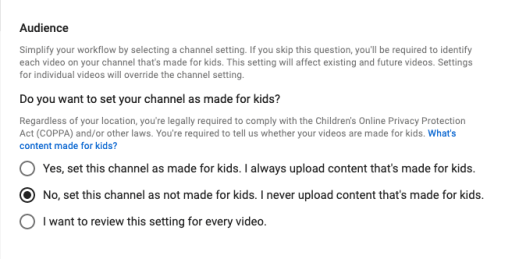
This setting, for all intents and purposes, isn’t related to COPPA. COPPA doesn’t care whether video content is targeted towards children. COPPA cares about how data is collected from children and how that data is then used by web sites. COPPA is, as I said above, all about data collection practices, not about whether content is targeted towards children.
Let’s understand that in the visual entertainment area, there are already ratings systems which apply. Systems such as the ESRB ratings system founded in 1994. This system specifically sets ratings for video games depending on the types of content contained within. For TV shows, there is the TV Parental Guidelines which began in 1996 and was proposed between the US Congress, the TV industry and FCC. These guidelines rate TV shows such as TV-Y, TV-14 or TV-MA depending, again, on the content within. This was mandated in 1997 by the US Government due to its stranglehold on TV broadcast licenses. For theatrical films, there’s the MPAA’s movie ratings system which began in 1968. So, it’s not as if there aren’t already effective content ratings systems available. These voluntary systems have been in place for many years already.
For YouTube, marking your channel or video content as “made for kids” has nothing whatever to do with COPPA legislated data collection practices.
YouTube Creators
Here is exactly where we see Google and YouTube’s fundamental misunderstanding of COPPA. COPPA is about the protection and collection of data from children. Google collects, stores and uses this and all data it collects. YouTube creators have very, very limited access to any of this Google-collected data. YouTube creators have no hand in its collection or its use. Google controls all of the data collection on YouTube. With the exception of comments and the list of subscribers of a channel, the majority of the data collected and supplied by Google to the creators is almost exclusively limited to aggregate unpersonalized statistical data. Even then, this data can be inaccurate depending on what the Google account ID stated when they signed up. Still, the limited personal subscriber data it does supply to content creators is limited to the subscriber’s ID only. Google offers its content creators no access to deeper personal data, not even the age of its subscribers.
Further, Google (and pretty much every other web site) relies on truthfulness when people sign up for services. Google does not in any way verify the information given to Google during the signup process or that this information is in any way accurate or truthful. Indeed, Google doesn’t even verify the identity of the person using the account or even require the use of real names. The only time Google does ANY level of identity verification is when using Google Wallet. Even then, it’s only as a result of needing identity verification due to possible credit card fraud issues. Google Wallet is a pointless service that many other payment systems do better, such as Apple Pay, Amazon Checkout and, yes, PayPal. I digress.
With that said, Google is solely responsible for all data collection practices associated with YouTube (and its other properties) including storing, processing and managing of that data. YouTube creators have no control over what YouTube (or Google) chooses to collect, store or disseminate. Indeed, YouTube creators have no control over YouTube’s data collection or storage practices whatsoever.
This new alleged “COPPA mechanism” that YouTube has implemented has nothing whatever to do with data collection practices and everything to do with content which might be targeted towards “children”. Right now, this limited mechanism is pretty much a binary system (a very limited system). The channel either does or it doesn’t target content towards children (either channel as a whole or video by video). It’s entirely unclear what happens when you do or don’t via YouTube, though some creators have had seeming bad luck with their content, which has been manually reviewed by YouTube staff and misclassified as “for children” when the content clearly is not. These manual overrides have even run counter to the global channel settings, which have been set to “No, set this channel as not made for kids.”
Clearly, this new mechanism has nothing to do with data collection and everything to do with classifying which content is suitable for children and which isn’t. This defines a …
Ratings System
Ratings systems in entertainment content are nothing new. TV has had a content rating systems since the mid 90s. Movies have had ratings systems since the late 60s. Video games have had them since the mid 90s. COPPA, on the other hand, has entirely nothing to do with ratings or content. It is legislation that protects children by protecting their data. It’s pretty straightforward what COPPA covers, but one thing it does not cover is whether video content is appropriate to be viewed by children. Indeed, COPPA isn’t a ratings system. It is child data protection legislation.
How YouTube got this law’s interpretation so entirely wrong is anyone’s guess. I can’t even fathom how Google could have been led this astray. Perhaps Google’s very own lawyers are simply inept and not at all versed in COPPA? I have no idea… but whatever led YouTube’s developers to thinking the above mechanism in any way relates to COPPA is entirely wrong thinking. No where does COPPA legislate YouTube video content appropriateness. Categorizing content is entirely up to a ratings system to handle.
Indeed, YouTube is trudging on very thin ice with the FTC. Not only did they interpret the COPPA legislation completely wrong, they have implemented “a fix” even more wrongly. What Google and YouTube has done is shoot themselves in the foot… not once, but twice. The second time is that Google has fully admitted that they don’t even have a functional working ratings system. Indeed, it doesn’t… and now everyone knows it.
Google has now additionally admitted that children under the age of 13 use YouTube by the addition of this “new” mechanism. With this one mechanism, Google has admitted to many things about children using its platform… which means YouTube and Google are both now in the hot seat with regards to COPPA. They must now completely ensure that YouTube (and Google by extension) is fully and solely complying with the letter of COPPA’s verbiage by collecting children’s data.
YouTube Creators Part II
YouTube creators have no control over what Google collects from its users, that’s crystal clear. YouTube creators also don’t have access to view most of this data or access to modify anything related to this data collection system. Only Google has that level of access. Because Google controls its own data collection practices, it is on Google to protect any personal information it may have received by children using its platform.
That also means that content creators should be entirely immune from prosecution over such data collection practices… after all, the creators don’t own or control Google’s data collection systems.
This new YouTube mechanism seems to imply that creators have some level of liability and/or culpability for Google’s collection practices, when creators simply and clearly do not. Even the FTC made a striking statement that they may try to “go after” content creators. I’m not even sure how that’s possible under COPPA. Content creators don’t collect, store or manage data about children, regardless of the content that they create. The only thing content creators control is appropriateness of the content towards children… and that has nothing to do with COPPA and everything to do with a ratings system… a system that Google does not even have in place within YouTube.
Content creators, however, can voluntarily label their content as TV-MA or whatever they deem is appropriate based on the TV Parental Guidelines. After all, YouTube is more like TV than it is like a video game. Therefore, YouTube should offer and have in place the same ratings system as is listed in the TV Parental Guidelines. This recent COPPA-attributed change is actually YouTube’s efforts at enacting a content ratings system, albeit an extremely poor attempt at one. As I said, creators can only specify the age appropriateness of the content that they create. YouTube is simply the platform where it is shown.
FTC going after YouTube Creators?
Google controls its data collections systems, not its content creators (though YouTube does hold leverage over whether content is or remains monetized). What that means is that it makes absolutely no sense for the FTC to legally go after content creators based on violations of COPPA. There may be other legislation they can lean on, but COPPA isn’t it. COPPA also isn’t intended to be a “catch all” piece of legislation to protect children’s behaviors on the Internet. It is intended to protect how data is collected and used by children under 13 years of age… that’s it. COPPA isn’t intended to be used as a “ratings system” for appropriateness by video sharing platforms like YouTube.
I can’t see even one judge accepting, let alone prosecuting such a clear cut case of legal abuse of the justice system. Going after Google for COPPA violations? Sure. They stored and collected that data. Going after the YouTube content creators? No, I don’t think so. They created a video and uploaded it, but that had nothing whatever to do with how Google controls, manages or collects data from children.
If the US Federal Government wants to create law to manage appropriateness of Internet content, then they need to draft it up and pass it. COPPA isn’t intended for that purpose. Voluntary ratings systems have been in place for years including within motion pictures, TV and now video games. So then why is YouTube immune from such rating systems? Indeed, it’s time YouTube was forced to implement a proper ratings system instead of this haphazard binary system under the false guise of COPPA.
Content Creator Advice
If you are a YouTube content creator (or create on any other online platform), you should take advantage of the thumbnail and describe the audience your content targets. The easiest way to do this is to use the same ratings system implemented by the TV Parental Guidance system… such as TV-Y, TV-14 and TV-MA. Placing this information firmly on the thumbnail and also placing it onto the video at the beginning of your video explicitly states towards which age group and audience your content is targeted. By voluntarily rating not only the thumbnail, but also the content itself in the first 5 minutes of the video opening, your video cannot be misconstrued for any other group or audience. This means that even though your video is not intended for children, placing the TV Parental Guidance rating literally onto the video intentionally states that fact in plain sight.
If a YouTube employee manually reclassifies your video as being “for children” even when it isn’t, labeling your content in the video’s opening as TV-MA explicitly states that the program is not suitable for children. You might even create an additional disclaimer as some TV programs do stating:
This content is not suitable for all audiences. Some content may be considered disturbing or controversial. Viewer or parental discretion is advised.
Labeling your video means that even the FTC can’t argue that your video somehow inappropriately targeted children… even though this new YouTube system has nothing to do with COPPA. Be cautious, use common sense and use best practices when creating and uploading videos to YouTube. YouTube isn’t there to protect you, the creator. The site is there to protect YouTube and Google. In this case, this new creator feature is entirely misguided as a COPPA helper, when it is clearly intended to be a ratings system.
Before you go…
One last thing… Google controls everything about the YouTube platform including the “recommended” lists of videos. If, for whatever reason, Google chooses to promote a specific video towards an unintended audience, the YouTube creator has no control over this fact. In point of fact, the content creator has almost no control over any promotion or placement of their video within YouTube. The only exception is if YouTube allows for paid promotion of video content (and they probably do). After all, YouTube is in it for the $$$. If you’re willing to throw some of your money at Google, I’m quite sure they’d be willing to help you out. Short of paying Google for video placement, however, all non-paid placement is entirely at the sole discretion of Google. The YouTube creator has no control over their video’s placement within “recommended” lists or anywhere else on YouTube.
↩︎
Where are the Vault-Tec Cross Promotional Bobbleheads in Fallout 4?
If you own the Nuka-Cola Collector Creation Club item, you may or may not know that 5 new Bobbleheads were introduced into the game by this add-on. Let’s explore where they are.
Vault-Tec Cross Promotional Bobbleheads
In the vanilla Fallout 4, there are 20 Bobbleheads. These offer various perks when you pick them up, such as Luck or Small Guns. However, if you have visited the Creation Club store and purchased the Nuka-Cola Collector add-on, 5 new Bobbleheads were introduced into Fallout 4. They don’t have names specifically or special qualities, other than being named the very creative “Vault-Tec Cross Promotional Item #1”. There are 5 of them spread throughout the world.
As I had been looking for where these Bobbleheads are, there is no good resource on the Internet for this. Even Google is of no help. I finally did manage to find the Bobbleheads, though. I thought I’d write this article to describe exactly where each Bobblehead is located within Fallout 4. Thankfully, these Bobbleheads respawn. If you pick them up, you can go back to each location later and get another set.
So what good are they if they don’t offer any perks? They are simply introduced into the world as an Easter egg for the owners of this Creation Club item (and for decoration purposes). They can be used to decorate your settlement. I believe you can also create a version of them via the Workshop menu. But, these created ones are static and can’t be picked up or dropped. The ones you locate in the world can be used for decoration in the Bobblehead displays just as any other bobblehead. So, there’s that.
Let’s jump right into this one, shall we?
Locations
- “Vault-Tec Cross Promotional Item #1” is located at DB Technical High School. As you enter the main building doors, head down to the basement. This one is located on table across from a long ramp leading to the back. You will have to clear the Raiders and the boss before you can get to the table where it sits.
- “Vault-Tec Cross Promotional Item #2” is located at Fallon’s Department Store on the top floor in an office on a desk. You’ll have to walk up two different disconnected sets of escalators to get to the top floor. Watch out for the Super Mutants.
- “Vault-Tec Cross Promotional Item #3” is located in Prost Bar. To get to Prost Bar, you’ll need to travel to Swan’s Pond and cross the park straight back and to the left. Across the street there is a staircase leading down to a cellar with a blue door. This is Prost Bar. Note, if you have any Prost Bar cleanup mods enabled, you will need to disable them to ensure that the Bobblehead is there. As you walk into the door, walk straight by the bar and and look for the manager’s office on the left. The Bobblehead will be sitting on top of a filing cabinet.
- “Vault-Tec Cross Promotional Item #4” is located at Greenetech Genetics. Enter the main door, then find the stairs upward. This building is kind of confusing inside, so work your way up until you find the elevator. Take this elevator to the top of this tall building. At the top, you’ll need to work your way up again until you find a small table sitting on a balcony overlook. This bobblehead will be sitting next to a broken terminal.
- “Vault-Tec Cross Promotional Item #5” is located at Vault-Tec Regional Headquarters. In this building, it’s about two floors up. Find the stairs that lead you up to a pool table breaking through the floor. Go around the right side of this pool table to the back wall, then turn right into an office. It will be sitting next to a Mr. Davidson’s Terminal.
That’s all 5 bobbleheads. These Bobbleheads all wear a red Nuka-Cola shirt and have either a Nuka-Cola, a Nuka Cherry or a Nuka-Cola Quantum bottle as part of the Bobblehead.
These bobbleheads are for decoration purposes only. They offer no function or perks. Though, I will say they are fun addition and look pretty cool.
Happy Hunting!
↩︎
What is the Fallout 76 1st subscription?
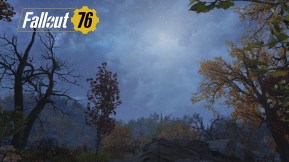 Bethesda has released Fallout 76’s first paid product named 1st. This uninspired and unfortunate naming doesn’t mean much, but it does come with some welcomed and important improvements to Fallout 76. Let’s explore.
Fallout 1st
Obviously the 1st branding is intended to be pronounced “first”. Let’s get that one out of the way right off. The naming itself doesn’t mean much and in the context of the game itself means very little. But, this add-on subscription does add some welcomed, important and substantial improvements. Whether those improvements are worth the price, I’ll have to leave that up to you. The costs for this service are USD $12.99 a month or USD $99 per year (USD $8.25 per month — a fairly substantial savings over paying monthly). The additional fee does offer some worthwhile improvements. Let’s investigate these next.
“Infinite” Storage Scrapbox
 For those of us tapped out on Stash space, the new Scrapbox is an invaluable asset. You can take all of that weighty scrap out of your 800 weight limited Stash, release up to 300 weight or more from your Stashbox and put all of that weight all into the “infinite” space Scrapbox. This means substantially more Stash to use for storing weapons, armor and other collectibles. This is an important and welcomed change. Not to mention, being able to store “infinite” amounts of lead, steel, copper, cloth, crystal, leather, etc. This feature offers way more crafting, workshop and camp building options. Though, I highly doubt the Scrapbox offers actual infinite storage, the storage cap is probably so high as to be almost infinite.
On the other hand, you can’t store anything in there but scrap. It won’t store weapons, armor, aid or any other category of items. It also won’t store ALL types of scrap. For example, bulked items cannot be stored in the Scrapbox. If you wish to store already bulked items, you’ll need to unbulk them to store them in the Scrapbox. However, the Scrapbox does offer a scrapping feature. No longer do you need to have a workbench handy. If you have a bunch of junk that you simply want to break down into scrap, the box will automatically do this before depositing it into the box. This makes the Survival Tent much more functional without any workbenches.
Survival Tent
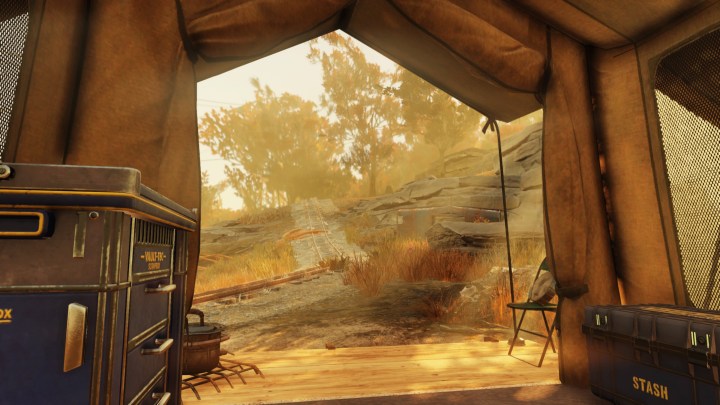
This freely deployable tent offers a second free fast travel point that can be easily moved and costs no caps to move about. It is definitely welcomed to have a second free moveable fast travel point… and which offers access the new Scrapbox easily and quickly, offers a cooking pot, a Stashbox, a sleeping bag for the “Rested” perk, and a banjo for the “Well Tuned” perk. Unfortunately, the sleeping bag only offers the “Rested” perk (lasts 1 hour) instead of “Well Rested” perk (which lasts 2 hours). Having a second fast travel point will drastically save on spending caps to travel around the map. This means you can leave the tent in a convenient location and avoid paying caps to get to that location and pay much reduced caps to get to locations near it.
Private Servers
 Private Servers that had been promised for a year are finally here! These are great for many reasons. For example, locating items that you can’t otherwise find because other players are actively farming them. Additionally, trying to locate legendary enemies to finish up the Enclave commendations can be tricky. With a private server, it’s easier to find such events which spawn legendary enemies (i.e. Wolf Pack) and finish the event (and receive commendations), without interference from other players. It also makes questing alone easier and it makes group questing more fun when you invite only your friends while no one else can join that world’s server.
Alone questing is much easier because the game server spawns enemies at the level of the most recent person who happens by. If a level 150 player hits up a location minutes before your level 30 character arrives, the enemies will likely be level 68. This can make situations impossible to win. It may also mean hopping servers until you find a world where your level 30 character is the one who has spawned lower level enemies. A private server avoids this problem entirely. Since the server is brand new the moment you launch it, only your character influences the world around you when playing alone. However, if you invite high level players into your private world, then the same problem of high level spawns will occur even in the private server. You’ll want to be cautious when you invite friends into your server.
One additional benefit of the private server is it durability. What I mean is that once you start a private server, this same server is available to you for up to 20 minutes while no one is online. What that means is you can swap characters and load into the same private world over and over. While 1st doesn’t offer any means to directly share stuff between characters, this world durability means you can drop a bag of items in the world in an easy location (like Vault 76) and then pick up the bag using a different character. This allows you to swap items between characters without using an intermediate third person to hold your stuff or watch your bag. Simply drop a bag from one character, log out, change characters, log back into the private world, go to the spot where you dropped it and pick up the items. Simple. It works well and it is predictable. Because it’s a private server, there’s no danger of another player grabbing your stuff while you’re working on this activity.
It would be preferable if Bethesda could give us an official way to share stuff between characters, but in the interim, the private server is a great option to share weapons, armor and items between characters. I’ve always intensely disliked using random third parties for this transfer process. Using a private server to share items is an excellent alternative. And yes, it does work. I’ve done this several times between characters.
Of course, there’s no easy way to share caps between characters using a private server. If you want to do this, you’ll still need to use a third party.
Another benefit of the private servers is, while playing alone, you can hold any workshop in the game without fear of PVP reprisal. You will have to occasionally manage defend events, but that’s as far as it goes. If you choose not to do the defend events, you can come back later and just fix everything that got broken. Also, if your game accidentally crashes, the private server remains tied to your ID for at least 30 minutes. This means that in private servers you continue to own your workshops even after disconnects or crashes, unlike the public servers. However, you do have to rejoin the server with the same character to remain the owner of the workshop. If you wait too long, the private server will be unassigned to you and you will lose your workshops, but that takes about 20-30 minutes. If you change your character, you will likely have to take ownership again with your other character.
Atom Shop Exclusives and Inclusions
 This isn’t really so much a benefit as it is a nicety. After all, the Atomic shop is mostly just for cosmetics. However, it’s great to see Bethesda include Atom shop exclusives for 1st subscribers. Additionally, the 1st subscription offers 1650 atoms each month included with the ~$13 monthly fee (or the yearly fee if you go that way). That’s $16.50 worth of Atom in addition to all of the above add-ons. The included $16.50 worth of Atom makes all of the rest almost seem free. To previously buy that much Atom, you’d have to spend at least $13 and you wouldn’t even get all of the above access. Receiving the Atom alone almost makes the entire subscription worth it, assuming you regularly buy Atom instead of earning it in the game.
Pay to Win?
There’s something to be said for each of these 1st add-ons. A lot of people may dislike paying the money per month or somehow think this part is “pay to win”, but in reality none of it helps you “win”, but it does substantially improve the game by adding the above features. I guess many could argue that the Scrapbox and the Survival Tent should have been added to the base game for free… but then, that would reduce the reasons to subscribe to 1st. Eventually, it may come down to pay-to-win, but for now there’s no way to actually pay to win.
In fact, I’d argue that most of what 1st offers to gamers now is end-game content. After you’ve done the quests and completed the entire main story, what’s left over is farming items, looking for cosmetics and, in general, locating rare weapons, armor and potentially selling them. It’s less about winning and more about extending the play value of this game. That’s exactly what 1st is intended for… extending the play value of the game.
Improvements to Fallout 76 and 1st
Even with all of the above, there still needs to be improvements in the base game to better support 1st subscribers. Scrapboxes need to become widely available at all train stations and in Whitesprings. Without scrapboxes there, you are forced to travel to your tent or to your camp to drop scrap into the scrapbox. Inconvenient. Else, you have to temporarily drop it into your stashbox and move it around later (even more inconvenient).
 1st is an important step for Fallout 76 as a game, but the subscription support needs to be improved throughout the game. As mentioned above, the Scrapbox doesn’t support bulked scrap. It only supports loose scrap. This is another design flaw in this storage system. This means you still need to continue to store all of your bulk scrap in your Stashbox or you must unbulk it to shove it into the Scrapbox.
1st isn’t in any way perfect, but the game is much better with these improvements than it is without them. 1st is one of the actual first tangible improvements to the base game which hasn’t really been offered by Bethesda in past updates. Most past updates have involved bug fixes or simplistic add-ons (backpack or distiller or limited time events). 1st is one of the first set of improvements that implies Bethesda might actually be trying to improve the game. Unfortunately, too many of us are at the endgame and 1st may be too late to really bring in enough new players. Perhaps the upcoming NPC additions may help the game revitalize, but we’ll have to wait on that.
The current 1st addition won’t revitalize Fallout 76 by itself, but it is a vast improvement in solving basic problems that still plague this mostly beta game (e.g., small sized stash boxes, small inventory sizes, small camp budgets). Seeing Bethesda release actual improvements to the game shows that Bethesda is finally willing to offer better features to those willing to pay. Now if only we can get Bethesda to buff our weapons for subscribing to 1st… that would be a much welcomed improvement. Bethesda should also consider giving us some 1st perk cards to improve our SPECIAL stats… such as additional and exclusive 1st damage multipliers. I know this may sound like pay-to-win additions, but these are the kinds of things that help improve the game, give incentives to subscribe and offer much welcomed improvements.
Sure, Bethesda could have released all of this for free to the current game players… but, the Private Servers alone would have been overwhelmed almost instantly and essentially become public servers. By putting it behind a paywall, it ensures fewer people utilize it and fewer people will abuse it.
I was initially skeptical when I paid for the 1st feature, but I quickly realized the benefit of the Scrapbox. Forget the Private Servers, the Scrapbox is the single thing that almost completely sells me on 1st. The Private Servers are great, don’t get me wrong, but the Scrapbox is the single thing that I have absolutely needed in this game. If only Bethesda would also increase our C.A.M.P. build limit by subscribing to 1st.
Downsides?
There are a few downsides to 1st. Let’s talk about these. I believe non-1st subscribers can be invited to a private server, but I’m uncertain about this entirely. This may also change over time and it may not work correctly. If the owner of the private server leaves the private server, you’ll have about 20 minutes before the server shuts down and kicks you off… regardless whether you are a 1st subscriber or not.
You can’t join a friend who is visiting or has started their own private server from the social menu. There’s no option for this. You must be explicitly invited by the friend into the server. Additionally, only 8 people can join a private server. The 24 people on a server won’t work on a private server. You have to use a public server for that. This could make some events more difficult to complete in a private server environment.
A downside for PS4 users is that the 1 month subscription expires in one month. It is left up to you to renew the subscription manually at the end of each month of service. It does not auto-renew. Bethesda may fix this issue by updating its digital store item to support renewing subscriptions, but for now the subscription does not auto-renew. Be sure not to forget to pay for your monthly membership or all of the scrap in your Scrapbox may disappear. Be cautious with this. Also, if you’re thinking of not renewing, then you should plan to move whatever valuable scrap you have in your Scrapbox back to your Stash to avoid losing your most important scrap in your Scrapbox.
I’d also recommend keeping flux and other valuable scrap items that you simply can’t afford to lose in your Stash. The Scrapbox is a new storage vehicle in the game and may have significant bugs. Be sure that whatever you put into the Scrapbox is something you are willing to lose and collect again.
It is also unknown what happens to the 1st exclusive items you own from the Atom shop if you cancel. They might hang around or they might disappear from your inventory unless you renew. Don’t get too invested in these exclusives if you don’t plan to retain the subscription.
One last downside is the private servers themselves. Sometimes you are lucky and you will get a private server that has been freshly spun up. What this means is that all of the spawn places are already spawned. However, it seems Bethesda’s spin-down processes don’t adequately wait long enough before reassigning a private server world to a 1st user. What this means, unluckily for you, is that if a previous 1st user has already farmed the world for its “treasure”, you could find that what you’re looking for is not in its respective spawn locations. In fact, you could find the spawn locations empty all over the place. Bethesda needs to get better at either resetting the worlds after a private server use or ensure that when a private server is spun up, all spawn points have properly reset. Getting a “previously used” private server world just sucks all around. Worse, you are stuck with that same world for at least 30 minutes even if you aren’t using it. It takes that long for the server to be released and unassigned from your 1st subscription.
If you have any questions about Fallout 1st, please leave a comment below.
↩︎
Remembering the Star Trek Experience in Las Vegas
 Back in the late 90s and into the early 00s, the Las Vegas Hilton had a Star Trek attraction called The Star Trek Experience. This attraction morphed some over the years and added new features, but its first attraction remained its most impressive. It closed in 2008. Let’s explore and remember this amazing attraction.
Star Trek at the Las Vegas Hilton
The Las Vegas Hilton was a casino and hotel not far off the strip at the south end. Down at this end of the strip and at the time you’d find hotels like the Stratosphere, the Sahara and Circus Circus. Though the Las Vegas Hilton wasn’t on the strip directly, it was not far off of it across from the Las Vegas Convention center.
To combat its off-the-strip location, it employed various marketing practices to entice would-be gamblers to head to this hotel and casino. In that effort, in 1997, it enticed Paramount to build its Star Trek Experience attraction at the hotel where it remained in operation until 2008. I actually liked this casino, not strictly because of its Star Trek area. Today, this hotel is no longer named the Las Vegas Hilton and the Star Trek Experience no longer operates there having lost its lease. The hotel was later briefly renamed the LVH and is today known as the Westgate Las Vegas Resort and Casino and received this rename in 2014. It no longer bears the Hilton name.
However, back in the early 2000s, The Star Trek Experience was something to behold.
Star Trek Experience
This experience was like none other that I’ve visited. When you first entered the hotel where the attraction lived, the Star Trek Experience was to the left. The hotel was to the right. There was also a bar to the immediate right. In fact, the entire casino portion of the hotel around the entry way was entirely space and futuristic themed. This included everything from the carpeting, to the beams to the lighting and even the slot machines had a futuristic theme. The Hilton did up this area right and it entirely looked appropriate with its space theme.
As you entered the Star Trek Experience, the entry way consisted of basically a museum of Star Trek props, video screens running, large starships suspended from the ceiling… yes, including the Enterprise. The size of these ship models was incredibly impressive. As you made your way into the entry area, you arrived at a ticket desk. Here you bought tickets to enter the attraction. When it was just the Star Trek Experience alone, you had two ticket choices: the museum alone or the museum and the experience together.
Whichever ticket you bought gave you admission to mill around the museum and look at the props and use the interactive exhibits. The museum encompassed mostly the entry way and ran up into the upper level. The Star Trek Experience had two levels. The upper level, which the museum had ramps and/or stairs to lead you to the queue line. The downstairs included various gift shops and Quark’s restaurant and bar. We’ll talk about the downstairs a bit later.
In the museum, one of the interactive exhibits was a pseudo functional replicator. Of course, it didn’t replicate anything, but the screen in the well area simulated the replication of food and drink items. It was interesting, but it was also a little bit cheesy in quality… as were many of the interactive exhibits. They really weren’t cutting edge when this museum was in operation. The museum portion of the Star Trek Experience wasn’t really the reason to go there. In fact, I found the museum portion to be of such average quality that it kind of set off warning bells that the actual experience itself might not fare much better (at least when you’re a first timer).
In this attraction’s case, it was very much a don’t-judge-a-book-by-its-cover situation. The Star Trek Experience show part was well worth every cent of that ticket price… at least to me. The museum, on the other hand, was a rip-off that I wish that I could have skipped. Unfortunately, you were locked into buying both with one ticket if you wanted admission to the “show”. To me, it was just a way to boost the ticket admission price.
The Experience Itself
After you made your way to the back of the museum, there was a queue line where you would queue up for the next show. The shows ran about every 15 minutes or so. This meant you could stand in line for up to 15 minutes for the next show, assuming you were in line at less than the number they admit per show. The show itself could only house maybe 15-20 people. I don’t recall the exact number, but once they counted enough heads into the show, the line closed off to wait for the next show.
I visited the show maybe 3 or 4 times while it was open over the years and I think I had to wait one time for the next show because of the head count situation. If you had intended to visit the show at certain times of the day or on certain days, you could encounter larger crowds. If you went on some weekdays, you could breeze through the line into the next show.
All the while you’re standing in line, there are TV displays talking about various Star Trek stuff, sometimes showing excerpts from the TV show or the movies. As you move to the head of the line, there’s a monitor that talks about the safety requirements of the show itself. The museum extended down the queue line hallway which housed props and costumes from characters such as Lursa and B’ator and various Spock outfits from the then recent movies. While the museum portion was interesting enough for the first time visitor, it was simply wallpaper on subsequent visits. It wasn’t even very impressive. I can’t recall the museum updating its contents or remodeling during the entire run of The Star Trek Experience. I could be wrong about that, but that was entirely my impression of the museum area. I personally would have been just as happy to skip the museum cost entirely and jump right into line.
Once you were let into the Experience, you were led down the hall into a small blue room with an interesting lighting concept. You were asked to stand on a line. I believe there were 5 yellow stripes down the center of this rectangular blue room. This meant there would be 5 groups of people each standing on a line. Everyone was situated so that you were standing in the center of the room not touching any of the walls. If you inadvertently leaned on a wall or were touching it, one of the staff would loudly request not to do this.
Once everyone was situated on their line, we were directed to look up and forward to a screen which ran a video that began the entire Experience. Mostly, it discussed safety protocols and not leaning against walls and blah, blah, blah. It was a mostly cheesy video that really was nothing more than what the staff had already told us about standing on the lines. In the middle of the video, the lights begin to flash and there’s a bunch of audio noise as if the power is going out and the whole room plunges into darkness. And… pitch black it was. You couldn’t see your hand in front of your face. There was no light anywhere.
Suddenly, there’s a huge whoosh of air flow all around. It wasn’t gale force or anything, but it was a startling cold breeze that didn’t seem to come from any specific direction. Then, the floor and ceiling lights come on and… we’re now standing in the center of a transporter room. A literal round, brownish transporter room. The circular room with a circular ceiling, light in the center and all of the paint job of a Next Generation transporter room. It was uncanny. Gone was that small blue room with its yellow lines and in its place was an honest-to-goodness transporter room.
The effect was uncanny and astounding. It was the single thing that made the entire Star Trek Experience worth its price tag. I could have walked out of the Star Trek Experience right at that point and I would have felt satisfied.
But no, the show had only just begun. Two people dressed in Next Generation jumpsuits walk in and one explains that we were transported and intercepted on the Enterprise. The show proceeds on the premise that one in the crowd is related to someone on the Enterprise and that gave the whole show its “story”. As we are led from the transporter room, we are led onto the bridge. This is where the whole story derails a bit. Randoms transporting onto the Enterprise are not likely to be lead to the bridge due to the possibility of takeovers. That’s a breach of protocol. Instead, we likely would have been led to a cargo bay large enough for a crowd of our size or perhaps some place like Ten Forward. I digress.
Anyway, we are led to the bridge… and, a marvel that bridge was. This TNG Enterprise bridge set reconstruction was amazing and entirely spot on. From the wooden arch in the back to the seating just below to the helm control seats in front of the screen. The lighting was spot on, the paneling, the paint job, the leather on the seats… everything was as spot on as I could have ever imagined. It was simply an amazing bridge replica.
Because the story needs to progress, we are again lined up either around the back of the bridge or around areas where the ‘actors’ could do their thing without obstructions. The view screen begins showing a ‘transmission’ about the “heir” being transported aboard for safety and a bunch of blathering ensues between the screen and the actors. The hired actors ranged from decent to downright bad. It all depended on the show. Most of the ‘actors’ were hired due to their height and weight proportions… not so much for their acting abilities. I can guarantee you every single person wearing those TNG jumpsuits looked immaculate in them. They could have easily been an extra in any TNG episode. Everything about this part of the show was high quality. From the costumes to the communicator on their outfits to the pips. Everything was nailed perfectly. In fact, it was so perfectly designed, the show could have used one of these bridges in a pinch had they needed to film there.
The concept of the show itself was really its weak point. The story was designed to enthrall the audience, having them become active (sort of) and unwitting participants. It worked to rope the audience in, but the story was just not that great… and the next part bears this out.
As the whole bridge scene ends, we are led out of the bridge into a oversized turbolift. Once we’re suitably situated into the “turbolift”, the whole thing rocks a bit, the lights flash, there’s some sound and an announcement during the commotion and then it all subsides and the door opens. Not a terribly convincing effect here, admittedly. We’re told while all of the commotion ensues that something is firing upon the Enterprise. At this point, this is where the magic kind of dwindles a bit. As we’re led out of the turbolift, we walk down a hallway that looks more like a hallway on DS9 than the Enterprise and then into an open area, presumably a Shuttle Bay where there’s a shuttle craft parked waiting with the door open. There are also visible EXIT signs along the walk which completely break the magic and which were presumably required by law. As I said, the magic kind of ends here. The shuttle bay area wasn’t that well designed and the shuttle interior looks like a cheesy motion simulator, which it in fact is.
At this point and once we’re in the motion simulator, the “experience” concludes with a ride in a movie based motion simulator that sways, rocks and jerks in time to a movie. The difficulty with the “movie” is that I always found it to be blurry and not a great experience. It was filmed and I believe it actually used many from the TNG cast, but the overall story just wasn’t that great. Additionally, the simulator’s movements were overly herky jerky. If you were one with back or neck problems, you’d want to skip this last part of the ‘ride’ entirely. This part was extremely hard on even people with healthy backs. Again, Shuttle Crafts would have been designed with inertial dampeners and, in fact, you probably wouldn’t have felt much movement at all with the inertial dampeners operating, even when diving and banking and whatever other screen movements were going on. In reality, the entire rocking, swaying and jerking motions were entirely unnecessary and pointless. As I said, the magic dies pretty quickly once you get into this cheesy motion simulator ride.
If the show had ended on being transported back out at the end, that would have been something I could have found to be a befitting ending. At the end, when we exit the shuttle craft, we’re back on Earth and the room looks like a standard building interior. We are led to an elevator and are deposited into the gift shop and restaurant area below the attraction… an area that looks remarkably like DS9’s Promenade deck.
The entire show experience lasted perhaps 15 minutes all told, most of it being the movie at the end. The sets built and costumes used were all spot on. The actors were of average quality, many of them you could tell had been doing it for far too long. What I mean by this previous sentence is that when someone performs a script too often and constantly, the performance can suffer from the loss of sounding fresh or genuine. Instead, most of the actors seemed too rote, even though they stayed fully in character. The actors all being height and weight proportionate certainly made the costumes look all the better. There was certainly not a single overweight actor there. That, unfortunately, didn’t excuse the rote performances.
Gift Shop and Restaurants
After the final elevator deposited us into the gift shop area on the lower floor, we were left to shop at various stores. I recall there may have been 3 or 4 different gift shops with Quark’s bar and restaurant being the primary food place there.
While I did eat at Quark’s once and the food was typical for a mid-high-priced American Bistro like TGI Friday’s or Chili’s, the reason to go there was simply for the ambiance and the unique menu. The bar itself did resemble Quark’s bar on DS9 without Dabo. Though, I think it would have been more appropriate to build Ten Forward instead of Quark’s. The DS9 theming is probably what drove this decision. While the area downstairs was themed DS9, the shops themselves looked more like a mall shop than it resembled being on a futuristic ship. On the other hand, the wares being peddled ranged from cheap crap to middle of the road to high end props. It depended on the shop.
I didn’t buy much from these stores because nearly everything was way overpriced. Even Quark’s was overpriced for the type of food quality. As I said, the only reason to eat there was its atmosphere and its unique bar drinks. As for shopping, I always liked to look at everything in the shops, but look only, not to buy. Of all of the times I visited, I think I may have bought perhaps one or two small items.
Costumed Actors
In the shop area, you’d also find additional actors in various Star Trek dress. Some were dressed like Klingons, some dressed like Ferengi and some dressed like TNG officers, male and female.
As I understood it, the people working these “roles” were actually hired as actors by Paramount. In the Experience attraction itself, these people actually had speaking roles. Downstairs it was all free form. You asked questions and they would ad-lib answers in their character. Mostly it was for photo op purposes. I recall that you could only take pictures in the shop area, but I could be wrong about photography even in this area.
Photographs were entirely off limits throughout the attraction and the museum. Though, many did sneak pictures here and there.
Behind the Scenes
Later during the run of The Star Trek Experience (toward the end of its life), the show began offering a Behind the Scenes / “Making Of” ticket purchase. This was separate from and unique to the original show. Instead of going through the show like normal, in between the shows you would take a tour of the set behind the scenes while a show was in progress. You would get photo opportunities on the Bridge itself that you don’t get during the Experience show.
The behind the scenes also showed how the gimbal setup worked for the transporter effect. Basically, the entire blue room was on a gimbal / fulcrum of sorts utilizing creative lighting, sound and set movement. In about 10 to 15 seconds, the entire room (walls and ceiling) sans floor moved swiftly upwards. The “transporter set” round ceiling and walls quickly moved into place just below the now raised room. When the lights are brought up, it’s as though you’re now standing in the transporter room. The effect is uncanny and astounding. It’s even more astounding when you realize the engineering involved in getting this to work so seamlessly, quickly and silently. The behind the scenes showed a much slowed down version of it to show how the effect was achieved. Amazing engineering.
The gust of breeze was an unintended side effect of the room volume being raised up so rapidly. It wasn’t designed as part of the effect. When something that large moves that rapidly, air is displaced. Because the air movement heightened the transporter effect as a happy accident, no effort was employed to get rid of it. Even after knowing how the transporter effect was achieved, subsequent visits, at least for me, were just as mesmerizing. In fact, the entire transporter effect was the entire reason to visit The Star Trek Experience. The rest of it was all gravy. The transporter effect was worth the price of admission alone… which is why I wished they had utilized it twice. Once to start. Once to end it. The cheesy motion simulator was a big letdown after all that had come before.
In fact, the transporter effect and the bridge were the two most immersive and amazing portions of the attraction. Unfortunately, everything after these two segments, the immersion begins to fall apart, almost completely falling apart while being escorted to the “shuttle bay” for the final segment. As stated above, the legally mandated lighted EXIT signs were one of the biggest immersion busters, when you’re supposed to be aboard a starship in space. Yeah, that just doesn’t work.
As part of this tour, we were also taken below the motion simulator, but we had to remain there for the duration of the entire operation of the motion simulator room. This is where the lion’s share of time was spent on this “Behind the Scenes” tour. I’d say we spent at least 8 minutes down below watching the craft rock and lurch. Because of the amount if time we had there, the tour guide was able to completely explain how this motion simulator worked. It was technically impressive, but the problem I had with this motion simulator is that it made no sense in the Star Trek universe. When riding around in a shuttle craft, the inertial dampeners would have reduced the motion of the craft so much that short of an intense blast, you wouldn’t be able to feel the motion of the craft at all no matter if it banked, dived or performed any other maneuver. In fact, the motion simulator’s motion was so sudden and so violent at times, even people with perfect backs and necks could still feel out of sorts after having ridden in this simulator. Anyone with a bad back should have completely avoided this “ride”.
I completely “got” that the attraction creators felt that need to have a “ride”, but that shuttle simulator was entirely the wrong choice for continued immersion. In fact, I don’t think this attraction even needed that “ride”. A standard movie theater modeled to look like a Holodeck would have been sufficient. They could have even had a few actors move in and through the Holodeck to “act” the final movie portion.
The Borg Invasion
Around the time the Behind The Scenes tour began (maybe a little before), the Star Trek Experience introduced a new show called the Borg Invasion. This show was even more of a letdown than the final motion simulator. In this one, you enter a room and you sit in a standard movie theater type seat. A 3D movie begins playing and the only thing that happens with this is a light motion to the seat itself. The seat cushion piece also goes up and down in addition to vibration.
The experience was, in fact, so bad compared to the original Experience that I find it hard anyone could have greenlit the idea. It was an average experience that was more akin to seeing a movie in a theater than having an experience. Even when the Borg Invasion began, the original Star Trek Experience continued to operate. You could still experience the transporter effect and visit the bridge.
The Overall Experience
The best part of the Star Trek Experience was definitely the transporter effect. It was so well done and so convincing that everything else around it pales in comparison. I do wish that they had given more thought to the story line around the show. The “being an heir to Picard” (or whomever) idea was such a stretch that it felt clumsy. Though, the sets, costumes and the primary effect were top notch. Even the downstairs shop area was particularly convincing as a set inside of DS9.
I do wish the original Star Trek Experience was still in operation somewhere. The show would need to be retooled a bit and perhaps updated for Discovery, but that transporter effect still boggles the mind as to how impressive it is (or was).
If you have visited the Star Trek Experience in the past, please recall your experience below in the comments. If you formerly worked at the Star Trek Experience, I’d like to hear from you as well. Please comment below. To avoid any copyright complications with Paramount or CBS, I am avoiding the use of any Star Trek imagery in this post. Please enjoy this post without Star Trek images.
↩︎
Where can I find Delbert’s Traditional Chitlins in Fallout 76?
 This is a question with few answers on the Internet. Let’s me answer it here.
Fallout 76 and Bugs
[Updated: 1/30/2022] Good news! Happy to now report this recipe is finally available in the game. After 4 years of reporting this bug both on this blog (and to Bethesda), Bethesda has finally decided to fix it. Delbert’s Traditional Chitlins is FINALLY learnable. I do not know which release actually fixed it, but it was a release sometime between September 2021 and January 2022. The last time I attempted to retrieve this recipe was in the summer of 2021 and it was still broken even then.
With that said, let’s talk about where this recipe is located.
Delbert’s Traditional Chitlins
This recipe spawns at the Spruce Knob Campgrounds located at Spruce Knob Lake and which actually gets you closest to this table via the Spruce Knob Lake fast travel point. If you have played through “The Order of the Tadpole” quest line, you have probably attempted to obtain the Swimmer’s badge. If you have, then you know this lake.

The recipe paper is located on a picnic table right next to a blue cooler. The picnic table is next to the shore of Spruce Knob Lake. Again, use the Spruce Knob Lake fast travel marker to get here, but be sure to bring enough ammo to avoid the two Mirelurks and the Mirelurk King that skulk around the shore line.
In case you’re wondering, the issue with this Recipe is that it was formerly bugged, for 4 years running! When Bethesda released this recipe into the game, this piece of paper had no interaction (see the screenshot). However, 4 years later and this bug has now been fixed! It took 4 years for Bethesda to fix a relatively simple bug! This means you can now retrieve this recipe and learn it. However, the placement of the recipe has been moved from next to the cooler (pictured) to the left lower edge of the table.
Bug Fixes
Yay, it’s finally fixed!
All 13 Delbert’s recipes are finally available in Fallout 76. All of these recipes look like a piece of 3 hole school paper. They do not have the same appearance as standard recipes. In fact, let me explain where each of Delbert’s Recipes spawn.
Note that early in the game’s life, Delbert’s Sunshine Oil, Mountain Hocks and Appalachili all existed in Flatwoods. After the Steel Dawn update, two moved to new locations. The recipe locations are as follows:
- Delbert’s Appalachili recipe is still located next to the armor bench on the porch of a house just across from the Flatwoods Tavern.
- Delbert’s Bunless Cramburger recipe is located at The General’s Steakhouse in the Cranberry Bog. It is located downstairs in the basement kitchen at the end of the counter to the right just as you come down the stairs. This is NOT the same recipe as “Cramburger”. Bring ammo or don your 3 star Sneak Card, because you’ll need to take care of a number of Super Mutants and two hounds downstairs or sneak past all of them.
- Delbert’s Company Tea recipe is located at Superior Sunset Farm in a half-open basement of this farmhouse in the Cranberry Bog. It is pinned to a cork bulletin board.
- Delbert’s Corn Pone recipe is located in a small funnel cake stand at Tyler County Fairgrounds. This kitchen spawns a Scorched inside.
- Delbert’s Delicious Deerskins recipe is located behind a Level 2 locked door to a candy shop at Wavy Willard’s. Be sure to equip your lock picking cards.
- Delbert’s Granny’s Sweet Tea recipe is located at Mac’s Farm on a small table to the right of the front door entrance. Watch out for the Mirelurk Queen and two Mirelurks around the house.
- Delbert’s Mountain Hocks recipe
is located next to a skeleton in the Red Rocket just outside of Flatwoods. This recipe is currently located at Beckwith Farm (Savage Divide) on top of a stone of a burned out campfire. - Delbert’s Mud Cookie recipe is located on the kitchen counter of the blue house at Aaronholt Homestead.
- Delbert’s Pothole Potpie recipe is located in
the center of Treehouse Village in the Mire.It is on a shelving unit across from Lorne’s terminal. This recipe can now be found at The Retreat (formerly named Treehouse Village). The recipe sits immediately to the right of Lorne’s terminal which was moved onto a small desk in a new area. From the spawn point, run straight ahead towards a power armor repair station, run up the stairs and into the red door. - Delbert’s Sweet Labrador Tea recipe is located inside of Raleigh Clay’s Bunker in the mire. It is on the dining room table in the kitchen. You will need to begin the quest at Abbie’s Bunker to get the password to gain access to Raleigh Clay’s bunker.
- Delbert’s Sunshine Oil recipe
was located in Delbert’s trailer on the nightstand next to the bed. It can currently be found inside the right most of two adjoining houses in Welch on the kitchen counter. - Delbert’s Tato Salad Surprise recipe is located on the kitchen counter at Silva Homestead.
- Delbert’s Traditional Chitlins recipe is located at the Spruce Knob Lake Campground Area (Savage Divide). It is located on a picnic table near a blue cooler next to the edge of the table. This recipe unlocks Chitlins Con Carne.
Updated Note as of 2/2021: As of a recent update (perhaps Steel Dawn), Bethesda removed two of the recipes from Flatwoods and located them elsewhere. Delbert’s Sunshine Oil recipe can no longer be found next to the bed in Delbert’s trailer. Delbert’s Mountain Hocks recipe no longer spawns next to the skeleton in the Flatwoods Red Rocket. Of the three, only Delbert’s Appalachili recipe remains in its original location in Flatwoods.
Here are pictures of each of these recipes in Fallout 76:
Recipe Notes
Delbert’s Company Tea requires using a serving of Delbert’s Sweet Labrador Tea to make. This means you’ll need to have both recipes to make Delbert’s Company Tea. To make Sweet Labrador Tea, you’ll need honeycomb… a very hard ingredient to find in the game. As for where to find honeycomb, I’ll have to leave you to locate that in Fallout 76 for yourself.
Also note that you are allowed to pick up all of these recipes more than once, as of now. However, the recipes may also only be acquired once per 24 hour period of time (real 24 hours, not in game hours). This means you must wait for the recipe to respawn over a full 24 hour day of play time. Note, Bethesda can always change this or any game mechanic. If the recipe hasn’t respawned and it seems like a long time, you must play a full 24 hours of real clock hours in Fallout 76 before the recipes will respawn. Basically, give it plenty of time.
Alternatively, here’s a faster way. If you have multiple characters and subscribe to Fallout 1st, while waiting for them to respawn for your primary character, have your alt characters go get the recipes and hand them over to your primary character. Each character has a separate 24 hour clock for these recipes.
Good Luck!
↩︎
Game Review: The Outer Worlds
 [Updated Dec 2019] While I hadn’t specifically heard that Obsidian was building “The Outer Worlds”, I was certain that this studio must have something in the works. I only came to find out about The Outer Worlds a week before its release. Due to other commitments, I hadn’t actually been keeping up with game releases for 2019. Let’s explore this game.
The Engine
Let’s start with the brightest star of this game. Unlike other RPG game studios that will remain nam… oh, that’s never gonna work. Bethesda. Ok, I said it. Bethesda… Happy now? Anyway, as I was saying, unlike other RPG game studios like Bethesda, Obsidian’s engine driving this game is rock stable. By “rock stable”, I mean nary a crash, glitch, frame rate drop or any other odd artifact have I run into while playing this game. The engine delivers a solid, fully functional, fully realized gaming system that seems free of major bugs or defects. Definitely a welcome change in the game development industry. That doesn’t mean this game is “bug free”… oh, no no no, my friends, but it does mean that unlike Bethesda, Obsidian seems to actually employ real game testers and a real QA team who do their jobs correctly. The bugs you are likely to run into are small, super edge cases you’re almost never likely to run into. The bugs you’ll find are also not at all likely to be showstoppers. Inconvenient occasionally, yes, but we can all live with an occasional minor bug.
What that means in this game is a poster child and a shining example to pretty much every other bug laden studio out there. The Outer Worlds proves that, yes, games CAN be written without glitching and crashing every 30 minutes. Obsidian definitely shows us and the industry that this level of software development is, in fact, possible. No, you don’t have to rely on your users to beta test your games and file bug reports. You can, instead, employ actual teams designed to locate, spot and eliminate these bugs before players ever venture into your story or your game world.
However, while this reliability and stability is a shining spot in The Outer Worlds, let’s talk about the features of this game including what it is and what isn’t… and believe me, there’s a lot to talk about here.
Role Playing Game?

 While The Outer Worlds does employ a number of role playing elements, it isn’t really a role playing game in the truest sense. In effect, The Outer Worlds is a party/team-based first person shooter. Sure, there’s looting, skill-building and limited workbench activities, but that’s really where the “Role Playing” ends. It has about as much a role playing in the game as the Resident Evil series.
A “role” playing game usually indicates that there are, in fact, multiple role types available. In Skyrim, for example, you could choose your race and your class. These features are typical in role playing systems. In Skyrim, you could make your character a Khajit Magic User or a Breton Warrior. It was up to you how you set up your character. If you set your character up as a warrior, this would increase certain “warrior” attributes up front and decrease others. This meant you had certain types of attacks which were very strong and certain attacks that were very weak. That’s the point in an RPG. Setting up your character to perform a certain way in specific combat situations.
In The Outer Worlds, there are no classes or character types. You are who you are and what you are. In this case, you’re human and you’re a colonist on a failed transport mission. It is now your mission to free your fellow colonists still stuck in the transport. That’s the pretext. The rest of the game is about leveling up your character, learning about the enemies and foes, negotiating with them (yeah, we’ll talk about this shortly) and sometimes killing them.
Anyone classifying this game as a true role playing game doesn’t fundamentally understand what an RPG is. It is, in fact, a first person shooter containing limited RPG elements. I liken it to Mass Effect in this way.
Space Epic
Here’s another area where it’s difficult to quantify this game. It purports to be a space epic, yet it has almost nothing to indicate it even takes place in space. Sure, you’re aboard a “space ship”, but not once do we get to see any space battles, scenes of landing on planets, no cut scenes, nothing to indicate the ship is, in fact, space faring.
 All we get is a small galaxy map that when your ship travels, a tiny little sprite representation moves across the map and then, bam, you’re there. No space scenes. No faster than light travel scenes. No cut scenes. No waiting on travel. One second you’re in one location and the next you’re in another.
It’s entirely disappointing that being a space epic, you have absolutely no space flying scenes at all. Not a single one. The only cut scene that indicates space travel is the very first one that opens the story. After that, nothing.
Dialog
 Unfortunately (or fortunately, depending on your point of view), within The Outer Worlds the dialog abounds… and boy does it ever! If you love having random conversations with random NPCs, this is your game. The amount of dialog in this game is astounding. You can have several multi-minute long conversations about nothing in particular with an NPC that really makes no difference to the outcome of the story. Sure, it might make a difference to your “charisma” with that specific character, but the dialog is shallow and pointless.
For the same reason that Bethesda expects you to spend minutes tooling around listening to pointless holotapes full of “lore”, Obsidian expects you to tool around for minutes in dialog with pointless NPCs. Worse, too much of the dialog is dry and really doesn’t do anything specific.
The only reason to even converse with random NPCs is to, hopefully, receive a new quest so you can get loot and gain more experience. Not that that’s really required as you can get loot and experience simply by joining random skirmishes in the landscape.
If you’re really happy about seeing tons of dialog throughout a game, well then this is your game! For me, there’s a tipping point to too much dialog. Dialog should be equally nestled into a solid gaming experience. Dialog should only be used to advance the story, but never to sidetrack the player into pointless dialog experiences. Unfortunately, The Outer Worlds falls far into the “too much dialog” trap.
Voice Actors
While there are a few solid voice actors in the roster of characters within The Outer Worlds, there are a number of voices that are outright bad. There’s nothing worse than trying to dig through dialog choices when the voice actor is so bad you have to cringe. It only makes the dialog experience worse. If you’re going to rely so heavily on dialog in a game, you should also make darn sure that your voice actors are up to that task.
Visuals
 Here’s where this game gets rough. I’m not talking about stability here, I’m talking about lighting, textures and stylistic design. What I mean here is that the game’s visuals are problematic. First, there’s an odd choice of heavily relying on chromatic aberration over the entire screen without the option to turn it off. Not only is this effect hard on the eyes, it’s tiresome to look at constantly, it dulls the image and makes the image muddy. It’s fine to put a screen effect on as long as it can be disabled in a setting. If I don’t want chromatic aberration on the screen, let me turn it off.
Night scenes with low lighting fare even worse with this effect. The textures don’t read, become lower res and generally look bad. This is a rendering issue in the chosen engine. This game isn’t very realistic as it is, but certain lighting conditions look particularly bad. The above Stellar Bay image looks reasonably okay, but clicking to enlarge that image will show off the chromatic aberration problem.
Second, the game adds an odd color hue filter over the screen to not only give the world a color cast, it also dulls the scene by reducing contrast. Instead of the visuals popping because of contrasts, it all remains a similar monotonous contrast range.
Third, the game is chock full of “fake” product placements. In fact, that’s part of the story. These products are strewn all over the world on tables, in containers, in vending machines and so on. You can buy them, you can find them and you can even steal them. There are so many food and drink items in this game, it’s almost confusing what’s available. It’s just the opposite of Fallout, where you basically have only Nuka Cola and Blamco Mac and Cheese. The rest of the food’s labels are so degraded, the maker has been lost. In The Outer Worlds, there are at least 4 different vending machine types selling at least 4 different types of “branded” products. You can find these items strewn all over the world in containers, but you can also buy them.
On the one hand, I appreciate all of the “brand” artwork that was built to make this world seem (and is the key word here) grounded, but too many branded products means overkill… and in this game, there’s plenty of overkill.. but not for the…
Combat
Here’s where the game gets really weak. The combat system in this game is completely last gen. While it does offer a tactical time dilation (TTD — time slowing) gimmick, unfortunately that gimmick just isn’t very useful. It doesn’t increase damage output. It doesn’t help you aim. It doesn’t provide auto-aim. In fact, the only thing it does is slow down movement… and not even for very long. Yes, it might help you target the enemy’s head better, but that’s about where the benefit of TTD ends. It’s a “wannabe” VATs, but fails to work like VATs on just about every level.
As for straight up combat, it’s average. It’s no better than just about any other shooter and it relies heavily on the player’s ability to use the controller to aim. If you’re good with movement and aiming, you’ll do fine in combat. If you aren’t good at aiming, your character will die often and you’ll need to employ other strategies to win. Also, the combat is repetitive, but not in the way you might be thinking. It’s repetitive because the skirmish locations are entirely predictable, coupled with always being manned with the same exact enemies in the same quantities and strength. It’s simply monotonous after the first skirmish.
Perks and Skills
As with any modern first person shooter, the game wouldn’t be complete without some form of leveling system. To that end, the game offers you both perk and skill points. Perks offer your character an ability that enhances your character or your companion(s) in some way. For example, you can apply a perk that increases your carry weight, increases TTD duration, decreases cool downs, allows you to fast travel while overencumbered and so on. There are many perks that can enhance your play experience. However, you are limited to one perk point every few levels. This means these perk points take a very long time to achieve.
The second way to get perk points is by the game finding “flaws”. For example, if you’re hit too many times by energy weapons, the game might find a flaw that makes you more vulnerable to this type of weapon. If you accept the flaw, your character’s damage resistance to that type of weapon will be reduced by up to 25% in exchange for giving you a new “perk” point. Let me say right here that this is absolutely, without a shadow of a doubt, one of the worst, most ridiculous game mechanics (and ideas) included in a video game in a very long time. Why the hell would anyone intentionally hobble their hero character simply to get a new perk point? Why would you do it multiple times over and over? Yeah, it’s a very dumb idea. Extra perk points? Fine. But, not at the expense of intentionally hobbling my character.
Skill points, on the other hand, enhance your character’s attributes, such as persuasion, lying and dialog. It can also help your melee skills, your ranged weapon skills and others. However, until level 50, you can only apply skill points by section. This then applies one point per each item in that section. Once skill points reach 50 in a section, you can then apply points individually to specific skills. Skill points are issued at every single level up where perk points are only issued every now and then.
Additionally, you can also find wearable items that can enhance your character’s skills without the need to add points or wait for a level up. For example, a pair of goggles might add +5 to sneak or tech.
Crafting
 Here’s another place where the game is extremely light. There is a single workbench in the game. This workbench allows you to modify, break down, repair and enhance existing weapons and armor. This is as far as crafting in this game goes. You can’t actually craft anything in this game, you can only fix, modify, destroy or upgrade existing items that you find. Destroying something only returns components which are needed to repair items, which wear down.
Weapons and Armor both wear down rapidly in this game. Without perks equipped which reduce the speed of damage, you’ll find yourself at a workbench after one or two skirmishes to repair your gear. This means you’ll need to break down lots of stuff to have enough components to perform these repairs. This means grinding and lots and lots of looting. Don’t pass dead enemies or containers by without checking. You’ll need to do this to progress in this game.
Unfortunately, while the planets team with plant life, you can use none the plant life to create potions, foods or healing serums. Expect that you’ll need to loot or buy your health items at vendors. I found this lack of health item crafting a huge miss for this game (and, in general, a miss for a modern RPG style game). There also aren’t specific health containers in this shooter. You’ll have to open buildings and loot kitchens for items. Even then, you will more than likely need to buy health inhalers and such from vending machines… so expect to grind, loot and then sell, sell, sell to get enough bits to buy this stuff. Same for armor.
Assigning Weapons and Health
You can assign weapons to 4 slots and toggle through them one at a time. You can also assign health items to slots which can then be used when you press the “emergency medical inhaler” key. You’ve got to manually remember to go assign these, though. If you forget, you’re going to be doing this in the heat of battle.
Autosave and Character Death
The game offers only a limited Autosave feature, it only saves when you exit certain buildings. There’s no way to trigger an autosave manually. These only trigger under specific limited conditions.
When your character dies, there is no “respawning”. This is a game where character death means “game over”. This means you need to reload a previous save from the saved games area. The game doesn’t automatically reload from that save. Instead, you are forced to stop what you are doing, open the save game area and reload… waiting for the game to reload the whole area again.
This is much more than a mere inconvenience. I also consider this a huge miss in game design. Most modern games are designed with at least minimal respawn capabilities. How hard is it to hold a save location somewhere in reserve, then use it to automatically reload the game after a player character’s death? We’ll come to why this is important shortly.
Quests and Currency
Many game designers seem to think that putting up a huge hurdle to overcome at the beginning of the game is a smart choice. It’s not. However, Obsidian decided to use this idea and run with it. Within the first four main questlines, your character is required to come up with 18,000 bits (in-game credits) to buy two mostly nonsensical items. Let’s understand why this is such a bad idea and such a miss.
In a game where your character is just barely getting its footing with armor and weapons, the game throws two main quests at you basically forcing you to gather 18,000 bits (in addition to the bits you’re going to need to buy weapons, armor and health). Being new to the game, you have to make a choice. Do you hold all of your bits and not spend any so you can get through these quests or do you spend your bits and upgrade your character properly? That the designers forced gamers into making this choice very early in the game, it means that those who want to progress the main quest must leave their characters and companions weak until past these quests.
This type of quest shouldn’t have appeared in this game until at least halfway through when, by sheer volume of questing alone, you will already have amassed that many bits organically rather than being forced to do so. It makes absolutely no sense to throw these “reach for the stars” kinds of quests at the gamer 3 and 4 quests into the game. This is not only a huge miss, it’s a poorly designed quest choice.
Modern Video Game Design
 The Outer Worlds seems as if it had begun its design phase back when the Xbox 360 was an active current console. It seems that this game was designed to operate on a lesser console platform like the Xbox 360. A console with lower res graphics, limited audio, lower res textures, lesser speed CPUs, lesser ram and so on.
This game doesn’t in any way seem or feel modern. It feels like The Elder Scrolls Oblivion (or more aptly) Fallout New Vegas in look and feel. These latter games were designed to operate on the Xbox 360’s limited constraints with none of the “modern conveniences” being designed into today’s bigger, bolder and brighter games. The Outer Worlds seems to have been designed using the same creative mindset as Oblivion and New Vegas.
Instead, The Outer Worlds is a lightly designed game with a light operational framework offering few modern conveniences. It’s like thinking you’re buying a Tesla only to find that you really bought a bare bones Toyota Camry. Sure, both are cars, both get you from point A to B, but instead of that cool innovative touch screen LCD computer panel to guide you on your way, you are disappointed to find an antiquated illuminated speedometer with a needle. Not exactly what you were expecting… and, thus, this is The Outer Worlds in a nutshell. That doesn’t make The Outer Worlds bad, but it does make The Outer Worlds a less than modern gaming experience.
Missing Modern Conveniences
Unlike many recent games which have sought to solidify and define both the PS4’s and the Xbox One’s next gen gaming standards, The Outer Worlds seems intent to break many of these existing standards and revert back to older days. For example, on the PS4, this game’s control scheme is upended. Whether this was intentional by Obsidian or simply ignorance, I don’t know. Back when a game like Star Wars: Knights of the Old Republic was published, such button control standards were only just becoming defined.
Today, controller standards are well defined. Placing “back” onto the O button and “interact” on X is as natural as tying your shoelaces. When a developer comes along and moves the Interact function to a button where it doesn’t belong or places jump onto the X button, it seems well out of place. And, out of place it is. Even switching to the alternative predefined controller maps on the PS4 doesn’t completely solve this problem. For example, the more or less useless and single purpose Tactical Time Dilation is oddly placed onto the X button when using the “Modern” or “Legacy” remapping. This odd choice of button placement gives me pause to consider Obsidian’s gaming ideals. Why would they choose to NOT map interact onto X in at least one controller mapping when this is pretty much the industry standard today? It’s a small peeve, but it is a concern for this game.
Another questionable choice is the lack of a manual Quicksave feature. Instead of spending time hopping through multiple layers of menus simply to save a game, you could press “Quicksave” at the top of the Save Game menu. You could then perform a quicksave and be on your way. You don’t need to stop everything you’re doing, then press “Save Game” and go through a bunch of dialog boxes simply to save a game. Additionally, on character death, you are summarily thrown to the “Load Game” screen. You are then forced to navigate through your saved games and load one of them. You have no choice. It’s an odd play. The convenience of Quicksaves in games like these is both readily apparent and a necessary modern convenience. That this convenience is inexplicably missing from this game is, again, an odd play.
For this reason, this is why I continually feel that this game must have be begun its development roots back sometime between 2005 and 2011 when this project was, for some reason, shelved. It seems like this game was then pulled off of a shelf by Obsidian, polished and released in 2019. It feels every bit like a game designed over a decade ago, spit polished to look somewhat modern. Even the liquidy-looking health and TTD UI elements hearken back to games from day’s past, though I can’t recall which exact game used a similar UI element.
As another example, when you press the pause button, the entire screen blacks out to a small menu. This is something that would have been used back in the days of the Xbox 360. Today, game designers use much more modern, sophisticated approaches to drawing a menu screen. For example, most developers use depth of field to blur the game imagery and then place a menu over the top of a blurred and darkened screen. It’s a modern approach to this screen. Not only does it make the game look more polished, it shows that the developers are aware of the importance of continuing to show the game imagery. When you black a screen out, you can’t see at all where your characters are, where the camera is or anything else about the game. You must exit the pause screen to see anything. A blurred version of the screen is much more informative than having nothing at all. It is an innovation and convenience that has helped retain the action of the game. That it’s not here is yet another odd play.
The “Inventory” screen also has its fair share of problems. For example, it doesn’t remember where you were when you last left it. When you enter the inventory screen, it always throws you back into “Inventory”. If you were formerly on the map screen and you exit the screen, then reenter it, you are back on “Inventory”. It doesn’t remember which tab you were on. This is yet another convenience that’s missing. These kinds of UI problems existed in games back in 2006, but haven’t existed in modern games since about 2013 (when the PS4 launched). That this game has reverted back to the days of 2006 seems odd.
Additionally, the use of hand drawn icons in the inventory instead of rendering an actual 3D model is something games back in 2006 would also have used, back when memory was short and showing 3D models in small places wasn’t something that was easy to do. Today, showing 3D models all over the screen is a common and regular occurrence. That Obsidian opted for hand drawn art in the inventory screen seems antiquated and, again, odd. It is also another indicator that this game may have begun its development lifecycle back in 2006.
Innovation (or Lack thereof)
Not using modern conveniences is actually only half the problem in The Outer Worlds. The other half is the lack of adding any modern innovation to the game. Other than TTD (which isn’t very modern nor innovative), that’s the extent of the gimmicks I’ve so far found. For example, there is lack of innovation in the dialog system. It’s straight forward and simplistic. Not only does the game zoom in for a bust shot of the other character, it locks the camera to a fixed position. Games haven’t done this for many years. In most modern games, when you’re taking to an NPC character, you can continue to walk around and talk to them so long as you don’t wander too far off. As long as you remain in the talk circle, you can continue to converse with them without the screen being locked into a fixed position.
Additionally to this, most games now voice the main character as a modern standard. This means that when the main character asks a question, you get to hear the main character say the words audibly. Then, the NPC character responds with their words. This mechanic makes the game more genuine, conversational and realistic. In The Outer Worlds, the protagonist is not voiced at all. In fact, the only thing you get to choose is the text in a menu of dialog. Again, an odd choice. Yes, some people complained that Fallout 4’s main character’s acting and wasn’t great. But, it did add to the experience of the overall game. That this is missing in The Outer Worlds makes it seem like Obsidian cut more than a few corners.
Other innovations that were missed included the use of individual armor pieces (left arm, right arm, left leg, right leg, chest and helmet). Instead, armor is full body and helmet only. Again, oddly not innovative.
Cutting Corners
In fact, let’s jump right into the heart of the issue with this game. The corner cutting in this game is palpable. These cut corners make The Outer Worlds seem less than a modern gaming experience. Indeed, the lack of being able to change much of the appearance of the main character is odd, though you do get limited customization. Worse, there seem to be a total of about 4 to 6 each male and female character models in the game. What this means is that the game uses and reuses these models with all NPCs. In fact, several character models are overused so many times, it’s almost like talking to clones all over this universe. It’s, once again, an odd play. Modern games typically utilize custom models for primary characters to avoid this “clone” problem. Yet, here we are.
Nothing makes a game seem less realistic than continually reusing the same 3D character models over and over on main story characters.
Space Scenes
Let’s talk about space scenes. Earlier, I discussed that this is a space epic. How can this be a space epic when there are no space scenes at all? It’s a space ship, yet the only places of interest are planets? What about space battles? What about other space ships? Again, it seems that Obsidian may have cut corners here to get this game produced. Instead of focusing on space scenes, the game focuses on ground play and combat. In fact, there are pretty much two things that this game heavily relies on… dialog and ground skirmishes. Fetch quests are obviously part of the reason for the ground skirmishes, after all there’s no point in running all over the terrain without a reason. Hence, fetch quests.
Simplistic Quests
With questing, there seem to be even more corners cut. Most of the quests are simplistic at best. Get quest from A, go to B and get thing, return to A and tell of success (ABA). The vast majority the quests given in this game are of the ABA variety. There are very few extra steps, options or things to do along the way (other than skirmish). These are not in any way deep, thoughtful quests. They are, instead, simplistic and straightforward. Even then, when skirmishing, the skirmishes are predictable, simplistic and straightforward.
Is it fun?
Well, that entirely depends on your idea of fun. If running around doing another NPC’s bidding is fun, then maybe. The difficulty with the quests in this game is that they are simplistic, short and somewhat nonsensical. For example, Udom on the Groundbreaker has you run over to a shop just mere steps from where he is sitting and has you spend 8000 of your own bits (in-game currency) to retrieve his “stamp”… a task which I am quite sure he not only has bits to handle, but one that he can walk over himself and resolve. Why is the “hero” the one who has to go gather said bits and spend them on another NPC’s behalf? This is but one example of similarly poorly written quests. Another is getting “auntie-biotics” for a guy. When you exit the shop, a nosy ne’er-do-well eavesdrops on your conversation who also wants these “auntie-biotics” for her own purposes. As cliché a quest setup as I’ve ever seen. And yet, also a very simplistic ABA quest.
Lack of Multiplayer
With all of that said above, the game also doesn’t sport a multiplayer mode. It’s still early in this game’s lifecycle, so there is a possibility for DLC to add this feature (and other multiplayer features). However, in this first release, there is no multiplayer anything this game. It is as single player as a single player game gets.
Overall
For as relatively antiquated as this first person shooter game seems, its rock stable engine helps this one along tremendously. We’ve ALL grown tired of having games crash every few minutes, particularly Bethesda’s games. The Outer Worlds’ stability is definitely a welcome relief from this level of bugginess and is a step in the right direction. Yet, there is so much unfulfilled potential in this antiquated game, it’s really hard to rate this one.
What I will say about The Outer Worlds is to be cautious when considering a purchase. If you like the simplistic nature of earlier Xbox 360 RPGs and significant amounts of dialog, you might like The Outer Worlds. If you’re looking for more complex questing, complex combat situations, unique space combat or a useful crafting system, you’ll need to look elsewhere.
[December 2019 Update]
I have completed this game fully and can, without a doubt, say this is definitely an Xbox 360 throwback game. It is a game that should have existed on a lesser platform with more strict graphics and RAM limitations. In fact, with only slight alterations to support touch, this game would play just fine on an iPad of any size. This is why I firmly believe this game may have begun its development life back when the Xbox 360 was still an active console. It may have even begun its development around the same time as Mass Effect (the first game). As a result of Mass Effect and because of Mass Effect’s similar play style, Obsidian might have shelved this title until 2019 to avoid any unnecessary comparisons to Mass Effect… when it seems that in 2019 it pulled this game from its code vault and began the work to complete it.
While I could be entirely wrong on this, this is the way the whole game feels. Regardless of its origins, it’s definitely a throwback game. It’s definitely not a game I would have expected to see on a Next Gen gaming platform in 2019. It has none of the Next Gen eye candy I would have expected to see in a modern Next Gen game.
Worse, the close of this game is a very l o n g montage outro consisting of a bunch of still images which cut from one to the next, narrated by a less than stellar voice over providing a very matter-of-fact and bland reading. The closing narrative strings together what your play through accomplished and how your shipmates fared after the story ended. Ultimately, this outro is a complete and utter letdown for a game that had a throwback-ish, but promising start.
In among the incredibly weak outro, it’s unfortunate that the close of this game is also bittersweet. That may have to do with story choices, but I can’t see how. Ultimately, Halcyon must fall and the beginnings of that fall had nothing whatever to do with game’s hero. The hero may have played a part in ushering along that fall faster, but it would have fallen regardless of the hero’s involvement. Ultimately, Halcyon has to fall based on the final narrative on Tartarus. It’s like the game is trying to blame the hero for all of the colony’s woes, yet the narrative can’t exactly do this because the hero had only just awoken from the Hope but a short time ago.
The story also brings up unnecessary information, such as the loss of communication with Earth and the loss of a large space vessel with many thousands of troops on the way to Earth. There’s no follow-up after the game ends to understand if this claim is even true. Perhaps the game is setting itself up for DLC or possibly for The Outer Worlds 2? This game feels like it was intended to be episodic in nature, but fails to solidify that this game is but one episode in a series. If you’re planning on creating a game as a series, at least disclose that it’s a series somewhere along the way. I believe this information may be left open for DLC because there are still 4 planets left locked on the star chart map. It is assumed these 4 unvisited planets will make their appearance in possibly upcoming DLC. Though, if DLC is coming, where is the season pass?
The additional trouble with the Earth communication loss information (and loss of a ship en route to Earth) is that this information comes solely from Adjutant Akande, a person who has proven herself (and the rest of the Board) to be an unreliable source of information. That Welles believes Akande wholeheartedly means Welles is incredibly gullible or simply woefully stupid. The game has given us no reason to believe the truthfulness of anyone on the Board, let alone Akande. If anything, Akande was, as the hero stated, a psychopath… and she probably was. The rest of the Board wasn’t much better in this regard. They were all at least sociopathic liars, treating the colony as nothing more than nuisances who spend money. The Board even had no trouble putting people of Byzantium to death just because (the retiree quest line). How can you trust a Board of people who are that subversive and uncaring about its very own population?
Worse, when the hero does put an end to the Board, the game summarily ends. There’s no more playing the game. You can’t walk the streets and see what all of your hard work has accomplished. Instead, we’re treated to that still image montage voice over. Obsidian, at least put just a little bit more work into the closing montage. Seriously, how about a cinematic with characters actually moving around and doing things? How about having some of the characters voice their lines? Oh well, it is what it is… a letdown.
Graphics: 5 out of 10 (decent, but chromatic aberration is hard on the eyes)
Gameplay: 6 out of 10 (fair, game is predictable, all planets look the same, no crafting)
Voice Acting: 5 out of 10 (ranges from very good to very bad)
Music: 8 out of 10
Combat: 5 out of 10 (too much of the same thing every time)
Stability: 9.5 out of 10
Story: 5 out of 10
Ending: 1.5 out of 10
Overall: 6 out of 10 (wait for a sale or rent… $60 is too pricey for what amounts to an Xbox 360 throwback with such a lame ending.)
↩︎
Rant Time: What is a Public Safety Power Shutoff?
 Here’s where jurisprudence meets our every day lives (and safety) and here is also where PG&E is severely deluded and fast becoming a menace. There is actually no hope for this company. Let’s explore.
California Fire Danger Forecasting
“Officials” in California (not sure exactly to which specific organization is referred here) predicted the possibility of high winds, which could spark wildfires. This happened earlier the week of October 7 (or possibly earlier). As I said, these are “predictions”. Yet, as far as I can see, no strong winds have come to pass… a completely separate issue, but it is heavily tied to this story.
Yet, PG&E has taken it upon themselves to begin powering off areas of Northern California in “preparation” for these “predictions”… not because of an actual wind event. If the high winds had begun to materialize, then yes, perhaps mobilize and begin the power shut offs. Did PG&E wait for this? No, they did it anyway.
What exactly is Public Safety?
In the context of modern society, pretty much everything today relies on electric power generation to operate our public safety infrastructure. This infrastructure includes the likes of traffic lights to street lights to hospitals to medical equipment to refrigeration. All of these need power to function and keep the public safe. To date, we have come to rely on monopoly services like PG&E to provide these energy delivery services. Yet, what happens when the one and only one thing that PG&E is supposed to do and they can’t even do it?
Granted, what PG&E has done is intentional, but the argument is, “Are the PG&E power outages in the best interest of public safety?” Let’s explore this even further.
PG&E claims that these power outages will reduce the possibility of a wildfire. Well, that might be true from a self-centered perspective of PG&E as a corporation. After all, they’ve been tapped several times for legal liability over recent wildfire events. They’ve even had to declare bankruptcy to cover those costs incurred as a result. We’ll come to the reason behind this issue a little bit later. However, let’s stay focused on the Public Safety aspect for the moment.
PG&E claims it is in the best public safety interest to shut down its power grid. Yet, let’s explore that thought rationale. Sure, this outage action might reduce the possibility of sparking from a power line, but what it doesn’t take into account is the reduction in and lack of public safety from all of the other normal-everyday-public-safety mechanisms which have also had their power cut. As I said, street lights, traffic lights, hospitals, medical equipment, 911 services, airports and refrigeration.
The short term effect of shutting the power off might save some lives (based on a fire prediction that might not even come true), but then there are other lives which might be lost as a result of the power being shut off for days. Keep in mind that PG&E claims it might take up to 5 days to restore power after this scheduled power off event. That’s a long time to be without standard regular public safety mechanisms (simply ignoring the high wind advisory).
If PG&E has been found responsible for wildfires, then why aren’t they responsible for these incidental deaths that wouldn’t have occurred if the power had remained on. Worse, what about medical equipment and refrigeration? For people who rely on medical equipment to sustain their lives, what about these folks? How many of these could die from this outage? If it truly takes 5 days to get the power back on, what about the foods being sold at restaurants and grocery stores? If you do trust it, you might get sick… very, very sick… as in food poisoning sick. Who is responsible for that? The retailer or the restaurant?
Sure, I guess to some degree it is the retailer / restaurant. They should have thrown the food out and replaced it with fresh foods. Even then, perhaps the distributors were also affected by the outage. We can’t really know how far the food spoilage chain might go. At the root of all of this, though, it is PG&E who chose to cut the power. How many people might die as a result of PG&E force shutting off the power grid versus how many might potentially die if a wildfire ignites?
I’ve already heard there have been a number of traffic accidents because the power has been cut to traffic lights. It’s not a common occurrence to have the power out on intersections. When it does happen, many motorists don’t know the rules… and worse, they simply don’t pay attention to follow them. They just blast on through the intersection. Again, who is responsible for this? The city? No. In this case, it is truly PG&E’s responsibility. The same for food poisoning as a result of the lack of refrigeration. What about the death of someone because their medicine spoiled without refrigeration?
Trading One Evil For Another
Truly, PG&E is playing with fire. They are damned if they do and damned if they don’t. The reality is, either way, shutting off electricity or leaving it on, PG&E risks the public’s safety. They are simply trading one set of public safety for another. Basically, they are “Robbing Peter to pay Paul.” By trying to thwart the possibility of setting an accidental wildfire, the outage can cause traffic accidents, deaths in hospitals, create food poisoning circumstances and this list goes on and on. When there is no power, this is real danger. Sometimes immediate danger, sometimes latent danger (food poisoning) which may present weeks later.
The reality is, it is PG&E who is responsible for this. PG&E “thinks” (and this is the key word here) that they are being proactive to prevent forest fires. In reality, they’re creating even more public safety issues by cutting the power off indiscriminately.
Cutting Power Off Sanely?
The first problem was in warning the public. PG&E came up with this plan with too short of a notice. The public was not properly notified in advance. If this outage scenario were on the table of options for PG&E to pursue during the wildfire season, this information should have been disseminated early in the summer. People could have had several months to prepare for this eventuality. Instead of notifying months ahead, they chose to notify at a moment’s notice forcing a cram situation when everyone floods the stores and gas stations trying to keep their homes in power and prepare. At the bare minimum, PG&E should be held responsible for inciting public frenzy. Instead, with proper planning and notification, people could have had several months notice to buy generators, stock up on water, buy a propane fridge, buy a propane stove, prep their fridges and freezers, and so on.
With a propane fridge, many people can still have refrigeration in their home during an extended (up to 7 day) power outage. This prevents both spoilage of foods and of medicines. Unfortunately, when it comes to crunch time notices, supplies and products run out quick. Manufacturers don’t build products for crunch time. They build for limited people to buy over a short period of time. Over several months, these manufacturers could have ramped up production for such a situation, but that can’t happen overnight. PG&E was entirely remiss with this notification. For such drastic knee-jerk actions to public safety, it needs to notify the public months in advance of this possibility. This is public menace situation #1.
Indiscriminate Power Outages
Here’s a second big problem with PG&E’s outage strategy. PG&E can’t pick and choose its outages. Instead, its substations cover whole swatches of areas which may include such major public safety issues as traffic lights and hospitals, let alone restaurants and grocery stores whose food is likely to spoil.
If PG&E could sanely turn off power to only specific businesses and residences without risking the power to hospitals, cell phone infrastructure, 911 and traffic infrastructure, then perhaps PG&E’s plan might be in a better shape. Unfortunately, PG&E’s outage strategy is a sledgehammer approach. “Let’s just shut it all down.”, I can almost hear them say. Dangerous! Perhaps even more long term dangerous than the possibility of not setting a wildfire. Who’s to say? This creates public menace situation #2.
Sad Infrastructure
Unfortunately, this whole situation seems less about public safety and more about CYA. PG&E has been burned (literally) several times over the last few wildfire seasons. In fact, they were both literally and monetarily burned so hard that this is less about actual public safety and more about covering PG&E’s legal butt. Even then, as I said above, PG&E isn’t without legal liability simply because they decided to cut the power to thwart a wildfire. In fact, while the legal liability might not be for causing a wildfire, instead it might be for incidental deaths created by outages at intersections, by deaths created in hospitals and in homes due to medical equipment failure, by deaths created via food spoilage in restaurants and grocery stores… and even food spoilage or lack of medical care in the home.
The reality behind PG&E’s woes is not tied to its supposedly proactive power outage measures, it is actually tied to its aging infrastructure. Instead of being proactive and replacing its wires to be less prone to sparking (what it should have been doing for the last 10 years or more), it has done almost nothing in this area. Instead of cutting back brush around its equipment, it has resorted to turning the power off. Its liability in wildfires is almost directly attributable to relying on infrastructure created and installed decades ago by the likes of Hetch Hetchy (and other early electric infrastructure builders) back in the early 1900s. I’m not saying that every piece of this infrastructure is nearly 100 years old, but some of it is. That’s something to think about right there.
PG&E does carry power from Hetch Hetchy to its end users via Hetch Hetchy generation facilities, but more importantly, through PG&E’s monopoly electric lines to its end users. PG&E also generates its own electricity from its own facilities. It also carries power from other generation providers like SVCE. The difficulty with PG&E is its monopoly in end user delivery. No other company is able to deliver power to PG&E’s end user territory, leaving consumers with only ONE commercial choice to power their home. End users can opt to install their own in-home energy generation systems such as solar, wind or even diesel generators (when the city allows), but that’s not a “commercial” provider like PG&E.
Because PG&E has the market sewn up, everyone who uses PG&E is at their mercy to provide solid continuous power… that is, until they don’t. This is public menace situation #3.
Legal Troubles
I’m surprised that PG&E has even decided to use this strategy considering its risky nature. To me, this forced power outage strategy seems as big a liability in and of itself as it does against wildfires.
PG&E is assigned one task: Deliver Power. If it can’t do this, then PG&E needs to step aside and let another company more experienced in to replace PG&E’s dominance in power delivery. If PG&E can’t even be bothered to update its aging equipment, which is at the heart of this entire problem, then it definitely needs to step aside and let a new company start over. Sure, a new company will take time to set it all up, but once it’s going, PG&E can quietly wind down and go away… which may happen anyway considering both its current legal troubles and its bankruptcy.
The state should, likewise, allow parties significantly impacted by this forced power outage (i.e., death or injury) to bring lawsuits against PG&E for its improperly planned and indiscriminately executed power outage. Except, because PG&E is still in bankruptcy court, consumers who are wronged by this outage must stand in line behind all of those who are already in line at PG&E’s bankruptcy court. I’m not even sure why the bankruptcy judge would have even allowed this action by PG&E while still in bankruptcy. Considering the possibility of significant additional legal liabilities incurred by this forced outage, the bankruptcy judge should have foreseen this and denied its action. It’s almost like PG&E execs are all, “F-it, we’ll just turn it all off and if they want to sue us, they’ll have to get in line.” This malicious level of callous disregard for public safety needs much more state and legal scrutiny. The bankruptcy judge should have had a say over this action by PG&E. That they didn’t, this makes public menace situation number 4, thus truly making PG&E an official public safety menace and a nuisance.
Updated 10/11/2019 — Clarification
I’ve realized that while one point was made in the article, it wasn’t explicitly called out. To clarify this point, let’s explore. Because PG&E acted solely on a predicted forecast and didn’t wait for the wind event to actually begin, PG&E’s actions egregiously disregarded public safety. As I said in the main body of the article above, PG&E traded one “predicted” public safety event for actual real incurred public safety events. By proceeding to shut down the power WITHOUT the predicted wind event manifesting, PG&E acted recklessly towards public safety. As a power company, their sole reason to exist is to provide power and maintain that public safety. By summarily shutting down power, not only did they fail to provide the one thing they are in business to do, they shut the power down for reasons other than for fire safety. As I stated above, this point is the entire reason that PG&E is now an official menace to the public.
↩︎


 Random Thoughts - Randocity!
leave a comment