Should I get vaccinated for COVID-19?
This is a very good question, but the answer may not be as simple as you think. Let’s explore.
[Updated Aug 1, 2021] This article was written in December of 2020 when the vaccines were first introduced and still new. However, the vaccines have at least proven their safety record. Meaning, taking the shot, even if it doesn’t work as intended (which it likely will), has an infinitesimally low chance of harming you. The point here is that it’s now been long enough to see both the good and bad side effects.
To that effort, there have been some negative side effects associated with the J&J vaccine, including the possibility for blood clotting in some individuals. Moderna and Pfizer’s shots also aren’t free from side effects, including heart inflammation in some younger adults apparently under the age of 29. There’s also the possibility of rare allergic reactions, but that can be said of lots of medications. If you have had allergic reactions to other medicines, including any immunization shots, you should consult with your doctor before having the COVID shot.
Whether the shot is truly and completely effective against all current and future COVID variants is a matter of debate and may depend on how much longer these surges persist. Even the Delta variant seems to be giving the vaccines a challenge. However, it does seem that so long as your vaccination is still in effect and offering you antibodies, if you contract COVID-19, the symptoms should be reduced to much more manageable, less severe levels… thus, keeping you out of the hospital and off of a ventilator. That’s at least a good thing.
With the recent surge of the Delta variant and its associated uptick in cases after the July 4th holiday gatherings (almost as a directly result of these gatherings) coupled with the CDC’s guidelines to drop masking and distancing requirements for those who are vaccinated, this left the remaining 60% of the unvaccinated population fully susceptible to another Pandemic surge and even those susceptible vaccinated people. The CDC’s drop in masking and distancing guidelines was far too premature. It was the CDC’s hubris and unwise decision which has almost directly and irresponsibly led to this uptick in cases of the Delta variant. The CDC’s guidelines dropped just over 1 month prior to July 4th (middle of May). As a result, many people took the CDC’s change in guidelines as a “blessing” that “COVID was over”. Clearly, COVID is not over and it never was. The CDC’s stance should have remained cautious, not exceedingly optimistic. The CDC should always be working towards public health and safety interests, not against it. Hubris doesn’t belong anywhere near the CDC. The CDC should have left its masking guidelines in place until at least holidays, if not longer. Dropping their guidelines immediately prior to one of the biggest summer holidays, as I said, intentionally left the 60% unvaccinated population fully susceptible to COVID-19. So, here we are with surges in every state as of this update.
Worse, the CDC (and other medical professionals) kept espousing an unproven (and now false) assumption that those who have been vaccinated could “rarely” transmit the virus to others. We now know that transmission assumption has been proven false to which the CDC has even admitted, thus forcing the CDC to rethink its masking guidelines in indoor spaces for vaccinated and unvaccinated alike.
Unfortunately, the genie is out of the bottle. State’s leaders who have likewise rolled back their mask mandates, also against public health and safety interests were based, in part, on the CDC’s drop in guidelines. This means that even though the CDC has recently (as of July 27th) walked its guidance backwards and is now, once again, asking ALL people (vaxxed or not) to mask up in indoor public spaces. It’s too late. The CDC should have predicted this outcome before dropping its guidelines. Few are actually masking up now. As I said, the genie is out of the bottle and it doesn’t want to go back in. Worse, the general public is now wary of listening to anyone to mask back up, especially not listening are those who are vaccinated, who feel they are “invincible”. If we want to stop the virus, we have to stop being selfish and mask up. The point in masking isn’t to protect YOU, it’s to protect others FROM YOU. It is a reciprocal arrangement that works so long as everyone wears masks. As long as the vast majority refuse to wear masks, this pandemic will continue unabated…. yes, even eventually working around the vaccines. To stop this pandemic, we must stop the transmission. That can’t happen while people refuse to wear masks.
To those who claim that if we get to 99% vaccination rate that this will all stop, I say, “Let’s wait and see.” That’s, once again, being overly optimistic and offering up unnecessary hubris. It’s clear, this virus is resilient and it wants to propagate. Even were everyone to become vaccinated, I believe this virus would mutate and figure out a way around it, just like the Flu virus does. This is why no one should be touting the vaccine as a magical cure. It isn’t. It’s a stepping stone to getting out of the pandemic, but only if all of the correct pieces also fall into place around the vaccine. Getting us out of the pandemic will require multiple pieces of this health jigsaw puzzle, including best practices, distancing, masking, limiting gatherings and so on…. in addition to the vaccine. The vaccine cannot bring us out of this pandemic alone.
Onto the article…
COVID-19 Pandemic
COVID-19 is clearly the news of the year. It is a virus with an approximate 6% mortality rate for at-risk individuals. What that means is that for every 100 people infected, around 6 people will die from contracting it. That’s a 94% survival rate. While 6% seems low, it’s high when considering the number of people infected so far. By comparison, let’s consider that the Flu’s mortality rate is about 0.1 percent. To see one death to Influenza would take 1000 infections.
Let’s consider that there are around 330 million people in the United States. We’ll go with this number for calculations, but the population of the United States may now be closer to 350 million people as of 2020. Let’s consider that 2% of 330 million is 6.6 million deaths and 6% is 19.8 million deaths. If the range of mortality swings from 2% to 6%, that’s somewhere more than 6 million and less than 20 million dead due to COVID-19 if the majority of the United States population becomes infected. That’s a lot of dead people… way more than from Influenza and colds combined.
COVID-19 was identified by China on December 31st, 2019 to the World Health Organization. However, the virus may have been in circulation as early as mid-November 2019. This means that the virus could have been circulating the globe since late November 2019.
Statistics
As of this article, COVID-19 has claimed the lives of nearly 290,000 people in the United States. Compared against the reported number of infections of 15.5 million, that’s an approximate 1.9% mortality rate. That may seem lower than the 6% high, but that’s partly because hospitals have had time to reduce the mortality rate under their care. It’s also that during the summer into fall, those who tested positive were younger adults whose survival rate is much higher than older adults and those at risk.
Unfortunately, the Spring statistics when the virus first appeared showed the mortality rate much closer to that 6% number than it is today. There are many reasons for this change, but suffice it to say that survival of the virus isn’t going up specifically. It’s that the age (and survival rate) of those infected during the summer have skewed the numbers of dead in a lower direction. Though, medical workers have also had some time to help work through better treatment options which may have had some impact on survival in some cases, including the use of Remdesivir. The only way to know the true mortality rate is for the virus to spread through the entire population of the U.S. before we can really know the survivability statistics.
Vaccination
One other way to alter the survivability is by developing a vaccine that can help our susceptible and fragile human bodies build up immunity to this virus before exposure. To that end, pharmaceutical companies are hard at work fast tracking human vaccines that have been tested (albeit with limited trials) for their effectiveness.
Unfortunately, fast tracking a drug through the United States system is fraught with peril. Most drugs go through years of many clinical trials and FDA approval processes before being allowed to be sold within the United States. This is the way the FDA works. Years of clinical trials ensures that each drug’s side effects are mostly documented and known. Fast tracking a vaccine through the system means that while the efficacy of the drug may be somewhat proven, the long term side effects have not at all been tested. Long term testing of side effects cannot happen when a drug maker has a few months to formulate a product and a few weeks to test it.
Side Effects
What all of this means is that these vaccines may have unintended side effects that could appear weeks, months or even years later. In fact, these long term effects could lead to cancer or any number of other deadly diseases or medical conditions. These vaccines are simply untested and unknown how far or deep these unintended side effects may go.
Sure, it’s great that a rushed vaccine may (or may not) produce an immunity to COVID-19 (we’ll come to this point in another section below), but at the cost of what future medical reality? Do you really want to be the first to jump out of a sinking boat into another sinking boat simply because it looks like it isn’t?
This isn’t saying the COVID-19 vaccines aren’t effective. They may very well be. But, we also don’t know what else may come to those who cannot wait. If you take the vaccine and then a month later develop a nerve disorder, then what? The damage has already been done. You can’t un-vaccinate yourself. Once you take the vaccine, it’s a done deal. The cards fall where they may. If that means that you become debilitated by a separate disease, then you’re stuck with that choice for the rest of your life.
Waiting Game
What I’m stating is that this is a game of wait and see. What I mean is that we’ve waited this long for a vaccine, we can wait a little longer. Being the first person to have that needle stuck in your arm may mean future health problems. We simply don’t know what’s in store with this vaccine.
What I’m advocating is waiting to see how the early adopters fare. Let them be the guinea pigs to inject themselves. Let those early adopters jeopardize their health first. When you’re buying an Apple product, the 1.0 version is always literally the worst version to buy. It’s never ready to go day one. The same exists for this vaccine.
Can it get worse?
After all of the above, it can still get worse. Considering that the vaccines for COVID-19 currently being formulated are explicitly designed to trigger an immune system response, there’s always a danger. First, it could trigger the wrong response in the body. The below documentary describes a clinical trial for an immuno-mucking drug which ultimately led to a Cytokine Storm in almost every trial participant, which in-turn nearly killed every participant in the trial. If the trial had been performed in any place other than in a very large hospital under hospital auspices, the trial may have been lethal.
Second, consider that when taking this vaccine, you’re likely to leave that medical facility the very same day without any further monitoring. You’re going to head home or back to work or out shopping immediately. If your body spirals into a cytokine storm half an hour after taking the vaccine, it could be fatal before you ever reach a hospital. You won’t be at a hospital for them to notice and treat you. Even then, hospital staff aren’t likely to determine that it’s a cytokine storm reaction. Instead, they’re likely to admit you under the guise of COVID-19 and then treat you as if you have COVID-19… that even assumes that with the overcrowding of hospitals to COVID-19, that you can even be admitted and treated. If the hospital misdiagnoses the cytokine storm, it could be fatal. Even respected journals have published theories discussing cytokine storms as a possible outcome from a COVID-19 infection. In fact, it is supposed that many of the deaths from COVID-19 may, in fact, be because of a cytokine storm.
If an adverse reaction occurs after taking a COVID-19 vaccine, the hospitals may not have any beds to treat you. Yet a third reason why it may not be a great idea to take the vaccine during this hospital overcrowding situation. Considering the unknowns surrounding these vaccines, it may be medically wise to consider all options, including waiting to take the vaccine until a time when hospitals are far less crowded.
You don’t want to be first in-line and then end up in the hospital hours later clinging to life because your body’s immune response has overreacted to the vaccine and your organs are shutting down.
Realities, Theories and Promises
It’s always wise to consider all options before you jump into anything that requires poking a needle into your arm. Anything that is something you haven’t taken before is always a risk. These vaccines are particularly at risk because not only were they rushed to market, not only were they not fully clinically trialed, not only does this vaccine muck with immune system responses, not only does it claim efficacy, it may not even work as promised and may have unknown side effects.
The theories surrounding the method of action for these vaccines is that these vaccines are designed to elicit the same immuno-response as COVID-19 in the body. That’s the theory (and the promise). If the formulations are off, if the quality control is suspect, if the manufacturer can’t replicate the vaccine properly, if the vaccine is improperly stored, it can lead to all sorts of complications. This is the reason it’s important to consider all options before being stuck with a needle.
You don’t want to find out that your body rejects the vaccine and now you’re in a life or death struggle. But, that’s an immediate response. What about long term responses? We simply don’t know what those are. The vaccine companies and doctors are espousing exactly how “safe” these vaccines are, but they’re speaking out of turn. In reality, they have no idea how safe or effective these vaccines actually are.
Even if the best case is that the vaccine does exactly what it claims (and there’s a chance it won’t on at least some percentage of the population), it may turn out that the vaccine’s effects only lasts for 3 or 4 months. That’s effectively the same as wearing SPF in the sun where you have to reapply it every 30 minutes. Yes, SPF works, but at the cost of constantly reapplying it. Same for this vaccine. Unless a vaccine lasts for years, it’s not really a vaccine. It’s a drug. If you’re required to re-administer this “drug” every 2 months, that’s not really a useful product. Worse, you’ll end up exposing yourself to this drug every 2 months which increases the risk of short and long term side effects with each dose.
We simply don’t know how long this “vaccine” lasts. Taking this shot every 60 days is really not an option. I’m sure the pharmaceutical companies would love this for money making purposes, but heading to the doctor’s office for constant shots is not an option.
As a result of the rapid testing, there’s no way to know just how long the antibodies will last in the body. We could also find that in just a few months, a new strain of COVID-19 has taken hold, invalidating this “vaccine”. It’s impossible to know much about the effectiveness of this vaccine.
Risks vs Reward
Yet, CNN and other so-called “health correspondents” vigorously advocate the use of the vaccine and completely downplay all of the above concerns.
The risk with this vaccine is that it does nothing to stem the tide of COVID-19 deaths. That taking it was all for naught. We can certainly go through the charade of an ineffective vaccine, but what may come out of it is, at best, little. At worst, even more death.
We have to weigh which is more problematic, COVID-19 or the vaccine itself. I’m sure the pharmaceutical companies have formulated this vaccine with the best of intentions. We know how that proverb goes…
that and Murphy’s Law…
Anything that can go wrong will go wrong
Rushing to produce anything medical is fraught with unknown consequences. It is these exact unknown consequences that may very well lead us down the road to hell.
Way Down The List?
If you’re way down the list of vaccine recipients, consider yourself lucky. Those who are most at risk will be the ones who will test both Murphy’s Law and this proverb. The difficulty is that it is the front line medical workers and those most at risk earmarked for the first batches of the vaccine.
If the vaccine has consequences which are as yet unknown, complications for our front line workers could turn our hospital systems into ghost towns. If even 10% of the medical workers die as a result of unknown consequences from being vaccinated, that will leave our hospital systems unable to cope with the the mounting COVID-19 illnesses, let alone those who are ill strictly from the vaccines (see next section for more details).
These vaccines are very much an unknown risk. COVID-19 is a risk, but it is known. Which risk is better? I’ll have to let you decide. If you feel the risks of taking the vaccine are being overinflated here, then by all means go have a poke. If you’re cautious about your own body, then you may want to wait until others have jabbed themselves first. Never in the history of never has a vaccine been produced this rapidly. We just can’t know what we don’t know. Only after a first batch of vaccines have been widely disseminated and administered with few ill effects will I personally feel more confident about these vaccine risks.
That doesn’t necessarily mean the vaccine’s efficacy will fare as well as its safety record, however. The vaccine might prove to be safe and not at all risky, but how well (or long) that it is able to fend off COVID-19 has not yet been determined. For the efficacy, we will have to wait at least several months to determine.
Front Line Medical Workers and Vaccination
[Updated: 12/16/2020] Here’s a point that’s highly concerning and I thought needed more detailed discussion. Since the powers that be have decided that the front line medical workers will be the first in line to get the Pfizer vaccine, this could set the United States up for a huge future medical system failure. I can’t sugar coat this next part at all. Should an unknown medical condition rear its ugly head a month after these vaccines have been administered and incapacitate or kill many of these front line medical workers, that could leave our hospitals in a huge problematic state. As I said above, even a 10% reduction in the front line medical workers could devastate our hospital system so much so that they can no longer function.
It’s not like medical schools are ready to graduate 10% more medical students into the system who are “ready to go”. If such a problem grows way beyond 10%, then it’ll become an epic disaster. Any unforeseen problem with these vaccines could quite literally decapitate our hospital system leaving not only a disaster in this vaccine, but thousands of people without the medical care they need just as COVID-19 is ramping up to be the worst medical disaster in recent history.
Basically, if we think COVID-19 is bad now, such a vaccine failure could decimate the United States’s ability to medically handle this escalating pandemic. With such a vaccine failure, it’ll be almost impossible to foresee how much worse it will get with the loss of 10% of our front line medical workers. Let’s not even discuss the devastating blow to investors that will be laid bare on Wall Street. Considering that politicians also want to be first in line, such a vaccine failure could devastate our election and Capital Hill.
Note that the above is not intended to predict anything. In fact, these are suppositions… what if scenarios. We may find that the vaccine is perfectly safe and entirely efficacious. However, considering how rushed-to-market these vaccines are, such a vaccine failure is not at all out of the realm of possibility. In fact, simply because this failure possibility exists, I have to grit my teeth every time I see some random medical doctor on CNN or Fox News or any other news program espousing just how safe and efficacious these vaccines allegedly are. Worse, these alleged “medical professionals” completely downplay the above possibility. Even news networks which have been extremely biased towards specific politicians have completely ignored this possibility.
If I had been in charge over who gets the first vaccine doses, I would not dose every front line medical professional. Instead, I would temper that decision by giving it only to a critically short list. Any hospital professionals who are not directly in contact with COVID-19 patients should wait until we know if the vaccine has any unforeseen consequences. Dosing every front line medical worker could accidentally leave not only hospitals in the lurch, but other critical front line industries severely short on staff, like pharmacies, grocery stores and other critical industry workers.
If we think COVID-19 is bad today, a vaccine failure could take COVID-19 to a whole new level of survival… way beyond the devastation that we presently face today.
↩︎
Will there be a second COVID wave?

This seems to be a burning question on everyone’s mind. Unfortunately, the information on this front will not be good news. Let’s explore.
CDC and WHO Guidelines
Both the Center’s for Disease Control (CDC) and the World Health Organization (WHO) have fairly stringent guidance as to how the world should reopen during this pandemic. Even the White House has come up with its own 3 step plan. Unfortunately, the world’s leaders are far too anxious for their own good. I fully understand why. The economy is tanking, unemployment is now at an all-time high, and many business are on the verge of collapse.
With that level of pressure, any political leader would be anxious to want to reopen. The problem with reopening is not the reopening itself. It’s the second wave that’s looming. We’ve already seen, numerous times (here, here, here and here) that people can’t be trusted nor do they have any discipline to stay home, when given an inch. The only way this can happen is strictly by forced closure. It’s unfortunate that people feel the need to defy closure orders and safety advice, but here we are.
When restaurants open, when bars open, when stores open fully, when beaches and parks open, throngs will (emphasis WILL) head out in droves. It’s not a matter of IF it’s a matter of WHEN. There are many reasons for this defiance, but many who turn out believe that the whole COVID-19 problem is either a hoax or isn’t serious… or they are self-centered and simply believe it does not apply to them.
Whatever their deluded mentally deranged reasons, they head out in droves… and they will again. This is why reopening will lead to a second wave.
Second Wave Deaths and Reopening
Because many people are fed up with staying indoors at home, tired of being around their kids day in and out and eating the same home cooked meals, this sows the seeds for wave 2. After all, many people erroneously and foolishly believe, “It doesn’t apply to me. I’m healthy. I won’t get it.” Additionally, many also justify their actions by, “I’m healthy, why should I stay home?”
It is for all of these irrational thoughts that people flock to flea markets, beaches and other large gatherings… New York City Blue Angels flyover anyone? The point is, people cannot be trusted to stay home. If a crowd gathering event opens, people will come. It’s inevitable.
The point is, reopening of ANY sort will automatically trigger, in many people’s deranged minds, that it’s now okay to go hang out with the masses ignoring social distancing, ignoring face masks and ignoring any guidelines whatsoever. It’s clear, as I’ve shown above, there’s no way any early reopening ends well for the public. The public is not at all well disciplined enough for that.
Double Whammy

The bigger problem is the double whammy effect. People are fed up at staying home. Any chance they have to get their kids back into school or head back into the office, they’re going to take it like a kid grabbing candy from a stranger. That anxiousness will be on overdrive. It will override many sensibilities of health. People will be grasping at ANY straws that lead them into a feeling of comfort and safety when none actually exists.
At this level of desperation, people will begin congregating together in masses simply because the government leaders have relaxed the requirements even just a little. For many, “A little ain’t enough.” In fact, the other adage that applies is, “Give an inch and they’ll take a mile.” And yes, people WILL most definitely take that mile, and then some. Many people have no self-control at all. They’re social creatures and must live in the moment with other people around, regardless of their own safety or the safety of others (if they are infected).
It’s not a matter of IF, it’s a matter of WHEN. When is coming and very, very soon. With both the White House and the state governors feeling the pinch, not only are they feeling that pinch with their own state economies, they are getting the pinch from businesses too. It’s just a matter of time before the states, counties and cities succumb to these pressures and reopen out of desperation to placate businesses, but not to satisfy public safety.
Is COVID-19 subsiding?
In short, no. It is not subsiding. Distancing measures and stay-at-home orders have slowed its progress, but all of that will be entirely undone by reopening. Once people can travel, shop, stay at hotels, visit beaches and generally bunch up together like lemmings, COVID-19 will not only break out again, it will do so with a vengeance the second time around.
It won’t be a sparse set of cases in specific locales, it will be all over the country. Lifting stay-at-home orders is tantamount to ordering a second wave on a platter. In fact, COVID-19 may very well arrive on a literal platter for some.
Let’s consider the infection rate in the US. There are around 330 million people in the US. If 3.3 million people have been infected, so far, that means the United States has only seen a 1% infection rate. That means that 99% of the population of the United States remains susceptible to infection.
While some of those 1% who’ve already been infected may be out and about feeling confident about their ability to withstand another COVID infection, 99% have no immunity at all (assuming a past survivor has any immunity). That means that the vast majority of those who are out and about will be people who’ve never had COVID-19. It will be these people who will strike up the second wave.
Brutal

While the first wave was somewhat brutal with potentially up to 3.3 million infected and around 80,000 deaths (and counting), this death rate will skyrocket come reopening day.
Just like 1918’s pandemic, people are now being lulled into a false sense of security because the numbers are dropping. Many justify that the lower numbers are because the virus is not intense, but that simply isn’t true. The virus is not only highly contagious, it’s extremely virulent and, to many, deadly. This is why the second wave will be brutal.
Because of the callous disregard for safety, people will chance their own lives in an effort to get back to some semblance of normal social interactions with their friends, co-workers, clubs, gyms and faith. It’s a chance that will end up in death.
For this reason, the second wave will be even less forgiving than the first. Partly, this will be because of the carelessness of individuals, but partly it’s because this virus has mutated 12 times in 3 months. The virus strain that has been going around Europe has made it onto US soil and believe to be what’s causing most of NY’s cases. It is this strain that may even see even those who have even survived an earlier strain back in bed again, let alone the remaining 99% who’ve never been infected who now get sick.
Hard Lessons and Death Statistics
Death is never a lesson that people should have to learn. Unfortunately, it is a lesson that many are learning, at least via their surviving loved ones. Even seeing the White House is not immune to close colleagues becoming infected, it proves just how easily transmissible this virus really is. If the White House can’t keep it out of their doors, then no one can.
Unfortunately, I believe we are now firmly following down the same path as the 1918 Pandemic which struck and killed somewhere between 20-50 million people worldwide. Yes, you read that correctly: 20-50 million people. The first wave of COVID-19 will seem like small potatoes next to the next wave that’s coming… and coming, it is.
Protecting Yourself
Unfortunately, many of us need to work. At the same, we need to protect ourselves. Many business owners / executives are not amenable to people working from home. For this reason, they may mandate people back into the office earlier than is safe. This is likely to be the first salvo for the virus. Workplaces are communal environments. There’s no way you can avoid becoming infected in such a communal environment. Worse, many rented office spaces utilize recirculated air. These systems can pose a risk to everyone in the building. It only takes one COVID infected individual to cough, sneeze or otherwise expel their bodily fluids and some portion of the building can become infected. This is the reason that people in one part of the building can become infected by others in that same building, but without having any personal contact.
Closed recirculated ventilation systems and other communal office spaces can see to the transmission of COVID-19 across individuals in buildings. You might even get infected by performing something as simple as using the copy machine or drinking from the water fountain or water cooler or touching the faucet handle. Though, transmission through the ventilation system is still a big problem in many, many commercial building structures.
As a personal example, I worked in a 6 story building for 5 years. In that time, I’d had maybe 2 colds the entire time I worked there. These illnesses were within the first year. The remaining years I got sick maybe once. I moved on from that business and hired into another company that rented office space in a 16 story building. I worked on the 11th floor. In the first year that I worked there, I’d had several colds, the flu and an extremely long bout of bronchitis. That building’s A/C system was incredibly bad and seemed to circulate air not only from our floor, but apparently it also circulated air between multiple floors through a common shaft.
This ventilation system left everyone in the building vulnerable to sickness. I’ve never been sick that often in any other business where I’d ever worked. This building was so poorly engineered and because the company encouraged sickness in the office via its exceedingly poor sick leave policy, I had considered leaving the company just from this alone. Even when I attempted such things as social distancing, avoiding the kitchen, bringing my own food, washing hands often and staying at my desk as much as possible, none of it helped. I still got sick too often. There was truly “something in the air”. I finally left that company and I’ve not been sick since. That building was just one big petri dish.
Sick Leave Policies

The whole building situation was made worse by, you guessed it, HR’s sick leave policies. Many corporate sick leave policies are less than ideal. For example, some businesses choose to gang up sick time onto paid time off (PTO). This is a bad, bad idea.
This means that your allotment of PTO must cover for all out of the office situations, including when you’re sick. This means you have to use up precious PTO to be at home nursing a cold or the flu. Not many people are willing to give up their PTO (i.e., their vacations) to be at home sick. Hence, people arrived into the office sick and worked sick at their desks. This crappy sick leave policy actually encouraged people to come to the office while contagious, thus infecting everyone around them. This company also took no steps to send people home if they appeared to be sick.
Companies which choose to separate PTO from sick days off tend to have less problems with people working sick at the office. The company where I worked prior to this poorly ventilated building company had an “unlimited” sick time policy. Keep in mind that “unlimited” isn’t truly unlimited. What that means is that if you’re sick, stay home and get well and take however many days is needed to get better. However, if you’re at home sick often, your job is in jeopardy. This meant that as long as you were truly sick and your boss can see it (or hear it), staying home is an option. Although, even though you’re at home, that doesn’t mean you’re not working. While you have claimed a sick day, you could still be called to work on projects or issues while in the throes of the flu. While an “unlimited” sick time policy is novel, it still has limits and requires manager approval every time you’re sick. Getting this time off can be tricky with many managers.
I’d prefer companies give realistic hard set amounts of sick time off per year. Just define an amount (5 days per year) and hold us to it. Because it’s hard sick time, you don’t need approvals. Just use it when you need it. You will need to inform your boss that you’re at home sick to avoid “no show” problems, but you can use that sick time when you need it. If you run out of the allotted amount of sick days, you may need to consider disability leave or PTO instead. That’s a separate issue from ganging up sick time onto PTO up front, which is not a good idea and encourages the wrong behavior.
COVID and Corporations
Corporations are difficult slow boats. What I mean is that trying to get stick-in-the-mud executives to change corporate standards to help reduce or eliminate sickness in the office can be a real challenge. Human Resource staff might have a better time at steering that slow barge than those of us not in HR. The difficulty is, many executives don’t really care. They want butts in the office. They don’t care about people being sick. In fact, many executives don’t care about the welfare of their employees specifically. That’s left up to the HR team to handle. Many times, the HR team operates benefits from the cost perspective. If it costs too much, it won’t get implemented. This can leave situations like the above, where sick time is ganged up on PTO time. Yes, the HR team came up with that idea and implemented it.
Unfortunately, the costs outweigh the fact that such a policy encourages people to horde their PTO time at all costs. That means seeing people at their desks wheezing, sneezing, coughing, with runny noses and contagious with the flu. Staff simply won’t give up their vacation days to stay at home sick. They value that summer Hawaii trip way more. In fact, many of these people may even show up to work sick facetiously in an attempt to “get back” at the rest of the office for its asinine sick time policy. They are willing to let their co-workers, boss and other office staff become sick just to fulfill a vendetta against a perceived corporate injustice. Yes, this does happen.
COVID won’t be different

With many corporations, they can be exceedingly slow barges that simply can’t or won’t course correct their corporate culture and policies for something like COVID. Some might, but many won’t. If it’s going to cost the corporation even more money in benefits, then you can bet it won’t get implemented. This means that such antiquated sick time policies, such as the one stated above, will continue to be enforced in a post-COVID world.
Some corporations do legitimately care for their staff. Other companies really don’t give a damn. Only you can review your corporate policies to see if your company is trying to make positive changes with COVID or not.
Unfortunately, many corporate policy changes are simply for show. What I mean is that corporations appear to make policy changes simply to get free press from the industry. However, internally, these corporate changes are mere window dressing. This means that the policies remain exactly identical as before. What’s stated to the outside is not what’s being practiced on the inside. It’s more about making the company look good than it is about that company actually being sincere. There are plenty of companies that follow this asinine example. Yours may even be one of them.
Ultimately, what this means for COVID is more and faster infection rates. Corporations are itching to get their offices open with employees back at their desks so they can continue to sell and make money. It’s all about the money. Unfortunately, the money motivation can remove motivation from keeping employees healthy. In fact, many corporations see employees as disposable commodities. If a position becomes vacant, they believe they can fill it almost instantly. In an employer’s market, that might be true. In an employee’s market, that’s absolutely false.
Economic Impact and Employer’s Market

Here’s where we are. Because employers have furloughed or laid off millions of workers due to temporary closure, it is now back to an employer’s market. That means that any employer who is now hiring has an unfair advantage. This means the employer can demand less wages, poorer working conditions, longer hours, less benefits, more dedication with less rewards and on and on. Because people are now firmly out of work, this means employers who have positions to hire hold the upper hand.
While once we had days where employers were bending over backwards to get new talent in the door, we now have the reverse situation where there’s too much talent looking for work. This means that employers can write bad sick time policies forcing employees to use their PTO as sick time… or even worse, reduce PTO days.
As a result of the poor economy, we have now firmly moved back to an employer’s market where they can treat their staff with all of the careless disregard they so rightfully wish. That can only last for so long, but it’s here for now. The problem is, COVID can easily infect not only staff in the office, but the executives. Unfortunately, we’re likely to see most executives board themselves into their offices and never come out to see anyone. That assumes that many executives choose to even come into the office at all. Many executives may not even show up and, instead, choose to work from home. While those executives practice stay-at-home, they firmly will not allow their staff to do so. It’s a, “Do as I say, not as I do” situation. Unfortunately, these truly one-sided executive privilege situations occur with much more frequency in high unemployment markets, just as we face in 2020.
Worse, these callous self-centered greedy executives will treat their bottom end employees as entirely disposable. Because of the high unemployment rate, this gives them the opportunity to treat employees poorly while tossing them aside with frequency and impunity. If a few of their employees die to COVID, they don’t really care. This also means that COVID will spread with all of the careless abandon it needs to usher in wave 2. These poor corporate decisions will also be one of the primary reasons why wave 2 starts, though it won’t be the only reason why it continues to propagate.
That will be thanks to public transportation, beach gatherings, public gatherings, shopping in stores, restaurants and so on. All of the standard social fare that everyone has become accustomed to every day and on weekends, these will be the method of propagation of COVID-19. It may start in the office, but it will transmit through “open channels”. Though, as I said, it will also transmit due to poorly conceived office spaces combined with executives treating staff as dispensable in a high unemployment market. If someone in a corporation gets COVID, executives won’t necessarily take swift action. They might disinfect the workplace, they might not. It all depends on the corporation. Many corporations, as I said, don’t really give a damn about their employees’ health.
 Worse, far too many executives are sociopaths. They really don’t care one wit about anyone other than themselves. They put on a good face, but behind that is someone who doesn’t actually care. If someone gets COVID, they don’t really care as long as it doesn’t impact them directly. As long as they continue to practice stay-at-home, they won’t be affected. If half of their office staff gets COVID, they’ll simply fire them and get more staff. However, that might only work for so long until they have a huge lawsuit pending against them for improper staff treatment (and a number of COVID deaths). OSHA won’t take too kindly to sociopath executives playing games with their office staff in this callous and reckless way.
By the time any kind of litigation is forthcoming, the damage will already have been done. This means that COVID-19 will be firmly partway through its second much larger and deadlier wave. Those executives might be fired or the company might have to shut down, but not before the damage to the population has been done.
Second Wave Part II
Don’t kid yourself. The second wave is coming. As soon as the politicians decide that we need to reopen the US (and, indeed, the world) is the day the seeds for the second wave are planted. It only takes 14-28 days to incubate COVID-19. Within that period of time, we’ll see a ramping up, again, of the number of cases. Within 30 days, assuming the politicians keep the economy open, the cases will skyrocket. Unfortunately, we’re presently in the lull just before the storm. That 14-28 days will seem like everything is status-quo. That we’ve gone back to our older days. People will be out and about, happy, content and oblivious. All the while, COVID-19 is transmitting between many people. You can’t see it transmitted. You can’t feel it. It’s there, but it’s invisible. The only way to know is 1) getting tested or 2) getting sick.
Because we, as a nation, seem to have opted to go with #2 as a primary means of detection, this means that we have to wait until its far too late before understanding just how badly the whole situation is screwed up. The numbers of dead in wave 2 will far exceed the numbers of dead we’ve seen so far.
Grim Statistics
Here we come to how this may all pay out. It’s also the place where we need to review numbers. If numbers aren’t your thing, then it’s a good thing I saved the best for last. Let’s get going.
My guestimate is somewhere between 2% – 5% of the nation dead assuming an infection rate totalling at least 50% of the population (165 million).
At a 2% death rate at a 50% infection rate, that’s 3.3 million dead… and that’s just for starters. If the death rate reaches a whopping 5% (likely once hospitals reach capacity), that’s 8.25 million people dead. Those numbers are still less than the total number of dead from the 1918 pandemic at 20-50 million dead worldwide, though it’s much higher than the ~700,000 dead from the 1918 pandemic in the US. Keep in mind that in 1918, the population of the US was around 103.2 million people or roughly 1/3 of the population in 2020. Extrapolating the death rate from 1918 using 2020’s population of 330 million, the 1918 pandemic would have claimed 2.1 million people in the US alone. With COVID, we’re no where near that death rate yet. We’ve got a long way to go, which is why reopening now WILL only lead to a much more severe wave 2 death rate.
The sheer fact that we may not yet have even reached a 1% US population infection rate should be wildly concerning. We’ll need to reach an 85-95% infection rate across the entire US population before COVID-19 is considered “done”. We’re no where near those numbers. Opening the economy at this moment invites many, many more infections. You don’t even want to consider about the numbers of dead once we reach an 85% US population infection rate. Though, we’re quickly heading down this road.
Steps to Reopening
Unfortunately, we can’t stop the tide that is now turning. Politicians are going to do what they’re in the process of doing. If that’s reopen the economy, then that’s it. Come hell or high water, we’re reopening. That means that any published steps for how to safely achieve that reopening are mere suggestions. There’s no way that any leader will follow every step to the letter. Indeed, we’re likely to see some state governors open their entire state back up simply out of fear of political reprisal. Some deluded people have even called for recall of some governors. Governors are doing what they are doing to protect that state’s citizens, not because, as some people have put it, that those governors are “drunk with power”. It’s not a Kool-Aid issue. It’s an issue of public safety.
Though, some people don’t seem to get this. I get it. They’re out of work. They have no income. It’s difficult to make ends meet. I get that wholeheartedly. The problem is, what are we opening back up to if we do it now?
If “you” want to go to back to work face-to-face with the throngs of the COVID-bearing public, go for it. If you get COVID-19 and perish, that’s your choice. That’s a Darwinian Award level choice. While it’s fine to make such decisions for yourself, don’t drag other people into your quagmire along with you. If you have a death wish, that’s yours alone. Leave other people’s lives, health, safety and livelihoods out of it. If we choose to stay out of the public, that’s our choices. Don’t attempt make choices for or force choices on others. We all can make choices for ourselves. If the rest of the country chooses not to have a death wish, you must respect that choice.
If your employer chooses not to have that death wish, you must also respect their choice. If your company wants you back to work tomorrow and you’re willing, that’s also your choice. If your company wants you back at work and you’d prefer to stay-at-home as ordered, that’s a choice companies also need to respect without ramifications. If you can safely and effectively work from home, then a company needs to allow that choice. So long as stay-at-home orders remain, companies should be required to abide by those orders regardless of whether their business is now allowed to reopen.
Corporations and small businesses alike will do whatever is most cost effective to operate their business, rather than operate in the public’s best interest. The difficulty, with both business and government alike, is having a death toll approaching 3 million is catastrophic to any economy. If it gets to has high as 8 million (this is entirely possible), the economy will be way beyond problematic. It is, unfortunately, where we are presently heading with the early reopening that both the President and the governors are pushing hard, regardless of their documented steps.
↩︎
How does Twitter Philanthropy work?

How does all of this Twitter philanthropy actually work? Let’s explore the seedier side of it.
Twitter Philanthropy Exposed
I won’t name any specific accounts simply because there are too many of these accounts preying on people’s needs, but let me expose how these accounts REALLY work. There is one on top of this pile, but I will let you find it yourself. If you search Google for the key words “Twitter Philanthropy“, you will find this specific Twitter account within the first 10 search results. But, don’t go run over there just yet to follow it before reading this article.
Twitter Impersonation
Let’s start this out by explaining how these accounts operate. While some of these large Twitter philanthropy accounts purport to be operated by a single individual, they are not. Instead, they are operated by a team of individuals who have access to this single Twitter account so named for a single person. In fact, this situation is in violation of Twitter’s Terms of Service rules of impersonation.
Impersonation is a violation of the Twitter Rules. Twitter accounts that pose as another person, brand, or organization in a confusing or deceptive manner may be permanently suspended under Twitter’s impersonation policy.
By operating an account as a team, rather than by the single individual named on the account, this is definitely impersonation… regardless of whether the single individual has authorized that “team” for that purpose.
If you are interacting with a Twitter account who appears to be a single person, but unbeknownst to you there are actually multiple people who are not the named individual operating that account, this is entirely deceptive and misleading… and the very definition of impersonation. You are not dealing with the person you think you are. This is in violation of Twitter’s rules. Whether Twitter sees it that way is entirely subjective and based on Twitter’s whims, unfortunately.
Team Accounts
There are many team operated accounts on Twitter. Many celebrities operate such accounts. Since the celeb can’t be at the account 24/7 to answer responses, they hire staff to manage these tweets. Most times, these celebrities are represented fairly and appropriately by their hired staff, mostly because the staffers remain in close contact with the celebrity to make sure the tweets are appropriate to the celebrity’s brand.
With these philanthropy accounts, it seems these are much more loosely operated. The team is made up of people around Twitter who manage this account and have Twitter accounts of their own. They don’t always seem to have direct approval of the account owner. If you read through some of these philanthropic account tweets, they seem to show random and incoherent tweet-to-tweet messaging, espousing differing and hypocritical ideals. Why? Because different people are posting these tweets to that single account under the guise of impersonating a single person.
Philanthropy Exposed
While these accounts may have started out as genuine philanthropy, they have degraded into an odd scam that takes advantage of people’s needs… and mostly exist as ways of gaining followers. Worse, these accounts breed even more scam artists. Scam artists who WILL take advantage of you and scam you in the process. I’ll talk about the scammers at the end and how those work. Let’s focus on the actual purported philanthropy accounts first.
Why a team?
Good question and one that you’ll understand once I explain it. Basically, when more team staffers are attempting to locate money from other contributors, that means more money to share in the guise of philanthropy under that single Twitter account. Looking for contributions isn’t the problem here, though. It’s the scammy WAY that this team goes about looking for contribution money. If this single aspect doesn’t leave a bad taste in your mouth, keep following along as it gets so much worse.
The team that makes up the single top Twitter philanthropy account uses Twitter (and sites like GoFundMe) to gain money first. Instead of actually giving out money from the purported account owner, the team actually solicits money contributions from random people using dubious methods including begging, groveling and outright scamming using sites like GoFundMe. These team members are then adding their ill-gotten money into that Twitter account’s philanthropy fund for giveaways.
Here’s where the deceptive part comes in. This team of people collect these monies using their own personal accounts, accounts not associated with that Twitter philanthropy account. This makes it difficult to trace where that philanthropy money actually came from. Deceptive and a form of money laundering. Dirty. When other people contribute their money to one of these outside accounts for some possibly even fake purported need, this is a huge problem for these larger philanthropist accounts. Any money given out by a philanthropist shouldn’t have been obtained by using a scam. Yet, here we are.
Yes, this means this team is not actually giving out the philanthropy account owner’s money, as is implied by the account owner’s statements. Instead, that team is raising funds using outside means, possibly using deceptive means (claiming to be raising money on behalf of a veteran or claiming to have a high electric bill). Then, they take that money that has been raised and give it out on Twitter. Do they give out 100% of that contributed money? Do they use the money towards the claimed need? My guess to both of these questions is no. These philanthropy accounts might be keeping as much as 50% or more of the money they collect and, in turn, only give out 50% or less of those ill-gotten contributed funds.
It’s one thing to solicit money for an intended purpose and use it for that purpose. It’s entirely another to solicit money for a purpose, not use it for that purpose and give it away to someone on Twitter. Full disclosure here? Yeah, no. Not to mention the tax ramifications of such a setup.
Giving Money Away
While giving away money might seem a good thing, this action actually preys on people in need. Worse, the way these accounts are being managed is dubious at best. Yes, it gets even worse. These accounts have so many followers that they can’t possibly manage what gets written into their Tweets. What you’ll find in most of the Tweet replies consist of people claiming to also give away money. I’d bet that at least 99.9% of these people dropping in Tweet replies are scammers looking to part you from your money. It might even be some of the team running that same philanthropy account looking for money for their next “giveaway”.
This is why this situation is a double whammy for those in need. Not only is there so little money given away from these top Twitter philanthropy accounts (they can only raise a couple hundred dollars at a time usually), the Tweet replies are chock full of scam artists willing to take advantage of you.
The act of giving away this money on Twitter might seem altruistic, but I guarantee you that it is not. There is no altruism going on here. It’s all about gaining followers on Twitter and making it SEEM like the account is altruistic. It’s just a show. The reality is, it’s a business that follows the following formula:
- Team hides behind Philanthropy account (unbeknownst to Twitter followers)
- Team is tasked to raise money (using whatever dubious means necessary) from random individuals, each team member raising money separately using their own individual accounts
- Team places raised money into Twitter account fund for “giveaways”
- Team likely keeps much of that money for themselves as “payment”
- Twitter Philanthropy occasionally awards random folks for random reasons
What if I win?
If you are one of the very few who manage to get picked to receive money from a philanthropic Twitter account, don’t think it’s all roses. To receive any money, you are required to jump through legal hoops before that money is deposited into your account.
“What legal hoops?”, you ask. Good question. You are required to agree to a long, stringent set of terms and conditions before you are awarded any money. These conditions allow this Twitter philanthropy account to do whatever they want with your win while restricting you. What document would I sign? You will need to read and sign a Non-Disclosure Agreement (NDA) and return it to the team operating the philanthropic account before you can take possession of that $20 or whatever small amount they are willing to give you. This is the very definition of victimizing someone in need. Someone in desperate need of money would be willing to sign just about ANYTHING to get that “free” money.
Once you agree to their restrictive terms and conditions, they will send you that money via CashApp or whatever other agreed upon payment system. If you violate these terms, they will sue you.
This is not a no-strings-attached way to get money. In fact, it wouldn’t surprise me to find that some of these “charity acts” might actually be loans which must be repaid at some point in the future. In other words, be very, very careful if you choose to attempt to get money out of these philanthropic accounts. They may screw you on the way in and on the way out… and perhaps even later in the future.
Twitter’s Response
Unfortunately, Twitter (the company) doesn’t monitor or manage any of these philanthropy accounts. They allow them to operate with impunity. Because it seems that these philanthropic accounts “appear” (it’s all about appearances) to be doing good for the community, Twitter (the company run by Jack Dorsey) turns a blind eye and allows this bad situation to continue and fester. Few people actually get anything good out of these accounts. Even more are getting scammed from the tweet replies claiming to also give away money for following and retweeting. Don’t fall for any tweet replies. They’re almost certainly a scam.
Essentially, Twitter is turning a blind eye to these accounts which, in fact, do not perform a “good service” for Twitter. In fact, there are likely more people being scammed out of their money than ever receive money from any Twitter philanthropy. On Twitter, it’s not okay to write about certain controversial topics, but it’s perfectly acceptable to take advantage of people in need and scam them out of even more money? Thanks for looking out for us, Jack!
Scams and Philanthropy

As I stated earlier about Tweet replies in the article, let’s now understand how you can get scammed through fake philanthropy on Twitter. There’s actually more fake philanthropy going on Twitter than there is genuine philanthropy.
In fact, it’s very easy to get scammed out of money on Twitter. This specific scam isn’t what the top philanthropy accounts are using, however. Instead, they use the model described above, which is nearly as seedy. With that, let’s look at how fake philanthropy accounts on Twitter attempt to part you from your money so they can sip champagne on a beach.
This next philanthropy scam is bait and switch and it’s the primary way they scam you. How this one works is that you’ll see someone Tweet replying they’re willing to give you money and all they need is your CashApp tag sent to them over a direct message (DM). You then give it to them. Seems harmless enough, right?
The Scam Begins
Over the DM area, they’ll start by asking you a lot of seemingly personal questions. If you pass all of these probing questions, they’ll explain to you that their CashApp app is broken and that they can’t use it. They’ll tell you they need to switch to using PayPal. Here’s where the scam actually begins. Any philanthropy person who switches the payment method sets up a HUGE RED 🚩. Don’t fall for this. If the person can’t use CashApp, which enticed you in, to send you the money, walk away. CashApp can be used by anyone and it can be set up quickly. Any excuse someone gives for not using CashApp is fake.
When they switch to using PayPal, they can then claim to need you to send them money to cover fees or other such nonsense to complete the PayPal cash transfer. In that goal, they’ll issue you an invoice to pay. This is the scam. First, PayPal doesn’t need money to complete a cash transfer. Anyone making this claim is scamming you. Second, you shouldn’t need to pay any money to get money. If they can legitimately pay you, they will pay you no strings attached. Third, remember that they roped you in by offering the use of CashApp, then inexplicably switched to PayPal (bait and switch).
Anyone who can legitimately pay you money can do so using CashApp. There is no need to switch to another service. You can read more about PayPal scams here, and there are plenty more just like this one.
Screenshots
To attempt to trick you further by making themselves seem legit, they will send over a screenshot showing that they paid someone else money. A screen shot is EASILY faked, let alone found on the Internet. There’s no way to verify that any screenshot they send you is in any way linked to them (or even legitimate). In other words, screenshots are not proof of anything, let alone of being charitable.
If the person is legitimate, they will send you the money without asking you for anything in return. If they ask for anything in return, it’s a scam.
Uncomfortable Questions
Other behaviors they might exhibit is asking a series of deep probing questions you might not feel comfortable answering. Specifically, question like what bank you are using, what credit card companies you have, and so on. That’s none of their business. If they’re willing to send you money under philanthropy, they don’t need any of this information. If they begin asking probing questions like social security numbers, birth dates, actual account numbers or any other deep personal information, this has the hallmark of scam all over it. Remind them that the CashApp tag is all they need to send over money. If they can’t do this simple one thing, then they’re not legitimate.
Philanthropy should be about the good in giving, not finding out as many personal details about a person as possible. If someone begins asking very deep diving personal questions about you, your location and your finances, walk away. Explain to them that they don’t need that information to be charitable. If their charity relies on this information, they can find someone else.
Chances are, the reason they are asking these personal questions is to not only scam you, but take the rest of your accounts for a ride.
The Dark Side of Twitter Philanthropy

Yes, there is actually an extremely dark side to Twitter philanthropy which has now been exposed showing just how dark it can get. No, Twitter philanthropy is not all roses, as some adamantly claim.
For a moment, let’s suppose you do win the philanthropy lottery. Let me ask you this simple question. As a recipient of that supposed good will money, do you really want to accept that money not really knowing if someone behind that philanthropy account scammed another to give you that money?
Yeah, I wouldn’t want to either. Money can be helpful, but not at the cost of someone else being scammed out of it. Be careful and tread lightly when following any Twitter philanthropy accounts. Keep your guard up and watch out for people on Twitter claiming to be altrustic do-gooders. In these especially hard times, don’t fall for fake altruism. If you are really in need of money, head over to GoFundMe and plead your own case with your money raising efforts. The money you raise at GoFundMe will be yours without such underlying strings. If you’re putting your hand out towards someone else’s wallet, particularly on Twitter, expect the worst in people.
In fact, let me point you to this exposé article describing one particular philanthropy account on Twitter. This article is a bit disjointed of a read, but if you can follow it, you will better understand this very dark and seedy side of Twitter Philanthropy in excruciating detail.
↩︎
Are contact thermometers spreading the coronavirus?
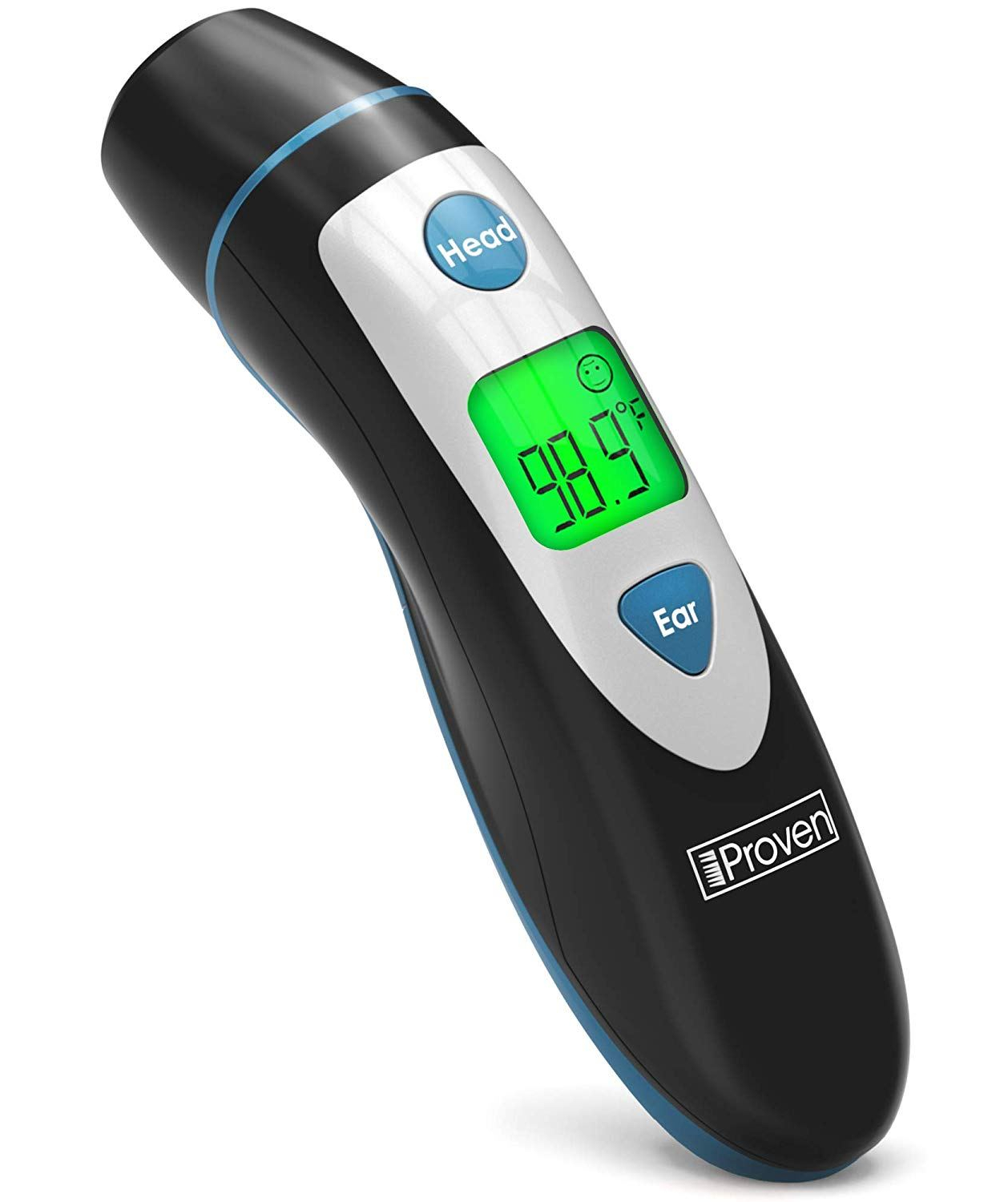 This seems a fairly straightforward question and seems like it should have a fairly straightforward answer. With all sorts of makeshift fever checkpoints being set up to screen for the coronavirus by so many cheapskate companies, it’s definitely a risk. Let’s explore.
Contact Thermometers
What is a contact thermometer? It is an electronic thermometer that looks something like so:
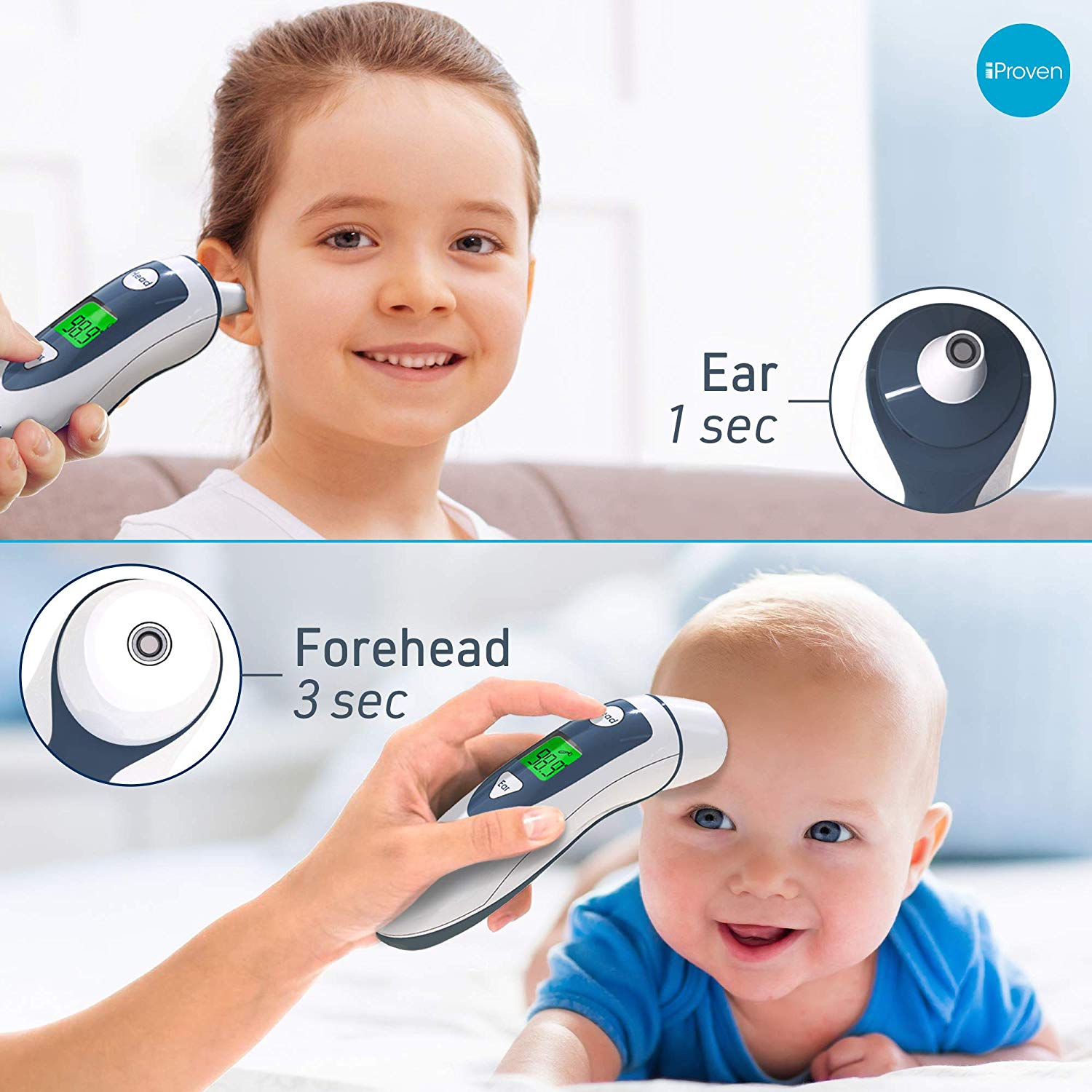
These contact thermometers must come into skin contact with the forehead or ear to perform its job. Why is this important to your health? It’s important because many makeshift fever screening zones for the Coronaviris (COVID-19 aka nCoV-19) utilize such low cost contact thermometers to check for fever, but at a severe risk of transmitting it.
Sweat and Transmission
Many people believe that sweat can’t transmit a virus. However, if you’ve got a fever, you’re likely perspiring a little. Even still, that doesn’t make using a contact thermometer an unsafe choice by default. But, it can still spread a virus for other reasons.
When people are asymptomatic (or even symptomatic), they can rub their noses or eyes, then rub or scratch other parts of their faces. This can then rub the virus on other portions of skin. This means that using such a contact thermometer could pick up a latent Coronavirus on a forehead or ear and transmit it to at least the next person that thermometer touches.
Unfortunately, there’s no way to protect yourself from such a screening point unless you turn around and leave or refuse to use their contact thermometer. While in the US, such refusals might be met with some consternation until explained, in a country like China, it might lead to much more drastic action by the authorities.
Amateur Hour
However, those in charge over the setup of these impromptu screening zones and which are forcing the use of contact thermometers (without any sanitary protection) are clearly medically untrained amateurs. A virus is a virus. It transmits like all other cold viruses, through contact. If that contact is through the surface of a thermometer or by rubbing your hand across a railing someone has just touched, you can pick up a virus. This type of spreading is called contact spreading. It’s one of the primary reasons that cold viruses spread so easily and rapidly.
You will still need to put your hands in your eyes, nose or mouth to fully infect you, but that’s not at all difficult considering how frequently we touch our eyes and noses and scratch itches. We also must eat, so touching our food with an infected hand is very common. It’s not a matter of if, but when after exposure.
Washing Hands
Hand washing is important, particularly before consuming any food or drink, after having been out and about in public. If someone touches an unsanitary thermometer to your forehead at a screening zone, visit the restroom and wash your face and hands immediately. Don’t wait. Use soap and hot water, if available. Better, don’t allow a fever screening area to touch anything to you.
Non-contact Thermometers
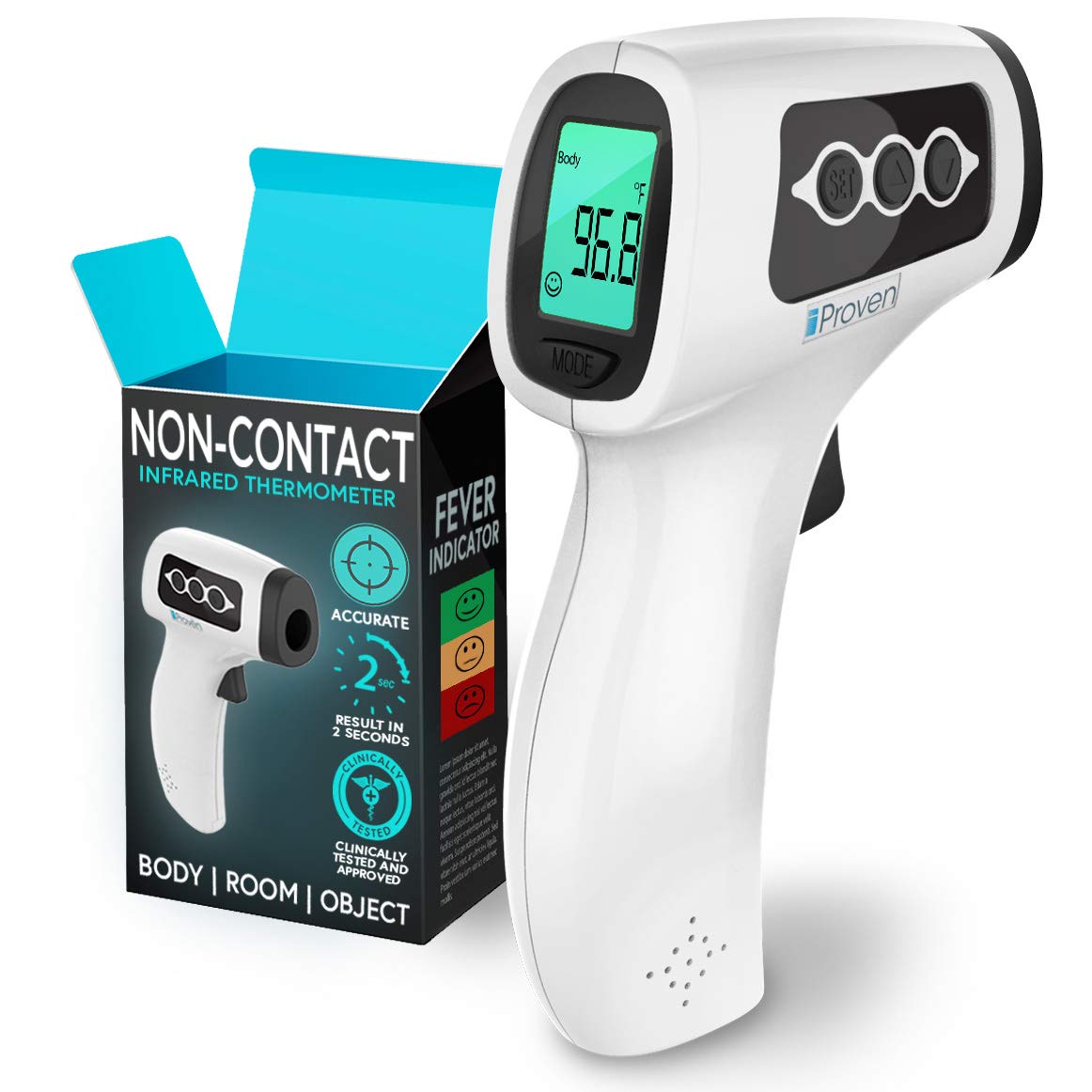 There are non-contact thermometers available on the market. Unfortunately, they are much more costly than the contact variety. Cheapskate companies may not be willing to shell out the $$$ to buy these more sanitary thermometers. There are also other sanitary versions of thermometers which utilize disposable tips. Either of these two methods of screening thermometers would be fine for use at a public screening check point. However, all skin-to-skin contact thermometers need to stop being used at public screening checkpoints.
In fact, I might even attribute some of the spread of the coronavirus to such well-meaning, but entirely amateur fever screening points… points which have unwisely chosen contact thermometers for public screening.
If someone intends to place a thermometer against your forehead, say, “No.” If they seem dismayed by your statement, explain, “That contact thermometer is likely already infected, if not even by the coronavirus.” No one wants to get the regular cold or flu, let alone the coronavirus. Nothing should touch your skin when being checked for fever at a public screening point. If that screening point can’t determine if you have a fever without touching something to your skin, that’s a sanitary issue on their part… and not your problem.
Screening Points
Anyone in charge of setting up impromptu screening points to test for fever needs to use a device that either has disposable sanitary coverings between each check or is of the non-contact variety. Preferably, nothing should be touched to the surface of anyone’s skin, then touched to another person. Anything that performs skin to skin contact has a high probability of transmitting viruses from one person to another. This makes these fever screening checkpoints exceedingly risky ventures with a potential for legal liability should death or injury occur.
I’m guessing that these check points were not designed by someone in the medical profession, that or these operators simply don’t understand how viruses are transmitted. Either way, it comes down to amateur hour.
If you happen upon an impromptu fever screening check point, do not allow anything to touch your skin. If they can’t check your fever without touching you, simply leave and go somewhere else. There’s too much risk of infection by allowing someone at a checkpoint to touch you.
↩︎
Top 10 gripes for Fallout 76

You’re thinking of buying Fallout 76? You’ve rationalized, “It’s only a game, how bad can it be?” Let’s explore the top 10 gripes for why Fallout 76 may not be the best game purchase in 2019.
Number 10 — It’s not a new game
This game was released over a year ago in October of 2018. It’s over a year old already. Games typically have a 1 year lifespan of relevance before losing steam. The useful lifetime of this game is already waning and the clock is now ticking down on this game. Bethesda knows it, the industry knows it and gamers know this. You could invest your money into this game and find in 5 months that Bethesda has decided to pull the plug. For this reason alone, I’d be cautious in investing time in building a character.
Bethesda RPG-like games usually take months to fully play through. You might not even see all of the endgame content before Bethesda pulls the plug. Though, you can most certainly get through the main quest line before then, as short as the main quest is. Keep in mind, however, that because it’s an online game, there’s no local save file on your computer. If Bethesda pulls the plug, all of your characters and the work you’ve spent building them will disappear.
Number 9 — Multiplayer Game Modes
If you’re solely looking at the purchase of Fallout 76 for its multiplayer player-vs-player (PVP) game modes, you might want to think again. There are only three multiplayer modes in Fallout 76:
- Native (Workshop and Adventure)
- Hunter / Hunted Radio
- Battle Royale
Native PVP
None of the 3 PVP modes are particularly well designed and none of them fit into the Fallout universe and actually make sense. This first mode, “Native”, requires two people to initiate this mode through a handshaking process. One person fires on another. The second person must fire back to complete the PVP handshaking and launch into PVP mode. The problem is, there’s no fun to be had in this PVP mode and it’s rarely, if ever, used. Most players in adventure mode are there to explore and play PVE, not to get into PVP battles. So, be cautious when trying to elicit a PVP action from another player.
The second half of the PVP mode is at Workshops. If you claim a workshop, the handshaking mode is disabled and the entirety of the workshop area becomes an active PVP zone. Once you own a workshop, anyone can come into the workshop and begin PVP with you or your team. It’s the same PVP as the version that requires handshaking, except there is no handshaking.
Speaking of teams, be cautious when teaming up with other players. It only takes one player in a team to begin PVP with another player. Once that happens, the entire team becomes vulnerable to PVP with that player (and anyone on a team with that player). No warnings are issued by the game to other team players when one team member begins PVP activities with another player.
Hunter / Hunted Radio
The second game mode, “Hunter / Hunted Radio” requires you open a radio station on the in-game Pip boy (heads up display giving access to your inventory, weapons, armor, etc). This “radio station” links you into a matchmaking mode that allows up to 4-5 players in a given radius to begin PVP activities. As the name suggest, it’s about hunting for other players all while being hunted yourself. It’s also a sort of ‘Last Man Standing’ mode in that whichever player ends up with the most kills gets the most rewards.
Both of the above listed game modes are effectively “death match” style PVP. That means that it’s solely about player characters killing one another… which then comes down to which player has the best and strongest armor and weapons. Both of these styles rapidly elicit boredom because “death match” is the oldest and weakest type of PVP mode there is and is simply about killing other player characters.
This PVP also makes no sense within Fallout 76 where all of the people who lived in Vault 76 were supposed to remain civil and friendly towards one another. Not even the game setup or later found holotapes reveal any story aspect of people in Vault 76 turning on one another before “Reclamation Day”. If that had been a story element, then perhaps the PVP might have made some sense. But, no. The holotapes found almost ALL tie into the Scorched threat or other similar environmental survival threats (bad water, radiation, etc). None of the holotapes discuss bad blood between the residents within Vault 76. If that had been true, the “Reclamation Day Party” the night before would have ended in bloodshed before the vault even opened.
Nuclear Winter — Battle Royale
The third PVP activity is separated from the above because it arrived much later in 2019. At the same time it is a merely a weak copy of other better implemented Battle Royale games, which are currently “trending” in the game industry. Bethesda added this game mode, not because it made sense to Fallout 76 (or the Fallout universe), but because it is so popular in other popular game franchises, such as Fortnite and Apex Legends. It’s simply Bethesda’s attempt at a cash grab in an industry being inundated by other better Battle Royale based games.
Battle Royale is nothing new. It is a game mode that has been around since the early days of PVP. However, games like Fortnite and Apex Legends have turned this mode into hugely successful franchises. This mode is another “Last Man Standing” mode which is simply an alternative version of “Death Match.” In this death match style game, instead of people picking off one another and continually respawning until the clock runs out, you only get one try to win. This means that once your character has been killed, you can only watch the action unfold for the remaining active players. The point of any Battle Royale mode is to survive as long as you can and possibly become the “last man standing”.
With Fortnite and Apex Legends, it’s not so much about being Battle Royale, it’s more about the game makers crafting the game using interesting characters using gimmicks (building forts) with interesting attack modes. It’s about finding a character who has the “best” attack in the game. This means you can bring in experience earned and weapons owned back into the game to use over and over.
Why is all of this important to Bethesda’s “Battle Royal”? Because Bethesda chooses to allow nothing into its Battle Royale mode. All experience earned is earned explicitly within this game mode. But, even that experience doesn’t matter. Any weapons you may have used or armor you may have found cannot be used in subsequent plays. You must ALWAYS find weapons and armor in the game once it begins. Even then, it’s all random what you find. The chests generate random weapons, armor and loot. It could be good loot or it could be bad. Since you have no idea what you might or might not find, you’re at the mercy of the game to outfit you while you’re in the game. All the while, the clock is ticking.
You’re never given enough time to really outfit your character in a useful fashion. You end up spending inordinate amounts of time hiding from other players and, hopefully, finding decent armor and weapons in the loot chests. Some Battle Royale games offer this “loot chest” idea, like Player Unknown’s Battlegrounds (PUBG). Unfortunately this game concept fails to work in a game like Fallout 76 where the entire point of playing Fallout 76 is to gain experience, weapons and armor over time. Having to “start over fresh” every time you play is, unfortunately, tedious.
Ignoring the nonsensical nature of this game mode even being IN Fallout 76, Nuclear Winter is boring. Even after one playthrough, it’s the same every time. Hide, search, outfit, stay alive. In fact, in this game mode, if you actively attempt to go looking for other players to kill, your character is more likely to be killed. To survive in this game mode, you need to remain hidden until the ever enclosing “ring of fire” gets too small to ignore any other players.
Additionally, any earned experience in “Nuclear Winter” is not carried into the “Adventure Mode” of Fallout 76. Everything in Nuclear Winter is for Nuclear Winter and vice versa. These modes are mutually exclusive.
Considering that Apex Legends and Fortnite are free-to-play, buying Fallout 76 solely to play Bethesda’s Nuclear Winter game mode is a waste of money. Go get the free Fortnite or Apex Legends or buy into Player Unknown’s Battlegrounds which do Battle Royale mode much, MUCH better. Bethesda would have done better to separate Nuclear Winter into a separate, standalone, free-to-play game… not tied to Fallout 76. I might even suggest retheming it either as its own franchise or theme it under a franchise more known for multiplayer games, such as Doom or Wolfenstein.
But… don’t run out and buy Fallout 76 strictly for Nuclear Winter. It’s too expensive for as weak as this game mode’s design is. If you already own the game, then it’s worth trying.
Number 8 — Holotape Hunt
This game has categorically been chastised for its lack of NPCs. And… that criticism is rightly justified. All previous Fallout games have been HEAVILY centered around NPCs and their dilemmas. To yank a mainstay out of a Fallout game means to yank out its very heart-and-soul and its reason to exist. The reason players play Fallout and Skyrim is because of the sometimes heart wrenching stories of its human NPC inhabitants.
In Fallout 76, because there are no human NPCs, save Super Mutants and a bunch of robots, the game is devoid of ANY interactivity with other NPCs. Instead, the game’s primary story sees you hunt down a trail of pre-recorded holotapes to “listen” to a bunch of canned messages and read random text on computer terminals. Worse, many of these holotapes open up quests that you are required to complete, yet the holotapes are way too short to really give the player any sense of urgency. Indeed, the holotape has likely been sitting by a dead body for months, if not years already. How can there be any sense of urgency around listening to something that’s been sitting there that long? In fact, whatever that dead person may have been doing to prompt that tape is likely long over and done.
Worse, sitting around listening to holotapes as a matter of story course, then reading text on a bunch of terminals is entirely boring. Storytelling, particularly in video games, should be done by interactive characters, not by text on a screen or pre-recorded audio tapes. In fact, such a storytelling tactic thwarts the point of even using a video game to tell a story. This isn’t the early 80s when Zork was the best that computers could achieve, it’s the days of Call of Duty when it’s all about realistic cinematic 3D character storytelling. Yet, the best Bethesda can come up with is effectively what we got in a game from the 80s?
Number 7 — Shorter Than Expected
While there are a wide number of side quests, events and tertiary activities, the main quests total 22. Considering that previous Fallout installments had way more than this number for its main quests, this is a sad number for Fallout 76. In fact, if you solely focus on just these 22 quests, you can probably get through all of them within a week or two at most. Note, most of this time is spent grinding up levels and gaining resources to ensure you can complete some of the quests properly and, of course, survive.
Number 6 — Eating, Drinking, Diseases & Weapon and Armor Breakage
To extend the amount of time you play Fallout 76, Bethesda has implemented some, at least they think, clever time extending mechanisms. Mechanisms such as eating, drinking, diseases and then there’s weapon and armor breaking frequently. The point to adding these mechanisms is less about realism and more about making you grind, grind, grind to keep your character from dying. Sure, in real life we do have to eat and drink. We’ll also have to repair armor.
These mechanisms in Fallout 76 are implemented poorly. For example, water consumption is entirely too frequent. You will find you have to consume water and food at least once per hour of play. No one eats food that frequently. You might sip water over the course of the day, but you don’t drink the amount of water they force your character to drink at every interval.
Worse, if water consumption drops too low, the penalty is reduced action points. Action points aren’t even a concept in real life. This is where the realism ultimately ends. It is also where it becomes apparent that the point to why Bethesda added these unnecessary additions comes into play. It’s not about realism, it’s about extending the time it takes you to play the game. Indeed, it can and does slow you down. Instead of actual, you know, questing, you’re not forced to forage for food, water and resources to keep your weapons and armor repaired and keep your character from dying. That’s not survival, that’s stupidity.
Worse, it’s all manual. To eat and drink, you are forced to stop and perform a manual task. There is no perk card that automatically consumes marked favorite foods whenever it gets too low. No, it’s all manual. In the middle of a fight? Too bad, now you have to open a menu and consume some food. Forgot to mark it as a favorite? Now you have deep dive into a bunch of slow menus in the middle of a battle. Yeah, not fun.
Number 5 — Menu System / Lack of Pause
As was discussed immediately above, the menu system is clumsy, cumbersome and dated. As I was talking about Zork from the 80s, that’s how this game feels. Like it was designed in the 80s for an 80s audience. Fallout 76 doesn’t in any way feel modern.
When you’re in the heat of battle (and because this is a multiplayer game that doesn’t allow for pausing), if you want to change weapons or swap armor, it’s a laborious process involving a convoluted set of menus.
Sure, there’s a wheel you can plant your favorites, but that’s limited and must be used for ALL items in the game. This means this small menu wheel is overloaded with food, clothing, aid, armor and weapons. You don’t have separate wheels for weapons, armor and food… which this game desperately needs.
While the PipBoy seems like a great idea, in practice and for a game UI, it really sucks for quick access when in a multiplayer non-pausable environment. For Fallout 4 where pause was a mainstay, thus allowing you time to think and swap, in Fallout 76 the PipBoy’s UI system entirely fails the player and Fallout 76.
Number 4 — Scorched and Broken Canon
With Fallout 76, Bethesda introduces a new enemy into the Fallout universe. The Scorched. However, this enemy addition doesn’t really make any sense at all. Fallout 76 is a prequel to Fallout 4. If the Scorched existed in Fallout 76, they very likely made their way to from Virginia to Boston in Fallout 4. After all, Scorchbeasts fly. This is where Bethesda breaks its own canon and lore simply to create new games.
There are a number of places where Bethesda has broken canon in the Fallout universe, the biggest faux pas being the Scorched. So, let’s focus on the Scorched. Even after you complete the game’s main quest (which is supposed rid Appalachia of the Scorched), the game remains status quo and unchanged with regards to Scorchbeast Queens, Scorchbeasts and even Scorched… which continue to reappear. The player following the Scorched quest line does nothing to resolve the Scorched plague… which doubly means that the Scorched should have made their way to Boston to appear in Fallout 4. Yet, they inexplicably don’t. And, it’s not like Bethesda couldn’t have rolled a Fallout 4 update to apply retroactively continuity to add the Scorched information into Fallout 4 and make the universe consistent. Nope, Bethesda didn’t do this.
So, now we have Fallout 76 which remains with story incongruities by introducing enemies, clothing, items and concepts which have not appeared in games that have chronologically come after Fallout 76.
Number 3 — Grind Grind Grind
While some people might think this is the number 1 problem in the game, it is not. In fact, we will come to the biggest problem in just a few, but let’s grind on with number 3.
While this one is somewhat tied to the number 1 problem, it is separate and unique. But, it is not at all unique to this genre of game. Developers seem to think that grind, grind, grinding your way through the game is somehow fun. It’s a mistaken thought rationale. While grinding does extend the length of time it takes to play the game, we gamers can see right through that charade. We know when game developers have added grinding for the sake of grinding and not for the purposes of general game exploration.
There’s a fine line between grinding to complete a quest and grinding because you have to play the subgame of surprise grab bag to locate the best weapons, armor and loot in the game.
Purveyor Murmrgh is the poster child of everything wrong with not only grinding within Fallout 76, it also bookends and highlights this major industry problem across the RPG genre, but also of video gaming in general.
 Slogging through the same pointless battles over and over just to gain “currency” to play the Loot Bag Lottery is not in any way fun. That’s exactly what Purveyor Murmrgh is to Fallout 76. It is the icing on the grinding cake… but it’s more like Salmonella.
Oh, and believe me, most of the junk given out by Murmrgh is just that, junk. It’s a Junkie’s Meathook dealing 25 damage. It’s a Vampire’s Knuckles dealng 20 damage. It’s an Instigating Shovel dealing 5 damage. It’s a Vanguard’s Pipe Pistol dealing 10 damage. It’s literal junk. The only thing you can do when you’re issued this junk is turn it back in and get at least some Scrip back. Yes, you might get super lucky and get a Two Shot Gauss or a Instigating or Furious Pump Action Shotgun, but it might also take you hundreds of tries (100 Scrip per try) to get it.
Let’s understand exactly how much grinding is needed to gain the 100 Scrip required to “buy” a 3-star randomly generated legendary weapon from Murmrgh. Each 3-star legendary traded in offers 40 scrip. That means it takes three 3-star legendary weapons to gain 120 scrip and top the 100 Scrip mark. That means that it takes at least 3 Scorchbeast Queen kills to gain three 3-star legendary weapons… and that assumes she will even drop a 3-star legendary weapon every time. Hint, she doesn’t. Many 3-star legendary enemies rarely drop 3-star weapons. In fact, most drop 1 or 2 star weapons most commonly.. which you can trade in at a lesser Scrip value (see chart below). Ultimately, this means even more and more grinding just to find those ever elusive 3-star legendary weapons to turn in and gain Scrip.
You also can’t get Scrip in any other way than grinding for and “selling” Legendary loot. You can’t buy Scrip with Caps. You can’t buy Scrip with actual money (although that would be an even bigger problem for Bethesda). You can’t buy Scrip with Atom (because you can buy Atom with real money). You must grind, grind, grind your way into getting Scrip.
Here’s a table of how it all breaks down for Legendary Scrip:
What this table means to a gamer is that you should expect to grind, grind, grind to find 3-star legendary weapons (which you can trade toward Scrip), versus any other type when you’re looking to get a 3 star legendary weapon out of Murmrgh any time soon. That doesn’t mean you won’t happen upon a great 1, 2 or 3-Star legendary weapon or armor along the way while grinding. But, it also means that if you want to play the Scrip Loot Box Lottery game at Murmrgh, you’re going to need to grind your way through a lot of legendary weapon drops before you get enough to visit Murmrgh. Even then, because it’s a Surprise Loot Box, you’re at the mercy of whatever crap it decides to roll the dice and give you.
Ultimately, Fallout 76 is about grinding and Bethesda’s understanding and design of its game constructs are intended for gamers to spend inordinate more amounts of time grinding than questing. Bethesda’s rationale around this is having people grinding on the game is better than not playing it at all. To some degree this may be valid, but only because there are some gamers that actually LIKE grinding. I’m not one of them. Doing forever repetitive tasks over and over is not something I want to do in an RPG, let alone in Fallout. Let’s grind on.
Number 2 — Bugs, bugs and More Bugs
This one goes without saying for Bethesda. The game industry has been in a tailspin in this area for the last 3-5 years. When the N64 was a mainstay in the home gaming, game developers did their level best to provide solid, reliable, robust, well crafted gaming experiences. Literally, these games were incredibly stable. I can’t recall a single N64 game that would randomly crash in the middle of the game. While there were logic problems that might have made games unintentionally unbeatable, the games were still rock stable.
Since then when the N64 console was popular, games have moved more and more towards hardware being driven by Microsoft’s operating systems (and also adopting Microsoft’s idea of stability), the former push towards gaming excellence has severely waned. No longer are developers interested in providing a high quality stable gaming experiences. Today, game developers are more interested in getting product out the door as fast as possible than in making sure the product is actually stable (or even finished). What this has meant to the gaming industry is that gamers have now become unwitting pawns by paying retail prices to become “Beta Testers”. Yes, you now must pay $60 to actually beta test game developer software today. Let’s bring it back to Fallout 76.
Bethesda has never been known for providing particularly stable software products in its past gaming products. Even Fallout 3 had fairly substantial bugs in its questing engine. Obsidian muddied the already murky waters of Fallout with its Fallout New Vegas installment. Obsidian is much more attuned to producing high quality stable products. This meant that many gamers probably conflate the stability imparted by Obsidian’s Fallout New Vegas with Bethesda’s much buggier Fallout 3 as both games were released during a similar time frame. Fallout 4, however, can’t rely on this conflation. Fallout 4 stands on its own, for better or worse, and its bugs were (and are) readily apparent. Fallout 4 even regularly crashes back to the dashboard hard. By extension, so does Fallout 76. Fallout 76 was also born out of Fallout 4 and many bugs in Fallout 4 made their way unfixed into Fallout 76. Some of those Fallout 4 bugs are even still there!
Fallout 76 has, yet again, become an unwitting poster child for this newest trend towards cutting corners. Even though Bethesda has always provided buggy experiences, Fallout 76 is by far Bethesda’s worst. Even The Elder Scrolls Online (ESO) at its worst never fared this bad, even though it was not completely bug free when it first arrived and was still considered fairly beta. Fallout 76, however, was released entirely unfinished and chock full of serious bugs.
Worse, the whole lack of NPCs feels more like cutting corners than it does an active design decision. It’s like they simply couldn’t get the NPCs working day one. So, they cut them out of the mix and quickly threw together a bunch of voiceovers for holotapes and wrote a bunch of terminal entries. The bugginess and being unfinished for Fallout 76 is readily apparent, but what may not be apparent is this lack of design forethought for the (lack of) NPCs. There are even areas of the game that seem as though they were designed to have functional quests on day one, but never had anything attached. For example, Vaults 94, 51, 63 and 96.
Recently, however, Bethesda released add-ons that fill in Vault 94 and Vault 51 (sort of). Vault 51 is still unfinished in the Adventure server portion of Fallout 76, but it exists as Battle Royale (a completely separate game mode). Vault 94 is a raiding vault intended for multiplayer group play. Unfortunately, Vault 94 is entirely a disaster. Not only is the interior one of the worst designed vault interiors I’ve seen, the actual gameplay is so overloaded with unnecessary amounts enemies, it’s a chore to go in there. By ‘chore’, I mean literally. There’s so much stuff being thrown at you, the game engine can’t even properly handle it. It ends up a completely stuttery, herky-jerky gaming mess. If you can even fire your weapon timely, you’re lucky. Most times, you’re so inundated by swarms of enemies, you can’t even properly aim or fire. VATs barely even works in this “dungeon” simply due to the enemy overload.
As for vaults, 63 and 96, there’s still nothing associated with them in Adventure. It is assumed that, like Vault 94, both will become part of later group raids.
Still, there are many, many unfinished quest lines throughout Fallout 76. Not only are there many presidential ballot systems all over the wasteland, including in Harper’s Ferry and Watoga, there is also a locked presidential suite in the Whitespring Enclave bunker. Also, while there are several hand scan locked rooms in the Whitespring villas, there are also many more hand scan locked rooms in the Whitespring Hotel proper. This almost entirely indicates that being General in the Enclave may not have been the end of the road for the Enclave quest line. Instead, it seems the quest may have led the player to becoming President over the Wasteland. With all of the random ballot systems, it seems that you may have had to repair enough of these systems to allow vault residents to vote for you to become President using those ballot systems, thus giving you access to the Enclave’s Presidential suite. It seems Bethesda abandoned this quest idea somewhere along the way. This, in fact, may have been dependent on NPCs which were summarily stripped from the game. Without NPCs to help vote you in as President, there’s no way to actually play this quest… probably the reason it was left out of the game.
In addition to this abandoned quest line, there are the upper floors in the Whitespring hotel. The front desk Assaultron specifically says the hotel is still under refurbishment. This is, yet another, unfinished quest. You don’t build a hotel like Whitespring and then lock off half of the building as “unfinished”. These are self-autonomous robots. They can easily finish this refurbishment process… and should have finished it by now. This Whitespring Hotel part is simply more on top of the vaults that still remain locked. There are likely even more than this in the Wasteland (crashed Space Station with no explanation), but these are the ones that stand out.
And now…
Number 1 — Revisionism of Fallout 76
Here we come to the biggest foible of Fallout 76. Instead of fixing bugs, Bethesda has focused solely on revising Fallout 76. Instead of releasing a complete and functional game, the developers got to about a 45% finished state and Bethesda pushed it out the door. Unfortunately, when something is pushed out unfinished, it never does get finished.
What that means is that like what’s described in #2, too many long standing bugs remain. Instead of Bethesda focusing on knocking out the remaining bugs, they have instead diverted to “value added content”. More specifically, designing shit they can sell in the Atom shop… that and the addition of mostly pointless short term events that haven’t even dropped loot that they should have dropped. Because of all of this, this game hit the game market hard, garnered intensely negative criticism (and still does) and ended up as a huge miss with many Fallout fans. Bethesda, however, has been riding this storm of negativity in hopes they can somehow succeed.
Unfortunately, all of what Bethesda believes to be “better” for Fallout 76 has been merely temporary bandaids, without actually fixing much of the basic underlying problems. There are so many bugs in Fallout 76 from day one that remain unfixed, it’s a surprise the game actually even functions (and in many cases, it doesn’t).
Bethesda has even spent time towards targeting “fixes” for things which haven’t even been problems. For example, Bethesda has reduced the damage output of weapons that in previous Fallout installments have been some of the most powerful weapons in the game. What that means to Fallout 76 is that the game is so heavily nerfed (reduced) that it’s almost no fun to play. You go into Fallout to spend time looking for the best weapons and armor in the game. Since all of these “best” have been so heavily reduced in damage, they are no longer the best. They are, in fact, now some of the worst weapons in the game. For example, they have reduced the Two Shot Gauss rifle’s output damage to no better than a non-legendary shotgun.
This has forced the remaining gamers to perform even more rounds of grind, grind, grinding. Because now you blow through even more armor and ammo… meaning you now have to go repair everything every few plays (yes, even when you have the perk cards equipped).
And here’s even more unnecessary meddling… Bethesda has mucked with how well the perk cards work. Many cards claim up 60%-90% reduction of “whatever”. Yet, if you really do the math, it’s way, way less than that percentage. Sometimes, it’s more likely 10-15%. The cards lie on their face. Many perk cards don’t even function.. AT ALL. You can buy into a perk card stack, but some cards literally do nothing. When the cards do function, they function at much less than what the face value of the card says. The perk cards nearly all lie in some way. They are merely there as “feel good” helpers. Many of them don’t function as intended, if they function at all.
Much of this reduced functionality is because of Bethesda’s revisionism. Instead of leaving well enough alone with the cards, Bethesda has continually felt the need to tweak these cards silently without informing gamers of the changes they are making. The cards are not the only place where they have done this. Silently screwing with VATs seems to be yet another pastime of the Bethesda devs. Yes, Bethesda is sneaking in changes without letting anyone know. But, you don’t have to take my word for it. Simply equip your Perk cards and see if they actually perform at the level they state. This all assumes that you really want to invest in this way less than mediocre game title. It’s these unnecessary changes that make this game less than stellar. It is also why this is the #1 gripe for this game.
The only thing that Bethesda’s revisionism has done for Fallout 76 is turn it into even more of a disaster than it already was. Yes, Fallout 76 is actually worse now than it was when it launched (when most of the game actually functioned as intended). Only after Bethesda began its revisionism has the game turned into junk heap. And, junk heap it is.
Bethesda continues with its revisionism in Fallout 1st (pronounced “first”), Bethesda’s monthly / yearly subscription service. You should be careful investing into this service. Considering the state of Fallout 76 today, it may not have a year of life left before Bethesda cans this game. If you’re considering purchasing a year of 1st, you may find that in 6 months, the game is shut down. How you get half of your $99 back is as yet unknown. If Fallout 76 remains in service for one more year, I’d be surprised.
Bethesda also doesn’t want to listen to what the gamers want. Instead of adding things gamers have actually requested, Bethesda has had its own agenda of questionable add-ons. Add-ons that no one has actually requested or even wanted (Distillery?). Add-ons that have added limited value back to the gamers. For example, Purveyor Murmrgh. No one wants surprise loot-crates. We want to BUY our legendary rifles already outfitted and ready to go. We want to buy legendary module add-ons so we can add legendary effects to our existing weapons and armor. We also want to be able to level our weapons up along with our player. None of this has been provided by Bethesda. All of these requests have gone unfulfilled and unanswered.
As another example of incompleteness in the game, there are 5 star slots on legendary armor and weapons. Yet, the highest amount of stars is still 3? So what gives with that? If you’re only planning to ever have 3 star weapons and armor, then remove the extra 2 unused stars as we’ll never see any 5 star weapons or armor. So many misses in this game, yet Bethesda keeps going without addressing or fixing all of these simple little problems… instead Bethesda has focused on breaking, breaking and more breaking.
The big takeaway here is be cautious with purchasing this game and be doubly cautious if you decide to purchase a 1st subscription. This game is already skating on thin ice as it is. If it lasts another year, call me surprised.
↩︎
The Dangers of Social Media
 Social media as a platform can be a good thing, but it can also be dangerous. It all depends on how it is used. Let’s explore the dangers lurking on social media.
Social Media as a Platform
Social Media, as its name suggests, is social in nature. That is, it relies on crowds of people to function. Without crowds of people, social media wouldn’t actually be social in nature. Let’s first talk about a few social platforms and then we’ll move onto the core of this discussion.
Social media platforms include such sites as Twitter, Facebook, Instagram, Snapchat, Discord, Quora, YouNow, YouTube and even the older MySpace. Even such platforms such as Yelp, TripAdvisor, SoundCloud, WordPress and even news sites like DailyMail. Basically, any site that allows you to sign up and comment about what others are doing or saying, that’s considered social media. If you can create your own content on the site and which contains your own opinions that others can comment on, that is considered a form of social media. Some of these comment areas do not allow followers, but some do.
Social Crowds and Controversy
The one thing that has been born out of social media is controversy. Controversy comes in many forms including such topics as gun control, border crossings, politics, political views, LGBTQ, simple stupidity and, yes, racial issues.
Controversy is also what fans the viral fires. If you post something that’s considered a highly controversial topic, it’s very likely to go viral. The more controversial the opinion, the more likely it will go viral. The most controversial topics might even be picked up by news outlets like local TV news or possibly even nationwide news outlets like CNN, CBS, ABC, NBC or Fox News and made to go nationwide or worldwide viral.
Many people mistakenly believe that things go viral because social media subscribers make it go viral. Not exactly. Content goes viral because of its controversial nature, not because people make it go viral. Yes, it does take people to make stuff go viral, but a sufficiently controversial topic doesn’t need much help to spark the viral fire. Simply by posting such a highly controversial topic may be enough for that content to become the newest viral sensation.
Viral Degradation
In the beginning of social media, only the absolute most interesting information went viral. Today, social media has degraded from showing ‘the most interesting’ into ‘the most controversial’. That doesn’t mean that this controversial information is in any way ‘interesting’ or ‘good’. It simply means that it’s viral. By viral, I mean that far too many people share and re-share and re-re-share that content over and over. The more people who share it, the more viral it becomes. Viral doesn’t always equal ‘good’; though an ever diminishing percentage of these viral posts do have worthwhile content.
Viral fires typically die down over a 24 hour period. Sometimes less than that. Something that goes viral might take off and be heavily viral for 3 or 4 hours until ‘the next viral thing’ appears. It’s very much a quick up and down situation.
Because of the recent degradation in the quality of stuff that’s going viral, it shows that people’s tastes are changing from being more sophisticated to being much less sophisticated. This likely can be attributed to cost reduction of smartphone devices (and Internet services) which have allowed access to these apps by more and more people. This means that the ‘less educated masses’ of the world now have access to and can sign up for social media platforms directly on their phone with just a few clicks in an app store.
When phone devices remained at the $500-1000 range and only those devices connected to social media by folks with higher educations, the quality of what came out of social media was much higher. Today, because there are now $50-100 devices using lower cost Internet services (with increased rural coverage) and these devices can run Twitter and Facebook and other social apps, these devices have trickled down to the hands of the less educated of the world.
What does this all mean? It means that more and more folks around the world now have access to making comments on social media sites. As a result, there are now, more than ever, such problems as death threats. Whether those threats can be taken seriously depends on many factors… factors which you should let the police determine.
The Dangers of Social Media
Now we get to the crux of this article. Yes, it took a lot of build up to this section because it took all of the information above to describe why social media danger exists.
When social media began, people were urged to only friend people they actually knew. This suggestion was both prudent and entirely ignored. It’s prudent because friending people you don’t really know can lead to dangerous situations. That’s clear. However, in the resulting years since the birth of Twitter and Facebook, people have ignored that safety tenet. Instead, far too many people have chosen to friend everyone and anyone in hopes of obtaining a massive following.
With sites like YouTube and YouNow, designed to encourage unknown followers from around the world and whom you do not know, these followers typically follow you because they like what you have to say. Because of models like YouTube, people assume the same model applies when joining Facebook or Twitter… basically, just get followers at any cost. And yes, some people even begun to pay money to get people to follow them.
The difficulty with followers isn’t that they follow you. It’s that many of them are psychotic. It is estimated that 1% of the population has Schizophrenia and 3.5% of the population has some form of psychosis. The 2019 U.S. population is right around 329 million people. That means 11.5 million people suffer from some form of psychosis and 3.29 million people, in fact, suffer from schizophrenia. But, it doesn’t stop there. You can get followers from all over the world. The world’s population is estimated to be 7.7 billion. Not all of those people have access to social media, but a large enough percentage of that 7.7 billion do.
Let’s bring that down in size a little to a social media feed. If you have a following of 10,000 people on a social media site, that means that at least 100 people in your feed suffer from schizophrenia and at least 350 people suffer from some form of psychosis. Not all of these people are dangerous, but some are. It only takes one… and it’s guaranteed you have at least one in your following.
Psychosis and Social Media Celebrity
Having psychotic people in your following is something that you will need to consider whenever you post something to your feed. It is these folks who might take your opinion the wrong way and possibly even wish harm on you. Whether these folks are capable of actually performing harm on you is based on many factors out of your control. What is in your control, however, is what you post to your feed.
Posting controversial topics is likely to draw these folks out into the open to either heavily praise or condemn you for your statements. Some might even threaten your life with harm or death. The more controversial the topic, the more likely it is to bring divisive and, potentially, dangerous comments. If you discuss politics with an unpopular opinion, you’re going to get many fanatics who will come at you.
On the flip side, you also have the rest of your following who is likely sane. It’s not the sane people who wish you harm. The sane folks also won’t protect you, but they may help you defend your feed. However, those in your following who are sane are impossible to tell from the potentially insane… that is, until you start receiving extremely disturbing responses to your posts. Controversy does bring in followers, but it also draws out the psychotics. If you post something highly controversial, expect to draw out a number of psychotic people into the open… who may then attack you with words and possibly even threaten you.
Unfortunately, sometimes it’s way too late once you’ve already posted the content to withdraw it. Once something has gone viral, your content may even draw in even more psychotic people disproportionately to your following. Controversy seems to draw in psychotic people.
Trolls, Psychosis and Threats
Many social media site owners dismiss harsh, irrelevant, dangerous or threat comments as ‘trolls’. Some of these folks may be trolls, but being a troll doesn’t make the person harmless. You never know who is intent on harming you. If you receive a threat, you should always take that threat seriously. You should never dismiss a disturbing comment as harmless, particularly if the person seems to know who you are and where you live. If you receive a threat of a personal nature that even seems to know you and where you are, you should immediately contact the police with all of your evidence. It doesn’t mean the person is actually going to carry out the threat, but you can’t be certain of that.
Livelihood and Viral Dissing
There are likely many folks, probably even more than those listed as having psychosis as being borderline psychotic. What that means is that it might only take one thing to push a person over the edge… that thing might be your next post on your social media feed.
For example, if someone visits your home to service your dishwasher and knows exactly where you live, you should never, ever insult or in any way badmouth this person on your social media feed. Not ever! If that person is a repair person or a delivery driver or any similar locally operated profession, never ever photograph or video them in hopes of putting it on your social media feed to humiliate them. Don’t do this. You are asking for a world of hurt by doing this.
As soon as you do, you’re going to regret it in more ways than one. The primary way is that when this person finds your post humiliating them on your page (and they probably will), particularly if it’s gone viral, they (or their friends) can come back to your house and take action against you or your property. Be warned! Anyone who knows where you live is never a candidate for social media humiliation or harassment.
If you have problems with a local service, use Yelp to describe why their service was a problem, but only using professional words about the service itself. If a specific staff person did something to offend you personally, again use Yelp. Always keep it professional discussing only business reasons why it didn’t work out (what about their service failed you) and never humiliate or call out an individual person by name or show them on video. Only describe the service and, if you must call out employee behavior, call out the person by gender only (e.g., female cashier, pool guy, male pizza delivery driver, etc).
As another example, if you’ve visit a restaurant and the waitperson is exceedingly rude or bad at their job, you can write about that person in your review, but never name them. You can describe that employee’s actions, but only describe them by their actions. Only name names or describe the person to the management team of the restaurant chain and only in relation to your poor service. Never name names or post photos of such employees on social media! You can name names via direct message, private chat or via email to a management representative of the company, but never do it on open public forums for followers to see. If you so choose to photograph or video the person in action, don’t post that to your personal feed. You can choose to hand the video off anonymously to media outlets like the AP, Reuters, CNN or even random YouTube news outlets, but posting a video to your own personal social media feed allows that video to be traced directly back to you. This is never a good idea.
What does this have to do with livelihood? Everything. If you call out a person by name, their current and future employers can find this information online and take action against them. Current employers can fire them for “inappropriate” actions. Future employers can deny hiring or fire them later if found. You don’t want your content to be the downfall of someone’s career now or any time in the future. Why? Because, as I said, psychosis is a problem… particularly if someone is borderline. If your social media action causes someone to lose their job, they could come take that out on you and your family.
I’ll also point out that if you choose to fill your social media feed with controversial topics about businesses, you may find your own employer may not like these posts. Derogatory posts against businesses may backfire on your own employment. You should be exceedingly cautious when posting these types of posts into your social media feed. You never know when something you’ve put onto social media might have insulted your CEO, HR manager or even your boss’s best friend.
There’s no need to take that risk by…
Throwing Caution to the Wind
Buy vomiting up everything controversial you possibly can (simply to gain followers) about anyone and everyone you meet, you are putting yourself in very real danger. You never know who is reading your words and, even more than this, who might take action on those words.. perhaps even against you personally. Inciting people to do things is never a good idea on social media. At some point, there will be a Charles Manson-like social media personality who will incite enough people and then who will feign innocence that it’s just words on a screen. Yet, this person will have incited many people to do entirely inappropriate actions towards others. The police and the legal system will have to up their game to cover these inappropriate uses of social media. I guarantee you, this is coming.
However, that’s the most extreme example of using followers to do bad things. Most well meaning folks are simply ignorant of how dangerous their words and videos can be. If what you’re posting is considered a danger to national security, I can guarantee you the NSA will be at your doorstep ASAP. If what you’re saying, on the other hand, simply shows disrespect your local repairman in a very public and ugly way, you’re putting yourself and your family in very real danger. There’s no need for that when you can CHOOSE not to post such content.
You shouldn’t intentionally throw caution to the wind when writing social media posts. Sanity, intelligence and professionalism should always prevail. I do realize that controversy ‘sells’, but it also sells danger. If you choose to ignore this advice, then you must take the consequences of your actions even if that means someone puts you into the hospital or the morgue. Yes, it can and does happen.
Here’s another very recent example of a homicide of a young girl by a stalker after her stalker caught up with her after harassing her on Discord (and via iMessage). You’ll want to click to follow this thread through to Twitter and read all about this:
↩︎
Spotting a Liar
 Recently, I’ve come across a book by Pamela Meyer entitled Liespotting: Proven techniques to Detect Deception released in 2010. Unlike Pinocchio, determining if a human is lying is quite a bit more complicated. While this is not the only book involving the topic of lie detection, let’s review Pamela Meyer’s visitation of this topic and of the act of deception itself. Let’s explore.
Lies and Deception
Let’s open this article by talking about Pamela’s TED talk. The difficulty I have with Pamela’s TED talk, which was apparently meant to simultaneously accompany and promote her book, was her seeming lack of expertise around this subject. Oh, she’s certainly knowledgeable enough… but is ‘enough’ really enough? It seems that her corporate America stint has led her to using these techniques to ferret out suspected liars from truth tellers. While that’s a noble reason to go into writing a book, it doesn’t make you an expert on the subject. I will fully admit now that I, like Pamela, am not an expert on the subject of behavioral psychology. Only a trained professional should be considered an expert on the art of detecting lies and detecting body language clues. I leave that to the experts. And even then, this art is so nuanced that detecting a lie could mean the difference between indigestion and actual lying.
The difficulty I have with Pamela’s book is that she focuses on trying to catch people in a lie whom are unwittingly using verbal and body cues that tell a different story. Her methodology suggests and implies that you’re planning to sit in a room with that person for potentially an hour (or longer) and have a conversation. Okay, so maybe ‘conversation’ isn’t the right word. Maybe the right word is ‘interrogation’. Or really, the correct word is probably ‘grill’.
If you’re planning on sitting in a room with a suspect grilling them for a lengthy period of time and asking all sorts of pointed questions, perhaps you can eventually catch someone in a slip-up or even multiple slip-ups. Even then, you have to question whether that ‘grilling’ methodology can really uncover a definitive measure of lying. Even more than this, is ‘grilling’ a practical methodology to employ in everyday use? Perhaps it is with your children if you’re trying to get to the bottom of who broke the lamp. But, would you ‘grill’ your friends? A co-worker? Your boss? No, this methodology is not in any way practical. Practicality aside…
In her TED talk, she discusses looking for ‘clusters’ during these question ‘sessions’. Seeing many telltale behaviors in a row may indicate deception. Though, is it really deception, is it fatigue, is it simply a person’s idiosyncracy, is it indigestion or is it, indeed…
Coercion?
The longer you sit with someone in a room interrogating them, the more it becomes about coercion. There’s a fine line here. While Pamela may not have called this aspect out, it’s a line that can easily be crossed when interrogating someone at length. At some point, you have to ask if the “cluster of mistakes” the person seems to be making is attributed to lying or coercion? With enough questions and time, you can actually get someone to confess to something they didn’t do simply because they wish to end the conversation and get out of there. Fatigue and boredom easily causes people to make mistakes, particularly when you ask the same questions over and over and over. Coercion, like lying, is part of human nature. In fact, I’d consider coercion to be the flip side of lying.
If you know the person and interact with them daily, you would know how they “normally” behave. You can then tell when they do, say or act in a way that’s somewhat off. If you’re talking to someone you don’t know, you have no idea of their personal behaviors… so how can you spot clusters of anything? Even then… if you think (and the key word here is “think”) you have spotted deception, what do you do?
Spotting a Lie…
is half the battle. The other half is what you choose to do with that information. Do you leave and go grab a pizza and beer and forget all about it? Or, do you confront the person? Confrontation is not likely to get you very far.
Pamela’s book seems geared towards brokering corporate business deals. I’m not sure exactly how useful her information would be in corporate business considering that the majority of corporate executives are not only pathological themselves, but many are also sociopaths and/or narcissists. Few CEOs actually care about their underlings. Additionally, C-Level anybody is not likely to sit long enough to be ‘grilled’. Perhaps they may be willing to submit to being ‘grilled’ under certain business conditions of duress. For example, if a CEO’s company is failing and there are millions of dollars at stake needed to revitalize a failing company, then they might be willing to sit through a grilling session by investors. However, they might not. So, again, I question out how useful her information might actually be in corporate America employed at an executive level?
Certainly, at corporate meetings and outings, executives put on a good face. But, don’t kid yourselves. They didn’t get to be a CEO without being some measure of ruthless and sociopathic. No, it also follows that most of these CEOs lie through their teeth when at corporate meetings. If they’re on a stage professing the latest greatest thing the company is offering, they’re simply telling you what you want to hear (and, more specifically, what they want you to hear). Personally, I’ve worked in many businesses where CEOs say things at a corporate events that, in fact, never take place. In fact, I already knew it was a lie the moment it was said. It’s not hard to spot when a CEO is lying to the company. Perhaps I’m being a bit too cynical here, but I don’t think so.
Another example, when the CFO takes the stage and begins is talk about finances, you can bet there’s information on his/her spreadsheet that’s not accurate, or indeed is not even there. This is the lie that corporate executives tell often. They want you to think the company is “on target”, is “doing well” and is “making money” even when things aren’t nearly that rosy. You simply cannot believe all of the “rah-rah” that corporate executives tell you at events. If you do, you’re extremely gullible. Nothing is EVER that rosy… or as another idiom goes, “There’s two sides to every coin.”
That not to say that all CEOs lie all of the time. But, they certainly are masters at withholding key information from the common folks in most organizations. Withholding key information is a lie, make no mistake. If a company insists on “transparency” in its business operations, you can bet that CEOs won’t apply transparency to their own business decisions. However, this is getting off into the deep end of the psychology of corporate business America. I could write a whole article, perhaps even a book, on this subject alone. For now, let’s move on.
Being Caught
You think you’ve caught someone in a lie? The question remains… what do you do with that information? Do you confront them? Do you walk away? Do you ask them for the truth? And, these are all questions, choices and decisions you’ll have to make for yourself. Knowing that someone is lying is entirely different from acting on that information. How do you act when you think someone is deceiving you? The answer to this question depends on where the lie happens.
If the lie is in your personal life and it involves a personal relationship, then only you can work it out with your partner. If your relationship is supposed to revolve around truth and trust, then it’s probably worth bringing it out into the open to discuss it.
If the lying involves a co-worker or boss at your company, then you have to make the decision how this affects your ongoing position at that company. If it’s a small lie that really doesn’t affect you personally, walk away and forget about it. If it’s a large lie that could easily jeopardize your position at the company, then you need to take steps to both protect yourself and distance yourself from that person. In this case, it’s worth having a sit-down with your manager and explain what you have uncovered and why you believe it’s a lie… bring proof if you can find it.
If it’s a lie that involves and may materially impact a business deal, this is difficult to offer a suggestion here as there are many forms of this which would require me to go off into an extremely long tangent and could significantly impact corporate legal agreements. In fact, maybe I’ll circle around to this topic and write an individual article involving corporate lying, legal contracts and business deals.
Deceit, Deception and Lying
With that said, I’d like to get into a little about the ‘whys’ of this topic and types of lies. Why do we lie? Two reasons: 1) To protect ourselves and/or 2) To protect someone else. Yes, that’s the primary reasons that we lie. Though, there is also a third category. The third type are those who are pathological. They lie because 1) they can and 2) because they find it fun.
Basically, there are two types of liars: 1) the ordinary liar and 2) the pathological liar. The “ordinary” liar is the person you’re most likely to meet in a lie. The ordinary liar is also more easy to spot. The pathological liar is less likely to be seen or caught. Don’t kid yourself, some co-workers are pathological liars… and these are the ones you need to completely avoid. Pathological liars will basically stop at no lie to get what they want. Many pathological liars are also ruthless sociopaths and/or narcissists, so don’t get in their way.
There are many types of deception, not just verbal lies. There is also deception by lack of information… or, what they aren’t telling you. Company executives are brilliant at this strategy. Withholding vital information from folks is the way they keep what they know limited. It’s also a way that many corporations choose to do business with customers. Lies sustain corporate America. In fact, you’ve probably been told a lie by someone selling you something… simply so you’ll buy that product or service. It’s not about what they are telling you, it’s about what they aren’t telling you.
Internally, companies also lie to employees. As an example, a company where you work may have rumors of “going public”. The executive team will not officially announce any information about this until it’s considered “official” and “unstoppable”. The difficulty I have with this process is that if I’ve been given ISO stock, I’m a stockholder. I should be kept informed of when or if the company chooses to IPO. Being left in the dark is not good for shareholders. Yes, this is a form of a lie. Withholding information from someone even if they have asked you pointed questions is lying.
Credentials and Lying
Here’s yet another type of deception… and it’s extremely prevalent in the self-help industry. Many people profess to have knowledge of things they do not. Again, Pamela Meyer is from a corporate business background. She does not have a medical or science degree. She can’t claim to have medical behavioral psychology training. Yet, here she is writing a book about this topic as though she does. Yes, she does carry a Ph.D. That means she has a doctorate of philosophy. That is not a medical degree… and even then, calling someone a ‘doctor’ who carries a Ph.D is dubious at best. The word ‘doctor’ is primarily reserved for those folks who are medically trained professionals and who carry, for example, a medical degree such as M.D., D.O. or even a D.D.S. These are folks who spent significant time not only in medical school, but have served at a hospital to solidify their medical training. For doctors licensed in psychology, that would be a Phys.D degree. Psychiatry is a totally different thing and is governed by professionals holding a Ph.D.
Carrying certain Ph.D. credentials in no way, by itself, qualifies you to write about psychological related subjects with authority or impunity. Sure, you can have an opinion on the subject matter, as we all do, but carrying a Ph.D doesn’t make you an expert. That would require medical training, and specifically, psychology related medical training.
That doesn’t mean she didn’t take some measure of psychology classes as part of her Ph.D program. In fact, I’m sure that her school’s degree program required psychology as part of its foundation class load. However, these college fundamental classes are simple basic introductory classes. These basic classes introduce you to the basics of psychology… such as terms and vocabulary with general purpose, but limited information. There’s nothing specifically introduced in these “basic” classes that would qualify anyone to be an expert covering the nuances of human behavior or teach them the detail needed to identify someone in a lie. These are all techniques that would most likely be taught in advanced behavioral psychology classes, usually only attended by students intending on graduating with a degree in and intending to practice behavioral psychology. Even then, you’d have to practice these techniques for years to actually be considered an ‘expert’.
That’s not to say that her time working in corporate America didn’t give her some valuable corporate life experience in this area. But, that still doesn’t indicate expertise in this field. And this is the key point I’m trying to make here. This article is not intended call out only Pamela Meyer. She’s used as a broader example here because she’s the most obvious example to call out. There are many forms of lying. Writing psychology and medical leaning books beyond your actual expertise level is considered disingenuous… or one might even say lying.
Even were she (or any other author writing about this topic) to have a Phys.D degree, I’d still want to understand exactly how an author had come to know this information (e.g., clinical work, working with the military, working with prisons, working with the police, etc). You know, show me years of training in and practice in this area. Even publishing journal articles, theses and dissertations in this area which have been accepted by medical publications would lend legitimacy to her ‘expertise’. Simply writing a book and having a TED talk doesn’t exactly qualify you as an ‘expert’. Though, maybe it does qualify you as an expert researcher.
Behaviors and Lying
One of the things Pamela does to solidify her credentials in her TED talk is open by discussing how “we all” perform these behaviors when we’re lying. That’s the perfect opening to get the audience to “relate to” you. After all as humans, we all occasionally lie. What’s more perfect than roping the audience in than with a blanket statement designed to make the audience immediately think she “knows what she’s talking about” simply because the information is “accessible”. Accessibility of information doesn’t make someone an expert. What she is, if anything, is articulate. Yes, Pamela is actually very articulate. However, being articulate, and I’m going to reiterate this once again, doesn’t make you an expert.
Expertise comes from training, research, publications and working in this specific area as your career choice for multiple years. She’s not a behavioral psychologist. Instead, she draws upon others works to help write her book… to flesh out those pesky details. This is typical of teachers and researchers and even journalists, not practitioners. This is the problem and the difference between the teaching profession and the doing profession. She’s a teacher, not a doer… so her advice in this area may or may not be helpful.
Lying is Rampant
One thing Pamela does get right is that lying is extremely common and seems to be more and more nonchalantly used today. We lie to our boyfriends and girlfriends. We lie to our spouses. We lie to our bosses. We even lie to our friends. The question isn’t that we lie, but to what degree. If the lies consist of the insignificant or “little white” variety, then these don’t matter.
The lies that matter are those that lose relationships, that tank businesses, that lose millions of dollars or even that cause someone to be killed. These are the lies that actually matter. Putting down the wrong information on the wrong patient chart may be unintentional, but it’s a lie that could get someone killed in a hospital. These are deceptions that where saying, doing or performing the wrong thing can get someone dead. Some might consider this a ‘mistake’, but I consider it a lie. It all depends on perspective.
What Pamela got wrong is that most lies don’t matter. Let me say that again. Most lies do not matter. What I mean is that if someone tells you they like your shoes, but in reality they’re hideously ugly, that’s a lie that is meant to help someone feel better. There’s nothing wrong in that. This is the ‘little white lie’.
Lying to a Walmart employee claiming you bought something there that you didn’t actually purchase at Walmart does monetary damage. Lying to an insurance company claiming damage or injury that doesn’t exist, that also causes monetary damage. Both of these actions are also called fraud. The lie is half the problem. The other half is proof of the lie. In Walmart’s case, if their computers were actually better than they are, they could look up the person’s recent purchase information and catch them in the lie. In the case of insurance fraud, there are private investigators.
And here’s another thing Pamela got wrong. Catching a person in the lie is enough. There’s no need to spend hours interrogating them as to “why”. We don’t need to know why. We just need to catch them in the lie. Hence, the need for private investigators who follow people claiming injury to insurance companies. The proof is catching them in the act, not spending time looking at body language and listening for verbal clues. Another phrase comes to mind, “Ain’t nobody got time for that.” It’s true, we don’t have the time to spend hours sitting in a room trying to get to the bottom of a liar. We need to get the proof that they’re lying and that proof lies (pun intended) outside of the liar. Proof is what matters in a lie, not a confession. A confession is great IF you can get it, but the proof is what tells you the person is lying, not their words or actions.
In law enforcement, getting a confession seems to be the “holy grail” out of a perpetrator. However, there’s no need to get a confession if you have proof that the person was there and did whatever he/she claimed not to have done. Considering that crime scenes can easily become tainted and proof dismissed due to ‘technicalities’, a confession overrides that red tape problem. Red tape is there for a reason, but many times it allows acquittal of someone who is actually guilty. Of course, red tape has nothing to do with lying and everything to do with law and policy.
If the person chooses to tell the “truth” and “confess” to whatever they had been lying about, that’s great. Obtaining proof is the key, not spending hours waiting on someone to squirm in just the right way only offering a possible 50% success rate. With computers becoming faster and more powerful and able to store more and more data about each of us (some of it voluntarily posted on social media), lying about certain things (DNA tests to determine relationship) may become impossible.
As detection technologies evolve and become faster, smaller and more portable, determining such information as paternity may become as easy as a cotton swab to the mouth and in minutes you’ll have an answer.
Lying has never been a crime
This subject heading says it all. It’s not the lie that’s the crime. It’s whatever the lie is attempting to conceal that may or may not be a problem. For this reason, you won’t find laws on any books that ban lying. If any legislation was introduced that actually attempted to enforce telling the truth, it would be met with much consternation (and, at least in the US, would be against the fifth amendment of the constitution — which this amendment says you have the right not to incriminate yourself).
Pleading the fifth, in the US, means that you do not have to talk to anyone about anything. Simply saying, “I plead the fifth” stops all questions regarding whatever matter is under investigation… at least when talking to the authorities. In some cases, pleading the fifth may, at least in the public eyes, make you seem guilty. If you aren’t willing to talk, then it is assumed you have something to hide… perhaps something that implicates you, thus making you seem guilty.
In the US, the tenet is, “Innocent until PROVEN guilty.” This only holds for official courts of law. In the court of public opinion, “Guilty until proven innocent” reigns. In the court of public opinion, there is no proof needed. Once you are seen as guilty, you are always considered guilty.
In a criminal court of law, the burden of proof is typically measured as ‘reasonable doubt’. The word ‘reasonable’ being the key word. It doesn’t take 100% proof, it simply takes ‘reasonable’ proof. ‘Reasonable’ is intentionally left subjective and vague and is up to any specific jury to ascertain what they consider as ‘reasonable doubt’. Indeed, some juries are sometimes confounded by the word ‘reasonable’ and rightly so. What is ‘reasonable’? The word itself means “to reason” or “decide” or utilize any similar thought process. But, what does it mean in a court of law or in legal circles? Juries are never comprised of legal professionals. Instead, they are comprised of people not in the legal profession and usually not professionals who might significantly impact the prosecution’s case. Instead, legal counsel typically appoints jury members who do not appear biased in either direction (toward or against the defendant) and whose profession is not considered a ‘conflict of interest’.
Civil courts offer a different legal standard. In civil trials, the burden of proof is “preponderance of evidence”. In a way, ‘preponderance’ offers nearly the same vagueness as ‘reasonable’. Both are vague terms meant to be interpreted by the jury at hand. In both criminal and civil trials, these terms are intentionally so vague as to allow juries to effectively make up their own rules under “reasonable” and “preponderance” when deliberating. This allows juries the leeway to consider some evidence and dismiss other evidence. It also means that, for example, a jury has 25 pieces of evidence, but only 8 pieces are solid enough to consider. Simply doing the math, 8 solid pieces of evidence is well less than 50% of the evidence presented. Is eight really enough? If those 8 pieces basically put the person at the scene and also shows that the person’s DNA was found at the crime scene and also that they were there at the time in question, then ‘lack of reasonable doubt’ and sufficient ‘preponderance of evidence’ has been established. From here, the jury should convict on whatever counts are listed for that evidence.
Note that ‘preponderance of evidence’ is tantamount to a phrase that more or less means, ‘overwhelming’ or more simply ‘enough’. The ‘preponderance of evidence’ phrase implies looking for ‘more than enough’. With ‘reasonable doubt’, it implies the opposite. The jury should be looking for ‘reasonable doubt’ or ‘not enough evidence’ to convict. In civil cases, juries (or a judge) would need to look for ‘preponderance’ (or more than enough) evidence to convict. Both result in the same outcome, conviction or acquittal. It’s just that the way the jury is directed to act is slightly different based on the legal phrasing of the burden of proof.
What that all means is that the ‘laymen’ folks who are chosen for a jury typically are ignorant of laws and legal proceedings. They are there because they don’t have this knowledge. They can then remain impartial throughout the trial by reviewing all of the evidence presented in a ‘fair’ and ‘just’ method. Yes, they can even use some of the verbal and body cues of the defendant to determine if they ‘feel’ his body language is indicative of lying, which could sway their view of ‘preponderance’ or ‘reasonable’. In civil trials, juries are reminded to rule based on “preponderance of the evidence”. In criminal trials, juries must rule based on “reasonable doubt”.
What does this all mean? It means that in a court of law, while you could use some of these lie spotting techniques to determine whether a defendant is telling the truth, what makes the difference is the evidence presented. The evidence is what catches someone in a lie… particularly when they don’t confess.
For this reason, legal court proceedings require burden of proof for juries to ponder during deliberation… rather than using hunches, intuition or gut feelings.
Local Friendships
Back at home, we don’t have to judge our friends based on vague legal terms. Instead, we have to use our own critical thinking skills. This is where you can use and apply lie spotting techniques (which, if you have noticed, I have not included in this article intentionally), to spot a friend, co-worker or boss in a lie. Again, it’s up to you what to do with that information once you spot it.
If lying or telling the truth is an important concept for you, this article might not make you happy. You should understand that lies are everyday things told to us by even our closest friends. If you get worked up at the thought of someone lying to you, you should probably learn to relax more. Lies are something told by many people every day. If you’re a bit uptight at learning this, you might want to forget all about this article and go on with your life oblivious. After all, “ignorance is bliss”.
We don’t have to use juries or law books to judge our friends. We use our instincts and common sense. If you add in a little behavioral profiling (yes, it is a form of profiling) you may be able to determine if that leg twitch or nose itch or eye glance or finger motion is a telltale sign of lie. As I said, most lies are insignificant in the grander scheme. Learning to let these things go or, as another phrase goes, “don’t sweat the small stuff” will let you remain a happier person. Nothing in life is ever perfect. Nothing. Not relationships. Not people. Not actions. You have to expect that anyone around you will not always do things for your benefit, not even your spouse. You have to be willing to understand this and compromise by ignoring these lies.
If a lie is something you can’t ignore, particularly a life changing event (birth of a child), then that’s where you must stand up and take responsibility for your own actions… or confront someone about their actions.
↩︎
Amazon How-To: The ASIN
 Many thousands of people shop Amazon daily. Did you know that every product at Amazon has a unique identifier? In most stores it’s called an SKU or stock-keeping unit. Amazon’s stock code is called the Amazon Standard Identification Number or ASIN. Let’s explore.
Product Identifiers
Every product stocked at any retailer uses a product identifier to locate that product in its database. In fact, many retailers have their own unique identifiers which are separate from such other identifiers as the Universal Product Code (UPC) or the Industry Standard Book Number (ISBN). In Amazon’s case, its unique identifier is the ASIN, not the UPC. The ASIN is visible on the URL of every product you view on Amazon. It’s a 10 digit code containing both letters and numbers. For example, a pair of cut resistant gloves has the ASIN of B012AFX9VY.
Many store products might have as many as two, three or even four unique identifiers. Books, for example, use the ISBN as an identifier in addition to the UPC code and Amazon’s ASIN. However, stores and online retailers typically use their own product identifier to identify stock in their system. For example, Target’s stock identifier is the DPCI code which goes back to Target’s original days of price stickering or tagging its merchandise with a Department, Class and Item… hence DPCI.
Even the UPC code, which is typically used at the register to ring up items, is simply translated to Target’s, Best Buy’s, Walmart’s or Amazon’s unique product identifier to locate the item and its price in its database.
How is the ASIN helpful?
Knowing the ASIN is useful because this quick identifier allows you to locate to a product on Amazon easily. If you’re on Amazon’s web site, you simply need enter the product ASIN into Amazon’s search panel and it will immediately bring up that item’s listing.
If you’re off of Amazon’s web site and you have the ASIN, you can easily craft a URL that will lead you to Amazon’s product listing in your browser. To craft a functional URL, is simple…
Append the ASIN number to the following URL: https ://amzn.com/ASIN … or in the case of these gloves: https://amzn.com/B012AFX9VY.
While that domain may seem strange, Amazon does own the amzn.com domain. This domain is actually intended to be used as a URL shortener for locating Amazon products in combination with an ASIN. Simply by post-appending the ASIN to this much shorter URL, you can feed this into your browser’s URL field and get right to the product’s details, pricing and all of that information. You can also use it on social media sites as a much shorter URL to aid with character limit restrictions.
Product Reviews
Many of us rely on Amazon’s product reviews to know whether the product is worth considering. Many of us also contribute to Amazon’s product review area for the products we purchase, particularly when we feel strongly about the item’s quality (good or bad).
Amazon has recently taken its website backwards in time (before Web 2.0). Amazon’s older editor was much more feature rich than its newest editor.
When writing product reviews, you could immediately search for items right in the ‘Insert Product Link’ area and then insert those product links and place them into your product review. Unfortunately, with Amazon’s recent interface change, Amazon web developers have inexplicably removed the insertion of product links via this former feature. Now, you have to know the product’s ASIN and craft a product link yourself.
Worse, you can only get access to this ‘Insert Product Link’ feature when you’re crafting a new comment on a product reviews, not when creating or editing a new product review. Odd. You don’t even get it when you edit a comment.
Here’s the latest search panel when attempting to insert a product link:

As you can see, it’s odd. I mean, why even change it to this non-intuitive interface? Now you are required to open a new browser tab, go chase down the product using that separate browser tab, copy the URL then come back to this panel and paste it in and hit enter. That’s a lot of extra work which could be done (and was previously offered directly) in this panel. After that, it will either find the product and offer a SELECT button or fail to provide you with anything. And that “http ://…” nonsense is entirely misleading.
You can enter ASIN numbers right in this field and it will locate Amazon’s products from this panel strictly using the ASIN only, even though it does not indicate this in any way. No need to type in that silly http:// stuff. I’m not even sure why they want you to spend the time to go find and insert URLs here. Why can’t this panel search in Amazon’s product database directly with key words? Ugh.. Oh Amazon, sometimes I just don’t get you and your want to be obtuse.
Creating / Editing Product Reviews
Let’s move on. The new product review editor no longer offers a facility for inserting product links via a search helper tool. It’s simply gone. Poof. Nada. However, you can insert them if you happen to know the format, but you’ll have to manually craft them using the ASIN or ISBN.
If you’re wanting to add product links to your review, you have to now do it ALL manually. I’m entirely unsure why Amazon’s web development team decided to take this odd backwards step in its user interface, but here we are. You would think Amazon would be pleased to have people hawking additional products in their product reviews, but based on this step backwards, I’m guessing not. Either that, or someone at Amazon is clueless… maybe it’s a bit of both? *shrug*
Crafting Product Links in your Product Reviews
When you’re writing a product review and you realize you’d like to insert one or more product links into your review using the completely idiotic ‘new’ (and I use the term ‘new’ very loosely) and far less intuitive editor, you’ll need to craft them yourself.
The format of an Amazon product link is as follows:
[[ASIN:B012AFX9VY The Product’s Description Here]]
Example:
[[ASIN:B0792KTHKJ Echo Dot (3rd Gen) – Smart speaker with Alexa – Charcoal]]
The format of the product link is:
[[ID_TYPE:ID_NUMBER PRODUCT_DESCRIPTION]]
where
ID_TYPE = ASIN, ISBN or any other product identifier which Amazon supports
ID_NUMBER = The product’s unique identifier, like B012AFX9VY
PRODUCT_DESCRIPTION = The description of the product with spaces
Once you create a product link, you can use it in place of words and it will show a clickable link. Take note that there’s no space after [[ or before ]]. For example:
This product offers you two pairs of [[ASIN:B012AFX9VY Black Stainless Steel Cut Resistant Gloves]] for use in the kitchen.
once published, the sentence should translate to…
This product offers you two pairs of Black Stainless Steel Cut Resistant Gloves for use in the kitchen.
Questionable Changes
Because Amazon seems intent on sabotaging and gutting its own web user interface at the expense of important and useful features for shoppers, it’s possible that such product links may no longer function at some point in the future. You’ll want to try this out and see if this tip works for you. If it doesn’t work, it’s very possible that Amazon no longer allows product links inside its reviews. However, they are still available as of this writing. If you find that product links no longer work, please let me know in the comments below.
However, the https ://amzn.com/ASIN should continue to work unless Amazon loses or dumps this domain. Note that this feature doesn’t work when using https ://amazon.com/ASIN. Amazon’s primary domain of amazon.com is not set up to handle short ASIN link syntax. You’ll need to use the amzn.com domain instead.
If this information helps you, please leave a comment below. If not, then please leave a comment below and let me know that, too. Happy shopping and reviewing!
↩︎
Security Tip: Spam, Bitcoin and Wallets
 In writing this blog, I encounter a lot of different spam comments every single day. None of this spam reaches the comment area of any blog article because of moderation and spam filtering. However, every once in a while I see a spam message that catches my eye and I feel the need to write about such traps. Let’s explore.
Today’s Spam
Today, I found this spam message and it spurred me to write this blog article:
Invest $ 5,000 in Bitcoin mining once and get $ 7,000 passive income per month
This sounds like a great deal, doesn’t it? Of course, this spam message arrived complete with a link to a website. I’ve redacted that part of this spam. The text is the most important part (or rather, the sleaziest part) and what I intend to discuss in this article.
Let’s dispel this one right away. You cannot invest $5,000 into a Bitcoin mining rig and get $7,000 a month in passive income. This is not possible. First off, Bitcoin is entirely volatile so values vary every minute. Second, you have to place your mined Bitcoin into a wallet somewhere. Third, a compute rig requires electric power, air conditioning and internet services requiring you to pay bills every month. Fourth, the maximum you could mine per month is a fraction of a Bitcoin.
Most mining rigs are lucky to make any money at all considering the electric bill cost alone. You must also pay your Internet service as Bitcoin mining requires regular check-ins with its sites to transfer the data processed during mining and download new data. Both the electric and internet bills are not at all inexpensive to own and will substantially reduce the value of any Bitcoin you might mine. There are also exchange fees to convert your Bitcoin into US Dollars (or vice versa), which will eat into the profits of your mined Bitcoin.
Mining
Bitcoin mining seems like a great thing. In reality, it is far from it. As I mentioned above, you need to not only invest in a specialty computer rig designed for Bitcoin mining, you also need to supply it with electrical power, heat dissipation (A/C or a fan) and internet service. In exchange for “mining”, you will occasionally receive tiny fractions of Bitcoin (when the bits align just right). When Bitcoin first began, the amount and frequency of Bitcoin given during mining was much higher than it is today. Worse, mining of Bitcoin will see less and less Bitcoin issued as time progresses. Why?
Bitcoin is a finite currency with a limit on the maximum number of coins ever. Once the coins are gone, the only way to get a coin is by getting it from someone who already has one. Even then, there’s a problem with that. That problem is called ‘end of life’ and, yes, even Bitcoin has an expiration date.
But… what exactly is “mining” and why is it a problem for Bitcoin? Mining is not what you think it is. This word imparts an image of men in hardhats with pickaxes. In reality, mining isn’t mining at all. It is a collective of computers designed to compute the general ledger of transactions for Bitcoin. Basically, each “mining” computer takes a small amount of potential ledger data given to it by an “authority” and then solves for the equations given. This information is handed back to the “authority”. The “authority” then compares that against all other results from other computers given the same data. If a consensus is reached, then the transaction is considered “valid” and it goes into the ledger as legitimate. This is the way the currency ferrets out legitimate transactions from someone trying to inject fake transactions.
There’s a lot more to it, but this is gist of how “mining” works. In effect, when you set up a mining computer (or rig), your computer is actually performing transaction validation for Bitcoin’s general ledger. In return for this calculation work, your computer is “paid” a very tiny fraction of Bitcoin… but not nearly enough to cover the real world money needed for the 24/7 constant computing. A Bitcoin payment is only issued during mining IF the calculation solves to a very specific (and rare) answer. And so begins Bitcoin’s dilemma…
Basically, if you take all of the fractions of Bitcoin you receive over a year’s worth of 24/7 general ledger computing, you might be lucky to break even once you take your electric and internet bills into account. However, you are more likely to lose money due to the rare incidence of solving the equation for payment.
Additionally, to store those fractions of Bitcoin from your mining activities, you’re going to need a wallet. If your wallet is stolen, well that’s a whole separate problem.
Bitcoin Logistics
Unless you’ve been living under a rock, many crypto wallets and companies that store wallets are entirely insecure. They “think” they are secure, but they’re not. They’re simply living on borrowed time. Too many wallet companies (and wallet technologies) have been hacked and have lost Bitcoin for many people. Because of the almost trivial vulnerability nature of a crypto wallet, owning Bitcoin is almost not even worth the risk. We’re not talking small amounts of Bitcoin lost. We’re talking tens of thousands of dollars “worth” of Bitcoin gone *poof* because the companies / wallets were hacked and Bitcoin emptied.
While there might be some reputable and secure wallet storage companies, you have no idea how secure they really are. Because it’s cryptocurrency, once the Bitcoin has left the wallet, there’s no way to get it back. It’s the same as if someone stole your wallet out of your pocket or purse. Once it’s gone, it’s gone.
Further, because Bitcoin’s wallet technologies are so hackable and because it holds real world value into convertible fiat currencies, like the US Dollar (and other currencies), there’s a real and solid motivation for hackers to find ways to get into and pilfer Bitcoin wallets from unsuspecting owners.
The Downsides of Bitcoin
As a miner, you’re paid in Bitcoin. Bitcoin has limited uses in the real world. There are some places that accept Bitcoin, but they’re few and far apart. Most places still only accept the local currency, such as the US Dollar in the United States. For Bitcoin to become a functional currency, it would need to be heavily adopted by stores and businesses. Instead, today most places require you to convert Bitcoin into the local currency. This is called exchanging currency and usually incurs fees for the exchange. You can’t put Bitcoin into a traditional bank. You can’t use it to pay most bills. Any business wanting to remain in business would need to convert any Bitcoin received into USD or similar. The conversion fee could be 1%, 2% or up to 10% of the transaction. There might even be a separate fixed transaction fee. These fees begin to add up.
All of this reduces the value of Bitcoin. If one Bitcoin is worth $1000 (simply used as illustration), you could lose up to $100 of converting that single Bitcoin to $1000… making it worth $900. Because Bitcoin is entirely volatile, a Bitcoin worth $1000 today could be worth $100 tomorrow. For this volatility reason and because of electric and internet bills, the idea of making $7000 in passive income in a month is not even a reality. If you could receive one Bitcoin per month via mining (hint: you can’t), you might clear $7000 (assuming one Bitcoin is worth $7000 when you go to convert). Chances are, you’re likely to get far, far less than one Bitcoin per month. More likely, you’ll get maybe 1/10th (or less) of a Bitcoin in a month’s worth of computing … barely enough to cover the cost of your electric bill… assuming you immediately cash out of your Bitcoin and use that money to pay your bills.
Insurance and Fraud
The US government insures bank and savings accounts from loss via the FDIC (Federal Deposit Insurance Corporation). No such governmental insurance programs cover Bitcoin (or any other cryptocurrency). Until or unless the US government issues its own digital currency and extends similar protections of the FDIC to banks storing those digital currencies, today’s decentralized cryptocurrencies are simply the “Wild West” of currency.
What “Wild West” means is that anyone who owns cryptocurrency is at risk of loss no matter what means is used to store your Bitcoin. Your coins are as secure as the weakest link… and the weakest link (among many) appears to be the wallet.
Cryptography and Security
Many crypto “banks” (though I hesitate to even call them a bank) claim high levels of security over your Bitcoin wallet. Unfortunately, your wallet is always at risk no matter where you store it. If it’s on a self-contained card on your person, that can be hacked. If it’s at a currency exchange service, like Coinbase, it can still be hacked (in a number of ways).
The problem with crypto “anything” is that (and this is the key bit of information that everyone needs to take away from cryptography) is that cryptography was designed and intended to offer transient “short term” security.
What I mean by “short term” is that it was designed to secure data for only as long as a transaction requires (usually a few seconds). An example is using an app on your phone to perform a transaction with your bank. Your logged-in session might last 5-10 minutes at most. Even then, a single communication might last only a few seconds. Cryptography is designed to protect your short burst transmissions. It would take a hacker well longer than that short transmission period to hack the security of your connection. By the time a hacker had gained access, your transaction is long over and you’re gone. There’s no way they could change or alter what you’re asking your bank to do (unless, of course, your device is compromised… a completely separate problem).
Bitcoin, on the other hand, is required to be secured in a wallet for months, years or potentially even decades. Cryptography is not designed for that duration of storage and protection. In fact, cryptographic algorithms become weaker every single day. As computers and phones and devices get faster and can compute more data, these algorithms lose their protections slowly. It’s like when rains erode soil on a mountain. Inevitably, with enough soil eroded, you’ll have a landslide.
With crypto, eventually the computers will become fast enough so as to be able to decrypt Bitcoin’s security in a matter of weeks, then days, then hours, then minutes and finally in real-time. Once computers are fast enough to hack through a wallet’s security in real-time, nothing can protect Bitcoin.
This is the vulnerability of Bitcoin and other cryptocurrencies. Once computers hit the threshold to instantly decrypt Bitcoin’s security (or, more likely, Bitcoin’s wallet security), then Bitcoin is all over. You can’t store something when computers can gain unauthorized access in a few minutes. This law of diminishing cryptography returns is the security fallacy of Bitcoin.
Of course, Bitcoin developers will say, “Well, we’ll upgrade the Bitcoin cryptography to last longer than the then-current processing power”. It is possible for developers to say and potentially do this. But, that could still leave YOUR wallet vulnerable. If your wallet happens to be stored in an older cryptographic format that is vulnerable, then what? You may not even know your wallet is being stored in this vulnerable way if it’s stored at an exchange like Coinbase. That could leave yours and many other’s wallets hanging out to dry. Unless the currency exchange shows you exactly the format your wallet is being stored in and exactly the strength of cryptography being used, your wallet could very well be vulnerable.
Note that even the strongest encryption available today could still contain vulnerabilities that allow it to be decrypted unintentionally.
Bitcoin Uses
Probably the only single use of Bitcoin is as part of a balanced portfolio of assets. Diversifying your portfolio among different investment strategies is the only real way to ensure your portfolio will continue to grow at a reasonable rate. This is probably one of the only reasons to legitimately invest in Bitcoin. However, you don’t need to outlay for a mining rig to do it. Some investment firms today now allow for investment into cryptocurrencies as part of its investment portfolio offerings.
Still, you’ll have to be careful with investing in cryptocurrencies because there can be hidden transaction fees and conversion fees involved. These are called “loads” in the investing world. This means that you might invest $50, but only receive $40 in Bitcoin. That $10 lost represents the “load”. If you sell out of Bitcoin, you may also receive yet another “load” and again lose some of your money in the exchange. You have to take into account these “loads” when you choose to invest in certain funds. “Load” funds are not limited to Bitcoin. These exist when investing in all sorts of funds including mutual funds and ETFs.
However, Bitcoin (and other cryptocurrencies) can be valuable as part of a balanced portfolio. Of course, Bitcoin would be considered a Risky type of investment because of its volatility. Depending on how your portfolio is balanced, you may not want to invest in something as risky as Bitcoin. Not all portfolio management companies (i.e., Schwab, E*Trade, Ameritrade, etc) may offer cryptocurrency as an investment strategy. You’ll need to check with your specific company to determine if Bitcoin is available.
End of Bitcoin
Because Bitcoin is finite in total numbers of coins, eventually computing the general ledger will no longer pay dividends. What I mean is, once the Bitcoins run out, there will be no way to pay the miners. Bitcoin currently pays miners from the remaining ever diminishing pool of Bitcoin. Once there’s no more Bitcoins in the pool, there’s no more payments to the miners. This means that Bitcoin is dead. No one is going to continue to spend their expensive electric and internet bills on computing a general ledger that offers no dividends. No general ledger computations, no transactions.
This means that eventually, miners will stop mining. Once a critical mass of general ledger computation stops, computing Bitcoin transactions may become impossible. This will be the death of Bitcoin (and any other cryptocurrencies that adopt the same mining payment model). You can’t spend a Bitcoin as liquid currency if there’s no way to validate a transaction.
Some people think that it might require Bitcoin to completely hit zero, but it doesn’t. Once the remaining pool gets small enough, the algorithm gives out ever smaller amounts of payment in return for computing. At some point, spending thousands of dollars on a rig to gain a few pennies worth of Bitcoin every month won’t be worth it. Miners will shut off their mining activities. As more and more miners realize the futility of their mining efforts, fewer and fewer will mine.
When a compute (or lack thereof) critical mass is reached, Bitcoin will be in a crisis. This is the point at which the value of Bitcoin will plummet, taking with it many “paper Bitcoin millionaires”.
If you own Bitcoin, you need to watch and listen carefully to this part of the Bitcoin world. In fact, we are likely already on the downward slope of the bell curve for Bitcoin computing. How far down the bell curve is unknown. Unfortunately, as with most investment products, many people hold on far too long and get wiped out. It’s best to sell out while you know the currency holds value. Don’t wait and hold thinking it will infinitely go up. It won’t.
Eventually, Bitcoin will die because of its finite number of coins and its heavy reliance on “mining”… which “mining” relies on offering dividends. When the dividends stop being of value, so will end the mining and, by extension, so Bitcoin will end.
↩︎


 Random Thoughts - Randocity!
10 comments