How to create Amiibo cards
 [Updated 1/5/2019] For SSBU and Printers. Tired of lugging all of your big plastic Amiibos around with you? Now you can carry them around on flat cards. Let’s explore.
What you’re going to need
- Blank Playing Cards
- NTAG215 stickers
- Android Phone with NFC capability
- TagMo Android App
- (optional) HP Sprocket Printer
- (optional) zInk Happy Printer with 2 inch Tape Roll
- and, of course, some Amiibos!
Updated for Super Smash Brothers Ultimate on the Nintendo Switch
 If you happen to have a copy of the Nintendo Switch Super Smash Brothers Ultimate, you’ll need to convert your older Wii U or 3DS SSB Amiibos to use them on the the Switch version. Once converted, you won’t be able to use them on the older SSB games again.
For this reason, creating Amiibo cards is your answer. You’ll want to create the cards before you start using the Amiibos on the Switch SSBU version. This will allow you to use your Amiibos on both games if you want. You can create cards of your current Amiibos and continue to use those cards on the older SSB and convert your actual Amiibos for use on the new Switch SSBU. Of course, creating cards is flexible enough that you could create two sets and use them however you like.
It’s worth noting that a level 50 SSB Amiibo created on the Wii U SSB game becomes a level 12 character on the Switch version of SSB. You’ll need to spend time leveling it up again.
To clear any confusion now that Super Smash Brothers Ultimate has been released on the Switch, TagMo does allow you to level up limited SSB data within the TagMo app as described below. However, this SSB level data is strictly used by the Wii U and 3DS game versions. This SSB data does not apply to the new Switch SSBU version. A new update to TagMo will be necessary to support the Switch SSBU data in the tag. For now, the current 2.6.1 version of TagMo from September 2017 does not support the new SSB data format in use on the Nintendo Switch version of Super Smash Brothers Ultimate.
I’ll also add that to get the in-game level up cards for the Switch’s Super Smash Brothers Ultimate, you’ll want to raise your Amiibos up to level 50 using TagMo before importing them into SSBU. It seems that these level up cards may only appear when an Amiibo is imported at level 50. You’ll also receive support cards for characters that do not appear in SSBU such as the Revali, Urbosa and Guardian Amiibos from Zelda: Breath of the Wild.
Why an Android Phone?
Why not a tablet or other Android device? Other than phones, few other devices offer an NFC reader / writer. Some older tablets may have this capability, but the TagMo app may not work if the device is too old. Stick to a recently released phone with NFC (newer than 4 years).
For example, I picked up a Samsung S5, but there are other phones that also support NFC besides this specific model. You can even find budget Android phones (less than $80) that contain NFC capabilities. I specifically chose the Samsung S5 because it’s got an OLED screen (read awesome), fully supports the most NFC formats and it is fully compatible with TagMo and the rest of the software needed.
Why not iOS / Apple?
The TagMo app must be side loaded onto the device rather than obtaining it through a ‘store’. Because Apple phones are almost impossible to side load apps, these devices are excluded from using TagMo. Sorry Apple fans, no TagMo for you. It’s also very unlikely Apple would ever approve such an app to be in the store… hence, side loading.
This leaves Android as the only platform that has the necessary phone features and also allows for app side loading. If you don’t have an Android phone, then you’re going to need to go get one to use with TagMo.
Installing the App
Before you attempt to download and install the app, you will need to prep Android so that you can install software outside of the app store and side load the TagMo app. This setup is done through security settings.
After having set the security settings, using a browser, go to the app download link above on your phone device. Choose the latest version. Once the file is downloaded, clicking to open it will prompt to install it. You will then need to allow access to parts of your device for this app… specifically, the NFC hardware and anything else it might request. Once installed, the app will appear in your apps list like any other app. You can drag it onto your desktop like in the video above.
Setting up Keys
After the app is installed, you’ll need to set up keys to allow it to read the Amiibos properly. If you don’t perform this step, you can’t backup your Amiibos and create cards from them. The two file names are unfixed-info.bin and locked-secret.bin. You may or may not be able to download these directly onto your Android device from Google Drive. It seems that Google Drive doesn’t download properly with Android devices when the files are not part of your own Google Drive account. Instead, you may need to download them onto a computer, then upload them into your personal Google Drive using the Google account connected to the phone. Then, download these two files from your personal Google Drive account to your phone. Or, alternatively, you can use DropBox or other similarly supported file storage sites.
You can’t USB load or use a zip unarchiver to place them into the download area of the phone. This won’t work because Android requires the DownloadManager service to register the files into the downloads area. This is only done if the files are actually downloaded. If you side load the files via USB or by placing them onto the microSD card remotely, the files won’t be registered in Android and, thus, won’t appear when you click to install them in the TagMo app.
These two files are required to enable TagMo to work with Amiibos. This download task is not hard, but thank Google for making this task more complicated than it should be. I’ll leave it to you to determine the best way to get these two files onto your phone. Once you have the files on your phone after downloading from your own Google Drive, continue to the next step. If you get stuck at this step, please leave me a comment and I’ll help walk you through it.
Once you have the keys ready to go, launch TagMo and your screen should look like so stating ‘Amiibo keys not found’:

With your keys ready, install the the keys like so:
Scanning your first Amiibo
Now that you have your keys installed, you can scan your first Amiibo. So, the TagMo app should look like the below with the SCAN TAG button now enabled (be sure to have NFC turned on):

Grab any Amiibo you own and click SCAN TAG like so:
Here’s what a scanned tag screen looks like:

To save the tag you’ve just scanned into the phone’s database, click SAVE TAG. Let’s go through the screen above to understand what each button does:
- LOAD TAG — Loads a tag from the phone’s tag database
- SAVE TAG — Saves the currently loaded tag to the phone’s tag database
- VIEW HEX — Not really needed, but let’s you view the HEX value of the tag
- SHOW QR CODE — Let’s you show a tag QR code for another phone to scan easily through the camera
- SCAN TAG — Turns on the NFC reader to read an Amiibo (card, figure or NTAG215 stored Amiibo)
- WRITE TAG — Turns on the NFC writer to write the currently loaded Amiibo shown at the top of the screen to an NTAG215
- RESTORE TAG — Let’s you restore SSB data from one Amiibo to another, but this only works if it’s the same Amiibo on both tags.
- SCAN QR CODE — Lets you scan a QR code from another phone and load it into your phone’s TagMo database… for easy sharing.
- Checkbox “Auto save scanned tags”, when checked, will automatically saved tags when scanned. This Checkbox does not stay checked between application runs. If not checked, you must save the tag manually after it’s been scanned.
- Checkbox “Allow restore to different tag” — When checked, allows you to attempt to restore one tag on top of a tag with something different. May not work.
- EDIT SSB DATA — Lets you modify the level and various limited data of your Amiibo before saving it to your TAG. If you want to level up a character to maximum, this is how to do it before writing a new tag out. This means you can fully level up your character without having to grind it.
Amiibo Database
As you scan your Amiibos and save each one to TagMo’s database, you’ll always have them available to create a card at any time. This means you don’t really even need to carry the pre-written cards around with you. You’ll just need to carry around some blank NTAG215 cards. You can then write out any Amiibo stored in your phone’s database at any time.
However, having pre-built Amiibo cards makes using them a lot faster. It also means you don’t have to rely on the phone to create a new card when you need it, especially if you’re borrowing someone else’s phone to do this.
The database screen looks like so:
Syncing the AmiiboAPI Database
Sometimes if you scan an Amiibo, the app won’t recognize it and it will appear on the screen with a red title and labeled as ‘Unknown’. If this happens, simply click the gear icon on the main screen that has the SCAN TAG button, scroll down and select Sync Amiibo info with AmiiboAPI. This setting updates and syncs your TagMo database with what’s in the AmiiboAPI database on the Internet. When you pull down the screen to refresh your Amiibo phone’s database, your recently scanned Amiibo should now show a proper name. If it doesn’t, it may mean the Amiibo is too new and hasn’t yet been added to the AmiiboAPI database.
SSB Data
As mentioned just above, you can edit the SSB data to increase the level and features of your Amiibos. This allows you to customize your backed up Amiibo without having to modify your original. This SSB data feature currently only works with Super Smash Brothers on the Wii U and DS. The currently released version of TagMo can’t manage character level data for SSBU on the Switch. A new update to TagMo will be needed to manage the SSBU character level data.
Amiibos and Backups
TagMo allows backing up and restoring any Amiibo of any type. This includes the plastic figures as well as cards or any other type.
NTAG215 and Reuse
An NTAG215 is simply known as a tag. A tag can be written once with a single Amiibo. If you attempt to write to it a second time with an entirely different Amiibo, this won’t work and will likely destroy the tag. Tags are write-once. Get a new unused tag if you want to write a new Amiibo. With that said, an NTAG215 can write SSB data multiple times because only the values are changing, not the entire character. So, a tag Amiibo will function just like a plastic figure Amiibo on any game that supports them.
Purchasing NTAG215 Tags and Printers
Now that you have the app installed and functional, you’ll need to head over to Amazon and place an order for some NTAG215 tags and some blank white playing cards. Optionally, if you choose to buy a printer, you can print a nice looking image to stick on the card to identify what Amiibo you put onto the tag. The Zink printers are a little expensive at around $99 (or more) + paper, but they do make the cards look and feel a whole lot more professional.
If you’ve read this article before, you may have noticed that I recommended the Polaroid Zip. Because Polaroid recently changed its app quality, I can no longer recommend the purchase of the Polaroid Zip. The newest version of the Polaroid app (Android and iOS) is completely broken and no longer produces high quality prints. Instead, choose another brand of printer with a better quality app. Because devices like the Polaroid Zip and the HP Sprocket entirely depend on a high quality app, Polaroid illustrates the danger of investing in products that only work with a single proprietary app. You should always read the app reviews before purchasing a product that depends on that app. Even then, like Polaroid, the company can burn you by releasing a new app version that completely ruins the functionality of a formerly working product.
If you’re a little more flush with money, you could consider buying NTAG215 plastic cards and a Dye Sub printer for the cards. This will produce very high quality images printed directly on the plastic card. Though, the cards are more bulky than the paper cards. These printers are usually used to produce corporate ID badges, but you could just as easily use them for printing your Amiibo cards. It’s just that these printers are very expensive, starting at $475 and going up from there.
If you’re feeling creative, you can buy some markers or colored pens and draw the character onto the reverse side of the card. I prefer the Zink printer approach as it takes about 2 minutes to print an impressive image of the Amiibo and stick it on the card. The print will then cover over the tag.
Some people have chosen to put their NTAG215 round tags into plastic coin holders. You can do this, but it makes for a jumble of little plastic coins that aren’t easy to read or label and more difficult to carry around. The cards can be wrapped in a rubber band, the plastic coins would have to remain loose or in a case (if available).
You can skip buying the playing cards or any other type of holder. However, without cards, keeping track of your Amiibo tags becomes more difficult and the tags can be easily damaged. The cards help reinforce the tag to keep it from bending and make it easy to scan them into the games. The cards also fit nicely into a card binder. Though, if you really want, the bare minimum to get a functional Amiibo is just the tags.
Types and Sizes of Tags
You may also notice that there are many types and sizes of NFC tags (like NTAG213 and NTAG216) that you can also find on Amazon when searching. You don’t want these as they won’t work. Be sure to buy only NTAG215 tags. The NTAG215s hold a maximum of 540 bytes of data. The other tags are either larger or smaller, but these won’t work as an Amiibo. Only buy NTAG215 tags. Note, some sellers may mix up tags with the wrong size, so be sure to test your tags immediately when you get them. If they don’t work, the seller may not have sent you NTAG215s even if the listing said that they were.
If you’re unsure if a tag will work as an Amiibo, read the listing closely. Most of the listings will tell you if it works as an Amiibo. If not, check the questions and answers section of the listing. If it’s not there, then ask a question or email the seller and ask. However, the link I give here are tags I’ve personally tested and know that they work. I also prefer the smaller physical sized tags over the larger ones. The physical dimensions of the tag don’t matter, what matters is that they are formatted as NTAG215. As I said, I prefer the smaller physical size tags because they fit on the blank playing card better and are more easily covered by a printed Polaroid Zip sticker.
Happy Carding!
If this article is helpful to you, please leave a comment below to let me know. Please click the ‘Follow’ button to receive notifications when new articles are published.
↩︎
Review: Law and Order Special Victims Unit
 When Law and Order: Special Victims Unit began in the late 1999, I only watched it sporadically… basically whenever it was on. I’ve continued that same viewing behavior throughout the years. I’ve recently found that Hulu has 19 seasons streaming and I’ve decided to start watching it from the first season. I’m done watching all of the episodes to date. Let’s explore.
Sometimes silly with repetitive plots
The first season for this series started out extremely rough. Not only did the show not really know how to handle each of the characters in the squad room or how often, this season focuses almost entirely on Olivia Bensen and Elliot Stabler. It also didn’t really nail down its visual format until episode 3. It’s understandable I guess when it’s a new show. I’m uncertain how this show has managed to make it to 19 seasons considering the show is limited to sex crime which includes, rape and statutory rape and rape and rape. Did I mention rape? Sure, the circumstances are different in each episode. Sometimes the victim is dead, sometime the victim is alive. Sometimes the victim is alive, but then gets killed. The base stories are always similar. The perp might be the guy next door, a priest, a friend, a co-worker, a rich kid, a poor kid or whomever makes the most sense for the episode.
Cases that don’t belong in SVU
I also find that there are many cases that end up on the SVU desk that have no place being there. They aren’t even sex crimes, S5 E2 for example. I thought that when SVU determined the case wasn’t a sex crime that it got handed over to another appropriate division? Why would you waste valuable SVU resources (which are quite limited) on a case that isn’t sex related when there are other cases that need SVU’s attention. SVU has certainly had cases handed to them mid-investigation when a sex crime was uncovered. Why doesn’t this go the other way? Just have the writers hand it over to another division and introduce a new plot at that point. Just be sure to do it early in the episode. If you want realism, handing over unrelated cases certainly fits that bill. Having SVU hang onto a case just because they started with it makes no sense. See BAD writing below for more about this.
Early Seasons
The first season is both a mix of sex crimes and personal stories, sometimes intermingling. I thought the show might continue heading this direction, but it’s moved away from this direction as the seasons have progressed. Even by the second season, the stories mostly focused on sex crimes. I also thought the show’s writing would have stabilized into a regular format. Not really. Not only is the writing inconsistent in quality, the show displays a number of fairly egregious technical problems (booms in camera, booms in reflections and even a sound guy captured in frame — S2 E21). I’ve watched a wide array of series and have not encountered this many egregious technical snafus by halfway through third season. You’d think by the third season they’d have solved all of these silly filming problems.

I am also surprised to find the writing in many episodes is subpar. It’s a police procedural, how hard can it be to sweat the details?
When the writing is bad, it’s B A D …
Throughout the seasons leading up to this point, the show has touted each of the detectives to be the best and the brightest at what they do.. ‘An Elite Squad’ as the show announcer states. While I realize as a detective you can’t do anything about the things you don’t know, glossing over details you do know is not only stupid, it’s negligent… and it can get people killed. I realize this is “just a show”, but each episode attempts to tell a story that purports to be realistic (at least by Hollywood standards).
Well, this next episode’s writing is particularly awful, though it’s not the only episode. Not only does it show that the detectives are insanely inept, they probably shouldn’t even be detectives when they gloss over such visibly simple, but incredibly important details.
Here begins the list of the most clumsy and sloppily written SVU episodes.
Contents
- S03 E17 – Scourge
- S05 E02 – Manic
- S09 E15 – Undercover
- S09 E17 – Authority
- S09 E19 – Cold
- S12 E09 – Gray
- S12 E24 – Smoked
- S14 E24 – Her Negotiation (William Lewis)
- S15 E01 – Surrender Benson/Imprisoned Lives (WL)
- S15 E05 – October Surprise
- S15 E09 – Psycho Therapist (WL)
- S15 E19 – Beast’s Obsession (WL)
- S15 E20 – Post-Mortem Blues (WL)
- S18 E20 – American Dream / Sanctuary
- S19 E01 – Gone Fishin’
- S19 E20 – The Book of Esther
- S19 E21 – Guardian
- S19 E23 – Remember Me / Remember Me Too
As a synopsis for this episode, Emily Deschanel’s character ‘Cassie’ is assaulted and potentially raped in her own apartment. The detectives come to find that her apartment is bugged with 4 cameras watching her every move. How the cameras got there is a mystery yet to be solved.
Over the course of the episode they find a stalker named Terry who’s been stalking her since college. He’s recently moved into secretly filming her by bugging her apartment with cameras using the stolen credit card of the landlord where Terry lives. After being let into Terry’s apartment by the female landlord and discovering a shrine to Cassie, Benson and Stabler have a conversation with this female landlord, who claims to be Terry’s girlfriend.
Okay, stop right here. This is major story strike #1. Not only did Benson and Stabler choose to ignore this statement from the landlord, they proceed on the assumption that Terry is the attacker based on the shrine alone. Not following up on this landlord conversation is not believable, but I’ll let it slide for the moment.
Later, the detectives grab Terry from Cassie’s viola performance at an arts center and pull him into the interrogation room at the station. During the course of the interrogation, Terry states that he is not the landlord’s boyfriend. He also states that he loves Cassie and would never hurt her. Strike #2. The guy’s been stalking her since she left college. If he wanted to hurt her, he would have done so long before she (and he) moved to NY. So, right here Benson and Stabler should have stepped out of the room and had conversation discussing the inconsistent statements between Terry and his landlord “girlfriend”. She says he is, he says she isn’t. The first thing this says to me is that the landlord girlfriend is either lying or she has a personal vendetta. Whatever the reason, it’s definitely now suspect enough to follow up on this lead. The landlord “girlfriend” is also very likely a stalker intent on going after Terry. On that new information, the investigation should have turned attention to the landlord girlfriend and brought her in. Who would have more intent to harm? Terry, who idolizes Cassie and who’s been stalking her for years or a distraught woman claiming to be a “girlfriend” and who’s seems angry at Cassie? This is where this episode writers jumped the shark. Strike #3. Also, where was the psychologist in this episode?
Not only do Benson and Stabler miss this crucial clue that practically slaps them in the face, what does it say of their detective skills? This missed detail makes them seem like rookies. This TV show, up to this point, has prided itself on making these detectives, particularly Stabler, look to be articulate, intelligent investigators and sticklers for details. So, how could they possibly miss this clue? It’s one thing if the writers don’t tell the characters (or us viewers) crucial details and, instead, reveal them at the end. It’s entirely sloppy detective work when the characters have the information in hand and do nothing about it. Both Stabler and Benson have followed up less important clues in other episodes. They should have followed up on this one. Bad writers, bad.
Benson is also particularly sensitive to missed clues leading to the death of someone. She continually beats herself up about these. Yet here, not only did the show not acknowledge this missed clue leading to the death of Terry, it ends before we find out what happens to the perpetrator. The show also, way out of form, treats Terry with all the dignity and respect as that of a piece of human garbage. Prostitutes in other episodes have gotten more respect (and coffee and donuts) than Terry. This show, up to this point, has always been sensitive to any victim. Terry didn’t deserve his fate, even though he had stalked Cassie. Terry’s death could have been prevented if Benson and Stabler had simply followed up on the inconsistent statements back when Terry was in the interrogation room. The show didn’t even acknowledge this deficiency of the detectives.
And the inconsistent writing quality continues… I don’t understand why this episode opens with Stabler breaking down doors with uniformed cops (even before Benson arrives). What’s the deal with that? I thought they were detectives, not street cops. The point to becoming a detective is to sleuth the situation after-the-fact. Are the NYPD cops somehow now so short-handed that they need help from detectives in breaking down doors and apprehending suspects? Also, why is Stabler the one there doing this? Is he getting so disenchanted with being a detective that he feels the need to go back to the front line? Also, he’s in a hoodie seemingly without wearing a bullet-proof vest. Seriously? He’s also the one taking the lead and calling the shots.
Worse, after all of the breaking down doors and entering, we find a kid whose head has been grazed by a bullet and who has not been sexually molested and is very much alive. We come to find that the kid had taken a drug that caused him to go manic and kill two kids. At this point, Captain Donald Cragen (Dann Florek) should have referred this case to appropriate narcotics division and gotten it off of SVU’s desk. Does he hand it off? No.
Horrible writing.
I know the stories have been a lot the same and Dick Wolf wanted something different in this episode. Well, this episode is totally improbable and unnecessary.
Despite being strongly advised not to do so, Olivia chooses to infiltrate a prison to find a guard who is raping female inmates. Yet more bad writing starts right here. Even Cragen says that its not NYPD’s job to police the prison system. That should have been a done deal, yet Cragen still allows Olivia to go into the prison undercover? Under any other circumstance, Cragen wouldn’t allow this of one of his top detectives.
This is a stupid story from the get go. Not only is the setup implausible, why would Olivia ever consent to put herself into such a degrading position? Why would Cragen even allow this? This is a woman who is intensely private and unwilling to share much with even her closest friend, Stabler. She won’t even share that she has a boyfriend. Yet, she’s willing to go into a prison knowing she’s going to be entirely degraded, humiliated and beaten? No, I don’t think she would have agreed to that. This episode is entirely out of character for how Benson had been portrayed up to this point. Then, when the perp takes Olivia down to the rape bed, she’s not raped, yet she’s left with severe mental anguish? And this piece they decide to carry into future episodes? Dumb writing at its best (or worst?).
This episode features Robin Williams as a guy who always seems one step ahead of the detectives. Unfortunately, instead of the story making the Robin Williams character look he’s intelligent, smart and outwitting, it makes Stabler and Benson look like rookies just out of the academy. At every step, Benson and Stabler are played by this guy… not once, but many times. Never did Benson or Stabler make the observation that they’re being played.
If this story had had an element like one of Stabler’s kids involved, I could understand how Stabler’s personal interest might heavily cloud his judgement and put him into an emotional rage. I know that the writers were trying to use Benson to play the personal clouded judgement card, but it just doesn’t work against Stabler with Benson. Elliot is definitely fond of Olivia, but he’s not so fond of Olivia as to go manic like he does with his family.
The writers attempting to play this Stabler clouded judgement card here just doesn’t work. There were so many times that Stabler and Benson could have apprehended this guy, yet the story has him walk away. And, it makes both Stabler and Benson appear inept. For one, I thought cops were supposed to carry tasers for non-lethal take downs? Seriously, how hard is it to take down a suspect and cart him in? With a taser, it would have taken all of a few seconds. I also find it terribly hard to believe that Benson, as capable as she is, would simply allow herself to be carted off to an abandoned recording studio and be hooked up to wires without any kind of a struggle. This episode was so far fetched as to be stupid. It once again shows how rookie Benson and Stabler are. And, of course, this series will never bring this story arc back around. This Robin Williams character will simply be forgotten in among many hundreds of other forgotten and unresolved stories.
This episode is convoluted, hard to follow and entirely implausible. This episode starts out with us finding out that Detective Lake likes to solve cold cases through an outside advocate group consisting of off duty law enforcement officers from all over. An advocate group that NYPD is aware of and dislikes. Upon leaving this particular advocate group meeting that we see him attending, he gets into a gun battle with two other people leaving another detective dead. In the process, Lake is injured and hospitalized. Lake also invokes a 48 hour NYPD policy that he cannot be questioned about the incident during that 48 hours. This 48 hour period conveniently overlaps with the 48 hours when the crime scene is the most fresh and when evidence can be lost. Convenient. Apparently, this policy trumps all other policies and even laws and prevents Stabler and Benson (or anyone else) from questioning Lake about the incident. Also, that Lake invokes this 48 hour holding period does not in any way prove innocence or guilt. Stabler comes dangerously close to having questioned Lake during this period and Novak calls this out. If Stabler had gotten anything out of him, it would have been inadmissible. Yet, Novak seems to be under the gun to determine what happened and get this case in front of a judge in less than 48 hours.
*needle rips across the record*
Wait.. what? Why would anyone want to get the case in front of a judge in 24-48 hours without having the detectives do their due diligence? How can the ME properly investigate the body, let alone the crime scene evidence and document it properly in less than 48 hours? How can the detectives even know what’s going on while within Lake’s 48 hour silent period? The writing on this episode is so intentionally atrocious as to be trite. Lake later escapes from the hospital and tries to run away, still during his 48 hour silent period. Up to this point, SVU has tried to remain reasonably believable. This one, however, is so unbelievable, it’s trash writing.
At the end of the episode, Lake is dismissed from SVU along with Novak who is to be hauled in front of the bar questioning her license over a Brady violation. A violation, I might add, that was not even of her doing. We’re talking about taking a case to court in less than 48 hours that had no business being there before all of the evidence and testimony was in. Talk about premature. How can you possibly take a case to trial without getting a statement from the one witness (Lake) who was there? I’ve seen Novak prevent trials for less than this. How can a medical examiner even rule on what happened in less than 48 hours? What DA would ever intentionally do such a piss poor job? If there was a Brady violation here, it wasn’t Novak who caused it. It was her superiors who set her up to fail by forcing the trial to proceed before all of the evidence was available. There was no Brady violation, only stupid superiors who rushed the case to trial before it was ready. Let’s not even discuss the weird editing and convoluted story pacing. Horrible episode through and through. Why are so many of SVU’s season enders so bad?
In among the never ending parade of ADAs through Seasons 10, 11 and 12, Sonya Paxton (Christine Lahti) makes her first reappearance after alcohol rehab in this episode. Unfortunately, this episode’s writing is so atrocious, it makes the above episodes look great by comparison. I’m not particularly a fan of the ADA Sonya Paxton character. She is self-righteous, abrasive, condescending and she’s not a very good attorney. It’s one thing to be good at your job and have an attitude (i.e., Novak or Cabot). It’s entirely another when you’re bad at your job and have that same attitude. I don’t fully understand why Dick Wolf keeps bringing this character back. She’s a bad attorney and doesn’t do any favors for this show or this episode. Sorry, Christine. I know you put a lot of work into this character, but a crap written character always remains a crap character.
This episode features a college rape case. A girl claims rape against a guy she met at a college party. Later, after a series of convoluted scenes that slowed the pace, we find that she had been pregnant and miscarried a baby from the rape. Further, we find that her rapist came back a second time to have sex again… Wait what? *** hold it right there ***
The show has now gone painfully off the rails. If a female is claiming rape, why would she ever let her rapist back into her bed a second time? And, 8 weeks later? She willingly let him into her bed and willingly allowed him to use “Love potion #9” while she was pregnant ?!?
At this point, this is no longer a case of rape. It is consensual sex. If she willingly allowed this guy into her bed a second time, she willingly allowed him into her bed the first time. You can’t have it both ways here, writers. Let’s continue with this crap story…
Then, the episode turns away from the victim and plows forward with a trial against the male rapist based on evidence given to Stabler by his daughter from the University where Stabler’s daughter attends (conveniently, the same school as the victim). Yet, Stabler being a seasoned detective doesn’t even put 2+2 together to ask his own daughter if she knows the victim or the rapist? He only finds this out after the college’s psychologist points Stabler to his own daughter? *eye roll*
Anyway, Kathleen Stabler (Allison Siko) obtained that file of information from a guy she likes who works in the Dean’s office. Once again, Stabler acts like a rookie and doesn’t tell anyone about where he got this information and, of course, no one asks… not even Olivia… you know, the partner who questions everything? And, Stabler takes solely the word of his daughter (you know, the one who got arrested for a DUI) that the information he receives from her is admissible. Really? Kathleen Stabler is now an expert on all things law? So anyway, the victim claims that the second round of (ahem) consensual sex with her rapist, she miscarried the following day after having that sex.
After some investigation into the evidence, it’s uncovered that the rapist used a drug called Misoprostol in his “love potion” that the rapist’s attorney alleged was used to treat his erectile dysfunction symptoms, even though he had no troubles ‘getting it up’ during the alleged rape or during the second round of consensual sex. While the defense attorney claims he used Misoprostol for E.D., the prosecution claims it is being used to abort the fetus… which, of course, it did. After all, that’s what the drug’s primary use is.
Later in the episode, the victim dies because the miscarriage was incomplete and caused a systemic infection which killed her. Even a quick search on Google demonstrates the number one use of Misoprostol is for pregnancy termination, not E.D. Further, if this guy had a problem with E.D., why choose Misoprostol over Viagra? A pill is a whole lot easier to consume and would have lasted a much longer than using Misprostol when combined with a vacuum pump. A lot less trouble too and wouldn’t have endangered the fetus. This was a slam dunk case that this rapist kid intentionally used Misoprostol to force terminate the pregnancy. A good ADA with should have been able to prove this beyond a doubt. Yet, we have Sonya who’s just out of rehab, not sure on her feet and not a great attorney. I can’t even fathom why the D.A. would consider rehiring her after that drunken stunt she pulled in the courtroom in S11 E4 – Hammered.
All other above stupidity aside, let’s cut to the chase on crappiest part of this episode which is also the worst part of this episode’s writing. Against all of SVU’s training which the 11 other seasons have proven, the detectives did not have the victim go to the hospital to be checked out… particularly after finding out she had miscarried about a week before they talked to her. In fact, her death was entirely preventable had Olivia followed her training, had been sympathetic to the victim… and escorted her to a hospital to be examined. If a hospital had examined her after Olivia’s prompting, they would have caught the incomplete miscarriage, then admitted her and treated her for it. Yet more rookie moves by SVU’s most seasoned detectives. A rookie move, I might add, that resulted in the death of the victim… a preventable death. Yet, once again, neither does Olivia nor does Stabler recognize their egregious mistake… because, you know, writers. Of course, her death conveniently leads to the close of the episode by getting her (ahem) rapist behind bars for manslaughter… or at least, we assume this to be true as the episode closes with yet another cliffhanger and no closure. Such crap writing.
While this episode’s writing is particularly bad, this episode follows in SVU’s past footsteps as yet another exceedingly bad season ender. I’m unsure why the season end episodes are so bad, but here we are. This one, however, most certainly deserves to be on SVU’s worst written list.
Suffice it to say that a rape victim is killed while walking down a street with her daughter a week before her trial to convict her rapist. Convenient… at least for the rapist. Of course, the kill is pinned on the rapist, but predictably he had help. As the plot thickens, we come to find that the FBI is involved in, of all things, an illegal cigarette tax evasion sting. Here’s where this one goes off the rails. The FBI snatches the alleged killer from SVU’s lockup and takes him to an FBI facility. Because, you know, the SVU is so excellent at all things cop, they pose Stabler as a shop owner looking to score cigs from this ring that the FBI wants to bust. This all goes down because, hey, can’t we all get along and because SVU needs this killer back in custody and the FBI isn’t willing to give him up before this sting goes down. Enter Stabler posing as a shop owner… as if SVU detectives can just do anything in the cop world and be great at it.
So, this FBI arc is entirely stupid and unnecessary filler. Anyway, Stabler goes in with the rape victim’s killer (???) as his sidekick to pull off this cigarette sting. Why would Stabler ever go along with this shenanigan? Seriously, just take the perp back to SVU by force and leave the FBI high and dry. They can get him back after they’re done arraigning him. Anyway, the cigarette sting goes bad because, you know, bad WiFi reception and the killer gets away.
Fast forward. The killer is found again and put in custody at SVU, along with the FBI guy who gave him the gun and the rapist who set it all up. Yes, three different perps in this one.
The daughter of the rape victim waltzes into the SVU station and, after asking Olivia to take her to the lockup to see the killer, she pulls out a gun and attempts to kill everyone in the lockup and also kills Sister Peg and injures a few blue shirt cops. Moments later, because she finds that after nearly entering a full clip into the lockup and the squad room hadn’t killed her mom’s killer, she attempts to shoot him, only for Stabler to shoot that grieving daughter turned killer. She dies in Stabler’s arms. Fade out.
Once again, they let anyone into the precinct without any kind of search? Really? After a number of previous gun shootouts in the SVU offices, how did this happen again? Seriously, how many times does a grieving relative have to come into SVU offices and shoot up the place before they institute some security measures… before being allowed into the building? Worse, Olivia didn’t even notice that the rape victim’s daughter was not only distraught, but agitated. The show has continually put both Olivia’s and Stabler’s victim sensitivities on parade for all to see. Yet, at the end of this episode, where was Olivia’s sensitivity awareness? Why was Olivia so oblivious to the this girl’s completely obvious anguish. Worse, it’s SVU’s job to keep anyone in their custody safe from harm. Yet, this precinct has continually put people in their lockup in harm’s way time and time again. And, for whatever reason, this lockup is right out in the open next to all of the detectives desks where anyone can take a pot shot.
Why hasn’t One Police Plaza stepped into shut down this precinct? With so many egregious and fatal mistakes, this entire precinct needs to be furloughed and re-hired. Reassign those people who can be and let the rest go. This precinct is a disaster. I can’t even imagine what the Bronx and other SVU teams think about the Manhattan SVU team with as many mistakes and deaths that this precinct has intentionally caused by its mistakes. The writers should be entirely ashamed at writing this dreck.
S14 E24 – Her Negotiation and S15 E1 Surrender Benson/Imprisoned Lives (two parter)
Here begins the tale of the serial killer, William Lewis. I’m clearly unsure what’s going on in the writer’s minds in SVU at this point. Sure, this one is a two parter that spans two seasons. I get that. I also get that it was likely trying to boost ratings. But, instead of writing actual detective stories, the writers appear to want to write IAB driven stories about dirty cops or prosecutorial misconduct or the personal lives of the detectives in the squad room. It’s less about doing their detective jobs and more about everything other than detective work. In this two-parter, Olivia is kidnapped by a guy named William Lewis (Pablo Schreiber) who gets off on serial sexual assault possibly leading to death of the victim at the “end”. Not only is Pablo Schreiber’s acting work laughable rather than menacing, the story is contrived, trite and stupid. Olivia taunts the guy in the interrogation room in the first part who then later kidnaps Olivia (end of first part) and sets out to “make her dreams come true” in a sadistic torturous way. Let’s forget that Olivia is a seasoned detective. Let’s forget that she carries a weapon that she failed to use when she heard a noise in her apartment. Let’s forget that she failed to call for backup when she heard the noise.
I’m sure when this episode was on, many people ooo’d and ahh’d it. I just want to roll my eyes at it. How many of these silly episodes do we need to endure? Yes, this sadistic character is a butt. Yes, he needs to be taken down. Yes, there are at least 3 or 4 times when someone could have popped a bullet in him and yet they let him live over and over. Even when Olivia has the chance to wound him, she doesn’t even after the beating she has taken.
Don’t even get me started on the ludicrous setup when the William Lewis character burned his finger tips off to prove a point to his roommate at a halfway house. Ok, let’s. Seriously, he turns the grill on and 20 seconds later we’re led to believe it’s hot enough to burn his fingertips? No, I don’t think so.
Then after about 1/3 of the way through S15 E1, a new episode begins and we’re seeing a story about a guy who abducts kids and then raises him in another house somewhere else and keeps them locked up in cages in the basement? Because it was only given about 25 minutes of a 40 minute episode, this partial episode just didn’t work. Why didn’t the writing team just make the entire episode about Olivia and William? I’d have been more interested to see the William Lewis character take her on a very long outing forcing her into Stockholm Syndrome. Then once she’s back, require her to be deprogrammed before being allowed back onto the squad. If you’re going to take Olivia to Victimsville, let’s take her all the way there.
Once again, the writers surprise us with yet another weak and horrible story idea that doesn’t belong under the purview of SVU. Yet, here we are and here they are investigating a story about a mayoral candidate, Alejandro Munoz, who is a close friend of Barba from childhood. It also seems that this mayoral candidate’s wife may have had an affair with Barba. However, Barba refuses to recuse himself from this investigation, allegedly at the DA’s prompting. I highly doubt that.
Anyway, Munoz is apparently paying off women he’s slept with or otherwise had indiscretions to prevent losing the election. Clearly, there is not a “special victim” here. SVU comes to find after tremendous digging and way, way later that Munoz has some kind of sexting fantasy and, in that process, he received (but did not prompt) nude pictures of a 12 year old girl from the Internet.
Hold it right here… There’s no rape victim, no one claiming to be a victim, no one coming forward as a victim… So, why again is SVU investigating this?
Overall, this episode was another non-starter and shouldn’t have even been handled by SVU. I still don’t understand why Cragen refuses to punt these back over to other teams. This one had nothing to do with special victims as Munoz’s worst offense was possessing pictures of a 12 year old girl when he likely didn’t even know her age. Not once did he rape any of these women. Not once did he assault any of the women. The 12 year old girl consensually sent him the photos. Sure, it’s pedophilia by the legal statutes, but SVU wouldn’t have even known if they hadn’t been told to intentionally go look for dirt on Munoz by the DA. If anything, this seriously shows that the DA led some kind of conspiratorial effort against Munoz to try to get him removed from the running… and SVU colluded with the DA in these efforts. This is one of those episodes where the writers were entirely misguided by the story’s idea and misguided in how SVU works.
I’d much rather have a straightforward case of rape than dealing with these sideline non-starter stories. I know that the writers are trying to freshen up the series with interesting stories, but these kinds of stories aren’t the answer. It’s no wonder why John Munch (Richard Belzer) left SVU during season 15 with these trite, horrible plots. Hey, at least they gave John Much a proper send off (S15 E5 – Wonderland Story), unlike how they handled Elliot Stabler’s departure, who got absolutely nothing (S13 E1 – Scorched Earth).
I debated about even watching this episode because I knew the writers would screw the pooch. I wasn’t wrong. William Lewis (Pablo Schreiber) is now standing trial and he’s up to all his courtroom shenanigans again… first by self-representation, next by playing games, then by making wild accusations all while ADA Rafael Barba (Raúl Esparza) sits there and does nothing about it. But, that’s not the primary problem with this episode.
If I didn’t know better, I’d say Barba was colluding with William Lewis. Why? At one point it becomes known to Barba that after Benson had broken free from Lewis in the final act of her abduction, Benson ushers an immigrant maid and her daughter out of the house quickly. But, that’s not the problem. We’ve already established just how much of a loony psychopath that Lewis is.
Why then do I think Barba is colluding with William Lewis? During this episode and after one segment of a day’s trial, Barba asks Benson, “Why weren’t [the maid and her daughter] in the house when the police showed up?” Barba, what are you, stupid? Seriously? William Lewis is the very definition of a dangerous psychopath who would kill anyone who got in his way. Lewis had already proven this mental state several times in both the S14 and S15 episode. If the maid and her daughter weren’t in the house when the police arrived, it’s because Benson told them to leave because of danger. It’s 2+2, darlin’. Yet, Barba asks the question in some kind of accusatory fashion like Benson did something wrong simply by asking them to leave the house? Benson had already told you she broke free just as Lewis pulled the maid and her daughter inside. The question Barba should have asked Benson is, “Why did you ask the maid and her daughter to leave the house?” Even then, it’s still a stupid question with an obvious answer.
This Barba story point makes no sense at all. If anything, it points to Barba’s collusion with Lewis. Are the writers so blind to their story creations that they can’t see proper story logic? There’s no other explanation for this silly question except that Barba is helping Lewis go free. In fact, I’m also seeing more and more of Barba helping Lewis win this case. That’s not what an ADA is supposed to be doing. Of course, nobody recognizes this collusion.
This next story point (which happens before the maid incident) corroborates Barba’s collusion. Lewis dismisses his lawyer and requests self-representation. Yes, defendants do have the right to self-representation… but, the judge can also curtail it “…when self-representation is [excessively] disruptive of orderly procedures…” In this case, based on past Lewis antics in (and out) of the courtroom, his request to self-represent fully falls firmly under ‘excessively disruptive of orderly procedures’. Barba should have argued this point vehemently by showing past courtroom examples when Lewis requested to dismiss his attorney and self-represent. What the hell, Barba? Of course, the writers would make Lewis win no matter what just to prove this point.
I’m actually tired of the unrealism of the William Lewis character. There is no way that this person would have this much continual dumb luck and be this bad of a person. That is unless he was continually drinking Felix Felicis (Harry Potter luck potion). Lewis’s luck had to change. Seriously, with the amount of luck that William Lewis continually has, he should screw banging people over the head and go into a casino and rob them blind. Play the lottery. Then, go into bank and jewelry store heists. Anyone with THIS MUCH dumb luck should be able to do all of that, get rich and never get caught at it.
All the while that Lewis is tormenting Benson on the stand, Barba sits there saying absolutely nothing. What the hell, Barba? He should have been objecting every other word coming out of this guy’s mouth.
Worst of all, when it comes time for Barba to make closing arguments, the episode conveniently skips this. So, we get to watch the defense’s demeaning closing arguments but not Barba? Then he gets 25 to life. Then he fakes a seizure with his attorney? Really? There is absolutely no way they would transfer a 25 to lifer outside of the prison. He would get medical aid in the prison or die there. The writers seriously want us to believe this trash? SVU has seriously jumped the shark here. I’m surprised it wasn’t cancelled in season 15.
Oh, and I should also mention that Pablo Schreiber’s one-note scenery-chewing smirk-acting in this episode is actually worse than in previous episodes. If I never see this guy in any other program, it’ll be too soon. Pablo, find another profession.
As we continue the saga with *eye roll* William Lewis, we find that he died and couldn’t be resuscitated, but then mysteriously comes back to life in Bellevue, then conveniently escapes without being seen. Yet more of Lewis’s dumb luck at work. This episode also introduces the new ‘acting’ Captain to take Cragen’s place. This new boss pops up without showing so much as a shield and everyone just accepts him at face value without checking with One PP? Yes, they were little suspicious of him at first, but how is it they all seem to just know this guy? Rollins knows him and so does Amaro and Benson, but the rest?
*sigh* This ludicrous story arc has become the bane of SVU. It has nothing whatever to do with SVU and simply exists in some fantasy world that resembles SVU. Let’s just say that, for whatever reason, Benson decides to forgo better advice and her two person protection detail to gallivant off into the waiting arms of William Lewis, yet again. It’s almost like she likes doing this or something. This story arc is so completely ludicrous and unbelievable as to be intentionally this level of stupid. Seriously, Benson is still recovering from her previous ordeal. Why in the hell would she do this once again? Lewis has captured a little girl (predictable) and takes her off to some place somewhere. He lures Benson to him with the promise of getting the little girl back.
Anyway, long story short. Lewis, once again, sets Olivia up to take the fall for his suicide in a nebulous way. He sets it up so that it could appear incriminating towards Benson, as the ME rules the death as caused undetermined (CUPPI). Basically, his death could appear as his own suicide just as Benson describes or it could appear as if Olivia intentionally pulled the trigger on him. Fade out.
Actually, the writers and cinematographers for this episode attempted to be too smart for their own good and made a tremendous writing mistake. The medical examiner, Melinda Warner, states there was gunshot residue on both Lewis and Benson (S15 E20 – Post-Mortem Blues). However, this statement was so casually tossed out and not at all examined properly that when coupled with the screenshot below, this is a serious writing blunder.
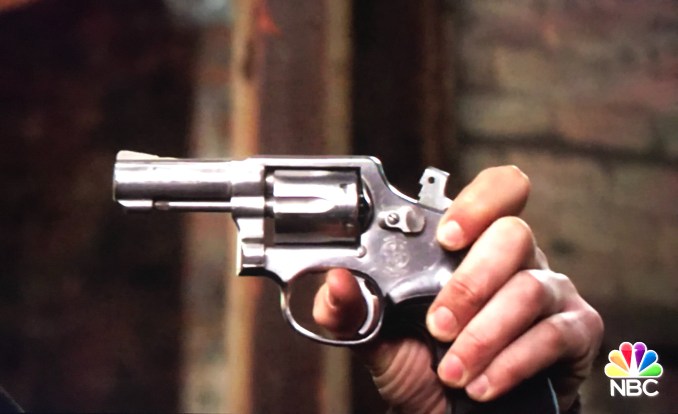
This is a screenshot moments before Lewis pulls the trigger. As you can so clearly see, only Lewis’s left hand is on the gun, not Benson’s. The medical examiner didn’t have this screen shot to examine and had to work strictly from gunshot residue (GSR). And, the GSR tells us (and the medical examiner) exactly what happened. While GSR might be sprayed onto Benson based at the angle and proximity of Lewis to Benson, the GSR would not have appeared on Benson’s free right hand in the correct pattern to implicate her in firing the weapon. The only way Benson’s hand would have had GSR consistent with firing this revolver would have been if Lewis had forced Olivia to hold the gun along with Lewis’s own hand and they pulled the trigger together. While Lewis was twisted enough to think of this, the writers (and the filmmakers) failed to show Lewis doing this.
One might argue that they both played Russian roulette. Well, yes they did. But, it doesn’t explain anything to do with the GSR. Olivia didn’t fire the weapon during this game otherwise she’d be dead. Olivia also didn’t fire this revolver at any other time during this scene. She held this revolver, yes. Yes, her fingerprints would be on the revolver. Since she never fired this revolver (or any gun during this scene), she wouldn’t have GSR blowback residue on either of her hands. This further reiterates this writing blunder.
This means that Benson’s free right hand would be entirely free of gunshot residue blowback in the quantities necessary to prove that she held the gun when it fired. The GSR pattern would have conclusively proven that Lewis held the gun in his left hand alone when it fired, which then conclusively proves that Benson was not holding nor was her hand anywhere near the revolver when it fired. Based on forensic testing of the crime scene, this should all have been captured. This further means that the medical examiner should have ruled Lewis’s death a suicide. The medical examiner was either complicit with Lewis to hide this GSR evidence or this has to be one of the biggest forensic blunders in the history of SVU. Melinda Warner should have her license revoked. Everything that happens next to Benson (accusations from IAB and the Grand Jury) after Melinda Warner’s inept report is entirely the fault of Melinda Warner.
I’ll reserve further judgement of this arc until after ….
Here’s where the fallout from Lewis’s suicide takes shape in the form of legal problems for Benson, singlehandedly because of Melinda Warner’s inept handling of the GSR forensic evidence. Benson is thrown into a long arduous IAB investigation which eventually leads to a Grand Jury hearing regarding Benson’s actions. Since the police headquarters at 1PP are looking for a scapegoat to hang out to dry, Benson is being set up for the fall. The prosecutor in the Grand Jury hearing, Derek Strauss (Greg Germann), appears to intentionally throw out only one-sided arguments regarding Benson’s actions, disregarding all else at the expense of throwing Benson under the bus.
As the hearing progresses, it’s clear this is entirely a fantasy world. Lewis has intentionally left a wake of raped and dead victims all along the way. He’s an escaped convict who is now at large and considered armed and dangerous. He’s also kidnapped a little girl and is now holding her hostage at gunpoint. Oh, but let’s forget all about those pesky details and focus on how Benson lied when she claimed she beat Lewis within an inch of his life while he was cuffed to a bed OR how she *might* have pulled the trigger on this known serial killer, kidnapper and rapist, which the evidence shows she didn’t.
No, let’s simply ignore this killer’s heinous acts, his escape from prison and focus on the red tape to convict Benson by completely disregarding any of those pesky Lewis details that just get in the way of this crap storytelling. Wait what?
What the hell Dick Wolf? You really expect us to swallow this trite, unrealistic, pretentious bullshit?
You can damned well bet that any prisoner who manages to escape from prison will be considered as top priority and not just by SVU. An escaped armed prisoner is well beyond a handful of sex crime detectives to be tasked for recovery. No, his recovery to prison would be top priority by law enforcement throughout the state. When prisoners escape, they aren’t allowed simply to gallivant off into the sunset freely. Worse, after he shot and killed several people at the hospital to escape, he would be considered armed and extremely dangerous. Lewis’s recovery would have been ordered as apprehend by deadly force, if necessary.
Based on this order, whatever it took for Benson to subdue Lewis would have been considered reasonable and appropriate force rather than suspicious. Not only was Benson robbed of her kill. She was then hung out to dry by the Grand Jury for doing her police duty against an escaped and dangerous prisoner. The medical examiner, Melinda Warner, also egregiously failed to do her forensic duties properly with the GSR evidence, which would have clearly exonerated Olivia Benson entirely. Worse, it was an entire slap in the face when the Grand Jury hearing completely and conveniently ignored Lewis’s heinous acts, including the little girl’s abduction and kidnapping let alone his prison escape and his killings along the way.
And here I thought seasons 13 and 14 were bad. Season 15 is the single worst season of SVU by far. But, that’s pretty much because of the William Lewis story arc, which was not only the single worst story arc in the history of SVU, it also has one of the worst casting decisions ever made on SVU with Pablo Schreiber. Schreiber couldn’t act to save his life. This guy simply has no talent, unless you count his incessant one-note stupid smirk-smile as acting talent. In fact, placing this guy into any scene drags down the acting talent of anyone around him.
The second worst casting decision was the introduction of Lt. Declan Murphy (Donal Logue) as Cragen’s SVU replacement. He simply has no charisma at all and no chemistry with the rest of the cast. It was entirely no consolation to the viewers when he steps in and defends Benson in one of the worst monologues in SVU’s history at the Grand Jury. Seriously? You’re going to pick the second worst actor ever in SVU to be the voice of reason and pull off a Benson save? Why couldn’t it have been Tutuola, Cragen or Munch. You know, someone we actually care about and have invested time in, not some random actor you’ve picked up in Toronto. Heck I’d even taken Cassidy, Rollins or Amaro in a pinch. Why choose this guy who’s been on maybe 3 episodes and in whom we have no interest to become Benson’s savior? The is so unsatisfying on many levels.
I realize the show started this story arc and needed to end it. It’s clear, the writers on SVU simply don’t know how to handle anything but fantasy writing with long arcs. There is absolutely nothing realistic at all in the William Lewis story arc… which then led to an entirely unsatisfying conclusion. Sure, he died (or did he?). If we’re going to get into the situation where people can now magically come back to life on this kind of series, then there’s no reason to continue it.
I’m entirely surprised that Mariska Hargitay has stayed with this series after this trash arc. We’ve gone from being a decent police procedural early on with Benson and Stabler to a Buffy the Rapist Slayer wannabe. What’s next? Cartoons running around with the main characters? Or, Superheroes?
This ends the crapfest tale of William Lewis.
S18 E20 – American Dream / Sanctuary
This one starts with a somewhat minor nitpick and progresses from there. After bursting through the front door of Hector Ramirez’s apartment, they find his wife and two kids, but no Hector. After a bit of searching, Detective Carisi (Peter Scanavino) meets up with Detective Rollins in the kitchen with Hector’s wife. Carisi calls the wife by her first name, Soledad. Wait… what?
This writing blunder is that nowhere leading up to the detectives entering Hector’s apartment is it disclosed that Hector’s wife’s name is Soledad. Also, there is no time after they burst through the front door where she discloses her name to them. While it’s possible that Carisi could have looked up her name on the police computer on the way or before heading there, this detail was not established either in dialog or in any other way.
The writers need to be much more careful about these types of establishing details.
Beyond the above, the ICE grab and deport a material witness in SVU’s double homicide case. The SVU team finds out the witness is already on a plane over the Atlantic. Hello? It’s a plane. Contact air traffic control and have them reroute the plane and have it land back at JFK. Then, pick the witness up there. Why does NYPD always feel helpless under certain situations like this? As soon as they found that the plane was in the air, they should made a call and required the plane to reroute back to JFK.
Oh, and this episode gets even worse. How is it that the season ender episodes are almost always the worst written, least realistic and most illogical of the entire season? Anyway, Hector provides testimony to the Grand Jury that he has pled guilty to murder two and kidnapping. Yet, immediately following this, some random shmoe kills Hector just a block away from the courthouse? Seriously?
How is it possible that Hector ended up “walking around” free after having just pled guilty? What the hell is wrong with the writers? How is it in any way believable that the NYPD would let a man who has just moments before pled guilty to murder two simply walk away free from the courthouse? Shouldn’t he have been in custody at the very least? He obviously wasn’t in custody because there were no cuffs. What is it with the writers here? The NYPD wouldn’t be so careless as to let a material witness in an extremely high profile case walk around unprotected on the streets of NYC knowing the amount of protesting at the steps of the courthouse. Yet, the writers want us to believe this? Of course, the writers put Hector into the hospital with a nicked aorta in some dramatic fashion. What’s the point in the hospital scene if Hector dies just moments later? Just have him be dead on the sidewalk. What trash writing!
While I’ll let the child aging thing with Noah slide, I can’t let the whole Benson and Noah and first day of school thing drop. Olivia Benson is a whole lot smarter than this episode suggests. What were the writers thinking? The first day of school and the school finds a bruise on Noah. Olivia suggests maybe he fell down. The next day, Olivia is called into the school and is patronized by the teacher because Noah told the school nurse that Olivia gave him the bruise. The only way she could have given Noah a bruise is when she yanked him off the street just before being run over. Though, I doubt that gave him a bruise.
Because Olivia knows she didn’t give Noah that bruise, she should have turned the tables on that instructor. She should have explained that this is Noah’s first day at this school. If anyone gave Noah that bruise, it was likely someone at the school. Further, she should have strongly suggested to that teacher the she will be opening an investigation into that school for further bruising and other injury complaints by parents. If she finds anything amiss with the school, she would see that appropriate charges are filed against the school and any instructors. She should have put he fear of god into both that teacher and the nurse. Olivia should have made certain that the school understood that you don’t screw with upstanding cops and expect to get away it. Yet, Olivia walks away sheepishly. That is not a Benson cop trait.
Here’s another episode with writers who are writing beyond their means. A girl shows up at the station malnourished, underweight with physical injuries consistent with assault, who we come to know as Esther. She babbles on Bible quotes and it’s clear that she’s not all there. She doesn’t test positive for rape, so they let that one go. Her father shows up and attempts to spout a bunch of holier-than-thou crap and threatens legal action if he doesn’t take Esther home. The father shows a piece of paper that purports that Esther is 27 even though she looks like she’s 16 or so. This means she’s not a child and that child welfare laws wouldn’t apply. Convenient.
Rollins confronts Benson and states they can’t just let her go back home, that they have to detain her. Benson states they have nothing to detain either of them on. Let’s hold it right here. What the hell writers?
It’s clear that Esther is both in physical and emotional distress. In fact, there is at least one applicable New York state law that would have allowed them to detain the father. Specifically, reckless endangerment and assault. There are even degrees to reckless endangerment, but that’s for a court to decide. When Rollins asked Benson to detain someone, the father should have been detained for reckless endangerment. He could have also been detained on assault charges.
Are the writers even trying? This is supposed to be a police procedural isn’t it?
This writing jackassery aside, Rollins goes off on her own to investigate the family. She follows them to a bowling alley as the whole family piles out of a van with a bunch of children. Yet, Rollins just sits there and does nothing? It’s clear that they have underage children. Call ACS right then and there. What the hell is wrong with you, Rollins? Are you even a cop?
The story then escalates into a Waco-like standoff at a house when Esther and a couple of other kids are killed. Later, we come to find through some miracle of writing that one of Rollins’s bullets managed, through brick and mortar, through walls and through kitchen appliances to pinpoint kill Esther in the head… in the back left side of the house, in the kitchen. No, I don’t think so.
Boy, ballistics works fast considering how many rounds were fired and that both suspects only just moments before got into their respective interrogation rooms. Why doesn’t Benson question these findings? Benson needs to investigates the ballistics lab. Thanks writers for not allowing SVU to do its job and stop this before it even started. Thanks writers for pinning it on Rollins with such improbable scenarios. Stupid writing trumps this show once again. *eye roll* This episode’s writing is so atrocious it matches only one other story arc in SVU’s history… the William Lewis story arc. If this is the level of writing we’re getting at this point, I think it’s time for SVU to retire.
I’ll to cut to the chase with this one. Three kids are being accused of rape of a girl on a playground at night. When they’re rounded up and thrown into interrogation rooms, the first kid interrogated says of meeting the girl and her friend on a playground, “They were drinking Absolut. We asked if they wanted to party.”
Then, his lawyer says, “This is not a rape, not by a long stretch.” Carisi interrupts and says, “This victim was incapacitated. She had drugs and alcohol in her system.”
The lawyer leans over to the kid and asks, “Did you know this?” Hello, not 1 minute earlier had that kid confirmed that they were drinking Absolut Vodka. He most certainly did know that, he confirmed it to the cops just two sentences earlier. Was no one listening? Yet, no one calls this out? Stupid writing trumps this show again.
S19 E23 — Remember Me / Remember Me Too
This is effectively a two parter in one and the season ender, not that that makes any difference here. Almost every season end SVU episode is poorly conceived and written. I really should know better by now. I’m not sure what the writers were attempting to show with the Benson character, but this episode is so far from what the show has established Benson to be, it’s beyond stupid. I’m surprised Mariska Hargitay is still putting her name to this farce they call a police drama. Anyway…
A girl meets a guy at a night club and they head back to “his place” for some casual after-club sex. Instead, she pulls a gun on him and holds him hostage. Turns out, it’s not his place. It’s his friend’s place and it’s wired with cameras on the ‘dark net’. Yes, that ‘dark net’ thing rears its tropishly ugly head, again. Anyway, the whole thing is streaming live on the ‘dark net’ preventing law enforcement from finding the location easily. Based on some ridiculous visual and aural clues, Benson and team determine the building’s general vicinity and begin canvasing the suspected area.
Benson, once again, stumbles upon the correct building and, without a partner, manages to find the suite and enters without gun drawn, without backup and without radioing in. Peeking her head in the front door, which was naturally wide open, you can see that the decor matches what they’d been staring at for the last hour or so on the video. Instead of stepping back into the hallway and calling for backup, she rushes in because a cop had already entered… as if that somehow makes the situation in any way okay.
So then, Benson allows herself to become a hostage of this clearly deranged girl, Lourdes, who is holding a revolver on Miguel (probably the same prop used in the William Lewis episode) and she proceeds to listen to what Lourdes has to say. Hold it right there.
I can buy some of this to a point, but story’s writing is difficult to swallow. Benson is a Lieutenant. What the hell is she doing working the field? Cragen rarely, if ever, stepped out and hand participated in investigations. As a captain or lieutenant, this is what your team does. So what the hell, Benson? Shouldn’t you be either back at HQ coordinating from there or standing on the street and coordinating your team from a van? Why are you entering apartments?
Suspending the ridiculousness surrounding Benson’s involvement in the situation she’s put herself in, I can then understand Benson doing whatever she needs to do to diffuse the situation and disarm the suspect. I get it. You say and do whatever it takes to diffuse it. It doesn’t mean you believe a word of what they’re saying, but you agree with and you appear empathetic and sympathetic because you need the situation to be resolved without casualties. I totally get it.
What I don’t get… when the situation is resolved, Benson is still painting the girl holding them hostage at gunpoint to be the ‘victim’. Damn Benson, where the hell is your head? She’s not a victim, she’s a perp facing a class D felony charge in NY. I don’t care what happened in her past. When she pulled that gun and pointed it at a cop’s head (not to mention shattering the skull of and killing the apartment owner), her past history is no longer relevant. If she wanted justice for a rape or trafficking committed on her past, she lost that chance by pulling a weapon on a cop and by assaulting and killing people. She needs to be convicted and sent to prison, end of story for her. If there are any traffickers in Rikers seeking a vendetta there, she should have thought about that before pulling a loaded weapon on a cop and before bashing in the skull of the apartment owner.
As for whether Miguel’s the guy who trafficked her (as she kept claiming), that’s an entirely separate investigation. Hold him and investigate his past. If he was involved in any human trafficking, then go find the evidence to uncover that. As it is, he appears innocent based on his statements. Also, anything he might have confessed while being held at gunpoint by her is considered coerced. It won’t hold up in any court. And, it cannot be believed. He was also doing and saying whatever was necessary to survive the situation. Worse, Lourdes fed him everything he parroted back, which is the very definition of a coerced confession.
In part two, two more improbable things happen. First, Miguel admits to having trafficked Lourdes and other women from Mexico. Convenient. Second, the newest ADA Peter Stone (Philip Winchester) is threatened that his sister may be hurt by someone who seems to be from the Mexican cartel. Comes to find that improbably, a single individual manages to take out the protective detail surrounding where Peter Stone’s sister is being held. Amazingly, even though the entire protective detail, about 3-5 people, are all dead, at least one guy is left alive to tell the police what happened. There is no way that would happen. If the Mexican cartel were to kill the protection detail, they wold kill everyone but the one they want to kidnap. So, the guy who threatened Stone kidnaps Stone’s schizophrenic sister and takes her to a warehouse.
The SVU and ESU teams meet at the warehouse. Effectively, the ESU goes in guns-a-blazin’ ultimately killing Stone’s sister. However, it takes hundreds of round of ammo hitting everything but the target… which eventually does bring down this lone dumbass guy. Did the ESU guys earn their weapons certifications from the Stormtrooper school of weapons training?
Yeah, it’s definitely as bad as it sounds.
Continued Bad Writing
I don’t know what Dick Wolf is thinking with this series in terms of consistency, but he’s definitely put some questionable episodes on the air. However, I will say that from seasons 5-7, the stories were acceptable with the occasional stinker, usually related to the personal lives of Stabler. In fact, the Stabler household stories are usually some of the weakest and most predictable, with Elliot usually abusing his shield to get one of his kids off of some kind of charges.
I don’t even fully understand why Dick Wolf added the Lake character to the cast for season 8. This character was absolutely not needed. He did nothing to fix a perceived squad shortage condition. In fact, the stories never once showed that the squad was short staffed. As an adjunct SVU Bronx character for a single episode, fine. As a recurring character given main title billing, what? This guy can barely act with his incessant mumbling. The only thing he had going for him is his looks… and even that wasn’t enough to carry this character. This actor had zero chemistry with the rest of the cast. Worse, Wolf decided to push Munch aside and partner Tutuola with Lake even though Tutuola could barely work with the guy. It was like oil and water between the original cast and this new guy.
By Season 9, the series takes a serious turn for the worse. At the end of 9, there’s a continuous string of poorly written episodes that show, once again, not only just how green and novice Stabler and Benson are, but also Munch, Tutuola and even the absolutely useless and newly introduced Chester Lake (Adam Beach) character. Starting at S9 E17 to the end, these three episodes are possibly some of the worst writing I’ve seen so far in SVU and is at least as bad as the writing in seasons 14 and 15.
Thankfully, Lake lasted two seasons and departed at the end of season 9 along with ADA Kasey Novak. While losing Lake was actually a benefit for the show, Kasey Novak’s departure handling was surprisingly atrocious. As seasoned a lawyer as Kasey was, she knew the Brady law. Kasey wasn’t at all this level of stupid. Yet, the show treated her like a rookie green lawyer just out of college. It was a cheap and stupid story move. If you’re planning to have an important character like an ADA leave, have them leave of their own accord because they’re a victim. This is Special Victims Unit. Let her become a victim of a crime that leaves an emotional scar so intense she has to move away from the city. This is a fitting reason to leave the series. Using a stupid rookie maneuver to ruin her career says the writers are hopelessly amateur.
The Multi-show Crossover Episodes
For whatever reason Dick Wolf and crew decided to link the his police and fire procedurals together through several different crossover narratives between seasons 15 and season 17 of SVU. This is frustrating on so many levels, particularly if you’re binge watching. The binge watching problem forces you to stop watching SVU and then go and locate the Chicago Fire and Chicago P.D. episodes to complete the narrative. Hulu doesn’t have them. You’ll end up over at Amazon buying the episodes to complete watching the full narrative. THIS is a primary reason the crossovers are frustrating. I’m sure it was fine when they were aired on TV, but when you’re binge watching later on streaming, there is no warning about these in the SVU episodes. They just happen and you’re expected to figure out what the CF and CPD episodes that match are. Otherwise, the episode is just lost on the viewer.
The other problem with these crossovers is the change in show format between the storylines. If you’re used to watching SVU’s way of doing things, you’re in for a culture shock when you watch Chicago P.D. Not only is the entire series format different and, of course, the characters, but the way the story unfolds is also entirely different.
The first three-show crossover between Chicago Fire, SVU and Chicago P.D. saw the worst of the narrative on Chicago Fire. Not only did the writers wait until practically the last second to introduce the crossover narrative in CF, what they did include was pointless. In fact, the tiny segment on CF can entirely be skipped. The SVU episode was average, but not outstanding. The conclusion on CPD was horrid because of not only the change in show format which is jarring, the way the story unfolds is entirely unsatisfying. I mean, you get used to seeing the conclusion in SVU based on the way SVU does things, yet you’re robbed of that conclusion because it ends in CPD with CPD characters using CPD style endings. I didn’t bother to watch the second three-show crossover because, at the time, I hadn’t chased down the other episodes until just now while writing this update. The first crossover was just not worth the time to go watch the second one.
Here are the crossovers if you’re interested in watching:
Crossovers in order of appearance
- SVU S15 E15 Comic Perversion and CPD S1 E6 Conventions
- CF S3 E7 Nobody Touches Anything, SVU S16 E7 Chicago Crossover and CPD S2 E7 They’ll Have to Go Through Me
- CF S3 E21 We Called Her Jellybean, CPD S2 E20 The Number of Rats and SVU S16 E20 Daydream Believer
- SVU S17 E14 Nationwide Manhunt and CPD S3 E14 The Song of Gregory Williams Yates
Enough with the crossovers already, Dick Wolf.
Season 13
This is the first season sans Detective Stabler (see Stabler’s badly handled departure) and the show feels empty without this character’s presence. Worse, the episodes are now slow and oddly paced. SVU now feels more like a soap opera than a detective show. Clearly, the creative team has changed and not for the better. As this season progresses, the writing takes a terrible turn towards the last half of the season. SVU supposedly has one of the highest conviction rates of all SVUs in New York. Yet, you wouldn’t be able to tell this by season 13. This is particularly true of S13 E18 entitled Valentine’s Day. This episode is about an sociopathic nymphomaniac who, in her own trial, tampers with one of the jurors. Yet, even with all of the evidence, Novak (who’s back again, by the way) can’t even get a conviction of this manipulative woman. Who writes this stuff?
If the there’s even a hint of jury tampering, Novak should have called to have the entire jury replaced with alternates. That’s her right to ask for this. Why didn’t this happen? Seriously, let that suspected juror continue? No, I don’t think so.
Worse, episodes which would have been written for Stabler are now being given to Benson and which make her look like a stubborn unwavering cop. Stabler had a temper, could be stubborn and didn’t always follow the rules. Olivia simply wasn’t like this. However, in S13 E17 entitled Justice Denied, this episode sees Olivia wrongfully imprison a suspect 8 years earlier based on a 9 hour coerced confession. That’s not a Benson tactic. That would have been a Stabler tactic. And, 8 years earlier Stabler would have been in the room with her. Where the hell was Stabler during that 9 hours of coercion? If you’re planning to write an episode 8 years in the past, then you better hire in the cast that would have been there at the time… yes, this includes Elliot Stabler.
Additionally, not once in the 12 previous seasons had we seen an interrogation last more than a couple of hours. There were none that took 9 to get a confession. And, if it had taken 9, the DA couldn’t have used the confession because it would have been considered coerced. Further, why wasn’t this given to Munch or Tutuola? They’ve been with SVU long enough to have had such an incident take place. And, both could have been placed in the room at the time. In fact, it would be nice to see old cases before Tutuola or Munch joined SVU to come back and haunt them. It would have fleshed out more details about Munch and Tutuola both whom we rarely get to see much of their past. In fact, we know so little about Munch, it would have been better handed to this character. We already know what we need to about Olivia, there was no need to add this to her repertoire of character development. Giving it to Munch would have worked far better.
Then there’s the episode with Olivia’s half brother, Simon Marsden in S13 E16 entitled Child’s Welfare. We see Simon back creating more havoc for Olivia. Here Simon and his fiancé are being investigated by child services for alleged brutality of his kids. The kids are taken away. Olivia is pulled in by Simon to help him get his kids back. Olivia makes a bunch of stupid decisions again and so does Simon. The episode is a non-starter and really shouldn’t have been greenlit.
Also, why has the series abandoned having a shrink in the precinct. If George Huang had been watching the conversation given by the alleged rape victim in S13 E18, he would have seen how manipulative she was and could have given the detectives advice on how to break her down.
Season 13 is overall poorly written and out of place for SVU. I hope the subsequent seasons after this one get better. I’m unsure why this show has continued beyond season 13 all things considered. This season is a serious low point for the SVU series.
Season 14 and 15
These seasons continue the trend from season 13 and perpetuate the odd, disjointed and poorly written episodes. The introduction of ADA Barba was an odd choice. The departure of George Huang didn’t hurt the series directly, but the show should have replaced the role with a new psychologist character. Without this character in the series, the stories are much less credible. The psychologist who can sit outside the room psychoanalyzing both the suspects and the victims gave immense insight to both the audience and the detectives. Without this crucial bit of information, the detectives seem trapped by their own preconceived notions, which don’t always turn out for the best.
Unfortunately, many of the episodes within seasons 14 and 15 continue the downward writing trend which began in season 13 compared to season 12 and earlier. It seems the show is still reeling from the loss of the Stabler character dynamic whether the creative team recognizes it or not. And as such, they keep giving Olivia all of the weird episodes.
Season 15 is also seeing main character cast departures. With both Munch and Cragen leaving, the show is, yet again, losing more of its mojo and charisma. It’s not that Benson can’t be acting Captain, it’s that it’s way too early after her Lewis ordeal for that to happen. This show just seems to rush things along without thinking the story arcs through. It’s just another form of the World Reset problem.
Seasons 16 and 17
If Season 16 was the return of some sanity, then the insanity returns in season 17 with all of the unnecessary and frustrating Chicago Fire and Chicago P.D. crossover episodes. Season 16 was at least somewhat better than the bottom of the barrel season 15. However, many of the Season 16 episodes were average with many unsatisfying conclusions. If you like SVU, season 16 isn’t a horrible watch. However, Season 17 is terrible with its incessant crossovers. So far, I’m only halfway through Season 17 and there have been 3 crossover episodes. Give it a rest Dick Wolf, will ya? I mean, one crossover episode… okay. But three?
Personally, I find Chicago Fire to be a snorefest. Watching the characters bicker about their problem-of-the-day is about as much fun as burning myself with a lit cigarette. The crossovers were entirely unnecessary.
Arrests and Asking for a Lawyer — Plot Conveniences
This show started off by making a big deal about not being able to arrest people in their own homes. Also, when a suspect asks for a lawyer in interrogation, the detectives must stop what they are doing and walk out of the room. By season 13 and above, these concepts are mere plot (in)conveniences. There have been many times when they have arrested people in their own homes without showing a warrant (one example, S16 E3 — Producer’s Backend) when Benson (of all people) arrests a Lindsay Lohan clone in her own home without asking her to step outside first.
This convenience problem is even worse when it comes to suspect interrogations. I’ve lost count of the number of times that the detectives have continued to interrogate the suspect after the suspect has asked for a lawyer. If the writers can’t even follow the real laws of NY when writing scripts, then why is this show still on the air?
Weird Endings
One of the things that irks me of this show is the odd cliffhanger endings. I’m guessing that this is a thing that the producers like. Well, I dislike it… A LOT. We watch through an episode where Benson and Stabler, Tutuola and Munch run around chasing and apprehending the perpetrator, yet at the very end, the screen fades before we find out the perp’s fate? Isn’t this supposed to be Law and Order? We get the Law part, but where’s the Order? Meaning, once the show catches the perp, aren’t we supposed to get see the adjudication proceedings? That’s the payoff. We want to see exactly how the perp gets sentenced. We don’t want to be left hanging after the fade. When we don’t get to see this payoff, as viewers we feel robbed. This makes watching seasons SVU frustrating and unsatisfying.
Character Musical Chairs
The ADA characters seem to come and go. At first it was Angie Harmon as Abbie Carmichael as a crossover from Law and Order, then she disappears in replacement with Stephanie March as Alexandra “Alex” Cabot. Before March joined on, it was a random array of ADA characters in and out with Angie Harmon in a lightly recurring role. In fact, I would have preferred to see a guest star in the ADA role every week. It’s not realistic, but it allows the show to hire a guest star whenever an ADA character role is infrequently needed. It’s not that I don’t like Stephanie March as an actress, I just don’t like the Alex character whose ideas blow with the wind… or more specifically, whichever way the writers need her to blow to make the episode work.
Stephanie’s acting of Alex certainly comes across as staunch, righteous and indignant as a DA’s office defender, sometimes to the point of endangering people’s live. I always felt that ideology was wrong for the role. Angie Harmon’s character was a whole lot more right for it. Not sure why the show went with March over Harmon in the early seasons.
Then there was detective Monique Jeffries (Michelle Hurd) and several medical examiners before the show settled on Melinda Warner (Tamara Tunie).
Also, the first psychologist Emil Skoda (played by J.K. Simmons) disappears for a random second replacement with George Huang (played by BD Wong)? In fact, I liked Emil Skoda better because he at least he acted normal with reasonably normal dialog. The George Huang character has both an oddly soft speaking style, a condescending tone and pretentious dialog as to be distasteful. Why the producers thought this character might be a better choice, I have no idea. You do want your main characters to be likeable, right?
What’s with the introduction of Detective Lake in Season 8? I know they trialed this character in an earlier episode. I didn’t like him then. Yet, Dick Wolf decided to bring him back in as a regular in season 8. He lasted two seasons before being given the boot. This character was a horrible addition to the squad room. Not only was he now the odd man out, the actor Adam Beach had no chemistry with the cast. Whenever he was featured in an episode, I found it excruciating to watch. The actor mumbles and chews his words badly. It’s not a good trait in an actor. I know he has other acting gigs under his belt, but Adam Beach was way out of his element in this role. It’s good thing that Dick Wolf dumped him at the end of season 9. He should have been dumped earlier.
Next, it’s Declan Murphy.
Elliot Stabler’s Badly Handled Departure
This one goes hand-in-hand with the musical chairs of cast. While it’s always up in the air what happens behind the scenes with an actor’s contract negotiations, it’s crystal clear what happened (or, rather, didn’t happen) with the exit of Elliot Stabler. Basically, Stabler is there one episode, gone the next. The all of about 5 minutes of screen time devoted to the memory of Elliot Stabler was so tritely handled in S13 E1, the show should have convicted itself of a crime. Considering how long this character had been with the show, Stabler deserved a properly crafted longer story arc exit. Instead, we get the most minuscule thing possible in the opening of Season 13. This crap treatment treats Elliot with all of the grace as one time throw-away characters. Even Sonya Paxton’s ADA character got a more befitting exit from the show than Stabler.
I can’t understand why the show runner didn’t at least have Olivia stop by Stabler’s house and have the tiniest bit of a conversation. Heck, even if Stabler did quit the force, that wouldn’t have quit Olivia’s friendship with Elliot. She should still occasionally stop by on her off time to catch up. Eventually, they might grow distant and lose touch, but not right away. And, what about Stabler’s wife and kids? That whole family was a staple on the show… and then what? They’re just gone? How hard would it have been to at least contract Christopher Meloni for one episode in Season 13 to give proper closure to Elliot Stabler and family?
What I will say about this is that the dynamic of SVU changed dramatically (and not for the better) after Christopher Meloni’s departure. Mariska Hargitay just doesn’t have the same chemistry with the then new rookie cast members. Season 13 simply doesn’t have the same feel as previous seasons for many reasons beyond just cast. Stabler and Benson were the cornerstones of SVU. To kill the show’s chemistry so completely by not keeping Elliot is just stupid. Even beyond Stabler’s crap departure, it also doesn’t help that the episodes in Season 13 are much slower paced and oddly off-key than in previous seasons. That’s partly because it seems they also changed the show runner. It also seems they try to give stories which would have been better handled by Stabler to Benson. The stories just don’t work. Let’s just hope that from here the show gets better again in later seasons, but I’m not holding out much hope.
Duds
With any series, there are always duds. In the case of SVU, there’s a first season episode that stands out: S1 E12. In fact, it’s so bad I couldn’t make myself watch the whole thing. It’s about a rich guy who gets killed leading to some Russian females as suspects. This episode is jam packed with Russian stereotypes.. to the point that they hired white American actors and asked them to put on fake Russian accents. It was not only cringe inducing to watch, the episode was highly boring. Skipped this one. If you can’t do it right, don’t bother. This is not the only episode this bad. I’ve skipped 2 others in addition to this one in 3 seasons. I guess that’s not a bad track record, but a good TV show shouldn’t have any worth skipping.
World Resets
More bad writing here as this style of episodic TV is one of my biggest pet peeves. Here we have a story about Stabler who assigns a protective detail to Benson (against her wishes and unknowing to her) because a former case perp has come back to haunt and target her. When Benson finds out about the protective detail, she becomes distraught and distrusting of Stabler (her partner) to the point where she avoids him. By the end of the episode, Benson isn’t on speaking terms with Stabler and she is sitting at home alone crying, fade out. The next episode, Stabler and Benson are happy as larks working together just fine like nothing ever happened. This lack of continuity in character relationships drives me nuts. How can you have two characters who have this level of falling out and then the next episode it’s like the world has reset and nothing has happened? There has also been no further mention of this issue in later episodes. So, what gives SVU? If characters have a falling out, then carry it over into the next episode…. or fix the problem before the episode ends.
Note that similar issues occur between many episodes. This example above just happens to be one of the most egregious I’ve seen to this point. What’s more frustrating about this situation is the randomness at which the writers choose to or not to world reset. Sometimes the show continues to carry forward plot ideas, sometimes it doesn’t. It’s entirely random.
Overall
Many of the stories are watchable if not predictable, but be prepared for the problems described. Also, how many stories can be written about rape? Most SVU stories are about female rape victims. Even in the 3 seasons that I’ve watched, I feel the stories are already treading dangerously close to one another. I’m unsure how the show has managed 19 seasons worth of original stories. Though, the episode about a male being raped by 3 women brings up a very good point at a time when it wasn’t considered possible. This story is a bit hackneyed. I would have preferred a more legitimate story rather a private male dancer who took money to please the women who allegedly raped him. Ultimately, because he was a male dancer for pay, the women got away with the rape. This episode would have been far more interesting to watch if the male could have conclusively been found to have been raped without the extra mitigating circumstances.
With SVU, it seems the writers like to add circumstances to the plot to intentionally make it more difficult for the DA to prosecute or simply to further convolute the plot. I’m not trying to imply that cases of rape are easy to prosecute in any way. But, some cases are likely to be easier than others depending on the circumstances. SVU should show cases of all difficulty levels. Some unwinnable, some practically handed to them on a silver platter and many somewhere in between. It seems the writers preferred creating stories about the most difficult end of the spectrum (i.e., extremely hard to impossible to prosecute).
I give Law and Order: SVU a 3 out of 5 star rating. Most of the positive portions of this rating is due to the stellar cast up to season 12. At season 13, the stellar casting breaks and doesn’t really recover. While the story writers do not get the stories right each time and the fact that there have also been a number of technical filming problems, up until season 12 th actors have amazing on-screen chemistry and give it their all each and every episode. They also do a spectacular job even with the crappiest of stories and dialog. Even as good as the actors perform and as decently written as some of the stories are, the mounting technical problems combined with progressively sucky plots, poor endings and near constant cast changes drags down this rating and this series.
If you enjoy reading Randocity articles, please click ‘Follow’ at the top, like, share and leave a comment below (not necessarily in that order).
↩︎
Fan Backlash: What’s wrong with Star Wars?
 I’ve been watching several YouTube channels recently… yes, I do watch YouTube. And yes, there has been a huge fan backlash against the latest Star Wars installment, The Last Jedi. Some of these channels outright blame the social justice warriors for the fundamental problem. I don’t agree. The SJWs aren’t to blame, Disney and Kathleen Kennedy are. Let’s explore.
The Original Trilogy
Episodes 4, 5 and 6 are arguably the best of Star Wars. These films were created and conceived by George Lucas. We got a tiny taste of the cutesy characters the Jawas and R2D2 in A New Hope and again with Yoda in The Empire Strikes Back, but these characters were tempered to avoid becoming cartoons. As fans, we were able to mostly ignore these cutesy characters because they were limited in scope and/or served a genuine purpose (more than being cute). George then pushed the bounds again in Return of the Jedi with the Ewoks. These little cutesy bundles of fur were almost entirely “for the kids” and very much cartoons. Thankfully, the introduction of these cuddly characters didn’t entirely ruin the plot of the film. Yes, they were cute, but most of us were able to get over the cute-cuddly teddy bear nature of them. However, George was skating on thin ice with these characters. Many fans weren’t impressed. Still, Return of the Jedi worked as a sufficient ending to the original trilogy.
Thankfully, at the time, social media was non-existent. The only people who could effectively and loudly complain about it were the newspaper critics. The fans had no outlet for their own outrage. The Internet was just budding, email didn’t exist and neither did Twitter, Facebook or any other social site. Fan complaints traveled almost entirely by word of mouth (or via the convention circuit).
The Prequels
By 1999, when Episode 1 — The Phantom Menace premiered, email, text messaging, blogging and even early versions of social media began their rise to becoming ubiquitous. This is the time when fans finally had not only an outlet for their words, but people to read them. Not long after this period of time is when the term ‘social justice warriors’ would be coined. At this time, they were simply called, ‘keyboard warriors’.
When George introduced Jar Jar Binks, he took the cutesy cartoon idea to extremes producing one of the biggest pop icons of the era and simultaneously one of the most derided characters ever to grace the silver screen, let alone a Star Wars film. Many people have a love-hate relationship with Jar Jar.
Not only is Jar Jar very much a cartoon character, he’s also a politically incorrect figure in so many different ways. Not only in his voice, but in his manner of speech and in simply what he says. This is through no fault of the voice actor who portrayed Jar Jar. This is the fault of George Lucas. This is also where Star Wars effectively “jumped the shark”, but not solely because of Jar Jar. Oh certainly, Jar Jar heavily contributed to this, but writing a trilogy long story about the origin of Darth Vader is, well, pretentious. It really doesn’t take 3 films to show the entire Anakin Skywalker story. That could have been condensed into one film leaving two others to show Darth Vader doing nasty things and birthing the rebellion. Instead of boring senate scenes about trade blockades (*yawn*), we could have been watching Darth Vader and the Emperor fighting the beginnings of the rebellion (much more interesting).
This is where George has not only fallen on that thin ice, he fell through it. This is where George finally got a taste of fan backlash. Backlash that he would have gotten a whole lot faster had social media existed when the Ewoks showed their cute little faces on screen the first time. No, he had to wait until the prequels were released to finally get a taste of what would become Social Justice.
It also didn’t help that George’s revisionist tendencies led him to re-release the original trilogy with updated CGI visuals and modified scenes. In combination with the prequels, this led fans to begin their disenchantment with the direction of the Star Wars film universe. Did it really need to be revised who shot first in the cantina scene?
The Disney Films
Because of George’s less than stellar trilogy story in the prequels (Episodes 1, 2 and 3), George felt downtrodden and unable to produce more Star Wars films. Ultimately, he sold the franchise to Disney.
By 2015, with the release of The Force Awakens, fans were more excited than skeptical. By this time, not only had social media well matured, we now have instant access to it anywhere. Yes, even in the theater while watching it. It was inevitable that people would post their reviews within minutes of exiting the theater, possibly writing it while they were watching. Initially, fan reviews of The Force Awakens were positive. However, as fans mulled over the film on social media and via other means, it became clear just out vacuous this first new installment really was.
Yes, The Force Awakens feels like a Star Wars film, but it isn’t a Star Wars film in structure. It’s a J.J. film. After a few months of mulling over what The Force Awakens meant, it was quickly clear that it simply wasn’t what fans wanted.
Hollywood’s Affirmative Action Plan Initiative
Since at least 2014, the gender and ethnic equality war began in Hollywood in earnest. Since then, Hollywood has been sacrificing its screenplays and film profits (and projects) to the Hollywood Affirmative Action Plan Initiative (HAAPi — pronounced “happy”). Instead of telling stories as written with characters as created, directors and producers now feel the need to rewrite and cast politically correct ethnic and/or gender bending casts at the expense of producing a high quality entertaining film that will become a box office success.
Here are are two examples:
- 2016’s Ghostbusters reboot was recast entirely with women in the lead roles
- 2015’s Johnny Storm was recast as a black male against his white female sister in the latest failed Fantastic Four… not how the comic was written.
Both of these films I’d classify as box office bombs sacrificed to HAAPi. Bill Cosby and Harvey Weinstein have additionally been sacrificed to this movement. I’m not sure if the women of Hollywood intend to bring down the entire film industry or what exactly is their agenda, but trying these silly shenanigans in an effort to force a cast of women and ethnic minorities at the expense of a logical story is insane.
I am 100% for gender and ethnic diversity in casting … When. It. Makes. Sense. Don’t do it because you can, do it because the story requires it.
Do you want to make money or do you want to make a point? Let’s hope this trend ends before all of the studios in Hollywood end up bankrupt. On the other hand, perhaps it is time for Hollywood’s day to end.
The Last Jedi
To some extent, The Force Awakens’s sacrifice to HAAPi was both inevitable and thwarted. Because this was the first installment and these were brand new characters, we ignored HAAPi (for the most part). As excited fans, we were able to look past HAAPi and ignore any specific casting defects in starring roles.
However with The Last Jedi (helmed not by J.J. Abrams like The Force Awakens, but by Rian Johnson), this film not only succumbed to HAAPi, but slapped us fans in the face with it like a dead fish. Instead of casting smart, Johnson (and Kennedy) cast HAAPi. With Rose Tico, we ended up with an Asian female. There’s nothing specifically wrong with this casting choice if it had happened in The Force Awakens. Instead, because of HAAPi, this character was shoehorned into a main character role at a time when the character was not needed. This character was also shoehorned into a plot device that just didn’t work. In fact, the entire romp between Finn and Rose was entirely pointless for this film and wasted about 15-20 minutes of screen time. Perhaps the resistance ring Rose handed to the boy may have some level of significance in the final film… or it may not. That ring could have been given to the boy in so many other better ways by already established characters.
Also, why introduce Rose at all? She’s a wrench jockey who fixes things. She doesn’t appear to have force powers. What is she likely to bring to the story of any real importance? You can introduce a Rose-like character in a series like Clone Wars or Rebels because it’s a multipart series. There are so many episodes, characters need to come and go. In a trilogy, every character introduction counts. And, such an introduction takes away character development time from other characters. We already don’t know enough about Finn, Poe and Rey, we don’t need yet fourth character to have to get to know.
The reason Star Wars the original trilogy worked is primarily because of the triangle lead roles of Luke, Leia and Han. We had that triangle going with Finn, Poe and Rey. Yet, now we have Finn, Poe, Rey and Rose (?). This character has upset that triangle. If you’re going to do that, then the story should have introduced this character in the opening film to this trilogy.
The Rose problem exists entirely because, like 2016’s Ghostbusters and 2015’s Fantastic Four, The Last Jedi has been sacrificed to HAAPi to solve a perceived film deficiency, not because the story needs it. This time, however, fans were able to lift the HAAPi veil and see through it for what it is… sad. And so, the fan backlash ensues.
Star Wars is a fantasy series. Bringing Hollywood casting agendas into a film’s story isn’t what fans want to see. This not only insults the fans’ intelligence, it insults the fans. What else would Disney expect to happen? Using a franchise like Star Wars to further a Hollywood agenda is entirely insane. Disney and Kathleen Kennedy, you need to get your shit together and wake up. HAAPi is trying to solve a problem that doesn’t exist and it doesn’t belong in Star Wars.
The Final Film
This film has not yet released as of this article. However, it’s almost certain that not only will this film bomb at the box office, it may end the franchise entirely. Disney would be wise to shelve this last film and any future Star Wars film projects until this whole thing blows over… and Disney, you need dump the current team working on it including Kathleen Kennedy.
Let the final film stew for a few years. Make the fans wait until they clamor for it. Make the fans want it. Putting it out right now is a recipe for box office failure. This franchise is already skating on thin ice because of HAAPi. It’s almost certain that the final film will also be sacrificed to HAAPi. Abusing HAAPi makes me (and many other Star Wars fans) very, very sad.
What does “moving the plot forward” really mean?
This is a good question and it’s a question that many recent screenwriters and storytellers have lost sight of in their zeal to create blockbuster entertainment. Let’s explore the answer to this question.
Important Details
What is good storytelling? Good storytelling is the ability of the writer to keep the audience’s interest, develop interesting characters, tie story details together and all while keeping the story moving. How does this all work?
It means that if you introduce something into your story that’s important enough to call your audience’s attention to it, then it’s important enough to bring it around later and give it closure. It’s as simple as a character pulling a box of cereal from the cabinet, spilling it into a bowl and putting it away all in the span of a page or two. That’s a quick open and close to that box of cereal. Not only is it an important character detail… “the character likes cereal”, it can be used as metaphor for your character (spilling the beans or in other foreshadowing ways).
If it’s important enough to understand that the character likes cereal, then it’s important enough to bring that plot detail back later. It’s also important to use this plot device. If a character pours a bowl of cereal, have them at least take a bite. You don’t pour out food as a thing to do. You do it because you’re hungry.
It’s can also be as detailed as a character buying a car at the beginning of the story and driving it cross country to their destination. It’s the thing that helped the character get where they needed to go.
There’s lots of story reasons that make both that box of cereal or that car important in the larger story and to carry the story forward. It’s that realization later that, “Oh, now I understand why that [insert thing] was shown to me 30 minutes earlier.”
Character Motivation
Characters need motivation to do the things they do. If the movie is about a missing child, then the parent as a main character has a goal of getting the child back. Their motivation is then doing whatever it takes to make that happen. Motivation is a critical plot point that many fail to understand or use properly. Without proper character motivation that the audience can understand, the story doesn’t work.
Unimportant Plot Details
Recently, many stories are breaking the “moving the plot forward” rule and are writing and presenting details that don’t have any follow up or, indeed, any relevance to the story.
In murder mysteries, these “seemingly unimportant details” are important to throw the audience off and make the audience assume the wrong thing about who did it. Typically, murder mysteries either quash or validate all of those seemingly unimportant details in the end to explain how it was done. In a fantasy story, including these types of details only serves to slow (or stop) the plot and bore the audience. Worse, when the audience looks back over the story as a whole, they realize that they wasted 15 or 20 minutes of their lives on details that didn’t progress the story.
This is important, particularly when telling a story that needs to make sense (specifically if it’s part of a series of books or films). If you’re writing for a film, you need to treat each film is a standalone entity and as a whole, never as a part of a set. The only time a detail should be left open is at the very end to create a cliffhanger. Cliffhangers should only be introduced at the very end of a story, never in the middle of your story. However, foreshadowing is a form of a seemingly unimportant detail, but that can be easily overlooked because of its lack of context for the audience at the time.
A cliffhanger introduced in the middle of the story makes you look like an amateur author. That is, someone who can’t be bothered to close all ends of presented details. If you don’t close details, you better make it appear to be intentional. Otherwise, it’s an amateur move.
Introduction of Scenes
Many movies today introduce scenes into films that have no followup and no explanation. If you’re planning to have your characters do something in a scene, that scene must be important for something in the future.
For example, if your characters need to go to the grocery story to pick up something, then make the grocery store scene count in some way. The characters meet someone there who imparts an important story detail or item (even if hidden). Use the scene as important to the story. If showing the grocery store is important enough to describe in detail, then it should be important enough to advance the plot. Otherwise, cut the scene out. Simply explain the characters have left for the store at the end of one chapter and have the characters arrive back from the store at the beginning of the next chapter and skip the grocery store environment altogether.
The point is, if a scene is important enough to include and describe in detail, then the scene should impart important plot details that move the story forward.
Montage Scenes
There are many ways to show passage of time. On the pages of a novel, you can do it between chapters simply by explaining the date and time when appropriate. On screen, it’s simple enough to show passage of time through a montage of daily activities. Instead of deep diving into every activity, you simply show a quick succession of scenes that show details (shopping, driving, running, tennis, etc). Whatever the scenes are, they should impart character details that lead up to wherever the plot is heading. It isn’t important to show everything the character does, but it may be important to know some of the daily activities a character enjoys doing when developing a character.
Again, if it’s important enough to show the details, it’s important to use this information to advance the plot. When it’s important to show a bunch of details in quick succession, this can be done through montage scenes without character dialog. In fact, tension scenes and montage scenes without character dialog are a whole lot more effective than characters talking or arguing.
Write with Intention
The point to all of this is, as a writer, you need to write with intention. Make every word you write count towards the plot. If you write a scene that doesn’t make sense, doesn’t follow logic, is out of character or doesn’t impart any new or relevant information, cut it. Scenes that stagnate the story make the writer seem distracted and amateur. Write with relevance, write with detail, write with intention.
Sure, go ahead and write and get your story done. But, be prepared to edit and trim those sections and details that don’t affect the plot. If you’re writing an action story, then you want to keep the action going. Having your character stop and spend 30 minutes in a cemetery bereaving a loved one doesn’t move your story forward. Cut it. The only time you could use this is if your action character goes to the cemetery looking for bad guys. Setting this location up for an action scene is fine, but just going there not to do anything, that’s story death.
Always keep your story genre in your mind when writing. If you’re writing a murder mystery, then keep on that track. If you’re writing an action fantasy story, then make sure it stays true to that. If you’re writing a family drama, then stay true to that. Don’t hop around genres hoping to hit gold. The audience will not only end up confused, they won’t know what’s going on. Stick to your genre.
Closing Threads
If you bring up a story detail early, be sure to close it later. What that means is, when writing your story, keep a list of open story items and then find the best places to close them. If you can’t find a place to close a detail, get rid of it from the story as it’s an unimportant detail.
For example, if a character drops their car off at a mechanic at the beginning of the story, then make sure the character picks it up later. It could be at the very end of the story or it could be anywhere along the way. Just make sure it happens. If the audience gets to the end of the story and is still left wondering what happened to the car (or why the car detail was included), you’ve failed as a writer. If you leave two or three of these plot devices open, it makes you look amateur. Close all open threads in meaningful ways and at appropriate times.
Visual Storytelling versus The Written Word
In a novel, it’s important to describe very detailed descriptions of a scene, of the character’s dress, demeanor, looks and so on. When writing for the screen, let the visual elements do the talking. You don’t need to have characters describe what they are seeing or doing. It’s redundant and unimportant and can be seen by the audience. The only time this works is if a character is talking to another character on the phone or over a radio. Here it’s important because not only is the audience finding out what’s going on on the other end of the phone, more importantly, so is the character.
It’s more important to have the characters unfold their stories themselves rather than catering to the audience. In visual mediums like film and TV, let the camera describe the scene. Don’t have the character (or a narrator) do this unless the character is blind or in some other way handicapped and needs this information. It has to make sense for the character in the story. Never cater to the audience by describing in visual medium. In the written word, it’s required to describe all of the details because the audience won’t have any other way to get this information.
In a way, a novel is just the opposite for descriptions than visual medium. You almost have to be too verbose when composing for the written word. When composing for film, you want to be the least verbally descriptive as possible. Let the audiences see the wonder themselves.
Writing for the Characters
The story is always about the characters, never about the audience. Sure, you can have the character break the “fourth wall” if it’s an important story detail (i.e., a running gag). The problem is, breaking the “fourth wall” takes you out of the story and is firmly rooted in writing gags for the audience. If you take your story seriously, then don’t do this. For some stories and characters, it works fine. For anyone writing a story where the characters are the most important thing, then don’t write gags for the audience.
Humor is fine when it’s between the characters, but when it becomes the characters interacting with the audience, this stops the story and makes the audience realize the gag (and loss of suspension of disbelief).
Suspension of Disbelief
To rope an audience into your story, writing solid, believable characters is the key. It doesn’t matter what the characters are doing or where they are placed, it matters that the audience believes the characters can do those things in those places. This is a powerful concept that is also the key to good storytelling. Doing even one thing that ruins this suspension of disbelief ruins your story. It’s the thing that can make or break your writing efforts. This concept is the quintessential key. Having an audience suspend their disbelief and buy into your fanciful world is the magic of a successful story.
For example, using a fourth wall gag can make or break your story. It also requires a certain kind of story to succeed. In other words, adding such a fourth wall gag makes your life as a writer much more difficult. If you’re not accustomed to what goes along with such a gag, you should avoid it. I’d also recommend avoiding it because it really does nothing to progress the story and it does much to discredit your story up to that point.
Cliché Tropes
Let me say right now that nothing today is original. There is always something that can be found as derivative of something else. As a writer, you have to accept that notion going into your story. What makes your story original is not the setup, or the locations or even the plot, but how your characters deal with their situations. Characters are what drive stories. Yet, tropes are what make stories fanciful and, sometimes, fun to watch. Using them isn’t necessarily a bad thing. Overusing them, however, most certainly can be bad. Using a trope here and there can make the story familiar to the audience. Familiarity allows for the audience to latch onto your story faster and ‘get into it’.
There are lesser used and more frequently used tropes. You should avoid the frequently used tropes and focus on those that are lesser used. Having your characters doing something a little bit unexpected or unpredictable can make the story work better. Tropes add predictability to the story. This can be a good thing when you’re trying to lead the audience off the track of what the characters are really doing. This allows you to trick your audience into believing one thing, when the characters are actually doing something else. Some audience members will see right through that, though. You have to expect that.
I’m not saying not to use tropes, just use them sparingly and at appropriate times. Again, write with intention. Make every word and thought count. If you’re including it, make sure that it serves a purpose (even if it’s a cliché trope).
Character Development
This is probably the most important element to establishing suspension of disbelief. Grounding your characters in a reality that your audience can understand goes a long way towards getting your story off of the ground. Basically, you want to properly introduce your main characters at appropriate times. Your main characters should, unless the story warrants it, remain throughout the entire length of your tale. They may face adversity, trials and even risk life and limb, but they should survive the tale.
Killing off your established characters is not only a waste, but usually unnecessary. On the other hand, secondary characters can be treated with all of the careless abandon that you choose. If they live for a page, so be it. If they fall off of a cliff, so be it. If they disappear and reappear in the story, so be it. It’s entirely up to you how you handle secondary characters.
When building your main characters, it’s important to understand their motivations, wants, likes, dislikes, hobbies and desires. You can unfold these along the way, particularly when it’s important to move the story forward. With secondary characters, you don’t go nearly as deep. Secondary characters are, for all intents and purposes, scenery. They’re there to show that other people live in this same universe, but they don’t need to be fleshed out to exacting detail.
Identifying Plot Moving Details
If you intend to flesh out a secondary character with heavy detail, then you should make them a main character or avoid fleshing them out. The home life and kids of a cashier at the above grocery store is an unimportant detail. It slows down the plot and story pacing to learn more of this character when she serves no future purpose in the plot. If the cashier doesn’t swoop in to save the day at the end, then there’s no point in including heavy detail about that character.
This is how you identify useless versus useful plot points. If you introduce a plot point and it comes around later, then the point of introduction did move the story forward. If you introduce a plot point and it never comes around later, then it didn’t move the story forward. Anything that doesn’t serve to move the story forward should be cut from the story.
This is why you need to read and re-read your story several times front to back. Then, let other people read it and offer feedback on your story’s logic. If you’re a one-man team writing a story without getting outside feedback, then your story is likely nowhere near as good as you think it is. It takes other people to help you find the weak spots and fix them. Constructive criticism is always your friend. Use it to improve your stories. The final advice is, never take your first story draft as your final. Nothing is ever written perfectly the first draft. Not even this blog article.
Examples of Bad Storytelling
I didn’t include any real entertainment production examples in this article because I want it to remain as an objective guide to would-be storytellers rather than as a rant against any specific entertainment production, even though those productions well deserve the rants.
With that said, I do intend to write a follow-up article with examples identifying recent entertainment story failures and call out why and how they failed. I will also mention that this problem is not limited to film and novels. It also rears its ugly head in video games and in TV series. I will also mention that some bad storytelling isn’t always the direct fault of the writer. Though, the writer is somewhat culpable. Instead, it can be because of politics within the production (i.e., inclusion riders). Sometimes characters or specific actors are forced into a story, not because they were there, but because the producer wants it in the production. This forces the director to introduce something that shouldn’t be there and throws off the entire story’s logic. Note, I do classify this politically correct shoehorning as a failure in writing.
Basically, when writing your story’s setting, make sure to represent all ethnic groups and genders equally or face the consequences if your story is ever optioned for the big or small screen. Otherwise, expect your period piece’s story logic to fall apart when an ethnic cast is chosen to play a small white mostly male mid-America town set in the 70s.
Note, there is tons more that I could write about this topic. However, this guide is simply intended as an ‘Intro Guide’ on good storytelling. If you would like me to flesh out this article in more detail, please leave a comment below about what you would like to see included.
How to use your PS4’s DS4 controller on Windows
 In a follow-up to the Randocity article How to pair your PS4 controller wirelessly, this article is an extension to explain how to pair a DualShock 4 controller to Windows via Bluetooth. Since that pairing article shows you how to pair a DS4, this article will show you how to make use of it on Windows.
DS4Windows
You’ll need to download DS4Windows for your system. Note that there are two releases of DS4Windows. One by Jay2Kings which has been abandoned and a newer fork being handled by Ryochan4. You’ll want to get this newer version from Ryochan4. This version is being updated constantly.
- Windows 7 or newer
- Microsoft .NET 4.5.2 or higher (needed to unzip the driver and for macros to work properly)
- SCP Virtual Bus Driver (Downloaded & Installed with DS4Windows)
- Microsoft 360 Driver (link inside DS4Windows, already installed on Windows 7 SP1 and higher or if you’ve used a 360 controller before)
- Sony DualShock 4 (This should be obvious)
- Micro USB cable
- (Optional) Bluetooth 2.1+, via adapter or built in pc (My recommendation) (Toshiba’s bluetooth adapters currently do not work)
Xbox 360 Controller Emulation
This driver works by latching onto the Xbox 360 controller emulation system that’s available as an add-on in Windows 7 or newer. As you’ll note, you’ll need to install the Microsoft 360 Driver if you’ve never used a 360 controller on Windows. If you have previously used a 360 controller or you are using Windows 8 or above, you can skip that installation step.
Downloading DS4Windows
To download the latest version of DS4Windows click through to this link:
Choose the top most release number. As I write this article, that number is version 1.4.119. However, if you’re reading this 6 months from now or later, it will likely have changed. If you’re running 64 bit Windows, download the x64 version. If you’re running 32 bit Windows, choose the x86 version.
After you download it, you’ll extract out the zip file which contains the following files:
From here, double-click the DS4Windows application icon. Note, Windows may warn you that this application is from an unknown developer, be sure to click ‘Run Anyway’. There’s no way around this issue because this developer has chosen not to code sign this application.
Once you run DS4Windows, you should see a window that looks like this:

Follow these steps:
Step 1: Install the DS4 Driver — Click the Button highlighted in red
Step 2: Install the 360 driver (only needed if Windows 7 or below). Skip this step on Windows 10.

Step 3: Connect your DS4 Controller

From here, you’ll need to choose if you’re going to use this controller via USB cable or via Bluetooth. If you have a USB cable, then follow the instructions at the top of the red box. If you intend to use the controller wirelessly, then follow the (optional) Bluetooth instructions at the bottom of the window above.
If you’ve chosen Bluetooth, then change settings by clicking the ‘Bluetooth Settings’ button and connect the controller to Windows through Windows’s control panel settings. Once you click on Bluetooth Settings, you should see a window appear like:

Make sure Bluetooth is enabled on your computer. Then, click add a new device. From here you should see a window like so:
Click on Bluetooth type devices and make sure the controller is in pairing mode. It should show up as ‘Wireless Controller’. Select it and it will pair. After this, DS4Windows will ensure the proper drivers are loaded for this controller. You’ll see a few notifications pop up regarding installation of various controller drivers for this newly found controller.
Step 4 — Finished

Once that’s all complete, you’ll see the DS4Windows main window now looks like this and contains your new controller:
Your controller’s ID will be different than mine. Note, like the PS4, you can only connect a maximum of 4 controllers using this tool.
Using your new DS4 controller on Windows
After you get your controller set up to this point, you’ll need to select and/or create a profile. A profile maps the controller’s buttons and joysticks to actions on Windows (or a specific game). When you click on the Profiles tab across the top of the window, you can create new profiles or import existing profiles that you’ve downloaded.
I’m still on the lookout for a high quality archive of profiles for specific games. Unfortunately, I’ve not yet found any. For the time being, you’ll need to create your own. Setting up profiles goes beyond the scope of this installation tutorial. However, I will leave you with a few YouTube videos to get you started.
Note, the above video does not have sound.
Jump to 6:53 in the above video to begin the mapping setup tutorial.
Profiles
If I manage to find any preexisting game profiles, I will create a list below of their locations. If you have a specific game that needs a profile, please leave a comment below and I will attempt to locate a profile for you. Note, however, I can’t create any profiles where I don’t have the game installed. The best I can do is look for someone who has already created a profile and point you there.
Request for Profiles Bounty
For all readers, I have a request. If you have any existing DS4Windows profiles that you have successfully used on a game, please contact me. If you’re willing, I’d like to create an archive of your DS4Windows profile(s) here on Randocity. For every profile you upload, I will list your name in credit to the profile.
Now, here’s the challenge. To get this DS4Windows archive started, the first person who uploads 10 functional DS4Windows popular game profiles to this archive will receive a new Sony Dual Shock 4 controller as bounty. This offer is good throughout the world, but void where prohibited. This bounty is valid through December 31, 2018. All entries must be received before January 1, 2019. To submit your entries, leave a comment below or use the Randocity contact form. Be sure to use your contact email address in your WordPress account so I can see it to contact you. Do not leave your email address in the actual comment. Note, this bounty is separate from the 500 million limited edition controller giveaway on a separate article… which means you have the possibility of receiving 2 controllers if you submit 10 functional DS4Windows profiles here in addition to entering that giveaway.
As always, if this article is helpful to you, please leave a comment below. If you like what Randocity offers, please click the Follow button in the upper right corner to receive notification of new Randocity articles.
↩︎
Game Review: Detroit — Become Human
 I’m usually a big fan of Quantic Dream video games. However, this one tries a little too hard and fails in many ways. Let’s explore.
SPOILER ALERT
If you’re interested in playing this game, this review may contain spoilers. You should stop reading now and play first. I encourage you to come back to this review once you have played it.
Story
This is a story of android emancipation. The world has androids as servants which are being sold in retail stores. They are used as personal assistants, house maids and so on. However, something has happened and androids have awoken from their blissful subservience into thinking and feeling entities. Herein lies the opening of this story and the game.
Stories vs Gameplay
Let’s take a step back just a little from this game and analyze its broader genre within the game industry. The story versus gameplay war has been waged in earnest for the last 10 years, particularly when Quantic Dream released Heavy Rain on the PS3 in 2010. Note that there have been a semblance of these kinds of cinematic games going all the way back to the Amiga days with Rocket Ranger and Defender of the Crown. But, these full blown episodic TV games arrived with Heavy Rain. With the release of Heavy Rain came a game where you effectively watched a TV show unfold with periodic button choices thrown in to change the flow of the narrative.
Well, that’s exactly Detroit: Become Human. In fact, the story that’s being told in Detroit seems like a failed TV series turned into a video game. In reality, that’s what it is. That’s not to say there’s not actual button-press game play in this game, but these segments are so infrequent as to feel less like a game and more like watching a TV show with an interactive narrative component.
Note that there have been a number of episodic style games released very similar to Detroit. In addition to Heavy Rain, these include The Last Of Us, Quantum Break, L.A. Noire, Beyond Two Souls and the Alan Wake series. Note that Quantum Break took this whole idea one step further by including 20 minute (or longer) live actor-filmed episodic TV segments as part of your reward for finishing a game segment. That game was truly like watching episodic TV. Detroit doesn’t make this leap, but does the next best thing by trying to make its rendering as photo realistic as possible on the PS4.
Choices
As with all Quantic Dream games, the game is reasonably chock full of gamer choices. That is, choices that you make that affect whether a character lives or dies or whether you uncover an important detail or not. Though, even Quantic Dream’s stories are not unlimited and must follow a certain limited path to the end. Yes, there may be two or three outcomes, but ultimately the outcomes don’t drastically affect the next segment or, indeed, the entire plot. In fact, the choices may not affect much at all.
Chapters
The game breaks each ‘episode’ into chapters. Each chapter focuses on a specific character and their role in that particular story segment. Occasionally, the chapter switches between two or three different characters… and even less frequently, sometimes the characters meet.
What is the story?
The story is much like I, Robot. It’s about androids that become self-aware and, instead of simply being a utilitarian “thing” now wish all of the equality that humans have. Effectively, it’s a modern day slave story… where humans enslave androids for utilitarian purposes, yet they wake up and become aware that they no longer want this and wish to live free.
As a result, Markus (an android hero of this story) rises up to revolt against humans and bring the android freedom cause front and center. How you make that cause unfold is up to the gamer. You can effectively go pacifist or violent. If you go violent, the story unfolds a certain way. If you go the pacifist way, then the story takes a different turn. It’s left up to the gamer to choose the path.
Story Inconsistencies and Contrivances
 Unfortunately, Quantic Dream’s writers failed in a number of important ways. For one, the story establishes that androids have direct contact memory probe capabilities. One android can probe another android’s “mind” simply through touch. Yet in one segment of the game, there’s a 1.5 minute timer that counts down after an android is revived and before it expires again. In this segment, you’re playing as Connor (an android enlisted to work with the cops to solve ‘Deviant’ murders). A deviant is an android that is no longer obeying its central programming and has become self-aware and can make choices for itself.
In this 1.5 minute countdown timer, an android needs to impart crucial information for Connor’s and Hank’s investigation. It would have been simple for Connor to touch and extract that data he needed in less than a second without saying a word to the android. This would have made the countdown timer pointless, yes. Instead, the game forces you to waste time using speech to try to talk to the android via interrogation. If it had been Hank (Connor’s human partner) forced to do perform this investigation segment, this section would have made sense. But, since it was Connor performing this interrogation, it made no sense at all. It’s these stupid little story details that are a pet peeve and that get in the way of telling the story. It doesn’t matter whether the story is in a game or in a novel, logic must be followed in full. If the story’s details aren’t logically presented, then the story fails.
A second one of these writer failures was after Connor is shot and dies in a previous segment. I won’t say exactly how, when or by whom, but it happens. Yet, in the next chapter, Connor is very much alive, undamaged, dressed in his normal Connor android garb. He looks the same and meets up with Amanda in the garden yet again. Is it the same Connor? *shrug* A tombstone in Amanda’s garden says not, but who erects tombstones for androids and when and why would it have been erected? How would Amanda have even known? There was no story detail to state that Amanda had even known of Connor’s demise. However, the title to the upper right of this segment says ‘Betrayed’ with a down red pointer. Amanda completely ignores this betrayal. Without any explanation, Amanda talks with Connor and inexplicably gives him yet one more chance to quash the android rebellion. If this were a replaced Connor as the tombstone suggests, this replacement would have some significant drawbacks… particularly the rapport that he had built with Hank along with all of the knowledge Connor had built up about the deviants’ hide out. Though, later, another story contrivance shows that androids can somehow transfer their entire memory consciousness in the 2 seconds it takes to fall off of a several story building. If this is the case, then why would Connor be afraid of dying in one section of the game?
A third contrivance is the rA9 moniker that’s found written all over walls and posters during the beginning of the game. In fact, Connor makes a point of stating that rA9 had been written on a wall over 1000 times. Yet, halfway through this game, the thread is dropped never to be heard from again. What the hell, guys? If you’re going to bring it up as an important discussion point, at least close it out at the end of the story! Was Markus the rA9 or not? And, what is an rA9? This one deserves an eye roll.
Unfortunately, much of this game is chock full of such story contrivances… this is why I call this premise a failed TV series. Perhaps it’s time for video game studios to actually hire some seasoned TV writers to write these video game stories, particularly when they are so cinematic in nature. These video game stories need to hold up to logical scrutiny in just the same way as any story arc does. Quantic Dream, you need to hire better writers and you need your games to follow through with every story detail.
Gameplay
Combat is where the game really fails the hardest. For some die-hard Mortal Kombat fans, the combat part of the game might be considered fun. For us casual gamers, where random button presses don’t make sense, this section of the game is not only no fun, it entirely detracts from the game and story being told.
This game intentionally plays mostly like one very long cinematic with only small and brief interruptions for you to control a specific character to accomplish a task, get from point A to B or to make a decision. These small interruptions in the narrative only serve to force the gamer to lead the story down a specific path. However, the majority of the game is like watching episodic TV. Unfortunately, Quantic Dream made the entirely wrong control choice for the combat portions.
Much of the game choices are a casual X press or a motion of the controller or some simple untimed action. These casual selections are perfectly acceptable. However, when it gets into full on combat, this is where the Mortal Kombat style combos take over. A style, I might add, that is entirely no fun and detracts heavily from the story at hand. Not only is the gamer presented with sometimes 15-20 different button presses, six-axis motion, multi-button presses, shoulder button presses or any number of other combo choices, they’re presented with such randomness and in such quick timed succession that unless you have the reflexes of an android, you’re not likely to succeed pressing most of them on time. Frustrating.
In these combat sections, the timers are incredibly short, sometimes less than half a second. The button or movement choice also doesn’t make sense with the action requested. You could press the left arrow joystick to kick then press R1 the next action to kick then press X the third time to kick. There’s absolutely no rhyme or reason to why an action ends up on a specific button.
The only saving grace is that these actions are the same in each play through. If you want, you can map them out and then follow them like a script. However, the easier method is to keep pressing pause. This gives you enough time to decipher which button it is, prepare, take it out of pause, press it, then pause again. Whether or not you use pause, this combat system heavily detracts from the story action, so much so you can’t even keep up with what’s going on.
It’s entirely one thing for a developer to assign a specific combat action to a specific button. For example, many games assign X to a sword press or some other melee attack. The left shoulder button button might be block or parry. The triangle button might be kick or jump. When they’re hard mapped, you know what they do. It’s entirely another thing to free form map actions with random abandon. In this game, there is no mapping. The buttons being pressed or the actions being performed have no logical sense to whatever the character is doing. The button or action appears randomly and the gamer is expected to decipher that, process it and press that button all in less than a second. Some gamers are very good at this, many are not. This means that, by choice, Quantic Dream has automatically alienated a lot of gamers who are not good with this style of combat. A style of combat, I might add, that is perfectly placed in Mortal Kombat, but makes zero sense in a narrative driven story like Detroit: Become Human. Who at Quantic Dream thought this was a good idea? The question then is… Do you want your game accessible to all types of gamers or just those who are good at this style of combat? This is QD’s biggest fail in this game.
As gamers, we want predictability in our combat button mapping. We want to know that X is mapped to melee attack. It’s simple to understand why. When we get into combat, we press X naturally. It then becomes second nature pressing X. Most of us don’t want to second guess what’s about to appear on the screen, then try to reach for the button in time. It works fine with Guitar Hero, but it sucks hard in a game like Detroit.
Additionally, the failure with this random combat style is that you don’t know when the next press will appear on the screen. It could come immediately after a previous press or it could be 5 to 10 seconds later. Sometimes you need to wait 1 minute for a bunch of screen action to play out before the next is presented. Sometimes they appear in rapid succession. It’s the combination of this full randomness that is what I consider not only a horrible combat system, but one of the worst I’ve ever encountered in any game. It is also entirely out of place here.
For the gamer who’s trying to remain focused on the story, this gameplay style completely detracts from watching the unfolding story. Not only can you not focus on the story action at hand, you’re so focused on that next button press that that’s all you’re looking for. There’s also no warning when combat starts. It starts without warning and ends without warning. Most recent games have begun adding musical queues to know when you’re going into combat and when you’ve left it. Not here. Worse, there’s no way to succeed in this gameplay section without tunnel vision focus on the button presses. Even then, you’re likely to miss a few. The game doesn’t even let you know if you’ve ‘won’ or ‘lost’ this action scene after missing one or more than one of these moves. In fact, ‘won’ or ‘loss’ is randomly part of the story whether or not you succeed in hitting every move. In this game, these actions are, in fact, entirely pointless.
This, Quantic Dream, is your greatest failure in this narrative. Not only does this combat style entirely detract from the cinematic / TV episodic nature of the story, it forces the gamer to become so tunnel vision focused to avoid missing a button press, the story is lost. You simply cannot watch what the characters are doing AND play the combo button game. Even more than this, when the combat is all over, the character may die anyway because, you know, story. When designing a combat segment, make that combat actually mean something… especially when the gamer has to jump through hoops to get there. Else, just let the combat play out based on previous dialog choices.
To me, this style of combat is on par with fetch quests. They’re a means to an end, yes, but the techniques are forced, contrived and unnecessary… particularly in a game that relies on this level of cinematic storytelling.
Characters battling other Characters — Confusion
Latching onto the previous combat issue presented, this issue extends that problem even further. There are at least two times in the game when two of your characters end up fighting each other. The already convoluted combat system becomes even more convoluted and confusing. I didn’t think that was possible. Yet, on top of the random button presses and actions, now you can’t even decipher to which character the action is attached. Was that last move for Connor or Hank? *shrug* Sometimes you can tell when they’re far enough apart. Most times, they’re struggling with each other, when the button or action appears, you don’t know to which character the action applies. This system is completely detestable.
Seriously, how did this game even get out of beta testing with this level of combat confusion?
Unexpected Choices and Restarting
Unfortunately, it’s almost impossible to predict the story outcomes from choices you make. The dialog choices which seem the most innocent and the least problematic can turn out the most deadly for your characters. This is frustrating on so many levels. Because of this unpredictability of story, it’s almost impossible to read into a specific dialog choice and assume you know what it might accomplish. This is particularly problematic when dialog choices are strung together one right after the other, but then the outcome playback isn’t seen until after all choices have been made. This is an incredibly poor design choice. Instead, the dialog choices should unfold one at a time immediately after each choice.
Many actions I would have deemed to be the ‘safe’ choice end up getting a character killed or taking the story in the wrong direction. This unpredictability, while good in one way, is a horrible idea in the long run. You do want some character predictability. Characters should act in specific ways, or more specifically, show a certain type of moral bent. If I want to keep that character on that same moral path, that shouldn’t lead to death for other characters. I shouldn’t have to compromise my character’s morals to keep some other character alive. The AI should understand this ideal and uphold it for each character. Should you decide to take a character down a path that’s nefarious intentionally, then the consequences should be problematic.
I find the storytelling problems disturbing on so many levels with Detroit. If taking a specific action leads to certain death for a character, or at least a high probability for danger, that choice should be called out in the dialog by flagging it with a red color. At least let me know that the choice that I’m about to make won’t necessarily end well. In reality, the game should offer at least some level of foreshadowing in the choices. For example, if you drink too much then choose to drive, the dangers of this outcome are quite apparent. Let’s offer at least this level of forewarning in game choices.
This also leads to a broader problem with this game. If you make a choice during a long episodic segment, there is no way way to save your game, reload and remake that choice a different way. Instead, you have to cancel out of the entire segment back to the title screen and start the whole segment over. Or, alternatively, you need to wait for the chapter to play out in full, then exit to the title screen and redo whatever checkpoint is available forward to the end. The game makes you jump through unnecessary hoops to start levels over. This is a horrible design choice.
This game mechanic is also quite stupid. If you’re designing your game to enforce an unpredictable choice mechanism, then damn well give me an easy way to restart and remake those choices. Don’t force me to wait up to 15 minutes through an unexpected choice only to spend even more minutes and play through again. This is my time you are wasting. It’s a game, give me the option to abort where I am and start over at some recent checkpoint. I know that the game designers intended you to play it through in one long stretch, but that’s not how I want spend loads of my time (backtracking and starting over)… especially when the obviously ‘safest’ choice isn’t. If you can’t offer reasonable dialog choices that offer some semblance of sane outcome, then you need to offer a compensating control to allow restarting the segment quick and painless. Without one or the other game mechanism, it actually turns this game into a chore to play.
And no, I’m not going to listen to the title screen character telling me to give it a play through in some random way the first time. I’m going to play this game in the way I approach all games… I play it in the way that gives me the most satisfaction. If the game intentionally gets in my way of doing that, then the design is crap.
Making Development Choices
Quantic Dream needs to take a drastic change to its play style choice in its next game title. You have a decision to make. Is this to be a TV show or a game? Trying to marry both concepts into a single whole doesn’t work in many ways. You need to rethink the current combat button play style. In this game, you’d already added the computational component to the game. This component, like VATS, allows the player to pre-calculate the odds of success to a particular string of movements. This play style allows the player to play the scenario out to see the success or failure outcome before commencing the real movements.
 This would have been the ideal combat method for this game. Get rid of the quick succession button presses and let Markus (or whomever) calculate the odds of success in advance with a particular combat strategy. Then, unleash the action and let it play out just as it did in other sections of the game. This way, the gamer gets to watch the entire action unfold with his/her strategy choices without unnecessary constant button press distractions. You already had this system in the game, it simply needed to be added to the combat.
After all, these are androids. Let them do what they do best… calculate. Again, this goes back to narrative logic failure. The writers simply did not impress story logic enough upon the game developers … and enforce the significance of the android in this gaming narrative. This, in fact, would have not only shown more of what the androids are capable (cold calculated combat), it would have decidedly ensured a terrifying outcome of exactly how dangerous the androids are. Quantic Dream entirely missed this incredibly important story point.
Title Screen Taunting
This is an issue that’s been progressing at a rapid pace in the video game industry and this title is no exception. When you reach the title screen, an android’s face appears (Chloe) and begins prompting you to do things and even goes so far as to tell you how you should play the game. To her I say, “shut the hell up”. I don’t want to hear what you have to say. If you want to be there and fidget or blink or do whatever, that’s fine. But, don’t intrude on my game and try to tell me how to play it or that I missed a crucial element or that one of my story’s characters died. I already know this. You don’t need to further “rub it in” by telling me this again. Keep in mind that part of the reason a character may have died was due to a stupid decision by the story designer to turn an innocuous dialog choice into a massacre.
This is my game and it’s my choice how I play it. Give me those tools to play the game in the way that I choose. If I want to quit out of the middle of a segment and restart it, that’s my choice. I don’t want to hear taunts from the title screen character telling me in no uncertain terms just how I eff’d up. I’m there trying to work through the story again to correct that mistake. A mistake, I might add, that had nothing to do with me, but had to do with the story designers who chose to turn a dialog choice or action deadly. To me, that’s both poor story design and poor game design.
Skipping Cinematics
Any game that offers long cinematics (by long, I define that as longer than 1 minute) needs to offer a way to skip them. This game does not offer that. There is no button to skip watching very long and, after you’ve seen them once, unnecessary cinematics. Once is most definitely enough in this game. This is, again, a waste of time.
One of the first things a game designer needs to learn is not to waste the gamer’s time. If we want to skip past a long unnecessary segment, give us the option to do so. Quantic Dream has not yet figured this out. By this game, they should have.
Characters and Guns
Here’s yet another thing that chaps me. A character finds a gun on the ground and we are given the choice to pick it up. Yet, the character is never given the opportunity to use the weapon at all… not via dialog choices, not via actions and not via any other means. Why have a character find a weapon then not be given the choice to use it? I shake my head here because this is one of the weakest designs I’ve yet seen in a game. If it’s important enough to have a character do something, then it’s important enough to bring it back into the game later.
Graphics and Sound
This is the single brightest point of Detroit: Become Human. The rendering engine is probably one of the most realistic I’ve yet seen on a console. The models, unfortunately, are a bit stilted in places (hands and mouths), but that only adds to the androidiness of the whole thing. If they were entirely realistic to the point you couldn’t tell them apart from the humans, that might make for a more compelling story, but at the same time, it’s kind of already been done in various TV series including Westworld.
Keeping the game a bit less than real only serves to enhance the android idea and to allow buy-in for this world. That’s not to say that the graphics couldn’t be better. Of course, they can always be better. Where this game falls down is mouth movements for speech. I’ve seen so much better mouth movement in video games, it’s surprising this part is so stilted and poorly done. It’s long past time for a developer to produce a mouth phoneme movement kit for the industry as a whole. With rendering engines that look as realistic as Quantic Dream’s games, you’d think they would have spent the little bit extra time to develop a better mouth movement toolkit? Nope. The mouth movement is particularly bad on the main screen android because her mouth is front-and-center. It’s really the only thing you can look at. In-game mouth movement is allowed to be a little off because most times we’re not seeing it. Quantic Dream, spend a little more time when you’re building title screen animations.
The sound quality is very cinematic, particularly the music which ebbs and flows perfectly with the scenes. Unfortunately, the musical themes don’t end properly at times. The music ends abruptly when the task is done. At least get your composers to write an outro for the segment that seamlessly flows with the music already playing… or, at least fade it out. Do something a little more professional than just abruptly stopping the music in the middle.
Movie Replay
I was expecting that by the time we reached the end of creating our narrative that we would be able to replay the full movie without interruption. Alas, no. Quantic Dream doesn’t offer that level of game foresight. When you get to the end of your narrative, it’s over. There’s nothing else to do but replay parts of it again. Again, I shake my head.
Overall
I give Detroit: Become Human 6 out of 10 stars. It’s not game of the year in my book. But, with a few patches, they could fix up some of the deficiencies. Though, it’s doubtful they can patch the story problems or the failed combat system. Though, they might be able to introduce the playback system as an extra.
My recommendation is to rent this. You can get through the entire narrative in about a day. It’s very, very short and definitely not worth $60. The ending isn’t really an ending. It’s more of a cliffhanger. There are also story elements simply left unclosed. Also, Quantic Dream is not known for offering up sequels. I wouldn’t expect one here.
If you liked Quantic Dream’s other games like Heavy Rain and Beyond Two Souls, you’ll probably like Detroit: Become Human. But, don’t expect perfection. If you like heavy story driven games (to the point of almost being episodic TV replete with monologues and touching scenes), then you’ll probably like this game. However, don’t set your hopes high for the game play elements.
Graphics: 9 out of 10
Sound: 9 out of 10
Gameplay: 7 out of 10
Combat System: 1.5 out of 10
Story: 8 out of 10
Fun Factor: 6 out of 10
Stability: 9.5 out of 10
Length: 3 out of 10 (main story takes no more than a day to get through)
Overall: 6 out of 10 (It’s way too short, rent it).
↩︎
Game Review: Assassin’s Creed Origins
 Assassin’s Creed Origins is an attempt by Ubisoft to milk this tired franchise for more money. With each new iteration, they are making more and more mistakes and the games make less and less sense. This game’s sole purpose to exist seems to be a money grab. Let’s explore.
Bayek and Aya
In Assassin’s Creed Origins, you play as the Medjay (pronounced madge-eye) hero Bayek. He’s a nobody really, but the game makes you think he’s somebody. Unlike Altair and Ezio, who were at least well respected for who they were in their respective communities, Bayek is a small-town-kid… kind of like Connor in Assassin’s Creed 3. Unfortunately, this plot device has already worn thin by this franchise. At least come up with something different.
Bayek’s wife is Aya. She only appears in the game in tiny sections and you do get to play as her (sort of) during a boat mission and a handful of other smaller end missions. In fact, Aya takes on a crucial role in one of the final assassinations taking away that pleasure from Bayek unnecessarily. However, you don’t get to do something truly unique and switch between (or choose to play as) either of the characters. Come on Ubisoft, get with the program.

Bayek is conflicted all throughout the game because his kid was killed by who really knows for whatever unnecessary reason. This is intended to give Bayek motivation to become an assassin and kill for revenge (among other reasons).
Storylines
This is as good a time as any to talk about the stories presented. Bayek must find and kill 8 (or so) different individuals along the main quest. Most of them are temple priests who’ve done wrong… or at least, so the game tells us. Aya kills one of the primary baddies as well.
The side quests consist of fetch quests as well as a few side assassination quests, occasionally taking the time out to do racing or fighting. Unlike the original Assassin’s Creed, there is no run-climb racing. The stories are average and uninspired for an Assassin’s Creed title. The ending is forced and really explains nothing. The stories can be fun the first few times doing a task, but ultimately it’s the same things over and over… especially if you’ve already played the Desmond versions. It would be great if Ubisoft could figure out a way to make the stories more dynamic, fresh, less fetch-questy or fighty and do something different. Yes, it does have assassin in the name of the game, but that doesn’t mean everything in the game needs to be a fight. The majority of the stories have nothing to do with assassinations or being stealthy. The ones that do are so weakly written, they might as well just tell you who to kill and put a map pointer. Why bother with the crap setup? Let’s just get to the activity and be done with it.
Taking it to the Next Level
To revitalize this Assassin’s Creed, Ubisoft needs to take this franchise to the next level by extending Assassin’s Creed into a full blown RPG. It’s nearly there, but it needs so much more. First, it needs to abandon the idea of a specific character’s look. Instead, let us choose our character’s look through various presets (head, body, body shape, height, facial features, etc). Second, let the player choose a class and focus on it (fighter, seer, magic user, etc).
While the main quest can be primarily about assassinations and then seeing the bad guys one last time in the Duat (the place between life and death) to give them their final send off, the second part of the primary quest should be about present day and the importance of the animus experience to the present day (something lost in this version). The rest of the time the stories should focus on assassinations. It can be side quests or it can be quests that are required to give you an item that let you finish the main quest. There are so many ways to improve the game into a full blown RPG.
After this, they will need to add auto-generating / regenerating dungeons to dive into with random loot. This gives the possibility of finding some really great weapons and armor during the game.
The game would need functional armor, not just costumes that look pretty when worn. In Origins, you can effectively wear nothing or steel armor and it doesn’t reduce your ability to take damage. Armor needs to protect the player character from damage in increasing amounts when worn.
Armor needs to be broken into pieces (chest, legs, arms, head, feet, etc). You should also be able to find or forge armor for your steed. This not only lets you increase your armor in levels, you can mix and match armor to create your own unique costumes. Right now, it’s a look-pretty situation. The costumes look great, but they’re not functional in the game. Also, whatever happened to dying the costumes? Where did that feature go? There is a dye shop in the game, but it can’t be used.
Weapons do have individual strength, but are leveled. That’s fine for the first pass. This method can be carried over. But, I’d like to see a way to craft and improve weapons from in-game materials (brass, copper, etc). The raw materials are in the game, but you can’t really do anything with them. Crafting is only in ACO in a tiny little way. It needs to be fully expanded. Also, having weapons break and wear out allows you to overpower an enemy and wear their weapons, shields and armor out, thus disarming them and gaining the advantage.
The side quests are fine, but lose the fetch quest idea as much as possible. I really tire of having to “go get” something for an NPC. They have legs and can get access to a horse, let them go get it. If it’s a fetch quest type that ends as the item in payment for my service, then I’m okay with that.. particularly if the item is a worthy weapon or piece of armor. But, I don’t want to have to carry it all the way back only to get a piece of food or some silly trinket. Let me keep the stuff I find or let me get it back in some way.
Co-op and group dungeons should be added. Let’s get back to the idea of multiplayer in an RPG. This means I can find and assemble a team to go into a group dungeon to take on a swarm of enemies that can’t be taken alone. This encourages team play.
Item and building interactions must be more complete. Instead of these facades that sit on the ground and do nothing (other than as obstacles to climb), the buildings need to allow for entry into new dungeons to master. Items on the ground should offer much more interactivity. There are so many containers that can’t be opened or checked. Instead, let the game choose which container types to fill with random loot.
This is by no means to be taken as an exhaustive list of ideas for turning Assassin’s Creed into an RPG. It’s nearly there already, it just needs to take the next step. This is exactly what the AC series needs take it to the next level and let it rival that of Bethesda RPG games. However, it’s going to need an entirely new exact game save system by abandoning the current checkpoint save system in Origins.
Random NPC Banter
This just needs to go away. The NPCs have, at most, 3-5 phrases they can say when you pass by them and using the same voices over and over. Don’t do this. Unless you plan to spend the time to create hundreds of different audio clips that can be randomly said by NPCs, just leave them silent. Hearing the same phrases over and over is just plain annoying and unnecessary.
Fighting
Unfortunately, this is probably the worst part of the game. While Assassin’s Creed 2 practically got the fighting aspect 100% right, Assassin’s Creed Origin gets it almost 100% wrong. The fights are not in any way fun. Let me just make this clear. Fighting should be extremely fun in a game like this, but no. There are two tactics the enemies use that just drive me absolutely crazy. It doesn’t matter if it’s an animal or an NPC, they both use this tactic.
Backing Up as an AI combat strategy
While I realize walking backward could be used occasionally by an enemy, it is entirely overused in this game. This tactic always has the enemy moving just out of reach of even your longest weapon. There’s absolutely no point in this AI tactic. It wasn’t in any other AC game, why is it here? It just wastes time and serves to frustrate. This crap tactic is at the top of my least favorite AI fighting tactics in a video game. I’ve never played any other game where this tactic is used by enemy AI. I don’t even know how to rant enough on this particular tactic, but it drives me bat shit crazy.
Note, I’ve seen this tactic employed with human NPCs, lions, tigers, hyenas and practically any other ground combat. Ubisoft, get rid of this tactic. It doesn’t make the game fun, it only makes the combat incredible shite.
Shields
 While I realize some NPC’s have shields, the only tactic to get around the bigger shields is try and flank the enemy (almost impossible because they turn around instantaneously) or try to press and hold with a large sword (power attack). The problem I have with these two suggested combat tactics is that they rarely ever work. Yes, the game gives them to you, but by the time you attempt a power attack, the enemy has either stabbed you repeatedly several times or knocked you on the ground and stabbed you. Press and hold attacks are worthless.
Worse, it’s almost impossible to break through a shield on an enemy. The strategy I end up using is climbing and performing a top down assassination over trying to do a break on a shield. Again, Ubisoft got this part totally wrong. Let me at least pull that stupid shield out of their hands and disarm them. Nope, no such feature in the game. Disarming an NPC is just a basic maneuver in any fighting simulator, why is it not here Ubisoft? How about letting me me break their shield in half? Nope, not here either. Shields don’t take damage.
Worse, when I try to use a shield, it’s not nearly as strong as when an NPC uses it. This is the dreaded one-sided fighting behavior that I absolutely abhor in games. If you’re going to make a fighting game, at least have the decency to make it a fair fight. When you tilt the fighting towards the NPC and away from the player, that’s just a shit tactic, Ubisoft.
Finally, shields should eventually break. If I keep hammering on it with my sword, the NPC shield should eventually disintegrate. Nope, these NPC shields are entirely invincible. I shake my head at this crap design.
Combat Mode
In this game, it’s way too easy to trigger combat mode and almost impossible to shut it down short of running far, far away… and even then that doesn’t work if the enemy is on a horse or in a chariot. For whatever reason, an enemy’s horse is always about 25% faster than yours. This is yet another unfair cheat tactic on the part of the game. Horses should either be of equal speed or … what the hell Ubisoft? … let us upgrade our horses to be faster than theirs. Yet another craptacular design failure.
Can’t break out of animations
This should be self-explanatory, but I’ll go ahead and explain it anyway. When you’re in the middle of combat, if you attempt to do certain moves, you can’t do anything else until the animation plays out in full. I’ve had enemies desync the game because I inadvertently triggered a long combat animation sequence that you cannot stop. Because there is no way to break out of an animation sequence, you always have to let it play out in full, enemies can come in and stab or hammer or poke you.
This is even more commonly frustrating because sometimes if you’ve got two or three enemies, they can gang up on you and prevent you from getting out of their fighting tactics. If they hit you in just the right order, even dodging is impossible because the taking wounds animations have to completely play out and cannot be broken out of.
This is crap game design. The player character should always be able to regain control over the situation without waiting for a long-ish animation to complete. All animations need to be broken out of and stopped.
Leveled Characters
So I get that Ubisoft finally added numbers and character levels to the NPC’s in the game. It’s been a long time coming. But, the way this is implemented is entirely and complete garbage… especially for an assassin.
 Some enemies are, for all intents and purposes, invincible. These appear with a skull in a red shield above their head. I shake my head at this crap. To simulate real people, the hero should be able to assassinate anyone at any level. Knives don’t discriminate based on level. Assassination is assassination. Level doesn’t matter to a knife. Levels should only matter for melee combat where skill is involved. A stealth assassination from behind or above should always kill the enemy regardless of level. I should rain down from above, knock them down then assassinate any NPC in the game regardless of level. This is how a knife works, Ubisoft. Unfortunately, Ubisoft sets it up so that whenever an enemy is ‘too strong’ (or too high a level), they are invincible from either weapon’s attacks or knife assassination. In fact, a sword that might kill someone at your same level, an invincible enemy might take at most 90 damage.
Again, this crap drives me absolutely bat shit crazy. It’s such a crap design. Ubisoft, stop, learn and listen… and STOP playing these stupid games with your franchises. If you can’t do leveled characters right, then don’t do them at all.
Worse, there’s a preference that allows you to set NPCs to fight at or around your level. Yet, when you turn this setting on, it does absolutely nothing. Characters who were weaker are always weaker. Characters who are leveled way above you stay leveled way above you. If you’re going to add this setting to the menu, Ubisoft can you at least make it work?
Can’t Kill Citizens
In past games, you could kill civilians, but if you killed more than 5, the game would desync. In this game, you can rarely do this. They are simply unkillable in many cases. He’s an assassin. Blades should work equally well on enemies and on civilians alike. Go back to desyncing if you don’t want us doing it. Don’t just prevent the blades from working at all. Though I have found places in the game where civilians can be killed, I’ve also found places where they cannot. This was an unnecessary addition to the game engine.
Horrible combat button placement
For whatever reason, Ubisoft has decided to muck with all of the previous combat button placement. In past games, attack was always on the ABXY or X⃝△▢ buttons in some manner. In Origins, Ubisoft decided to move them to the trigger buttons by default. Wait… what crap is this? Who ever designs games with attack on shoulder or trigger buttons? Thankfully, they offer an alternative mapping that at least puts them on X and Y. No, it’s not optimal placement, but it’s at least it’s on these buttons. Why would you put combat on X and Y over A and B? These combat moves should always be on A and B buttons (Xbox) or X and O buttons (PS4)… like every other game on the planet.
This is always called messing with a good thing and Ubisoft is now firmly guilty of screwing with this game just to screw with it and for no other reason. Bad design.
Smoke Bombs
In past games, you had the ability to get and drop smoke bombs at will. In this game, smoke bombs are tied to combat. To drop a smoke bomb in this game, you now have to perform some kind of combat maneuver, then following that maneuver, press the A button quickly to drop a smoke bomb. No No No NO NO! Dropping a smoke bomb should be a button on its own. Never tie it to a combat move. If I just want to drop a smoke bomb for no reason, that’s my choice. Stupid design.
Perfect Aim
This is one of those complaints I’ve had for a very long time and it keeps coming back time and time again. Every enemy has perfect aim and infinite line of sight. No one ever misses hitting you unless you’re overly good at dodging. Even then, arrows still seem to make their target even after dodging. Yes, you can use your shield to protect yourself, but if that works 50% of the time, you’re lucky. Some enemy is always knocking you back and typically enemies swarm making it impossible to use the shield effectively.
Swarming and moving out of range
Enemies in this game always want to come in swarms. When you climb to avoid the swarms, the NPCs (animals or humans) move just out of range of your ranged weapons if they can’t reach you. This means you can’t shoot arrows at them. This is plain out cheating by the developers. Don’t move NPCs just out of range because they can’t get to you. I’ve seen this tactic in other games and it is entirely unnecessary. Once again, stupid design.
Boat Battles
This is easily the weakest and most unnecessary parts of this game. Several times you’re on board a ship with Aya and random NPC schmoes who don’t make a difference to the story (other than Cleopatra in one battle). You’re tasked to sink ever increasing sized warships. These activities are stupid, unnecessary and overly hard to control. I didn’t find this part of the game at all fun. In fact, I would have preferred skipping this entire section of the game and have the game take me to the final destination. In fact, I almost abandoned the game entirely at this point. I managed to get through this lame, unskippable section of the game through some unnecessary tactics. If you can’t do boat battles right, don’t do them at all… or, at least let us skip the entire activity.
Seriously, what does a boat battle have to do with being an assassin?
Climbing Activities
As with other Assassin’s Creed games, climbing was the gimmick that made Assassin’s Creed work. It’s still in this game as well, but not explained as to how this character does it. He just does. As with other AC titles, climbing sometimes works, but sometimes doesn’t. It depends on what you’re trying to do.
In most cases, the camera gets in the way. Because climbing direction is heavily dependent on which way the camera is facing, when the camera randomly moves, you’ll end up careening off in the wrong direction and setting off a bunch of guards in the process. This is, in fact, one of THE most frustrating aspects of this game (and really, any AC game).
For utilitarian purposes, climbing works fine. For stealthy assassinations, I could swear that the game cheats and sends me careening right in the middle of a load of guards simply to alert them. I’ve learned never to use climbing as an assassination strategy unless there’s plenty of room to maneuver. Even then, it can all go horribly wrong.
Ignoring all of the combat problems, this is one of the games top problems. Though, I’ve had this complaint with just about every Assassin’s Creed game ever made. Though, this game seems to be worse about it than others.
Senu
 In lieu of the previous semi-magical “Eagle Vision” that simply just existed, they replaced it with, you know, a pun. They give you “Senu”, a flying Eagle with ‘Vision’. It circles overhead like a vulture. When you activate Senu, you can control him to fly around and over various encampments to identify enemies, loot chests and various other identifiers.
Senu was an unnecessary addition to the game and does nothing to explain the other version of “Eagle Vision”. Instead, they should have simply used the tried-and-true Eagle Vision that had been long established in every prior game. It needed no explaining. Adding this eagle served no purpose other than to make a pun, which wasn’t funny. Senu could have been a great help if it could have not only stunned enemies, but actually damaged them by dive bombing them and/or pecking / scratching them. If you’re going to give us a companion (and since you’re already making this world completely unrealistic anyway), then while you’re at it, let us use Senu as a weapon against enemies right from the start. Such a waste.
Leveling Up
Yes, there is the ability to level up, but it’s so limited as to really not be helpful. You get enough experience points to level up timely enough, but it really doesn’t help make you stronger or better or faster most of the time. The majority of the perks are worthless. There are a few that help (poison darts, smoke bombs), but most don’t do anything to help make Bayek stronger, better or faster. In other words, the majority of the perks do nothing, with only a few having any real purpose. The few that do have purpose are so buried behind the ones that do nothing, you waste a ton perk points just to get to them.
Photo Mode
The photo mode in this game is nice enough, but doesn’t have near enough filters to make it worthwhile with depth of field being the best of the effects. Overall, it’s a nice enough feature, but it’s not worth playing this game just to use it.
Frame Rates, Audio Problems, Crashing, Lost Quests
Frame Rate Problems
One of the things I’ll say about the Xbox 360 versions of this game is that the frame rates were always consistent, particularly with climbing a synchronization point. When you get to the top, the camera circles the player character. This has always been a particularly smooth animation. Not in Assassin’s Creed Origins. Every single synchronization point animation is herky jerky and choppy… and this is at 1080p. I’m not even trying to run this game at 4K. I can’t even imagine what this animation looks like in 4K.
I only recently started playing this game because of a backlog of games I wanted to play first. I also thought that waiting would give Ubisoft enough time to patch stupid bugs. Well, they haven’t. This game is chock full of bugs and problems.
Lost Quests
This is a problem that also drives me insane. I’m playing along, select a quest and I’m on the way there to pick it up or finish it. There are two ways quests are lost here. The first way is I’m traveling a road and an invincible enemy appears and immediately spots me. Invincible enemies are an entirely stupid concept (see above), but they are also on horses that run far faster than mine does… which doesn’t make sense. So, they inevitably catch Bayek and desync. BTW, a single arrow shot or sword swing from an invincible enemy is nearly enough to desync. A second swing or shot and the game always desyncs. Upon respawning, the quest is gone. No where to be found. You can’t find it and you don’t know where it went.
The second place where quests get lost is when the game locks up and/or crashes. Upon restarting the game, the quest is gone. This one is just insanely stupid. It’s not like the game doesn’t have autosaves turned on all throughout. Even if the game just saved seconds before, the quest is gone. Worse, when you respawn, you can end up a long ways away from where you were.
I don’t know how many quests I’ve lost as a result of either of these two problems. Probably 15 to 20. This problem stems from the way this game chooses to save games (see below).
Audio Problems
This is a known problem. Ubisoft has had many reports of this problem going to late 2017. Yet, Ubisoft still hasn’t fixed this issue. I’ve run into it several times. After I’m done playing the game, I then sleep the Xbox One for a period of time. When I wake up the console, there’s no sound at all. When I attempt to change any audio settings in the game to bring it back, I only get an audio chirp about every 5 seconds. Note, the console itself has no problems producing sound as I get that from the Home screen and Cortana and other apps. This problem is entirely a bug in Assassin’s Creed Origins.
Crashing
Most games today crash occasionally. However, this game is well more buggy, crashing way more frequently than average. I’ve had hangs that turn into crashes. I’ve had hangs that recover. I’ve had random crashes with no hang. Since I’ve started playing, I’ve had at least one crash every 1-2 days. This game is not at all stable. Thankfully, the game saves frequently enough that you don’t lose what you’ve already collected. But, you may lose your active quest.
Game Saves
This game chooses to checkpoint save randomly. It makes a noise whenever it saves. I could really do without that noise. If you want to save a game, leave the noises off. Just save the game and put a visual notification. That’s all that’s needed.
You’d think that the game saves would do you a favor. In fact, they don’t. If you desync for any reason, you have to start whatever it was you are doing over from the beginning. The only thing that seems to be saved is chests you may have looted. These seem to remain looted after a desync. Other than that, your character respawns usually far away from the location where you were. This is annoyingly frustrating.
What is the point in a game save if not to recover exactly where you left off? Ubisoft, checkpoint saves are stupid. Get rid of them. Let us save exactly where we are and let us save at will. Let us start right back where we left off… in the middle of battle if necessary. Don’t throw us a long distance away and make us start that activity completely over. Stupid design
Graphics and Sound
While the cities and NPCs are ironically unrealistic in their actions, the visual world itself, particularly the sand dunes, the deserts and the oases are look reasonably realistic. Bayek’s character model is particularly well done. The same for the anime character seen in “Gift from the Gods” quest. I’m not even sure what that quest was about, but the character was straight out of a game like Final Fantasy. For less than 5 minutes on the screen, someone spent an inordinate amount of time modeling that character for the game.
The underwater action is well done and the water movement is better than most games of this type. As with most games today, these hyper-realistic game engines fall down in many small ways… specifically, low res models. While the lighting is well done, the statues and other models are just too low poly. Worse, the flags at the top of the temples are downright horrid. They fly and flap fine, but the edges of the flags look like something out of an 8-bit SuperMario game.
There is one sound thing that drives me insane in this game. It’s when Bayek has to constantly prompt the gamer to go do whatever urgent task is at hand. I don’t need or want that prompting. At least let me turn it off from the settings menu. Additionally, the enemies constantly taunt that the player’s imminent demise. I don’t want to hear this either. Let me shut off those taunting remarks from the enemies. These audio comments are entirely worthless. Either that or turnabout is fair play. If they NPCs can taunt, then let me taunt back with Bayek. Either that, or shut that stupid and repetitive taunting off.
DLC and Season Passes
As if I haven’t railed enough on this game already. Well, let me rail just a little bit more. The season pass costs $40, in addition to the $60 you’ve already paid. Yes, the Season Pass offers the following:
- The Hidden Ones (Land add-on)
- The Curse of the Pharaohs (Land add-on)
- The worthless Calamity blade
- The Horus Pack (outfit)
- The Roman Centurion Pack (outfit)
- 500 Helix credits
Questionably, Ubisoft has excluded certain DLC from this season pass (see below). This is where I begin my rant. What the hell, Ubisoft? First, you add critical game features (levels 41-45) as add-on content instead of actually, you know, patching the game where we already paid $60. I argue features such as increasing character level caps of the original game a critical game patch… not a DLC add-on. At least raise the level cap for everyone in any game version as prep for DLC add-ons. Tying this patch to a DLC is just asinine.
Second, you exclude certain DLC (e.g., the Deluxe Pack) from the season pass entirely? Why is this? All DLC world add-ons should be part of the season pass eventually, including whatever is in release day Deluxe Packs. Excluding these is just an unnecessary money grab. Sure, you can make a deluxe pack be exclusive for a month or two, but they should eventually make their way into season pass holder content. Shit, that’s an extra $10 on top of the $30 we’re expected to spend? Season passes are already questionable enough investments considering it’s possible that no further content will release for that $40 season pass price. Season passes are already a gamble for the gamer as there’s no guarantee of content quality, availability or indeed anything purchasing a season pass on game release day.
Present Day
As with most Assassin’s Creed games, Ubisoft throws in the animus portion as an afterthought. In fact, the story line almost identically follows the Lucy story line in the Desmond stories. Can you guys not think up anything original? The first time through it was fine, but a second time is pointless.
Perhaps it’s finally time to switch the roles around? Make the in-animus games as the afterthought and the out-of-animus present day the actual assassination area. I’d like to see an assassin scale a 50 story building and jump off into a dumpster below or use a parachute. I’d like to see then use the present day as a means to an end. It is fun to see these time period pieces, but let’s not lose sight of the story goal here. If you’re trying to tell a story about Abstergo, then let’s do that.
The in-game ancient temples were almost entirely worthless quest lines in the game as they never come full circle back to the present with Layla. Ubisoft, you guys have a lot of work ahead to actually turn Origins into something better than it currently is.
Overall
The game play mechanics are average. When the mechanics work, they work okay, but occasionally the collision detection is intensely bad. I can see the weapon connect with the enemy, yet nothing. This means extra work just to kill an enemy because the game didn’t detect it. Sometimes it means desync and forced restarting. The enemies who use the back up tactic just drive me absolutely insane. This tactic needs to be removed from the NPC combat AI. It doesn’t serve any purpose other than to frustrate. It doesn’t make the combat harder, it’s just plain stupid.
 The stories are twice told tales that don’t really lead anywhere of any specific nature. The only story that ties it all in is when you exit the animus with Layla… Layla being a cheap knockoff of Lucy from Assassin’s Creed. However, what is she really doing there in the first place? We’ve already established the animus as a commercial thing that people can buy and use at home. Why are we going back to these coffin shaped devices? The only storyline that seems to tie it all in are the too few and far between temples were Bayek enables a pedestal which talks of Desmond and the imminent world destruction… not that Bayek will understand any of that… nor does he ever make any comments under his breath afterwards.
Worse, all of that modern day gibberish was inserted into the genetic code replay by the animus as a bug/feature rather than being an actual genetic memory from Bayek’s original story. Yet, Ubisoft completely ignored this leaving the gamer to assume that Bayek actually encountered that information. Sure, I believe he may have visited those temples, but I don’t believe he actually encountered that information during the reign of the Pharaohs. Why should I believe this? The story gives me more reason to believe the animus added that story element than Bayek actually having encountered it for real.
As for multiplayer, what multiplayer? Past AC games have had multiplayer elements, but this game has no direct multiplayer aspects. The only hint of multiplayer are the revenge quests which have you examine a body of a multiplayer in your world. Then, take on a revenge against the in-game enemies who killed that other player in their game. This is of very little consolation for the lack of multiplayer. It’s not like Ubisoft hasn’t offered multiplayer in past AC games. So, I’m befuddled why it was not in Origins.
This game could have been much, much better.
Graphics: 8.9 out of 10
Sound: 6 out of 10
Game Saves: 1 out of 10
Gameplay: 4 out of 10
Controls: 4 out of 10
Combat: 3 out of 10
Stories: 5 out of 10
Multiplayer: 0 out of 10 (there is no direct multiplayer or co-op).
Stability: 2 out of 10
Final Rating: 4.5 stars out of 10
Buy this game at $20 or less from the bargain bin or, if possible, rent it.
How much data does it take to update my PS4 or Xbox One or Switch?
 It seems this is a common question regarding the most recent gaming consoles. Let’s explore.
Reasons?
- If the reason you are asking this question is because you’re concerned with data usage on your Internet connection or if your connection is very slow, you’ll find that this answer will likely not satisfy you. However, please keep reading.
- If the reason you are asking this question is because you want to predict the amount of data more precisely, then skip down to the ‘Offline Updates’ section below.
- If the reason you are asking this question is because you’re simply curious, then please keep reading.
Xbox One, PS4 and Switch Update sizes
The PS4, Xbox One and Switch periodically patch and update their console operating systems for maximum performance, to squash bugs and to improve features. However, this process is unpredictable and can cause folks who are on metered Internet connections no end of frustration.
How much data will it need to update?
There is no way to know … let’s pause to soak this in …
How much data is needed is entirely dependent on how recently you’ve upgraded your console. For example, if you’ve kept your console up to date all along the way, the next update will only be sized whatever the newest update is. With that said, there’s no way to gauge even that size in advance. Not Microsoft, not Sony and not Nintendo publish their update sizes in advance. They are the size they are. If it fixes only a small set of things, it could be 50-100 megabytes. If it’s a full blown point release (5.0 to 5.1), it could be several gigabytes in size. If it’s a smaller release, it could be 1GB.
If your console is way out of date (i.e., if you last turned it on 6 months ago), your console will have some catching up to do. This means that your update may be larger than someone who updates their console every new update. This means that if the base update is 1GB, you might have another 1GB of catch up before the newest update can be applied. This catch-up update system applies primarily to the Xbox One and not to the PS4 or Switch.
Xbox One vs PS4 vs Switch Update Conventions
Sony and Nintendo both choose a bit more of an one-size-fits-all update process when compared to Microsoft. Because of this, we’ll discuss the Xbox One first. Since the Xbox One is based, in part, on Windows 10, it follows the same update conventions as Windows 10. However, because the Xbox One also uses other embedded OSes to drive other parts of the console, those pieces may also require separate updates of varying sizes. This means that for the Xbox One to update, it has a process that scans the system for currently installed software versions, then proceeds to download everything needed to bring all of those components up to date.
Sony and Nintendo, on the other hand, don’t seem to follow this same convention. Instead, the Switch and PS4 typically offer only point-release updates. This means that everyone gets the same update at the same time in one big package. In this way, it’s more like an iPhone update.
For full point-release updates, the Xbox One also works this same way. For interim updates, it all depends on what Microsoft chooses to send out compared to what’s already on your Xbox One. This means that the Xbox One can update more frequently than the PS4 by keeping underlying individual components updated more frequently if they so choose. This is why the Xbox One can offer weekly updates where the PS4 and the Switch typically offer only quarterly or, at least, much less frequent updates.
Size of Updates
If you want to know the size of a specific update, you have to begin the update process. This works the same on the PS4, the Xbox One or the Switch. This means you have to kick off the update. Once you do this, the download progress bar will show you the size of the download. This is the only way to know how big the update is directly on the console.
However, both the PS4 and the Xbox One allow you to download your updates manually via a web browser (PC or Mac). You can then format a memory stick, copy the files to USB and restart the console in a specific way to apply the updates. This manual process still requires you to download the updates in full and, thus, uses the same bandwidth as performing this action on the console. This process requires you to also have a sufficiently sized and properly formatted USB memory stick. For updating the PS4, the memory stick must be formatted exFAT or FAT32. For updating the Xbox One, it must be formatted NTFS. The Nintendo Switch doesn’t provide offline updates.
Cancelling Updates in Progress
The Xbox One allows you to cancel the current system update in progress by unplugging the lan and/or disconnecting WiFi. Then turning off the console. When the console starts up without networking, you can continue to play games on your console, but you will not be able to use Xbox Live because of the lack of networking.
Once you plug the network back in, the system will again attempt to update. Or, you can perform an offline update with the Xbox One console offline. See Offline Updates just below.
You can also stop the PS4 download process by going to Notifications, selecting the download, press the X button and select ‘Cancel and Delete’ or ‘Pause’. Note, this feature is available on 5.x or newer PS4 version. If your PS4 version is super old, you may not have this option in the Notifications area. You will also need to go into settings (Xbox One or PS4) and disable automatic updates otherwise it could download these without you seeing it.
How to disable automatic updates:
- PS4: How to set up auto-update downloads on your PS4
- Xbox One: How to enable/disable auto updates
- Nintendo Switch: How to enable/disable automatic software downloads*
With that said, you cannot stop system updates on the Nintendo Switch once they have begun. Nintendo’s downloads are usually relatively small anyway. Trying to catch them in progress and stop them may be near impossible. It’s easier to follow the guides above and prevent them from auto-downloading.
Also note, any of the consoles may still warn you that an update is available and prompt you to update your console even if you have disabled automatic software downloads.
*This setting on the Nintendo Switch may exclude firmware updates, your mileage may vary.
Offline Updates
The Xbox One allows you to update your system offline using a Windows PC. This type of update is not easily possible with a Mac. Mac computers don’t natively support formatting or reading NTFS properly, but there are tools you can use (Tuxera NTFS for Mac).
To use the Offline System Update, you’ll need:
- A Windows-based PC with an Internet connection and a USB port.
- A USB flash drive with a minimum 4 GB of space formatted as NTFS.
Most USB flash drives come formatted as FAT32 and will have to be reformatted to NTFS. Note that formatting a USB flash drive for this procedure will erase all files on it. Back up or transfer any files on your flash drive before you format the drive. For information about how to format a USB flash drive to NTFS using a PC, see How to format a flash drive to NTFS on Windows.
- Plug your USB flash drive into a USB port on your computer.
- Open the Offline System Update file OSU1.
- Click Save to save the console update .zip file to your computer.
- Unzip the file by right-clicking on the file and selecting Extract all from the pop-up menu.
- Copy the $SystemUpdate file from the .zip file to your flash drive.
Note The files should be copied to the root directory, and there shouldn’t be any other files on the flash drive.- Unplug the USB flash drive from your computer.
You can also update your PS4 console offline using Sony’s system updates. Here’s the procedure for PS4 offline updates. Note, the USB memory stick must be formatted either exFAT or FAT32. The PS4 doesn’t support any other types of stick formats. This means, if you buy a USB stick intended to be used on Windows, you will need to reformat it properly before you can use it on the PS4.
Update using a computer
For the standard update procedure, follow the steps below.
The following things are needed to perform the update:
- PlayStation®4 system
- Computer connected to the Internet
- USB storage device, such as a USB* flash drive
- There must be approximately 460 MB of free space.
- On the USB storage device, create folders for saving the update file. Using a computer, create a folder named “PS4”. Inside that folder, create another folder named “UPDATE”.
- Download the update file, and save it in the “UPDATE” folder you created in step 1. Save the file with the file name “PS4UPDATE.PUP”.
Click to start the download.
- Connect the USB storage device to your PS4™ system, and then from the function screen, select
(Settings) > [System Software Update].
Follow the on-screen instructions to complete the update.- If your PS4™ system does not recognize the update file, check that the folder names and file name are correct. Enter the folder names and file name in single-byte characters using uppercase letters.

Nintendo Switch Updates
Nintendo doesn’t offer offline updates at all. The Nintendo Switch only supports Internet updates. There is currently no way to download or update your Switch via USB stick or SD card. The Nintendo Switch is the newest of the consoles, so it’s possible that Nintendo could offer an offline update mechanism some time in the future. However, knowing Nintendo, don’t hold you breath for this feature.
Offline Updates are Point Release Only
These offline update processes apply point-release updates only and not interim updates. Interim updates must still be applied directly from the console. Interim updates scan your system, find what’s needed, then download the patches. This can only be performed on the console. This means you could find that after installing a point release, the Xbox One may still require an additional update or two.
Updates and Internet Connectivity
Game consoles require updates to keep them current. The primary reason for most updates is to keep yours and your friend’s games in sync when playing multiplayer games. This prevents you from having a network edge over another player. When all game consoles are running the same version, all multiplayer activities are on the same playing field.
For this reason, Xbox Live and the PlayStation Network (PSN) require all users to update to use networking features. If you declined or postpone any updates, both the Xbox One and the PS4 will deny you access to networking features. You must update both the console and the games to continue using networking.
If you don’t intend to use the network features such as multiplayer or leader boards, then you don’t need to worry about this. However, if you’re not using the networking features, then there’s no reason to buy Xbox Live or PSN. So far, Nintendo doesn’t yet offer a network capable of multiplayer gaming like Xbox Live or PSN, but as soon as they do I’m quite sure they will enforce the same requirements.
Pushing off Updates
While you can postpone updates to your console, it’s not always the best idea. I get that some people are on metered networking connections and can’t afford to download 20GB sized updates. But, at the same time, this is how consoles work. If you’re looking for a console that supports offline updates, then you’ll want to look at the PS4 or the Xbox One. You might want to skip the Switch if this is a show stopper for you.
As we move into the future, these consoles will continue to assume more and more connectivity is always available. Don’t be surprised to find that both the Xbox One and PS4 discontinue their offline update feature at some point in the future.
Though, Sony will still need to provide a way to install the operating system when a hard drive is replaced. However, that won’t help you with updating your console offline.
If you have a reason to want to know your download sizes more precisely, other than what I mention above, please leave a comment below and let me know.
↩︎
A history of the DIVX DVD
 In 1998 (almost 20 years ago), a new DVD rental format arrived named DIVX (aka Digital Video Express). It purported to be a DVD rental format that had no late fees and the media didn’t need to be returned… at least those were the benefits purported to the consumer. What they didn’t tell you was that you would need to buy a brand new expensive DVD player to play them. Let’s explore.
DIVX versus DivX
To get this confusion cleared up quickly, DIVX was a brand name assigned to a new DVD rental standard introduced by Circuit City and the entertainment law firm Ziffren, Brittenham, Branca and Fischer in 1998. However, it’s not entirely clear what problem Circuit City was trying to solve by introducing the DIVX rental format when DVD was already useful enough for rentals.
The DIVX brand name, introduced by Circuit City, bears no relationship to the DivX or Xvid video encoding standards. Even though there is no relationship by Circuit City to the DivX encoder, there is a slight reverse relationship from the DivX encoder to the DIVX brand. In fact, the original name of the DivX encoder was actually DivX ;-)
Yes, this encoder name included the winking smiley. This smiley was actually a nod (and sarcasm) towards Circuit City’s then soon-to-be-defunct DIVX rental standard. Here’s what the DivX Wikipedia article says of the early days of the video encoder named DivX ;-).
DivX ;-) (not DivX) 3.11 Alpha and later 3.xx versions refers to a hacked version of the Microsoft MPEG-4 Version 3 video codec (not to be confused with MPEG-4 Part 3) from Windows Media Tools 4 codecs. The video codec, which was actually not MPEG-4 compliant, was extracted around 1998 by French hacker Jerome Rota (also known as Gej) at Montpellier.
So then, what does DivX ;-) have to do with the DIVX DVD format? Not much other than DivX ;-) making a tongue-in-cheek poke at Circuit City’s DIVX rental format. Hopefully, this clears up any confusion around this convoluted naming.
DIVX as a rental standard
The primary impetus to build the new DIVX rental standard by Circuit City was probably brand recognition. At the time, Circuit City was considered the second largest electronics retailer behind Best Buy. The Circuit City management was obviously willing to do anything to become the number one electronics retailer, including dreaming up technology ideas that didn’t need to be built. Meaning that by 1998, Blockbuster had the rental market sewn up. However, Circuit City sought to disrupt that by trying to create a new standard that not only simultaneously upset Blockbuster’s cart, but introduced a new format that would bring more recognition to the Circuit City brand (and, of course, generate more hardware and rental sales). As a side note, Circuit City was also the second largest appliance retailer behind Sears at that time.
Here’s the Circuit City DIVX promo video (skip to 0:17 to begin an unrealistic family scenario, press 1 to skip the intro entirely or jump to 4:19 to begin use case demonstration). Don’t feel obligated to watch the whole thing.
Now, let’s watch this training video to better understand how then CEO Richard L. Sharp saw DIVX’s future within Circuit City. Pay close attention to his statements during the opening segments of this video. Again, don’t feel obligated to watch the whole thing.
Unfortunately, Circuit City’s management goals were way too ambitious and overconfident. They also dropped into a rabbit hole with this DIVX venture that took them away from their core retail business and caused them to spend millions to create and support a format that didn’t live up to the hype. In fact, it might even be considered that failure of the DIVX format ushered in the downward slide of Circuit City into oblivion. While Circuit City was a reasonable electronics retailer, they didn’t have any presence in the video rental market. When they introduced DIVX, the assumed strategy was to add $4-5 rentals and boost DVD player sales in the Circuit City and Good Guys stores. The management team thought that this rental business would somehow take them to the next level. If only they had adopted standard DVD rentals instead.
As shown in the demo, DIVX boasted a 48 hour rental period with no need to return the disc when the rental period ended. However, to use DIVX, you had to invest in a brand new type of DVD player that also supported the DIVX format. Tada! Here’s the catch. This is also where Circuit City comes into the picture. You’d have to run on over to your local Circuit City (or one of several other retailers owned by CC, like Good Guys) to buy one of these newfangled DIVX DVD player doodads. A doodad that might cost you $100-150 more than a DVD player without DIVX. At least, this is what the management at Circuit City hoped you would do.
This idea for introducing this new format was a huge misfire for Circuit City. In addition to the picture quality problems described just below, the DIVX player contained a modem that required the player to dial-up and register itself before you could play any DIVX discs. It also apparently dialed-up twice a day to register any new purchases and download advertisements. This modem required a physical telephone line plugged into the unit to dial home. This then authorized not only your player, but supplied the player with the necessary information to authorize playback of a rental disc you recently picked up. This concept all worked reasonably well, except for the fact that several privacy groups felt that this dial home feature meant that Circuit City (or whomever) could keep tabs on your viewing habits. Little did we know then exactly how much spying would become commonplace with sites like Google and Facebook. Anyway, that privacy concern didn’t help boost efforts to sell DIVX into main stream. Of course, it wasn’t the only problem.
Poor Movie Quality
The actual DIVX DVDs themselves failed to contain the more advanced features found on a standard DVD, such as 16:9 anamorphic widescreen needed to fill a large flat panel. DIVX movie discs also failed to contain alternate audio commentary and extra features commonly found on standard DVDs. Instead, these DIVX DVDs simply contained 4:3 cropped pan and scan versions of the film… a subpar version. This was a huge misfire for the format. When you can get a better looking film on standard DVD, why would you rent the crappier DIVX format for $5? Yet more consumer dilemma.
Consumer Misunderstanding
Because a DIVX DVD appears to be a standard DVD (it looks the same), some consumers didn’t understand that they needed to buy a new player to play the DIVX media. Instead, they bought the DIVX disc, took it home and inserted it into their regular DVD players only to find that it failed to work. They would then find that they couldn’t return the disc because it was open. The misunderstanding of this new format caused grief among would-be consumers and left a sour taste for this format. This problem only served to fracture the DVD market. Worse, who’s willing to buy a brand new and expensive DIVX player just to recover a $5 loss? Not many. This problem didn’t serve Circuit City well.
It seems that Circuit City’s commercials likely didn’t much help clear this misunderstanding. Let’s watch a Circuit City commercial from this era with that same guy from the Demo reel:
There were also a number of commercials released during 1998 and 1999 that failed to mention DIVX at all… like the following commercial from 1998. You’d think a company like Circuit City spending millions to try and force adoption of their new brainchild would advertise the DIVX format on every commercial, if even only a mention at the very end. Nope. You can’t sell something if you don’t market it.
Landfill Problems
One of the touted benefits to consumers would be throw-away discs. You’d spend $4-5 for each disc, but you didn’t need to return any discs after the 48 hour watching period was over. This also meant no late fees. You simply tossed the disc into the garbage can. This idea was to hit Blockbuster where it hurt. Blockbuster was the king of late fees at the time. A few months after introduction of this idea, Circuit City stores set up recycle containers to entice users to recycle used DIVX discs at Circuit City stores instead of throwing them into the trash. Not sure how well that worked. I don’t think this wasteful idea went over well with consumers, particularly after AOL’s constant barrage of wasted CDs ended up everywhere at the time.
Licensing Issues and Retailers
As a result of Circuit City’s involvement with DIVX (along with a legal team), for other retailers to sell DIVX compatible players required paying a licensing fee to Circuit City. As a result of the licensing fees, Best Buy and other retailers shunned the players choosing to avoid paying those fees. It’s no wonder, either. Why would you ever agree to pay another retailer money for the privilege of selling that retailer’s product in your store? You wouldn’t. This was a completely foreseeable miscalculation by the Circuit City management team.
This meant that Circuit City and other stores owned by Circuit City ended up the sole sellers of these players (and the DIVX format). Without wider support via other retailers, this format really had no hope of surviving. Circuit City should have dropped the idea for licensing fees quickly just to get better entrenchment for the format. It’s not like it wasn’t already costing Circuit City a mint to keep this format alive. Stupid is as stupid does.
Movie Studio Support
On the plus side for the format, because of what studios considered weak protection technologies associated with standard DVD (CSS), many studios jumped on board with the DIVX’s CSS + Triple DES protection standard. This boosted the initial ~20 titles when it arrived in summer of 1998 to well over 400 titles by early 1999. Some early studio adopters were 20th Century Fox, Disney and Dreamworks. Wikipedia says:
The initial trial of the DIVX format was run in the San Francisco and Richmond, California, areas starting on June 8, 1998. Initially only a single Zenith player was available, along with 19 titles. A nationwide rollout began three months later, on September 25, with players and 150 titles available in 190 stores. In total 87,000 players were sold during 1998, with 535,000 discs across 300 titles being sold.
The studios felt that the DIVX format offered a more solid encryption technique to protect their movie content. I’m sure they did. Due to the arcane structure needed to authorize the movie rental, it meant jumping through hoops just to get your movie to play. The movie studios love making consumers jump through hoops to play their content.
This quick studio adoption rate was a bone of contention because some studios began exclusively releasing their films onto the DIVX format instead of DVD. This issue caused further problems for the format and more consumer backlash erupted and threatened to fracture the industry into a new format war.
On the other hand, Sony and Warner Home Video, which at the time apparently comprised up to 40% of the movie rental market, refused to release their movies on DIVX. The primary reason for this refusal was that both of these companies had a stake in the success of standard DVD format. Supporting the DIVX standard would be a conflict of interest.
By spring of 1999, the number of titles had increased to over 410. Little did Circuit City or the consumers realize the end was near for DIVX. Due to mounting pressures and costs, Circuit City didn’t realize how much of an albatross that DIVX would become. There was just no way Circuit City could go this new format alone without wider industry investment and consumer acceptance.
Overconfidence
Circuit City’s biggest mistake was its heavily miscalculated financial ability to support this newly created format. After all, Circuit City is a retailer, not a tech innovator. Driving a new tech format through a retail company already has many hurdles and reputational issues to overcome. Circuit City was also too confident in its ability to entice other retailers to make this format succeed. Those retailers didn’t bite. Even in 1998 when this format came about, Internet RFCs were still a thing. Circuit City entirely avoided the RFC and Whitepaper approach that had become commonplace to announce new technologies. Instead, they launched this format without much fanfare hoping that the party train would show up. It didn’t.
Because of all of the above and including backlash from consumers and lack of retailer support, Circuit City way overestimated its ability to get this format adopted… and why would anyone want to adopt this format? With licensing fees, there was no incentive for non-affiliated retailers to adopt some other retailer’s idea as practical or realistic… especially when the standard DVD already provided a better rental and sales format.
Without the necessary support by consumers and other retailers alike, the format was doomed from the go. By the summer of 1999 (just 1 year after it launched), the format officially died on June 16th, 1999 (almost exactly year since it had launched). However, due to format commitments to existing consumers, it would limp this format along until 2001. Wikipedia writes of the DIVX demise:
The format was discontinued on June 16, 1999, because of the costs of introducing the format, as well as its very limited acceptance by the general public. It was shot down by Blockbuster Video stores not wanting to carry it. Also Circuit City announced a $114 million after-tax loss, and Variety estimated the total loss on the scheme was around $337 million. Over the next two years the DIVX system was phased out. Customers could still view all their DIVX discs and were given a $100 refund for every player that was purchased before June 16, 1999. All discs that were unsold at the end of the summer of 1999 were destroyed. The program officially cut off access to accounts on July 7, 2001.
Retail, DRM and Tech Innovation Don’t Mix
Due to the conflict of interest between the Circuit City chain, other retailers, licensing and this new format, there was ultimately no way this idea could survive. Circuit City made so many missteps along the way to adoption, the format was doomed from the outset. Even the management should have been able to foresee this event. If Circuit City had spun off the DIVX idea into a separate holding company that Circuit City had founded and enticed other retailers in (to avoid licensing requirements), the standard might have had a chance of surviving. While DRM was a relatively new thing in 1999, consumers could already begin to see how it could become a problem in the way they viewed content with DIVX (and other formats).
The Future of the Movies at Home
Even if DIVX had managed to make the slightest dent in the rental market (hint: it didn’t), the future of Internet streaming movies would have still seen to its demise. Even in 1997, a year before DIVX came to exist, Reed Hastings was in the process of setting up Netflix. By 2002, Redbox led the downfall of Blockbuster through it’s DVD rental kiosks. Some people blame Netflix on the death of Blockbuster, but it is firmly the self-service and low cost nature of the Redbox kiosk that ushered Blockbuster out the door. Yes, Netflix started Blockbuster’s problems, Redbox nailed Blockbuster’s doors shut. Blockbuster simply couldn’t compete with $1 DVD rentals at a time when Blockbuster was still charging sometimes $5 per disc. Netflix chose a per month plan fee with limits and was (and still is) charging well more than $1 per disc that Redbox adopted. In fact, Redbox is still the best deal going for both DVD and Blu-ray rentals, even though their prices have somewhat increased.
Getting back to DIVX, Netflix’s movie streaming, along side Redbox, Amazon, Hulu, Vudu, Crackle, YouTube, YouTube Red and others would have killed the DIVX DVD format anyway. Ultimately, DIVX didn’t have a place in the market or a problem to solve. It was already behind the times when it was introduced by a company that didn’t have the capital to invest in the longevity of such a format.
In short, Circuit City bit off well more than they could chew with DIVX. Today, these DIVX players are essentially worthless for playing DIVX format discs. Because the players could play standard DVD format discs also, this is their only redeeming point. There’s no way to authorize the players or discs as the service has been dismantled. If you have any DIVX discs in your collection, they can no longer be played as there’s no way to authorize the players or discs.
Even today, DVD is so behind the times when compared with UltraHD 4K, even that would have killed DIVX in short order. Ultimately, even if DIVX had managed to survive longer than 1 year on the market, it would have eventually died because of movie streaming services. There was just no way for DIVX to compete with that. However, it died long before that happened simply because of Circuit City.
Final Death of DIVX
The DIVX format supported limited viewings as well as unlimited viewings (DIVX Silver). Limited viewings of a disc were based on your rental period. Unlimited viewings cost more and was known as DIVX Silver. Why this is important is that the players still needed to dial home to verify the viewing of each play of the movie. After June 30, 2001, the DIVX service was shuttered including the dial home feature. For those who had purchased into DIVX Silver for some of their films, they could request a refund before the service was shuttered. This meant that any further viewings of DIVX movies after June 30, 2001 were impossible, rendering the DIVX format and the DIVX portion of the players useless.
The LA Times wrote of DVIX’s failure on June 17, 1999:
But the venture never connected with consumers and represented a major miscalculation of both the market and the video industry by the nation’s second-largest consumer electronics retailer.
The failure of Divx is an embarrassment for Richard Sharp, chief executive of Circuit City Stores. Sharp fought an uphill battle to promote the venture, which became a significant drag on Circuit City’s bottom line.
Sharp declined to comment Wednesday, but the market cheered the decision to junk Divx. Circuit City’s stock closed at $90.38, up $8.38 on the New York Stock Exchange.
A Cautionary Tale
This whole DIVX situation serves as a cautionary tale for early adopters of technology when produced by a company that’s never been in that business. This is particularly a problem considering the DIVX players required so much constant hand-holding with home base. If that home base connection was unavailable (i.e., Circuit City closed the service), the movies would stop working, which is exactly what happened in the end. Why would you, as a consumer, want to buy into a media format that’s so heavily dependent on a third party’s continued success? The other problem is that the players chose to use a phone line instead of phoning home over the Internet. Of course, had the format lived, it would have been relatively trivial to introduce new players that supported Internet always-on capabilities.
The real cautionary tale here is that consumers should never early adopt into entertainment content that relies on phoning home to authorize each viewing. One could argue that Netflix is a form of this, but I’d argue it isn’t. When you use Netflix, the movie is either there or it isn’t. There’s no pulling-the-rug-out-from-under tactics. Meaning, you leave your media sitting for a few months only to find that it will no longer play. Standard DVD movies have never required authorization per play. However, Blu-ray technology has instituted a somewhat similar phone home approach, but so far this hasn’t been an issue. However, should Sony die or the servers cease to exist that enables a specific Blu-ray to function, we could find that Blu-rays become coasters at some point in the future like the DIVX media.
If you happen to own a DIVX player and any DIVX media, know that it’s dead and it’s not coming back. There is really no way to revive it. The decryption keys and the authorization service that allowed each movie to work have long been dismantled. As far as I know, there has never been anyone willing to reverse engineer this phone home service to allow old DIVX media to play. Though, why bother? The movies were mostly of inferior quality. Other than as a novelty of showing a functional DIVX movie off on a YouTube electronics history channel or possibly for nostalgia, there’s no other legitimate reasons to want to watch DIVX movies today.
↩︎
Shadow Profiling: Should I be concerned?
 Recently with Facebook’s fall from grace, another issue has surfaced at Facebook: Shadow Profiling. Yes, you should be concerned. Let’s explore.
Facebook and Cambridge Analytica
With Cambridge Analytica, Facebook got caught with its pants down. Facebook allowed Cambridge Analytica, a known data broker, to mine data from Facebook’s network at a time when Facebook was vulnerable to such attacks. Facebook has been, for years, skirting every privacy initiative. In fact, Facebook didn’t want to implement any privacy controls, truth be told. They wanted to keep everything as open and accessible as possible. On the one hand, I can understand this… because it makes it easier for people to find other people. On the other hand, people’s data is their own. These are two parallel lines that will never meet.
I won’t go into every single little problem that Facebook has run into along the way, but suffice it to say that Facebook has taken baby steps to implement privacy. In 2014 when Cambridge Analytica did its mining, Facebook hadn’t implemented many controls to prevent such data mining attacks via their APIs. In fact, one might even call Facebook egregiously wilful in not implementing such data protections. Sure, they had implemented some in their web UI for user-to-user control, but not on the backend where businesses operate.
After Cambridge Analytica performed its mining operation, Facebook claims to have plugged-that-hole the same year to prevent any further Cambridge-Analytica’s from doing the same thing. Likely, they saw what CA had done and realized they were gamed and closed the hole. Of course, too little, too late. And, they didn’t disclose this fact to the public. It wouldn’t be until 2018 (4 years later) when Facebook got caught.
I won’t get into just how close Cambridge Analytica was to Facebook between then and now (hint: they occupied the same office space in 2016), but suffice it to say that Facebook was well aware of Cambridge Analytica and what business line they are in. To feign ignorance about another business using your network is so disingenuous as to be a lie.
This is all the pretext that opened the door to further scrutiny for Facebook.
Government Hearings
As a result of Facebook’s conduct back in 2014, many governments have interviewed (and will continue) to interview Mark Zuckerberg over Facebook’s conduct at that time. In that process, many side things have been uncovered. One of those things coming to light is shadow profiling. What exactly is shadow profiling?
A shadow profile is data collected about you without your knowledge. It might be data from public records, it might be personally identifying information such as email address, phone number, birth date, home address, social security, public information you share on Facebook or Twitter or Amazon. In Facebook’s case, they are collecting data about you via photos of you (facial recognition), through text messaging through WhatsApp and via other messaging means. Even simply visiting a site where you do have a login and where Facebook hosts comments is enough to gather data about you. The list goes on and on.
Facebook and Profiling
Let’s understand that many companies have shadow profiles on you, not just Facebook. Facebook is obviously one in a long list of companies that perform shadow profiling, but don’t kid yourself, Facebook is not alone in this practice. Companies such as LexisNexis, insurance companies and credit bureaus collect this information. In fact, credit bureaus hold a mountain of personal data so important that even the tiniest leak could cause immediate irreparable damage to those affected. Damage such as identity theft. Theft that, in fact, could be so bad you’d need to have a new social security number issued (along with all of your credit card numbers, phone numbers and the list goes on). Equifax found this out the hard way… and, I don’t think we’re done with these credit bureau hacks yet. It’s only going to get worse.
I digress. There are many companies that collect data about you without your knowledge. Facebook just got caught at it after this information was unceremoniously disclosed. But, don’t kid yourself that Facebook is alone in this. Google does this also. In fact, Google probably has more data on you than even Facebook has… even if you’ve never ever had a Google account. Why? Because you’ve inevitably sent email to someone@gmail.com or to a domain hosted by Google.
Google has already said they scour emails for content that helps target advertising to the Google user. If they’re scouring emails, they’ve inevitably found your email address, your phone number, address, first and last name and on and on. Google doesn’t have to do anything with this data, but it is almost certain that they store it for use later. Why? Because if you ever do create an account, they’ll already have data on you and things you like. It will make targeting ads to you much easier.
Don’t kid yourself, Facebook isn’t the only company keeping shadow profile data on people who do and don’t use their networks.
Reviewing Shadow Data
Unfortunately, to review or delete any data that Facebook has collected on you, you must first create an account. As soon as you do that, they’ve roped you in. Once you create an account, you can then download the data and see what they’ve collected. Then, you can go through the request Facebook to delete that data and your newly created account.
However, that means you are firmly in their system. Even when you ask to have your data deleted, Facebook is under absolutely no obligation to delete any data from their systems. The only thing they need do is make it not visible through their APIs and Web UI, but that’s like hiding your iPad under your bed. You can’t see it, but it’s definitely still there.
Request Shadow Data Removal
So, you’ve decided to create an account so you can request deletion. Even if Facebook does delete some data, there’s no guarantee they’ll delete every copy of it. Companies today utilize many technologies to manage, mine, extrapolate and handle user data. These systems include short term storage (hard drives), long term storage systems, multiple copy offsite backup systems, local hard drives, AWS glacier, billing systems, text based log files, marketing and advertising systems and even analytics systems such as Splunk or Kibana.
In fact, companies today have so many systems storing bits and pieces of your personal data, it’s nearly impossible for a company to actually delete ALL of your data. There will be some amount of your data that will continue to exist in at least one system somewhere on their property. That’s a guarantee. Chances are, it will exist in a whole lot more places then one.
Continued Shadow Profiling
Even if you do request your data to be removed by Facebook, it’s an entirely fleeting effort. Why? Because as soon as you’ve logged in and requested deletion and they do so, Facebook will continue their data collections efforts right after. Your request for deletion is a single point-in-time request. That request isn’t perpetual going forward. It’s a one-shot-deal. Facebook will continue collecting data on you going forward from that point. It is then entirely pointless to request deletion because within 1 year, they will have collected it all again.
In fact, there is no way to permanently request Facebook to not shadow profile your data. It is left up to you to recreate your account and request deletion every year. You may not even be able to do this more than once. Once you’ve deleted a Facebook account, that placeholder may be held in a locked state preventing you or anyone else from opening it again. At this point, any data they may have collected after you’ve requested deletion is entirely locked out from you.
For this reason, I’d suggest not requesting data deletion at all. At least, not until some laws come into effect that require Facebook and similar companies to stop shadow profiling and permanently delete data from any shadow profiling efforts.
Note that if you have even one friend who continues to use Facebook and you interact with that friend on any Facebook property (text messages, email, etc), Facebook can continue to pull that data on you and create / add to your shadow profile. Don’t think you’re safe by logging in and requesting deletion. If you’re dissatisfied by this outcome, reach out to your state representatives and request them to introduce legislation to regulate this practice.


2 comments