Rant Time: Google doesn’t understand COPPA
 We all know what Google is, but what is COPPA? COPPA stands for the Children’s Online Privacy Protection Act and is legislation designed to incidentally protect children by protecting their personal data given to web site operators. YouTube has recently made a platform change allegedly around COPPA, but it is entirely misguided. It also shows that Google doesn’t fundamentally understand the COPPA legislation. Let’s explore.
COPPA — What it isn’t
The COPPA body of legislation is intended to protect how and when a child’s personal data may be collected, stored, used and processed by web site operators. It has very specific verbiage describing how and when such data can be collected and used. It is, by its very nature, a data protection and privacy act. It protects the data itself… and, by extension, the protection of that data hopes to protect the child. This Act isn’t intended to protect the child directly and it is misguided to assume that it does. COPPA protects personal private data of children.
By the above, that means that the child is incidentally protected by how their collected data can (or cannot) be used. For the purposes of COPPA, a “child” is defined to be any person under the age of 13. Let’s look at a small portion of the body of this text.
General requirements. It shall be unlawful for any operator of a Web site or online service directed to children, or any operator that has actual knowledge that it is collecting or maintaining personal information from a child, to collect personal information from a child in a manner that violates the regulations prescribed under this part. Generally, under this part, an operator must:
(a) Provide notice on the Web site or online service of what information it collects from children, how it uses such information, and its disclosure practices for such information (§312.4(b));
(b) Obtain verifiable parental consent prior to any collection, use, and/or disclosure of personal information from children (§312.5);
(c) Provide a reasonable means for a parent to review the personal information collected from a child and to refuse to permit its further use or maintenance (§312.6);
(d) Not condition a child’s participation in a game, the offering of a prize, or another activity on the child disclosing more personal information than is reasonably necessary to participate in such activity (§312.7); and
(e) Establish and maintain reasonable procedures to protect the confidentiality, security, and integrity of personal information collected from children (§312.8).
This pretty much sums up the tone for what follows in the body text of this legislation. What it essentially states is all about “data collection” and what you (as a web site operator) must do specifically if you intend to collect specific data from someone under the age of 13… and, more specifically, what data you can and cannot collect.
YouTube and Google’s Misunderstanding of COPPA
YouTube’s parent company is Google. That means that I may essentially interchange “Google” for “YouTube” because both are one-in-the-same company. With that said, let’s understand how Google / YouTube fundamentally does not understand the COPPA body of legislation.
Google has recently rolled out a new feature to its YouTube content creators. It is a checkbox both as a channel wide setting and as an individual video setting. This setting sets a flag whether the video is targeted towards children or not (see image below for this setting’s details). Let’s understand Google’s misunderstanding of COPPA.
COPPA is a data protection act. It is not a child protection act. Sure, it incidentally protects children because of what is allowed to be collected, stored and processed, but make no mistake, it protects collected data directly, not children. With that said, checking a box on a video whether it is appropriate for children has nothing whatever to do with data collection. Let’s understand why.
Google has, many years ago in fact, already implemented a system to prevent “children” (as defined by COPPA) to sign up for and use Google’s platforms. What that means is when someone signs up for a Google account, that person is asked questions to ascertain the person’s age. If that age is identified as under 13, that account is classified by Google as in use by a “child”. Once Google identifies a child, it is then obligated to uphold ALL laws governed by COPPA (and other applicable child privacy laws) … that includes all data collection practices required by COPPA and other applicable laws. It can also then further apply Google related children protections against that account (i.e. to prevent the child from viewing inappropriate content on YouTube). Google would have needed to uphold these data privacy laws since the year 2000, when COPPA was enacted. If Google has failed to protect a child’s collected data or failed to uphold COPPA’s other provisions, then that’s on Google. It is also a situation firmly between Google and the FTC … the governmental body tasked with enforcing the COPPA legislation. Google solely collects the data. Therefore, it is exclusively on Google if that data is used or collected in inappropriate ways, counter to COPPA’s requirements.
YouTube’s newest “not appropriate for children” flag
As of November 2019, YouTube has implemented a new flag for YouTube content creators. The channel-wide setting looks like so:
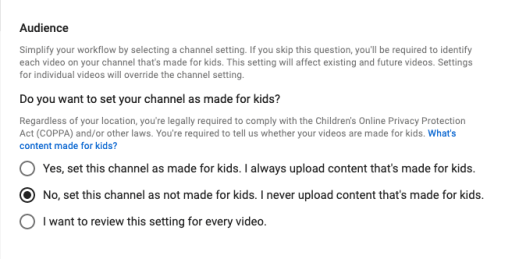
This setting, for all intents and purposes, isn’t related to COPPA. COPPA doesn’t care whether video content is targeted towards children. COPPA cares about how data is collected from children and how that data is then used by web sites. COPPA is, as I said above, all about data collection practices, not about whether content is targeted towards children.
Let’s understand that in the visual entertainment area, there are already ratings systems which apply. Systems such as the ESRB ratings system founded in 1994. This system specifically sets ratings for video games depending on the types of content contained within. For TV shows, there is the TV Parental Guidelines which began in 1996 and was proposed between the US Congress, the TV industry and FCC. These guidelines rate TV shows such as TV-Y, TV-14 or TV-MA depending, again, on the content within. This was mandated in 1997 by the US Government due to its stranglehold on TV broadcast licenses. For theatrical films, there’s the MPAA’s movie ratings system which began in 1968. So, it’s not as if there aren’t already effective content ratings systems available. These voluntary systems have been in place for many years already.
For YouTube, marking your channel or video content as “made for kids” has nothing whatever to do with COPPA legislated data collection practices.
YouTube Creators
Here is exactly where we see Google and YouTube’s fundamental misunderstanding of COPPA. COPPA is about the protection and collection of data from children. Google collects, stores and uses this and all data it collects. YouTube creators have very, very limited access to any of this Google-collected data. YouTube creators have no hand in its collection or its use. Google controls all of the data collection on YouTube. With the exception of comments and the list of subscribers of a channel, the majority of the data collected and supplied by Google to the creators is almost exclusively limited to aggregate unpersonalized statistical data. Even then, this data can be inaccurate depending on what the Google account ID stated when they signed up. Still, the limited personal subscriber data it does supply to content creators is limited to the subscriber’s ID only. Google offers its content creators no access to deeper personal data, not even the age of its subscribers.
Further, Google (and pretty much every other web site) relies on truthfulness when people sign up for services. Google does not in any way verify the information given to Google during the signup process or that this information is in any way accurate or truthful. Indeed, Google doesn’t even verify the identity of the person using the account or even require the use of real names. The only time Google does ANY level of identity verification is when using Google Wallet. Even then, it’s only as a result of needing identity verification due to possible credit card fraud issues. Google Wallet is a pointless service that many other payment systems do better, such as Apple Pay, Amazon Checkout and, yes, PayPal. I digress.
With that said, Google is solely responsible for all data collection practices associated with YouTube (and its other properties) including storing, processing and managing of that data. YouTube creators have no control over what YouTube (or Google) chooses to collect, store or disseminate. Indeed, YouTube creators have no control over YouTube’s data collection or storage practices whatsoever.
This new alleged “COPPA mechanism” that YouTube has implemented has nothing whatever to do with data collection practices and everything to do with content which might be targeted towards “children”. Right now, this limited mechanism is pretty much a binary system (a very limited system). The channel either does or it doesn’t target content towards children (either channel as a whole or video by video). It’s entirely unclear what happens when you do or don’t via YouTube, though some creators have had seeming bad luck with their content, which has been manually reviewed by YouTube staff and misclassified as “for children” when the content clearly is not. These manual overrides have even run counter to the global channel settings, which have been set to “No, set this channel as not made for kids.”
Clearly, this new mechanism has nothing to do with data collection and everything to do with classifying which content is suitable for children and which isn’t. This defines a …
Ratings System
Ratings systems in entertainment content are nothing new. TV has had a content rating systems since the mid 90s. Movies have had ratings systems since the late 60s. Video games have had them since the mid 90s. COPPA, on the other hand, has entirely nothing to do with ratings or content. It is legislation that protects children by protecting their data. It’s pretty straightforward what COPPA covers, but one thing it does not cover is whether video content is appropriate to be viewed by children. Indeed, COPPA isn’t a ratings system. It is child data protection legislation.
How YouTube got this law’s interpretation so entirely wrong is anyone’s guess. I can’t even fathom how Google could have been led this astray. Perhaps Google’s very own lawyers are simply inept and not at all versed in COPPA? I have no idea… but whatever led YouTube’s developers to thinking the above mechanism in any way relates to COPPA is entirely wrong thinking. No where does COPPA legislate YouTube video content appropriateness. Categorizing content is entirely up to a ratings system to handle.
Indeed, YouTube is trudging on very thin ice with the FTC. Not only did they interpret the COPPA legislation completely wrong, they have implemented “a fix” even more wrongly. What Google and YouTube has done is shoot themselves in the foot… not once, but twice. The second time is that Google has fully admitted that they don’t even have a functional working ratings system. Indeed, it doesn’t… and now everyone knows it.
Google has now additionally admitted that children under the age of 13 use YouTube by the addition of this “new” mechanism. With this one mechanism, Google has admitted to many things about children using its platform… which means YouTube and Google are both now in the hot seat with regards to COPPA. They must now completely ensure that YouTube (and Google by extension) is fully and solely complying with the letter of COPPA’s verbiage by collecting children’s data.
YouTube Creators Part II
YouTube creators have no control over what Google collects from its users, that’s crystal clear. YouTube creators also don’t have access to view most of this data or access to modify anything related to this data collection system. Only Google has that level of access. Because Google controls its own data collection practices, it is on Google to protect any personal information it may have received by children using its platform.
That also means that content creators should be entirely immune from prosecution over such data collection practices… after all, the creators don’t own or control Google’s data collection systems.
This new YouTube mechanism seems to imply that creators have some level of liability and/or culpability for Google’s collection practices, when creators simply and clearly do not. Even the FTC made a striking statement that they may try to “go after” content creators. I’m not even sure how that’s possible under COPPA. Content creators don’t collect, store or manage data about children, regardless of the content that they create. The only thing content creators control is appropriateness of the content towards children… and that has nothing to do with COPPA and everything to do with a ratings system… a system that Google does not even have in place within YouTube.
Content creators, however, can voluntarily label their content as TV-MA or whatever they deem is appropriate based on the TV Parental Guidelines. After all, YouTube is more like TV than it is like a video game. Therefore, YouTube should offer and have in place the same ratings system as is listed in the TV Parental Guidelines. This recent COPPA-attributed change is actually YouTube’s efforts at enacting a content ratings system, albeit an extremely poor attempt at one. As I said, creators can only specify the age appropriateness of the content that they create. YouTube is simply the platform where it is shown.
FTC going after YouTube Creators?
Google controls its data collections systems, not its content creators (though YouTube does hold leverage over whether content is or remains monetized). What that means is that it makes absolutely no sense for the FTC to legally go after content creators based on violations of COPPA. There may be other legislation they can lean on, but COPPA isn’t it. COPPA also isn’t intended to be a “catch all” piece of legislation to protect children’s behaviors on the Internet. It is intended to protect how data is collected and used by children under 13 years of age… that’s it. COPPA isn’t intended to be used as a “ratings system” for appropriateness by video sharing platforms like YouTube.
I can’t see even one judge accepting, let alone prosecuting such a clear cut case of legal abuse of the justice system. Going after Google for COPPA violations? Sure. They stored and collected that data. Going after the YouTube content creators? No, I don’t think so. They created a video and uploaded it, but that had nothing whatever to do with how Google controls, manages or collects data from children.
If the US Federal Government wants to create law to manage appropriateness of Internet content, then they need to draft it up and pass it. COPPA isn’t intended for that purpose. Voluntary ratings systems have been in place for years including within motion pictures, TV and now video games. So then why is YouTube immune from such rating systems? Indeed, it’s time YouTube was forced to implement a proper ratings system instead of this haphazard binary system under the false guise of COPPA.
Content Creator Advice
If you are a YouTube content creator (or create on any other online platform), you should take advantage of the thumbnail and describe the audience your content targets. The easiest way to do this is to use the same ratings system implemented by the TV Parental Guidance system… such as TV-Y, TV-14 and TV-MA. Placing this information firmly on the thumbnail and also placing it onto the video at the beginning of your video explicitly states towards which age group and audience your content is targeted. By voluntarily rating not only the thumbnail, but also the content itself in the first 5 minutes of the video opening, your video cannot be misconstrued for any other group or audience. This means that even though your video is not intended for children, placing the TV Parental Guidance rating literally onto the video intentionally states that fact in plain sight.
If a YouTube employee manually reclassifies your video as being “for children” even when it isn’t, labeling your content in the video’s opening as TV-MA explicitly states that the program is not suitable for children. You might even create an additional disclaimer as some TV programs do stating:
This content is not suitable for all audiences. Some content may be considered disturbing or controversial. Viewer or parental discretion is advised.
Labeling your video means that even the FTC can’t argue that your video somehow inappropriately targeted children… even though this new YouTube system has nothing to do with COPPA. Be cautious, use common sense and use best practices when creating and uploading videos to YouTube. YouTube isn’t there to protect you, the creator. The site is there to protect YouTube and Google. In this case, this new creator feature is entirely misguided as a COPPA helper, when it is clearly intended to be a ratings system.
Before you go…
One last thing… Google controls everything about the YouTube platform including the “recommended” lists of videos. If, for whatever reason, Google chooses to promote a specific video towards an unintended audience, the YouTube creator has no control over this fact. In point of fact, the content creator has almost no control over any promotion or placement of their video within YouTube. The only exception is if YouTube allows for paid promotion of video content (and they probably do). After all, YouTube is in it for the $$$. If you’re willing to throw some of your money at Google, I’m quite sure they’d be willing to help you out. Short of paying Google for video placement, however, all non-paid placement is entirely at the sole discretion of Google. The YouTube creator has no control over their video’s placement within “recommended” lists or anywhere else on YouTube.
↩︎
Rant Time: What is a Public Safety Power Shutoff?
 Here’s where jurisprudence meets our every day lives (and safety) and here is also where PG&E is severely deluded and fast becoming a menace. There is actually no hope for this company. Let’s explore.
California Fire Danger Forecasting
“Officials” in California (not sure exactly to which specific organization is referred here) predicted the possibility of high winds, which could spark wildfires. This happened earlier the week of October 7 (or possibly earlier). As I said, these are “predictions”. Yet, as far as I can see, no strong winds have come to pass… a completely separate issue, but it is heavily tied to this story.
Yet, PG&E has taken it upon themselves to begin powering off areas of Northern California in “preparation” for these “predictions”… not because of an actual wind event. If the high winds had begun to materialize, then yes, perhaps mobilize and begin the power shut offs. Did PG&E wait for this? No, they did it anyway.
What exactly is Public Safety?
In the context of modern society, pretty much everything today relies on electric power generation to operate our public safety infrastructure. This infrastructure includes the likes of traffic lights to street lights to hospitals to medical equipment to refrigeration. All of these need power to function and keep the public safe. To date, we have come to rely on monopoly services like PG&E to provide these energy delivery services. Yet, what happens when the one and only one thing that PG&E is supposed to do and they can’t even do it?
Granted, what PG&E has done is intentional, but the argument is, “Are the PG&E power outages in the best interest of public safety?” Let’s explore this even further.
PG&E claims that these power outages will reduce the possibility of a wildfire. Well, that might be true from a self-centered perspective of PG&E as a corporation. After all, they’ve been tapped several times for legal liability over recent wildfire events. They’ve even had to declare bankruptcy to cover those costs incurred as a result. We’ll come to the reason behind this issue a little bit later. However, let’s stay focused on the Public Safety aspect for the moment.
PG&E claims it is in the best public safety interest to shut down its power grid. Yet, let’s explore that thought rationale. Sure, this outage action might reduce the possibility of sparking from a power line, but what it doesn’t take into account is the reduction in and lack of public safety from all of the other normal-everyday-public-safety mechanisms which have also had their power cut. As I said, street lights, traffic lights, hospitals, medical equipment, 911 services, airports and refrigeration.
The short term effect of shutting the power off might save some lives (based on a fire prediction that might not even come true), but then there are other lives which might be lost as a result of the power being shut off for days. Keep in mind that PG&E claims it might take up to 5 days to restore power after this scheduled power off event. That’s a long time to be without standard regular public safety mechanisms (simply ignoring the high wind advisory).
If PG&E has been found responsible for wildfires, then why aren’t they responsible for these incidental deaths that wouldn’t have occurred if the power had remained on. Worse, what about medical equipment and refrigeration? For people who rely on medical equipment to sustain their lives, what about these folks? How many of these could die from this outage? If it truly takes 5 days to get the power back on, what about the foods being sold at restaurants and grocery stores? If you do trust it, you might get sick… very, very sick… as in food poisoning sick. Who is responsible for that? The retailer or the restaurant?
Sure, I guess to some degree it is the retailer / restaurant. They should have thrown the food out and replaced it with fresh foods. Even then, perhaps the distributors were also affected by the outage. We can’t really know how far the food spoilage chain might go. At the root of all of this, though, it is PG&E who chose to cut the power. How many people might die as a result of PG&E force shutting off the power grid versus how many might potentially die if a wildfire ignites?
I’ve already heard there have been a number of traffic accidents because the power has been cut to traffic lights. It’s not a common occurrence to have the power out on intersections. When it does happen, many motorists don’t know the rules… and worse, they simply don’t pay attention to follow them. They just blast on through the intersection. Again, who is responsible for this? The city? No. In this case, it is truly PG&E’s responsibility. The same for food poisoning as a result of the lack of refrigeration. What about the death of someone because their medicine spoiled without refrigeration?
Trading One Evil For Another
Truly, PG&E is playing with fire. They are damned if they do and damned if they don’t. The reality is, either way, shutting off electricity or leaving it on, PG&E risks the public’s safety. They are simply trading one set of public safety for another. Basically, they are “Robbing Peter to pay Paul.” By trying to thwart the possibility of setting an accidental wildfire, the outage can cause traffic accidents, deaths in hospitals, create food poisoning circumstances and this list goes on and on. When there is no power, this is real danger. Sometimes immediate danger, sometimes latent danger (food poisoning) which may present weeks later.
The reality is, it is PG&E who is responsible for this. PG&E “thinks” (and this is the key word here) that they are being proactive to prevent forest fires. In reality, they’re creating even more public safety issues by cutting the power off indiscriminately.
Cutting Power Off Sanely?
The first problem was in warning the public. PG&E came up with this plan with too short of a notice. The public was not properly notified in advance. If this outage scenario were on the table of options for PG&E to pursue during the wildfire season, this information should have been disseminated early in the summer. People could have had several months to prepare for this eventuality. Instead of notifying months ahead, they chose to notify at a moment’s notice forcing a cram situation when everyone floods the stores and gas stations trying to keep their homes in power and prepare. At the bare minimum, PG&E should be held responsible for inciting public frenzy. Instead, with proper planning and notification, people could have had several months notice to buy generators, stock up on water, buy a propane fridge, buy a propane stove, prep their fridges and freezers, and so on.
With a propane fridge, many people can still have refrigeration in their home during an extended (up to 7 day) power outage. This prevents both spoilage of foods and of medicines. Unfortunately, when it comes to crunch time notices, supplies and products run out quick. Manufacturers don’t build products for crunch time. They build for limited people to buy over a short period of time. Over several months, these manufacturers could have ramped up production for such a situation, but that can’t happen overnight. PG&E was entirely remiss with this notification. For such drastic knee-jerk actions to public safety, it needs to notify the public months in advance of this possibility. This is public menace situation #1.
Indiscriminate Power Outages
Here’s a second big problem with PG&E’s outage strategy. PG&E can’t pick and choose its outages. Instead, its substations cover whole swatches of areas which may include such major public safety issues as traffic lights and hospitals, let alone restaurants and grocery stores whose food is likely to spoil.
If PG&E could sanely turn off power to only specific businesses and residences without risking the power to hospitals, cell phone infrastructure, 911 and traffic infrastructure, then perhaps PG&E’s plan might be in a better shape. Unfortunately, PG&E’s outage strategy is a sledgehammer approach. “Let’s just shut it all down.”, I can almost hear them say. Dangerous! Perhaps even more long term dangerous than the possibility of not setting a wildfire. Who’s to say? This creates public menace situation #2.
Sad Infrastructure
Unfortunately, this whole situation seems less about public safety and more about CYA. PG&E has been burned (literally) several times over the last few wildfire seasons. In fact, they were both literally and monetarily burned so hard that this is less about actual public safety and more about covering PG&E’s legal butt. Even then, as I said above, PG&E isn’t without legal liability simply because they decided to cut the power to thwart a wildfire. In fact, while the legal liability might not be for causing a wildfire, instead it might be for incidental deaths created by outages at intersections, by deaths created in hospitals and in homes due to medical equipment failure, by deaths created via food spoilage in restaurants and grocery stores… and even food spoilage or lack of medical care in the home.
The reality behind PG&E’s woes is not tied to its supposedly proactive power outage measures, it is actually tied to its aging infrastructure. Instead of being proactive and replacing its wires to be less prone to sparking (what it should have been doing for the last 10 years or more), it has done almost nothing in this area. Instead of cutting back brush around its equipment, it has resorted to turning the power off. Its liability in wildfires is almost directly attributable to relying on infrastructure created and installed decades ago by the likes of Hetch Hetchy (and other early electric infrastructure builders) back in the early 1900s. I’m not saying that every piece of this infrastructure is nearly 100 years old, but some of it is. That’s something to think about right there.
PG&E does carry power from Hetch Hetchy to its end users via Hetch Hetchy generation facilities, but more importantly, through PG&E’s monopoly electric lines to its end users. PG&E also generates its own electricity from its own facilities. It also carries power from other generation providers like SVCE. The difficulty with PG&E is its monopoly in end user delivery. No other company is able to deliver power to PG&E’s end user territory, leaving consumers with only ONE commercial choice to power their home. End users can opt to install their own in-home energy generation systems such as solar, wind or even diesel generators (when the city allows), but that’s not a “commercial” provider like PG&E.
Because PG&E has the market sewn up, everyone who uses PG&E is at their mercy to provide solid continuous power… that is, until they don’t. This is public menace situation #3.
Legal Troubles
I’m surprised that PG&E has even decided to use this strategy considering its risky nature. To me, this forced power outage strategy seems as big a liability in and of itself as it does against wildfires.
PG&E is assigned one task: Deliver Power. If it can’t do this, then PG&E needs to step aside and let another company more experienced in to replace PG&E’s dominance in power delivery. If PG&E can’t even be bothered to update its aging equipment, which is at the heart of this entire problem, then it definitely needs to step aside and let a new company start over. Sure, a new company will take time to set it all up, but once it’s going, PG&E can quietly wind down and go away… which may happen anyway considering both its current legal troubles and its bankruptcy.
The state should, likewise, allow parties significantly impacted by this forced power outage (i.e., death or injury) to bring lawsuits against PG&E for its improperly planned and indiscriminately executed power outage. Except, because PG&E is still in bankruptcy court, consumers who are wronged by this outage must stand in line behind all of those who are already in line at PG&E’s bankruptcy court. I’m not even sure why the bankruptcy judge would have even allowed this action by PG&E while still in bankruptcy. Considering the possibility of significant additional legal liabilities incurred by this forced outage, the bankruptcy judge should have foreseen this and denied its action. It’s almost like PG&E execs are all, “F-it, we’ll just turn it all off and if they want to sue us, they’ll have to get in line.” This malicious level of callous disregard for public safety needs much more state and legal scrutiny. The bankruptcy judge should have had a say over this action by PG&E. That they didn’t, this makes public menace situation number 4, thus truly making PG&E an official public safety menace and a nuisance.
Updated 10/11/2019 — Clarification
I’ve realized that while one point was made in the article, it wasn’t explicitly called out. To clarify this point, let’s explore. Because PG&E acted solely on a predicted forecast and didn’t wait for the wind event to actually begin, PG&E’s actions egregiously disregarded public safety. As I said in the main body of the article above, PG&E traded one “predicted” public safety event for actual real incurred public safety events. By proceeding to shut down the power WITHOUT the predicted wind event manifesting, PG&E acted recklessly towards public safety. As a power company, their sole reason to exist is to provide power and maintain that public safety. By summarily shutting down power, not only did they fail to provide the one thing they are in business to do, they shut the power down for reasons other than for fire safety. As I stated above, this point is the entire reason that PG&E is now an official menace to the public.
↩︎
Consumer Tips: How to navigate the Toys R Us liquidation
 [UPDATED: 12/17/2018] TRU officially closed all remaining US stores as of mid-summer. This article is here simply for legacy reasons. Buh-Bye TRU and thanks for all the fun. We’ll miss you this holiday season.
If you’re thinking of visiting Toys R Us to take advantage of the store closing liquidation sales, this is your safety guide. Don’t throw your money away at Toys R Us, make every dollar count. Let’s explore.
Giving Gifts
Toys R Us’s liquidation is All Sales Final. The first tip is pretty straightforward. If you’re looking to buy a gift for a child, you are trying to stock up for the holidays or for any other rainy day reason, keep in mind that you cannot return, exchange or refund anything you purchase at this time. For gifts, this can be critical, particularly with children. You should always make sure that the person who receives that gift can return or exchange it if they don’t like it. Purchasing from Toys R Us on liquidation, you forfeit the return option.
Even if the gift is to be given while Toys R Us is still open, there are no refunds or exchanges. So, be aware that whatever gift item you choose is theirs to keep forever. You might want to be prepared to perform an exchange with your own money. Note that this can become an uncomfortable situation.
If you know there’s a possibility that your gift might be returned, you should buy from Amazon, Target or Walmart instead which leaves that option open for the recipient.
No Returns, Refunds or Exchanges
This goes hand-in-hand with All Sales Final. If you purchase items from Toys R Us during liquidation, you may get a great deal, but at the cost of no refunds, returns or exchanges. Make absolutely certain that what you buy is absolutely something you intend to keep.
Whether or not you intend to give the item as a gift, you should open the item and check it thoroughly. Do it in the store if at all possible. If it has batteries, make sure to test the item for functionality. You may not be able to test a battery powered item in the store, however. They may not allow you to remove the item from its packaging in the store to perform this test. You may have to take it home and check it there. By that time, you’ve already purchased and it’s too late if it’s defective. If you’re in doubt, leave it at the store.
If you do find a dead or defective item, you will need to contact the toy manufacturer directly and work your exchange through the manufacturer. Keep your receipt. This exchange process could take a whole lot more time than if you bought at a store still accepting exchanges.
Consider your purchases during a liquidation carefully. Do not purchase Toys R Us gift cards… but this should go without saying.
Extended Warranties
If you decide to buy an expensive item that could break easily, you should ask of Toys R Us to offer you a SquareTrade warranty plan. This will ensure you can get a replacement after Toys R Us closes. In preparation for this article, I spoke with a representative at SquareTrade who confirmed that they will continue to honor all SquareTrade warranties purchased at Toys R Us. If you do decide to invest in an expensive item that is prone to defects or breakage, you should also consider purchasing a SquareTrade warranty during liquidation.
Video Games and Video Game Consoles
Purchased video game content is a reasonably safe investment during the Toys R Us liquidation. It’s rare that a disc or a cartridge is defective.
On the other hand, purchasing a video game console or other video game hardware is a bad idea. If you must purchase one, purchase a SquareTrade warranty at Toys R Us to go with it (assuming they are still selling these warranty plans). If it’s not SquareTrade, then you should call the plan service provider before you check out at the store to ensure that insurance plan will continue to cover your purchase after Toys R Us closes for good.
Without an extended service plan, you have no replacement policy if it’s defective or gets broken. Be very cautious of buying video game hardware from Toys R Us during liquidation without a warranty. Though, you can try to work through the manufacturer warranty, it’s sometimes only 90s days. During liquidation, this is the one time where you should consider the purchase of a third party warranty, at least for purchases like video game consoles… particularly the Nintendo Switch which is portable and prone to being dropped.
However, certain types of lesser expensive video game hardware, like controllers, wires, Amiibo, cases, pens and other similar $30-$50 items are safer to buy, particularly when they are marked down 50% or more. However, consoles themselves, like the Nintendo Switch, Xbox One X and PlayStation 4 are not considered good investments from a liquidation sale.
I’d also suggest to avoid buying these devices from eBay as well because many will flood eBay listings from sellers who went to Toys R Us just to cash in on these low prices. If you’re thinking of buying a console from eBay, ask where it was purchased. Be wary if it’s from Toys R Us.
Dolls, Action Figures and Non-Battery Toys
Toys that don’t require batteries and don’t have complex moving pieces are some of the safer items to buy. They offer less defects and are more likely to last the test of time than RC vehicles, video game consoles, battery powered electric child cars, electric skate boards and other custom battery items.
Consumer Safety and Toy Recalls
Toys R Us was very good at keeping up with safety recalls. Unfortunately, they are going out of business. This also means that any toys you purchase during the liquidation that later fall under a recall, you can no longer return to Toys R Us. Like the All Sales Final discussion above, consider that items like cribs, baby items and other possible dangerous infant and toddler toys won’t have any place to go if they are recalled, especially if your baby gets hurt. Though, the manufacturer might honor a return or exchange, you will not be able to do so at Toys R Us. You will also not be able to make any legal claims of injury to Toys R Us once they have closed.
Safe or Unsafe Investment?
Here is a list (not exhaustive) of items that I consider safe, somewhat safe and not safe for a liquidation purchase so long as you fully understand that you cannot return or exchange them at TRU.
Note, safe, somewhat safe and not safe represent what I consider as a “safe purchase” (i.e., getting value for your money vs. throwing your money away), these labels do not describe whether the toy or item itself is safe for use by a child. You will have to determine toy safety yourself.
| Toy Type | Liquidation Safe Purchase? | Contains Battery? | Reason |
|---|---|---|---|
| Dolls | Safe | No | |
| Motorized Dolls | Not Safe | Yes | Prone to defects and can be unsafe No store warranty |
| Bicycles | Somewhat Unsafe | Depends | If you’re buying for a gift, unsafe. If you’re buying to use now, perhaps. If it has a battery, unsafe. TRU may or may not offer assembly. Use your best judgement. |
| Motorized Electric Kid Cars | Not Safe | Yes | Batteries can be defective May not be able to find replacement battery No store warranty |
| Action Figures | Safe | No | |
| Plush Animals | Somewhat Safe | No | Depending on what it’s made from, it may be safe or unsafe. Choose carefully. |
| Vinyl Figures | Safe | No | |
| Hot Wheels | Safe | No | So long as the Hot Wheels contain no batteries |
| Lego | Safe | No | So long as the Legos contain no batteries |
| Motorized Toys | Not Safe | Yes | Avoid motorized or electronic toys |
| Video Games | Safe | No | Games themselves are rarely defective |
| Video Game Consoles | Not Safe | Maybe | Could be defective No way to exchange No store warranty Choose 3rd party insurance plan if you must buy |
| Video Game Controllers | Somewhat Safe | Yes | Typically okay along with certain accessories. |
| Barbie | Safe | Depends | If the Barbie doesn’t contain a battery, this should be safe. If it contains a battery, make sure the doll is working before leaving the store. |
| Baby Toys | Depends | Depends | For safety reasons, I do not recommend buying baby toys and items via liquidation sales. |
| Diapers | Safe | No | |
| Cribs | Not Safe | No | Cribs can be dangerous for infants. Purchase at a store where you can return. |
| Car Seats | Not Safe | No | Car Seats can be dangerous for infants. Purchase at a store where you can return. |
| Skateboards | Safe | No | |
| Electric Skateboards | Not Safe | Yes | Avoid because of custom battery (replacement) |
| RC Vehicles | Not Safe | Yes | Avoid because of custom battery (replacement) |
| Tablets | Somewhat Safe | Yes | If Apple, you can rely on Apple. If another brand, avoid. |
| Wrapping Paper / Party | Safe | No | |
| DVDs and Blu-ray | Safe | No | |
| Toys To Life (Amiibo) | Safe | No | |
| Headphones | Not Safe | Depends | High chances for problems |
| Toys R Us Exclusives | Somewhat Safe | Depends | Avoid with custom batteries |
| Wooden Toys | Somewhat Safe | Depends |
Use Your Best Judgement
The above is not an exhaustive list, so always use your best judgement if it’s not listed here. If the toy contains no battery at all, it should be fine. If the toy contains or uses standard AA, AAA, C, D or button cell batteries, you’re fine. If the toy contains a lithium ion and/or custom battery, you should avoid purchase. Any toy that contains a custom battery may have been custom made for Toys R Us. This means you may find it difficult or impossible to find batteries later. House brand or Toys R Us exclusive toys requiring refill packs should be avoided. Toys and products for infants should be avoided for safety reasons. The only product I would suggest is safe for an infant is diapers and possibly formula as long as it’s a name brand, not a house brand.
Tablets and electronics should be avoided if not from Apple or another recognized brand. If it’s a house branded electronic item, avoid.
Toys R Us Exclusives
Toys R Us Exclusives are now considered rare. However, that doesn’t mean they’re a good investment. Pop figures are fine, exclusive Barbies are fine and exclusive Hot Wheels are fine (see the list above). However, any exclusives that require something that you can only get at Toys R Us (like batteries or refills), you should avoid purchase.
Toys R Us Geoffrey toys
These are likely to be some of the rarest toys available. If you want a piece of memorabilia to commemorate Toys R Us, you should head over fast and pickup whatever Geoffrey items you can find. If you’re looking for plush, you might have to ask at the service desk.
Happy Deals and good luck!
↩︎
Can Tesla survive?
 Investors have been overly exuberant about Telsa. By that I mean, because Tesla set up shop in Silicon Valley rather than Detroit, many investors see Tesla as a ‘tech company’. Folks outside the Bay Area, however, see Tesla as a car company. Let’s explore.
Car Company vs Tech Company
For whatever reason, too many people see Tesla as a tech startup. The fact is, Tesla is in no way a tech startup. It is a car company. Tesla has, so far, provided no new tech to the world. Cars, in fact, are not in any way new technology. Worse, there’s nothing new about Tesla’s cars that have not been done before. The only claim to fame that Tesla has is its partnership with the Lotus design team to design and help produce the Tesla Roadster. If the Roadster looks amazingly like a Lotus Elise, now you know why. But, paying for someone else to design your vehicle’s interior and exterior isn’t innovative, it just means you have money.
Let’s also consider even though Tesla decided to go electric in its vehicles early on, it is by no means the first electric vehicle to market. Tesla’s decision wasn’t without a significant amount of peril or adversity, adversity that continues to this day. For example, gas powered cars have huge infrastructure around the globe to buy fuel. In 5-8 minutes, you’re fueled up and ready to go again for hundreds of miles on a single tank. Unfortunately, charging electric vehicle batteries is a laboriously slow process by comparison. Sure, even with a Tesla Supercharger, you’re still stuck charging your vehicle for at least 30 minutes to get a 65% charge (about 170 miles). If you want a 100% charge, you’ll be there a whole lot longer. If it’s not a Supercharger, then plan to spend a whole lot more time there.
If the 30 or so minutes you must wait is at a time when it’s convenient (i.e., you’re stopping for dinner anyway), then that’s great. If it happens to be when you’re pressed for time, you’re not going to be a happy camper. If you don’t plan your trip properly or if you get tripped up by construction, you may find yourself off course without a charging station handy. Then where are you?
So far, all of the things I’ve mentioned above have nothing to do with tech and everything to do with usability. Specifically, car usability. More specifically, car usability with regards to electric vehicles which charge slowly and offer very little nationwide infrastructure. This is the adversity that Tesla is up against.
Pushing Boulders Uphill
Tesla has a long way to go before the US has electric infrastructure at a saturation where electric cars can even come close to replacing gas powered cars. That’s not to say it can’t happen sometime in the future, but Tesla is pretty much alone in this and has given up several times along the way. Yes, Nissan, Toyota, Mini and Chevy have all introduced electric vehicles, but they are the outliers. They aren’t pushing for nationwide charging coverage. These vehicles have not yet become the bread-and-butter vehicles that keep these brands afloat. Every car manufacturer, other than Tesla, sells gas powered vehicles. With Tesla’s electric-only approach, it is sink or swim… and currently, Tesla is pretty much just treading water. Tesla hasn’t even tried hedging its bets by producing an alternative fuel assist hybrid to augment its slow recharge times and offer a vehicle with much longer distance. In fact, by not embracing such a strategy seems to be terribly remiss on their part.
For Tesla, this should be considered self-imposed adversity. Why not invest in producing a car that accepts natural gas, gasoline, alcohol or even hydrogen? I think we’ve already seen that Tesla has pretty much pushed the limits of its electric vehicle paradigm as far as it can go.
Expensive Bells and Whistles
I can hear the throngs of Tesla owners now… groaning at this article. Wake up! You bought a $100k commuter car. Sure, it has that nice 17″ (now dated) display in the middle of the dash and a few interior niceties, but it’s a car. A car is a car is a car. It takes you from point A to point B. Does it matter what bells and whistles it offers inside? You’re not buying the functionality of the technology, you’re buying the functionality of the car. Worse, it’s not that this technology hasn’t already existed in a car before Tesla and it will definitely exist in many cars in the future. Just look at the Prius. It’s not 17″, but it definitely had an in-dash display from the beginning.
Don’t be fooled by the Silicon Valley hype. Tesla isn’t a tech company, it is a car company. They don’t offer innovative technical solutions or innovative technical products. They offer a car (or rather, many models of cars). A car, I might add, that is from a brand that has yet to prove itself as a long term car brand. Let’s take the Saturn car brand as a prime example. When Saturn came about, its claim to fame was all of the hand-holding and attention they gave new car owners. Where is Saturn now? Dead. The company ceased producing cars in 2009 and closed its doors in 2010. Its sales model wasn’t sustainable. Its cars were mediocre.
Can Tesla Survive?
Is Tesla’s model sustainable? That depends on Elon Musk. Once Elon finally admits to himself, his employees and the rest of the world that Tesla is, in fact, a car company and not a tech company, he will be able to realize what he needs to do to take Tesla to the next level. The problem right now is that many investors in Tesla see them as a tech stock, not a car company. Tesla is not a tech stock. Let me repeat that. Tesla IS NOT a tech stock. Don’t fool yourself that Tesla is anything other than a car company, like any company out of Detroit or Japan or anywhere else in the world where car manufacturing exists.
Fundamentally, Tesla has been battling the infrastructure issue. Elon simply hasn’t been able to gain any substantial traction for Tesla’s electric plan throughout the continental United States. Sure, there are Tesla Supercharges in select areas, areas requiring you to plan your trip well in advance to ensure you can find chargers all along the way. If you find yourself off the Supercharger path, you could literally end up stranded in the middle of nowhere with no way to get a charge. If your car happens to break down, then what? Better have AAA with its longest distance towing option as you might find yourself sitting in the cab of a tow truck being hauled to the next Supercharger station.
Infrastructure has not been a friend at all to Tesla. Let’s understand a little better why. Electric cars, while they are clean vehicles, are not clean on the environment. Instead of pushing the pollution out of the tailpipe, it is now being pushed out of the exhaust stacks at electric generation facilities. Tesla (and other electric car makers) need to understand that the pollution doesn’t stop, it just moves to a different location. If California’s electricity were produced from 100% clean, renewable resources, I’d be writing something different here (at least for California). Instead, that’s a pipe dream. California still receives much of its electric generation from fossil fuels which is used to charge up a Tesla (or any electric plugin vehicle), less than ideal for pollution. This is why the government hasn’t hopped on board with bringing electric infrastructure to the forefront. On top of that, there’s no incentive from gasoline producers to push this agenda. So, where would those incentives come from? The government (and ultimately, all of us via our tax dollars). I don’t want to have to pay to build a huge electric infrastructure raising my taxes.
Tesla’s Failures
Ultimately, Tesla had planned to introduce a battery swap program to help reduce charge times. However, Tesla had to admit that this was a failed pipe dream. They were forced to drop the idea entirely. This is where Tesla made its first and most important mistake. Apple releases products that it feels are good for users. They don’t care if people like or dislike them. That was Jobs’s MO. He decided on behalf of the public what we should like. If you didn’t personally like it, you went someplace else. Tesla should have introduced the battery swap option in spite of the complaints, costs or problems. Push the idea out regardless. Drive the market to adopt the idea instead of caving into market pressures. This is where Elon completely differs from Jobs and Apple. Though, Jobs was arguably a marketing visionary. Elon is, at best, a huckster. There is literally nothing visionary at all about the Tesla cars being produced. Modern yes, visionary no.
Once you understand the difference between the words “modern” and “visionary”, you’ll quickly understand that what makes a Tesla vehicle attractive is its amenities. These same types of amenities are those that drive the sales of Lotus, Lamborghini, Maserati, Bentley, Cadillac, Mercedes Benz and even Lexus… i.e., luxury car brands. Tesla is less about being an electric vehicle and more about becoming a luxury car brand. Luxury is why you buy Tesla. That’s why you buy any type of luxury car. Again, don’t kid yourself. It’s not the technology, it’s the luxury. Luxury, I might add, that comes with a fairly steep price (both monetarily and time wise). Yes, it costs around $60k-$100k, but that’s not the half of it. You also spend a fair amount of time not even being able to use the vehicle because it’s hooked to the charger. With a gas powered vehicle, its downtime is measured in minutes. With Tesla, its downtime is measured in hours. When I say downtime, I’m strictly talking about the time it takes to ‘refuel’ it, not mechanical breakdowns which are a whole different bag.
Since most people don’t have Superchargers available at their homes, they are subject to longer charge cycles. This means you need to plan for this. Don’t come home on low charge and forget to charge it. You’ll be in a world of hurt the following day when you need to get to work. Tesla is a car brand that isn’t completely worry free. You must take the time to plan your day and when to charge. If you forget even once, you’re going to be late for work.
Tesla as a Commuter Car
Considering all of the above and the ~256 mile range on a charge makes Tesla not ideal for long distance travel, at least not without proper trip planning. It’s a great about-town car, but for long distance travel, I’d suggest owning a vehicle with a gas charger. A gas charger vehicle means you can stop at any gas station to refuel the power generator. Our alternative fuel infrastructure may not be optimal today, but it is the infrastructure we are stuck with for the moment. Trying to find alternative fuels like propane, hydrogen or natural gas could leave you just as stranded as electric alone. With a gas car, you can travel anywhere there is a gas station and refuel in minutes. This infrastructure is far and wide and everywhere.
Ultimately, this lack of electric infrastructure relegates Tesla vehicles to commuter cars as their best use case. For me, justifying spending $60-100k for a commuter car is way too much. Consider that for those of us who also live in apartment complexes means leaving our expensive Tesla vehicles sitting idle on dark parking lots to fully charge, then walking away. Not ideal. You pretty much have to own a home and install a Tesla specific charger to get decent charge times and know your car is safe. It’s also fairly inconvenient leaving your car sitting on a parking lot for several hours only to have to go back when it’s done and pick it up.
Many apartment complexes are way behind the times, but they are not the exception. Let’s consider the infrastructure that Tesla has built since the first Roadster was introduced. Let’s just say, it’s not much. It’s better than it was, but it is no where near where it should have been at this point. This is the primary reason Tesla will fail, unless they change their ideas and embrace the fact that they are not only car company, but a luxury car brand. This is the reason other car companies will do better than Tesla with their everyday electric vehicles. Tesla is a luxury brand that only families of a certain affluence can afford. Vehicles like the Nissan Leaf and the Chevy Volt are the everyday electric cars. These are vehicles that are both affordable and offer better value for the money than Tesla’s short distance expensive luxury vehicle.
Oh, but the Model X has gull wings you say? Really, that’s something you’re going to argue? Ok, let’s argue it. If you have kids, these doors are entirely unsafe for little fingers. Sure, Tesla may claim safety features, but do you really trust your kid’s little fingers against an electric door closing mechanism? Go ahead, I dare you.
Safety Track Record
Tesla is a fairly new car company founded in 2003. It never produced cars before 2006. Its first vehicle is the Tesla Roadster. Tesla has had difficulties keeping up with demand for the Roadster. Its first commercially successful vehicle was the Model S introduced in 2008, Tesla’s second model vehicle. Other models have since followed. And yes, I realize the ~$33,000 Model 3 is on the way… but they’re having production problems with this model. It could be years before you see your preorder.
Basically, what Tesla is making is all new without the benefit of years of manufacturing experience. This means that testing safety features in its vehicles may not be a top priority. Let’s consider the safety of lithium-ion batteries when in a crash. Actually, let’s scale that back a little. Just by poking a hole into your cell phone’s lithium-ion battery will cause noxious fumes, possible fire and/or explosion. Let’s scale that up to electric cars. If the battery in your Tesla is compromised due to an accident, you could easily find your car on fire, electrocuted or in an explosion. While this is not exclusive to Tesla’s electric cars, the size of Tesla’s batteries could make them particularly unsafe. It could also mean that if you’re injured in a Tesla, first responders may need to secure their own personal safety against your vehicle’s battery before using the jaws-of-life to extract you from the vehicle. This precious time lost could mean the difference between life or death.
You’re exposing your family’s safety to Tesla each and every day you drive it. Ford, Chevy, GM and even Toyota are brands that have existed for decades. These companies fully understand the concept of proper safety design and of recalls, lawsuits and defects. Unfortunately, Tesla has only had just a few years to gain this knowledge. Yes, they have hired seasoned industry vets to help get their vehicles to be their safest quickly, but the question isn’t what they added, but what they missed. They’re a new car company with new growing pains. Sure, you can hire expertise, but can you be sure of what you missed? Who really knows? Tesla has been relatively lucky that they have not yet seen an egregious safety failure on all of their vehicles. The question is, have they done it right or have they been lucky or it is just a matter of time?
Worse, could Tesla survive such an huge safety recall in all of their vehicles? Who really knows? Sure, their company is highly valuated, but that doesn’t mean they have the cash to support a massive lawsuit or an expensive recall. Ultimately, when you buy into Tesla, you’re buying into all of this. You should think long and hard about whether this is the car for you. Don’t buy it because it drives nice or because the seats are comfortable or because dashboard looks cool, buy it because it makes the most sense for your budget, the way you intend to use it and your family’s safety.
Can Tesla survive? This depends on whether they can truly get beyond their ‘tech company’ mentality. Tesla is a car company. At some point, they’ll have to admit this. Once they admit this, then they can truly begin to take their cars to the next level. If not, then perhaps Tesla is just a flash in the carburetor.


 Random Thoughts - Randocity!
leave a comment