Facebook Puzzle: 6÷2(1+2)

Many puzzles that pop up on many social media networks are math problems. One of these older math “problems” is 6 ÷ 2(1 + 2). Let’s explore the difficulties and controversies surrounding this math problem.
PEMDAS, BODMAS, BIDMAS & BEDMAS
These are all acronyms for more or less the same ideology. This ideology is intended to help students solve math problems logically. Unfortunately, PEMDAS and its similar ilk all have problems when it comes to certain advanced mathematical constructs… constructs that are, in fact, intentionally ignored in PEMDAS for the sake of simplicity.
PEMDAS stands for Parenthesis, Exponents, Multiplication and Division, Addition and Subtraction. BODMAS, BIDMAS and BEDMAS all utilize this same ideology, using alternative words to describe these approaches to logical math problem solving. Interestingly enough, BODMAS, BIDMAS and BEDMAS all seem to place division before multiplication, unlike PEMDAS. However, multiplication and division, at least according these problem solving helpers are supposed to be equal and performed strictly in order from left to right. In effect, the ‘DM’ order in BODMAS (and similar) or ‘MD’ order in PEMDAS make no real difference because the math problem itself dictates the order in which to solve the problem, left to right. In other words, the order takes precedence, so the ‘DM’ or ‘MD’ order listed in these helpers don’t matter.
Why PEMDAS or similar?
The PEMDAS and similar helpers were created to help grade school students solve basic math problems. This would include simple math problems like 10 ÷ (5 – 3) or (5 + 2 – 1) x 2. For those unfamiliar, the ⇝ symbol should be read as “which leads to.”
For the first problem 10 ÷ (5 – 3) that would be solved by the helpers with the following:
Parentheses first: (5 – 3) = 2 ⇝ 10 ÷ (2)
Next drop the parentheses, then solve for MD/DM: 10 ÷ 2 = 5
Answer: 5
For the second problem (5 + 2 – 1) x 2
Parentheses solved first with + and – solved inside parens l-to-r: (5 + 2 – 1) = (6)
Drop parens, multiply 6 x 2 = 12
Answer: 12
These above are simple math problems that don’t involve one key concept included in the somewhat more advanced math problem 6 ÷ 2(1 + 2). The key math concept included is …
Multiplication by Juxtaposition (aka Implied Multiplication)
Multiplication by Juxtaposition adds a level of complexity that PEMDAS and BODMAS can’t always resolve. Let’s understand why.
Multiplication by juxtaposition is a concept that gets introduced during a student’s first Algebra class. Prior to taking algebra, the concept of implied multiplication isn’t involved. PEMDAS wasn’t designed to adequately support this advanced math concept. PEMDAS, thusly, isn’t the whole truth. PEMDAS is a ruleset that works for many math problems, but not for ALL math problems. This is why PEMDAS trips up many people when attempting to use it on problems like 6 ÷ 2(1 + 2).
Before getting into this specific math problem, let’s understand a few more implied multiplication examples. An implied multiplication example is 



The point here is not to get deep in the weeds of algebra, but instead to understand the intricacies of multiplication by juxtaposition when used in combination with PEMDAS. Juxtaposition is illustrated in problem like 
Juxtaposition is a method of writing equations without the need to include the * or x symbols which explicitly state multiplication. When choosing to use juxtaposition instead of explicit symbols, this is what is called using a “style guide” for mathematical equations.
Like map legends are used to describe such information as color coding and distances on maps, style guides in mathematics describe the proper order that an equation needs to solved. Why is a style guide important? Because of the ambiguities and disparities between PEMDAS and writing equations using these shorthand methods, such as juxtaposition.
Juxtaposition is intended to help simplify the printing of equations in printed texts as well as reduce the clutter when building such complex equations. When complex equations are written, then, a style guide reference discussing precedence, levels and order of operation is imperative. Without this information printed alongside a text book, this would leave the reader in the dark, forcing the reader to utilize their own knowledge to attempt to solve the written problem.
This is exactly the problem with the Facebook problem in 6 ÷ 2(1 + 2). Because no style guide is offered, this math problem has two valid solutions; solutions that depend on which style guide you are familiar. If you subscribe to only the PEMDAS helper style guide, the answer is 9. If you subscribe to the vast majority of scientific and technical literature style guides used by STEM professionals, the answer is 1.
Let’s understand why
6 ÷ 2(1 + 2) can be written in effectively two different ways depending on which style guide you choose. The PEMDAS style guide implies the following style should be applied:
6 ÷ 2 * (1 + 2), alternatively written as 
Mathematical professional style guides would apply the following:
6 / (2 * (1 + 2)) (adding another set of parentheses for clarification)
Let’s understand these styling differences.
Under PEMDAS styling, the equation is understood as:
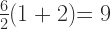
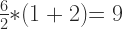
Using scientific and engineering style guide rules, the equation is understood as:

These two equations are markedly different both in their appearance, but also in how they are solved. Under PEMDAS styling, the answer is clearly 9. Under scientific styling the answer is obviously 1.
The question is, why are there two different style guides here?
Two Style Guides?
PEMDAS (et al) is a rudimentary style guide intended to teach grade school children mathematic basics. PEMDAS is not intended to carry the child’s mathematical knowledge all the way through their life. Think of PEMDAS like a set of training wheels on your bike. The training wheels keep you upright to get the hang of balancing on your bike. Once you’ve mastered the art of balancing, the training wheels are removed.
PEMDAS is simply a set of training wheels that eventually need to be removed.
To be perfectly fair, PEMDAS should really be written as 

This updated 4 component notation means MD are at the same level and equal priority, but evaluated in order left to right. AS follows the same logic as MD, but only after MD have been resolved.
The difficulty with PEMDAS is that it was designed to be used by students NOT working with either multiplication by juxtaposition (implied multiplication — an algebra concept) or by using a slash (/) in place of the division (÷) symbol (also an algebra concept). PEMDAS expects the primary four simple operators to be explicitly used: + – ÷ x. PEMDAS breaks down when advanced operators are used because PEMDAS has no proper solution when these advanced mathematical concepts are included.
The reason for these existence of these two style guides goes back to the history of order of operations, long before even PEMDAS was coined. Most engineering and mathematics texts define that multiplication by juxtaposition is to be handled BEFORE division. In PEMDAS terms, that means the acronym becomes 
instead of the PEMDAS understanding as
What does the division symbol ÷ mean exactly?
If you look at the ÷ symbol, it has a dot on the top and a dot on the bottom. As an abstract visual, it means “divide by”. As a literal symbol, it means move the left argument to the numerator and the right argument to the denominator. This turns 6 ÷ 2 into 

The ÷ symbol also has a sibling, the forward slash (/). This slash symbol can be used as a drop-in replacement for the ÷ symbol. When a slash is used, this then represents the two numbers as a sort of sideways or horizontal fraction, like 6/2. In STEM professional circles, both the ÷ and the x symbols are exchanged for alternatives when writing equations. Think of these changes as mature upgrades to mathematics. As we grow and learn, we adopt shortcuts which make life easier. In mathematics, juxtaposition and slash are two mature “shortcuts” in the way that equations get written. Instead of writing an equation as 6 ÷ 2(1+2), it would be written as 6/2(1+2) or if using TeX, it would appear more formally as 
Why are there TWO answers?
Good question. One that needs all of the above understanding to address. Style guides vary. The PEMDAS style guide given to early grade school students is intended to be used as a loose style guide only. Meaning, given our rudimentary understanding of mathematics at the time, PEMDAS is a helper tool that “guides” us in the right direction. PEMDAS isn’t an end-all be-all idea. It is simply a helper tool. If mathematical equations ended at the type given to us in grade school, PEMDAS is all that we would ever need.
However, moving into Algebra and higher mathematics like Trigonometry and Calculus, mathematical nomenclature must become more refined and mature… and so it does. In that goal, what PEMDAS taught us was basics. What we learn in advanced mathematics classes overrides what we learned with the basic PEMDAS logic.
Because math style guides acknowledge that there are more priority levels than the simple PEMDAS understands, our knowledge of PEMDAS must expand into that bigger understanding of more priority levels. We must take off the PEMDAS training wheels and let go of the past. We must acknowledge that there is more to mathematics than PEMDAS.
PEJMDAS is a good first step, but it doesn’t explain everything. For example, why does PEMDAS view the equation 6 ÷ 2(1+2) as 
The answer to this is really pretty simple. PEMDAS places ALL multiplication at the same level and priority as under the M. Because PEMDAS isn’t really aware of juxtaposition rules, it mistakenly moves even juxtaposed multiplication under M. PEMDAS then mistakenly turns the equation into
The problem is that PEMDAS is taught at a time in school when juxtaposed multiplication isn’t even a concept in mathematics. As a result of juxtapositioning not being understood at that moment in a student’s mathematical learning, the student would then assume, based on PEMDAS, that ALL multiplication must roll up under that M… that’s assuming the student even understands or had been previously explained about implied multiplication. Most students learning early mathematics would likely have to ask what 6 ÷ 2(1 + 2) means. More specifically, why is a 2 sitting directly next to the (1 + 2) parentheses without an operator symbol and also what it means in this equation? This is where juxtaposition multiplication would have to be explained to the student.
In reality, in many advanced academic mathematical style guides, something that a grade school student would not be aware of, these documents state that multiplication by juxtaposition must be calculated BEFORE division. With this academic rule in place, that changes 6 ÷ 2(1 + 2) into the more widely understood and accepted
Why is there even a question here?
Many insist that 9 is the correct answer. Yet, just as many insist that 1 is the correct answer. The disparity between these two camps comes because of one simple disagreement in math priority; a math priority that is defined by many academic and professional texts. Even many calculators have adopted this math priority rule as genuine and valid. The disparity whether multiplication by juxtaposition happens BEFORE division or whether it happens only when all general multiplication occurs in an equation is what gives rise to this equation’s dilemma.
When equations are not written in a left to right format, such as in
Why? Because many academic style guides adopt the rule that when using a slash (/) to describe division in an equation, equations like 6 / 2(1 + 2) become the same as
For example, 6 / 2 * (1 + 2) translates into 
Standards in Mathematics
What this article all boils down to is a failure to create a common ruleset of standards that everyone across all mathematical areas agree to. Thankfully, all areas of STEM professions agree by including style guide information when applicable. These style guide rules prevents confusion and misinterpretation on how to read and solve equations in a professional setting, such as in engineering, architecture and other critical areas.
What 6 ÷ 2(1+2) uncovers is the lack of generally agreed upon standards outside of professional environments. Grade school teachers and students believe that 9 is the correct answer because they’ve never been taught and have never used the style guides used by STEM professionals. On the flip side, STEM professionals don’t use PEMDAS as their leading style guide ever in their professional careers. Instead, because academia has defined specific priorities and rules regarding multiplication by juxtaposition, rules which many calculator manufacturers have adopted, this Facebook math problem only serves to uncover who was taught what.
Someone probably realized the disparity between the guide a STEM professional uses and the PEMDAS (et al) style guide(s) grade school teachers use. Then, this person decided to exploit this situation by creating this equation dilemma as a joke.
In reality, this equation only serves to show us all that consistent standards don’t exist even in mathematical circles. More than this, it shows that grade school math alone isn’t enough understand that there are two answers to this equation, with both answers being completely correct. In other words, this equation intentionally serves to disclose who follows PEMDAS and who follows more advanced mathematical style guides.
Calculator Dilemma
Some calculator manufacturers support PEMDAS, but many more support PEJMDAS as described above. As a result, unless you explicitly read the calculator user manual before you buy it, you may not understand why your calculator seems to be giving you the wrong results. In reality, it’s not giving you the wrong results. It’s giving you those results because of the disparity between the two differing style guides in use within different mathematical circles.
What does this all mean?
It means that there is no consistent teaching of the order of operations rules across all math classes across the globe. Because there are effectively two camps of people who were taught different orders of operation at differing priorities, your best bet is to write unambiguous math problems; problems that can’t have two potential answers. To do this, you’ll need to be aware of the above disparity in how order of operation is taught in mathematics in differing locations and under various instructors. Until you acknowledge that there is inconsistency in this area of mathematics, you can’t work around this problem.
The way to avoid such ambiguous problems as 6 ÷ 2(1 + 2), you can either write the problem more specifically like
If you are one of those stubborn folks who believes that there is and can only ever be once correct answer. Sorry to pop your bubble, but in this reality, there are technically two answers based entirely upon which style guide you adopt and/or which teacher taught you mathematics.
Are you a student?
A small disclaimer here for students. If you’re a student still in school reading this, know that there are two answers…. but also know that you need to follow your teacher’s lead. If your teacher is teaching you the “answer is 9” approach, always follow your teacher’s lead. The same goes for teachers who adopt “the answer is 1”. You want to get the best marks and that means catering to your math teacher’s approach. Know that there are two approaches that can work here, but don’t use the counter approach with your teacher unless you enjoy fighting with your teacher over your marks. As a general rule of thumb AND to make your school life a whole lot easier, always cater to your teacher’s wants, requests and whims to get the best marks and make them happy… even if you recognize those whims to be stupid.
As a student, be comfortable in your knowledge that you have recognized there are sometimes multiple ways of doing things. Know that there is absolutely nothing wrong in recognizing and booking this alternative knowledge. However, there is also no reason to fight with your instructors over knowing this information when it’s absolutely not necessary to get good marks in your class. Yes, you can be smart and know something your teacher may not. It’s also not necessary to pick a fight with your teacher over that knowledge. You never know how a teacher may respond when presented with information that’s contrary their lesson plans. You may find that many respond adversarially. It’s simpler to avoid this adversarial problem and go along with the lessons as written.
This is the trick to getting through school unscathed while also acknowledging the downsides and limitations of school curriculum. If you’re really interested in the above topic, wait until you’re in college to write and publish a paper on this very topic. Doing it this way, you can get college credit for disclosing such problems in your paper, but you can also get good grades from your teachers at the same time without being adversarial involving their teachings. Just make sure to write it for your English writing class and not as a paper for your math instructor, who might end up taking the paper far too personally or as an insult. It’s never a good idea to insult instructors, even if it’s through a well written, well researched paper.
Recap
To recap this article, the two answers for 6 ÷ 2(1 + 2) are 1 AND 9 respectively depending on which style guide you choose to adopt. Both style guides are entirely valid. Like map legends define what a map is telling you, a math style guide tells you how to solve any specific math problem.
If you are a student taking a mathematics class, only use the style guide your teacher permits. If you follow their style guide, you will always solve problems they give you with the correct answer. As for calculators, make sure the calculator you choose to buy also follows your instructor’s style guide. That means reading the calculator manual and, if possible testing the calculator. If the calculator doesn’t work as expected, return it for one that follows your teacher’s style guide.
↩︎
What’s wrong with Quora?
 You might be asking, “What is Quora?” We’ll get into that soon enough. Let’s explore the problems with Quora.
Questions and Answers
Before we get into Quora, let’s start by talking about Google. Many people seek answers from Google for many different questions. In fact, questions are the number one use for Google. You don’t go to Google to seek answers you already know. You go there to search (or question) things you don’t know. Such questions might include:
- Where can I buy a toaster?
- How long do I bake a chicken?
- How do I make Quesadillas?
- What’s the value of my 1974 Pontiac T-Bird?
These are full text questions. And yes, Google does support asking questions in long form such as these above. You can also search Google by using short key words, such as “toastmaster toaster” or “pontiac t-bird” (no, you don’t even need to use the proper case).
These short form questions are solely for use at search engines. When seeking answers to long form questions both Google and other sites can offer responses to your questions. One such site is Quora. Another is Yahoo Answers (a much older platform). Even Google got in on this action with Google Questions and Answers.
Quora
Quora is a recent incarnation of the older Yahoo Answers platform. Even before Yahoo Answers, there was Ask Jeeves. Even Epinions, a product review site (defunct as of 2018), had many answers to many questions. Epinions, in fact, opens a bigger discussion around site closures and content… but that’s a discussion for another article.
The real question (ahem) is whether sites like Yahoo Answers and Quora provide valuable answers or whether they simply usurp Google’s ability to answer questions in more trusted ways. I’m on the fence as to this question’s answer. Let me explain more about Quora to understand why I feel this way.
Quora is a crowdsourced product. By that I mean that both questions and answers are driven by crowds of subscribers. Not by Quora staff or, indeed, Quora at all. Unlike Wikipedia which has many volunteers who constantly proof, correct and improve articles to make Wikipedia a trustworthy information source, Quora offers nothing but the weakest of moderation. In fact, the only moderation Quora offers is both removal of answers and banning of accounts.
Quora has no live people out there reviewing questions and answers for either grammar and mechanics, nor trustworthiness. No one questions whether an answer is valid, useful or indeed even correct. Quora doesn’t even require its answer authors to cite sources or in any way validate what they have written. In fact, Quora’s moderation system is so broken that when answer authors do cite sources, their answer might be flagged and removed as ‘spam’. Yes, the very inclusion of web site links can and will cause answers to be marked as spam and removed from the site. Quora’s insane rationale is that if there’s a web link, it must be pointing to a site owned by the answer author and in which the answer author is attempting to advertise. This stupid and undermining rationale is applied by bots who neither read the content they review nor do they understand that the answer author can’t possibly own Wikipedia.com, Amazon.com or eBay.com.
Indeed, Quora’s moderation is so bare bones basic and broken, it undermines Quora’s own trustworthiness so much so that when you read an answer on Quora, you must always question the answer author’s reputation. Even then, because Quora’s verification and reputation system is non-existent, you can never know if the person is who they say they are. But, this is just the tip of the troubles at Quora.
Quora’s Real Problems
Trustworthiness is something every information site must address. It must address it in concrete and useful ways, ways that subscribers can easily get really fast. Wikipedia has addressed its trust issues by a fleet of moderators who constantly comb Wikipedia and who question every article and every statement in each article. Even with a fleet of moderators, incorrect information can creep in. Within a day or two, that information will either be corrected or removed. Wikipedia has very stringent rules around the addition and verification of information.
Twitter (prior to Musk having bought it) offered a verification system so that celebrities and people of note could send information to Twitter to verify who they say they are to Twitter’s staff. You’ll notice these as little blue check mark’s by the Twitter subscriber’s name. These check marks validate the person as legitimate and not a fake. HOWEVER … After Musk’s takeover of Twitter => X, the blue check has become nothing more than a useless symbol that someone paid a few bucks to X. The former trust that the blue check mark offered prior to Musk became entirely worthless after anyone could buy it with no verification.
Quora, on the other hand, has no such rules or validation systems at all. In fact, Quora’s terms of service are all primarily designed around “behaving nicely” with no rules around validation of content or of authors. Indeed, Quora offers no terms that address trust or truth of the information provided. Far too many times, authors use Quora as a way of writing fanciful fiction. Worse, Quora does nothing to address this problem. They’re too worried about “spam” links than about whether an answer to a question is valid or trustworthy.
Yet, Quora continually usurps Google’s search by placing its questions (and answers implicitly) at the top of the search results. I question the value in Quora for this. It’s fine if Quora’s answers appear in search towards the bottom of the page, but they should NEVER appear at the number 1 position. This is primarily a Google problem. That Google chooses to promote untrustworthy sites at the top of its search results is something that Google most definitely needs to address. Sure, it is a problem for Quora, but it’s likewise a problem for Google.
Google purports to want to maintain “safety” and “trustworthiness” in its search by not leading you to malicious sites and by, instead, leading you to trustworthy sites. Yet, it plops Quora’s sometimes malicious answers at the top of its search results. Google needs to begin rating sites for trustworthiness and it should then push search results to appropriate levels based on that level of trust. Google needs to insist that sites like Quora, which provide consumers with actionable information, must maintain a certain level of trust to maintain high search rankings. Quora having its question results appear in the top 3 positions of the first page of Google search based entirely on weak trustworthiness is completely problematic.
Wikipedia strives to make its site trustworthy… that what you read is, indeed, valuable, valid and truthful information. Quora, on the other hand, makes absolutely no effort to ensure its answers are valid, trustworthy or, indeed, even truthful. You could ask Google for the answer to a question. You might see Quora’s results at the top of Google’s results and click it. Google placing such sites in the top 3 positions implies an automatic level of trust. That the sites that appear in the first 3 results are there because they ARE trustworthy. This implicit trust is entirely misplaced. Google doesn’t, in fact, place sites in the top of its search because they are trustworthy. It places them there because of “popularity”.
You simply can’t jump to this “trustworthiness” conclusion when viewing Google search results. The only thing you can glean from a site appearing in Google results is that it is not going to infect your computer with a virus. Otherwise, Google places any site at the top of its ranking when Google decides to rank in that position. As I said, you should never read any implicit level of trust into sites which appear in the first 3 positions of Google search. Quora proves this out. Quora’s entire lack of trustworthiness of information means that Google is not, in any way, looking out for your best interests. They are looking out for Quora, not you. Quora’s questions sometimes even rank higher than Wikipedia.
Google and AI results
This section has been added in 2025 with new information regarding changes with Google Search. Google formerly relied heavily on Quora for questions and answers, because Google’s own answer site didn’t stack up. With the recent introduction of AI answers at the top of Google’s search results, Google has now pushed Quora out as a useful answer for most searches. Much of what was stated involving Google and Quora within this article has now substantially changed for Quora. No longer are Quora answers being promoted to the top of Google’s search. That spot has been replaced by Google’s AI answers system. That Quora has gotten bumped out of Google is a good thing. Unfortunately, what replaced it isn’t a good thing, at least not yet.
So, be careful. Google’s AI answers are likely to be even more untrustworthy and incorrect than Quora’s answers. Google’s AI answers are speculated to offer wrong information as much as 60% of the time.
Recent studies and user experiences indicate that Google’s AI Overviews can be wrong quite frequently. A study by the Columbia Journalism Review found that AI search tools, including Google’s, provided incorrect answers to over 60% of queries. Google acknowledges these errors and has even admitted to past mistakes, particularly in the early stages of AI Overviews. While Google is working to improve its AI, users should be aware of the potential for inaccuracies, especially with uncommon or complex queries.
Be cautious when relying on Google’s AI answers, but also be just as cautious when reading Quora’s answers. However, because Quora’s answers are more likely to be handwritten by human authors, those answers may end up correct more often than 60% of the time. Though, answer authors can now use AI systems like ChatGPT to craft their answers for Quora. Again, remain cautious. Now back to the regularly scheduled original article.
Quora’s Answers
With that said, let’s delve deeper into the problem with Quora’s answers. If you’ve ever written an answer on Quora, then you’ll fully understand what I’m about to say. Quora’s terms of service are, in fact, counter to producing trustworthy answers. Unlike news sites like CNN, The Washington Post and the L.A. Times, where journalistic integrity is the key driving force, Quora ensures none of this. Sure, Quora’s answer editor tool does offer the ability to insert quotes and references, but doing so can easily mark your answer as ‘spam’.
In fact, I’ve had 2 or 3 year old Quora answers marked as ‘spam’ and removed from view because of the inclusion of a link to an external and reputable web site. Quora cites violation of terms for this when, in fact, no such violation exists. The author is then required to spend time appealing this “decision”.
Instead, its bots will remove reviews from its site based entirely upon reports by users. If a user doesn’t like the answer, they can report the answer and a Quora review bot will then take the answer down and place it under moderation appeal. There is no manual review by actual Quora staff to check the bot’s work. This work is all done by robots. Robots that can be gamed and sabotaged by irate, irrational, upset users who have a vendetta against other Quorans.
The answer takedowns are never in the interest of trust or making Quora more trustworthy, but are always in the interest of siding with the reporting user who has a vendetta or is simply insane. Users have even learned that they can game Quora’s robots to have answers removed without valid reasons or, indeed, no reasons at all. There’s no check and balance with the moderation robots or takedown requests. Quora receives a report, the answer is summarily removed.
Unfortunately, this is the tip of a much larger Quora iceberg. Let’s continue.
Which is more important, the question or the answer?
All of the above leads to an even bigger problem. Instead of Quora spending its development time attempting to shore up its level of site trust, it instead spends its time creating questionable programs like the Partner Program. A program that, in one idea, sums up everything wrong with Quora.
What is the Partner Program? I’ll get to that in a moment. What the Partner Program ultimately is to Quora is an albatross. Or, more specifically, it will likely become Quora’s downfall. This program solidifies everything I’ve said above and, simultaneously, illustrates Quora’s lack of understanding of its very own platform. Quora doesn’t “get” why a question and answer platform is important.
Which is more important to Quora? They answered this question (ha, see what I did there?) by making the question more important than the answer.
That’s right. The Partner Program rewards people monetarily who ask questions, NOT by rewarding the people who spend the lion’s share of their time writing thoughtful, truthful, trustworthy answers. In effect, Quora has told answer authors that their answers don’t matter. You can write a two sentence answer and it would make no difference. Yes, let’s reward the people who spend 5 minutes writing a 5-10 word sentence… not the people who spend an hour or two crafting trustworthy answers. And this is Quora’s problem in a nutshell.
Worse, it’s not the questions that draw people in to Quora. Yes, the question may be the ‘search terms’, but it’s not why people end up on Quora. The question leads people in, it’s the ANSWER that keeps them there. It’s the answers that people spend their time reading, not the questions.
This is the iceberg that Quora doesn’t get nor do they even understand. The questions are stubs. The questions are merely the arrow pointing the way. It’s not the end, it’s the beginning. The questions are not the reason people visit Quora.
By producing the Partner Program, Quora has flipped the answer authors the proverbial middle finger. If you’re a Quora answer author, you should definitely consider the Partner Program as insulting. Quora has effectively told the answer authors, “Your answers are worthless. Only questions have monetary value.” Yes, let’s reward the question writers who’ve spent perhaps less than 5 minutes devising a sentence. Let’s completely ignore the answer authors who have spent sometimes hours or days crafting their words, researching those words for clarity and truthfulness and ensuring trust in each detailed answer.
It’s not the questions that draw people in, Quora staff. People visit Quora for the answers. Without thoughtful answers, there is absolutely no reason to visit Quora.
Indeed, Quora’s thinking is completely backasswards, foolish and clownish. It shows just how much a clown outfit Quora really is. Seriously, placing value on the questions at the expense of answer authors who spend hours crafting detailed answers is the very definition of clownish. That situation would be synonymous to The Washington Post or The New York Times valuing and paying readers to leave comments and then asking their journalists to spend their own time and money writing and researching their articles, only to give the article to the newspaper for free. How many journalists would have ever become journalists knowing this business model?
Qlowns
Whomever at Quora dreamed up this clownish idea should be summarily walked to the door. Dissing and dismissing the very lifeblood of your site, the actual question authors, is just intensely one of the most stupid and insane things I’ve seen a site do in its life.
Not only is the very concept of the partner program qlownish, not only does it completely dissuade authors from participating in Quora, not only is it completely backwards thinking, not only does it reward question authors (which honestly makes no sense at all), this program does nothing to establish trust or indeed, does nothing to put forth any journalistic integrity.
Instead, Quora needs to ditch the question Partner Program and fast. It needs to quickly establish a system that not only rewards the best answer authors, it needs to enforce journalistic integrity on EVERY ANSWER. It needs to implement a validation system to ensure that authors are who they say they are. It needs to make certain that every answer author understands that they are in every real sense a ‘journalist’. And, as a journalist, they should uphold journalistic integrity. That integrity means properly researching sources and properly citing those sources. Yes, it’s a hassle, but it means that Quora’s answers will become trustworthy sources of information.
Right now, the answer authors are mostly random and low quality. In fact, most answers are of such low quality that you simply can’t trust anything found on Quora. Since Quora does not enforce any level of journalistic standards on the answers, there is no way anyone reading Quora should trust what any answer author writes. An answer may seem detailed, but in some cases they are pure fiction. No one at Quora ensures that answers in any way uphold any level of journalistic integrity (there’s that phrase again). It’s an important phrase when you’re writing something that people rely on.
Making a statement of fact for something that seems questionable needs to be cited with a source of reference. Show that at least one other reputable source agrees with your “facts”. That doesn’t mean that that “fact” is true. It’s easy for other reputable sites to be fooled by tricksters. This is why it’s important to cite several reputable sources which agree with your facts. I don’t want to dive deep into the topic of journalistic integrity or what it takes to validate sources, so I’ll leave this one here. This article is about Quora’s inability to uphold journalistic integrity.
Quora’s Backward Thinking
Indeed, the Partner Program’s existence confirms that Quora’s site importance is the opposite of journalistic integrity. Quora’s team values only the questions and the question writers. They do not, in any way, value the journalistic integrity required to write a solid, trustworthy answer. Questions are mere tools. They do not at all imply any level of trust. Here’s another analogy that might make more sense.
A question is simply the key to open a lock. A key is a tool and nothing more. You pay for the lock and key together. You don’t pay only for a key. Paying for a key without a lock means you don’t value (or indeed) even need a lock. You can’t lock anything with only a key. The two are a pair and they both go hand-in-hand. If you lose the key, you can’t open the lock. If you lose the lock, they key has no value. However, it’s easier and cheaper to replace a key than it is to replace the lock. This shows you the value of a ‘key’ alone.
Because Quora chooses to place value only the key and not on the lock, they have entirely lost the ability to protect Quora’s reputation and credibility. Indeed, Quora’s credibility was already in jeopardy before the Partner Program was even a twinkle in someone’s eye. With the Partner Program, Quora has solidified its lack of credibility. Quora has officially demonstrated that it is committed to valuing and paying only for keys and never paying for locks to go with those keys. That means the locks will be the weakest, most flimsiest pieces of junk to ever exist… indeed, the locks won’t even exist.
When you’re trying to secure something, you want the strongest, most durable, most rugged, most secure lock you can afford. You don’t care about the key other than as a the means of opening and securing a lock. Sure, you want the key to be durable and rugged, but a key is a key. There’s nothing so magical about a key that you’d be willing the shell out big bucks solely for a key. You always expect a lock and key to go together. You expect to buy both and you expect them both to work as a cohesive whole. If the key fails, the lock is worthless. If the lock is breakable, then the key is worthless. A lock and key are the very definition of a synergistic relationship. In the lock and key relationship, both have equal importance to the relationship. However, the lock itself is viewed by most people as the most important piece. Locks, however, become unimportant if they can’t secure the belongings they are entrusted to protect. Yes, you do need both the key and the lock for the system to function as a whole.
Likewise, Quora needs both the question and answer to function as a cohesive whole. In the synergistic relationship between the question and an answer, neither is more important in this synergy. Of the two, however, like the lock mechanism, the answer is the most important to the end user because it is what imparts the most information to the reader. It is what must be trustworthy. It is what must contain the information needed to answer the question. The question then holds the same functionality as a key. In fact, it is very much considered a key to Google. That’s why they’re called ‘keywords’ or ‘key phrases’. Using the word ‘key’ when in relation to a search engine is intended to be very much synonymous with a real life key you attach to a key ring. A keyword unlocks the data you need.
Valuing both the Lock and Key
Quora needs a rethink. If there’s any value to be held on data, both the key and the lock, or more specifically the question and answer, need to be valued as a cohesive whole. If you value the question, then you must also value the answer(s). This means revenue sharing. The question author will then receive the equivalent % of revenue that each answer author receives based on work involved. Since a sentence might take you 5 minutes to write and requires no trustworthiness at all, the maximum value a question author might receive would be no more than 10%. The remaining 90% of the revenue would be issued to the answer authors based on traffic driven to the site.
Let’s say that $100 in revenue is driven to that Q&A for the first month. $10 is given to the question asker… always 10% of total revenue. That’s probably a little on the high side, but the question asker did kick the whole process off.
Now, let’s say 3 answers are submitted for the question. Let’s assume all 3 answer authors are participating in the revenue program. The remaining $90 is then spread among the 3 answer authors based on total views. Likes might pump up the percentage by a small percentage. If one answer is fully detailed and receives 2.5k views in 30 days and the remaining two answers receive 500 views each, then the 2.5k views answer author would receive at least 72% of the remaining revenue (2.5k + 1k = 3.5k). 2.5k is ~72% of 3.5k. This means this author would receive 72% of the remaining $90 or a total of $65. The remaining $15 would be split between the other two authors. The more participating authors, the less money to go around per answer. Questions that receive perhaps 200 answers might see only a few dollars of revenue per author.
There must also be some guidelines around answers for this to work. Answer authors must be invited to participate in the program. If the answer author isn’t invited and hasn’t agreed to terms, no revenue is shared. Also, one word, one sentence and off-topic answers disqualify the answer from sharing in revenue. Additionally, to remain in the revenue program, the answer author must agree to write solid, on-topic, properly structured, fully researched and cited answers. If an invited author attempts to game the system by producing inappropriate answers to gain revenue, the author will be disqualified from the program with any further ability to participate. Basically, you risk involvement in the revenue sharing by attempting to game it.
This math incentivizes not only quality questions, but also quality answers. The better an answer is, the more views it is likely to receive. More views means more revenue. The better and clearer the answer, the more likely the author is to not only be asked to participate in the revenue sharing program, the more likely they are to receive a higher share of that revenue. The best answers should always be awarded the highest amounts of revenue possible.
Google vs Quora
As I postulated early in the article, does Quora actually hold any value as a site or does it merely usurp Google’s search results? This is a very good question, one that doesn’t have a definitive answer. For me, I find that Quora’s current answers range from occasionally and rarely very high quality to, mostly, junky worthless answers. This junky aspect of Quora leads me towards Quora being a Google usurper. In other words, most of Quora’s results in Google are trash clogging up the search results. They shouldn’t be there.
Unfortunately, Google returns all results in a search whether high or low quality. Google does offer some limited protection mechanisms to prevent malicious sites from appearing in results. But, Google’s definition of the word ‘malicious’ can be different than mine in many cases. Simply because someone can put up a web site with random information doesn’t automatically make that site valuable. Value comes from continually providing high quality information on an ongoing basis… the very definition of professional journalism. Now we’re back to journalistic integrity. We’ve come full circle.
Unfortunately, because of Quora’s lack of insistence on journalistic integrity, I find Quora to be nothing more than a mere novelty… no better than TMZ or the National Enquirer. I’m not saying TMZ doesn’t have journalists. They do. But, a rag is always a rag. Any newspaper dishing dirt on people I always consider the bottom feeders of journalism… the very dreckiest of tabloid journalism. This type of journalism is the kind of trash that has kept the National Enquirer and other tabloids in business for many, many years. It’s sensational journalism at its finest (or worst). Sure, these writers might aspire to be true journalists some day, but they’ll never find reputable journalistic employment dishing dirt on celebrities or fabricating fiction (unless they begin writing fiction novels).
Unfortunately, many of Quora’s answers fall well below even the standards established by the dreckiest of tabloids. The one and only one thing tabloids and Quora have in common is fiction. Unfortunately, the fiction on Quora isn’t even that entertaining. It’s occasionally amusing, but most of it is tedious and cliché at its most common. Think of the worst movie you’ve watched, then realize that most of these Quora fiction “stories” are even less entertaining than that. There may be a few gems here and there (probably written by professional writers simply exercising their chops on Quora), but most of it is not worth reading.
Worse, the trust level of what’s written is so low (regardless of purported “credentials”), there’s nothing on Quora worth extending a level of trust. Reading Quora for sheer entertainment value, perhaps that can be justified a little. Even then, most answers fall way short of having even entertainment value. Even the worst YouTube videos have more entertainment value. Full levels of trust? No way. Quora has in no way earned that.
Seeking Answers
Yes, we all need questions answered, occasionally. We all need to seek advice, occasionally. Yes, I’m even seeking to answer the question, “What’s wrong with Quora?” Of course, don’t expect to read any answers like THIS on Quora. Oh, no no no. Quora is very, very diligent at removing anything it deems to be anti-Quora in sentiment, such at this article. Anyway, if you choose to seek out Quora for this kind of information, Quora’s immediate problems now become your problems. Considering all of the above, Quora is probably one of the worst ways of getting information. Not only can you be easily deceived by an answer author, you can be taken for a ride down Scam Lane. Trust advice from Quora with the same level of skepticism as you would from a 6 year old child. I’m not saying there are 6 year old children on Quora, but Quora certainly acts like one. Seeking Quora for advice means you could, in fact, be taking advice from 13 year old via a Barbie encrusted iPad.
Should I write for Quora?
I’m sure this is the question you are now contemplating after having read this article. This is a question that only you can answer. However, let me leave you with these thoughts. When you write answers for Quora under the current Partner Program, you are doing so for free. Yet, question authors are being paid for YOUR effort, answer and research. You spend the time, THEY get the dime. It’s an entirely unfair arrangement.
To answer this question more definitively… I personally won’t write any future answers for Quora. Quora currently relies on each answer author’s thoughtful, researched answers to make its a success (and bring in ad dollars). If you do not like this turn of events with the Partner Program, say, “NO” and do not write for Quora.
If enough answer authors stop 🛑 writing for Quora, the questions writers can’t and won’t be paid. This will have Quora scrambling for a new fairer equity system. If you are just as disgusted by Quora’s Partner Program as I am, then walk way from Quora and no longer write answers. I have stopped writing answers and will no longer write any further answers for the site until they come to their senses and compensate both question writers and answer authors equally in a profit sharing arrangement.
↩︎


 Random Thoughts - Randocity!
leave a comment