Rant Time: You gotta hate Lollipop
You know, I can’t understand the predilection for glaring white background and garish bright colors on a tablet. In comes Lollipop trying to act all like iOS and failing miserably at it. OMG, Lollipop has to be one of the most garish and horrible UI interfaces that has come along in a very long time. Let’s explore.
Garish Colors on Blinding White
Skeumorphism had its place in the computer world. Yes, it was ‘old timey’ and needed to be updated, but to what exactly? One thing can be said, skeumorphism was at least easy on the eyes. But, Lollipop with its white backgrounds and horrible teals, pinks and oranges? Really? This is considered to be ‘better’? Sorry, but no. A thousand times, no. As a graphic designer and artist, this is one of the worst UI choices for handheld devices.
If, for example, the engineers actually used the light sensor on the damned things and then determined that when it’s dark in the room and then changed the UI to something easier in the dark, I’d be all over that. But, nooooooo. You’re stuck with these stupid blinding white screens even when the room is pitch black. So there you have your flashlight lighting up your face all while trying to use your tablet. I mean, how stupid are these UI designers? You put light sensors on it… use them.
Stupid UI Designers?
Seriously, I’ll take skeumorphism over these blazing white screens any day. I mean seriously? Who in their right mind thought that this in any way looked good? Why rip a page from Apple’s horrible design book when you don’t have to. I’ll be glad when Lollipop is a thing of the past and Google has decided to blaze their own UI way. No Google, you don’t need to follow after Apple.
Just because some asinine designer at Apple thinks this looks good doesn’t mean that it actually does. Get rid of the white screens. Let’s go back to themes so we can choose the way we want our systems to look. Blaze your own path and give users the choice of the look of their OS. Choice is the answer, not forced compliance.
Smaller and Smaller
What’s with the smaller and smaller panels and buttons all of a sudden? At first the pull down was large and fit nicely on the screen. The buttons were easy to touch and sliders easy to move. Now it’s half the size with the buttons and sliders nearly impossible to grab and press. Let’s go back to resizing buttons so they are finger friendly on a tablet, mkay? The notification pulldown has now been reduced in size for no apparent reason. Pop up questions are half the size. The buttons and sliders on there are twice has hard to hit with a finger.
Google, blaze your own path
Apple has now become the poster child of how not to design UI interfaces. You don’t want to rip pages from their book. Take your UI designers into a room and let them come up with ideas that are unique to Google and Android. Don’t force them to use a look and feel from an entirely different company using ideas that are outright horrible.
Note, I prefer dark or grey backgrounds. They are much easier on the eyes than blazing white backgrounds. White screens are great for only one thing, lighting up the room. They are extremely hard on the eyes and don’t necessarily make text easier to read.
Google, please go back to blazing your own trail separately from Apple. I’ll be entirely glad when this garish-colors-on-white-fad goes the way of the Pet Rock. And once this stupid trend is finally gone, I’ll be shouting good riddance from the top of the Los Altos hills. It also won’t be soon enough. For now, dayam Google, get it together will ya?
Rant Time: No Survey For You
While I understand the need to ask for surveys or ratings or whatever after a purchase or talking to a sales or service rep, but give us a friggin’ break constant hounding. Flat out, I am not doing them any more.
Wasted Time
It seems that more and more places want to request surveys after having an interaction. Either they want vocal surveys over the phone after the call, place links on receipts or they want to send long and torturous Survey Monkey surveys. Worse, they are getting longer and longer and longer.. Worse, they’re getting to be so in-your-face with these requests now. These requests are way overreaching….and I’m not going to do any of them.
Yes, I’ll do them if I have a bad experience, but other than that, suck it up. I’m not doing it. So, don’t send me 2, 3 or 4 ‘reminder’ emails that I need to go and do it. Give it a rest. I’m not doing it. Worse, if you keep sending me these emails, I’m highly likely to mark them as spam, which isn’t going to help your email reputation. So, give that reminder thing a rest!
No intention of doing surveys
As the title says, not doin’ it. It’s a waste of my time to do these long survey forms that don’t really help me in any substantial way. If you want me to participate in your survey, why not give me an incentive? Like money off my next bill or a coupon for money off my next purchase? Seriously, how hard is it? If you really want me to do it, give me an incentive to do it. I’m not here to run your business for you. That’s your job. My feedback is likely to be tossed anyway. So, that 15-20 minutes I just spent on your behalf is a total waste of my time. If you want me to do them, then give me a substantial reason.
Bad service = bad review
On the flipside, if your service is awful, expect a bad review. So, you might not want to ask for them. Of course, if you actually intend to make your service better, then by all means ask. Not that I’m going to fill out a survey if the service is good. It just frustrates me when I fill out a survey and submit it to a company that has no intention of changing (Comcast, Verizon, AT&T, et al).
I get the reason for asking for these surveys, but let’s end this trend. Let’s figure out a way to get what you need in another way. Surveys don’t provide you with what you need anyway. You may think they do, but they don’t. In the end, they don’t work to improve things and, in many cases, fall on deaf ears. So, they’re pointless. For this reason and the lack of incentive, I’m not doing any future surveys and will decline them every chance. I also plan to start marking them as spam at every turn. So, I’d seriously suggest businesses start being much more careful when sending after-the-fact emails asking for completion of surveys.
Bottom line… no survey for you.
How not to run a business (Part 9): Culture Clash and Acquisitions
Okay, so now your business is big enough (and making enough revenue) to consider acquisitions. But, making acquisitions can be tough. Part of what makes acquisitions tough is making the tough decisions to ensure the success of the acquisition. Yet, some companies haven’t the first clue about how to make these tough decisions, especially when involving company culture.
Don’t let the company you are acquiring dictate any company culture demands
In other words, walk away from any acquisition deal where the owners demand (as part of the deal) to be allowed to continue their current company culture. No, no, NO! Do not allow this! Never concede this by allowing the acquired company culture to remain as part of the acquisition. If you do, it will tie your hands when it comes time to merge the the acquired company into yours. It all must become a single company culture or you will never make the acquisition a success.
At some point, you must merge the people and the cultures. If you don’t nip having two cultures in the bud, you’ll end up with part of the company doing things one way and another doing things entirely different. You can’t have your company culture fractured across the boundary of an acquired entity or you will never get rid of culture problems. Basically, don’t tie your hands before the deal is done.
Don’t let the acquired company executives dictate how their section will continue to operate
This goes hand in hand with company culture, but is distinctly different. Executives of the company being acquired do not want to lose their tenure, authority, position or compensation after having been acquired. Ultimately, this is not possible. And, ultimately, it can’t be allowed. You can concede this for a short time during a transition period, but you cannot allow it to remain after the transition period. If the acquired company executives don’t like it, they can leave. If you concede this point, you will never successfully merge the two entities.
This is one of the hard choices you must make. For companies being acquired, you have to lay down the law. If the person can have a role in the new company and can accept your company culture, give it to them. If they don’t have a role, lay them off. If that person can’t accept the company culture, lay them off. If they are unwilling to work within the current constraints of your company’s goals and processes, lay them off. This is a hard decision, but a decision that must be made. You cannot keep the acquired company structure and processes around in your business. If a process you’ve inherited from the company makes sense, then yes, you can integrate it. But, typically this never happens. The company being acquired almost never has more mature processes than yours.
Don’t allow an acquired company to remain located in a separate city from your business
Another hard choice, but one that is entirely necessary. You cannot leave the office open in the city where the acquired entity was located. You should dictate as part of the acquisition terms that you will close it and relocate staff who choose to relocate to your headquarter offices. While you can leave the office open during the transition period, you cannot leave that office open. If you do, you will never integrate the staff into your business. They will forever retain their culture in that office. Acquired staff must move to your headquarters or leave the company. If that’s a deal breaker, walk away from the deal.
The only exclusion to this rule is acquiring foreign entities. If you are a US entity and acquire a Japanese office, this is the only time where you will want to keep that entity in its entirety. However, in the domestic US, the rule is close the office. You can re-open and restaff an office in that same city later, but the acquired entity office must be closed as soon as possible to set the tone that your company is one culture and one team.
Don’t make the staff of the company the most important piece of the acquisition
Unless you are a staffing firm acquiring another staffing firm, you typically acquire a company for its customer base or its technology, rarely ever for its staff. You will need to keep in perspective exactly why you are buying a company… and it’s rarely ever for staff. However, if you are buying a software company, it’s probably a good idea to keep certain few key developers for at least a short period of transition time. But, do not keep them on staff forever. Once they have turned over their braintrust and code to your engineers, usher them out of the building. I’ll reiterate, you buy a company for its technology or customer base, never for employees. However, if those key employees are willing to relocate and willing to accept your culture (usually not), then you can invite them to stay. Otherwise, you should put that key staff on a 6 month contract to transition the software and documentation to your team, then usher them out.
Don’t hire executives for more than a 1 year contract on acquisitions
When you buy a company, you’re technically hiring these employees and execs blind. Sure, you could assume that the employees there did something right to get the company to the point where you considered buying it, but you may be making the wrong assumption. It’s entirely possible that the people (or person) who created the product or service has long since walked and you’re buying a shell in maintenance mode. Based on this fact alone, you should be prepared to walk everyone in the acquired company to the door. If you aren’t prepared to do this, you’ll have no hope of successfully merging two entirely different cultures. If you’re not prepared to fire every single acquired employee, you shouldn’t be in the business of making acquisitions.
If the acquired employees are not acutely aware and accept that your culture is the dominant culture, they will not fit in nor follow your company’s processes. Even if they are aware of this fact, they may still choose not to follow your company’s processes (see allegiances below). You should be prepared to let any acquired employee go quickly. In fact, you should plan to let these employees go after the transition period is over. This prevents culture issues entirely.
Don’t get lulled into thinking that a technology acquisition will save your business
It won’t. Plain and simple. If your own product or service isn’t cutting it, any company you purchase will not typically be any more successful than yours. In fact, you may find that it may make no money at all and you’ll end up (best case) giving it away for free or (worst case) shutting it all down and dumping it.
You should understand that, like any business, ideas come and ideas go. Some work, some don’t. Buying a company for software, hardware or specific technologies isn’t without risk. Sometimes you gamble and win, some times you lose. There is no crystal ball for this. But, you must willing and prepared to throw away everything from an acquisition. This is yet another tough decision, but it’s one that needs to be clearly understood. If you are unwilling to acknowledge the failure of an acquisition, then you shouldn’t be in the business of acquiring companies.
Don’t create new positions for acquired executive staff
If there isn’t a position already open, do not create fake titles for executive staff. You should explain that there is no position available for their skills within your company, at the bargaining table, and make it perfectly clear that they won’t have a role in the new merged company. Of course, you can compensate them, but they will have no job. If they won’t accept that, walk away from the deal. Additionally, don’t create co-presidents or co-CEOs or co-anything. Dual roles in your business generally do not work. Not only will your staff be confused over to whom they report, double decision makers lead to decision problems, never solutions. Additionally, you likely don’t know any of these acquired executive staff. Sure, they might appear knowledgable, but they didn’t go through your official interview processes. They bypassed that process and became your employee through acquisition. There is no accounting for their knowledge, skills, background or abilities.
One other point I should make here is about allegiance. Keeping executives from an acquisition in a position of power, especially co-leader positions, enables acquired employees to retain their allegiances to their former leaders rather forming new allegiances with your leaders. These fractured allegiances are likely to lead to more problems in the future. This goes back to company culture above. If you keep acquired staff and executives on board, you are asking for culture clash problems. This can be eliminated by eliminating acquired staff after the transition period is over, including executives.
Don’t skip the interview process for acquired staff
If you want to hire on any employee from an acquisition, force them to go through your same hiring processes as any candidate. Have your teams interview them and determine if they fit with the position based on their skills. If the staff like and accept them, hire them. If they don’t, walk them to the door. Do not blanketly accept staff from an acquisition simply because the company was acquired. Follow your standard hiring practices when considering bringing staff on from an acquisition. Make sure that that the acquired company is fully aware that every staff member will need to go through a rehire process by your hiring managers. If they don’t fit the skills needed for an open position, don’t hire them.
Don’t avoid reviewing your acquisition progress yearly
Company technologies and staff don’t always integrate nicely, especially over time. You need to review the progress of any acquisition regularly. Don’t just assume that the acquisition is working perfectly simply because you hear nothing about it. Instead, you need to go digging for information. Ask people on your team what they think of the acquisition and if it was successful. Get opinions from your team members and understand what they are saying. If your team members won’t give candid information, then ask for them to fill out a survey and offer a notes section at the end for free form comments. Assuming the survey is truly anonymous, the employees will be open and candid with you. You need to know when company culture clashes exist. These cannot be swept under the rug.
← Part 8 | Chapter Index | Part 10 →
Apple’s newest MacBook: Simply Unsatisfying
 It’s not a MacBook Air. It’s not a MacBook Pro. It’s simply being called the MacBook. Clever name for a computer, eh? It’s not like we haven’t seen this brand before. What’s the real trouble with this system? A single USB-C connector. Let’s explore.
Simplifying Things
There’s an art to simplification, but it seems Apple has lost its ability to rationally understand this fundamental concept. Jobs got it. Oh man, did Jobs get the concept of simplification in spades. Granted, not all of Jobs’s meddling in simplification worked. Like, a computer with only a mouse and no keyboard. Great concept, but you really don’t want to enter text through an on-screen keyboard. This is the reason the iPad is so problematic for anything other than one-liners. At least, not unless there’s some kind of audio dictation system. At the time, the Macintosh didn’t have such a system. With Siri, however, we do. Though, I’m not necessarily endorsing that Apple bring back the concept of a keyboard-less computer. Though, in fact, with a slight modification to Siri’s dictation capabilities, it would be possible.
Instead, the new MacBook has taken things away from the case design. More specifically, it has replaced all of those, you know, clunky, annoying and confusing USB 3.0 and Thunderbolt port connectors that mar the case experience. Apple’s engineers have now taken this old and clunky experience and ‘simplified’ it down to exactly one USB-C port (excluding the headphone jack.. and why do we even need this jack again).
The big question, “Is this really simplification?”
New Case Design
Instead of the full complement of ports we previously had, such as the clever magsafe power port, one or two Thunderbolt ports, two USB 3.0 ports and an SD card slot, now we have exactly one USB-C port. And, it’s not even a well known or widely used port style yet.
Smart. Adopt a port that literally no one is using and then center your entire computer’s universe around this untried technology. It’s a bold if not risky maneuver for Apple. No one has ever said Apple isn’t up for risky business ideas. It’s just odd that they centered it on an open standard rather than something custom designed by Apple. Let’s hope that Apple has massively tested plugging and unplugging this connector. If it breaks, you better hope your AppleCare service is active. And since the unplugging and plugging activity falls under wear-and-tear, it might not even be covered. Expect to spend more time at the Genius bar arguing over whether your computer is covered when this port breaks. On the other hand, we know the magsafe connector is almost impossible to break. How about this unknown USB-C connector? Does it also have the same functional lifespan? My guess is no.
I also understand that the USB-C technology automatically inherits the 10 Gbps bandwidth standard and has a no-confusion-plug-in-either-way connector style. But, it’s not as if Thunderbolt didn’t already offer the same transfer speed, though not the plug-in-either-way cable. So, I’m guessing that this means Thunderbolt is officially dead?
What about the Lightning cable? Apple recently designed and introduced the Lightning connector for charging and data transfer. Why not use the Lightning connector by adding on a faster data transfer standard? Apple spent all this time and effort on this cool new cable for charging and data transfer, but what the hell? Let’s just abandon that too and go with USB-C? Is it all about throwing out the baby with the bathwater over at Apple?
I guess the fundamental question is… Really, how important is this plug-in-either-way connector? Is Apple insinuating that general public is so dumb that it can’t figure out how to plug in a cable? Yes, trying to get the microUSB connectors inserted in the dark (because they only go in one direction) can be a hassle. The real problem isn’t that it’s a hassle, the real problem is that the connector itself was engineered all wrong. So, trying to fit in a microUSB cable into a port is only a problem because it’s metal on metal. Even when you do manage to get it lined up in the right direction, it sometimes still won’t go in. That’s just a fundamental flaw in the port connector design. It has nothing to do with directionality of it. I digress.
Fundamentally, the importance of a plug-in-either-way cable should be the lowest idea on the agenda. What should be the highest idea is simplifying to give a better user experience overall and not to hobble the computer to the point of being unnecessarily problematic.
Simply Unsatisfying
Let’s get into the meat of this whole USB-C deal. While the case now looks sleek and minimal, it doesn’t really simplify the user experience. It merely changes it. It’s basically a shell game. It moves the ball from one cup to another, but fundamentally doesn’t change the ball itself. So, instead of carrying only a power adapter and the computer, you are now being forced to carry a computer, power adapter and a dock. I fail to see exactly how this simplifies the user experience at all? I left docks behind when I walked away from using Dell Notebooks. Now, we’re being asked to use a dock again by, of all companies, Apple?
The point to making changes in any hardware (or software) design is to help improve the usability and user experience. Changing the case to offer a single USB-C port doesn’t enhance the usability or user experience. This is merely a cost cutting measure by Apple. Apple no longer needs to add pay for all of these arguably ‘extra’ (and costly) ports to the case. Removing all of those ‘extraneous’ ports now means less cost for the motherboard and die-cuts on the case, but at the expense that the user must carry around more things to support that computer. That doesn’t simplify anything for the user. It also burdens the user by forcing the user to pay more money for things that were previously included in the system itself. Not to mention, requiring the user to carry around yet more dongles. I’ve never ever known Apple to foist less of an experience on the user as a simultaneous cost cutting and accessory money making measure. This is most definitely a first for Apple, but not a first for which they want to become known. Is Apple now taking pages from Dell’s playbook?
Instead of walking out of the store with a computer ready in hand, now you have to immediately run to the accessory isle and spend another $100-200 (or more) on these ‘extras’. Extras, I might add, that were previously included in the cost of the previous gen computers. But now, they cost extra. So, that formerly $999 computer you bought that already had everything you needed will now cost you $1100-1200 or more (once you consider you now need a bag to carry all of these extras).
Apple’s Backward Thinking?
I’m sure Apple is thinking that eventually that’s all we’ll need. No more SD cards, no more Thunderbolt devices, no more USB 3 connectors. We just do everything wirelessly. After all, you have the (ahem) Apple TV for a wireless remote display (which would be great if only that technology didn’t suck so bad for latency and suffer from horrible mpeg artifacting because the bit rate is too low).
Apple likes to think they are thinking about the future. But, by the time the future arrives, what they have chosen is already outdated because they realized no one is actually using that technology other than them. So, then they have to resort to a new connector design or a new industry standard because no other computers have adopted what Apple is pushing.
For example, Thunderbolt is a tremendous idea. By today, this port should have been widely used and widely supported, yet it isn’t. There are few hard drives that use it. There are few extras that support it. Other than Apple’s use of this port to drive extra displays, that’s about the extent of how this port is used. It’s effectively a dead port on the computer. Worse, just about the time where Thunderbolt might actually be picking up steam, Apple dumps it in lieu of USB-C which offers the same transfer speeds. At best, a lateral move technologically speaking. If this port had offered 100 Gbps, I might not have even written this article.
Early Adopter Pain
What this all means is that those users who buy into this new USB-C only computer (I intentionally forget the headphone jack because it’s still pointless), will suffer early adopter pains with this computer. Not only will you be almost immediately tied to buying Apple gear, Apple has likely set up the USB-C connector to require licensed and ID’d cables and peripherals. This means that if you buy a third party unlicensed cable or device, Apple is likely to prevent it from working, just as they did with unlicensed Lightning cables on iOS.
This also means that, for at least 1-2 years, you’re at the mercy of Apple to provide you with that dongle. If you need VGA and there’s no dongle, you’re outta luck. If you need a 10/100 network adapter, outta luck. This means that until or unless a specific situational adapter becomes available, you’re stuck. Expect some level of pain when you buy into this computer.
Single Port
In addition to all of the above, let’s just fundamentally understand what a single port means. If you have your power brick plugged in, that’s it. You can’t plug anything else in. Oh, you need to run 2 monitors, read from an SD card, plug in an external hard drive and charge your computer? Good luck with that. That is, unless you buy a dock that offers all of these ports.
It’s a single port being used for everything. That means it has a single 10 Gbps path into the computer. So, if you plug in a hard drive that consumes 5 Gbps and a 4k monitor that consumes 2 Gbps, you’re already topping out that connector’s entire bandwidth into the computer. Or, what if you need a 10 Gbps Ethernet cable? Well, that pretty much consumes the entire bandwidth on this single USB-C connector. Good luck with trying to run a hard drive and monitor with that setup.
Where an older MacBook Air or Pro had two 5 Gbps USB3 ports and one or two 10 Gbps Thunderbolt ports (offering greater than 10 Gbps paths into the computer), the new MacBook only supports a max of 10 Gbps input rate over that single port. Not exactly the best trade off for performance. Of course, the reality is that the current Apple motherboards may not actually be capable of handling 30 Gbps input rate, but it was at least there to try. Though, I would expect that motherboard to handle an input rate greater than 10.
With the new MacBook, you are firmly stuck to a maximum input speed of 10 Gbps because it is a single port. Again, an inconvenience to the user. Apple once again makes the assumption that 10 Gbps is perfectly fine for all use cases. I’m guessing that Apple hopes the users simply won’t notice. Technologically, this is a step backward, not forward.
Overall
In among the early adopter problems and the relevancy problems that USB-C has to overcome, this computer now offers a more convoluted user experience. Additionally, instead of offering something that would be truly more useful and enhance the usability, such as a touch screen to use with an exclusive Spotlight mode, they opted to take this computer in a questionable direction.
Sure, the case colors are cool and the idea of a single port is intriguing, it’s only when you delve deep into the usefulness of this single port does the design quickly unravel.
Apple needs a whole lot of help in this department. I’m quite sure had Jobs been alive that while he might have introduced the simplified case design, it would have been overshadowed by the computer’s feature set (i.e., touch screen, better input device, better dictation, etc). Instead of trying to wow people with a single USB-C port (which offers more befuddlement than wow), Apple should have fundamentally improved the actual usability of this computer by enhancing the integration between the OS and the computer.
The case design doesn’t ultimately much matter, the usability of the computer itself matters. Until Apple understands that we don’t really much care what the case looks like as long as it provides what we need to compute without added hassles, weight and costs, Apple’s designers will continue running off on these tangents spending useless cycles attempting to redesign minimalist cases that really don’t benefit from it. At least, Apple needs to understand that there is a point of diminishing returns when trying to rethink minimalist designs…. and with this MacBook design, the Apple designers have gone well beyond the point of diminishing returns.
Done with Duracell
Rant Time Again.. I’ve tried. I really have. But, Duracell batteries are not what they used to be. Gone are the days when Duracell used to outlast the competition. Now, they don’t even outlast the cheapie batteries you get from the dollar store. Let’s explore.
Duracell Quantum Copper Tops
 Sometime early last year, I bought the red bottom ‘Quantum’ copper top batteries that were supposed to hold more power and last longer. Well, that’s a total fallacy. These batteries lasted no longer than the no-name brand batteries. In fact, these batteries died far sooner than these generic batteries. I put these Quantum batteries into an Apple Magic Mouse. Typically, this mouse will get at least 6 months on and off use with Energizer batteries. These Quantum batteries died within 2 weeks. Literally, they died to the day at the end of two weeks. I chalked this up to a new battery technology (they’re red colored after all). I vowed never to buy these again.
Duracell Black Bottom Copper Tops
 Target was recently having a sale on the standard alkaline copper tops. I hadn’t bought them in a while and thought they would be okay as they aren’t the same as the Quantum batteries. Was I ever wrong. These are not the copper tops of the days of yore. Far from it. I placed 3 of the copper tops into a clock. Yes, a clock. This specific clock, I might add, typically requires a battery change once a year or sometimes longer when using normal alkaline Energizer batteries. So, into this clock these 3 Duracells went. I can tell when the batteries are about to expire in this clock because the temperature gauge on the clock stops working. I had these ‘copper top’ batteries installed for approximately 1 month. Yes, 1 month! Seriously, 1 single month and the batteries began dying… the temperature gauge had stopped functioning.
I went and found my last 3 new Energizer batteries and replaced these Duracell batteries immediately. The temperature gauge begin working promptly. I should point out that the copper tops had recent dates and had a long expiration period. They were not old by any stretch.
Battery Technology Improvements?
Whatever Duracell is doing, it isn’t great. In fact, it’s horrible. Whatever design change they have made within their batteries has cut their lifetimes by over 90%. At first, I thought this problem was limited to the Quantum batteries. Nope, it extends to all of their batteries. Whatever they’ve done to try to ‘improve’ their batteries has seriously degraded their longevity.
One has to wonder, is this a ploy to sell more batteries? Is Duracell intentionally hobbling the lifespan of the batteries to force consumers to buy more batteries? Are they silently slipping in this change as a money making ploy? Is it intended to get people used to changing their batteries more frequently and then people won’t know any different? Clearly, they think this change will make more money for Duracell, at least that’s what they hope. Instead, all this is likely to do is chase consumers over to Energizer. This is exactly where I’ll be going. Duracell no more!
It’s been nice knowin’ ya, don’t let the door hit ya on the way out
As the subject of this article says, I’m officially done with Duracell. I will no longer invest money in or entrust my devices to any batteries produced by this company. I don’t know what happened over there and I don’t want to know. All I want to know is that when I put 3 AA batteries into my clock that I don’t have to change it for at least 9 months, just as I always have. I have absolutely no intention of changing batteries in this clock every month or in my magic mouse every week. That’s entirely ridiculous ask on the part of battery manufacturers.
 I’ll turn to using Sanyo Eneloop rechargeables before I’ll stoop to that. There is absolutely no reason why a commercially produced alkaline battery should ever have a reduced life of over 90%. So, there you have it. No more Duracell batteries in my house, ever. Unless Energizer makes the same big change to their batteries also, I’ll officially stick with Energizer for all of my battery needs. I might consider generics or Rayovacs if that happens. But, I’ve had bad experiences with leaking batteries when using generics. This is especially true in clocks and other low power rarely changed devices (i.e., remotes). I’ve rarely ever had this issue with Energizer or Duracell. I simply can no longer trust Duracell to provide the longevity that they formerly have.
Anyway, I’m off to Target to get more Energizers. These Duracell batteries are officially in the circular file.
How to make iTunes 12 look and act like iTunes 10
iTunes 12 has been out since just about the release of Yosemite. In the fall, out of the box iTunes 12 looks like iTunes 11, with that horrible all new interface that Apple foisted onto us. Well, all is not lost. You can now make iTunes 12 look and act a whole lot more like iTunes 10. Though, keep in mind that it’s not a perfect reincarnation of iTunes 10, for most purposes it is still very functional. Let’s explore.
The New Interface
When you first kick off iTunes 12 (or 11 for that matter), you’ll see that it shows your albums as large icons. If you click an icon, it expands and shows track listings below it in a split screen setup.
Here’s a tutorial video that shows what can be done. This video is HD, so you should expand it full screen to see the detail.
Obviously there are still differences between iTunes 12 and iTunes 10, such as the row of buttons moved to the top rather than in the left playlist sidebar. But, these are more cosmetic than a problem. As long as I can get to list mode that I am most familiar with using, this was my biggest gripe with the the new iTunes views. I’m glad they’re back.
Searching, Movies and Playlists
Searching has changed somewhat. When you search, you will get search results by song and by album. This is relatively handy when creating a new playlist. You simply drag the album over and drop it on playlists and it will create a new playlist. Though, the playlist info is shown on the right including renaming it. Once you click ‘Done’, it will be saved into the playlist sidebar and you can edit it there the normal way.
You can also create playlists that now contain movies. So, you can drag your favorite trilogies over and create a playlist of these films. It will them play the playlist in order. These will also show in the left sidebar under Playlists when on Movies. The Playlists view is in the center section.
Changing Art
If you highlight all of the tracks in list view then right click and ‘Get Info’, you can paste the art in the upper right corner with the keyboard (as long as it’s on the clipboard already) and then save. It will then apply the art to every selected track. This is not much different from iTunes 10 if you used the get info panel. However, if you used the drag and drop method in the lower left of the window, that method is no longer here.
Cover Flow
Unfortunately, Cover Flow is still not back in iTunes 12. It’s funny too, because Cover Flow is still available as an option in MacOS X Yosemite in Finder. I don’t fully understand why it was removed from iTunes 11, but for whatever reason was left in MacOS X. This is inconsistent and odd. Apple is usually very consistent in UI design, mirroring whatever is in the OS in the applications. For whatever reason, the iTunes engineers have inexplicably removed Cover Flow from iTunes. I know that there was a lawsuit against Apple for the use of Cover Flow. So, it’s possible it was removed from iTunes 11 to satisfy that patent lawsuit. Apple, just pay the friggin’ patent trolls off and put Cover Flow back in.
iTunes 10
While I still like iTunes 10 for many reasons (full screen artwork), the small art panel in the lower left, etc. These are small concessions when considering an upgrade to iTunes 12 when you need to manage your library and you need to sync your latest iOS devices. Most all of the functionality I used is now back in iTunes 12 and I’m glad that it’s there. The ugly horrid album view is, mostly, a memory for me. I use that view only for films because it makes sense. I want to see the movie poster to know that’s the movie I want to watch. For albums, I want the track lists in the original way that made it easier to manage.
So, there you go. It’s now easy to get your iTunes 12 install very close to the way iTunes 10 use to work. Of course, there are still some things that haven’t been added back in. Though, the list view that looks like iTunes 10 is the thing that allowed me to finally upgrade to this this latest version.
Update for iTunes 12.4+
As of iTunes 12.4, Apple has once again rearranged the UI interface in Apple’s never ending revisionist tendencies. So now they’ve have added more buttons and buried some functions. They also removed the drop down available on playlists to make for easy configuration. The option is still there, but it’s now buried in a menu.
To change the playlist look-and-feel, you must now use the View=>Show View Options menu selection or use the ⌘J keystroke to bring up the options window.
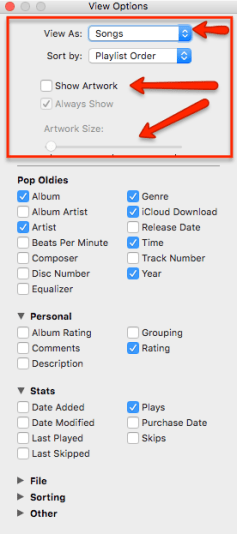 As you can see in the image to the left, the top most portion is what is most important for playlist setup. Click ‘View As’ to change the way the playlist looks. This drop down was formerly at the top of the playlist bar, but has now been removed. The only place where this option is now is in the View Options panel.
I guess Apple is now taking pages from Microsoft’s book of UI design. Meaning, they are now choosing to bury things under tons of mouse clicks which is extremely inefficient from a movement and time perspective. This does not in any way make moving around in this UI interface any faster. It is now firmly more cumbersome and pointless.
I just don’t even get what Apple is trying to accomplish here with these stupid and unnecessary design changes. If Jobs were alive, he’d be not only bringing some of these people to tears, but some of them might even see the door. It’s quite clear, there is no clear direction at Apple. If this is the work of Jony Ive, then please, let’s walk him to the Apple Campus door as fast as physics allows.
There seems to be no bad design depths to which Apple will now reach. I shake my head at just how far this malus domestica has fallen.
The Million Dollar Money Drop: $800k loss analyzed
Fox aired a game show entitled The Million Dollar Money Drop in late 2010. This show’s gimmick had contestants placing money piles (starting with $1 million dollars in $20 wrapped bill piles) on answers. If you answered correctly, the money stayed on the table and you got to answer more questions with that money. If the money fell, you lost that money. After a number of rounds, you might get to keep some or all of the money depending on how many answers you got right. The show ran for 1 season for a total of 12 episodes before being cancelled.
In 2010, a couple is seen placing $800,000 on an answer only to lose it all based on an incorrect answer. Let’s explore.
The Controversial Question
Category: Inventions
The answers:
- Macintosh Computer
- Sony Walkman
- Post-It Notes
The question: Which of these sold in stores first?
While this may seem like this question has a definitive answer, it doesn’t. In fact, it is in every sense of the word a trick question and should have never appeared on this show. Let’s understand why.
Point of View
While a predecessor to Post-It Notes may have been on sale during a limited test market run in 1977 as Press ‘n Peel offered by 3M (performing dismally), the product officially branded Post-It Notes didn’t go on sale nationwide in the US until 1980. But, the trick to these answers doesn’t stop here. Sony also introduced the product brand named Sony Walkman in the US in 1980. However, the Sony Walkman was on sale in Japan in 1979. But, since the question wasn’t explicit on where those stores were, the correct answer is still that there is no correct answer because of too much ambiguity based on the person’s point of view.
If you take the answer literally by looking only at the brand names, then Post-It Notes and Sony Walkman both went on sale in the US during the same year: 1980. Why is the US piece important? Let’s understand that this show was geared towards a US audience. This means that neither the contestants nor most of the audience would be aware of sell dates of products in other countries. So, the ‘first sold in stores’ would have to be taken implicitly to mean ‘in the US’. Taking only US sales of these explicit brand names into consideration, the answer would be a draw. They were both sold in stores the same year in the US.
If the question had asked more explicitly about worldwide sales, then the correct answer to the question would be Sony Walkman (still going by the product’s literal name) because of the sales in Japan in 1979.
Category Inventions
Because this category is explicitly discussing inventions, you have to ask if this question covers all incarnations of the invention branded or not? Which means that if you aren’t literally using the brand names and are covering all incarnations and names of the product before it was finally sold as these names (i.e., covering the entire invention history), then 3M’s product is the winning answer as Post-It Notes because they were introduced and sold in test markets as early as 1977. However, that also means that early Sony cassette players may also be considered Walkmans even if not branded explicitly with that name. Again, this adds even more ambiguity to this answer.
The Million Dollar Money Drop
Let’s bring this back around to the show. Why would a show ever put such a trick question on a show? Some people blame the show’s research department for (im)properly researching the answers. Personally, I don’t think this is true. I believe the question was properly researched and was used intentionally for one reason: To thin out the contestant’s money. Because this question was a trick, the answer that had the most money would have been the wrong answer. In fact, any answer with the most money would have been the wrong answer. The show could have justified that wrong answer by taking any of the above ambiguous points of view to justify dropping the money.
The point to the questions on shows like this is not to give you a chance to keep the money, but to take it away. These shows are in business to be, first and foremost, a TV show… to be entertainment. They want to give away the least amount of money possible. They do this by asking questions without simple answers.
Answer Controversy
In this particular case, the show went way overboard with this question. But, their ultimate goal was achieved by taking away $800,000 from the contestants. That was entirely intentional by the producers. The point is to take away as much money as possible from the contestants.
Unfortunately, the controversy surrounding this entire issue left the show in a tough position. Because so many people believe that the 1977 date is the ‘correct’ date for the 3M product, they also believe the couple lost the money on the ‘correct’ answer. They didn’t. This was a trick question that had no correct answer. They didn’t lose the money either because it wasn’t theirs to begin with. The show gives you the money as part of the show to ‘gamble’ with and that’s exactly what the contestants did. They gambled on that answer and lost. The contestants couldn’t have walked away with that money at that time. They had to answer the question. If they had walked away, they would forfeit the game and the show. Were that to happen, the show would likely have never aired.
If the couple had actually realized the controversy surrounding this question at the time of the show (which was evident in their own bickering), they could have hedged and placed 50% on one answer and 50% on the other. This would have at least kept 50% for further questions. The show was going to pull the drop on whichever answer had the highest amount of money. It just happened to be Post-It Notes. But, if they had placed all or most of their money on Sony Walkman, it would have dropped as the wrong answer. If they had put 50% on the two answers, the show couldn’t drop both. So, they would have at least kept $440,000 to continue playing.
If anything, what this says is that in the age of the Internet search, Game Shows would be wise not to use such ambiguous questions and answers. As soon as people walk away from a game show, they’re going to Internet search for the right answer immediately. If the contestant had had a phone on stage, I’m sure he would have looked it up right then and there.
Note that this show offered for these contestants a second chance to ‘try again’ because of this issue. Though, I’m sure that after this public humiliation, why would they want to do it again? After all, this YouTube video is likely to be around forever. I’m also certain that the controversy around this entire issue is what caused the cancelation of this game show. Fox just wanted to distance itself as far away from this as possible. The best way to do that was get rid of the show, and that’s exactly what Fox did.
‘Tis the season to be breached
As we roll into another holiday season just having passed through Black Friday, it’s wise to understand how to best protect yourself from these accidental data breaches at retailers (see: Bebe’s Data Breach). Let’s explore.
What is a data breach anyway?
A lot of people shop with credit cards without first understanding what they are or how they really work. By this statement I mean, I think people understand that the purchase extends credit for the items in advance and then pay the actual bill later to the credit card company. But, that’s not what I’m talking about. I’m talking about what happens when you swipe your card at a terminal. Let’s understand payment processing.
When you enter a store and swipe your card, information is exchanged between the terminal and the cash register. That information is whatever is on the back of the card (the card number, expiration, name, etc). All of that information is now accessible by the register (and cashier). Additionally, stores have networks that connect all of their registers (a type of computer system) to a central controller and ultimately to a company wide network. The company wide network may be connected to the Internet, but may only have direct connections to payment authorization providers.
When you swipe your card and that information is exchanged by the register, a program takes your card info along with the payment amount, securely asks a remote payment authorization service whether the card has sufficient funds to support the transaction (at least this part is secure). If your bank says yes, the transaction is approved and given a transaction number. This is a payment authorization and it instructs your bank to hold this dollar amount aside until the closing paperwork arrives (around 24 hours). If the paperwork never arrives, the authorization falls away and the money being held is released back into your account.
Now, if you don’t have enough funds (or for other reasons), the payment service receives a decline from your bank. The retailer and payment authorization service never know the reason for the decline, only that the transaction was declined. You will need to contact your bank to find out the reason for the decline. Declines can range from not enough funds to bad expiration dates on cards to reissued cards to fraud detection holds. Again, you will need to contact your bank to determine the reason and then rectify it. Note that if you are significantly over your limit and your card hasn’t seen a payment for several cycles, the screen may request the cashier call into a number. The person on the other end might request the card be taken and cut up. This typically means the account has been closed by the card issuer and you are no longer authorized to use the card. It is always wise to pay your bills if you value using that card.
Card Info Data Transit
The problem with data transit on a network is that, depending on the network and who built it, it could be designed to transmit your data as encrypted or in clear text. Let’s understand the difference. Encrypted data means that a key is needed to unlock the data to view it. This means that only devices that have the proper key can view and use the data. However, many network operators don’t use this type of security. A lot of people who build internal networks for corporations feel they are inherently ‘safe’ and choose to use clear text transit. What is clear text? Clear text is just like this blog article. It’s humanly readable without any extra work. Thus, many companies fail to adequately protect data transit between internal network devices under the assumption that no one should have internal access except authorized internal devices. In other words, because of the external border protections such as firewalls that prevent unauthorized inbound traffic, internal networks should be a ‘safe place’, thus adding extra safeguards only serves to slows down processing and, if you happen to be a retailer, could make the customers wait at the register longer.
Internal networks designed with limited or no encryption are a hacker’s paradise. If they happen to get into a network like this, everything is easy to read, easy to find and easy to download. It’s basically a dream come true for the malicious hacker. With little to no constraints on viewing data, it’s a kid in a candy store and that’s exactly how and why data breaches begin.
How do hackers get into a network then?
Because most companies today require their computers to have internet access, especially retailers who need access to payment authorization services, bugs in network and computer devices are impossible to squash. Internally, companies typically hire IT and operations teams to manage their network systems. They also typically hire security teams to help protect their networks. The security teams do their best to mitigate attacks and watch for data breaches, but it is the operations and network teams that manage the network gear and keep them updated. Because the security team and operations and network teams are separate sets of people, getting equipment updated with the latest-greatest version isn’t always expedient. This means that companies could be running one, two or five versions behind the latest version.
It happens for a lot of reasons. It could be old equipment that simply won’t support the latest update. It could be that there are thousands of servers that could be impacted by a single update. It could be that that single update might break custom software written by the company. There are a lot of internal factors as to why any piece of equipment is not on the latest version. Yes, sometimes it’s even a matter of complacence.
How do you protect yourself?
Before strolling into your latest big box retailer, you should arm yourself with knowledge. Knowledge like the above to better understand how your data gets moved around in company networks. Then, you can better understand when to take the risk to use your card and when to use another form of payment.
Use Store Cards
First and foremost, the safest card to use at a retailer is a store card without a Visa/Mastercard logo. These cards can only be used at the retailer where they were issued. They cannot generally be used anywhere else (unless the company owns several retail shops and shares the card among them). So, if you purchase at Target or Macy’s or Sears with a local store card, if there is a data breach, your ‘store card’ card number is no longer the lowest hanging fruit. The lowest hanging fruit are the Visa, Mastercard and Amex branded cards. With store cards, it will take time for a hacker to understand what that card is and how to use it. Also, once they realize that it only works at that single retailer or at that retailer’s web site, it’s much less appealing. Especially considering that many hackers today don’t live in the US. They might be living in China or Korea or Russia where that store may not exist and where they may not ship abroad.
So, sticking with store issued cards is really your safest bet when shopping at big box chains. Using a Visa or Mastercard or Amex branded card, if stolen, can be used anywhere around the globe (unless you call your bank an explicitly ask to prevent its use outside of your country). Note, not all banks can stop international transactions on branded credit cards, but most can. Call your issuing bank and ask.
Of course, should you plan travel abroad, you will need to make sure your bank authorizes international use before you leave. If you forget to call from home before you reach to your destination, you could have problems.
Limit transaction amounts
You can also limit your per day transaction amount to a much smaller amount. This can make it difficult if you want to buy a big ticket item with your card, so you’ll need to weigh just how often you make large purchase (and how big they are). However, lowering your per day transaction amount to $500 or less limits how much a hacker could put on the card per day. Again, your card would then no longer be low hanging fruit. Hackers want cards with high dollar amount transaction limits to they can spend a lot of money per day quickly and get away from it. As soon as a hacker tries to buy something expensive and they get a decline, that card is marked as not usable and they move onto trying another card.
Use gift cards
Because there are now Visa and Mastercard branded gift cards, you can put a dollar amount on the card that you wish to use while shopping. If this card number is lost to a hacker, it’s has limited liability (because of the logo) and it limits how much damage they can do to you financially. Also, because it’s a gift card, there’s limited personal information they could obtain about you in relation to this card. So, identity theft is much reduced by using gift cards. You should read Visa, Mastercard and Amex branded logo gift cards carefully. Some require fees after 1 year. So, you will need to use up the balance on the card within 1 year or you could start losing your balance to the monthly fees.
There are also store branded gift cards without any logos such as iTunes, Sears, Amazon, etc. These gift cards can only be used at their respective issuers. Again, these cards offer limited liabilities if stolen.
Though, if a gift card number is stolen, you will also want to read the terms and conditions with the card issuer. Not all of them assume replacement liability. So, if your gift card is stolen, you may be out whatever money was on them. So, you should always read gift card terms and conditions carefully.
Use good ‘ole cash instead
While cash does have its uses, I don’t believe holiday shopping is really one of those times. Because you’re typically buying large ticket items for holiday gift-giving, carrying a wad of crisp $100 bills around to pay for them can be downright dangerous. During the holiday season, you may be trading your financial safety for personal risk. For example, the first store you visit could lead someone seeing your cash, stalking you and taking your money and gifts from you by mugging…especially if you just happened to walk out of an Apple store. Depending on the city where you live, it’s sometimes not worth trading the potential safety of your financial security by putting your personal safety at risk. If you are mugged, they’ll likely steal your cards too, which also leaves your financial safety at risk.
And, if muggers rip off your cash, there is no replacement at all. It’s gone. Using credit cards, especially Visa, MC and Amex branded cards, these cards offer limited loss liability. So, if someone steals your card number and begins using it, your total loss is quite limited. The bank will pick up the tab on your behalf and then chase down the perpetrators for their involvement attempting to get the money or merchandise back.
Basically, cash is unsafe and insecure if carried in large amounts. Whipping out your wallet and flashing that set of crisp $100s once is all it takes during a busy shopping season to get you mugged.
Use a debit card
Last, but not least, use a debit card. Though, while liability on your debit card might be higher (check your debit card terms), you have a known pin code that is required to buy anything. A pin code is a lot stronger of a protection than a signature on a credit card. Basically, stores are not required to collect signatures from purchases. They can simply state ‘signature on file’ when that may not be true. This is how you can buy with a credit card from Amazon or Newegg without ever having to sign for your purchase. Even some retailers today are not asking for signatures on cards if the transaction amount is under $50.
Debit cards always require a pin for the transaction. With web site access today, pin codes are also relatively easily changed. You can also usually get the pin code changed long before the hackers are dipping into these cards to make purchases. Again, hackers prefer low hanging fruit. This means that most hackers would opt to use Visa, MC or Amex branded cards rather than trying to use someone’s personal debit card.
Though, keep in mind most debit cards issued by banks today contain a Visa or Mastercard logo. So, that means the card can be used like a credit card with a signature alone. Instead, you should ask your bank to send you a debit card without the logo. This card can only be used where debit cards are accepted or at ATM machines. It cannot be used to buy at places that don’t accept debit cards. Again, this keeps your card from becoming the lowest hanging fruit.
Limit your shopping days
When you do shop, keep your receipts so you know the date and time that you shopped and where. Keeping receipts is always smart if you need to return something, but it’s even smarter when there’s a data breach so you know if you may have been affected.
Also, limit your shopping to a limited number of places and keep record of when and where (use receipts or write it down). Four months after the holiday shopping season when a breach is announced, you might not remember that you shopped at that random store that lost data which then subsequently led to some random hacker racking up a large bill on your Visa card. In fact, you might only discover the breach yourself after you notice the large bill on your card.
If you limit the number of times you shop and use cards as suggested above, you can help eliminate your cards as being the easiest to rob.
Shop where breaches have previously occurred
This may seem counter to safe practices, but companies have have endured breaches are less likely to be breached again. This is especially true of big box retailers such as Target, Walmart and the like. These retailers have a whole lot to lose if they are breached a second time. It’s very likely that these companies networks are a whole lot more secure after the breach than before it.
Shopping at companies who have not yet had a breach doesn’t mean that their networks are insecure any more than they are secured. Yes, it could mean that. But, it could also mean that these yet breached companies are lucky not to have been targeted. If hackers focus their sights on a victim, they will chip away at the security until they find a way in. They also have plenty of time to do it. Let’s also note that way into a network may not be through the front door. The hackers could get in just as easily through an executive’s lost or stolen cellphone or notebook or a third party vendor (like HVAC, plumbing or other contractor who’s network might be less secure). Note that hackers may also work on several company networks at the same time until they find one to breach.
What about Sony?
Sony is a bit of an unusual case. Instead of strengthening their network security across the board, it seems their management team may have decided to only tightened security on the division that was compromised. Sony is a very large corporation containing many different entities all over the world. SCEA (the games division) was where the last breach occurred prior to this latest breach on the Motion Picture Group. So, anyone who has read through the MPG spreadsheet of salaries knows that there are at least 6 people in the US alone that are taking home well more than $1 million dollars a year in salary. You would think that these highly paid staff would understand the risks of computer networks and make it their top priority to secure their personnel and other records through best security practices. Nope. For example, an easy best practice is to use a password to open a spreadsheet. Sure, these can be easy to crack, but that’s extra effort required on the part of the hacker.
Unfortunately, these people are not doing their jobs. Some could argue, it isn’t their job. Their job is to be Senior or Executive VP of blah. Part of being a Vice President is to make sure your company is secure. If you can’t ensure that your division is secure, then you shouldn’t be taking home a million dollars in salary. It’s quite simple. These people are way overpaid for the job they perform for Sony. I digress.
Sony is clearly a situation where the left hand doesn’t know what the right hand is doing, and frankly they don’t care as long as they walk away with their pay. So, what about Sony? Here’s the takeaway.
For any company that has been double or triple breached (like Sony), you should stay as far away from that company (like Sony) as you possibly can. Sure, you can buy Sony products at a retailer because the retailer is responsible for the transaction. But, you should not use Sony products that require storage of credit cards for payment. You should also not purchase software from any site that Sony owns. It’s crystal clear, Sony cannot be trusted and they seriously don’t care about data security. If you must purchase something from Sony, use a Sony branded gift card, Paypal, Google or Amazon checkout. These payment systems are not owned or operated by Sony, but can send payment to Sony for whatever it is you need to buy. But, don’t buy directly from Sony (or any other company) that has repeatedly been breached.
Best Practices for Personal Finances
While these are but a few best practices to protect your home finances, there are plenty more common sense approaches to keeping your finances secure. Here are a few top examples of how to secure your own finances:
- Keep your credit cards in a safe place.
- Regularly check your bank statements for unauthorized transactions. Some banks now offer email notification of suspicious activity, use it.
- During the holiday season, make sure you know what stores you shopped by keeping receipts in a handy place.
- Open a second bank account to move small amounts of money in when you need to purchase items online or in stores. Secure your primary account using limited access to services like debit cards, ACH and other third party access. Use the second account much smaller account for these services. It’s easy to move money between accounts in the same bank using your phone app or on the web, so take advantage of this extra security.
- Call the bank immediately if you’ve lost or stolen your card. You should write down the number on the back of the cards into your smart phone so you have it in case the card is stolen or lost. Don’t write the account numbers down next to the phone number.
- Make use of the free credit report you can get once a year and check your credit every year.
- Don’t purchase from any retailer where they are not following proper credit card practices. For example, they should not have to double swipe your card, write the numbers down or ask for any further information aside from looking at the back of the card.
- Don’t allow any retail cashier to walk away with your card. They should only need to hold the card long enough to look at it or swipe it once at the register.
- While it is a regular practice for waitstaff to walk way with cards and bring them back to the table as a convenience, you should be wary of this practice. In fact, it might be best to take the check to the cashier at the place where they ring up your meal and watch them ring up your bill. Allowing waitstaff to walk away with your card out of sight means it could be duplicated, swiped through a cell phone or written down.
- Throughout the holidays, you should search through a major news site for data breaches at least once a week. As soon as you hear of any store that has breached where you may have shopped, you should ask for a replacement card if logo branded or change your pin immediately if debit. For Visa, Mastercard or Amex logo branded gift cards that may have been used at that retailer, you should call the number on the back to have a replacement sent immediately. Unused gift cards are not a problem.
- Request your bank place a fraud watch on your account if you suspect anything amiss with your cards. You should also request a replacement card if you have any reason to believe your card number has been lost. Yes, I know that can be a hassle during the holiday season while you wait for a new card, but it can potentially save you thousands of dollars lost to a hacker.
Overall
It is up to you to secure your own home finances. Using the above best practices should help aid you in achieving that goal. But, you should immediately become suspicious of anyone who attempts to do anything out of the ordinary with your card. If a cashier asks to do something with your card that doesn’t make sense, you should immediately ask for the card back and call over the store manager to clarify what’s going on. If they are the only person in the store, you should leave without making the purchase, step out of the store and immediately call your bank and put a fraud watch on your card.
As the Holiday shopping season gets fully underway, you need to be ever vigilant over your finances because the stores won’t do this for you. Worse, because there are many people who need money to meet their own bills and cover holiday shopping expenses, fraud and theft can be anywhere from anyone. That’s not to say that most people working at retail establishments aren’t screened and trustworthy, but for some people, the temptation of all of that money gets the better of them and they resort to taking other people’s money. By far and away, though, data breaches are the biggest problems of all because you don’t know who or where the attacker is. So, this is where you need to watch your finances closely and use your card very limited amounts over the holidays. Use cash where you can, but don’t jeopardize your personal safety by carrying too much cash.
Wishing a Happy and safe holiday season to everyone from Randosity!
Wireless Power: The time has come!
 We all have that love/hate relationship with cables. You know, having to plug all those devices in to keep them alive. With all of the new small mobile devices appearing and all of the new thinner phones we are seeing, one thing that is continually a problem is battery life. You know, that little square brick thing. The thing that, at the end of its life, fills up landfills with hazardous waste. I’m not talking close range wireless inductive power charging. We have that now. I’m talking long distance remote wireless power. Using a standard wireless power system, device lifetimes will extend far longer. No longer do you need to go track down an elusive battery to fit that old device. Let’s explore wireless power.
Device Sizes
As devices get smaller and smaller, one thing becomes painfully obvious, we cannot make batteries any better. Our battery technology is firmly limited in how much power it can hold and supply in a small size. The smaller the battery, the less power it holds. Our reducing electronics in size isn’t helping matters here. Worse, our battery technologies are relatively hazardous and, if charged wrong or if the battery gets fatigued, can explode or catch fire harming or injuring someone.
But, why do we continue to use batteries when it’s really not necessary? I’ll answer that, it’s because of the battery industry. That industry thinks that wireless power would replace batteries. But, that thinking is wrong. For small devices, we will still need the device to hold a capacitance charge for at least 15-30 minutes when traveling between areas without wireless power. Once a large enough network of wireless power is available, that capacitance charge requirement may no longer be necessary. Until then, most mobile phone devices have to accommodate off-grid usage for at least 30 minutes at a time and must hold at least that much power. However, a 30 minute charge shouldn’t require a huge brick of a battery. Though, some devices can choose not to offer this capacitance charge at all if it is designed with the intent of never being off of the grid.
Cell Phones
It’s fairly clear that cell phones need some form of extended power. Though, if you are in a car, your car could supply wireless power along with such places as your home, your workplace, shopping malls, restaurants, etc. Unless you live in a cabin in the woods without power, you probably live where wireless power could work. Even in a cabin in the woods, wirelessly transmitted power could reach such remote destinations giving power options to many who can’t afford to string power cables.
Wireless Power and Benefits
If you’ve seen any recent SciFi movie, you’ve probably seen a character pull out a transparent flat screen device or pull out a full motion newspaper. These devices could actually become real with wireless power. Neither of these devices are possible today. Why? because we cannot create a small enough battery to run these devices and retain the thin nature of the device. Instead, to support flat profile devices without the need for weighty and short lasting batteries, we need wireless power. Just as we have WiFi networks, we can set up wireless power networks that work much in the same way as WiFi.
Each device will register itself with the power network. If there’s an account associated with that device, you will be able to obtain power from the network no matter where you are. If you’re roaming, you might incur higher charges to pay for the power on a network that isn’t yours based on the local rates. Though, it’s also possible you could pay less if you roamed into a cheaper power area. If a business chooses to offer free power service (such as hotels or coffee shops) that’s also their choice.
Design Benefits
With wireless power providing electricity to our devices, designers no longer need to worry about batteries in their design. No longer do consumers need to worry about if their device might catch fire or explode or, in general, become a hazard. With wireless power, we can finally see paper thin devices including such devices as electronic newspapers or bendable tablet devices. It could be used for full motion flat posters or window displays. It could be used on the front of device packages (though, this might be an excessively wasteful use of this). It could be used in game controllers for endless power. Motion displays could be added to video game controllers without the need to worry about power usage. It could be used on notebooks for endless power. There are immense design benefits here for every vendor who relies on battery technology to power their devices.
Wireless power offers tremendous advantages over wired power. The most obvious is no more batteries, no more cables, reduction in device weight and the ability to always power small electronic devices that we always carry around. No longer would we have to worry about whether the battery is dying or the consequences of that. In fact, battery meters would become a thing of the past on most devices.
Wired Power vs Wireless Power
It’s clear that wired power will still have its place. To support 240V or higher, these devices would likely still need to be wired. But, for small portable devices, we need full long range wireless power. Just like moving to HDTV improved our visual entertainment experiences, moving to wireless power will vastly improve our electronics experiences for many years to come.
How would it work?
Tesla has already provided the concept to make it work. He was in the process of setting up his proof of concept when the power companies thought it might cause free power for everyone and the whole project was scrapped and his Tesla tower was abandoned. That was in the early 1900s. Since then, we have not explored wireless power. Instead, we explored the telephone, the lightbulb and many other inventions around that time, but Tesla’s vision of wireless power was way ahead of its time. However, long range wireless power is not without some hurdles. The protocol will need to be built and tested and the delivery and receiving systems will also need to be designed, built and tested.
Today, we actually need wireless power to move to the next paradigm shift in devices so we can eliminate the waste and the weight in our small portable devices. It will take some time to get there. It definitely won’t happen overnight. The power companies will need to adopt the shift to wireless power. But, only after supporting infrastructure technologies comes to exist.
That means that the power companies, like the cell phone companies, will need to build towers throughout the city. The technical infrastructure would work much like WiFi networks. In fact, were the power companies to actually move on this initiative, they could even set up their own Internet connectivity networks separate from the wireless carriers. The power companies could actually put themselves into a position with a huge alternative revenue stream in addition to wireless power. In fact, because the devices will need to be able to negotiate their connectivity on the wireless power network, an actual data network will need to be in place. This is the reason Tesla’s ideas were too far ahead. His wireless power idea required the data network to support registration of devices. That couldn’t be done in the early 1900s. Today, it makes perfect sense to offer both wireless power and wireless networking throughout the city to allow for registration of devices on the network.
Short Sighted
Unfortunately, our power companies have remained mostly short sighted and stagnant choosing to stick to power generation and wired power. Every technology deficit eventually catches up with every industry and the power industry is no exception. We need devices that don’t require batteries. The power companies are in the position to offer that goal. We now need the technology and power generation industries to meet in the middle so technology can progress into new paradigms.
It’s unfortunate that the power companies haven’t seen these other revenue potentials. As the anti-posterchild for the power industry, Enron tried alternative money making methods such as bidding for and selling power on the open market in addition to trading energy contracts. We all know what came out of that: California got the shaft causing consumers to pay a huge premium for power (and suffer from rolling power outages) and Enron hid its debt behind confusing business vehicles of which bankruptcy was inevitable (including Arthur Andersen.. their accounting auditor). This is not what we need. We need to viable plan for our future power needs.
The Future
There are creative, but illegitimate means ways to make a buck, as Enron has so aptly proven. Though, employing illegitimate means of making money eventually catches up with you. On the other hand, there are creative and legitimate means to extend existing services into new markets and, at the same time, bring about new paradigm shifts. Such a shift will occur when we begin using wireless power to deliver power to our watches, notebooks and tablets. Wireless power will ultimately clear the way for new devices like motion posters, flat paper displays, wearable displays (i.e., on clothing), lighted clothing and other much thinner and lighter devices. It will allow for cable free and plug free lighting around the home. No more tripping over cables on lamps or sending devices hurtling through the air.
Appliances and high powered devices (clothes dryers, electric stoves, refrigerators, etc) will likely always need a plug. But, our small electronics will perform quite well on wireless power. The time has officially come for us to cut the cord and setup and use true wireless power.
Apple Watch: A commentary
 I had not planned to write anything about the newest Apple announcements, but I’ve decided there are few things that need to be said about the Apple Watch. Let’s explore.
Apple Watch
So, this is the one thing that’s on everyone’s mind. I mean, it basically stole the show, but not necessarily in a good way. Why is that? Let’s start by saying that phones are the new watches. Most people don’t need to wear watches any longer because the phone itself suffices for that purpose. I mean, why carry around two different devices each needing their own battery charges when you can carry around one? I think this is where Apple assumes their distortion field is enough to overcome people’s recent aversion to wearing watches.
It’s not like the Apple Watch has reinvented something new. It’s a bloomin’ watch for chrissake. Its most basic feature is to tell time. It’s not like that’s new or revolutionary. It’s all the extra bells and whistles that come along for the ride that make or break the deal. Are those extra bells and whistles worth it? For some maybe yes, for others likely no. I mean, if you don’t need the pulse monitor or step tracker and you don’t really plan to use it as an iPhone controller, then you’re cutting about 60% of its functionality right off the top. For the $349 price tag, that’s quite pricey for a bulky thick watch.
Yeah, it’ll have a music player, but how much storage? We’re not really sure yet. But, if I know Apple, it’ll go out on the cheap and we’ll get 8G or some piddly amount like that. Just enough to hold a tiny music collection, but not enough to really be useful nor is that storage in keeping with a $350 price tag. It might also play movies, but why? Who wants to watch a movie on that tiny watch screen? Not me. That’s why I bought an iPod touch, though I don’t really much like watching moves there either. So that’s why I also bought an iPad.
Watch Failure?
Adoption of this device will be tough for Apple primarily because it will be difficult to retrain so many people to embrace the need for the Apple Watch. I mean, people have done without watches for the last decade just fine. For those people who love to wear watches, though, the Apple Watch might appeal to them. But, at that price tag, it might not. I mean, you’re going to be wearing a $350 device on your wrist in addition to carrying around a $500 valued iPhone. After all, what’s the point in buying this watch unless you have an iPhone? The other problem Apple faces is name brand watches. There is no way Apple will push aside such luxury brands as Rolex, Cartier, Patek Philippe, Tag Heuer or others. For the person looking for a luxury brand, they won’t think twice about looking at their favorite luxury brand. The Apple Watch won’t even factor in other than just having it as a novelty item. I guarantee the red carpet crowd will still show off their Rolex watches and not the Apple Watch when showing off their newest duds waltzing down the red carpet.
However, there will be a core group of Apple early adopters who will invest in this technology from Apple just because it looks cool and is new. After those people are done shelling out the cash, what then? We may find that the Apple Watch fares no better than sales of any other watch brands, which are not doing all that well today (other than the super ritzy brands of which the celebs adore).
Battery Life?
Apple faces a whole new set of problems when introducing this new device. Obviously, the battery will be a big deal clincher for a lot of people. If the battery lasts 3-5 hours, that’s just not enough to be useful or you’ll be yanking that watch off your wrist to charge it up frequently. This would be the absolute kiss of death for this device. No one is going to put that much time and effort into keeping it charged constantly.
Knowing that this device has Bluetooth and possibly WiFi, both of these wireless protocols are absolute battery hogs. There is no way around it. If you have Bluetooth and WiFi enabled, you can say goodbye to any decent amount of battery life on a device.
For example, when I cut off WiFi and cellular data on my iPhone 4s, I can typically get at least 3 days worth of charge out of the battery. With cellular data on, you might get a day at best. With WiFi on, you’ll get a day at best. These wireless protocols are out and out battery killers. For this reason, that’s why it wasn’t on the original square iPod nano. And, the battery on the iPod nano (aka. first gen Apple watch) lasted amazingly long.
Overall
This new Apple Watch itself is bulky, and bulbous. Though, I like some of the features, like the less breakable crystal. But, there are things I don’t like, like the icon vomit on the main screen. It’s easily one of the most ugly eyesores I’ve seen on an Apple device yet. I’m also not sure that Apple can sufficiently overcome this last decade of training people to use mobile phones as watches. Apple even ironically ushered in this trend with the iPhone itself. Now they’re trying to undo this? Good luck. I’ll wait and see just how the sales do on this long term, but I’m not holding out much hope with this first version of the watch.
Perhaps Apple can fix a lot of these problems in the 2G version of the watch. Personally, I’d rather see them do a pocket watch edition. Now that would be more useful. The screen would be bigger, you can hold it in your hand like you do a pocket watch and it has that cool button at the top which could be used for so many things (including opening a flap covering the display like a normal pocket watch). Not to mention, there are many people who collect pocket watches over standard wrist watches. We’ll just have to wait and see how well this all turns out.


 Random Thoughts - Randocity!
2 comments