How to pair your PS5 controller wirelessly
 As a follow-on to Randocity’s original How to Pair your PS4 Controller Wirelessly article, here’s how to do this for your PS5 controller. Yes, it’s still possible to pair a controller wirelessly. Let’s explore.
Intent
This article is intended to allow PS5 owners to pair a PS5 controller to your PS5 console without the need to use that ever elusive USB cable. If you’ve lost or misplaced your cable, no need to fret if you have certain prerequisites available. Unfortunately, if you don’t have any of these requisites, you’ll need to dig up a USB cable.
PS5 Controller
The PS5 Controller is much the same as the PS4 controller in terms of its buttons, with the exception of the controller’s labels. Instead of clearly worded ‘Share’ and ‘Options’ labels, they now have obscure icon labels. If you’re familiar with PS4 button placement, it is identical on PS5 controllers. Left upper button next to the touch pad is Share, right is Options.
To pair your PS5 controller wirelessly, however, you’ll need to have at least one controller active on your PS5. That controller doesn’t necessarily need to be a game controller. If you’ve enabled the HDMI link on your TV, you can likely use your TV’s remote to navigate the PS5’s UI to the proper settings location to pair your controller.
Many people don’t know that your TV’s remote control (via HDMI) can be used to navigate the PS4 and PS5’s menu systems by using the arrow controls on the TV’s remote control. With your TV remote, you can navigate to the settings area needed to pair your controller. Note that the HDMI Link must be enabled on the PS5 and may not work on all TV models. It seems to work correctly on Sony TVs (as expected), but brands other than Sony may or may not work. You’ll want to test your TV for functionality to ensure control with your TV’s remote works via HDMI.
To make the TV’s controller work, however, it must also be the active controller at the time you sign into your PS5 (or PS4). The controller that signs into the PS4/PS5 is the active controller. You can’t switch to the TV’s controller after a PS5 controller signs in. You’ll need to sign out or reboot your PS5 / PS4 to get back to the sign-in screen.
Also note that the TV’s remote control itself will not power on the PS4 or PS5. You’ll need to press the power button on the front of the PS5 unit if you have no PS5 controller handy. Alternatively, your PS5 should power on by switching to the PS5’s HDMI port using the TV’s remote control. If switching to the HDMI port doesn’t work, then you’ll need to press the power button on the PS5.
If you’re new to the PS5 and don’t know where these buttons are, they are on the opposite end from the blue USB port on the front of the unit. The longer button is the power button, the shorter button is the disc eject button. The Digital version might not have a disc eject button.
Pairing the Controller
Here’s the meat of this article. There are two pieces involved:
- The PS5 needs to see and be ready to accept the device once it’s found
- The PS5 controller needs to be placed into pairing mode.
Ensure that you have a controller that functions, such as your TV’s remote control or a second PS5 controller. Once you have this, on the PS5 navigate to Settings -> Accessories -> General -> Bluetooth Accessories. This places your PS5 onto the correct screen to continue the next part of this process.
 Here are the PS5 controller pairing steps:
- For 5-6 seconds or so, press and hold the Share button and the PlayStation (PS) button simultaneously until the controller light begins to flash in rapid succession. Once the lights begin to flash, look at your TV screen to see the controller appear under new Bluetooth accessories.
- The new controller will show up as ‘Wireless Controller’ below all other paired controllers.
- With your TV remote or your currently active controller, navigate down to that “Wireless Controller” and select it with the X button on a PS5 controller. TV remotes may use an OK or ENTER button for selection.
- Once selected, the PS5 will ask, “Do you want to register this Bluetooth Accessory?”
- Choose “Yes”.
- The PS5 will ask you to select an account for that controller. Choose an account.
- That new controller will be paired to your PS5.
- Done.
Your new controller is now paired and ready for use. If you have questions or if this article has helped you, please leave a comment below.
Enjoy.
If you found this article helpful, please click the ‘Follow‘ button on your screen. In a web browser, that will be in the upper right corner. In the WordPress App, press the 3 vertical dots in the upper right, then click ‘Follow site’ on the menu that appears.
↩︎
One Cockpit Pilot for Commercial Jets?

The airline industry has continued reeling ever since the start of the pandemic. I won’t get exactly into why that is, but let’s just said that the Airlines caused this problem for themselves. As a result, pilot shortages are now seemingly commonplace. Commercial airlines are now seeking ways to reduce their pilot shortage, but not in sane ways. One idea is that pilots should be reduced to one in the cockpit. Let’s explore why this is probably the single worst idea that could be floated.
Health Problems
Let’s jump right into this disastrous idea and understand why one pilot should never be considered for nor allowed on any commercial carrier flights.
The #1 combined reasons why this practice should not ever be allowed is health concerns and redundancy. Having two pilots in the cockpit allows the second pilot to take over should the first one become incapacitated or incapable of flying. Effectively, having two pilots offers a backup system, human redundancy. Human redundancy is the difference between a successful flight and a crashed flight.
Think about it. If a single pilot in a single pilot cockpit becomes ill, incapacitated or worse, who’s going to fly the plane? Are the airlines going to require one or more of the flight attendants to have extensive pilot training so they can assume the role as pilot under this circumstance? That would mean that every flight would need to have at least one flight attendant who is qualified and capable of piloting that specific plane. How many flight attendants would be flight attendants if they were trained to be a pilot?
Short Flights

Some might argue that flights under an hour might offer the possibility of a single pilot cockpit. I contend the opposite. The flight duration does not reduce the danger level. For short flights, that danger level might even increase. Commercial jumbo jets do not run themselves. Like driver assisted motor vehicles, commercial jets require someone to read the controls and understand if the automated systems are functioning correctly.
With only one set of eyes on the controls, it’s easy to miss critical information. Additionally, cockpits are designed to have two sets of eyes and hands. One pilot cannot reach over and touch the far controls that would be handled by a co-pilot. Unless jumbo jet owners plan to retrofit the ergonomics of every cockpit’s controls to accommodate a single pilot’s reach, a single pilot might be required to stand up and move to the second station to mess with those controls. Yes, most controls are right in front of the pilot, some may not be on some cockpit designs. In other words, one size may not fit all in this scenario.
Still, short flights are just as dangerous as any longer flight.
Long Flights
For international flights which might be 13-20 hours, you can’t expect a single pilot to work that many hours continuously. That flight must have at least two pilots simply to handle the shifts require to prevent overwork fatigue. On top of that, pilots need breaks. Who’s going to watch the cockpit when he or she needs a nature break? A flight attendant?
For a single pilot cockpit, on long haul flights, is that pilot simply going to leave the cockpit to go take a snooze for hours? Yeah, for long haul flights, it’s simply not practical. At least two pilots are a must. There’s no other way.
Remote Control

Some have argued that having the ground control able to remote control the flight safely from the ground could become a workable solution for a one pilot cockpit. Right now, we’re nowhere near allowing flight control to safely control a jumbo jet from the ground to a safe landing. Should that become a reality in the future, perhaps pilot free cockpits might work.
There are literal dead spots between control towers that would see a jumbo jet crash. We simply don’t have reliable means to remote control a jet through its entire journey, particularly those flying over open ocean areas where radio contact can sometimes not even be available.
Airlines and Cost Cutting
Airlines can’t just cut the flight crew down to one and “hope for the best”. That’s entirely reckless. It doesn’t matter how young or fit or well or able bodied that a pilot is. Health conditions can come on suddenly and incapacitate someone at any age… even simply from eating a bad meal on board a flight. The point here is that if pilots are reduced to one, every airline is rolling dice in the hopes that nothing bad happens. It’s pretty much guaranteed that allowing a one pilot system would very likely lead to more deaths in the airline industry.
Overworked Pilots
If pilots think they’re being overworked now with this pilot shortage, moving to a single pilot cockpit is most definitely going to cause even more fatigue and burnout with the existing pilots. Being a single pilot in the cockpit puts all of the flight stress and pressure onto one person who could easily make a mistake without knowing it. That’s tough. If commercial airlines want to chase away pilots, moving to single pilots is most definitely the way to do it.
The whole point to a second pilot is for the second pilot to check the first pilot’s work and suggest any corrections. The point in a team is to manage the flight together and agree that everything has been done correctly or disagree and correct the problem. Without that second person, there is no possibility of disagreement.
There’s no way to call any airline safe who chooses to practice having only one pilot at the controls.
Flight Attendant Training
To become a flight attendant, a person must go through rigorous safety training which lasts weeks. Some training can last months, depending on the airline’s requirements. Flight attendants must also reaffirm their training at least once a year to remain certified with the FAA. This training consists of medical training along with safety exercises such as how to safely and quickly evacuate everyone from a plane in emergency conditions using the evacuation slides.
They also learn how to perform their duties and must take practice flights to better understand what’s required of them while in flight.
If a flight attendant is also required to know how to pinch fly a jumbo jet, that takes their training to a whole new level. As stated above, if they’re effectively required to get a pilot’s license, then why become a flight attendant?
Airlines must either force some flight attendants into pilot’s training or technology must catch up to allow for remote control piloting. Either road leads to obstacles for airlines… and may simply shift the problem to a different business area. While it might help to reduce pilot shortages, it may move those shortages to flight attendants or in flight controllers. It’s never a workable solution to think you can make one change and not affect a whole lot of other people down the line. That’s exactly what will happen here.
Would you fly a commercial airline with only one pilot?
Sound off in the comments below.
Please click the follow button on your device to receive notifications of new content, but sometimes more frequently.
↩︎
Why I stopped using Twitter

Based on my recent article, Is the Demise of Twitter imminent?, I have outlined the reasons why I believe Twitter is very close to closing down entirely. While that is a reason not to use the platform, it isn’t my primary reason for leaving Twitter. Twitter has a lot more wrong with it than potential closure. Let’s explore.
Content Moderation and Trust
Let’s jump right into the heart of the reason why Twitter is in serious jeopardy. Any social network that offers User Generated Content (UGC) is at risk if the operators of the site are unwilling to handle that UGC appropriately.
Terms of Service (TOS) agreements and Acceptable Use Policies (AUP) exist to protect the site from lawsuits. Meaning, so long as the site adheres to the terms laid out in their agreements, then the site is said to be doing its fiduciary responsibility to its users.
TOS and AUP agreements define what is considered acceptable conduct by anyone who uses the web site. Most such agreements lay out that conduct such as hate speech, harassing speech, bullying, threats of violence, death threats and any conduct which is considered illegal federally or locally is prohibited on the web site. The article I mentioned above also touches on this topic.
Whenever a site is created that publishes such user generated content on behalf of its users, a site must make sure that the speech remains within the confines of acceptable use. That means offering such mechanisms as user reporting features (allowing users to report offensive content), automated scanning of content to detect such infringing content and a team of content moderators to remove or suspend users who willfully break the rules.
Why do these agreements exist?
Trust. These agreements are in place to help users understand that Twitter is a safe and trustworthy space. As long as the agreements are upheld, then users can know that Twitter is looking out for them. Without such agreements or, more specifically, knowing the agreements aren’t being enforced, then the safety level of the site drops precipitously, along with the site’s level of trust.
Politics and AUP
Recently, too many people on Twitter are now seeing everything through the a political lens. Specifically, the right wingers are now seeing everything they say through a political lens of free speech.
Let’s understand first and foremost that First Amendment Free Speech DOES NOT apply to Twitter or any non-governmental organization operating a social network. It never has. The First Amendment only applies to Governmental organizations and staff. While your local county official cannot abridge your freedom of speech or freedom of press, Twitter can.
Further, let’s understand that terms of service (conduct) agreements are not built with politics in mind. They are built by lawyers who are paid to provide legal services to corporations. These agreements are not political leaning. These agreements apply to everyone using the services equally. Anyone who infringes the agreement is subject to disciplinary action… yes, ANYONE.
Right Wing Activists and Lying
Right wingers have been completely jumping on the bandwagon that somehow Twitter is selectively applying its rules only to right wing activists and not to left wing activists. That would be unfair application of terms of service, but it’s also a false statement. That kind of false rhetoric is now a staple with right leaning conservatives. They’re willing to lie about nearly anything and everything. Why would social media be an exception? It isn’t.
Twitter has applied its rules equally to all people who infringe, left, right or center. It doesn’t matter what your political beliefs, if you put forth infringing content, you’re suspended or banned.
Left wing activists have also been banned from the platform. Thus, this right wing falsehood is just that, a falsehood… like many others. Yet, they keep saying it with careless abandon as though saying it multiple times will somehow make it true. It doesn’t.
As of this moment, right wingers are completely out of control on Twitter… running afoul of Twitter’s rules without any disciplinary action by Twitter staff. That’s not to say left wingers aren’t out of control, because they are also. In fact, there are a lot of apolitical people on Twitter simply playing games with Twitter’s rules because Twitter isn’t enforcing them…. and here is the problem in a nutshell.
Rules, Chaos and Crowd Sourced Moderation
Rules exist to stem the chaos and enforce trust. Without enforcement of rules, a social media site is simply a cesspool without trust… and that’s exactly where Twitter sits right now.
If Twitter had been designed to allow thread creators to manage and moderate user comments within their created thread, like YouTube owners can moderate comments on videos, then Twitter would be in a much better place right now.
It would mean that I, as a Twitter user, could dump off comments from my thread that break not only Twitter’s rules, but my own personal rules of decorum. Unfortunately, Twitter doesn’t afford that level of content moderation to the thread creator. That means relying on Twitter’s now non-existent staff. Of course, when that staff doesn’t exist, there’s no one there to do the moderation work that’s needed.
If Twitter had moved to crowd based moderation, the platform would be in a much better place. It wouldn’t need nearly as much moderation staff as thread creators could simply remove comments from threads they own. If someone chimes in with an insensitive, inappropriate or problematic comment, then “Delete” and the comment is gone. No Twitter staff needed.
In fact, this is the way social media needs to operate now and in the future. Twitter still firmly believes that it is Twitter’s staff sole responsibility to moderate content. That’s not doable when you have perhaps billions of messages being sent daily. A company can’t grow its moderation team to scale to this number of messages. It is also an antiquated idea that should have been gone years ago. However, at the time of Twitter’s conception, crowd managed UGC wasn’t really commonplace. Partly that’s something that wasn’t being done, but partly it’s because Jack Dorsey’s team didn’t have the foresight to realize staff moderation of billions of small messages was not humanly scalable.
In recent years, crowd managed moderation has become not only more acceptable, it’s become commonplace and even important. YouTube has allowed this for quite some time. It allows the channel owner to remove any and all messages from its videos that the content creator deems problematic. It firmly puts the burden of content moderation on the creator. That’s also a completely acceptable situation.
Crowd Moderation
Wikipedia has completely proven that crowd moderation of content works. As a company, you can’t afford to hire the thousands of people needed to scout billions of messages all over the platform. Instead, it’s better to empower content creators to manage a much smaller number of messages.
Reporting inappropriate comments is still available, however. This allows staff the opportunity to jump in and manage inappropriate content if the content creator reports a comment.
However, conscientious creators should be willing to hold and moderate comments prior to allowing them to be published. With Twitter, publishing is instantaneous with no advanced moderation possible. Considering the sheer volume of messages on Twitter, it might be almost impossible to handle a single hold-queue style moderation system. With a spam filter, it may be possible to separate the wheat from the chaff into more easily manageable piles.
Trust, Quality and Moderation
Here’s something that Twitter has needed for a very, very long time. Twitter is chock full of bad actors. Any bad actors who consistently write bad comments of low or questionable quality would see their comment moved into the “junk” moderation pile for the content creator to manage and/or report.
Such a system would allow Twitter to offer up content moderation for all of its content creators. Enabling content moderation places moderation in the hands of the content creator using a hold queue. This halts many instant responses, but it ensures higher quality comments. Comments are then examined and filtered into trust and quality buckets. High quality comments from more trusted individuals get placed into the pile the creator manages first. Successively lower quality comments from lesser trusted people get moved into successively lower moderation piles.
Content creators can both move comments from one pile to another and they can mark commenters so that future comments get placed into specific piles all the way to a block which prevents the user from commenting at all.
For example, piles might be labeled as:
- Instant Publish
- Mostly-Trusted
- Semi-Trusted
- Untrusted
- Untrusted Junk
- Junk
These 6 piles are a good starting place. Instant publish is for your most trusted followers. You know that these followers can be completely trusted to instantly publish a high quality comment with no holds. No moderation is needed for fully trusted people. For people who are mostly trusted, these comments go into the mostly-trusted pile for moderation hold. These are people who are very close to getting instant publish, but you still need to hold their messages because you want to read the comment first.
All other piles are reviewed at the sole discretion of the content creator. If the content creator chooses not to look through the remaining piles, then the comments get purged after 7-30 days on hold.
How does a user become trusted?
Trust comes from both following and adding a new button labeled ‘trust’ along with an assigned level (1-6). Following someone only places someone into the Semi-Trusted pile. Meaning, you’ve followed them so you’re assigning them the default trust of level of 3. However, you haven’t completely trusted them. This means you’ll need to moderate comment content.
As a user gets more and more messages posted out of moderation, the user will automatically move up the ranks of trust, eventually reaching Instant Publish unless the content creator explicitly sets the user’s trust level.
User trust levels can also be managed by interactions with others. A content creator can enable “inherit trust averages” to new followers. This means that user’s trust level is calculated and inherited based on past interactions. If a user has consistent bad interactions, been reported a number of times, been blocked by many people and so on, these bad activities affect the user’s inherited trust level and the user’s trust level goes down. Instead of being assigned a default of level 3, the user might inherit a level of 5 or 6.
Note, being blocked by lower trust level users doesn’t influence a user’s inherited trust. Only people of higher trust levels who block them influence the inherited trust level. This stops bad seeds from gaming this system and attempting to lower a person’s trust level by creating hundreds of accounts and blocking someone of higher levels of trust. The only trust levels that impact a user’s inherited trust level when blocked is if the blocking user has a trust level above 2. That means bad seeds would need to work their hundreds of accounts up to level 2 before blocking people to reduce trust. Even then, any user attempting to game the trust system will automatically be banned.
Note that there are effectively two trust levels at play. There is the inherited trust level of the user themselves, which is gained by behaving correctly, producing high quality content and, in small amount, by having someone follow you. The second trust level is set by a content creator. Even if a person is inherited with a 90% trust level, if they follow someone and comment, the content creator can set that 90% trusted user down to level 6 if they choose. That moderation trust level only applies to the content creator, but doesn’t impact the follower’s inherited trust level… unless many high level trusted people all mark that user down.
Trust levels are the means by which the bad actors go to the bottom of the pile and good actors bubble to the top. To date, no social networks have instituted such a trust system. Instead, they have chosen to allow chaos to reign supreme instead of forcing users to learn behavioral norms when interacting on social networks. Enforcing behavioral norms is something social media desperately needs.
Trust Numbers
Implementing a trust numbering system would also add more control by users and content creators alike. Users who insist on being untrustworthy, to lie, to generally be toxic will see their trust numbers reduced. It doesn’t matter if it’s a celebrity or a nobody. Trust numbers are what people will judge. Like any score system, it can be used to allow users to auto-block and auto-ignore users who choose to have trust cores below a certain threshold. If a comment from a user with a trust level below 50 would appear on a timeline, a rule saying hide comments from users below trust level 50 would automatically weed out toxic comments.
More than this, if a user has a less than 50 trust score, a content creator can make a rule that prevents low score users from commenting at all. In effect, the trust score auto-blocks the user from comments. If the user wishes to make a comment, then they need to do the right things to raise their trust score. A trust scoring system is the only way for users and content creators to know that they can be safe on a platform like Twitter.
Chaos now reigns at Twitter
Because Elon Musk has decided to cut over half of Twitter’s staff, there’s really no one left to enforce much of anything on Twitter. In effect, Twitter is now overrun by untrustworthy, lying, conniving bad actors. It is these toxic people who don’t deserve to have any interactions at all. They are the absolute dregs of social media. These are toxic people you would never interact with in person, yet here they are on full display on Twitter.
Because Twitter has no moderation staff left to manage these bad seeds, the platform is overrun by people of bad intent. These are people who insist sowing seeds of chaos and doing as much damage as possible all with providing no value to the platform. Their comments are worthless, bordering on toxic and are sometimes even dangerous.
With no moderation team, there’s no one at Twitter who can review these comments for their toxicity, let alone do anything about it. Worse, Elon Musk is pushing a “new freer” Twitter, which simply doubles down on this level of toxicity all over the Twitter platform.
If Twitter were to introduce a trust and moderation system as described above, Twitter could forgo the moderation staff, instead letting content creators manage these bad seeds to push them off of the platform. Such a moderation system would also take a huge burden off of Twitter’s staff. Bad seeds would eventually disappear when they find their comments don’t get published. They also can’t claim Twitter is a fault because a content creator moderation system would mean people of all political persuasions would be kicking these bad seeds to the curb.
There’s really no other way for Twitter to manage such bad seeds other than a crowd managed moderation system like the above. Unfortunately, Twitter’s staff is dwindling at an astonishing rate, including the very software engineers needed to design and build such a system.
If Twitter wants to become a platform about trust and safety, it needs to institute a mechanism that enforces this philosphy, like the above content creator moderation system. Without such a system, Twitter remains chaos.
Toxic People

Toxic people are everywhere, but it seems that social media like Twitter attracts them in droves. I don’t know why other than the anonymity that seems afforded. Suffice it to say that while Twitter was relatively toxic prior to Musk’s takeover, the content moderation staff took care of a lot of that toxicity through suspensions and banning.
Unfortunately, Musk seems to have reversed that stance and is now allowing (and even condoning) toxic people back into Twitter who were formerly removed. That means Twitter is now becoming even less of a safe and welcoming space than it formerly was. Toxicity now prevails. Toxicity is something no one needs in their life, least of all on Twitter. Toxic people are draining for all of the wrong reasons.
- Toxic people waste your time — Toxic people ask you to do stuff for them while providing nothing in return. Even if you do spend the time providing what they request…
- Toxic people always criticize you — Wasting time on someone toxic, they will turn that wasted time against you by arguing and criticizing what what you provided was not what they requested.
- Toxic people spread negativity — Even after trying to talk to them to convince them, they will still turn it back around on you as a negative, as though you did something wrong. You didn’t.
- Toxic people are jealous — The most likely reason they interacted with you in the first place is that they are jealous of what you have. In order to make themselves feel better, they will argue and downplay over whatever they are jealous… or they will try to make you feel jealous by claiming they have something that they don’t actually have.
- Toxic people play the victim — Instead of accepting their own faults and failings, it’s always someone else who is to blame for them. If you happen to get in their way, you will become the victim over their having been victimized by you. That goes back to being jealous. If they are jealous over something, they will blame you for their being victimized by their own jealousy.
- Toxic people are self-centered — This is a form of narcissism. How bad the narcissism is depends on them, not you. This means that not only are they likely to blame you for them being a victim, it all revolves around them, never around you. These people never see you as anything more than a punching bag to inflate their own ego.
- Toxic people really don’t care — In other words, they argue with you because it inflates their ego, but honestly they don’t care about you or how you feel as long as it makes them feel better. It’s a form of manipulation.
- Toxic people will manipulate you — This is another form of narcissism. It all ends up revolving around them. Most toxic people don’t care about your feelings at all. All they care about is getting whatever they want out of you. If that’s money or a ride or food, they’ll do or say whatever makes that a reality. On Twitter, you have to be cautious as money is really the only motivating factor. If Twitter enables money transfers, expect these toxic people to turn into scam artists.
Twitter currently enables, facilitates and now condones these toxic types of people on Twitter. Not only will they waste your time, they will attempt to play the victim game as though you caused them to be the victim. They will always claim that you are the one who is wrong and they are the one who is right. There is no middle ground, concession or compromise with toxic people. It’s always them and no one else.
If you feed into their garbage, you are likely the one to be harmed by them. Don’t allow it. As soon as you see someone like this, block them instantly. Don’t interact with them. If Twitter isn’t willing to handle toxic people, you have two choices, block and hope they don’t come back using another account or stop using Twitter.
Leaving Twitter
What Twitter currently means for sincere AUP-abiding content creators is increased effort to block toxic people, which actually does little to stop that user’s toxicity. They simply move to other victims to vomit their toxic rhetoric, with those users being forced to block them also. In other words, there’s nothing at all a standard user or content creator can do to stop toxic people from being toxic on Twitter (other than blocking that person for themselves). The best a legitimate person can do is block these toxic people for themselves alone, but that doesn’t make any impact on that toxic user’s account. Even reporting such an account today is likely to go ignored by Twitter. Musk appears to have no interest in holding rule breakers accountable.
A trust system would change this game. Meaning, users who insist on being toxic get to share in their consequences of being toxic. The more toxic they become, the more their account gets moved to the bottom. When the account gets down to a certain threshold, this allows Twitter to review these accounts for being a problem… thus requiring far less staff.
Unfortunately, Twitter has now placed this time suck burden onto each user to block, mute and dump users and to clean up the mess after. I don’t have time for that. Not only is that a complete waste of my time, I’m not being paid by Twitter to do it. It also means Twitter is not a safe or welcoming space. Spending my time managing my account only affects my account alone. It doesn’t in any way stop those toxic bad seeds from laying siege to other users on the platform. Since Twitter has no staff to manage these toxic bad seeds, Twitter is simply a chaotic cesspool of the lowest social media dregs all running amok in a quagmire of chaos. No one is safe from these toxic people.
If you’re looking for a safe and trusting space where you can feel like the social media site is looking out for you and your best interests, Twitter is not that place. Twitter has now become literally the worst, most toxic environment you could join right now, second up only to Facebook. Twitter doesn’t care about trust or safety or protecting you. They’re only interested in letting toxic social media users run roughshod all over everyone else.
For the reason of toxic users and Twitter actively choosing to be unsafe, I am off of Twitter. I simply cannot condone using a platform where the management is more interested in allowing chaos to rule over offering up appropriate safety measures for its users to use against toxic people.
Twitter’s Safety Rating
Safety: 1 out of 10
Toxicity: 10 out of 10
Recommendation: Avoid until Twitter closes or Musk figures it out
↩︎
Is the Demise of Twitter imminent?

With Elon Musk’s $44 billion hostile takeover of Twitter now closed, it’s clear that Musk is way out of his depth operating this social media platform and with that inexperience, this platform is very likely to die. Note, this is an unfolding story. Please check back for new updates to this article over Twitter’s latest blunders. Let’s explore.
Twitter as a Microblogging Platform
The rise of Jack Dorsey’s Twitter was rather unexpected considering its severe limits, such as its initial 140 character limit which was later doubled to 280 characters. Small messages are akin to SMS messages and I suppose that’s why so many people readily adopted this character limit.
Twitter has gained a lot of “people”, but unfortunately has also gained a lot of “bots”… which at this moment appear to far outnumber actual live people.
Blogging platforms, like WordPress.com on which this article is hosted, allows users to mostly say whatever they like. However, saying things isn’t without problems. Sure, free speech is important on blogging platforms, but what can be said isn’t without bounds. There are, in fact, TOS limits that prevent certain types of speech. For example, there are rules against hate speech, perpetuation of misinformation and disinformation and there are even laws against certain types of speech like “fighting words” and “defamation”. Free speech most definitely has its limits. Free speech is also not without consequences.
Freedom of speech is not truly “free” in the sense that you are free to say whatever pops into your head. You do have to consider the ramifications of what you say to those around you. One classic example is yelling, “Fire” in a crowded theater. That’s a form of trolling. It is most definitely not protected speech and could see the perpetrator fined and/or jailed for performing such reckless activities. Yes, freedom of speech has limits.
Those limits can be defined both by laws and by Terms of Service agreements. If you sign up for a service, you must read the Terms of Service and Acceptable Use Policies carefully to determine where the boundaries begin and end. Running afoul of Terms of Service rules can see your account restricted, suspended, banned or deleted. Such suspensions and bans can be limited to a few days or the action could be permanent. It might even see your account removed from the platform depending on the egregiousness of the action.
Suffice it to say that Free Speech, as I reiterate again, has limits and boundaries. You are not allowed to say whatever you want when using private company services. Other violating examples include such speech as death threats, threats of self-harm or of harm to other people, bullying, harassing others, inciting people into violence, stalking others or any other activities which are considered illegal or condone violence upon others.
Freedom of Speech
Many people hold up the first amendment as though it’s some sort of shield when using platforms like Facebook, Twitter or YouTube. The First Amendment is not a shield! Let’s examine the text of the First Amendment to better understand where and how it applies:
Congress shall make no law respecting an establishment of religion, or prohibiting the free exercise thereof; or abridging the freedom of speech, or of the press; or the right of the people peaceably to assemble, and to petition the Government for a redress of grievances.
Let’s break it down. “Congress shall make no law” firmly states that the limits of the First Amendment are strictly on the Congress and, by that same extension, all Government entities. The Constitution strictly governs how the U.S. Government operates. It does not cover protection of speech for private businesses at all. Thus, the text of this amendment does not apply to how Facebook, Twitter or any other social media site operates unless that service is wholly or partially owned by the Government. How the First Amendment applies is by preventing Government workers, including any branch of the government, from abridging speech either written (press) or verbal (protests).
For example, using sites operated by the U.S. Government, such as the FTC’s call for comments area, the First Amendment fully applies. If you say something that may become publicly visible on such Government web sites, your speech is protected by the First Amendment. However, if you say something on Twitter, a site not owned or operated by the U.S. Government (or any government), your speech is not protected by the First Amendment, but instead is governed by Twitter’s Terms of Service agreement and/or any other associated agreement(s).
Too many people believe that First Amendment free speech rights apply to private enterprise, but it does not. While most speech is allowed on these platforms, some speech forms are not and those that are not are clearly written into the Terms and Conditions to which you must agree by opening an account.
For example, Twitter only allows impersonation of accounts as parody when the parody accounts are clearly labeled in specific ways. This Twitter rule restricts your freedom of speech in very specific ways. Meaning, you are not allowed to impersonate an account in a way that makes it appear as if you are genuinely the person you are attempting to impersonate. If you don’t label your account according to Twitter’s rules, your account is considered in violation and will be disciplined accordingly.
The First Amendment doesn’t restrict this type of impersonation activity, however. Other state or local laws might restrict such impersonation activities, but the First Amendment does not. However, Twitter does restrict this activity via its rules to which you must agree as part of using its services. There are other such activities which are also considered in violation of Twitter’s rules which can also become apparent after you violate them.
In other words, Free Speech on Twitter is firmly at the whims and rules of those who operate Twitter… rules that can be changed at a moment’s notice.
Twitter as a Viable Platform
Prior to Elon Musk’s takeover, Jack Dorsey (and his successor team) operated the platform in a way that many political pundits believed to be unfair to certain parts of the political spectrum. Politics are generally divisive. After all, there are two parties and each party believes they are superior to the other. I won’t get into who’s right or who’s wrong politically, but suffice it to say that the rules must apply to political activists in the same way as any other person using the platform.
Unfortunately, Musk is now seeking to shield political activists from Twitter’s rules. Instead, choosing to not hold any political activists accountable to Twitter’s established rules.
For example, Musk has recently chosen to reinstate Donald Trump’s account to Twitter. Donald Trump intentionally and willfully violated Twitter’s rules in the past. Yet, because Musk now owns Twitter, he has forgiven Donald Trump those past transgressions and has reinstated his account. This is a very clear example of how Musk chooses to break Twitter’s own rules at Musk’s own whim.
“Rules are made to be Broken”
This is an old saying, but it’s one that has no place in Social Media. If rules only govern some people, but not others, then there can be no ethics or justice. Rules must apply to all or they apply to none. Selective rule application is the basis for no rules at all. That’s how law works. If law enforcement fails to enforce laws on some criminals, then laws mean nothing. Likewise, if rule breakers can get away with breaking rules, then rules mean nothing.
Twitter has firmly moved into ethically questionable territory. If Musk thinks that selective application of rules to some people, but not others, is a recipe for success, then Twitter is truly no platform anyone should be using. It’s part of the reason I am no longer using Twitter. I have walked away from the platform and will not return. Here’s another example of Musk applying selective rules.
Musk’s Selective Rules and Instant Rule Changes
With Kathy Griffin’s suspension, Musk has made it clear that Musk makes the rules and no one else. This means that if someone does something that Musk doesn’t like, he’ll instantly rewrite the rules to satisfy his own whims. That’s actually called a moving target. Any user who ends up rubbing Musk the wrong way might end up with a suspension simply because Musk decides he doesn’t like whatever it was and he’ll then rewrite the rules instantly to make that activity against Twitter’s terms.
He did that with Kathy Griffin. She parodied Musk in a way that Musk didn’t like, then Musk retaliated by strictly applying Twitter’s terms, but more than this, he also rewrote Twitter’s rules by not giving her the 3 required warnings. Instead, he gave her zero warnings and instant suspension. Twitter’s rules about warnings are clear. You’re supposed to get at least 1 warning in advance of suspension. Kathy Griffin didn’t get that. She got the boot from Musk without any warnings at all.
Again, that’s a moving target. If you don’t know what the full rules are, you can’t abide by them. Sure, Kathy should have read the terms of impersonation more closely to prevent even getting warned. However, Musk should have read Twitter’s terms and upheld those rules by warning her before suspension, not change the rules on a whim. Both Musk and Griffin are guilty of not following the rules.
For Twitter users, it means Musk can instantly rewrite Twitter’s rules without warning and then suddenly a user is in violation. That’s no way to run a site. The rules are written in advance so we all understand them and have a fair chance at abiding by them. Instant changes mean there’s no way to comply with randomly changing rules simply because you can’t know what they are or what they could become if Musk gets triggered.
App Store and Twitter about to Square Off
[Update 11/25/2022] Twitter’s new “freer speech” rules combined with its lack of enough staff to manage the deluge of hate speech on Twitter is leading Twitter down many wrong paths. In addition, Elon Musk is also complaining about losing between 15% to 30% of its $8/mo subscription fees to Apple and Google when purchased in-app.
Because Apple is also now investigating Twitter’s latest “freer speech” maneuvers, Twitter is poised to potentially lose its app listing in the Apple Store over Twitter’s own inability to abide by its App Store agreements with Apple. Apple is already investigating if this is the case now. If Apple shuts Twitter out of the app store, Google is likely to follow suit for similar reasons. That leaves Twitter with no new users. Existing Twitter app owners can continue to use the Twitter app, but new users will be shut out. That means new users will be forced to use a browser to consume Twitter.
An app store removal is an even bigger blow to Twitter than the mere loss of 15-30% to Apple’s and Google’s in-app purchase fees. Elon Musk is playing with fire by not honoring its own Terms of Service agreements against both previous and current violators, a fact that could lead to an app store removal. Instead, Twitter is also giving former violating accounts “amnesty” allowing them to be reinstated. App store agreements require that apps providing services must adhere to Apple’s app store has rules against apps which don’t properly handle hate speech and other objectionable content.
With Twitter’s more lax rules around objectionable content and reduced “freer speech” filtering, Twitter is very likely now in violation of Apple’s developer rules. Such an app store removal would have a devastating effect on Twitter’s bottom line, especially after advertisers have begun abandoning the platform. When even Apple staffers are abandoning Twitter, that doesn’t say good things for Twitter’s longevity:
Over the weekend, Phil Schiller, the former head Apple marketing executive who still oversees the App Store, apparently deleted his widely-followed Twitter account with hundreds of thousands of followers. —cnbc.com
[↩︎]
Twitter’s Demise
 In addition to all of the above, Musk has saddled Twitter with mountains of debt numbered in the billions of dollars. Some people speculate that it’s $13 billion because that’s what banks have issued Musk in loans. However, that doesn’t take into account the “investors” who Musk didn’t pay out or private investor loans from people who aren’t banks. Twitter’s debt is likely well higher than $13 billion, it’s just that $13 billion is what we can visibly see. Since Twitter is now private, Musk is not obligated to report anything to anyone about the Twitter’s total debt burden or any of its other finances.
One thing is certain, Twitter (and by extension, Musk) was required to pay out all shareholders to take Twitter private. That payout delisted Twitter’s stock and made Twitter a private company. If Twitter was in debt at around $1 billion prior to the takeover, Twitter is likely carrying at least 20-30x more debt now. If Twitter couldn’t make ends meet prior to Twitter’s takeover, there’s absolutely no way Twitter has any hope of doing that under Musk’s “leadership” (and I use this term quite loosely).
When attempting to reduce expenses in any company rapidly, there are only so many places to begin. The first place is in staffing. Staff reduction is low hanging fruit and it’s relatively easy to let staff go to stop at least that cash hemorrhaging quickly. It’s also the first place where Musk chose to begin. Nine days after taking over Twitter, Musk let half of Twitter’s staff go. But that’s not where the staff changes end. That’s just the beginning. In amongst Musk’s crass jokes and public displays about these staff reductions on Twitter, Musk continues to reduce staff every single day. There’s no way to know when Musk will be satisfied with the staff reductions. In fact, he could eliminate every single staffer and still not reduce expenses enough to keep Twitter from running out of money.
Other places to reduce after the above low hanging fruit include real estate (i.e., leases), employee perks and travel expenses.
Employee Perks
Musk has also taken aim at employee perks. Musk has claimed that it cost Twitter upward of $400 to feed each employee per day at the Twitter’s onsite employee cafeteria. While that claim is bold, it’s not really backed up with actual information. Though, Musk has claimed that less than 10% of the company participates in that free food program. If that’s true, then…
My assumption is that the cafeteria continues to buy enough food to feed an overly large lunch crowd every day, yet much of that food goes to waste as employees don’t show up. That’s really a food expense and food prediction problem.
If you want to operate a cafeteria, you have to buy enough food to handle future crowds. You can’t buy only enough food to handle 10% of the employees because then you’ll run out of food when 20% of the employees show up. The first option for this free food perk is to shut it down. If you don’t want to pay for the food expenses of a cafeteria, then you don’t run a cafeteria or you run it more intelligently.
For an example of a more intelligently run cafeteria, the cafeteria could publish its menu a week in advance. Employees who wish to order a meal for any given day submit their orders early. The orders would be accepted up to two days before to prevent people ordering a week’s worth of food in advance, but never show up to eat it. They also can’t order the “day of” because a cafeteria can’t operate that way without over ordering. This then allows the cafeteria to know a few days in advance how much food to order to handle that day’s lunch orders. This limits the food order costs to only those who order meals and only to the amount foods needed to create those ordered meals.
The cafeteria could add on a limited number of extra meals beyond those that were ordered to handle a limited number of walk-ins as well as replacement meals, just in case.
Alternatively, Twitter could contract with a meal provider like Eat Club, which essentially does the same as what I describe above. You order your meal up to a couple of days in advance. This allows Eat Club to only need food enough to cover the meals ordered. It also means that Musk doesn’t need to operate a cafeteria at all, removing food costs and all cafeteria staff.
Beyond smartening up food costs of a cafeteria, other perks may also be targeted for removal, such as child care, reimbursement of certain types of expenses and other employee benefits which are costly. The public may never know about the other perks that get eliminated unless Musk states them publicly or employees speak up, but that’s unlikely because Musk has likely required an NDA for all employees.
Moving Twitter’s HQ
To reduce yet more expenses, the next place for a CEO to look is to expensive office leases. Twitter operates in one of the most expensive real estate markets in the nation, San Francisco, California. Worse, Twitter operates in San Francisco city proper. While San Francisco has, at least in the past, been amenable to offering tax incentives and subsidies to companies willing to remain in San Francisco, there’s no way to know if Twitter benefits from those.
Unfortunately, San Francisco does not extend those tax breaks and incentives to individuals who work in the city. San Francisco is one of THE most expensive places in the nation to live and work. That’s why so many people commute into San Francisco rather than actually living there… that and the crime rate in SF is astonishing. If you work in San Francisco and commute there, expect to spend at least $340 per month simply for a parking space every day. And no, most companies operating in San Francisco won’t pay parking expenses for employees. That’s simply a pay cut you deal with when working at San Francisco companies. The same lack of reimbursement goes for gas expenses or choosing to ride BART or Caltrain every day.
What this expensive lease means for Twitter staffers is that eventually Musk is likely to move Twitter’s HQ to Texas along side Tesla’s HQ. That means that staffers will eventually be forced make the decision to move to Texas or find a different job in California. This mandate has not yet come down from Musk, but looking ahead to the future, this is very likely Musk’s trajectory. That all assumes Twitter doesn’t fail long before a move.
Bankruptcy
Twitter may not quite yet be on the verge of bankruptcy, but only because Musk apparently still seems to have some liquid cash stashed somewhere to pay Twitter’s bills. He may even be using some of his own personal cash to prop Twitter up at this point. Considering that many advertisers have left Twitter, which is made worse because the previous management team failed to secure pre-buys for advertising in 2023, Twitter is about to come into a cash crunch very soon. No advertisers means no ad revenue. For this reason, Musk has his hands tied trying to keep Twitter from running out of cash. Hence, Musk’s $8/mo plan to try and keep Twitter afloat. If Twitter runs out of cash, it’s all over.
There are very likely no banks willing to extend Twitter yet more loans amid the billions that Twitter has already leveraged in Musk’s ill advised buyout. Musk knows this. That’s throwing good money after bad.
Once Twitter’s liquid cash runs out, there’s no way to pay the server bills or staff or electric bills or any other bills. Considering how drastically and rapidly Musk is cutting, Twitter’s cash flow situation must be relatively dire.
What that all means is that Twitter is very likely just weeks away from bankruptcy, which is dependent on Twitter’s cash burn rate. As I said above, Musk may be dipping into his own personal wallet to fund Twitter at this point. If so, it’s understandable why Musk is cutting so deeply and so rapidly. Who wants to prop up millions in cash burn every day? Musk is wealthy, but that’s not a smart way to use (or rather, lose) money.
[UPDATE] It looks increasingly likely that Twitter will need to file bankruptcy. This New York Times article explains that some of Twitter’s bills are now going unpaid. That’s the first step toward not being able to pay any bills.
But once Mr. Musk took over the company, he refused to reimburse travel vendors for those bills, current and former Twitter employees said. Mr. Musk’s staff said the services were authorized by the company’s former management and not by him. His staff have since avoided the calls of the travel vendors, the people said….
Twitter’s spending has dropped, but the moves have spurred complaints from insiders — as well as from some vendors who are owed millions of dollars in back payments. —New York Times
Yeah, this is a bad sign. If vendors are now going unpaid, that indicates lawsuits from just about every angle are imminent against Twitter. It’s also a matter of time before Musk stops paying other critical bills.
Check Mark for $8/mo

One additional thing that Musk has banked on to increase revenues over Twitter’s loss of advertising revenue is to charge users $8/mo for Twitter. Not only was Twitter free to use in the past, the compensation for using Twitter was Twitter’s free access to the IP content generated by its users.
Instead, Musk has forgotten and ignored that gentleman’s agreement between Twitter users and Twitter, instead choosing to try to make money off the backs of its content creators. That would be tantamount to YouTube charging its content creators monthly for the privilege of creating content for YouTube. It’s a ridiculous ask.
The Check Mark verification system originally instituted by Twitter was intended to prove that those with a check mark are who they say they are. Unfortunately, by reducing this feature to an $8/mo plan and because more than half of Twitter employees have been sacked, there’s effectively no one left at Twitter who can actually verify someone who buys the $8/mo plan.
That fact was born out when Musk released the not-ready-for-primetime feature to the public before it was ready, let alone tested. A bunch of bad actors all paid $8 and then began impersonating nearly every celebrity that you could possibly think of. This then forced Musk to halt the program, but not before much damage had been done to the platform and the reputation of the “new” Check Mark program.
Musk was forced to shut down the subscription plan in an attempt to revamp it. So far, the fixed plan has not been released. Those who purchased and who played games were left holding the bag when they were unable to change their usernames back. Irony shines hard on bad actors for being bad actors. Anyway, Musk is a loose cannon and this is clear example of that. Musk was so desperate to make revenue, he was willing to release an unfinished feature that was easily gamed by the bad actors on Twitter.
Worse, it has brought even more bad actors to the platform and those are now beginning their own tirades. Yet, Twitter is now so understaffed and because the bad actors know this, they are running rampant all over the platform harassing, trolling, spewing hate speech and there’s no one there watching or enforcing. Twitter is literally a cesspool. If we thought Twitter was bad under Dorsey, it’s 1000 times worse under Musk… and Musk literally doesn’t care.
Above all of this, Musk plans to prioritize tweets for those who pay and de-prioritize tweets for those who don’t. Meaning, if you pay, you get placement and visibility. If you don’t, your tweets don’t get seen. More than this, Musk even admitted to hiding tweets that he doesn’t like. I’ve even seen this behavior. Hidden tweets are not new. Thread creators can hide tweets of those they don’t like. This goes one step beyond hidden tweets. This allows Twitter to hide tweets silently. No one knows tweets have been hidden unless you go check. Even then, you can’t know it’s been hidden unless you see certain behaviors within Twitter’s UI. Your tweet could be visible one moment and invisible the next, with no notification.
This behavior goes way beyond benign and lands well into nefarious territory. There is zero difference between suspending people over bad tweets and hiding people’s tweets from view without warning or notification. They’re both forms of oppression and speech suppression by an overly wealthy man-boy who simply becomes triggered too easily. This cliché comes to mind, “Out of the frying pan and into the fire!” Which leads to…
The Rise of Oligarchy in Journalism
Make no mistake, even 280 characters is considered a form of journalism. However, because users aren’t journalists, they aren’t bound by journalistic ethics. Meaning, bad actors believe they can say anything they wish, sometimes even doing so willfully to test the boundaries for how far they can take their speech.
Regardless, wealthy individuals are beginning to buy up these large platforms for their own egocentric interests. For example, Rupert Murdoch purchased Fox News (and other similar news outfits) to push his own personal political agendas. Later, after Warner Brothers Discovery purchased CNN, we’ve come to find that billionaire John Malone is a large stakeholder in this new CNN acquired outfit. The latest, of course, is billionaire Elon Musk who has now purchased Twitter, yet another more or less news outfit. Even Facebook’s Mark Zuckerberg has his own biases which get injected into Facebook’s operation… and yes, Zuckerberg is also considered a media influencing oligarch.
Oligarchy is now firmly entrenched in our media sources in ways that are not amenable to providing unbiased news sources. With Fox News’ right leaning bent at the hand of Rupert Murdoch and now CNN’s more-or-less right leaning bent with John Malone and Musk’s somewhat right leaning bent with Twitter, more and more news organizations are becoming right wing news sources because of these right wing billionaires.
Yet, the government is doing nothing to halt or stymie this harm to consumers. Overall, right wing propaganda is getting more and more intense, with these right wing news organizations spewing false propaganda claiming it is the left who is doing the damage? It’s not left wing billionaires buying up news sources. Note, there is another blog article here yet to be written which is born out of this section, look for it soon.
I’m not saying that left wing or right wing political slants are at all good business for media. However, it appears that the vast majority of false disinformation is coming from right wing media. False information that is perpetrated as truth, particularly about left wing politics.
I’m not here to get into who’s right and who’s wrong. I’m simply disclosing that the political discourse in many media platforms are now being swayed by right wing billionaires. This is to the loss of professional unbiased journalism. It will have to fall to small blog article sites, like WordPress, that are independently run not by right or left wing billionaires where news can be had in unbiased ways. That assumes that right wing billionaires don’t buy up these blogging sites, too. Unfortunately, too many people are willing to listen to these biased news organizations thinking they are both unbiased and purport truth when, in fact, they do neither the vast majority of the time.
Alternative Platforms
While there isn’t a clear winner for a Twitter replacement, some are in the works while others are trying. For example, both Tribel and Mastodon are giving it a good college try and likely have seen an influx of traffic since Twitter’s wobbly last few weeks.
One might also consider Truth Social were it not simply a playground for Donald Trump’s exceedingly fragile ego. If you go over to Truth Social, expect to be barraged by ads. Also, don’t expect to be able to say anything negative about Trump or any of his sycophants or you’ll be banned. Freedom of speech is most definitely not alive and well at Truth Social.
As for Tribel and Mastodon, read their terms and conditions closely before opening an account. Tribel, for example, requires you to agree to hand over all rights to any Intellectual Property (IP) that you upload into Tribel. You forfeit all rights for anything you submit to Tribel. Twitter’s terms allow you to retain ownership, but give Twitter rights to use it. However, with Musk’s haphazard behavior, anything is now possible. I simply can’t trust that Twitter is a safe space any longer.
One possibility is waiting for Jack Dorsey’s BlueSky social which is based on a decentralized system like Mastodon. However, there’s no way to know if Dorsey’s BlueSky will become the defacto Social Media site like Twitter was. However, it may be worth waiting for BlueSky to see if it can become a sufficient replacement for Twitter.
For now, there’s no real leader in social media… unless you trust Facebook and its ilk completely (i.e., Instagram and WhatsApp), which I personally do not. Facebook, or more specifically Meta, has proven itself time and again to be a completely untrustworthy organization. And now, Twitter has fallen into this same trap of being entirely untrustworthy.
Overall
Twitter is a train wreck unfolding right before our eyes. Musk says he wants Twitter to succeed, but his actions say the opposite. From his lackadaisical application of Terms and Conditions to random suspensions to sacking half of Twitter’s staff without understanding that there’s no one there to moderate the platform.
Because of all of these factors, Twitter has effectively become a free for all for bad actors. By ‘Bad Actors’, I mean people who are intent on causing mischief, trolling, attacking people and being general nuisances all without any supervision. In effect, the crazies are running the show at Twitter and Musk clearly doesn’t care.
Unfortunately, I don’t have the hours needed to spend babysitting Twitter trolls. Prior to Musk, at least 50% of the time you could have civilized discourse between various people. Now, there’s almost no one willing or able to have civilized discourse on Twitter, instead choosing to attack, troll or vomit random memes in hopes of solely getting a rise out of someone… simply to pick a fight.
I don’t have time to become a babysitter for Twitter babies. That’s Twitter’s job, not mine… and Twitter is not doing it. Twitter doesn’t pay me to do that work, yet I’m expected to deal with it? No.
As long as Twitter can’t get their shit together, I’m out. I simply can’t spend hours babysitting a Twitter account to continually mute, block and report thousands of users for inappropriate behavior. I don’t even want to think about what celebrities are going through right now with perhaps tens of thousands or millions of followers. Twitter is simply a disaster.
One thing is certain, there will be a dedicated chapter written over “How not to run a business” in business school textbooks for Musk’s incredibly shitty handling of Twitter.
Once Twitter folds, the best thing I can say about it is, “Good riddance to bad rubbish.” I’ll also say that, for the record, it does appear that Twitter is on the brink of collapse. Clearly, Musk didn’t perform his fiduciary responsibility to ensure Twitter’s books were solid before making an offer to purchase. Instead, he harped only on the excessive number of bots on the platform. If Twitter was in this dire of a financial situation prior to the purchase, that should have been enough for Musk to squash the purchase contract. Who agrees to buy a financially insolvent company?
Musk, if you’re reading…  .
.
If you enjoy reading Randocity, I urge you to click the follow button to continue to get notifications for all new content.
↩︎
PS4: How to repair extended storage that won’t repair
 Occasionally, you may find the need to unplug your PS4 because, well, it’s hung. Or maybe, the whole system just crashed hard. It happens. When rebooting from these conditions, it causes all hard drives to need a filesystem repair upon reboot. If you have an extended storage hard drive plugged in via USB, sometimes the PS4 will attempt to repair the extended storage, but then refuse to complete the repair. Fret not. If your hard drive was working fine prior to the crash, it’s likely still working just fine. Let’s explore.
PlayStation 4 (and PS5?)
Note that while this repair tutorial was written to address the PS4’s external storage, it likely also works with the PS5. With that in mind, let’s understand what goes wrong under these circumstances.
After rebooting from a crash, the PS4 system naturally takes a longer amount of time to boot up than is otherwise normal. This is expected. The internal boot drive filesystem needs to be repaired. I’ve never encountered a problem with the system repairing the internal drive unless the internal hard drive has failed. If your system won’t boot after a hang, you’ve got a lot bigger problems than the extended storage hard drive.
Swapping the PS4’s Internal Hard Drive
Here’s another scenario where this HowTo article may apply. If you’ve had to rebuild your PS4 with a new boot drive or you simply wanted to upgrade to a bigger drive, you’ll need to boot into safe mode and reinstall the latest boot system and operating system to get the system bootable once again. Once you’ve done that, you’ve got a whole lot of work ahead before your system will be back to the same state before replacing that internal drive.
That setup process is not within the scope of this article, however. This article also applies to the situation when your PS4 is fully once again bootable after a reinstall, but your external hard drive refuses to repair.
Extended Hard Drive after PS4 Crash
If you’ve encountered any issue where the PS4 refuses to repair the extended storage media connected via USB, then you’re not alone. It’s a relatively common problem and usually has a very easy fix, one that’s also not obvious.
Note that the operating system on the PS4, under this failure-to-repair scenario, is likely misleading you when that it suggests that the extended hard needs to be reformatted. Don’t listen to this advice. It very likely doesn’t need reformatting. Raise your hand if you enjoy having to download gigs and gigs of games again from the Internet! No one? Alright then, let’s continue.
Because of a crash or a hang, the operating system might have lost some critical data stored on the primary internal hard drive that prevents the repair and misleads you into an action that’s actually not needed.
Licenses
Every game that operates on the PS4 requires a license to operate. If you’ve purchased digital copies from the PlayStation store, these licenses are stored on your console’s internal boot drive. For physical disk copies, the license is the physical disk. This is why the PS4 requires insertion of the media into the drive before it allows the game to operate.
If your PS4 (or PS5) has had a crash or a hang, a hard boot may occasionally corrupt that licensing data, specifically about the game that was operating at the time. It only takes one corrupt license to prevent the external hard drive from repairing properly.
Don’t fret here. Game licenses are easily recovered, but may require two different steps.
Extended Storage and Licenses
Why do corrupt licenses cause this problem? When the operating system needs to repair an external hard drive, it seems to validate every license for every game stored on that extended storage before attempting a repair the external volume. If the licenses are invalid or cannot be found, the PS4’s operating system will refuse to repair the extended storage and suggest reformatting the hard drive… which, in turn, seems to suggest there’s a physical problem with the hard drive itself. Under this condition, there is absolutely nothing wrong with the the external hard drive.
In fact, all of the data is still completely intact. You just need to recover the licenses. So let’s do that now.
License Recovery
To allow your external volume to repair, ‘Restoring Licenses’ is the operation that needs to be performed. This action is done through the PS4’s settings area. This is located under:
Settings => Account Management => Restore Licenses
When you activate this function, the PS4 will clear all old licenses and then download all authorized game licenses anew from the PlayStation store. Then, write those licenses to your PS4’s boot drive. Once this action is complete, the game licenses for all of your digital game versions will be restored.
A second action may also be required called ‘Rebuilding the Database’. This isn’t done from within settings. It is performed from the PS4’s safe mode menu. To get into Safe Mode, you’ll need to use the following:
- Shutdown your PS4 fully (not Rest Mode) until it powers off.
- Press and hold the power button your PS4. You’ll hear one beep upon pressing and ~7 seconds later, you’ll hear a second beep.
- Once you hear the second beep, stop pressing the button.
- The system will boot into Safe Mode and show you a menu of options.
- Choose the option ‘Rebuild Database’ and activate
- Once this function is complete, choose ‘Restart PS4’ to boot the console into normal mode.
Repairing the External Hard Drive
Now that you have restored the licenses and rebuilt the database, your console has been prepped for your external hard drive to be repaired. At this point, plug the drive into a USB port. The system should automatically detect the drive needs to be repaired and prompt you to repair it.
This time, your hard drive should fully repair without any problems. If so, you’re good to go and enjoy your fixed up console.
Failure Continues?
If your external hard drive fails to repair after all of these steps, then clearly there’s something amiss with your hard drive that is likely not related to licensing. From here, you can try to reformat the drive and see if that works. However, if the PS4’s operating system cannot properly format the drive, attempting a reformat may not fix this problem. In fact, this problem may indicate your hard drive has gone bad or is in the process of failing.
Because you’re going to need to reformat the drive, I might suggest connecting the drive to a Windows or Mac system and attempt to have the drive perform a full long format on the drive. This might take several hours. This process allows the operating system to check every sector of the drive and explicitly mark bad sectors while formatting.
Unfortunately, the PS4 doesn’t offer this deep level of formatting. Thankfully, Windows does, but Macs don’t do it easily. As long as you format the drive as exFAT, you will be able to use it on the PS4 later. However, you may not be able to use it as an extended drive on the PS4 as that may require the PS4 to reformat the drive, which may release all of the bad sectors that Windows was able to find and mark as bad. Though, it’s worth a shot to try.
If you convert that drive to an extended drive and find that the PS4 can’t repair the drive again later, then you may want to repurpose that drive strictly for your Windows or Mac use and go buy a new drive for your PS4.
↩︎
Elizabeth Holmes: Why aren’t more CEOs in prison?

On the heels of Elizabeth Holmes’s conviction for four counts of fraud, the question begs… Why aren’t more startup CEOs in prison for fraud? Before we get into the answer, let’s explore a little about Elizabeth Holmes.
Theranos
Theranos was a technological biomedical startup, not unlike so many tech startup companies before it. Like many startups, Theranos began based out of Palo Alto, California… what some might consider the heart of Silicon Valley. Most startups that begin their life in or around Palo Alto seem able to rope in a lot of tech investors and tech money. Theranos was no different.
Let’s step back to understand who was at the helm of Theranos before we get into what technology this startup purported to offer the world. Theranos was helmed by none other than Elizabeth Holmes. Holmes founded Theranos in 2003 at the age of 19, after she had dropped out of Stanford University. In 2002 prior to founding Theranos, Elizabeth Holmes was an engineering student studying chemical engineering. No, she was not a medical student nor did she have any medical training.
Clearly, by 2003, she had envisioned grandiose ideas about how to make her way in the world… and it didn’t seem to involve actually completing her degree at Stanford. Thus, Theranos was born after having she had gotten her dean, but not medical experts at the school, to sign off on her blood testing idea.
Medical Technology
What was her medical idea? Holmes’s idea involved gathering vast amounts of data from a few drops of blood. Unfortunately, not everyone agreed that her idea had merit, particularly medical professors at Stanford. However, she was able to get some people to buy into her idea and, thus, Theranos was born.
From the drawing board to creating a device that actually does what Holmes claimed would pose the ultimate challenge, one that would see her convicted of fraud.
Software Technology
Most startup products in Silicon Valley involve software innovation with that occasional product which also requires a specialty hardware device to support the software. Such hardware and software examples include the Apple iPhone, the Fitbit and even the now defunct Pebble.
Software only solutions include such notables as Adobe Photoshop, Microsoft Office and even operating systems like Microsoft Windows. Even video games fall under such possible startups, like Pokémon Go. Yes, these standalone softwares do require separate hardware, but using already existing products that consumers either own or can easily purchase. These software startups don’t need to build any specialty hardware.
Software solutions can solve problems for many differing industries including the financial industry, the medical industry, the fast food industry and the law enforcement industry and even solve problems for home consumers.
There are so many differing ideas that can make life much simpler, some ideas are well worth exploring. However, like Theranos, some aren’t.
Theranos vs Silicon Valley
Elizabeth Holmes’s idea that a few drops of blood could reveal a lot of information was a radical idea that didn’t, at her young age of 19, have a solution. This is what Elizabeth Holmes sought to create with Theranos.
Many Silicon Valley startups must craft a way to solve the problem they envision. Whether that be accessing data faster or more reliably to creating a queuing system for restaurants using an iPhone app.
It’s not so much the idea, but the execution of it. That’s where the CEO comes into play. The CEO must assemble a team capable of realizing and executing the idea they have in their head. For example, is it possible to create a device to extract mountains of data from a few drops of blood? That’s what Elizabeth Holmes was hoping she could create. It was the entire basis for the creation of Theranos.
Investors
To create that software and device, it takes money and time. Time to develop and money to design and build necessary devices using R&D. A startup must also hire experts in various fields who can step into the role and determine what is and isn’t possible.
In other words, a CEO’s plan is “fake it until you make it”. That saying goes for every single startup CEO who’s ever attempted to build a company. Investors see to it that there’s sufficient capital to make sure a company can succeed, or at least give it a very good shot. Early investors include seed and angel investors, where the money may have few if any strings and later stage investors such as Venture Capitalists, where there are heavy strings tied to the money in the form of exchanging company ownership in exchange for money.
Later stage investors are usually much more hands-on than many angel or seed investors. In fact, sometimes late stage investors can be so hands-on as to cause the company to pivot a company in unwanted directions and away from the original vision. This article isn’t intended to become a lesson for how VC’s work, but suffice it to say that they can become quite important in directing a company’s vision.
In Theranos case, however, Elizabeth Holmes locked out investors by creating a …
Black Box
One thing that Silicon Valley investors don’t like are black boxes. What is a black box? It’s a metaphor for a wall that’s erected between a company’s product and any investors involved. A black box company is one that refuses to share how a startup company’s technology actually works. Many investors won’t invest in such “black box” companies. Investors want to know how their money is being spent and how a company’s technology is progressing. Black boxes don’t allow for that information flow.
Theranos employed such a black box approach to its blood analyzer device. It’s actually a wonder Theranos got as much investor support as it did, particularly for a CEO that young and, obviously, inexperienced when insisting on a black box approach. That situation is ripe for abuse. At 19, how effective could Elizabeth Holmes be as a CEO? How trustworthy and responsible could a 19 year old be with millions of dollars of funding? How many 19 year olds would you entrust with millions of dollars, after they had dropped out of college? For investors, this should have been a huge red flag.
There’s something to be said for the possibility of a wunderkind in Elizabeth Holmes, except she hadn’t proven herself to be a prodigy while attending Stanford. Even the medical experts she had consulted about her idea clearly didn’t think she had the necessary skills to make her far-fetched idea a reality. A chemical engineering student hopping into the biotech field with the creation of small, almost portable blood analysis machine at a time when commercial blood analysis machines where orders of magnitudes bigger and required much more blood volume? Holmes’s idea was fantastical, yet clearly unrealistic.
However, Theranos’s black box, dubbed the Edison or miniLab, was a small piece of equipment about half the size of a standard tower computer case and included a touch screen display and blood insertion port.

Unfortunately, this black box was truly a black box in all senses of the word, including its actual case coloring. Not only was the Edison’s innards kept a strict company secret, its testing methodologies were also kept secret, even from employees. In other words, no one knew exactly how the Edison truly worked. No, not even the engineers that Theranos hired to try to actually make Holmes’s vision a reality.
Theranos and Walgreens
By 2016, Theranos had secured a contract with Walgreens for Walgreens to use Theranos’s Edison machine to test blood samples by medical patients. Unfortunately, what came to pass from those tests was less than stellar. It’s also what led to the downfall of Theranos and ultimately Elizabeth Holmes and her business partner, Sunny Balwani.
The engineers that Theranos hired knew that the Edison didn’t work, even though they hadn’t been privy to all of its inner workings. Instead, what they saw was those tiny vials of blood trying to run samples on larger blood testing machines like the Siemens Advia 1800.
When the engineers, Erika Cheung and Tyler Shultz, confronted Holmes and Balwani about the Edison machine’s lack of functionality and about being asked to falsify test results, they were given the cold shoulder. Both Cheung and Tyler decided to blow the whistle on Theranos’s fraud. Cheung and Schultz both left Theranos after whistleblowing to start their own companies.
Ultimately, Theranos had been using alternative medical diagnostic technology in lieu of its own Edison machine, which the Edison clearly didn’t function properly and neither did the third party systems with the amount of blood that Holmes stated that it required.
This left patients at Walgreens with false test results, requiring many patients to retest with another lab to confirm the validity of Theranos’s results.
Elizabeth Holmes Fate?
In January of 2022, Elizabeth Holmes was found guilty of 4 counts of fraud. However, the jury acquitted her of all counts involving patient fraud… the patients were, in fact, hurt the most by Theranos’s fraud. The jury awarded monetary rewards to the investors, not to the patients who may have been irreparably harmed by her machine’s failure to function.
Why aren’t more CEOs in prison for fraud?
While the Theranos and Elizabeth Holmes case is somewhat unique among Silicon Valley startups, it is not completely unique. Defrauding investors is a slippery slope for Silicon Valley. Once one company is found perpetrating fraud on investors, it actually opens the door up to many more such cases.
Taking money from investors to attempt to bring a dream to life is exactly what CEOs do. However, Theranos (and Elizabeth Holmes) between 2003 and 2016 couldn’t produce a functional machine.
Most CEOs, given enough time and, of course money, can likely produce a functional product in some form. Whether that product resembles the original idea that founded the company remains to be seen. Some CEOs pivot a year or two in and change directions. They either realize their initial idea wasn’t unique enough or that there would be significant problems bringing it to market. They then change direction and come up with a new idea that may be more easily marketable.
Startups that Bankrupt
In the case of Theranos, other startups that go bankrupt could signal the possibility that CEOs may now be held accountable to fraud charges, just like Ms. Holmes. The Elizabeth Holmes case has now set that precedent. Taking investor money may no longer be without legal peril directly to company executives. If you agree to bring a product to market and are given investor capital to do it… and then you fail and the company folds, you may find yourself in court up on fraud charges.
Silicon Valley investors do understand that the odds of a successful startup is relatively low… which is why they typically invest in many at once. The one that succeeds typically more than makes up for the others that fail. If more than one succeeds, even better. It’s called, “playing the odds”. The more you bet, the better chances you have of winning. However, playing the odds won’t stop investors from wanting to recoup losses for money given to failed startups.
The Elizabeth Holmes case may very well be chilling for startups. It’s ultimately chilling to would-be CEOs who see dollar signs in their eyes, but then months later that startup is out of cash and closing down in failure.
CEOs and Prison Time
Elizabeth Holmes should be considered a cautionary tale for all would-be CEOs looking for some quick cash to get their idea off the ground. If you do manage to secure funding, you should be cautious with how you use that cash. Also always and I mean ALWAYS make sure the progress in building your idea is shown to your investors regularly. Let them know how their investor money is being used. When software is available for demonstrations, show it off. Don’t hide it inside of a black box.
Black boxes have no place in startup investing. As with Elizabeth Holmes, she’s facing up to 20 years in prison. However, her sentence has yet to be handed down, but is expected to be no less than 20 years. Though, it’s possible she may be given the possibility of parole and the possibility of a reduced sentence for good behavior… all of which is up to the sentencing judge.
Elizabeth Holmes opened this door for startup CEOs. It’s only a matter of time before investors begin using this precedent to hold CEO founders to account should an investment in a startup fail.
↩︎
No Man’s Sky Review: What are Expeditions?
 What exactly are No Man’s Sky Expeditions? Simply put, they are extended gameplay tutorials. Let’s explore.
Early Tutorials
Sometime around the year 2000, game designers found that it was simpler (and cheaper) to include a small intro tutorial in the game than producing an expensive and time consuming instruction manual. The purpose of a tutorial is to show the gamer how to use basic game mechanics to accomplish various tasks. It’s easier to do this interactively than trying to explain it in a written manual, which ultimately no nobody really reads.
In games like Call of Duty, these tutorials show you how to use the weapons, learn the button controller layout, such as stealth moves and so on. These tutorials began as simple introductory systems. These tutorials typically occur outside of the game’s normal play mode. Some games force tutorials to be completed, which prevents you from progressing into the game’s normal play mode until you complete all of the necessary tutorials.
However, game developers quickly realized the problem with these locked tutorials. Gamers weren’t happy with this forced intro system which tested a gamer’s patience before they could actually begin playing the main game. Gamers simply wanted to get into the meat of the gameplay immediately and couldn’t while locked into completing a silly, but long tutorial session.
Worse, many of the tutorials produce situations that ultimately never materialize in the game. It’s really frustrating to teach a gamer a specific technique which is never useful once actually in the game. The Titanfall game is guilty of forcing such a tutorial system, which also taught techniques never used in the game. What was the point in teaching a useless technique?
Tutorials Today
Today, game developers still use these in-game tutorial systems in various forms. Rarely are these tutorials forced, like in the above example. Many games allow you to skip the tutorials entirely, but they allow you to revisit any of the tutorials later if you want to learn a specific move, understand a mechanic better or simply hone skills around specific mechanics.
The best of all worlds is when a game developer chooses not to force a tutorial, but allows the player to skip them and revisit them later if needed. If tutorials are required, then the game developer should offer up a reward for completing them… as is done in the No Man’s Sky Expeditions.
Since most games have settled on standard controller layouts and many use similar mechanics, most gamers can easily fall right into a game within a few minutes, being required to learn only a few new concepts specific to that game.
No Man’s Sky has taken Tutorials to a New Level (aka Ways to Improve)
With the introduction the Expedition idea in 2021, Hello Games has turned long, but very basic tutorials into a gameplay mode, for better or worse. It is a gameplay mode that sees gamers earn rewards for all of their other game saves, but only after enduring very basic tutorial concepts.
Personally, I’d have preferred if Expeditions could be played on our existing game saves rather than cluttering up our game with a bunch of new saves, each used for a separate expedition. It’s a waste of space on our PC or console… space that we can’t get rid of easily because those saves earned the rewards.
More than this, I’d like to see expeditions offer us more than the simple, basic tutorials. Instead of teaching us basic concepts like using a portal, flying our starship, using hyperdrive on our freighter or installing technology modules, I’d prefer adding much more advanced features added to the expeditions that eventually get added into our normal play after the expedition is over. Basically, Hello Games should use expeditions as a preview mode for new features that eventually get rolled up and unlocked for our regular saves. As for these tutorials, the vast majority of players aren’t playing No Man’s Sky for the first time. We already understand all of these basics in abundance. That we must endure a somewhat condescending tutorial gameplay mode just to get some very basic rewards is quite time-wasting and insulting.
I’d have preferred a system that turns No Man’s Sky on its head, like allowing us to test out new features before being fully release to all game save modes. As an example, pick a planet and setup a PVP area. Then flatten that area and allow players to use a new unique vehicle to enter a new arena tournament. This allows full on competitive PVP on a specific planet. More than this, allow normal save players (not part of the expedition) to visit and spectate if they choose not to play the expedition. Simply spoon feeding us basics to collect a few low-level rewards seems mostly pointless. Instead, design brand new creative uses of the game engine, worlds and environments… then allow players to use those new areas in completion of an expedition. Better, use expeditions as a pre-release area to entice gamers to want to see what’s new and what’s coming.
Another example. Most worlds have large cave systems. Enable some kind of “egg hunt” in the caves of a specific world. Once you collect all of the necessary items and turn them in, you’ll get your expedition reward. This might require a new technology to be equipped on the scanner to allow searching for underground cave hollows. As it is now, it’s almost impossible to locate caves, thus a new technology must be added to the Multitool to allow for locating hollowed areas underground. Such a new Multitool feature would be an excellent use of an expedition to test this tool and get player feedback.
Now, I’m not advocating for expeditions to become strictly beta test areas, but pre-releasing fully working, but unreleased ideas allows Hello Games to understand if a feature is a hit or a bomb.
No Man’s Sky — 2016 Version
When No Man’s Sky (NMS) arrived in 2016, it had no tutorial. Gamers had to learn to play by doing. That’s fine, too. I find that tutorial systems take some of the fun out of learning the mechanics of the game and how far you might be able to take those mechanics. Tutorials teach you a straight-and-narrow approach for an individual mechanic, but it does not at all teach you the ways of using those mechanics in creative and unique new ways… ways that the developers might not have intended or, indeed, understood.
No Man’s Sky Expeditions
Let’s get into the meat of this review. What exactly is an expedition? To make an analogy, an Expedition is to No Man’s Sky as a Season is to Fortnite… mostly. More than this, an expedition is simply an extended tutorial for No Man’s Sky.
There are a number of pluses and minuses to expeditions and that’s what this article intends to uncover. Before we get into the advantages and disadvantages, let’s understand deeper what an expedition further is.
Extended Tutorial
Yes, a No Man’s Sky expedition is effectively an extended tutorial. That’s pretty much it in a nutshell. Hello Games takes you on a long-winded, convoluted journey by teaching you how to use, obtain and unlock features in No Man’s Sky in each expedition in an extremely detailed tutorialized way. Along the way, this very long extended tutorial will unlock a few exclusive items such as decals and decorations and an occasional piece of technology. These are both a plus and a minus.
If you’re thinking you would like to jump into the latest expedition, understand that it really only serves to teach you, in an almost condescending way, how to do extremely basic things in the game. When you complete a single phase milestone, the game unlocks certain rewards.
For example, in Expedition 8 (the current expedition running as of this article), visiting another player’s Freighter (a milestone), the game will give you a full Atlas Pass set, 5 million units and unlock all of the Portal glyphs. Nevermind that you have to find a random gamer, team up with them in a group, then hop aboard their freighter. Other player freighters don’t appear in multiplayer. They only appear after you’ve explicitly teamed up with another player. A hassle, to say the least. Why HG couldn’t have improved the game to allow all active gamer freighters to be visible and visitable without teaming up is unknown. That would have been an exceptional improvement to the game.
Almost all of the items that a phase milestone unlocks can usually be had without a phase milestone. It’s that if you perform a specific milestone, you’ll unlock them more quickly and easily in one step. The exceptions here are the expedition exclusive rewards. You can’t easily see which one these are, but you’ll know if you’ve played No Man’s Sky before. In effect, think of an expedition as a way to cheat your way through the game in just a few weeks simply by following the extended tutorial. By cheating, I mean that you get “sets” of basic items unlocked, like the Portal Glyphs, simply by doing a fairly simple thing. In a “Normal” game, it would take you way longer to get these Portal Glyphs.
On the flip side, however, the “new” exclusive Expedition rewards require extensive hoop-jumping exercises before the game unlocks these. If it’s an old mechanic, one thing unlocks the entire set. If it’s a new mechanic, expect to spend hours and hours jumping through burning hoops to unlock a couple of silly decals.
Advantage: Milestone Rewards
As mentioned just above, each phase milestone issues various rewards, most are standard while a few are exclusive to the expedition. While this is technically an advantage, it’s also a disadvantage because the game teaches you to get the basic items simply by performing basic milestones. With exclusives, you can only get these by performing a milestone. With the basics, you can get them by performing the milestone (the fastest way) or by doing standard in-game play (slower). While this is considered mostly an advantage, it honestly teaches the gamer the wrong way to get the basics if you intend to play using a “Normal” save. In other words, to get the basic rewards in a non-expedition save, you’ll have to do a whole lot more work by following the originally designed and intended method. There are no “expedition shortcuts” available in a normal game.
Disadvantage: Crap Rewards
Likewise, the primary disadvantage of expeditions is that they offer fairly crappy exclusive rewards. What I mean by that is, for example in Expedition 7, the final “big” reward was collecting the Living ‘Leviathan’ Frigate for your frigate fleet. While this frigate is unusual in its looks, it’s really nothing special as a frigate. It doesn’t have any features that are more unique than any other frigate you can find in the game. It’s a living frigate, but beyond that skin on the ship, it offers little unique benefit. In fact, it’s not even really a great frigate in and of itself. I have way better frigates in my fleet than this “reward” frigate.
What that means then is spending 6 weeks working your way through achieving 40 different milestones, each taking a substantial amount of time to complete. Then, only to be rewarded with something that isn’t substantially better than what you can buy with a couple million units. You can spend 6 weeks getting this “reward” or you can spend 6 weeks or less gathering enough units to buy several regular frigates, not just one.
That’s not say that the unique rewards, such as decals, aren’t somewhat interesting, but it may not be worth spending 6 weeks to complete an expedition that’s effectively a basic, but very extended tutorial.
Advantage: Rewards collected on other saves
Since the introduction of the Quicksilver shop in the Anomaly station, Hello Games has added the ability to collect expedition rewards for all of your game saves. So long as you play through an expedition, it will unlock unique rewards during that expedition. Thus, your other game saves can also collect those rewards, such as the Leviathan Frigate. That’s cool and all. Again, is it really worth spending 6 weeks just to unlock this reward for another game save?
Disadvantage: Starting Over
Starting any expedition, you must start a brand new game save. This means starting No Man’s Sky over from scratch with a minimally configured Exosuit, Multitool, Starship and, if given, a Freighter. It also means spending loads of time again collecting resources, units and nanites. It further means you need to collect salvaged data so you can, once again, unlock all of the unlockables at the Anomaly station and it means spending loads of time finding, then unlocking features in the Exosuit, Starship, Multitool, and Freighter.
In the case of Expedition 8, this “tutorial” is all about the newly introduced Freighter features. I’ll specifically discuss Expedition 8 more below. This means that Expedition 8 is effectively a very long tutorial to teach you how to unlock rooms in your freighter and build them. As a tutorial, it’s really basic. There’s a huge disadvantage to Expedition 8 in and of itself and I’ll also discuss that below.
After about the 3rd time going through an Expedition, the entire having-to-start-over thing gets very old. Being plopped down in a system with hazardous planets and being forced to forage for resources on these annoying planets is at once, time consuming and yet very, very pointless. If you choose to join an Expedition, that’s where you start.
Hello Games needs to figure out a way for us to import our character and at least one starship from a previous save into an Expedition save so we can start off with our suits and ships unlocked. Unless the goal is to tutorialize our way through the Exosuit and the Starship, then give us the ability to import those things that make no difference to the Expedition. Why make us continually start over from the beginning when it isn’t needed or relevant? It’s pointless and actually a severe disadvantage to expeditions. It also makes an expedition take way longer than is necessary.
Disadvantage: Slots
When starting over from scratch, that means minimal slots unlocked on the Exosuit, Multitool, Starship and Freighter… with the Freighter being the most difficult to unlock and the Exosuit being the most expensive. You can wait through achieving milestones to unlock some Exosuit and Multitool slots or you can buy your way into unlocking them.
During Expedition 8, I needed my Exosuit slots unlocked much, much faster than the milestones were offering. There were simply not enough slots given on the Freighter or Starship or Exosuit to proceed. I decided not to wait and paid 6 million units to buy 72 Drop Pod Coordinate Data, which I randomly found at a single Trade Terminal vendor.
I’d already paid to unlock all of the “General” slots by visiting space stations and the anomaly station. These slots are relatively cheap to unlock with the most expensive costing around 220,000 units. The only slots left unlocked are the incredibly expensive “Cargo” slots. I could spend a million or more units to unlock 1 slot at a time (after the first two or three) or I can pay 6 million units and chase down Drop Pods on a planet. I chose the latter.
I found a suitable anomaly “mushroom” planet, which has perfect weather and few sentinels. Then, I went to work with my trusty Signal Booster. Just craft this bad boy and drop it on the ground. Then use it to locate a Drop Pod using one of the purchased Drop Pod Coordinate Data items each time. Rinse and repeat. I did this maybe 45 times or however many slots were locked. It’s also way faster to do it this way than hyper traveling to system after system to unlock them at new space stations.
After I finished unlocking all Cargo slots, I proceeded to unlock the remaining Technology slots. That left me with 26 unused Drop Pod Coordinate Data items. I sold them back for 3 million units. To unlock almost every single Cargo slot and half of my Technology slots cost me around 3 million units all told… way, way cheaper than purchasing Cargo slots from a bunch of newly discovered space stations. In fact, if I had paid at space stations, I’d have spent maybe 20-50 million in total to unlock all of the Cargo slots. No. Using Drop Pod Coordinate Data is the cheapest and fastest way to unlock Cargo slots… and, it can be done on one single docile planet. In my case, unlocking that number of slots took me around 2 hours of real time. It’s pretty monotonous and repetitive, but once it’s done you don’t need to do it again.
Expedition 8: Polestar
Let’s review this latest expedition. With Expedition 8: Polestar, Hello Games has introduced some questionable new additions to the Freighter that really offer no added value to the game or to the freighter itself.
To reiterate, these new freighter room additions really add no substantial value to the overall game. In fact, the building additions dumb down parts of the game so much as to take the game in a completely wrong direction.
Building and Freighters
Building in No Man’s Sky has always been about using a construction kit and then placing specific technology objects wherever the player chooses. It’s a creative and rewarding endeavor because the player can use these objects in creative and interesting ways. The construction kits offer basic room designs that can be placed in unique layouts, including upper and lower floors.
Unfortunately, Hello Games has taken a huge step backwards with this latest freighter update. Gone is the basic room construction kit in the freighter and in replacement we get dumbed down and stupid single purpose rooms. Worse, though, is that these single purpose rooms are unconfigurable. Meaning, you must plop the room down as a whole as is. Gone is the empty room where you can place technology objects creatively. Now it’s just a single purpose whole room. Nothing creative at all about that.
Worse, Hello Games has decided to force the player to unlock these rooms from the freighter configuration area using Salvaged Frigate Modules (a form of in-game currency). Unfortunately, bar none, these modules are the single most difficult items (and currency) to locate in the game world. The only way to obtain them is by random spawn only. The chances of one of these spawning is probably 1 time out of 50, with the odds perhaps even higher than that. Meaning, it’s rare that these will spawn.
They can’t be purchased at all with any other more abundant currency, such as units or nanites. Nope. You must spend loads of time grinding in and around places that may or may not randomly spawn them.
Prior to this latest update, there were limited unlocks that required the need for the Salvaged Frigate Module currency. Since this update, there are many, many new items that now require them. Yet, Hello Games has not improved the spawn rate of these modules or made them easier to locate, making this Freighter update (and this expedition) at best a chore to complete. Worse, few of the expedition rewards offer Salvaged Frigate Modules as rewards. When they do, it’s between one and three at most, when the game ultimately requires around 15-20 of them to unlock all of the rooms, not counting the need for at least that many again to unlock hyperdrive add-ons and other useful freighter features.
When you’re playing outside of an expedition, you could spend several weeks and chase down only a handful of Salvaged Frigate Modules. Yes, they’re that rare.
Hello Games did a complete disservice to us with this update. Not only are these rooms almost 100% pointless to unlock as they don’t increase the freighter’s usefulness (thus wasting Salvaged Frigate Modules), the game itself is worse because of the new dumbed down building system combined with the need for even more Salvaged Frigate Modules to unlock these new features.
Overall, Endurance (the name of the update) is probably one of the crappiest updates Hello Games has dropped for No Man’s Sky.
New Rooms vs Old
Why is it so crappy? Because these new rooms don’t play well with one another, but more importantly, with the older legacy rooms. When you put these new rooms side by side with an older room, there are too many glitches and visual problems. Sometimes, the game leaves huge gaping holes. Yes, it’s that bad.
It’s also crappy because of the dumbed down building. With a game that includes building features, we don’t want single use rooms. We want a construction kit that offers creative building options. By dumbing down the construction in this way, Hello Games clearly doesn’t understand what us as gamers want from a building mode. Though, Hello Games was on the right track with the newest construction kit add-on for bases, these new one-use rooms in the freighter are a huge step backward for the game.
Freighter Improvement?
That’s the question, does this update greatly improve the freighter? No. Why? The freighter’s two main purposes include 1) being a starship garage and 2) launching frigate missions. That’s really the entire purposes of a freighter. With this update, nothing’s changed. The freighter’s usefulness is still limited to those two purposes. It’s far easier to equip your Starship for long distance hyperdrive travel using easier-to-obtain Nanites than trying to chase down rare Salvaged Frigate Modules only to get maybe half the distance with a freighter. No. The way to hyperdrive travel long distances in No Man’s Sky is still by using a starship. You simply cannot equip a freighter to achieve the hyperdrive distances that a starship can when properly equipped with technology modules. Freighters still do not offer enough technology modules in this or any other area.
With Endurance, we are once again forced to run around re-buying and re-unlocking all of the technology we had already spent weeks unlocking for base building. Instead, Hello Games has firmly separated base building from freighter building to the detriment of No Man’s Sky.
Freighter and base building should remain interlocked using the exact same features. If there’s a zone where you can build, all building construction tools should be available in every location. Instead, now we have these stupid one-use rooms that only work on a freighter and which also make zero sense. This change effectively takes the fun of building out of the game.
Base Building
The bigger problem is that, eventually, Hello Games will pull these single purpose rooms down into planetary base building. It doesn’t make sense to support two completely separate build systems. Eventually, Hello Games will want to marry this newer room based build system onto all build zones. What that means is that eventually base building will inherit this single use room concept, doing away with all of the current structures and technology by replacing them with these insipid all-in-one rooms.
For a game with construction capabilities, this really takes No Man’s Sky too far backwards. If you’re planning to take building back this far and dumb it down this much, then simply take building out of the game entirely. There’s no purpose in offering single purpose rooms and calling it “building”. Plopping down a handful of single purpose rooms is not considered in-game building. There’s nothing at all creative about that. Creation comes from construction kits, not from single pre-configured rooms.
This idea as a huge mistake and it is also badly implemented. In short, it’s an extremely disappointing move for No Man’s Sky.
Should I play No Man’s Sky Expeditions?
It depends. For Expedition 8, I’d suggest not. The Freighter additions are ultimately pointless and useless. With the exception of one thing, the Singularity Drive. This drive might be worth playing through to get this. Unfortunately, to get this drive, you have to play through Phases 1-4 and parts of Phase 5 to unlock it. There are still questions surrounding this drive, though. Since it’s a Singularity Drive, that means it likely uses the same jump mechanism as a black hole. When you traverse through a black hole in No Man’s Sky, technology ends up breaking once you emerge.
This means repairing technology after using a black hole and likely after using the Singularity Drive. I’ve stopped using this mode of travel because 1) it’s too random, 2) it doesn’t really get that much closer to the center and 3) technology breaks after using it. Traveling through a black hole is like circling a drain. You pop a teeny bit closer to the center, but you’re still just circling. It takes hundreds of hops through a black hole to get you even the tiniest bit closer to the center. It’s really, really pointless and it means repairing lots of technology with wiring looms along the way.
Outfitting your starship with the longest light year jump distance is really the best way to get to the center of the galaxy. It also avoids the broken technology problem each time you jump. I really despise it when Hello Games insists on breaking technology on the ship after using a jump technology. It’s such a complete waste of time and resources.
Also keep in mind that the Polestar expedition is entirely designed as a tutorial to teach you about these pointless freighter add-ons. Since the freighter itself isn’t drastically improved by these additions, I can’t recommend playing Polestar. Play if you like, but don’t expect great things if you do.
I also find that the rewards from the expeditions don’t match the time and energy expended to get through the milestones. While the rewards are “nice to haves”, they’re not ultimately required to play the game. That’s partly because Hello Games knows there’s no other way to get these rewards other than completing an expedition that eventually ends and may never return.
That means that if you never play a single expedition, you’re locked out of those expedition rewards. You can’t unlock them in any other way than by playing the expeditions. Ultimately, that means that the rewards offered by playing an expedition must ultimately remain inconsequential to any other game saves you may already have. This is why most of the rewards consist of posters or decals or other cosmetic items to decorate your base, with only one or two rewards being even moderately functional items.
Completed
[Updated Aug 6, 2022] I’ve recently completed Expedition Polestar. I didn’t complete the “Optional” milestone because it is a pointless multiplayer exercise that does nothing to help this expedition succeed; with its reward of 5 million units, unlocking of 16 glyphs and Atlas Pass set. The extra units are actually the most useful portion of this milestone, but units can be had in so many better ways than this. Unlocking the portal glyphs and the Atlas passes are entirely pointless as they are unneeded.
After completion of Expedition Polestar, there are still a large number of unresolved problems. The first problem is that while Starship Hyperdrive plans are unlocked, the red, green and blue drives are not! This means that your Starship is limited to yellow star systems only, forcing you to unlock all of the drives for the freighter ?!?? This also means that even though you have completed the expedition, the game is still nowhere near close to a “normal” save game mode. Secondarily and more importantly, the base computer remains locked with no way to unlock it. This precludes any base building after completing Expedition Polestar. Worthless!
I don’t know if the lack of unlocking these items was a simple oversight on the part of Hello Games or if they’re intentional. Either way, the left over save is pointless. Not only can you not build bases after you’ve completed this expedition, you can’t mine for resources on planets. This means you’re stuck using your crappy multitool alone to continue to gather resources from resource piles on planets. A complete waste of time and effort.
Some may think that these plans might get unlocked after the expedition clock times out weeks later, but I doubt it. If it hasn’t unlocked by the end of the expedition as part of the expedition, it’s never likely to unlock for that expedition save.
If you’re thinking of playing this expedition with the intent you can continue to use this game save after, you likely won’t want to. Even the biggest reward, the Singularity Drive, is more of a gimmick than it is useful. I wouldn’t suggest playing this expedition strictly for the Singularity Drive. It’s really not worth it for that. In fact, it seems Hello Games has been giving us ever crappier rewards (and saves) for each successive expedition.
To be honest, this is not only the single crappiest update for No Man’s Sky, Expedition Polestar is the single crappiest expedition to date. There’s nothing really of value to be had from these Freighter additions. In fact, these additions are so bad as to take the game back to a worse state than before the update… not just from a bugs perspective, but also from the single-purpose room building that Hello Games has now foisted onto us. There’s really very little that’s redeeming about this expedition overall.
Recommended: No
Stars: 1.5 out of 5
Play Value: 1.5 out of 5
Overall Rating: 1.5 out of 5
Overall Comment: Don’t play expeditions unless you really enjoy condescending tutorials that take forever and offer mostly pointless rewards.
↩︎
Is Trump Guilty or Not?

I know there’s a lot of speculation, particularly since the January 6th Select Committee Hearings. Let’s explore what might make Trump guilty of something and what that something might be.
Electoral College Vote
To begin to understand how the January 6th riots became a reality, we must jump back in time to the Trump “Save America Rally” at the Ellipse the morning of the riots. However, before we discuss the content in this rally, let’s talk about what it takes to put together such a rally. More than this, why was January 6th chosen for this specific rally in the first place?
Election Lost
We all should now know and understand that Trump lost the 2020 election. We actually even knew it long before January 6th, but Donald Trump is a major sore loser. He simply cannot stand to lose. Thus, to avoid having to admit defeat, he chose to lie and claim the election was stolen. This lie is ultimately how the Save America Rally began.
Invitations to this rally began to circulate perhaps weeks before the actual event. In fact, I saw a tweet requesting attendance to the event on January 2nd, before the event from Donald Trump’s now suspended Twitter account. I even replied to a tweet in this stream.
More than this, this invitation was also sent to extremist groups known for violence, such as The Proud Boys, the Oathkeepers and others. Donald Trump was well aware of whom were being invited to the Rally. Of course, he didn’t know which groups might show because it wasn’t an RSVP thing, but he assumed at least some of these groups, if not all of them, would show… and show up, they did.
This is the precursor that must be understood to what later transpires at the “Save America Rally” the morning of January 6th at the Ellipse.
The Ellipse
The morning of the Ellipse began with a mostly RA RA session, but with some inciting rhetoric from both Trump and a bunch of Trump sycophants, including Rudy Giuliani. Trump, during his speech, included certain key phrases to work up the crowd and to specifically incite them to take action. Let’s read his closing words from that speech!
But I said, “Something’s wrong here.” Something’s really wrong. Can’t have happen. And we fight. We fight like hell. And if you don’t fight like hell, you’re not going to have a country anymore. Our exciting adventures and boldest endeavors have not yet begun. My fellow Americans for our movement, for our children and for our beloved country and I say this despite all that’s happened, the best is yet to come. So, we’re going to… we’re going to walk down Pennsylvania Avenue, I love Pennsylvania Avenue, and we’re going to the Capitol and we’re going to try and give… the Democrats are hopeless, they’re never voting for anything, not even one vote… but we’re going to try and give our Republicans, the weak ones, because the strong ones don’t need any of our help, we’re going to try and give them the kind of pride and boldness that they need to take back our country. So, let’s walk down Pennsylvania Avenue, I want to thank you all, God bless you and God Bless America.
Thank you all for being here, this is incredible, thank you all very much.
— Former President Donald Trump at the Ellipse on January 6th
Donald Trump was, after this speech concluded, advised by his team not to walk down Pennsylvania Avenue and he took that advice and did not march along side the crowd. Instead, they did so of their own accord, but at Donald Trump’s prompting.
Let’s take a few more words of this apart. For example, “the bold ones”. For this he is specifically referring to those like The Proud Boys and The Oathkeepers. He didn’t mention them by name, but he knew such “bold” groups were in attendance. He could see them in the crowd from the podium. For “the weak ones”, he’s trying to incite the people who don’t normally perform violent acts to step up and “take back our country”. For “take back our country”, that rhetoric is specific to the “Stop the Steal” lie discussed below.
Because Trump and his followers believe the election was stolen, he wanted everyone at that rally to “take back the country” from those who have been labeled as “thieves”… when, in fact, it was Trump who was the thief and who, at the time, was attempting to dismantle Democracy and the Constitution and illegally take a position from the duly elected candidate, Joe Biden and harm the rest of America by setting aflame the fabric of Democracy.
“Fight Like Hell”
A lot of people claim that these words are innocent. They aren’t. They’re actually fighting words. Let’s understand fighting words.

Violent actions began almost immediately (within a few minutes) after this speech concluded at the Capitol… as it was stated by Trump where “fight like hell” needed to occur. Once the people had walked down Pennsylvania Avenue to the Capitol, all hell broke loose and the violence began. In this definition above, it says “incite an immediate breach of the peace”. How quickly “immediate” must be is a matter of debate, but I’d say it also matters based on its context… context that Trump supplied in his speech. “We’re going to walk down Pennsylvania Avenue… we’re going to try and give them (the weak Republicans) the kind of pride and boldness that they need to take back our country.”
Trump told the crowd exactly what to do, where to do it and when to do it… and then followed through.
Once the rioting began, there were 187 minutes of continuous rioting that remained until Donald Trump broke his silence and requested the rioters to leave the Capitol grounds. However, by that time, the police may have been getting the crowds under control, no thanks to the President’s 187 minutes of inaction and silence.
It’s not just the “fight like hell” words, though. It’s all of the subtext in his and other people’s speech both before and after and the Save America Rally. It’s even in the name of the rally, “Save America” as though America needed saving. Saving from what exactly? The peaceful transition from one president to the next.
Stop the Steal
Again, we must step back in time to understand where this rally began and why. The “Save America Rally” wasn’t a one-off rally that appeared out of nowhere without context. No. It began as part of the “Stop the Steal” campaign that Trump initiated.
As we all know, Trump rejected (at the time in 2020) the idea that he had lost the election. In fact, he so rejected the notion that he lost the election, he fabricated all sorts of scenarios as to why it cannot be possible. From bad voting machines, to dead people voting, to faked ballots, to voting fraud, to election rigging on the part of the Democrats. He even attempted to rig the election himself in his favor by trying to replace the legitimate Electors with a set of his own choosing, Electors that would be faithful to Donald, not to Democracy.
Anything Donald could wrap his little greedy paws around, he’d use as a possible reason for Biden having won illegitimately. This included many, many failed lawsuits and paying for independent third party auditors to re-audit ballots in some key states. None of this worked… not the lawsuits, not the audits and definitely not his lies. The states that were accused of “rigging” or “cheating” have since audited and re-audited each and every vote cast many times to prove Biden legitimately won the election.
All of this was to no avail. Nothing has convinced Donald Trump that he has lost the 2020 election. As of this article’s date, Donald Trump is still attempting to perpetuate this lie.
No, the Save America Rally was intended for one singular purpose: to storm Capitol Hill and prevent the Electoral College from completing its job. That was the single, solitary purpose behind the Save America Rally. The rally was simply a precursor to rile up the crowd and give them a purpose. That’s exactly what Trump did in his speech.
The crowd, however, knew exactly the reason why they were there… to “Stop the Steal”. Of course, there was no steal involved. The election was free and fair and just. Nothing was stolen from anyone, least of all Donald Trump. Trump lost the election in the same way he had won it four years earlier. The voters cast their vote for Joe Biden in 2020 just as they had cast their vote for Donald Trump in 2016.
However, because the rally attendees knew exactly what “Save America” meant and knew exactly why the rally came to exist, it opened the door for exactly what happened on January 6th on the Capitol grounds.
Violence
Because it was known to at least some people in Trump’s administration, and likely to Trump himself, the types and groups of people who were invited to the rally, not just everyday citizens, but groups of extremists, it should have been known that violence was an inevitable outcome. Instead of attempting to quell that possibility during the Save America Rally, Trump did the opposite. He told them to “fight like hell” because “something is wrong”. The crowd knew exactly why they were there and it wasn’t to stand and listen to Donald Trump.
The day was January 6th, the day the Electoral College votes were to be counted. Having a rally specifically on that day with a march down to the Capitol was handwriting on the wall. There’s no way to “stop” the Electoral College by standing there peacefully outside. No. The crowd knew this. They didn’t need to be told, even though Trump more or less spelled it out with “Fight like Hell”.
The people handling this Electoral counting activity in the Capitol could only be stopped from within. That meant breaching the grounds and entering the building… which is exactly what the crowd proceeded to do and ultimately did. However, Pence and the rest of the House and Senate took shelter away from where the crowds were, thwarting advances by the crowds… only delaying the counting process.
The point to all of this is that Donald Trump’s prior rally lies combined with this Save America Rally speech lead directly to the violent outcomes of the crowd that commenced. If the Save America Rally hadn’t taken place, there would have been no riot. The riot was a direct result of the Save America Rally and, more specifically, because of Donald Trump’s words immediately prior to the crowd walking to the Capitol.
Motives
Clearly, Donald Trump had motive, opportunity and intent here. We know what that motive is. We understand the opportunity because of the Rally. We also understood the intent and outcome he desired. The motive was to stop the Electoral College and prevent them from continuing with their vote count so that he could continue his Presidency. How exactly that was to happen, Trump didn’t really care. Stopping the Electoral College vote would have been simply a stopgap measure. Meaning, even if the House and Senate hadn’t performed their vote count, President Biden would have still taken office. The vote was already official. The Senate and House portion is simply a formality. It is a formality which could likely be forgone without any problems in the system.
Exactly what Donald Trump thought he could accomplish by stopping that vote count with people breaching the Capitol is unknown.
Mike Pence
As Vice President, at the time, Mike Pence was requested by Donald Trump to reject some or all of the Electoral College vote counts. However, that’s not a power that the Vice President holds during the Electoral College vote count procedure. His role is procedural and as a facilitator of the process. The Vice President holds no power to veto, change or alter Electoral College votes in the way that Donald Trump had requested.
Why is this information important? It goes to motive on the part of Trump. Clearly, Trump was willing to try any and every avenue at this disposal to try to retake the office come January 20th, inauguration day. Trump wanted to be the one being inaugurated. Unfortunately, there was no way forward to that end short of dispensing with Democracy and the Constitution entirely… which is likely what Donald Trump wanted. Clearly, Donald Trump didn’t care whose toes he stepped on, whose coat got wet, or who fell in his puddles of water, so long as the outcome he wanted materialized.
When Pence told Trump he would be unable to do as requested by attempting to change the outcome of the Electoral College, Trump effectively tweeted that Pence had effectively turned on him. This, at the time that Pence and other representatives were holed up in fear of their lives against rioters… and at that time the tweet went out, the rioters began chanting “Hang Mike Pence”. Trump’s tweet alerted the rioters to the fact that Pence was not on board with keeping Trump in power.
Pence remained steadfast and continued with his oath and duties all while Trump did nothing to quell the rioting for 187 very long minutes.
187 minutes
Here’s a turning point. If you didn’t believe Trump had any hand in launching the riots, then you should after you understand that it took Trump 187 minutes to make a statement to stop the rioting, which he himself launched at the Ellipse. He wanted the Electoral College vote count to stop. He wanted to remain in power as President. This is all a given.
So, for that 187 minutes, he sat quietly (mostly), Tweeting only a few times. None of those communications were to tell the rioters to stop. No. Instead, they were, like the Pence tweet mentioned above, more or less attempting to egg the rioters on.
Even still, at the end of those grueling 187 minutes (at least for the cops there at the Capitol), Trump finally called a halt, but then rewarded the rioters with “Go home. We love you. You’re very special”.
You don’t reward people for bashing other people’s heads with barriers, fire extinguishers and flagpoles all while dousing them with pepper spray. That’s not what you say to people involved in violent activities. That statement was, in fact, so inappropriate as to be distasteful. It also goes to show, once again, motive, opportunity and intent. A person truly wanting the violence to stop doesn’t offer up rewarding words. Truly disgusting.
Motive, Opportunity and Intent
All three of these indicate a mindset of Trump at the time. Let’s support these with Trump’s actions:
- Trump knew he had lost the election, but created the big election lie
- Trump began the Stop the Steal rallies
- Trump sued states to attempt to prove voter fraud
- Trump invited people to the Capitol on the day of the Electoral College vote count specifically to interfere and stop the count
- Trump incited and fomented the riot at the Capitol from the people who attended the “Save America Rally”
- Trump more than likely knew violent extremist groups were present at the rally
- Trump incited the crowd with phrases like “Fight like hell” and “Save America”
- Trump did nothing for 187 minutes while these groups continued attacking the Capitol
- Trump rewarded the attendees at the end of those 187 minutes once he knew they couldn’t succeed
- Trump lost at this attempt
The motive, then, is to attempt to stay in power as President illegally beyond his Presidential term. The opportunity is to use his public power and words to wield citizens as weapons against the U.S. Government. The intent is to stop the peaceful transition of power.
What was the intent during his 187 minutes of mostly silence? The same as stated above. However, there’s no way to know what was going through Trump’s head. That’s the reason for the January 6th hearing testimony. To uncover conversations people had with Donald Trump during those 187 minutes. These conversations and other information may be very relevant to see a glimpse into the mind of Donald Trump, to see what he was thinking and possibly doing (or not doing).
Guilty or Innocent?
While 187 minutes with him doing nothing to stop the riot may not be considered a crime as part of his Presidential duties, as part of a wider and larger operation, including his election lie, the Stop the Steal concept, the Save America Rally insurrection incitement and the subsequent riot when combined, it may point to other illegal activities. It certainly leads to this conclusion.
That Trump is likely guilty of attempting to overthrow the election to remain in office. What he did is actually a form of Advocating to Overthrow the Government, which is highly illegal and carries a fine and up to 20 years in prison, along with a 5 year ban on holding any government position. Advocating to overthrow may be further considered a form of treason if other conditions are present (i.e, 187 minutes of silence).
At the time of the Capitol riot, the rioters should be considered an enemy of the United States. As a result, Trump doing nothing during those 187 minutes to stop the rioters could see him considered guilty of “adher[ing] to their enemies, giving them aid and comfort in the United States.” The very definition of Treason. If the rioters are labeled an enemy of the United States for the duration of the riot, then Trump should be considered “giving aid” during that 187 minutes of silence. He started the whole thing and then did nothing to stop it. That’s very much “giving aid”. His “rewarding” words stated when he asked the rioters to go home solidifies the fact that he was “giving aid”.
Anyone who attacks a Federal building should automatically be considered an enemy of the United States for the time they continue to attack. It doesn’t matter if the person is a natural born citizen or not. It’s the action of attacking which changes the status of the person to an enemy of the United States.
Some argue, well Trump would be overthrowing himself as he was still in power at the time. No, he was actually attempting to overthrow the future Biden administration, which was just days away from taking office. Trump’s tenure was ending and he knew that. Trump wasn’t overthrowing himself, he was attempting to overthrow Democracy (and Biden). He was attempting to light the Constitution on fire and burn it all to keep himself in power and keep Biden out of the office after Biden was so duly elected.
Clearly, it failed. Trump failed. It wasn’t for lack of trying and it wasn’t without damage and consequences to police who lost their lives, to the Capitol building that needed repairs and to at least one rioter who was killed… not to mention, the damage it has done to the reputation of the United States around the world.
This all means that because of Trump’s direct actions, not only is he likely guilty for Advocating to Overthrow the Government, not only may he be further guilty of Treason, he is likely also responsible for the deaths during the Capitol riot. After all, if he hadn’t held the “Save America Rally”, those extremists might never have showed up. It was due to his Tweet and his prompting that led people to the Ellipse and ultimately to the Capitol that day. Therefore, at the very least, Trump is partially responsible for the deaths of those at the Capitol on January 6th, 2021. Because of his 187 minutes of inaction, he likely intentionally let the rioters continue unabated which appears that he had “given them aid and comfort in the United States”, the very definition of Treason.
Trial and Consequences
All of this means, especially after all of the January 6th Select Committee’s investigation, that there should be more than sufficient evidence for the Department of Justice to hold a trial over Donald Trump’s actions prior to and leading up to the January 6th riot event.
Leave the trial up to a jury to decide whether or not Trump is guilty of any or all of these charges. Personally, I don’t see innocence here. There is nothing at all innocent about lying about election fraud, then inviting violent extremists to the Capitol, unleashing them onto an unsuspecting police force and then giving them 187 minutes to perform their damage, kill people, all in an attempt to halt the Electoral College vote process. That doesn’t at all say innocent to me. No, Trump definitely needs an indictment and a trial over all of this.
↩︎
Are Nielsen Ratings Accurate?

This article seeks to show that how Nielsen Media Research chooses its ratings families may alter the accuracy of the Nielsen’s ratings. More than this, this article seeks to uncover just how antiquated and unreliable Nielsen’s household rating system actually is. Let’s explore.
What is Nielsen?
I’ll give a small synopsis here, but Wikipedia does a much better job at describing who and what Nielsen Media Research (one of this company’s many names) is. For all intents and purposes, I will refer to Nielsen Media Research as simply Nielsen for the purpose of this article.
Nielsen is a research group who seeks to identify how viewers, among other avenues of information that they gather, watch Television. During the 70s, this was the primary means by which TV executives learned the ratings fate of their television programs.
How does Nielsen work?
Nielsen still relies on its Nielsen households to provide the vast majority of its television ratings information. It does this by sending out unsolicited mail to households around the country attempting to solicit a household into becoming a Nielsen household. By using this moniker, it means the family who resides at a specific household must do certain things to not only participate in the Nielsen program, but must also provide feedback to Nielsen around its viewing habits.
How does Nielsen collect its ratings information?
According to Nielsen’s own site, it says the following:
To measure TV audiences and derive our viewing metrics (i.e., ratings, reach, frequency), we use proprietary electronic measuring devices and software to capture what content, network or station viewers are watching on each TV and digital devices in the homes of our Nielsen Families. In total, we measure hundreds of networks, hundreds of stations, thousands of programs and millions of viewers. In the U.S., electronic measuring devices and millions of cable/satellite boxes are used to provide local market-level viewing behaviors, enabling the media marketplace to gain a granular view of TV audiences.
What that means is that, as a Nielsen household, they will send you a device and/or require you to install certain software on your existing devices which will “measure” your viewing habits. In other words, they spy on what you’re watching and it reports back to Nielsen what you specifically watched and for how long. For example, Nielsen might install software onto your smart TV device, Roku, TiVO, Apple TV or possibly even your cable TV provider’s supplied box.
Nielsen may even be willing to supply you with their own device, which you will place in-line with your existing TV and devices. It does say “devices and software”, meaning one or both can be used.
Rural vs Urban
Typically, larger urban city areas tend to vote Democrat more often than Republican. These urban areas are also typically more densely populated. On the flip side, rural areas tend to vote Republican more often than Democrat. Why is this information important? It’s important to understand these facts because it can drastically alter the accuracy of Nielsen’s ratings. Let’s understand why.
For participating in being a Nielsen household, you’re given a stipend. In other words, you’re paid for this service. Let’s understand more about this pay. You’re paid around $10 a month to participate. If you remain a Nielsen household for a certain period, around 6 months, Nielsen will pay you a bonus. All told, for 6 months of service, a Nielsen household will receive around $200.
Here’s where the Urban vs Rural comes into play. Rural areas tend to be more depressed economically. Meaning, income is generally less and the need for extra money is, therefore, higher. Urban areas tend to boom more economically meaning the need for extra money is, therefore, lessened.
If a rural household receives a card inviting them to become part of the Nielsen family, explaining all of the “benefits” (including the pay), rural viewers are much more likely to take Nielsen up on their pitch. It seems easy enough to get paid simply for watching TV. On the other hand, urban areas are less likely to take Nielsen up on their offer not only because the pay is so low, but because urban viewers are much more savvy around their privacy.
Who would intentionally invite a company into your household to spy on you, even for money? One might say, well there’s Alexa. Alexa offers benefits to the user far greater than what Nielsen provides. Nielsen provides spying for cash. Alexa offers app features, smart house features, music, calling features, recipe helpers, and the list goes on. Nielsen’s device(s) and software(s) don’t provide those much extended features.
Nielsen’s spying is one tracked and only helps out TV executives. I might add that those TV executives PAY Nielsen to gain access to this information. Which means that if you’re a Nielsen household, you’re getting paid out of money collected from TV executives. In effect, it is the TV executives who effectively sign your Nielsen paycheck that you receive. I digress.
Random Solicitation
Make no mistake, Nielsen solicits households through a random mail selection process. It sends pitch cards out to inform and solicit households to participate. They may even include a crisp $1 bill to entice the household. Nielsen knows that a certain percentage of people will take Nielsen up on their offer to participate in the program.
The difficulty is that this selection process relies on random chance for whomever chooses to participate. This goes back to Urban vs Rural argument. Because depressed areas are more “hard up” for cash, they are more likely to take Nielsen up on their offer than Urban areas, who urban viewers are not only likely to be mistrustful of spying using digital devices, these people also don’t necessarily need the small-ish amount of cash that Nielsen is offering… considering the amount of time required to watch TV (and do whatever else Nielsen requires). Yes, Nielsen requires you to watch TV to participate. The whole thing doesn’t work unless you actually watch TV.
This ultimately means that it is more likely rural Republican areas of the country are over represented in Nielsen’s households and equally likely Democrat areas to be under-represented in Nielsen’s ratings. While Nielsen has no control over who chooses to accept the “Nielsen Household” solicitation, Nielsen does control the parameters to entice people into the program. Thus, their parameters are skewed toward lower income households, which are likely to be in predominantly rural areas.
In other words, depressed rural areas are far more likely to need the extra cash and be willing to jump through Nielsen’s hoops than more affluent urban areas. That’s not to say that there won’t be a percentage of viewers in urban areas as some households in those areas may elect to participate.
Disposable Income
Urban areas can be a bit more affluent than rural areas. Urban area residents may have more in disposable income, but also because it’s a larger city, it has more entertainment options. This means entertainment options besides watching TV. When you live in a small rural town, entertainment options can be extremely limited even if disposable income is available. Rural townships tend to encourage more TV watching more often than urban areas where night clubs, restaurants, theme parks, opera, live theater events, shopping and large cinemas are common. More entertainment options means less need to watch TV as often.. except for specific shows.
Thus, urban viewers are less likely to want to participate in Nielsen’s household program than rural viewers, whose entertainment options may be limited by both what’s available near them and by their disposable income.
Extrapolation
Here’s the crux of Nielsen’s problems. Based on the over and under represented areas due to Nielsen’s flawed selection process, they attempt to make up for this by extrapolating data. Regardless of how the households may be skewed, Nielsen intends to extrapolate its data anyway.
Nielsen estimates that it has around 42,000 households participating in 2022. Though, I’d venture to guess that that number is not completely accurate. I’d suggest Nielsen may have perhaps half that number actively participating at any one time. There might be 42,000 households signed up as a Nielsen household, but likely only a fraction actively participate at any specific moment in time.
For example, not every household will watch a specific sporting event when it’s on. Only those who truly enjoy watching a specific football game might be watching a specific game. This could drop that 42,000 households down to under 5,000 viewers. If it’s a local sporting event, it could drop that number down well below 1,000 and maybe even below 200 actively watching.
200 equals 1 million, 5 million, 100 million?
How does this affect the ratings? Good question. Only Nielsen really knows. The problem is, as I stated above, Nielsen uses extrapolation.
What is extrapolation? Extrapolation is the process of using 1 viewer to represent many viewers. How many is a matter of debate. It is a process that Nielsen has employed for many years, and it is highly inaccurate. It makes the assumption that for every one viewer watching, there will be a specific number also watching. How many are extrapolated is really up to Nielsen. Nielsen must come up with those numbers and herein lies the inaccuracy.
Effectively, Nielsen fudges the numbers to appear great (or poor) depending on how it decides to cull the number together. In other words, extrapolation is an exceedingly poor and inaccurate way to determine actual viewership numbers. Yet, here we are.
Digital Media Streaming
With digital streaming services, such as Netflix, Hulu, Amazon and Crackle… more specifically, devices such as DVRs like TiVO and devices like Apple TV, Nielsen’s numbers may be somewhat more accurate when using these devices. However, one thing is certain. Nielsen still doesn’t have 100% accuracy because it doesn’t have 100% of every TV household participating.
Again, Nielsen’s numbers may be somewhat more accurate because we now have active digital streaming devices, but Nielsen still employs extrapolation to inflate the data they collect. Nielsen takes the numbers they collect, then guess at how many might be watching based on each single viewer’s behaviors.
Why Extrapolation over Interpolation?
Interpolation requires two distinct sets of data points in which to fill in the interior data gap between those two sets. Filling in data between two distinct sets of data is a bit more accurate than attempting to guess at data points outside of them.
With viewership numbers, it’s only one set of data at a single point in time. Everything that is gleaned from that single set of data is always considered “outside” or “extrapolated” data. There’s nothing in a single data set to interpolate. You have 42,000 households. You have a smaller number watching a TV program at any point in time. That’s all there is.
If Nielsen ran two unique and separate sets of 42,000 households of viewers (a total of 84,000 viewers), interpolation would be possible between those to separate sets of 42,000. Nielsen doesn’t utilize this technique, thus making interpolation of its collected data is impossible.
How Accurate is Extrapolation?
Not very. I’ll point to this StackExchange article to explain the details as to exactly why. In short, the larger the number gets outside of the original sample size, the larger the margin for error… to the point where the error outweighs the value of the extrapolation.
One answer provides this quote:
[Extrapolation] is a theoretical result, at least for linear regression. Indeed, if one computes the so-called ”prediction error” (see this link, slide 11), one can easily see that the further the independent variable 𝑥 is away from the sample average 𝑥¯ (and for extrapolation one may be far away), the larger the prediction error. In the link that I referred to one can also see that in a graphical way.
In a system where there is no other option, such as during the 70s when computers were room-sized devices, extrapolation may have been the only choice. Today, with palm sized internet enabled phones containing compute power orders of magnitudes faster than many of those 70s room-size computers, continuing to use extrapolation honestly makes zero sense… especially when accuracy is exceedingly important and, indeed, required.
Extrapolation Examples
If 1 Nielsen viewer represents 1,000 viewers extrapolated (1:1,000), then 100 Nielsen households watching suggests 100,000 viewers may actually be watching. If 100 Nielsen viewers watch a program and each household represents 100,000 viewers (1:100,000), then this suggests 10,000,000 viewers may be watching. Just by changing the ratio, Nielsen can alter how many it suggests may be watching. Highly inaccurate and completely beholden to Nielsen making up these ratios. As stated above, the larger the number diverges from the original sample size, the larger the margin of error… possibly making this data worthless.
These suggested extrapolated viewership numbers do not actually mean that that many viewers were, in reality, watching. In fact, the real viewership number may be far, far lower than the extrapolated numbers suggest. This is why extrapolation is a bad, bad practice. Extrapolation is always error prone and usually in the wrong way. It makes too many assumptions that are more than likely to be wrong.
Unless the person doing the extrapolation has additional data points which logically suggest a specific ratio is at play, then it’s all “best guess” and “worst error”.
How many businesses would choose run their corporation on “best guess”? Yet, that’s exactly what TV executives are doing when they “rely” (and I use this term loosely) on Nielsen.
Biased
Even above the fact that extrapolation has no real place in business, because of its highly inaccurate and “best guess” nature, these numbers can be highly biased. Why? Because of the Urban vs Rural acceptance rates.
Unless Nielsen explicitly goes out of their way to take the under vs over represented nature of Nielsen households into account when extrapolating, what Nielsen suggests is even more inaccurate than I even suggest just from the use of extrapolation alone.
CNN vs Fox News
CNN has tended to be a more liberal and, thus, a Democrat favorable news organization. Though, I’d say CNN tends to be more moderate in its liberal Democrat leanings. Fox News, on the other hand, makes no bones about their viewpoint. Fox News is quite far right and Republican in too much of its of leanings. Fox News is not always as far right as, for example, Alex Jones or other extremist right media. However, some of its leanings can be as far right as some quite far right media. Here’s an image from the Pew Research Center that visually explains what I’m describing:

Whether Pew’s research and datapoints are spot on, I’ll leave that for you to decide. I’ve reviewed this chart and believe it to be mostly accurate in terms of each outlet’s political leanings. Though, I personally have found PBS to be somewhat closer to the “Average Respondent” location than this chart purports… which is why even Pew might not have this chart 100% correct. For the purpose of CNN, Fox News and Hannity, I’ve found this chart to be spot on.
As you can see in the chart above, Fox News itself is considered a right leaning news organization, but not far off of center at around a 2. However, the Sean Hannity show is considered just as far right as Breitbart at about 6-7. CNN is considered slightly left leaning at around a 1 (less left leaning than Fox News is right leaning at 2).
What does all this mean for Nielsen? It means that those who are Republican, which tends to include more rural viewers than urban, those rural viewers tend to be conservative. Because Nielsen is more likely to see participation from rural viewers than urban viewers, due to its enticement practices, this skews Nielsen’s accuracy towards conservative viewership and away from liberal viewership. Nielsen’s enticement practice isn’t the only problem which can lead to this skew, though.
Meaning, Fox News viewership numbers as stated by Nielsen may be highly overestimated and inaccurate. Quantifying that more specifically, Fox News viewers may be over-represented where CNN viewers may be severely under-represented. It further means that unless Nielsen actually realizes this liberal vs conservative under vs over representation disparity in its Nielsen households (respectively) and, thus, alters its extrapolated numbers accordingly, then its viewership numbers published for CNN vs Fox News are highly suspect and are likely to be highly inaccurate.
Worse, Fox News is owned by Rupert Murdoch. Because this man is in it for the cash that he can milk from the Fox News network, he’s more than willing to pay-for-play. Meaning, if he can get companies to favor Fox News by asking them for favors in exchange for money, he (or one of his underlings) will do it. Murdoch can then make more money because more advertisers will flock to Fox News under the guise of more viewership. Fake viewership is most definitely lucrative. Because Nielsen extrapolates data, this makes faking data extremely easy.
Unlike YouTube where Google has no reason to lie about its reported views, Fox News has every reason to lie about its viewership, particularly if it can game other companies into complying with its wishes.
Nielsen Itself
Nielsen purports to offer objective data. Yet, we know that businesses are helmed by fallible human CEOs who have their own viewpoints and political leanings and who are in it for the money. One only needs to look at Rupert Murdoch and Fox News to understand this problem. Some CEOs also choose to micromanage their company’s products. Meaning, if Nielsen’s current CEO is micromanaging its ratings product, which is also likely to be Nielsen’s highest moneymaking product, then it’s entirely possible that the ratings being reported are biased, particularly in light of the above about Rupert Murdoch (who is also a Republican).
Conflict of Interest
When money gets involved, common sense goes out the window. What I mean by this statement is that since TV executives / networks pay Nielsen to receive its ratings results periodically, Nielsen is beholden to its customers. The word “beholden” can have many meanings in this “sales” context. Typically in business, “beholden” means the more you pay, the more you get. In the case of Nielsen, it’s possible that paying more to Nielsen potentially means that business may get more / better ratings. That sort of breaks the “objective” context of Nielsen’s data service. It’s called “Conflict of Interest”.
In essence, in this case it could represent a pay-for-play solution, a true conflict of interest. There’s honestly no way to know what deals Nielsen has brokered with its clients, or more specifically with Rupert Murdoch’s Fox News Network. Most companies who do sales deals keep those details close to the vest and under non-disclosure binding contracts. The only way these deals ever get exposed is during court trials when those contracts can become discovery evidence for a trial. Otherwise, they remain locked in digital filing cabinets between both parties. Even then, such contracts are very unlikely to contain words disclosing any “back room” verbal handshake deals discussed. Those deal details will be documented in a separate system or set of systems describing how to handle that customer’s account.
Let me count the ways
There are many problems in the Nielsen’s rating services that may lead to highly inaccurate information being released. Let’s explore them:
- Nielsen’s solicitation of households can easily lead to bias due to its probability of luring in people who are hard up for cash (e.g., rural Republicans) vs those who are not (e.g., urban Democrats).
- Nielsen’s products and software spy on knowing users about viewership habits. Spying of any variety is usually viewed with skepticism and disdain, especially these days and especially by certain types of people in the population (usually liberal leaning individuals). Rural Republicans are less likely to understand the ramifications of this spying (and more willing to accept it) than urban Democrats (who tend to be more likely to work in tech based businesses and who see this type of spying as too intrusive).
- Nielsen’s numbers are “fortified” using extrapolation. Fortified is a nice way of saying “padded”. By padding their numbers, Nielsen staff can basically gyrate the numbers any way they want and make any channels viewership numbers look any particular way. Which ties directly into…
- Nielsen sells its ratings product to TV producers and networks. Because these deals are brokered separately for varying amounts of money, the network who pays the most is likely to see the best results (i.e., pay-for-play).
- Nielsen moved away from its “on paper” auditing system to the use of digital device auditing. Because Nielsen removed the human factor from this ratings equation (and fired people as a result), it also means that fewer and fewer people can see the numbers to know what they truly are (or at least were before the extrapolation). Fewer people seeing the numbers means higher chances of fabrication.
Looking at all of these above, it’s easy to see how Nielsen’s numbers could be seriously inaccurate, possibly even intentionally. I won’t go so far as to say, fake, although that’s entirely possible. However, because Nielsen employs extrapolation, it would be easy for a Nielsen staffer (or even Nielsen’s very CEO) to make up anything they want and justify it based on its “proprietary” extrapolation techniques. Meaning, numbers stated for any network’s viewership could be entirely fabricated by Nielsen, possibly even at a network’s request or possibly even as part of that network’s deal with Nielsen.
In fact, fabrication is possible based entirely on number 4 above. A TV network could pay significantly to make sure their network and their programming is always rated the highest, at least until they stop paying for it. With Nielsen’s extrapolation system and when data can get played fast and loose, it’s entirely possible for such a sales scenario to manifest.
Why are Nielsen’s Numbers Important?
Advertising. That’s the #1 reason. Companies using TV advertising wish to invest their advertising dollars into channels with the highest viewership. The higher, the better. Nielsen’s ratings are, therefore, indicative that a higher ratings share means higher viewership. The problem is, Nielsen’s extrapolation gets in the way of that. Regardless of whether or not cheating or fabrication is involved, the sheer fact that extrapolation is used should be considered a problem.
The only thing Nielsen really knows is that of the 42,000 Nielsen households that it has devices in, only a fraction of those households watched a given program or channel at any specific time. Meaning, the real numbers of viewership from Nielsen offers a maximum of 42,000 viewers at any moment in time… no where close to the millions that they claim. Any number higher than 42,000 is always considered fabricated whether extrapolation or any other means is used to inflate that number.
That companies like Procter and Gamble rely on those 42,000 Nielsen households to determine whether to invest perhaps millions of dollars in advertising on a channel is suspect. That companies have been doing this since the 70s is a much bigger problem.
In the 70s, when there was no other way to really determine TV viewership, Nielsen’s system may have held some measure of value, even though it used extrapolation. However, in 2022 with live always-on internet enabled phone, tablet, computer, game console and other smart TV devices, measuring actual live viewers seems quite feasible directly from each device tuned in. If someone is live streaming CNN over the Internet, for example, it’s not hard to determine and count this at all. If hundreds of people are streaming, that should be easy to count. If millions, it’s also easy. Why extrapolate when you can use real numbers?
The days of extrapolation should have long ended, replaced by live viewer tallies from various digital streaming devices, such as phones, computers and Apple TVs. Whether these devices are allowed to phone home to provide that data, that’s on each viewer to decide. If the viewer wishes to opt-in to allowing their viewership metrics to be shared with each TV station, then that’s far more realistic viewership numbers than Nielsen’s extrapolated numbers. If they opt-out, then those stations can’t see the numbers. Opting in and out should be the choice of the viewer.
That’s where privacy meets data sharing. Some people simply don’t want any of their private data to be shared with companies… and that’s okay. That then means some level of extrapolation (there’s that word again) must be used to attempt inflate the numbers accordingly.
Let’s consider that 42,000 is 0.01273% of 330 million. That’s trying to represent the entire population of TV viewers in the United States from less than 0.01% of people watching. Insane! With always-on digital devices, if 10% opt out, that’s still provides 90% more accurate viewership numbers than relying on Nielsen’s tiny number of households. Which means there’s way less amount of data to attempt to extrapolate. That advertisers don’t get this point is really surprising.
Auditing
You might think, “Well, isn’t Nielsen audited?”
Most companies dealing with numbers are typically audited. Unfortunately, I’ve found that working in a tech business which sees regular audits can still have fabrication. How? Because those who work on the technical side of the house are not those who get audited. Meaning, those systems administrators who maintain the logs and records (i.e. databases) aren’t under the scrutiny that the financial side of the house gets.
If it relates to money and sales, auditing of the accounting books is a regular occurrence and must uphold specific standards due to legal requirements. Auditing when it relates to anything else is catch-as-catch-can, particularly when laws don’t exist. Meaning, the auditors must rely on the statements of staffers to be accurate. There’s no way for an auditor to know if something has or hasn’t been fabricated when viewing a log.
Worse, if the company employs a proprietary algorithm (read private) to manage its day to day operations, auditors typically are unable to break through its proprietary nature to understand if there’s a problem afoot. In other words, auditors must take what’s told to them at face value. This is why auditing is and can be a highly inaccurate profession. I should also point out that auditing isn’t really intended to uncover treachery and deception. It’s intended to document what a company states about specific questions, whether true or false. Treachery and deception may fall out of an audit, but usually only if legal action is brought against the company.
In the case of money, it’s easy to audit records of both the company and third parties to ensure the numbers match. In the case of proprietary data, there’s no such records to perform this sort of matching. What an auditor sees is what they must accept as genuine. The only real way that such deception and fabrication becomes known is if an employee performing such fabrication blows the whistle. An independent auditor likely won’t be able to find it without a whistleblower. Because jobs tend to be “on the line” around such matters, employees are usually told what they can and cannot say to an auditor by their boss. Meaning, the boss might be acutely aware of the fabrication and may instruct their employees not to talk about it, even if directly asked.
In fact, employees performing such fabrication of data may intentionally be shielded from audits, instead throwing employees who have no knowledge at the auditors. It’s called, plausible deniability.
Overall
None of the above is intended to state that Nielsen fabricates numbers maliciously. However, know that extrapolation of data is actually the art of data fabrication. It takes lower numbers and then applies some measure of logic and reasoning that “makes sense” to deduce a larger number. For example, if one person complains of a problem, it’s guaranteed a number of other people have also encountered the same exact problem, but didn’t complain.
The art is in deducing how many didn’t complain. That’s extrapolation by using logic and reasoning to deduce the larger number. Extrapolation clearly isn’t without errors. Everyone who deals in extrapolation knows there’s a margin of error, which might be as high as 10% or possibly higher and which grows as the extrapolation data size increases.
Are Nielsen’s ratings numbers accurate? Not when you’re talking about 42,000 households attempting to represent the around 122 million households with TVs. This data doesn’t even include digital phones, tablets and computers which are capable of streaming TV… which smartphones alone account for about 7.26 billion devices. Yes, billion. In the United States, the number of smart phone owners is around 301 million. There are more smart phones in existence in the United States (and the rest of the world) than there are TV’s in people’s homes.
So, exactly why does Nielsen continue to cling to its extremely outdated business model? Worse, why do advertisers still rely on it? 🤷♂️
↩︎
If you’re a gun owner, you need to read this!
 Gun ownership comes with a whole passel of responsibility. However, on the heels of the Uvalde mass shooting and, inevitably, ever more mass shootings to come, some legal suggestions are brewing in Congress… suggestions that may impact your very freedom to live in the United States. Are these ideas good for gun ownership or indeed individual freedom? Let’s explore.
NRA as champions for gun ownership?
Many believe the NRA is a champion over gun ownership and for gun owners. Let’s explore why this may not be the case in the long term. If you’re a card carrying NRA member, you should definitely read this article to better understand how the NRA might not actually be looking out for your own welfare as a U.S. Citizen. Before we get into exactly why, we need more details on where we stand and where things are headed.
Uvalde Mass Shooting awakens Outrage
The Uvalde mass shooting, which saw a total of 21 people dead, including 19 children and 2 adults with 17 injured, has once again stirred the outrage pot. With that outrage comes many outrageous claims of how to handle the ever perpetuating gun violence clearly gripping the nation.
Some suggest repealing the 2nd Amendment. Some suggest banning only assault style weapons. Some suggest “red flag” laws. Some suggest “mental health” watches. Some suggest “Enhanced Background Checks”. Congress is now focusing on “red flag” laws and “mental health” issues. Here’s exactly where gun owners need to be concerned and outraged themselves. None of the suggestions currently on the table are actually good for gun owners. Why?
The 18 year old Uvalde shooter had purchased his rifles and ammo just 3 days prior to the incident. More than this, this shooter tagged his actions instantly as they were progressing. However, very little was tagged prior to the rampage beginning. What this meant for this shooter is that “mental health” examinations and/or “red flag” laws likely would have done little, if nothing at all to prevent this mass shooting. This shooter was, for all intents and purposes, clean of these possibilities. In other words, his purchase likely wouldn’t have triggered “mental health” concerns or “red flag” laws (if they had existed). This is why these “red flag” and “mental health” laws won’t work under these conditions.
How will “red flag” laws actually work?
Think about the movie Minority Report. If you haven’t watched this film, I highly that suggest you do so if only for research purposes. What exactly is a “red flag” law? The idea behind “red flags” is to find people of dangerous intent BEFORE a problem exists. These laws attempt to be “proactive” laws which seek to find “dangerous intentioned people” before any damage, injury or death can occur. That’s a very tall order. That also sounds a lot like clairvoyance.
As I suggested, “Doesn’t this sound like Minority Report?”. Having seen this movie, you know that its premise uses clairvoyant people known as Precogs to “see” crimes BEFORE a crime occurs. That’s exactly what “red flag” laws also attempt to do. How will “red flag” laws actually work?
We know that crystal balls and other clairvoyant techniques are not really possible in law enforcement. To a small degree, psychics may exist who can see small and limited information at specific times, but not to the degree or level of the Precogs in Minority Report. No. What will happen with these so-called “red flag” laws is that they will rely on everyday people to report suspicious activity by others to the authorities. We also know people tend to lie, cheat and steal. So there’s that.
Texas New Bounty-based Abortion Law
If “red flag” laws take the shape of the new bounty-style abortion law, then we have a serious problem. Bounty-style laws are ripe for abuse, lying and cheating against fellow citizens. It’s also ripe for use as cancel culture. If any “red flag” laws are bounty-based, it’s a guarantee that unscrupulous people will take advantage of the bounty by lies and cheating to cancel people they don’t like.
It gets worse. Because cops are masters of profiling, someone’s lie coupled with a perfect profile could lead to a “pre-arrest” over “red flags”. What exactly is a “pre-arrest”? It means the cops are authorized to take the person into custody over the possibility of an action not having yet been performed. Yes, this sounds exactly like Minority Report.
Let’s understand how such a scenario may unfold. You’re a family of four with another on the way. The typical 4.5 member household. You’re also avid gun owners. At least one of your kids is old enough to use guns for recreation purposes… and they do. Let’s also assume a bounty-based “red flag” law exists in your jurisdiction. Your neighbor sees little Billy out in the front yard playing guns with toy rifle you’ve given him, aiming it at random animals. The next day, a squirrel lay dead on that neighbor’s doorstep of what seems to be a gunshot wound.
These are all now incontrovertible facts. Coupled with a solid gun ownership profile in your family and what the neighbor witnessed, the facts line up to trigger both “mental health” evaluations and “red flag” laws. This means the cops now have the right to come take your son in for “mental health” evaluation based on “red flag” laws and those cops may also now have the right to confiscate your weapons as evidence. They might even have the right to take you, the parents, into custody.
This situation is likely “best case”. Meaning, the evidence is now fact and incontrovertible. This scenario doesn’t involve lying outright, but it does involve bad assumptions and bad conclusions. That doesn’t matter, however. The “red flag” laws take over and supersede bad assumptions. The cops have a duty to make sure the laws are enforced and that people are “safe”. Thus, off little Billy goes to be checked into a sanitarium for evaluation and held under suspicion of “red flag” violations.
14th Amendment vs 2nd Amendment
This is where we see a clear violation of the 14th Amendment. What exactly is the 14th Amendment? Let me give you a quick refresher…
Section 1
All persons born or naturalized in the United States, and subject to the jurisdiction thereof, are citizens of the United States and of the State wherein they reside. No State shall make or enforce any law which shall abridge the privileges or immunities of citizens of the United States; nor shall any State deprive any person of life, liberty, or property, without due process of law; nor deny to any person within its jurisdiction the equal protection of the laws.
How is this a violation? Because now, based on “red flag” laws, the child has been detained into “medical custody” (though it’s to a mental health facility, not a jail) and those guns may have been taken into evidence under that “red flag” law as evidence… without due process.
The question is, will the “red flag” laws be subject to due process as the 14th Amendment requires? Even if it does require due process, what is the person charged with? The future possibility of a mass casualty event? Are we really trying to make Minority Report a reality here? Are we truly trying to pre-arrest and pre-charge people based merely on suspicion of harm to others?
This situation is exceedingly dangerous, not for mass shooting events, but for the foundation of democracy itself. This is yet another severe erosion of the constitution. We cannot sacrifice the 14th Amendment to allow the 2nd Amendment rights to stand. We also should not erode 2nd Amendment rights to allow the 14th to stand. Both amendments must stand together or not at all.
Profiling and McCarthyism
We’re heading into dangerous territory with “red flag” laws. These types of laws won’t stop mass shootings, but they will halt democracy because of lack of due process. Minority Report is a film with a unique idea. It’s also an idea that has no place in today’s democracy.
We simply cannot create laws to “pre-arrest” people for something they might or might not do. Laws are intended to be reactive and handle situations AFTER a crime has been committed. Law was never designed to be “proactive” to stop crime before it happens. Some might say laws deter. In some cases they do, but a deterrent is not the same as proactive law. There is a difference. A deterrent shows people there’s a severe consequence and penalty for certain actions. It lets people decide whether to perform an action. If they choose to perform that criminal action, then they take the legal consequence. Proactive law seeks to empower law enforcement to arrest and detain people before they’ve done anything wrong, merely on suspicion of intent.
What “red flag” laws do isn’t a form of deterrent. Just the opposite. “Red flag” laws seek to use people to lie about others to get law enforcement to “handle” them. It’s a way to allow people make shit up, possibly plant evidence, then have people they don’t like carted away on suspicions alone.
What that means for gun owners is that after “red flag” laws pass, gun owners are on exceedingly shaky ground (and so are their guns). All it takes is an exceedingly nosy neighbor and your kid’s questionable behavior or even you may find yourself locked up in a “mental health” facility for an indefinite period of time. If law enforcement decides they believe you or your family are a “danger to yourself or to others”, the “red flag” law triggers and bye-bye 14th Amendment. No due process. No court trial. No charges even. Just locked up, possibly forced to take drugs, forced evaluation and no more liberty or 2nd Amendment rights until, well, who knows really? No due process means possible indefinite detainment.
Red Flags and Gun Ownership
As a gun owner, you should be exceedingly concerned over these “Mental Health” and “Red Flag” laws now being considered because these laws can and will be used in retaliatory ways against gun owners. Not only can these laws be used to take away your liberty on mere suspicion, they can be used to take your guns into evidence… depriving you of both 2A rights AND 14A rights simultaneously.
If you’re a gun owner and wish to remain that way, you should be vehemently against both “red flag” and “mental health” combined laws. Both will undermine your ability to continue to own guns. These “mental health” laws won’t seek to find the lying and cheating among us. No, they will seek to find those who are considered a “danger to self or others”… and those people are easy to spot being gun owners.
Why? Because the “red flag” laws are intended to target people who “might” use guns in very specific and mass damaging ways. These laws won’t and can’t target non-gun owners. These laws are, therefore, specifically intended to target any gun owner who appears intent on perpetrating gun violence upon others… which can be easily trumped up with seemingly innocent photos. Even simply owning a gun might be enough to make the leap to that suspicion.
Cancel Culture
A lot of people bring this topic up frequently, particularly on social media. Because many believe we are in the midst of a cancel culture, “red flag” laws give opportunistic “cancel culture” people the very means by which they can cancel gun owners that they don’t like. If you own a gun, be prepared for cancel culture. In fact, you might even consider these “red flag” laws as a type of law intended to be used for the purposes of cancel culture.
A neighbor doesn’t like how you think or how you act AND you own a gun? With “red flag” laws you’re at risk. You now fit the exact profile that “red flag” laws seek to find and eliminate. Nevermind that you never intend doing anything like a mass shooting. The fact that you fit the exact profile of that type of person is enough for “red flag” laws to trigger your capture. Yes, cancel culture may become very real.
Say, “No” to “Red Flag” laws. Say, “Yes” to gun licenses.
“Red Flag” laws have no place in our world. Not only do they violate the 14th Amendment to both life and liberty, but they also violate due process. I also guarantee these laws will be used to unfairly target gun owners. These laws also won’t solve our mass shooting problems.
Those intent on finding a weapon to perform a mass shooting will still manage to find them. Why? Because profiling doesn’t work. Let me say that again. Profiling doesn’t work. A small percentage of the time, background checks and intuition might aid in stopping a mass shooting. The vast majority of the time where there is no background information, there’s no red flag information and there’s no way to know the person’s intent, those people will find a way to gain access to a weapon and use it for mass casualties. These “no information” scenarios are most common (see Enhanced Background Checks below as to why) and won’t be caught by suspicions or mental health evaluations.
How do we solve the gun problem? Gun licensing.
Gun licenses solve two things at once:
1) It forces people into a specific process to obtain that license by paying a fee.
2) It forces people to learn required information about gun safety and owning a gun to obtain that license.
We’re required to have a license to drive. We’re required to have a license to practice medicine. We’re required to have a license to practice law. We’re even required to have a license to hunt and fish. Why are we not required to have a license to own a weapon?
Obtaining a license does a lot of things at once, beside those two mentioned above. It allows the license issuer to perform necessary checks prior to issuing the license. It also has the issuer inform necessary other government agencies of the license request. It also means a person cannot run out and buy a weapon without first presenting a valid license.
Applying for a license also tells the issuer that the person has passed any necessary tests to prove competency. If an eye exam is required, it tells the issuer that the person’s eye sight is enough to properly see to use the weapon. More than this, a licensee may be required to register all weapons owned under that license. Meaning, the license issuer knows which weapons the licensee owns.
Licenses may also grant other benefits, such as “concealed carry” as long as certain conditions have been met. If specific training has been learned around assault style rifles, that kind of a license may also be issued. For example, if you were in the military and trained with certain types of military grade weapons, that might grant a certain type of license.
There’s also the flip side. If the person violates the terms of the license, it can be revoked, suspended or confiscated, thus preventing the use of any weapons. If the license is revoked, all ammunition must be surrendered and all weapons that person owns must be sold within 10 days or be forfeit to authorities. This licensing, in fact, is the very definition of “well regulated” as defined in the 2nd Amendment.
Holding a valid license means you understand the value of what that license means and what those guns mean. Law abiding gun-holding citizens should have no problem obtaining a license or maintaining it.
Will licenses alone solve the mass shooting problem? No. There are those who are intent in doing what they intend to do. That means, they’re patient and willing to follow the processes. It does weed out those who are unwilling to follow the rules, which is a small percentage. In fact, it probably would have stopped the Uvalde shooter as he wouldn’t have been able to obtain a weapon without a license.
However, for those who are patient and willing to follow the rules, that won’t stop someone from performing a mass shooting while carrying a valid license. That’s why more is needed.
Minimum Liability Insurance
Like cars, gun owners need to carry liability insurance. If a gun is used to damage person or property, the owner of the weapon is responsible for that damage, in similar form to owning a car. Thus, minimum liability insurance should be required when purchasing any weapon. For every weapon you buy and own, you must inform the insurance company to add that weapon to the policy. Owning certain types of weapons or too many weapons might trigger higher insurance premiums, for example. Age might also dictate higher insurance costs, in similar form to car insurance. Some weapon types might even be considered uninsurable, preventing you from buying it.
This type of monetary cost of ownership is also a type of deterrent. Remember when I discussed various deterrents above? Well, this is a type of deterrent. By enforcing certain costs to gun ownership, it means the person is willing to take on those costs to own a weapon. Owning one (1) gun for protection is expected, thus insurance may be affordable. Owning 100 guns could be considered excessive and/or a hazard by insurance companies, thus higher rates. Owning too many guns might be cause to prevent insurance. Let the market decide what is considered socially acceptable.
Federal Taxation
The Federal government needs to heavily tax certain styles of weapons and firearms. If a gun falls into the assault style category, for example, the tax on the weapon might be as much as 50% of the cost of the weapon. If you want to own it, it will cost you. You don’t need assault style weapons to protect yourself. A small pistol is just as effective to prevent and deter bodily harm as an assault rifle. All firearms protect equally in this regard. Thus, weapons which cause overly excessive property damage or cause excessive injury should be taxed exceedingly high. Weapons which cause less injury or damage would be taxed at a much lower rate.
Taxation and insurance together won’t stop mass shootings because people will find the money to purchase the weapon regardless of its costs. Let’s talk about…
Enhanced Background Checks
Some have proposed enhanced background checks as a possible solution. Let’s examine why this one won’t work either. It’s all in the demographics. Let’s take a look at statistics of school shootings by age: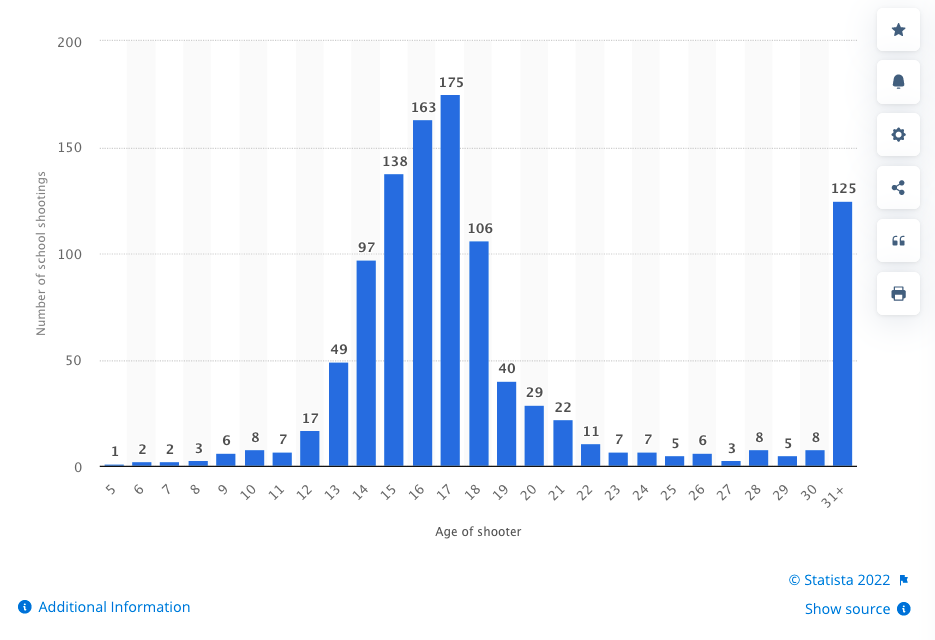
The vast majority of shooters start at age 12, peak at age 17 and taper off after age 21. That’s 836 shootings between those ages. Then, there’s a spike after age 31+ for a total of 125 shootings. The vast majority of shootings occur in that child to young adult age group demographic tapering off around age 21.
Between the ages of 12-21, there may be very little data to “red flag” or “mental health” to evaluate and likely even less for “enhanced background checks”. The one case where we absolutely need these proposed laws to affect change will, ironically, do absolutely nothing. These are mostly kids who’ve yet done anything. Most of the mass shooters are first offenders of anything. They’re not even in the system to find. Meaning, it is these shooters who end up the biggest problem, yet there’s likely almost no information to be found on them prior to their rampage. “Red Flags” require actual red flags. Meaning, you have to be able to find information on the child’s behaviors to know if any red flags exist. Without any data, attempting to apply “red flags” is meaningless.
For some, it may be possible to scour social media to find one or two of these of these children who may exhibit a behavior that could be considered suspect. However, does one or two posts sufficiently trigger “red flag” laws or even “mental health” concerns? Clearly, these kids likely won’t even have a background to review. Meaning, enhanced background checks won’t work.
This is why these “red flag” and “mental health” laws also aren’t likely find these shooters in this age group. These laws are likely to only impact only adults above the age group listed, not children in the mass shooting age group shown. Meaning, more mass shootings continue while “pre-arrests” take place against adults who likely weren’t even a threat.
Gifting Weapons
Children who want weapons are usually taught to like and want weapons by their parents. Meaning, the parents are usually gun owners themselves. Kids learn from their parents. Thus, when a child wants a gun, it’s typically because a parent already owns one. What does this mean for background checks exactly?
It means that parents know kids want to have a weapon of their own. Some parents oblige and are willing to buy their kids a weapon as a gift. Buying and gifting weapons to children means background checks are entirely subverted, as are “red flag” laws and “mental health” evaluations. Any background check performed would be on the parent, not against the child. A background check system can then be subverted by having a parent buy the weapon, then gift that weapon to their child. Even if the parent knows the child has violent tendencies, a parent might still buy and gift such a weapon to their child. Would a background check have found that child’s violent tendency? Possibly not.
Child privacy laws are fairly strict in the United States. Meaning, unless law enforcement has sent a subpoena to Facebook or Twitter or Instagram for those sites to release “hidden” child data, law enforcement may not even see the child has posted questionable, but hidden content. Even then, many of these posts aren’t uncovered until long after the fact… once law enforcement gets involved. As I said above, laws are reactive.
Even now, children are learning the lesson of what to post, when to post and what not to post. Such background checks are predicated on children continuing to post “red flag” content to social media without thought. Children learn quickly and, thus, “background checks”, “mental health” evaluations and “red flag” laws would only be as good as children are smart. Those kids will smarten up quick if they know their Instagram is being watched.
Would “red flag” laws help here? Likely not. However, these same “red flag” laws might actually end up flagging the parents over a child’s behavior. In fact, some recent cases seek to hold parents accountable for their child’s actions.
Holding Parents Accountable
Such a case is now pending. If this case is successful, it may open the door to charging more and more gun owner parents with their child’s actions. James and Jennifer Crumbley are looking at potential jail time over involuntary manslaughter charges stemming from their son’s actions. The trial is still ongoing as of this article, but the outcome of this trial could lead to further gun owner parents seeing jail time over their own child’s violent actions. This is the first in what’s likely to become a commonplace situation for many parent gun owners. “Red flag” laws only seek to expand this situation.
This Crumbley case, however, is not without merit. If a parent knows their child may have mental health issues and is a danger to themselves or others, the parent shouldn’t encourage and indulge in their child’s violent fantasies by buying them a gun. This is allegedly what James and Jennifer did for their son. Ethan Crumbley then allegedly killed four classmates at school with that gun. Now, the parents are being charged for involuntary manslaughter over knowing their son could do this, yet doing nothing to stop him… and even encouraging him by buying him a gun.
Where do “Red Flag” laws end?
That’s a good question. Since these laws have not yet been written, it’s too early to tell. However, based on the Crumbley situation above, it’s easy to see “Red Flags” laws covering not only the person flagged, but also people around them who’ve enabled that person, such as the situation with the Crumbleys. If the parents are found to have enabled and indulged their own child’s violent fantasies by buying weapons for them, those “Red Flags” could end up covering parents as well.
For this reason, gun owners need to be concerned over what these “Red Flag” laws are intended to do. The first major problem is that these laws more-or-less try to rely on clairvoyance. Cops aren’t clairvoyant. Therefore, the only thing cops can rely on is suspicion, experience and intuition coupled with reports from others. What that translates into is a cop possibly seeing things that aren’t there. If the laws are written vague enough and which give carte blanche to the officer, then as a gun owner and a parent, you could be carted off to a mental health facility simply because of a Facebook post of your child brandishing a weapon.
Nothing of what was done was considered “illegal” by itself. However, these “red flags” are enough to detain a person indefinitely under psych evaluation. That’s a grey area under the law. In a mental health facility, you’re not exactly jailed. Under certain exceptions, it can’t be considered unlawful detention. It also bypasses due process. Because “red flags” laws can’t really charge someone with a crime as none yet exist, which means detention in a medical facility. And.. here’s the loophole which allows that detention:
Although nurses or patients may disagree with the wisdom of such a decision, in most situations, patients do have the right to refuse treatment. Exceptions arise for mental incompetence, patients who are a danger to self or others, or where capacity is diminished due to drug or alcohol use.
These “red flag” laws when combined with “mental health” concerns will end up falling under the “danger to self and others” exception listed above. Because a person has been “red flagged” as a “danger”, that means they have given up their rights to live in society. Meaning, the concept of “false imprisonment” is now no longer on the table because those “red flag” laws will have superseded those rights.
Let’s take this concept one step further. Because the “red flag” laws have not yet been written, there’s no way to know how easy it will be to trigger cops into “red flag” action. Assuming it’s likely to be relatively easy, this means it will also be easy to have anyone committed to a mental health facility indefinitely under “danger to self or other” watch. This also means the person loses their liberty, which is protected by the 14th Amendment over a “red flag” law.
Effectively this becomes George Orwell’s 1984 on steroids.
Overturning Laws as Unconstitutional
Laws are valid until they aren’t. What I mean by this statement is that laws remain legally enforceable until a court enjoins them from being enforced. That means going through a court of law and requesting a judge to enjoin the law from enforcement on specific grounds. Until that happens, people who’ve been detained under “red flag” laws must remain detained until the law is enjoined. Even if a law is enjoined, it may prevent future detainment, but those already detained may remain detained until the court trial concludes.
This kind of law is an exceedingly slippery slope. Once we’ve walked down this path, other laws will begin popping up under this same “predictive” model, using these same “mental health” loopholes. Having words with your neighbor, then claim that person’s actions are a “danger to self and others” and off they are carted. This silliness could be perpetuated on many different items around the household and in many different forms, not only with guns. As I said, it’s a slippery slope.
“Red Flag” Laws have no place
There is no place in our society for “predictive” law enforcement. It’s ripe for abuse from unscrupulous people who will alarm police to false flags. Yet, police must follow up and investigate. If the person fits a specific profile or appears a “danger to self or others” (for whatever reason), they can be taken into custody and held for indefinite time under “mental health” evaluation, bypassing both due process and liberty rights given us by the 14th Amendment.
Predictive law enforcement has no place because it’s easily abused. Even our current reactive law enforcement is abused at times. However, these laws are mostly not based on bounties. If these new laws being considered are enacted using this new “bounty” model, all bets are off how the situations will be handled or how many people may end up detained.
This is a dangerous time to own a gun in the United States. That danger comes not only from the weapon itself, but from the laws that are being considered to manage the people who own them. Eventually, the stigma of owning a gun might be so severe that people are forced to get rid of their weapons or face “red flag” retribution from unsuspecting non-gun owning cancel culture neighbors.
Beware. This future is dawning.
↩︎


 Random Thoughts - Randocity!
1 comment