What’s wrong with Vista / Windows?
This post comes from a variety of issues that I’ve had with Vista (specifically Vista 64 Home Premium). And, chances are, these problems will not be resolved in Windows 7. Yet, here they are in all their glory.
Memory Leaks
Vista has huge and horrible memory leaks. After using Vista for a period of time (a week or two without a reboot) and using a variety of memory intensive 3D applications (Daz Studio, Carrara, The Gimp and Poser.. just to name a few), the system’s memory usage goes from 1.69GB to nearly 3GB in usage. To answer the burning question… yes, I have killed all apps completely and I am comparing empty system to empty system. Worse, there is no way to recover this memory short of rebooting. If you had ever wondered why you need to reboot Windows so often, this is the exact reason. For this reason alone, this is why Windows is not considered ‘stable’ by any stretch and why UNIX outperforms Windows for this reason alone.
Startup and Shutdown
Microsoft plays games with both of these procedures.
On Startup, Microsoft’s engineers have tricked you into thinking the system is functional even when it isn’t. Basically, once the desktop appears, you think you can begin working. In reality, even once the desktop appears, you still cannot work. The system is still in the process of starting up the Windowing interface on top of about 100 background services (on many of which the windowing interface relies). This trick makes Windows appear snappier to start up than it really is. In fact, I would prefer it to just ready the system fully, then present the Windowing interface when everything is 100% complete. I don’t want these tricks. When I see the windowing interface, I want to know I can begin using it immediately… not before.
On Shutdown, we have other issues. With Vista, Microsoft Engineers have done something to this process to make it, at times, ridiculously slow. I have seen 8-15 minute ‘Shutting Down’ screens where the hard drive grinds the entire time. I’m sorry, but shutdown time is not housekeeping time. That needs to be done when the system is running. It should not be done during shutdown procedures. A shutdown should take no more than about 1-2 minutes to complete flushing buffers to disk and killing all processes. If it can’t be done in 1-2 minutes, shut the system down anyway as there is nothing that can be done to finish those tasks anyway.
Windows Updates
Microsoft was supposed to eliminate the need to shutdown/reboot for most Windows updates. For some updates, this is true. For the majority of Windows updates, this is still not true. In fact, Microsoft has, once again, made this process multistep and tediously slow in the process. Don’t get me wrong, I’m grateful that they are now at least verbose in, sort of, what’s going on.. but that doesn’t negate the fact that it’s horribly slow. The steps now are as follows:
- Windows installation process (downloading and installation through the Windows dialog box). You think it’s over when you..
- Restart the system and it goes through finishing Step 2 of this process during shutdown… and then you think it’s over again when
- The system starts back up and goes through Step 3 of the update process.
Ok, I’m at a loss. With Windows XP, we had two steps. Those first during Windows updater and the second when the system starts back up. Now with Vista, we have to introduce another step?
Windows Explorer
For whatever reason, Windows Explorer in Vista is horribly broken. In Window XP, you used to be able to configure your Windows how you liked then lock it in with Tools->Folder Options and then View->Apply to Folders. This would lock in exactly how every window should appear (list or icon format, size of icons, etc). With Windows Vista, this is completely and utterly broken. Basically, this functionality simply no longer works. I’ve tried many many times to lock in a format and Windows just randomly changes the folders back to whatever it feels like doing.
For example, I like my windows to look like this:
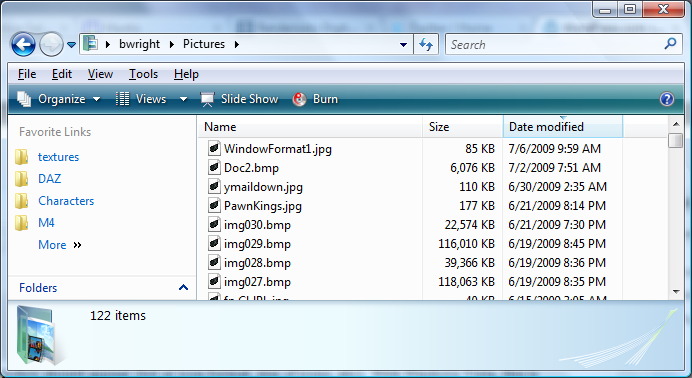
Favorite Format
Unfortunately, Windows has its own agenda. If I open a file requester (the standard Vista requester… the one that looks like the above) and I change the view to ANY other style than the one above, this change randomly changes other folder views on the system permanently. So, I might open the above folder and it will later look like any of these:

Format Changed 1

Format Changed 2
or even

Format Changed 3
All of which is highly frustrating. So, I’ll visit this folder later and see the entire headers have changed, or it’s changed to icon format or some other random format. Worse, though, is that I’ve specifically changed to the folder to be my favorite format with Tools->Options. In fact, I’ve gone through this permanent change at least 3-4 times after random changes have happened and inevitably it changes to some other format later. Again, highly frustrating.
Access Denied / Enhanced Security
For whatever reason, Microsoft has made shortcuts to certain folders. Like for example, in your profile directory they have renamed ‘My Documents’ to simply ‘Documents’. Yet, for whatever reason, Microsoft has created shortcuts that don’t work. For example, if I click on ‘My Documents’ shortcut, I see ‘Access Denied’. I don’t get why they would create a shortcut and then prevent it from working.
The only thing the enhanced security has done for Windows users is make it more of a problem to work. Security goes both ways. It helps protect you from malicious intent, but it can also get in the way of usability. Security that ultimately gets in the way, like UAC, has failed to provide adequate security. In fact, it has gone too far. UAC is a complete and utter failure. Combining this with making nearly every security issue tied to the SYSTEM user (with practically zero privileges), makes for stupid and exasperating usability.
Filesystem
To date, Windows still relies heavily and ONLY on NTFS. Linux has about 5-6 different filesystems to choose from (Reiser, VxFS, XFS, Ext2, Ext3, JFS, BSD and several others). This allows systems administrators to build an operating system that functions for the application need. For example, some filesystems perform better for database use than others. On Windows, you’re stuck with NTFS. Not only is NTFS non-standard and proprietary (written by Veritas), it also doesn’t perform as well as it should under all conditions. For database use, this filesystem is only barely acceptable. It has hidden limits that Microsoft doesn’t publish that will ultimately bite you. Microsoft wants this to become a pre-eminent datacenter system, but that’s a laugh. You can’t trust NTFS enough for that. There are way too many hidden problems in NTFS. For example, if you hit a random limit, it can easily and swiftly corrupt NTFS’ MFT table (directory table). Once the MFT table is corrupt, there’s no easy way to repair it other than CHKDSK. Note that CHKDSK is the ONLY tool that can truly and completely fix NTFS issues. And, even CHKDSK doesn’t always work. Yes, there are third party tools from Veritas and other companies, but these aren’t necessarily any better than CHKDSK. Basically, if CHKDSK can’t fix your volume, you have to format and restore.
Note, however, that this isn’t a general Vista issue. This problem has persisted back to the introduction of NTFS in Windows NT. But, Microsoft has made no strides to allow or offer better more complete filesystems with better repair tools. For example, Reiser and EXT3 both offer more complete repair tools than NTFS ever has.
Registry
The registry has got to be one of the most extensive hacks ever placed into any operating system. This kludge of a database system is so completely botched from a design perspective, that there’s really nothing to say. Basically, this system needs to be tossed and redesigned. In fact, Microsoft has a real database system in MSSQL. There is no reason why the registry is not based on MSSQL rather than that stupid hack of a thing call a hive/SAM. Whomever decided on this design, well.. let’s just hope they no longer work at Microsoft.
Failure
For the above reasons (and others), Microsoft has completely failed with Windows Vista. This failure was already in the making, though, when Longhorn was announced ages ago. In fact, Microsoft had planned even more draconian measures to enable heavy DRM on Windows. Thankfully, that was removed from Vista. But, what remains makes Vista so encumbered and exasperating to use, it’s no wonder users are frustrated using Vista. Combining that with its incredibly large footprint (1.6GB of memory just to boot the OS), and you have a complete loser of an OS.
Windows 7 is a glimmer of hope, but it is still heavily tied to Vista. If UAC and these stupid SYSTEM user security measures remain, then nothing will really change. Microsoft needs to take Windows back to the drawing board and decide what is necessary and what isn’t. Preventing the user from actually using the operating system is not and should not be a core value, let alone part of security. Yet, here we are.
Microsoft, you need to take a look at the bigger picture. This is your final chance to get Windows right. There are plenty of other unencumbered operating systems out there that do not get in the way of desktop computing. These operating systems are definitely a threat to Microsoft’s continued viability… especially with blundering mistakes like Vista. Windows will never win any awards for Best Operating System with issues such as these. Consider Microsoft’s stupid filesystem layout that allows operating system and application files to be thrown all over the hard drive and you’ll begin to understand why Windows continues to fail.
The single reason why Microsoft continues to exist is because users feel compelled to buy this antiquated dog of an operating system strictly due to application support. If developers would finally and completely jump ship to other more thoughtfully designed operating systems, then Windows would finally wither and die… eventually, this will happen.
American Idol: Failure to launch (artists)
While I understand the hype about this series (the competition and all), I don’t really understand why this show continues to exist. Yes, we go through each season and whittle down contestents to the final two. But, after the winner is chosen, then what? Oh yeah, they get a recording contract. What happens after that?
Spotting Commercial Viability
The ‘judges’ (and I use this term loosely) seem to think they know what’s best in the ‘pop music biz’. Frankly, if they could discover real talent, they would be working for a record company locating and signing talent right and left and not hosting a silly variety hour show. But, here we are… and here they are. So, I must honestly question the sincerity and realism of this show. The whole thing is staged, yes, to find someone who can sing. But, it’s really there as a money maker for whomever is producing that show. The underlying values aren’t to get someone signed to a contract. The real point is to put on a show. And, thats what they do, for better or worse.
Judges
It’s funny that they pick judges who are has-been recording artsts and supposedly A&R people like Simon Cowell. What’s funny about Simon is that his ability to pick talent has been extremely spotty. For example, he signed and produced Westlife. Westlife is a boyband that’s a meager shadow of N*Sync and The Backstreet Boys at best. What’s even more funny is that THAT is really his BEST claim to talent selection outside of Idol. Every other artist beyond that isn’t even worth mentioning.
So, how do these washed-up has-beens end up judging a show that supposedly prides itself on selecting quality talent? Well, let’s examine Idol more closely.
Winning Contestants
Since 2002, there has been (in order), Kelly Clarkson, Rubin Studdard, Fantasia Barrino, Carrie Underwood, Taylor Hicks, Jordin Sparks, David Cook and Kris Allen (most recently). Arguably, the biggest name to come out of the Idol circle is Kelly Clarkson with Carrie Underwood as a solid second. The rest, well, what about them? They may have produced records, but few appear to be listening. This isn’t a good track record for Idol.
Let’s consider Kelly Clarkson for a moment. Even she has had her ups and downs (mostly downs). While Kelly has a resonably strong voice, the question remains just how commercially viable it is. With a name like American Idol, you’d think that Kelly Clarkson would have taken the pop crown away from the likes of Madonna and Britney. Yet, while Madonna’s star is fading, Britney has taken the crown over and firmly holds it as far as pop acts go. Britney wasn’t even ‘discovered’ on Idol. More than this, Kelly has a stronger voice than Britney, yet you see what that gets you. Kelly isn’t even close to being in Madonna’s league and, while Britney has her own personal issues, her music producers provide a much better music experience than most of Kelly’s efforts.
Outside of these ‘winners’, we also have non-winners like Jennifer Hudson (who’s at least as well known as Kelly Clarkson and she wasn’t even a runner-up) and she’s also an overall more complete ‘star’ than Kelly. Then there’s David Archuletta, Chris Daughtry and Clay Aikin. These four people are the proof that the judges cannot pick winners. In fact, these 4 people should have won Idol, but didn’t. Yet, they are still successful on their own.
Track Record
Just looking at Idol’s track record, you can see more of the Idol winners have failed to be commercially viable than have been successful (Fantasia who? Jordin who? David who? Rubin who? Taylor who?). The point here, that the judges clearly are not capable of spotting talent. Even when someone has real singing talent, is young and good looking, clearly that’s not everything that’s needed. Otherwise, everyone graduating from Idol would have become an instant success… which, of course, has not happened.
I understand the fervor over this show and I understand that the point in watching is more about the competition than the outcome. But, isn’t the outcome why we come to watch? Don’t we actually expect the winner to become popular, make great music and usurp the pop crown from Britney? After all, that’s what Idol started out promising.
Idol is Flawed
The premise of Idol is flawed. The barometer by which they choose winners is in versatility in singing already commercially successful songs. The real barometer of talent is both in songwriting and performing. Even though someone has a great singing voice, that doesn’t automatically make them a pop sensation. Becoming a ‘Pop Idol’ comes with singing unique new songs. Songs that have not been heard before. Better yet, it proves talent when the person can both write and sing their own music. Artists like Prince and Sarah McLachlan are capable of this. To me, this is talent worth finding. But, today, commercial pop music is more about the look and voice than it is about songwriting. Music producers are far too prone to run to Taxi and buy a song or commission their favorite songwriter to write a song rather than having the singer write something.
For me, Idol would be a much more rounded show if they actually required the singers to also write all of their own material. This would be a lot more time consuming, but requiring this would also show the true talent of the artist. This premise would show a contestant’s ability to write music under pressure and, at the same time, perform that music admirably. Using this model in the show would likely have changed both the contestants in the show and the outcome of the winners. I would also have a lot more respect for the winners of the show. I also believe the winners would have been far more commercially viable as artists than anyone Idol has, so far, produced.
Idol’s days are numbered
We are now going into the 9th season and I believe this show is wearing out its welcome. Talent shows like this do come and go, so I expect this show go packing probably in one to two seasons. If it lasts beyond 10 seasons, I’d be highly surprised. I’m honestly surprised that it has survived this long with its dismal track record of spotting viable commercial talent. Yes, the winners can sing, but can they produce an album that people want? In 8 seasons, I’d say the answer to that question is unequivically no. The spectacle of the live performance is great, but it doesn’t mean the contestant has what it takes to succeed in the music business. Clearly, Idol has failed at it’s primary goal.
Sunscreens vs Natural Tanning
Every year at this time, the zealots come out of the woodwork promoting sunscreens. After all, it’s a multi-billion dollar industry. The truth is, no one has any idea of long term toxicity risks with regards to the use of sunscreen chemicals. Worse, people slather them all over their bodies without thought to the fact that your skin is the largest organ on your body. Is it worth the long term exposure and unknown health risks with the use of Parsol 1789, Mexoryl or Methoxcinnimate (or any other chemicals)? Unless you have a form of albinism or vitaligo, you should attempt to utilize the skin’s natural tanning properties over the use of chemicals in sunscreens. The natural sunscreen that appears in the skin is melanin. Melanin is much more broad spectrum than any lab created chemical at blocking the various wavelengths of UV (other than UVC, which doesn’t reach Earth).
UVA and UVB
Sunscreens protect you mainly from UVB (think of the B to mean ‘Burn’). These rays are shorter wavelengths and only penetrate shallow skin surface layers. These are the layers that lead to burning. UVA is a much longer wavelength and is associated with deeper skin level exposure (and is thought to aid in premature aging). Sunscreens have limited ability to protect you from UVA. Note that the Sun’s natural mix of UVA and UVB (that reaches the earth) is up to 5% UVB and 95% UVA. However, during some times of the year, the UVB can slightly higher than 5% (where the UV index is at its highest). These are the times where burning is very easy.
Bad Burns
The use of sunscreen chemicals can promote a bad burn. The reasoning is very clear. When you use these chemicals to block the sun, these chemicals prevent tanning. So, the one time you forget the sunscreen, improperly apply it or forget to reapply it, you will likely get a very bad burn. Even though many dermatologists recommend and endorse the use of sunscreens, utilizing the skin’s own tanning properties helps prevent a bad burn. Melanin works 24/7 and doesn’t need reapplication every hour or two. Although, a natural tan does wear off over several weeks if you don’t keep the tan going. On the other hand, sunscreens require frequent reapplication (probably every hour, especially if you’re in water or are sweating). The UVA chemicals actually break down rapidly (as quickly as 30 minutes depending on brand, quality and body chemistry) once applied, so you need to reapply a lot more often than you think to maintain UVA protection. The UVB chemicals also break down, but much more slowly. Having active UVB protection without UVA isn’t that helpful, though. So, you need to reapply.
The point, however, is that you want to avoid a bad burn at all costs. You want to tan and not burn. Thus, the use of sunscreens does not promote natural tanning and promotes forgetting to reapply which can then lead to accidental burns after the chemicals have stopped working. Remember that sunscreens give no warning when they have worn off. Worse, you won’t know your skin is burned until 3-6 hours after sun exposure.
Vacation and Tanning
If you will be traveling to a sunny destination, it is better to build up a natural base tan than constantly applying sunscreen every hour. You can build your tan slowly and steadily outdoors or you can do it in a tanning bed. Nothing ruins a vacation more than a bad burn, however. Having a base tan allows you to be outdoors without worrying about getting a bad burn. Yes, you can still get burned even with a tan, so you should always be cautious. But, having a base tan reduces your chance of a bad burn substantially over forgetting to apply sunscreen.
Beginning your Tan
To obtain a base tan, start the tanning process at least 6 weeks out from when you leave to go on vacation. You can do this outdoors or in a tanning bed. Note, however, that tanning beds are concentrated, but also timed. So, for example, 12 minutes in a high pressure bed is equivalent to about 2 hours outdoors. So, if you can only do about 15 minutes outdoors in midday sun, then you should start at about 6 minutes in a 12 minute bed. You would think to start at about 2-3 minutes, but 6 minutes isn’t enough to burn you in a bed in one session. Needless to say, always discuss tanning bed times with your salon professional.
Another note about tanning in a tanning bed. DO NOT USE SPF SUNSCREEN WHEN TANNING IN A TANNING BED! This is emphasized because it wastes your money. Yes, you can use low SPF to aid tanning outdoors only, but never use SPF in a bed. Even though a tanning bed mimics the UV from the sun, it isn’t the sun. It is also time controlled.. and this is very important to understand. Time controlled means that you do not need to worry about accidentally getting too much exposure. The maximum you can get in one session is equivalent to 2 hours outdoors at maximum bed time. Because the time is controlled and there’s little risk of a burn, there is no need for sunscreen. Further, using a sunscreen in a bed is a waste of money. If you spend $10-$40 per session, using SPF sunscreen completely prevents the rays from tanning you. So, you will have spent your money for nothing, literally. When using tanning beds, you are paying for access to the UV. SPF lotions prevent that UV from tanning you. Don’t do this unless you really like throwing your money away.
Reading your Skin
Understand that a burn is red and melanin is also red (initially.. and oxidises to brown). So, which is a burn and which is melanin? If there’s heat, redness and/or discomfort (followed by peeling), then it’s a burn. If you see redness only without any heat or discomfort, then that’s melanin. Controlled tanning will allow you to build up a base tan without peeling. If you peel, then you’ve 1) burned your skin and 2) lost your tanning efforts. You want to gain color slowly to prevent burning and peeling.
Lotions
When tanning in a tanning bed or outdoors, using a high quality tanning lotion is important. A lotion hydrates your skin before, during and after UV exposure. So, always use a lotion as sun exposure is very dehydrating. Tanning bed lotions can be used outdoors. However, most outdoor lotions cannot be used in a tanning bed (it can cause reactions with the acrylic surfaces). So, if you want to combine bed tanning and outdoor tanning, buy a lotion that works in a bed and also use it outdoors. Again, make sure the lotion does not have any sunscreen at all. You can buy a sunscreen lotion if you really need it for outdoor use.
There are various lotions on the market from various vendors. The one thing I will caution you about is that some tanning bed lotions can be very expensive and, yet, completely ineffective. You want to find a lotion that works for you and that provides results. However, don’t be fooled by ‘Triple Bronzing Formulas’ or ‘Quadruple Bronzing Formulas’. These are buzzwords that mean they have added either 1) color or 2) self-tanners (yes, like the ones you can get at the drug store). If you want to see how you are progressing naturally, make sure to NOT buy any lotion with a self-tanner. This may mean you have to buy the lotion from the Internet (which are cheaper this way anyway) than buying it from the salon.
You will need to read the label for self-tanners. The two common self-tanners are dihydroxyacetone and erythrulose. So, if you find these ingredients in the lotion, put it back on the shelf and find something else. You may find that your salon does not carry any lotions without self-tanners. The reason that salons carry ‘Bronzing formulas’ is that these lotions give immediate color (or, at least, within 4 hours). This immediate gratification supposedly brings back the customers. However, don’t be fooled. You want a real base tan, not a self-tanner tan. So, skip self-tanner bronzer lotions and find a lotion without self-tanners.
Here are a couple of manufacturers that make lotions without self-tanners: Designer Skin (Intrigue and a select others) and Hoss Sauce (Dark, Super Dark and Ultra Dark). I personally have found Hoss Sauce to be more effective than Designer Skin, but your mileage may vary. There are some lotions that also offer tingle, hot or cold sensations when you are tanning. Avoid these until you have a base tan. Otherwise, these may interfere your tanning or increase your chances of a burn.
Note: Self-tanner color offers no protection from UVA or UVB. Don’t be fooled by the color from a self-tanner. It offers no protection from the sun and, again, can encourage a bad burn. When trying to obtain a base tan, always use a lotion without self-tanners!
Tanning Beds
When tanning at a salon, you will find many different tanning beds. The least expensive beds (sometimes $6-8 a session) are the least effective beds at tanning. They should have a ratio of 5% UVB to 95% UVA (just like the sun). However, you may find these beds aren’t that effective. There can be many reasons for this. Cleanliness in a salon is very important. Bulb age is also important. Many tanning salons have these beds booked every open hour of the salon. These bulbs, then, get a lot of use. Many salon owners try to cut costs by not replacing the bulbs as often as they should. If you find that you get nothing out of a bed, the two main reasons are that 1) the acrylic is dirty and 2) the bulbs are old. When I say the acrylic is dirty, I’m not talking about the part where you lay. I’m talking about the underside of it. These acrylic surfaces must be removed about once a week and thoroughly cleaned on both sides. The bulbs themselves should also be wiped down to prevent any buildup on the bulb. Doing this frequently increases the tanning capability of the bed to what it should be.
Many salons pride themselves on thoroughly cleaning the bed surface, but how often do they remove the acrylics and clean the underside? Not often in many cases. Yes, even the ‘expensive salons’ as well. So, you should ask the salesperson how often the underside gets cleaned.
As far as tanning capacity, on the high end beds (high pressure beds), it is not uncommon to find up to 18000-20000 watts in the bed. The low end beds might provide around 9000-11000 watts. The difference in wattage (and UV output) is substantial. The high pressure beds, then, will probably run between 8-12 minutes for the maximum time of that bed per session. Low pressure beds might run between 20-30 minutes. So, if time is important to you, the higher pressure beds get you in and out faster.
Note, never tan in a bed and then immediately lay out or stay outside for extended time without sunscreen. You are asking for a bad burn. Do not do this. If you tan in a bed and then end up outdoors in the sun the same day, wear some sunscreen outdoors. Or, better, don’t tan in a bed on the day you plan on being outdoors.
Tricks for tanning in a bed
When trying to get your base tan in a tanning bed, you will need to move around in the bed. Don’t lay absolutely still. For example, lay on your back for a bit, then lay on one side, then the other, raise your arms, etc. Doing this will give you a much more even tan than lying perfectly still. If you stay still, you will get telltale bed marks on certain places like your shoulder blades and between your buttocks (where the acrylic touches). Moving around prevents these marks. You might even turn over and lay on your stomach for a while (even in a bed where you don’t need to turn). You can also use a standup tanning booth to avoid these issues.
How long does it take?
This question can really only be answered by the salon operator after they have assessed your skin type. Once they determine your skin type, they can tell you what you need to do in order to progress. However, you need to read your skin after you have tanned at a salon to know if you are going too fast. If, after a session, you have no color or redness by the next day, then you may be progressing too slowly. However, if you are red, hot and having discomfort, you are moving too fast (burned). If you do get a burn from a bed or outdoors, do not tan until the burn has gone away (takes several days).
For the lightest skins, it may take between 6-9 weeks to build a minimal base tan. For medium skin tones, you can probably see a base tan in 3-6 weeks. For dark tones, you probably already have a base tan, but if you are a lighter skinned, it may take 2-3 weeks in a bed. As a side note, dark tones can still get darker. Melanin works the same way in all people who can produce melanin.
Again, these are only estimates. You should always discuss your skin type with the salon owner to set up a proper regimen that works for you.
Melanin Colors
This portion is to set expectations on how your skin may look tanned. Note, there are two different types or melanin (pigment): 1) pheomelanin (reds and yellows) and 2) eumelanin (dark browns). The darkness of color depends on which types of melanin your body produces and the concentration of each type. Lighter skinned people tend to produce more pheomelanin (reds and yellows) and less eumelanin (dark shades). This mix gives the redish and yellowish copper or ‘golden’ colors. Darker skinned and olive toned people tend to produce much more eumelanin and with less pheomelanin. This color becomes much darker brown to black. Darkest toned people tend to produce nearly all eumelanin and in high concentrations. So, depending on your body’s type of melanocytes, your body may produce a range between both of these types of melanin. You’ll just need assess your tone after you’ve tanned. This also means that, depending on your skin type and melanin mix, you may not be able to turn very dark brown (if that’s what you are wanting). Or, alternatively, you may find that you get darker much faster than you thought.
You can gauge your skin’s tone by your hair color. The darker your hair, the more eumelanin your skin is likely able to produce. Melanin is also used to produce hair color. So, red haired people will likely produce more pheomelanin. You can see this color in the freckles of many red haired people. Blonds are likely to produce much more pheomelanin than eumelanin (blond would be the yellow melanin). Black haired people should be able to produce the darkest brown eumelanin tones. Note that hair color should only be used as a guide as some dark haired people may only produce a lighter ‘golden’ tan.
Melanin of all types will eventually oxidise to a brown color from its initial color and deepen the color of the tan. This oxidation will make the familiar brownish tones (yes, even the reds and yellows will oxidise).
Other Benefits
Getting UV exposure to your skin also helps maintain health with Vitamin D. Sunscreens prevent the creation of Vitamin D as UV is blocked. So, getting some UV exposure aids in stimulating the creation of beneficial vitamins. So, before you immediately put on that sunscreen, leave it off for a small amount of time to get your vitamin D. Put it on later to prevent the burning.
Suntans, Skin Types and Hormones
Some people feel that a suntan looks bad and prefer not to have a tan. Again, that thinking promotes a bad burn when you do need to be outdoors. Some people may think this way because they haven’t previously been able to tan. Some skin types (type I) can’t readily tan. For Type 1 and Type 2 skins, there is a product that may soon be on the market to help. It is a peptide (melanocyte stimulating hormone) that stimulates the melanocytes to produce melanin in individuals who do not have this hormone or where the hormone is ineffective. For many people, this simulated hormone works and allows people to tan in the sun or in a tanning bed when they previously couldn’t get a tan. Of course, this hormone only works if the melanocytes are functioning properly. By having a base tan, this prevents burns and also helps reduce premature aging by blocking UVA. Note, however, that you must get sun exposure to obtain a tan even with the use of this hormone. It does not tan you without sun exposure. So, the use of the hormone still requires UV exposure to obtain the initial tan.
Overall, sunscreens may not be long term healthy for your skin. Getting a tan requires some sun damage to obtain the tan. But, the melanin helps reduce the risk of burns and other related issues. It’s up to you to choose what you want to do, but nothing in life is without risks. Know that a tan is a natural skin process. Placing chemicals on your skin is not natural. Even though you cannot see or feel any damage by using sunscreen chemicals, that doesn’t mean no damage exists. When you get a sunburn, you feel it and know the skin is damaged. With sunscreen, there’s just no way to know if something you get later in life was related to earlier years of using large amounts of sunscreen. It’s your choice, however.
Skin Cancer and Burning
Yes, I know, we’ve all heard the rhetoric: Exposure to UV causes cancer. I’ll leave this one for you to decide. But, I will say is this. Tanning beds produce UV. The Sun produces UV. UV is UV is UV. It doesn’t matter whether it comes from the Sun or from a flourescent bulb in a tanning bed, it’s still UV. But, as I stated above, the difference between a tanning bed and laying outdoors: one is controlled, one isn’t. Again, it’s for you to decide which to choose. But, because of varying conditions with laying outdoors, you could end up burned and not know it for several hours. On the other hand, a salon will assess your skin and put you in a bed that’s timed based on your skin tone and type. So, they are trying to keep you from getting burned in a Salon. The Sun is not controlled or timed to shut off. This means, if you lay out longer than you had wanted or get caught up in an activity, you can easily forget and burn yourself. Burning is definitely damage to the skin and it is theorized that this damage leads to cancer… so you want to avoid a burn at all costs.
UPDATE: World Health Oganization (WHO) lists sunbeds (specifically) and all UV exposure as fully carcinogenic at all wavelengths (highest risk)
A new study conducted with mice, that I’ve yet to read, has classified sunbeds specifically and all UV exposure as the highest risk of causing skin cancer. I’m not sure what prompted this change in view, other than a single study, but they have made this change. Clearly, one study is not enough to make this determiniation, but that is exactly what the World Health Organization is doing. There must be some subtext here that’s prompting this change. Perhaps the sunscreen industry is losing more money to people choosing to tan rather than slather on the sunscreen.
State of the Art: What is art?
This debate has raged for many many years and will continue to rage for many more. In certain internet digital art communities this debate is again resurfacing. Some people put forth that using found digital materials like, for example, 3D models available through such sites as Daz3d.com and ContentParadise.com aren’t art when rendered through tools like Poser. Well, I put for this response to these people.
What exactly is art?
That is an age old question. It doesn’t matter if you’re talking about ‘old’ mediums such as paint, canvas, pencil, clay, or metal or if you are discussing ‘new’ mediuma such as Poser, Daz, Bryce, Photoshop, Z-Brush or even Maya. The question is still valid and still remains unanswered. Basically, the answer mostly lies in the eye of the beholder. Thus, whether or not something is art is all based on opinion. Some people never believed that Marcel Duchamp’s urninals were art. Some people never believed that Jackson Pollack’s paint splatters were art. Some people never believed that Robert Rauschenberg’s mixed medium works (including tires and other found objects) were art. Some people still don’t. But, does that make them not art? No. Clearly, these men have been recognized as artists in art history. Thus, what they have created is art.
The fact is, controversy has always surrounded new forms of art and new art mediums. There have been many artists who have taken existing pre-made structures and turned them into ‘art’. In digital media, this is no different than inserting an existing Poser figure and using it in any given digital artwork. Simply using Poser and a Poser figure does not necessarily make the work less profound as art.
Creating things from scratch
For those who believe that you must create everything from scratch in 3D, I put forth this argument. Most artists who paint today do not make their own paints, construct their brushes and create their canvas (down to spinning the yarn and looming it into a fabric). If it were required by artists to create everything simply to ‘create art’, not much art would be created. Most people would spend their time creating the tools they need to create the art. Should you be required to create the graphite and shape the wood just to turn it into a pencil? No. Sure, I admire those who want to create everything from scratch and I applaud them. But, that doesn’t mean every artist needs to work in that way.
If you want to take this argument further, then you should be required to write your own Photoshop application each time you want to modify an image. Clearly, this is silly and no one would think this. So, why is it that people believe that you must create every object you place in a 3D realized world and rendered image? You don’t create every object you put in your home, why should you have to create every object you put in 3D world you create? Again, this argument is completely silly.
Creating 3D objects
Yes, creating 3D objects using a modeling program is an art in itself. It takes a lot of patience and consumes time creating these objects. Again, I applaud these content producers. And I agree that it does make those objects art, but only in the sense of industrial design (very much like the camera or a chair). The object is nothing, however, without a showplace. Like the camera, if an object isn’t used in some way and no one ever sees it, then it’s not time well spent creating the object. Thus, without a showplace, the object is not an artwork. It is art in the sense of industrial design, functional art. In this case, though, 3D objects only have functions when used in the context of creating scenes or together with other objects. So, creating a 3D version of a Ferrari F40 is great, but as an object on its own it’s really not a piece of artwork (other than industrial design). However, this F40 could be used within a larger scene combined with other objects to create an artwork. Then, the object becomes much more than its industrial design heritage.
That’s not to say I don’t respect and admire those who create 3D objects. I do. I applaud them and encourage them to create more. Without such objects, artists won’t have the necessary things to create the imaginative scenes they can envision.
Art is what you make of it
Not to be overly redundant… ok, let’s…Art is what you personally make of it. Good art conveys emotion, makes a statement and usually motivates the viewer into a reaction (good or bad). However, whether a specific work is good or bad art is for each person to decide. A 3D object, its texture and bump maps and all of its underlying components don’t and can’t both evoke a reaction and make a statement alone. Only when these objects are placed within an imaginitive scene do these objects take on a new life and become much more than the sum of their parts.
Probably the single deciding factor for whether a specific piece of art is ‘good’ or ‘bad’ is whether or not the work was intentional (i.e., makes a statement about something). Thus, if someone intentionally takes a listless figure and does nothing to it and plops it in the middle of a scene seemingly uncreatively with a few simple lights, the deciding factor is if the artist did this scene intentionally to make a point about some subject matter. Intent is the single biggest factor in any artwork. As an artist, you have to understand this single aspect. Everything you put into a scene must be intentionally placed there and and placed there for a reason. If the scene does not seem intentionally constructed, then the artwork has failed as artwork. An artist might copy those who create ‘amateur’ works in a statement about amateur artwork, but which then becomes artwork in itself. It’s the statement itself that makes it art.
J.J. Abrams Star Trek: Pure Fantasy
While I could start this blog off by discussing how the acting was excellent, how the characters worked well, or even how the origins of the characters worked. I won’t. I could also discuss the amazing special effects, the tense moments that keep you on the edge of your seat or the thrill ride pacing of this J.J. Abrams romp. Again, I won’t. Clearly, Abrams has made all of that (and more) work in this film. But, there is still one major flaw that nags at me. What is that, you ask? I’m so glad you asked. Let’s explore.
Starting a new Trek era
Crafting stories around temporal anomalies that change future events and unfold the entire Star Trek universe differently from the way all of the other franchises have unfolded the Star Trek universe is just not proper. Is rewriting the entire franchise in Star Trek’s best interest? Does putting forth alternate timelines as ‘the’ new Star Trek timeline make sense for this franchise? Clearly, it needs invigoration, yes. Using temporal anomalies? No. For me, this type of story is a complete cop-out. It is not creative, it is only a way to make it appear creative when its sole goal is just a way for Abram’s to take creative liberties with the characters, universe, series and, yes, even the franchise itself. So, now Abrams can rewrite the Star Trek universe in any way he sees fit. This one anomaly lets Abrams write whatever he wants. For this reason alone, this goes against the grain of everything Gene Roddenberry had inspired in Star Trek.
By rewriting the timeline (and, arguably, the very franchise itself), J.J. Abrams could put an end to the ‘Prime Directive’, rewrite rules, change events, kill characters off at will, etc. He could take the series in a more militaristic direction and entirely do away with what originally insipired Gene Roddenberry. This storyline opens the door to making a lot of changes to the Star Trek universe by giving Abrans complete liberty over the entire series and, indeed, the entire franchise.
At a fundamental level, this movie works as a standalone. As a basis for the beginning of a new Star Trek series and, in fact, franchise is just wrong on so many levels. Temporal anomalies have no place in the creation, let alone re-creation, of the series. As of now, the entire timeline is left hanging at the end of this movie with no resolution. So, it is up to Abrams and Paramount at this point. Clearly, the success of this film will guide Star Trek’s future. If the success of this film is high, then Paramount may actually let Abrams continue down this pretentious road creating more Fantasy Trek.
Gene Roddenberry created this series in a certain way. Unfortunately, Abrams’ vision does not hold true to that ideal. There are plenty of ways to craft creative, thoughtful, evocotive story lines to make a film work.
Unfortunately, there are two story writing techniques that are always considered trite and even ‘deus ex machina’ and should be avoided at all costs (one was used in this film):
- The main character wakes up at the end revealing the entire film as a dream sequence
- Temporal anomalies that allow the writer to take liberties by altering a character’s timeline or by rewriting the underlying story itself
End of Roddenbery Trek Era
As of the recent passing of Majel Barret Roddenberry, this signals the end of Trek as we knew it. Rod Roddenberry (Gene’s Son) is still around, yes. However, it certainly appears that he either has no creative control over Trek or he is letting Abrams take these liberties with Star Trek. Either way, this film signals the end to the Roddenberry created Trek universe and a new non-Roddenberry beginning that has no basis in Roddenberry’s original vision.
All films, video games, events, series or any other creative derivatives from Abram’s Trek has nothing to do with Gene’s Trek. It is a ‘Fantasy Trek’, if you will. A ‘what if’ approach to Trek. This Abrams Trek is a derivative work and is not and should not be considered part of the Gene Star Trek Canon. In fact, this new Trek never existed. Abram’s Trek didn’t (and doesn’t) exist because this film’s anomaly created an entirely new timeline for Kirk, Spock, Uhura and the rest. A timeline that never existed before Abrams took the helm. Yes, Abrams has clearly created a timeline that isn’t Trek.
On the one hand, it’s a brilliant idea for Canon. Meaning, it marks the perfect delineation between Roddenberry’s works and Abrams’ works. So, Abrams has made it extremely easy to mark anything based on Abrams ‘rethink’ as fantasy (never existed).
Fantasy Trek
So, Abrams Star Trek universe never existed. It existed only because of the temporal anomaly. And now, Ambassador Spock (Roddenberry’s Spock) is trapped in that timeline….in a timeline that never existed or that never should have existed. So, technically, the only person who really makes a difference in Abrams’ universe is Ambassador Spock. And the only goal in Abrams’ Fantasy Trek should be at getting Ambassador Spock back to the ‘real’ Trek universe’s present and correct the timeline.
The series can take one of two approaches at this point. 1) To continue on with this Fantasy Trek universe exploring Abrams’ fake Trek universe. Granted, this might be fun to explore for a while. but ultimately… 2) To focus on getting Ambassador Spock back to the Roddenberry created universe and get the timelines corrected.
So, I would be fine with an approach where Abrams’ actually acknowledges his newly created Trek timeline as false and then later unfolds events such that the sole goal is to get Ambassador Spock back to Roddenberry’s universe. That, for me, should be the only goal in this new fantasy romp. There is really no other direction that this can take. If Abrams and, indeed, Paramount actually try to foist this Fantasy Trek off on the Star Trek fans as the ‘new’ canon would be insulting on so many levels. It would also be insulting to the original Trek series, to Gene and Majel Roddenberry and to everything of previous Trek lore.
To actually consider foisting Abrams’ Fantasy Trek on the fans as the ‘new’ canon invalidates Gene’s Star Trek entirely. It nullifies previous Trek series and canon by saying that it never existed in that way. It says that the Abrams’ Trek is the way things are and it says that Roddenberry’s Trek was fantasy. How can anyone possibly be that pretentious with storytelling? No. The only direction is to acknowledge this Trek as pure fantasy and move forward from there. Otherwise, this alternate time line could completely change events that lead up to the creation of Star Trek: TOS, TNG, DS9 and Voyager… let alone the previous films. No, Abrams must acknowledge this timeline is incorrect and set out to correct it and get Ambassador Spock back to his present.
Both Abrams and Paramount need to be extremely careful at the handling of this series from this point so as to not insult Trek (or the fans’ intelligence or knowledge of Trek).
↩︎
iTunes 8.1.x and Vista
[Update: 10/28/o9]
It appears that upgrading to Windows 7 and iTunes 9 resolves this entire issue with Vista and iTunes. Please see my latest Randosity article for specifics.
[End Update]
Just a quick update on the iTunes and Vista problems. If you are experiencing troubles using iTunes on Vista, please see my updated Randosity article on how to fix iTunes installation issues. The fix has been simplified and works easily to resolve the registry issues surrounding iTunes.
Paypal: Don’t trust them with your checking account!
Paypal has been in business for how many years now? Yet, they still can’t manage to find a way to verify a person without using a bank account? Since day 1 of Paypal, I’ve been sternly opposed to giving my checking account routing information to Paypal. Why? It’s very simple. I don’t trust them. I never have. I never will.
Why you should never give out bank account + routing information to anyone!
Let me first say that when I discuss ‘routing numbers’, this means a combination of both your account and your routing number. Clearly, you wouldn’t just give out only a routing number as that’s not useful. It is only useful when in combination with an account number.
When you give someone a signed check, you implicitly give them your routing information. That’s a danger when you write a check to a company. The protection, of course, is that you’ve given them a physical paper check for a specific amount and you know exactly how much that check was. So, when the check number arrives at the bank and drafts that amount of money from your account, it was expected. They can’t draw more than the amount the check was written.
Routing numbers, on the other hand, are effectively blank checks. When you give a company your routing number, you are handing them a signed blank check. That’s because you’ve agreed to allow them blanket access to your checking account. That company can then debit any amount of money from your account they see fit without so much as a thank you. Because Paypal uses EFT (electronic fund transfers) in the form of ACH (automatic clearing house), they can debit your account up to the maximum amount of funds in your account. This means, they can overdraw your account and completely drain your funds. ACH/EFT offers no liabilities to the consumer whether accidental or intentional. Because you gave that company explicit approval to debit your account at will, there are no liabilities for any inappropriate transactions. That’s left between you and Paypal to resolve. The bank will usually not become involved. When banks do become involved, the best they can do is tell you when it happened. You can try to ask your bank for additional help, but they will most likely point you to Paypal for resolution. The reason is simple, you agreed to give Paypal access to your account up front.
Worse, if the company that overdrafted your account chooses to not give you the money back, then you may be out of luck. At that point, you better seek a lawyer, assuming you have any money left to pay them.
Paypal and Checking Accounts
Paypal does not need a checking account to verify you. They just tell you they do because that’s the way they have always worked it. This verification process can easily be done with a credit card charge that you input later to validate that you receive the bill for the card. Paypal simply wants to have unfettered access to your checking account. Frankly, it’s a huge liability for you. It’s also a huge liability for Paypal to store this information. One hacker in their system and they could have a field day with your money.
Credit Cards and Fraud
Paypal is well aware of the fraud issues with credit cards. They are also well aware of chargebacks, merchant liabilities and fees associated with these processes. To avoid them, they prefer unlimited access to your checking account that hold no such penalties or liabilities. Because the consumer has no recourse over inadvertant transactions, Paypal has the upper hand. This is why Paypal will not verify you with only a credit card. Can they validate based on only a credit card, yes. They simply choose not to.
Credit cards have long established liability rules that prevent fraud occuring from both rip-off artists and from merchants alike. Unfortunately, there are no such rules for ACH.
Consumer Protection from Businesses
Whenever a company asks you to give them routing information from your checking account, tell them, “No!”. Not only should you tell them “no”, you should explain exactly why. Tell them that you don’t trust them with that level of access to your account.
Should you continue to do business with Paypal? That’s entirely up to you. But, I still do not have a verified account with Paypal because I simply will not give them the routing information from my checking or savings account. I simply do not trust ANY company enough with that information. Remember, Paypal is not a bank. Thus, it does not fall under any banking rules, liabilities or any federal insurance. In fact, who knows what insurance Paypal even carries? So, whatever Paypal does, you’re at their mercy to do it right. If they don’t, you have to fight with them to get your money back. The bank won’t help you.
But, I need to give out my routing number…
Here’s another option. It’s not optimal, but it works. Simply, open a second checking account. By setting up a checking account specifically and solely to be used with Paypal and merchants, you can limit your financial liability. You can then link another account to this new account for transferring in money only, but be sure NOT to link the new checking account to any overdraft protection on any other accounts. So, if Paypal overdraws your account inadvertantly, they won’t get any more money than what you have specifically placed in there. If you want to buy a $250 appliance, only transfer in $250 for just that appliance.
The problem with this technique is that banks sometime require minimums to open an account and minimums to keep it open. So, you may have to leave $1000 (or some other arbitrary amount of money) to prevent accrual of monthly fees or account closure. You’ll need to contact your bank for details.
While this does work, it’s not optimal by any stretch. It requires you to be extra cautious with how you use that account. You have to be diligent to place the money in there when you need it. And, you need to remember that transfers of money into the account are not always instanteous. So, you may have to transfer your money in the day before you intend to purchase to ensure the money is there to cover the transaction.
What if I’m a Merchant?
For merchants who want to get paid for products they sell, I understand the issue here with ACH/EFT. Again, in this instance, I would set up a separate checking or savings account solely for Paypal use. Only give this account to Paypal so that when you receive payments, you can transfer them out of that account and to your ‘regular’ account immediately. This way, if Paypal decides to debit you for any reason, the money won’t be there.
Overdrawn Accounts
If Paypal overdraws your account for any reason, don’t expect them to pay you back for insufficient fund fees. You will have to deal with these fees on top of the inappropriate debiting from Paypal. You will then have to argue with Paypal to get your money back and your bank fees reimbursed. But, good luck with both of those processes.
Spending Limits
If you choose not to give your routing information to Paypal, Paypal arbitrarily limits how much money you can send to an individual when you buy merchandise. For this silly reason alone, this is enough to tell Paypal to take a hike. There are plenty of ways to buy merchandise from merchants on the Internet. In fact, when a merchant is reputable enough, they will set up their own merchant account with a bank and let you pay the merchant directly. You should also feel comforted knowing that when you send a payment to a merchant, not through Paypal, you have the full card protections behind your transaction. When you purchase through Paypal, your Paypal account agreement may prevent you from using some of your card’s built-in protections… such as a chargeback.
Credit Cards
For all of these reasons above combined with card liability limits, fraud protection and other protections that come built-in with the Visa, Mastercard and Amex logos, credit cards protect a whole lot more than ACH/EFT. Cards limit your exposure to ID theft and they also limit your liability if someone steals your card and then, for example, buys a new car with it.
For payments, Paypal could choose to issue checks instead of requiring ACH/EFT. But, they have never wanted to go this route for payments. Instead, Paypal forces you to verify your Paypal account by giving them a routing number from your checking account. As I have said, this is not necessary and is a huge liability.
If you want to protect your money in your bank account from unauthorized transactions, you should not give Paypal (or any company) access to your checking account via routing numbers. Instead you should insist on the protections that credit cards offer. Credit cards are more than sufficient for anything that Paypal would need (at least for paying for merchandise). For merchants, you will need to determine what works best for you.
[UPDATE: 6/27/2012]
Paypal now has a new wrinkle in its verification process. When attempting to verify a checking account and your bank has a web portal (i.e., Wells Fargo), they will ask for the login and password to your bank’s web portal to do an ‘immediate’ verification. Don’t do it! Don’t give it to them. Paypal says they won’t store the credentials, but with all of the stolen information from various sites, do not trust ANY site with your bank’s web portal login and password. This should really be common sense, but maybe it isn’t. With that said, if you must verify a bank account with Paypal, do it the old fashioned method by letting Paypal make two small sized deposits. First, it makes Paypal give you about 25 cents. Second, you’re not giving out your bank’s web portal password to some random third party.
As much as I rant above about giving out routing numbers and blank checks, it’s far worse to give out your bank’s web portal login and password information. Do not do either if you can help it. However, if you can manage to set up a separate one-sided transfer system into a free savings or checking account for Paypal payments and transfers, then by all means set that up. Do not give Paypal access to your primary checking account with full access your bank account. Also, make sure that you have disabled overdraft protections on any accounts you give Paypal so that if they reach in and grab money out, when the account hits $0 it doesn’t go any further. You don’t want to be mopping up a mess of bad debits and at the same time having to pay interest payments on those bad debits. Paypal is not a bank and they’re not likely to reimburse you for any bad transactions leading to overdraft fees or interest accrued. So, avoid the issue and prevent Paypal from doing this damage in the first place.
73 AIG Execs get over $160 million in Bonus Payouts: Oversight?
Ok, so I know this story has been covered ad nauseaum in the press, but I also have some comments about this issue. My question isn’t that they received these bonuses, it’s about the contracts they cling to that they MUST fulfill.
Contracts and Bonuses
As far as I know, unless AIG is just completely stupid at writing contracts, most bonuses written into contracts and, later, given to employees are issued based on performance. That means, as long as you perform your duties properly, then the company will pay you at least part of the bonus. And note that ‘properly’ could be intentionally left vague or it could be specifically defined through a set of criteria. The criteria is the unknown factor in these employment contracts. If it was intentionally left vague, though, even my argument still applies. Further, to get paid the entire bonus, the employee and the company both have to perform in an outstanding way. I don’t exactly consider bankruptcy outstanding. Next in this debacle, why would you pay out 11 ex-employees? Contracts usually terminate once employment ceases and this should include bonus clauses. Again, stupidly written contract? I don’t think so. Clearly, there are flaws in AIG’s contract arguments.
Why would you pay out ANY performance bonuses to any executives in a company that came within millimeters of (and is still within) the brink of destruction? Clearly, not one single executive performed properly. Not one. Based on the fact that the company is clearly bankrupt, that the government now owns an 80% stake in it and that it as been bailed out with Government (come Taxpayer) money, it is crystal clear that there is not one single executive in AIG who deserves a performance bonus. Not one.
Check those contracts over
Since the government now owns an 80% stake in AIG, someone in the government needs to sequester their contracts and read them closely. Seriously, why would checking the contracts over not have been the FIRST thing that was done when these bonuses were announced? Someone needs to obtain a copy of each of these 73 employees’ contracts and read through the bonus section. I cannot even fathom that AIG crafted the bonus contractual obligations as 100% payout no matter what happens. If this is true, then AIG deserves to go out of business. If they can’t even write employee contracts correctly, how can they POSSIBLY write insurance policies correctly?
AIG executives need to return the money
I am almost 98% sure that these bonuses were based on performance. Someone would have to read their employment agreements to know for sure.. but, based on the assumption of a performance clause, these execs need to return this money. AIG is clearly stepping beyond the bounds and this issue proves that the executives currently operating AIG need to be terminated. Yes, every last one of them. If nationalization is the key, then that’s what needs to happen. Perhaps it needs temporary nationalization just long enough to clean house and then rehire the positions with executives who can actually run AIG properly.
If AIG did actually write employment contracts with mandatory bonus payouts, then this company is far beyond the help of a bailout. This company has serious internal problems where the only resolution is termination of everyone involved.
Closing AIG and starting over…
At this point, the only real hope is to force other solvent insurers to take exisiting insurance contracts away from AIG. Move as many as possible. For the ones that cannot be moved, force the closure of the contracts by a certain date. For the credit default swaps, too bad. These don’t need to be insured. These are the things that cost AIG its livelyhood. If another insurer is solvent enough and willing to take the risk to support the credit default swaps, those contracts can go there.
Once all of the insurance contracts have been moved, this company needs to be quietly wound down and closed so we can be done with AIG. There have to be other insurance firms that can take the existing insurance contracts from AIG and honor them. In fact, I’m quite sure there are plenty of other insurance groups that would be grateful to have the cash flow. The American public needs to be done with AIG once and for all.
Video game designers stuck in a rut
Video game consoles, such as the PS3, Wii and Xbox 360 (and even PC’s) have gotten more complex and provide impressive 3D capabilities and 5.1 sound. Yet, video games have not. There was a time many years ago when video game designers would take chances and create unique and unusual titles. Games that challenge the mind and challenge the video gamer’s thought processes. Games used to be fun to play.
In recent years…
Today, most games fall into a very small subset of genres: First/Third Person Shooter, Fighting, RPG, Simulation, Sports or Music (with a few lesser genres appearing occasionally). While the innovation in the hardware continues to progress, the video game designers are not progressing. Sure, it takes time to get actors into a studio to record tracks. Sure, it takes time to build and rig up 3D models. Sure, it takes time to motion capture realistic action to plug into those 3D models. Yes, it takes time to program all of those complex algorithms to make it all work as a whole. I understand all of that. But that’s the process, not the innovation. These are the tools necessary to get the job done. They are a means to an end and not the end in itself.
Design considerations
For whatever reason, big video game executives have it in their heads that the tried-and-true model sells a video game. That may be true to some degree, but you can also wear-out-your-welcome with overused techniques. In other words, when a game title sucks, the word spreads FAST in the video game community. That can stop a video game’s sales dead.
When starting a new game project, the producer and creative staff need to decide whether or not they are planning on introducing something new and innovative. First and third person shooters (FPS/TPS) have already been done and done and done and done again ad nauseam. That’s not to say that yet another TPS or FPS can’t be successful. It can.. IF there’s something compelling to the game… and that’s a big IF.
Sure, there are video gamers who will play anything they can get their hands on (known as video game fanatics). But, as a game developer, you can’t rely on these gamers to carry your title to success. These gamers do not necessarily make up the majority of the game buying public. As far as myself, I am an much more discriminating buyer. I simply won’t buy every title that comes along. I pick and choose the titles based on the styles of games I know that I like to play. For example, I do not buy turn-based games of any sort. I don’t care if it’s based on dice rolls or card draws whether in a fighting, FPS or RPG game. I won’t buy them because turn-based games get in the way of actual playing. Turn-based games also tend to be antiquated. I understand where turn-based play came from (i.e., board games). But, it has no place in a 3D world based video game.
Again, choosing to add turn-based play into your game is your decision as a developer. But, by doing so, you automatically exclude gamers who won’t buy turn-based games, like myself. There are gamers who do enjoy turn-based games, but I don’t know of any gamers who won’t buy real-time play styles and buy only turn-based. So, you automatically limit those who purchase your game to those who buy turn based. But, by making your game real-time, you include a much bigger audience.
These are up-front design considerations that, as a developer and producer, you need to understand about gamer buying habits. These are decisions that can directly affect the success of your video game title.
Previous innovations
In the early days of 3D console games (mid-80s through mid-90s), game developers were willing to try new and unusual things. Of course, these were the days when 3D was limited to flat untextured surfaces. We’ve come a long way in the graphics arena. But, even as far as we’ve come in producing complex and unusual 3D worlds within the games, the play styles have become firmly stagnant. For example, most First/Third person shooters today rely on a very linear story to get from point A to point B. Driving the game along is an invisible path. So, while the complex 3D world is wonderfully constructed, the character can only see the world from a limited vantage point. The cameras are usually forced to be in one spot (near or behind the character). The character is forced to traverse the world through a specific path with invisible boundaries. So, exploration of the world is limited to what the game designer and story allow you to do.
This style of game is very confining. It forces the gamer to play the game on the programmer’s terms rather than on the gamer’s terms. Worse, when this play style is combined with checkpoint saves, health meters and other confining aspects, these games can easily become tedious and frustrating. So, what a game developer may consider to be ‘challenging’, in reality becomes frustration.
A shot of new innovation
The video game development world needs is to open is collective eyes. Don’t rely on the tried-and-true. Don’t relay on formulas. Don’t assume that because a previous game worked that your next game will also work. What works is what video gamers like. What doesn’t work is what video gamers don’t like. The video game community is very vocal, so listen to your audience and learn. Most of all, try new things… and by that I don’t mean tweaking an existing formula. I mean, take a risk. Try something new. Let gamers explore the world. Produce worlds that are open and complete. Let gamers build things. Let gamers take the game to whole new levels. Build in construction sets to allow gamers to create things you have never thought of. Build in ways to save the constructions to web sites and allow gamers to monetize the things they’ve built.
These are innovations that lead to progress. These are innovations that instill addictiveness into the game. These are innovations that keep your game alive for years to come. You only need to look at the popularity of Second Life, World of Warcraft and even the Elder Scrolls series to understand that an unlimited world with construction kits allow gamers to take the game into directions you’ve never even thought of.
Most games play through in only a few weeks (sometimes less than 1 week). The gamer buys it, plays it through and then trades it in never to touch it again. This is effectively a movie rental. So, once the gamers have had their fill, the game is effectively dead. This style of game does not provide your company with a continued stream of revenue from that title. Only titles that have open ends, that offer expansion packs, and that allow gamers to construct things on their own are the games that keep a title alive for years rather than a few weeks.
That may require a slightly bigger cash outlay in the beginning (to support a title that has a longer lifespan), but if done correctly, should also provide much more income for that game company. This is why titles like Fallout 3, Oblivion: Elder Scrolls IV and World of Warcraft are talked about months (and even years) after the game’s initial release. But, forgettable games like Fracture, Too Human or even Force Unleashed have no extra play value after the game ends.
Gaming elements incorrectly used
In too many game designs, programming elements are used incorrectly to ‘challenge’ the gamer. Game challenges should come in the form of story elements, puzzles, clues and riddles. Game challenge elements should not involve game saving, turn-based play, checkpoints, character deaths, camera movement, controller button sequences, or anything dealing with the real-world physicality of the gaming system. In other words, challenges should not be tied to something outside of the video game or outside of the story. So, as a designer.. you should always ask yourself: Does this challenge progress the game story forward? If the answer is no, the challenge is a failure. If yes, then the story becomes better by the challenge.
Button Sequences
For example, requiring the gamer to respond to a sequence of button presses in a very specific real-world time limit is not challenging. This is frustrating. This means the gamer needs to trial-and-error this section until they can make it through the timed sequence of buttons. This is a failed and incorrectly used ‘challenge’ event. This section does not challenge. Instead, this sequence requires the gamer to ‘get through’ that section. Note that ‘getting through’ is not a positive gaming aspect. Worse, if this game section comes in a FPS game, but only occasionally (only to fight a boss), this is also incorrectly used. If this play style is used regularly and consistently throughout the game, then the gamer knows that it’s coming. If it’s used only at certain undisclosed points rarely, then the gamer has to fumble to realize what’s going on when there is no warning.
Death Sequences
Another common, but also incorrectly used gaming element is the character death sequence. For some reason, recent games have promoted the use of character deaths as part of the challenge element. So, there are sections of some games where the designers specifically designed the level so the gamer has to ‘die’ his way through the level. These trial and error sequences, again, are incorrectly used and do not aid in moving the story or the game forward. These also tend to promote deaths as a way to solve problems. This is not appropriate.
Games should always promote the positive aspects of life and not promote death as a means to an end. Worse, games like Too Human take the death sequence to an extreme and make the gamer wait through an excruciatingly long cinematic each time the character dies. This, again, is an inappropriate use of a gaming element. The game should be designed for the GAMER and not for the game designer. Long death sequences such as what’s in Too Human overly emphasizes death. This is, again, not appropriate.
Health Meters
Health meters are another common gaming element that are incorrectly used, or lack thereof. Every game that allows the character to ‘die’ needs to have a visible health meter. Games that use the Unreal engine do not have this. Instead, when your character takes enough ‘damage’, the screen will become red with a halo. The problem with this system (and this is also why its incorrectly used) is that the gamer doesn’t know how far from ‘death’ the character is. This is not a challenge. This is annoying and frustrating. This leaves the gamer wondering just how much health they have.
Game Saves
Again, story elements move the game forward. Having the gamer stop and reload a game takes the gamer OUT of the game and forces them to restart from some arbitrary point. Checkpoint games are particularly bad about this. When checkpoints are the only way to save a game, this means the gamer must waste their real-world time through trial-and-error gaming. This means, the user must wait through character deaths and then the subsequent reload of the level to restart at the checkpoint. Again, this is not a challenge… it’s simply a waste of time. When levels are designed such that the gamer’s character will die at least once to get through the level, the level has failed. This forces a reload of a previous save. This element, again, is misued as a challenge element. Taking the gamer out of the game by forcing a reload ruins the game experience and disrupts the story you, as a developer, worked so hard to make cohesive.
Future of Gaming
Even as game developers are now stuck in the genre rut, they do have the power to break out of it. They do have the means to produce games with more compelling and addictive content. Instead of using old formulas that used to work, designers need to look for new ways to innovate, monetize and bring video gamers into their game worlds and keep them there. Games shouldn’t be viewed as a short term point A to B entity. Games need to move to open ended and free exploration worlds. Worlds that let the gamer play on the gamer’s terms. Sure, there can be story elements that tie the game together like Fallout 3 and Oblivion. In fact, I’d expect that. But, these game threads should start and end inside the game as quests. You can play them when you want to and you can leave them hanging if you don’t want to complete it.
Game elements like checkpoints, saves and button sequences need to be rethought. Some of these elements can be successfully used, like checkpoints if implemented thoughtfully. However, allowing the gamer to save anywhere lets the gamer save and start at their leisure. But, that manual save process leaves it up to the gamer to remember to save. For this reason, checkpoints when combined with save-anywhere is the best alternative when gaming. After all, the game was supposed to be produced for the gamer.
Designers, creators and developers need to challenge the notion of what is a video game. They need to use the 3D worlds in creative NEW ways. Let the users explore the worlds on their terms, not on some dictated path and story. Designers need to take a page from Bethesda’s book on free-roaming RPGs and expand on this. Closed ended, path based games have limited playability and definitely no replay value. Monetarily, developers need to understand that open ended construction based games let gamers take ownership of the game and make it their own. Closed, narrow pathed games do not.
State of Emergency: California Aqueduct vs Drought
So, Arnold Schwarzenegger has now declared a state of emergency for California with regards to the ‘3 year drought’. So, apparently, California’s (specifically Northern California) water supplies are severely low. The rain we’ve had recently has helped, yes. Apparently, the amount of rainfall hasn’t been substantial enough to raise the resevoirs by any substantial amount. So, counties and other municipalities want to enact water rationing. Ok, so that’s the problem.
Plug up the drain already!
On the other hand, California decided to be neighborly and build the California Aqueduct to pump water from Northern California to Southern California. Ok, so does this make any sense? Northern California is in a state of emergency and under water rationing. All the while, the California Aqueduct continues to pump Northern California’s water supply down to Los Angeles. My question is.. why? If we need the water up here, cut the LA basin off. They didn’t have the water before the aqueduct was built, they can live without it until Northern California’s water supplies have recovered.
Why do we continue to pump at all under drought conditions?
Under a drought situation, why does Northern California continue to pump water down to Southern California from Northern California reserves (even with restrictive limits)? This setup makes no sense. Yes, perhaps the water supplies are just as low in LA. Yes, perhaps LA has no other water supplies to tap for LA use easily. Oh well. Northern California has its own drought to deal with and under these situations, the drain to LA needs to be plugged until further notice.
On the other hand, San Diego is apparently fed water from the Rocky Mountain runoff (which in 2008/2009 winter has been especially heavy). So, why doesn’t LA set up their own pumping system and pump water up from San Diego instead of taking it away from Northern California? Duh, San Diego is a heck of a lot closer to LA than Sacramento! Worse, who knows just how much water evaporates before it makes its hundreds of miles trek from Sacramento to LA? This Aqueduct is not efficient at all.
Los Angeles, find another supply. Sacramento, stop the water siphoning!
LA needs to find another water source.. like, for example, getting it from San Diego’s Colorado River run off. This situation is such that Northern California does not need to be pumping and redistributing its stored water to other parts of the state. This water needs to stay in Northern California where it originated. Who cares how much the Aqueduct cost or how many people it took to build it? Under drought conditions, the water siphoning to LA needs to stop and that water needs to feed Northern California resevoirs.
If the Aqueduct stopped flowing, Northern California could replenish its own resevoirs and get rid of this ridiculous drought that appears to be mostly manmade.


 Random Thoughts - Randocity!
leave a comment