The Microsoft Botch
Well, what can I say? Microsoft has been one series of botch jobs after another recently. I guess every company goes through a spate of problems, but this series of problems seems a bit excessive (and avoidable). Consider that Windows ME more or less started the botches (ignoring Microsoft Bob). But, after ME they had the successful 2000 and XP series… then Vista. Vista is the albatross that Microsoft would like to soon forget. But, that’s not all of their problems. We’ll come back to Vista.
The Office botch
Office 2008 for the Mac has been a huge bust (just check the reviews on Amazon) by the users because of the lack of VBA (among other compatibility issues). Then, there’s Office 2007 for Windows, which some developer in their infinite wisdom decided to use Microsoft Word’s HTML parser to render HTML emails! So, when you’re viewing HTML emails in Outlook 2007, there are page breaks! I’ll say that again, “page breaks”. You read that correctly. Since when does anyone paginate web sites? What makes Microsoft think that people want to see web pages paginated?
That doesn’t even take into account the entire GUI change they made between Office 2003 and Office 2007. Sure, 2007 is supposed to look modern and streamlined. But, instead, the new GUI ends up with a huge learning curve and is basically incompatible with previous versions of Office. Instead of doing actual work, now you have to chase down the function you need because it’s not where it used to be. The addition of the stupid round Windows Flag button instead of an actual menu bar is completely assinine design. Let’s hope that whomever thought up that innovation no longer works in Redmond. There are some things that just need to be user tested and this product clearly wasn’t.
The Zune botch
Consider the Zune 30GB had a leap year bug that caused the entire unit to completely freeze up. This required the owners to wait until the battery completely drained to reset the unit. That and wait until after the new year, otherwise it would refreeze.
The infamous Xbox 360 overheating botch
To this date, Microsoft STILL has no clue what’s causing the issue or how to resolve it. They *think* it’s related to heat so they’ve added a heat sink to try and help the issue. Even still, they had to take a huge financial hit and extend the Xbox 360 warranty out to 3 years from its original 1 year.
The Origami botch
“What was Origami”, you ask? Nuff’ said. If you really want to know, read this Wiki article.
Tablet Computers
Um, where are they today? No where. People don’t want to lug tablets around. They didn’t want to lug them when Grid was around. What made Microsoft think people would want to lug them around 10 years later? Oh right, I guess they thought they would because that oh-so-heavy tablet was running such a wonderful touch screen version of Windows. Doh!
The IE7 botch
Ignoring Microsoft’s constant security flaws as a botch job, although some of them certainly qualify, another is Microsoft’s decision to remove the ability to uninstall IE7 after you install Service Pack 3 (SP3) on XP. So, for an IE repair that should have taken all of about 15 minutes, you’re now saddled with the task of whipping out the Windows installation media and running repair on the entire operating system (broken or not). Thanks Microsoft.
Note that Microsoft’s justification for this IE change stems apparently from some files that SP3 installs. The SP3 installer may overwrite either IE7 or IE6 files that, were Microsoft to allow removal of IE7, might leave the system in an unstable state if you were to use IE6. Well, hello, you guys wrote the software!! So, instead of actually taking the time to write SP3 properly to still allow software removal of IE7, you take the easy way out and leave the system owner saddled with a huge task just to repair IE7 when it breaks.
Why does this matter? Been living in a cave? IE7 is not completely stable. Much of the time the search provider installation process doesn’t work. You try and you get ‘Errors on page’ and the search providers cannot be loaded. Then you have the ‘Save Your Settings’ problem. Once you install IE7, it asks to save default settings. Yet, much of the time this process won’t save settings and always continues to present this panel on startup. I’ve searched and searched and have been unable to find a workable solution to either the search provider or the save defaults issues. The ONLY workable solution (uninstall/reinstall) was conveniently taken away by Microsoft in their infinite wisdom. So, instead of a 15 minute fix, it now takes 2-3 hours to completely repair the system, reinstall windows updates and test everything. Of course, it is possible to remove SP3, but at what risk to the system? These things rarely work once you’ve installed apps on top of the system after an SP is installed. In other words, be prepared to have things begin breaking and applications to need to be reinstalled.
The bottom line is that Microsoft made this change to make things easy for Microsoft. For the end user, however, they will now incur high priced repair bills simply because Microsoft decided to make things easy for themselves.
The Vista botch
Well, what can be said about Vista that hasn’t already been said? Vista has so many user interface problems, lackluster performance, the overreaching and underperforming Aero system and the constant flickering between various modes and resolutions that make Vista seem more like Windows 3.1 than it does a mainstream OS. Combine this with constant driver issues, Vista is completely unsuable for any real purpose. You’re forever repairing it instead of actually using it. Vista also requires a hefty powered system to even perform decently. So, it’s no wonder businesses didn’t adopt it.
Combine all of this with the marketing of Vista, it’s just been a disaster. For whatever reason, Microsoft decided to put out 5-8 different version of Windows Vista… 3-4 of which were targeted at home consumers. This is more confusing for consumers than it is helpful. This should have been paired down to 1 to at most 2 versions. Consumers don’t want 4 choices in an OS. They also don’t want to pay $400 for an operating system. Yet more botch.
Windows 7 botch or not?
If Microsoft adopts Vista’s codebase to build Windows 7, this product will be no better than Vista and will likely end up being yet another botch. Vista’s codebase for the driver subsystem is a complete disaster (and continues to be a problem even as of this blog article). By taking Vista’s codebase for Windows 7, Microsoft ensures that Windows 7 will be just as problematic as Vista. The interface is only half of Vista’s problem. People can overlook the GUI learning issues when the components under the hood simply work. But, they don’t. For example, one of the most significant problems that Vista suffers from is “Display Driver has stopped responding and recovered”. Ok, now what is this? We’ve never ever had this issue before. Granted, maybe it prevents the blue screen of death, but having the display driver stop responding means what exactly? And, why is it now that the video drivers are just now having this problem. Using Vista’s codebase practically assures this issue to contiinue in Windows 7. So, 7 will end up just as driver problematic is Vista.
Suffice it to say that Microsoft is going through a bad way. Perhaps they’ve had an exodus of people who actually knew where to take things. But, Windows has become such a bloated hodge-podge piece of trash, I don’t know if Microsoft can honestly salvage it. Vista and Windows 7 may end up being the death knell for this operating system. By Microsoft basically botching their two flagship products (Office and Windows), I don’t know if they will be able to recover easily. Combine this with stupid programming mistakes (like the Zune) and clearly, Microsoft has major internal issues that need to be addressed.
Whatever the issue, I don’t see this botch trend ending any time Zune (pun intended).
$5 billion given to GMAC Financial
GMAC Financing (GM’s financing arm) has been given $5 billion in addition to the already $17.5 billion given to GM in order for GM to sell vehicles. It was stated that GMAC had gotten tangled up in bad mortgage debt. Um, hello, what business did GMAC have in giving out HOME loans? I thought this company originated for the purpose of auto financing? If auto loan companies are sticking their hands into markets where they don’t belong, they deserve to get them slapped.
Again, here is another bailout that was unnecessary. Yes, I do understand that GM can’t sell cars without its financing arm. Again, who’s problem is this? GM needs to work through its issues itself. The citizens of the US do not need to be propping up these badly run organization through these bailouts. What business did GMAC have even issuing home loans? Yes, I realize they are a financing arm, but GM should have been keeping careful watch over them to prevent GMAC from offering loans on items other than cars or vehicles. Again, another company with no oversight that does not deserve a bailout, yet the government is handing them $5 billion. I understand the reasoning behind the money, but it doesn’t make the pill any less bitter to swallow.
Oh, and the worst part of all of these auto bailouts is that there is no guarantee they won’t go belly-up anyway. Giving the auto makers this money may all be completely pointless, but we the taxpayers will have to pay the price in the end no matter the outcome.
ATI Radeon 3650 driver vs Vista 64: Who Wins?
After a bout of attempting to install the 12/10/08 graphics driver on my ATI Radeon 3650 on 64 bit Vista, I ran into a few glitches… well, many glitches actually. Glitches upon glitches… I guess you could say it was a clusterbuck (replacing the b with an f). Anyway, my system was rather messed up after the attempted installation. Suffice it to say that the 12/10/08 release of the Catalyst driver from ATI is Borked. It doesn’t run on the 3650 on Vista 64, so don’t even bother. However, that was only half of my issues.
The other half of the issues consisted of how to recover from the uninstallation of the driver and recovery back to my previous driver. Unfortunately, Microsoft has completely messed up driver installation and removal on Vista 64. So, be WARNED if you attempt to upgrade your graphics driver under Vista 64. Suffice it to say that here’s the short list of steps:
- As best you can, uninstall the ATI Catalyst tool from ‘Programs and Features’. If that fails…
- Remove all references to ATI and ATI Technologies registry keys from HKLM and HKCU
- Remove all ATI Technologies directories from C:\program files and C:\program files (x86)
- Follow the instructions below to ensure Catalyst Control Manager reinstalls properly:
- Check that registry locations are empty:
- a. HKCU/Software/ATI/ACE
- b. HKLM/Software/ATI/ACE
- Check that (Program Files or Program Files(x86) folder )/ATI Technologies/ATI.ACE is empty
- Check (Windows folder)/Assembly folder to see if there’s any files with Public Key Token of “90ba9c70f846762e” (Sort by Public key token to get a easier view). All these tokens should be uninstalled by right clicking and uninstalling.
- Check that (Document and Settings)/(User)/AppData/Local/ATI/ACE is empty
- Reinstall CCC
Hopefully, you won’t run into the same issues I did getting Catalyst reinstalled, but if you do run into this issue with your ATI Radeon card, perhaps this will help! Oh, and who wins? No one does… Vista sucks for Driver issues.
Disclaimer: If you don’t know what you’re doing in the registry, don’t go there. If you accidentally delete something you shouldn’t, that’s your responsibility. The registry can be a tricky place, so you are hereby warned. Use this information at your own risk.
Bush approves $17.4 billion for auto makers
While this may come as no surprise to anyone, we really have to wonder if these bailouts are in the best interest of the US. Yes, yes, I understand the argument about people losing their jobs, the trickle down issue of suppliers going out of business, etc etc. I do understand all of that. But, the one significant question is… When did it become the government’s responsibility to make sure businesses remain in business? Isn’t that the business’s responsibility?
Credit Crisis
Clearly, every company that has to extend credit is at risk during the credit meltdown, but the Detroit car makers were in trouble long before the credit meltdown. It’s just that now it is making it even harder for them to sell cars. But, is this because of the credit meltdown or is it the types of cars they are producing?
While I would love to say that their woes can be entirely blamed on the credit crisis, it can’t. Detroit has been lagging behind producing unappealing cars for many years now. Is it no wonder no one is going to the dealership and buying their cars? Sure, consumers may not be able to get the credit necessary to get a new car now, but even when credit was readily available, consumers still weren’t buying. If Detroit were making cars that people want, their business would have been booming all along. Just look at Apple. They make appealing technological products. Even in this economy, people are still buying iPhones that come with $90-120 a month plans! It’s an amazing feat when people, who probably cannot afford that amount per month, are shelling out that money just to get an iPhone!
Yet, the car makers can’t get their cars into consumer’s hands. So, the big question is.. why? Clearly, they aren’t providing high enough quality or appealing enough design, nor are they doing anything about becoming ecologically friendly. When gas prices hit almost $4 a gallon, they were still cranking out cars producing 20 mpg. Does this make sense?
By Design
The Detroit design teams need to rethink their ideas. They need to come out with some innovative approaches to vehicles. That means, trying things that haven’t been done before. I don’t usually like to give out free ideas, but I’ll make an exception here. For example, Toyota put into the Prius a touch screen control panel for pretty much all of the necessary comfort and convenience systems of the car. That’s a great first step. But, let’s take that one step further. Auto makers need to put in a touch screen system to control all aspects of the car including such things as controlling and viewing the engine tuning, tire pressure, and setting and releasing cruise control.
They should probably team up with Apple (or Microsoft) to add a mainstream operating system (embedded, of course) into their cars. Cars should offer WiFi or 3G connectivity. Cars should also have a full fledge computer as an optional built-in. But, the computer needs to be removable to take in during excessive heat or cold.
Ecologically Friendly
Fuel cells have been talked about for quite some time. But, this and other forms of innovation has not progressed. For example, when you’re driving the car along, there are other ways to recoup energy into the batteries. For example, wind and sun. As you’re driving, there is wind against the car. It should be a simple matter to add a wind turbine to recoup energy during driving. Adding solar panels in strategic places would also allow for additional energy.
Frankly, I’m surprised someone hasn’t come up with a photo conductive paint surface to use the entire vehicle’s painted surface as a giant solar panel. These are the kinds of innovations that make you go, “Hmm”. These are also the kinds of innovations that lead energy conscious consumers to buy into them. Regenerative breaking is a great first step, but we need to take it far beyond that.
Business 101
The detroit car makers have become so distant from what people actually want, that they can’t consistently produce sellable products. When you’re putting a car together, which is not an insignificant task, you want to make sure that you produce the best product possible. Detroit seems to have lost that edge and, instead, is hiding in a cave producing things they feel are ‘safe’, but that don’t sell.
Government and Business
What it comes down to is that Government should not become (nor have to become) involved in the day to day operations of ANY business, let alone the car makers. So, if these companies can’t produce quality wanted products, perhaps it’s time we let them go. We don’t need to prop up industries that don’t deserve to be propped up… no matter how many employees or small companies that they may incidentally subsidize.
In the spirit of randomness: Oxiclean
While I know that this may sound like an advertisement, it really is not intended to be. I’ve had a lot of people tell me that this product doesn’t work. However, that’s not actually true. The spirit of this article is intended to help people understand just how to properly use this product (and possibly other similar oxygen based laundry cleaners).
In the spirit
I’ve had some people actually ask me how I get my whites so white… and I thought that only happened in commercials. Well, after I started using OxiClean, that’s when it started happening. But, there is a trick to using this product. However, some people who’ve asked me what I use are usually also the ones who are quick to fire back, “It doesn’t work for me”. Yes, because you’re not using it correctly.
Regardless of what the commercials or packaging may tell you about this product, it really is only good at doing one thing: cleaning white cotton materials. It may work on colors to a degree, but probably no better than any other product on the market.
Ok, so what is the trick?
It’s very simple, the trick to using OxiClean effectively is hot water (the hotter the better) and time. OxiClean is most effective in hot water. In fact, it’s much more effective in hot water than bleach is in any temperature of water. OxiClean also doesn’t eat away at your clothes like bleach. But, you need to keep the water hot. Additionally, you need to give the garments adequate time to wash/soak. Running it in the shortest wash cycle will do nothing. For example, I have one of the European style front loading High Efficiency (HE) washers. When I place the dial to start on the Hot (regular) cycle, this cycle lasts at least 2 hours.
I then combine my regular tide HE detergent with about a half a cup of OxiClean and let it run the entire 2 hours with hot water. So, adding your standard detergent also helps the OxiClean.
But, but, but …
There’s no buts here. This product does work. Although, it doesn’t work without hot water. Don’t put it cold water washes. That’s a complete waste of OxiClean. So, if you have a garment that can’t tolerate hot water, there’s no point to using OxiClean as it won’t do much, if anything. This is probably why people generally think this product doesn’t work and is also the wrong way and reason to use it.
Soaking things
OxiClean works better the hotter the water is and the longer you let the garment soak. So, for heavily stained whites, you’ll want to let them soak at least 3 hours, if not overnight. For minimal to average discoloration, 1-2 hours should be sufficient to remove most stains.
Remember, use hot water and combine it with your longest hot water cycle (and your regular detergent) and your whites should whiten right up. The first time I used OxiClean like this, I realized that this would be the way I wash my whites from now on. I’ve been using OxiClean like this for at least 2 years now. No, it’s not the best product on the market for laundry overall, but it is the best product on the market for washing whites.
America’s Recession: loans and scams
Economic Downturn & The Fed
Unless you’ve been hiding in a cave, you’re probably aware that we’re going through a fairly deep recession. Recessions are cyclical, but in this case it probably could have been either avoided or lessened IF the banks and lenders had not been offering creative financing techniques. It also could likely have been avoided if our current pro-business govt. administration hadn’t chosen to look the other way while bad mortgages were being doled out. The problem with all of the creative financing is that it tended to lead some people into believing they could afford a mortgage they could not afford. When the loan reset after the promotional period, the realization quickly set in. Worse, the situation was compounded by property investors who sank huge amounts of loaned money into properties that would eventually become valued less than the loan.
It’s not as if the handwriting wasn’t on the wall several years ago when the fed dropped the rate to 1 percent. Now, we are back in this exact situation again with the fed dropping the rate to an unprecedented 1/2 percent. The feds are, again, trying to spur the economy like they did 2-3 years ago. But, this time, the banks don’t have money to lend. So, the 1/2 percent may not trickle down into the mortgage market like it did several years ago.
But, our economy is still likely being set up for yet another financial failure. The banks that do have money to lend are still advertising on the radio claiming extremely low interest rates. The problem isn’t the rate, but the loan you’ll be getting. If it’s a standard fixed rate loan, that’s fine. But, it’s the fine print you need to read. Don’t get locked into an adjustable rate mortgage or a limited time interest only loan. Once these creative loans reset in a couple of years, you may end up deep under water.
The Fed, therefore, needs to be extra careful when cutting the rates this low again to avoid the same mortgage problems all over again.
Scams in a down economy
With the economy being so depressed, it’s also a good idea to watch your money closely. As money gets tighter and tighter, the scammers will come out of the woodwork (and they already are). I’ve already noticed a drastic increase in spam and phishing emails since the economy has taken a turn. It’s going to get worse before it gets better.
There are many scams out there from the Nigerian 419 scam that claims to give you a ton of money only to rip you off of thousands of dollars before you realize it, to sending you what look like official invoices that only turn out to be scams in themselves. Don’t fall for them. The easiest way to avoid scams is to not give out any personal information to anyone who approaches you claiming to be from a legit company. This means, if you receive a call asking you to make a payment and they request for you to give a credit card over the phone, don’t. Make sure you know who this company is first and make sure you are a customer. Then, tell the company that you will call them back through their official channels and make a payment that way. As long as you are the person making the call to the official number, you should be safe. With incoming calls, you have no idea who is really calling you no matter what the CallerID says. Always, always call companies back from official numbers located on a trusted bill or from the back of your credit card.
TV advertisements that offer products or services usually employ people who are not paid very well. So, be wary when you give your credit card number out to TV commercial based purchases. Not only are some of these companies impossible to get refunds, your card number could be enrolled in a club or, worse, stolen by one of the telephone operators in an independent scam. You should always Google the product you are thinking of purchasing to 1) find out if you can find it cheaper online and 2) find out if people have had issues with either the product or the companies refund polices.
Get rich schemes are basically another form of scam. Yes, they do make someone rich… the person who created the scheme, but not you. Get rich schemes are usually designed to part you from your money. So, in a down economy, you should avoid get rich schemes (placing classified ads, setting up ecommerce sites that sell Amway products, or Multi Level Marketing – MLM schemes). Note that MLMs only make the top most people money. If you’re anywhere near the bottom, you will be parted from your money.
Craigslist and even eBay are a haven for scammers. Be careful when you work with people selling or renting things. Never buy or rent anything sight unseen and never give money out as a ‘deposit’ or to ‘hold’ something unless you truly trust the individual. Chances are, if the person you are thinking of doing business is presently outside of the US, you should immediately stop the transaction unless you know for sure that what they are selling/renting is legit.
If you are selling a car or renting out an apartment, watch out for scams here too. There are some people who are outside of the US who will claim to give you an excessive sum of money in the form of a check. They may even send you what looks like an official check.. the problem is that it will bounce causing you fees and other associated problems (and may let them get access to your account number). Don’t cash any checks like this.
The bottom line is that in this weak economy, you should be extra careful with your money as there are lots of desperate unemployed people willing to do anything to make a buck (or a thousand). Always make sure to do your homework before buying anything or giving out personal information to someone you don’t know. If you suspect a scam, you should alert your bank or credit card company immediately.
iTunes 8 never installs or upgrades, requests to reboot over and over in Vista
[UPDATE: 9/15/10]
This issue is back (without the rebooting part) in iTunes 10 and Windows 7. Please see my most current post describing how to resolve this issue. Note, the information contained in the article below is here for historical value only. Please see my latest post describing how to fix the most current issue with iTunes 10 and Windows 7. -Brian
[UPDATE: 10/28/09]
As an update to this Randosity article, I have upgraded my system to Windows 7 and then installed iTunes 9. Since making this change, I am no longer having the registry issue documented in this Randosity article. So, it may be worthwhile to upgrade your system to Windows 7 to alleviate this issue. Of course, it could be a fluke, but iTunes installed and started up without any issues on Windows 7. Before you upgrade, though, you’ll want to remove iTunes from your system, then run the upgrade to Windows 7, then reinstall iTunes 9. If you still experience registry issues with Windows 7 and iTunes 9, refer to this article for tips on what to do.
[UPDATE: 4/08/09]
Note: I’ve just found that the permissions issues resurface after the upgrade to the 8.1.1.10 version of iTunes. If it happens to you, you will want to follow the instructions below to fix the permissions problems such as to enable the use of the itms protocol (the protocol that lets you get to iTunes URLs from your browser through the iTunes app). Note that you may be able to uninstall iTunes and reinstall it with success. However, I wasn’t able to do this on my system. So, I had to utilize the instructions below. Note also that when you use the Software Update tool under Windows that it will change the permissions back to being non-functional. So, you will, again, need to follow the instructions below.
Note that I have simplified these instructions.
[END UPDATE}
What is this all about?
I ran into this iTunes problem on my Windows Vista 64 Home Premium installation. If you have an iPod or an iPhone, this can be extremely frustrating. I am also using the iTunes 64 bit version. I spent probably 2-3 days poking around on the Internet for answers to this problem. The answer is not as easy as one might have hoped. This fix should work with all versions of Vista, but specifically works for Vista 64. However, there is a solution.
So, let’s describe the problems you might encounter because of this issue:
- iTunes upgrades and asks you to reboot. You reboot. You try to start iTunes and a Windows Installer says ‘configuring’ again. It asks you to reboot again. You do this 2 -3 times and realize this is a dead end. iTunes won’t start from the icon.
- You launch an itms, itmss or itpc protocol in your browser and the browser tells you there is no application associated with this protocol.
- Quicktime gives you an ActiveX error and won’t run.
There have been several proposed solutions to this issue. The easiest being, go to your Program Files folder and create a shortcut from the iTunes.exe file to your desktop (or wherever). While this first resolution does work and will let you play your music, it will only work to a degree. It doesn’t fix Quicktime. It also doesn’t fix the underlying issue and it doesn’t fix the browser launching problem described above. For that, read on.
The Reason Behind this Issue
Feel free to skip to the The Solution below if you want to get started right away.
Windows Vista adds in much stronger security protections within Windows including Windows registry entries. So, things tend to run as the psuedo user SYSTEM (sometimes called Local System) and also apparently some registry entries get installed as the SYSTEM user. Note, the SYSTEM user is not an actual user. So, you cannot log in as this user, nor can you easily use RunAs on this user. Fret not, there is a way to get an interactive session with the SYSTEM user in Vista. We’ll come to that under the solutions section.
With the release of Windows Vista, Microsoft has completely thwarted the idea of a superuser. No longer is there a superuser on Windows Vista. Because of this change, there are now permissions that can be set onto objects, things and registry entries that can even prevent Administrator (the once previous superuser) from getting access to that object within Vista. That doesn’t mean that Administrator can’t ulimately get access to the object, it means that the initial permissions prevent it. The superuser Administrator can still change the permissions and ownerships always, but the initial permissions prevent access. In a truly superuser system, this should never happen. There should always be a full superuser that always has access 100% of the time regardless of set permissions. That’s the idea behind a superuser. Thus, Microsoft has officially broken the Windows’ superuser.
The Broken Apple Problem
Because the superuser is now broken in Vista, there are registry entries that get placed (or replaced) as a result of Apple’s inept handling of the installation of iTunes (and probably Quicktime also). So, entries get built with only SYSTEM user permissions. No permissions are given to Administrator, Users or any other group or user on the system. Because SYSTEM has such limited privileges (created specifically by MS to thwart privilege escalation exploits), the installer for iTunes (actually the Windows installer) cannot reset the broken permissions that the initial installer created in the first place!
In other words, let’s say you’re logged in as your account named ‘beaners’. The account ‘beaners’ is not allow access to read objects that are created by the SYSTEM user (where this object has no other permissions set). Since your ‘beaners’ account doesn’t have permissions to SYSTEM created objects, your account gets ‘Access Denied’. That would be fine if the object were intentionally supposed to be set this way. However, because of Apple’s ineptness, the iTunes registry entries get set up this way. So, your ‘beaners’ account again gets ‘Access Denied’ to these registry entries. This breaks iTunes and is probably not what Apple intended. In fact, the permissions for these registry entries should have been set so that all users have full control over these registry entries. Yes, there is a Users group that includes all users of Windows.
This is a fairly serious and stupid mistake by Apple.
The Solution
As of 4/08/09, I have found that the reason the script didn’t work for me initially wasn’t related the administrator account. Instead, it was the script itself being incomplete. I have, therefore, included a lot more registry fixes for mostly iTunes, but it also includes many Quicktime registry entries. Because of the fixed script, I am able to present a far easier methodology to get iTunes working. As a result of fixing this script to work better, I was able to reduce this article down to only a few steps.
Actually, the solution relies on a script that ultimately resets the permissions on the iTunes and Quicktime registry entries to give Administrator and Users (the group described above) access to all of these entries. The script must run as Administrator to be successful. Therefore, you will need to use the ‘Run as administrator’ feature on the script. This fix will not succeed if the script isn’t running as Administrator.
To proceed with this fix, you will need the following things:
- Subinacl: Download ‘subinacl.exe’ from Microsoft here.
- Reset.cmd: You can download the script from here.
Find your script where you downloaded it. Make sure that subinacl.exe is in your path or place this subinacl.exe in the same directory with the script. Next, right-click the reset.cmd file and choose ‘Run as administrator’ (see image below):

Run reset.cmd as Administrator
Once you run it as Administrator, it will open a command shell. You may see the security warning below:

Security Warning
If you see the security warning, it is just asking you to confirm that this is what you really want to do. Click the ‘Run’ button to run reset.cmd script. Once it runs, it will open a command shell:
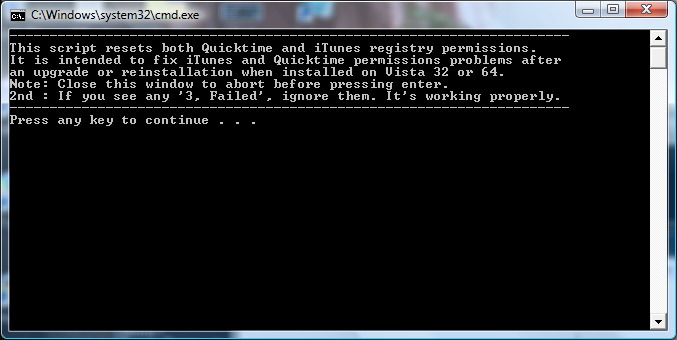
Command Shell Running Reset.cmd
Press any key to begin the repair or close the window to abort. If you want to see what the Reset.cmd command does before you run it, open it in Notepad. You will see that it simply modifies the permissions on the registry keys associated with Quicktime and iTunes to allow Everyone to access these registry keys. Once this task is completed, your iTunes will be repaired and functional.
Good luck and let me know if you have questions or if you have a success story.
Disclaimer: You are responsible for your use of this information. This information is provided as-is with no warranty expressed or implied. Use the above information at your own risk. You should always make system restore points or backups before making registry changes so you can restore your system in the event of unexpected problems.
Ponzi Schemes and Wall Street
I hope that everyone who invests money knows that entrusting your money to someone else is risky. It doesn’t matter if the yield is 0%, 2% or 5%. The act of handing your money to someone else involves risk. So, is it then no surprise when someone like Bernard Madoff, who once the chairman of the Nasdaq Stock Market, is arrested for an alleged ponzi scheme that bilked people out of billions?
Hello, no! Wake up people. When times are good, no one delves into such corrupt Wall Street vehicles because they are self-sustaining. It’s only when times become bad that these schemes fall apart. The way a ponzi scheme works is by paying old investors out with new investor money. The fund itself is not self-sustaining (and probably was never intended to be). So, as new investors dry up, the older investers can no longer be paid. The whole thing then falls apart.
But, the question isn’t so much that this one person did this. It’s the loss of trust and of faith in the system. It’s the question of how many more people are doing it? When respected people of the invesment community end up operating such scam vehicles, what does that say of Wall Street as a whole? Clearly, this is not and will not be the only ponzi scheme to turn up. It’s the first major case of it recently, but it certainly won’t be the last.
Is investing a bad idea? Not necessarily. But, it is risky. This is why diversification is part of the answer. Do not put your money into one fund or even two or three funds. Spread the money out into many funds. Granted, it’s harder to keep track of, but the chances that every single investment fund being corrupt is unlikely. However, we all know that money corrupts. So, you have to take the good with the bad when you give someone your cash to manage.
These are the kinds of problems that shake the foundations of investing to the core. These are the kinds of trust issues that the investment community needs to avoid like the plague. Yet, here we are. These are also the kinds of problems that America itself has been fostering for the last 10-15 years. Why is greed, power and corruption such a big part of the American dream today? Only a historian will be able to look back and fully answer this question. Today, these problems appear to be unrelated. But, is this problem systemic? Is it only likely to get worse? When well respected Wall Street investment professionals, such as Madoff, can bilk so many out of their money, this is much more than isolated and, indeed, does appear to be systemic and a symptom of a much bigger issue.
At this point, America needs an overhaul and perhaps this downturn and the financial sector upheaval is the beginning of that overhaul. The corporate and financial system on which this country is based is near completely broken. When 20 year veterans of Wall Street can turn to Ponzi schemes to keep their lifestyle afloat, anything can happen. So, watch your money closely when you invest. But, even doing so is no guarantee that you aren’t investing in a sham. One quote is more salient now than ever… “Caveat Emptor” (Buyer Beware).
Car Maker Bailout
Because I’ve already discussed my views on bailouts, I’ve debated about creating a post on this topic. So, I will keep this one short and sweet.
No no no! No bailout for car makers. We do not need to be footing any more bills for badly run companies. If the car makers cannot get their act together on their own, what makes anyone think they’ll be able to succeed with an infusion of cash from the government? The answer, they won’t.
Worse, without any government oversight (and there has been little oversight of the bank bailouts), they’ll take the cash and run without actually becoming accountable for it.
Again, no no no. No more bailouts. Let these companies go through Chapter 11 and rework their own company’s finances on their own.


2 comments