Should TikTok be banned in the US?

Clearly, TikTok’s executives would have you believe that there is no risk when using TikTok. Is there a national security risk, though? Yes. Let’s explore.
Bytedance
TikTok is presently owned by Bytedance. Bytedance’s company headquarters are located at Room 10A Building 2 No. 48 Zhichun Road, Haidian District, Beijing China. We also need to understand that businesses operating in Beijing China operate under Chinese law (such that it is). What that means for TikTok is that in order for this company to operate within China, it must always abide by China’s rules and regulations including spurious Chinese government requirements and mandates both existing and instantaneously required by the government.
For example, if Xi Jinping decides that Bytedance must turn over all information it has acquired to the Chinese government, Bytedance must comply or face the possibility of China pulling its licenses to operate its business in mainland China.
On the one hand, you have the TikTok CEO Shou Chew claiming that TikTok’s user data is safe. On the other hand, you have China’s government which can instantly require (i.e., force) Bytedance (or any Chinese based company) to hand over its data or face the loss of operating a business in China. Because China is a communist government, whatever China wants, China gets. Meaning, TikTok can absolutely make no assurances that user data is truly safe while Bytedance remains under China’s overreaching communist government authority. The rule of law only applies in China when the Chinese government WANTS it to apply, a key takeaway here. Internationally, China’s government does whatever it wants under the guise of appearing to support the rule of law.
Oracle Cloud
TikTok’s CEO has assured congress that it could move its data to within the Oracle cloud environment. While moving TikTok’s data storage to a United States owned business might sound great on paper, in reality it means nothing. Data stored in the US can STILL be easily exported, backed up, copied and recovered to computer equipment which resides in China. In fact, it would be entirely surprising if TikTok didn’t keep live backup copies of all user data somewhere on Chinese servers.
In other words, the CEO’s statements about using data storage on US shores as a “protection scheme” rings hollow. It’s far too easy to create copies of data and put it anywhere you want. It’s also guaranteed that if the Chinese government were to mandate that Bytedance turn over all relevant data to the Chinese government, TikTok would be forced to comply with those orders or face China’s government retaliation. In this case, not only can Bytedance not protect user data, they would have to appear completely willing to hand it over to the government instantly. Why? Because of Bytedance’s allegiance to China and not the United States… and because if TikTok doesn’t, China will close them down.
Allegiance
This word denotes a whole lot of things all at once. However, the most important thing this word signifies is what happens if China requests something from Bytedance and they refuse? A US based company protects all data of its users under the laws of the United States. If there were a subpoena by law enforcement issued for that data, a US based company would either have to comply with the subpoena or file an objection to quash the subpoena under specific grounds. In China, such avenues of refusal don’t necessarily work.
Because the United States is, at least thus far, based on the rule of law, the government would be required to allow an objection to funnel through the court processes before requiring the company to turn over whatever data is required by that subpoena. Even then, it would only be required if the court upheld the subpoena instead of siding with the appeal.
On the flip side, because China is a communist operated government, businesses operate under the whims of the Chinese government, which is not always based on the rule of law. While China does put up appearances suggesting that rule of law exists, the realities within China don’t always match that “rule of law” narrative. Meaning, China’s rule of law facade is just that, a facade.
For this reason, Bytedance’s allegiance must remain with China and never with the United States. The only reason Bytedance can operate within the US borders is because the United States, at present, allows it. But, that may be changing…
Is My Data Safe with TikTok?
The short answer is, no. Why? Because Bytedance’s allegiance remains solely with China because that’s where its business is incorporated. Regardless of what the executives of Bytedance may claim, that Chinese allegiance means that if Xi Jingping requires Bytedance to turn over all user data to China’s government about TikTok users, Bytedance must comply… and with no questions asked.
It doesn’t work like this if Bytedance were a company owned and operated within the United States. Rule of law actually matters in the United States where in China it only appears to matter, but doesn’t actually matter when the Chinese government wants what it wants.
What’s Wrong with China Knowing About Me?
If you don’t live in China or plan to visit, it might not matter that much. However, if you were ever to visit China, what you post on TikTok might be considered a legal offense in China and could see you legally apprehended, detained and/or jailed.
In other words, if you intend to post on TikTok and you have said or done anything that China takes offense to, you could become wanted in China. That’s a fairly extreme outcome, but China takes offense easily to many things and it takes those offenses seriously… so why poke that bull if you don’t have to?
Worse, because China is all about the money, having critical data from your phone device could allow would-be Chinese hackers to infiltrate your device, steal your identity and steal your money.
Should I use TikTok? — Should I allow my kids to use TikTok?
If you value your family’s privacy, no. YouTube and Facebook both offer similar enough video sharing features to more than make up for TikTok’s functionality. Both YouTube and Facebook are US based companies not under the Chinese government’s thumb. Why risk potentially losing your (or your child’s) personal data to China needlessly when you don’t have to?
This author definitely recommends avoiding the use of TikTok entirely. There’s really no reason to risk losing your family’s personal data to China over the use of a silly video sharing platform… a platform that already exists on YouTube and via other US operated companies.
Creators
The argument on not banning TikTok seems to stem mainly from both the TikTok executives (naturally) and from TikTok’s creators. Ignoring TikTok’s weak executive arguments for the moment, let’s focus on TikTok creators. While I agree that many creators may not have understood the ramifications of investing their creative efforts and skills into a platform of questionable origin, unfortunately they have. What that means is that a ban on TikTok in the US means that these creators must lose the audiences they have worked to gain. I get it, but that’s not reason enough.
For creators, this is a problem. However, it’s relatively simple for creators to ask their audience to move with them to a new platform. If a creator’s audience is truly committed to that creator’s content, most (if not all) of that audience should will be willing to move to any other platform that that creator may choose to use. A simple video which requests fans to sign up for and move to a new platform shouldn’t be a big deal.
If you’re a TikTok creator considering that you may lose your ability to create on the TikTok platform, you should definitely consider a movement plan to another platform. Whether that be YouTube, Instagram, Snapchat or any other short video sharing platform, moving away from TikTok is the key. You shouldn’t remain complacent and simply assume a ban won’t happen. You should take action now and, yes, complain if you like, but you should also prepare to move your fans and content to another platform. Don’t wait, take action now!
Creator arguments about engagement or loss of revenue or any other such arguments are simply not strong enough arguments to sway regulators away from the above China data sharing problem. There are too many other platforms owned and operated by US companies for such creator arguments to hold any weight at all. Simply, they don’t. This is why creators need to be proactive and take steps to plan to move both your fanbase and content to another platform now. Don’t sit on your hands and think it won’t happen. Plan ahead.
TikTok Audience versus TikTok CEO
While creators make up a relatively small portion of TikTok users, they are the ones responsible for bringing in the viewers. Still, having an audience is not an argument to keep TikTok from being banned. It’s not whether TikTok offers a valuable video sharing service, it’s that a Chinese based company manages TikTok’s data and always remains at the whims of China.
The CEO has stated that TikTok is beholden to no country, but that’s simply not a true statement. That statement cannot possibly be true. Every company must go into business under some country. Every country has laws and requirements for businesses to remain in business within that country. Bytedance incorporated its business within China. That means that Bytedance is beholden to China’s laws and regulations, no matter how, when or why they might appear. Because China’s government only appears to abide by its written laws and regulations, it only does so when it is convenient to the Chinese government. When it’s not convenient, new laws instantly come into being to cover whatever “thing” China is trying to make happen.
Instant laws don’t occur in the United States. It takes time, effort and lots of congressional or state legislator bickering and months of wrangling before a new law can come to exist. Most new laws require ballot measures to be voted on by the population, something that China doesn’t offer to its citizens.
What this all means is that TikTok’s CEO can say whatever he wants, but the realities of the way China operates remains. If Mr. Chew is so willing to lie about Bytedance’s allegiance to China, what else is Mr. Chew lying about? Lying to congressional members really doesn’t say great things about Bytedance or TikTok.
Should TikTok be banned in the United States?
We’ve come full circle from the beginning of this article. After all the above arguments are considered, I’d say that it is most definitely worth banning TikTok (and any other Chinese based apps) from the app stores. This situation shouldn’t be limited to TikTok. TikTok is simply so visible because it’s now used by more people than, in some cases, YouTube. The shear audience sizes alone for some TikTok creators means ever more and more people are signing up to use the service. Many of these new users are children (aged 17 and younger).
Children are unable to comprehend what sharing of personal data to China really means. They just see silly videos, but have no idea what information TikTok may be collecting while these children use TikTok.
Additionally, because Bytedance is a Chinese operated company, it doesn’t have to abide by federal regulations like COPPA. TikTok might choose to voluntarily comply (or simply put up a facade of doing so) as a measure of apparent goodwill. However internally, it may not at all comply with COPPA because it doesn’t have to. Because the TikTok company exists and operates outside of the US’s borders, United States federal laws don’t apply and cannot be enforced upon TikTok. This aspect right here is the single biggest elephant in the room and the single biggest reason why TikTok should be banned.
Without the federal regulations to help protect US citizens from nefarious or malicious use of data collected, Bytedance can literally do almost anything to non-Chinese citizens without any legal ramifications by the United States. Even if the United States were to try and bring suit, China wouldn’t allow it. This situation alone is why TikTok (and other Chinese operated services) should not be allowed to operate within the United States. TikTok is literally one Chinese company among many taking advantage of its Chinese locale to avoid being held accountable to United States laws.
The United States has every right to protect its citizens from unlawful interference by other countries. TikTok is one among many companies where this reality now exists, not just companies located in China. The United States legislators need to take a step back and really think long and hard about (the lack of) legislation around companies operating in countries which are mostly unfriendly to the United States.
China only tolerates the United States at this point because of the buying power the United States offers. Other than buying power, that’s where China’s civility with the US ends. China (and a Chinese operated company) doesn’t care how many people in the United States die, get maimed or get injured as a result of products made in China. The same can be said of services like TikTok. Anyone who legitimately believes that the TikTok CEO legitimately cares about United States citizens, other than for their wallets and the almighty dollar, is clearly deluded.
Yes, TikTok should be banned, along with every other app-based service operated out of unfriendly territories around the globe.
First Amendment?
Some have claimed that the First Amendment will be violated by banning TikTok. Let’s definitively state here and now that there is no First Amendment problem at play. Because TikTok is a Chinese company wholly operating out of China, Constitutional laws don’t apply to TikTok. The executives who operate TikTok aren’t United States citizens.
Even though there are United States users using the service as creators and viewers, the service itself is not bound by the United States Constitution. In effect, by you as a user choosing to invest your time and effort into putting your videos onto a wholly owned Chinese entity, you’ve effectively forfeited your right to First Amendment protections.
While some First Amendment advocates might disagree with the above stance, one thing is certain, the United States Constitution does not apply to non-US citizens… which would include any and all executives and staff who were hired and operate out of Bejing China. While it is possible that Bytedance has hired some United States citizens to help operate its service globally, that doesn’t wholly, suddenly or automatically then make Bytedance as a company bound by the United States Constitution.
↩︎
Movie Review: Smile Movie
 Paying to see a film in the theater, particularly a film that I already know is bad, is out of the question. And so it goes with the movie Smile. Let’s explore this film’s problems.
Spoiler Warning: Don’t continue reading if you want to watch this film.
Derivative
Another movie reviewer suggests that this film takes some of its cues from The Ring (2002). I didn’t get much of a “The Ring” vibe while watching Smile. However, I did get a heavy Final Destination (2000) vibe. While the movie doesn’t feel like a Final Destination film in its story, the predestined outcome, once revealed by Rose, feels very much like Final Destination.
What that means is that Smile is very much derivative of other films which have come before, like Final Destination. Thus, the film feels already way too familiar while watching it.
Hitchcockian?
While I’m sure that the director and producer(s) had wanted to produce something that felt like a psychological thriller, in the vein of Alfred Hitchcock, unfortunately Smile never achieves that level of professional treatment. That’s mostly because the story fails the film. Instead of watching a solid thriller unfold, what we get is something that feels at once all too familiar, but with an overly problematic story. Unfortunately, as I said, that leaves the film never reaching the level of foreboding suspense of an Alfred Hitchcock production.
Story Problems
This story feels a lot like a very long episode of the Twilight Zone. Unfortunately, the writers more or less fail this film almost completely. The first act of this film begins by unfolding Smile’s narrative of a crazed young woman named Laura Weaver who complains of being stalked by an unseen entity. Rose (an overworked therapist at a hospital) initially diagnoses Laura’s condition as a psychotic break. It isn’t until she witnesses the brutal suicide death of Laura where Smile truly begins. Laura’s suicide is odd because she does it all with a smile on her face; a smile that remains even after she’s dead by her own hand.
This is where Rose’s life takes a huge turn and where the Smile movie’s first act can begin in earnest. During the first act, Rose doesn’t fully understand that something’s amiss for quite a long time. Too long, actually. She goes about her daily life believing that her being overworked is the source of her anxieties and “seeing things”. It isn’t until her cat ultimately disappears and then turns up in a rather awkward place that she really begins to understand something more than merely being overworked is at play.
This is when Rose herself begins to see her former psychiatrist. More than this, Rose begins to understand that what Laura had said in her first encounter is actually unfolding in the same way for her.
Let’s stop right here…
Story and Plot So Far
To this point in the film, Smile is relatively slow burn, but the plot is unfolding in a way that’s not overly far fetched or out of line for its premise. However, most viewers by this point probably have a strong inkling of where this film is heading and where it is likely to head. That’s always a problem. The director and writer didn’t actually do anything counter this audience second-guessing problem, instead they double down on it… which ultimately doesn’t work.
What do the writers do? They begin Act II by waking Rose up and having her take her experience and knowledge and trying to determine if there’s truly something amiss… and more importantly, exactly how to resolve it. Of course, none of the characters around her believe any of her ramblings, partly because the entity is making her see people who aren’t actually there.
Act II
As we enter Act II of this film, Rose has decided that there’s a real problem that she needs to investigate. Rose dons her investigator cap and begins web surfing along with using an on-again-off-again boyfriend cop to get information related to her investigation of “the cycle.”
Suffice it to say that this investigatory process lasts way too long considering how it’s ultimately used in the film. Once again, let me stop right here.
Investigation and Horror
The only reason to launch a long drawn out investigation within a horror film is to try and break “the cycle.” Rose eventually determines that there is a cycle afoot; a cycle that could lead to her death if she can’t get out in front of it. This investigation leads her to one person who seemingly was able to break the cycle and lived to tell the tale.
Unfortunately, who and where this person is ultimately tells us exactly how the cycle was broken. Yet, the writers insist on taking us to where he is to actually talk to this person IN person to confirm it. Once we get there and Rose confirms the reason why this person was able to cheat the cycle, she instantly blurts out that she is unable to perform the act that got him out of the cycle. She blurts it out so fast, in fact, that it was somewhat difficult to understand what she said.
At first, I thought this admission was just the Rose character jumping to far-too-quick of a conclusion without truly thinking it through. If Rose’s life is on the line, her need for self-preservation should have eventually kicked in. After all, Smile is a suspense and horror film. For Rose to completely blow off the idea so readily and instantly tells me that the writers were hopelessly lost at this point. It’s a horror film, guys! Get with the program!
Second half of Act II
The second half of Act II was the time for a twist from the writers. Unfortunately, that twist just never materializes. Everything set up in the first act leads us in a very straightforward manner directly into the second act. Everything predicted by the cycle exactly comes to pass with no deviation… even though, Rose has had well enough time to investigate the cycle and even break it if she had so chosen.
Instead, the second half of the second act is merely devoted to just how the Smile entity can take over the mind of its victim making that person believe whatever it wants. In that goal, Rose decides to head out to an isolated house in the middle of the woods with no one there who can try to bring Rose back to reality… not that that would have been possible. Her rationale, though, was that with no one else there, the entity is trapped. Rose way underestimated the entity’s prowess.
Possession
One topic that was never really outright said in the film, demonic possession, was clearly the hallmark of this situation. This entity turns out to be some kind of demon who delights in seeing its victims commit suicide in front of others in a very brutal way. If the writers had embraced the idea of demonic possession, either Laura or Rose could have attempted to stop the demon from possessing them. Unfortunately, by the time the possession takes full effect (a slow buildup taking several days), once possessed, that leaves minutes before the person commits suicide in front of another, beginning the cycle anew. I have to assume the writers were thinking that the entity’s possession takes days because it takes that long to wear down the psyche of the person being tormented.
Overall
The film is derivative and unimpressive. The demonic smile isn’t demonic. It’s just a smile. The smile needed some major CG enhancement to make the smile wider, wierder and more sinister than it appears on the faces of each of the victims… perhaps, even tearing the face apart to achieve it.
Worse, the whole overly long investigatory aspect for Rose left the viewers wondering what the hell happened. Since Rose spent a large swath of screen time trying to make sense of the situation and, more importantly, trying to find a way out of it, you would think that Rose could have seriously contemplated what was needed to get herself out of it and survive. She didn’t. More than this, because it’s a horror film likely wanting to begin a franchise, killing off your lead character doesn’t allow for that.
If the writers are thinking that they can make Smile 2 using the ex-boyfriend cop as the lead, they need to think again. Of course, they can simply use him as the setup, like Laura, to initiate another lead character to try their hand again at trying to unravel the mystery of this demon. The question is, can a second Smile film actually pull that off? I’m not so sure.
For this film, the story doesn’t really work. If Rose had actually contemplated and achieved breaking the cycle, that would have been the twist that Smile required to make it satisfying. Yes, the cycle would have been broken for Rose, but someone else would have still inherited the demon to deal with later. Unfortunately, this all too predictable story was all too predictable in its ending.
Rating: 2 out of 5 stars
Recommendation: Watch only on “free” streaming services
↩︎
Fallout 76: Are Re-Rollers Gambling?

As of Season 12, entitled Rip Daring and the Cryptid Hunt, Bethesda might has well have entitled Fallout 76’s newest season, Welcome to Gambling. Let’s explore.
Challenge System
When Fallout 76 released in 2018, Bethesda included a “Challenge” system in the game. This challenge system allowed (and still allows in limited ways) players to obtain Atomic Shop currency called “Atom” in exchange for performing relatively basic challenges in the game world.
This Atom currency allows players to “buy” in-game items, such as CAMP add-ons, character clothing, hairstyles and face paint. The selection of the items in the Atomic Shop, at the time, was relatively limited in the early days, but has since expanded into consumables, Fallout 1st items, weapon and armor paints and even weapons.
Almost every video game released today offers a store with add-on items for players to purchase to enhance their gaming experience. The “Atom” currency has always been and remains the only currency in the game that can be purchased with real cash money in the form of USD (or other currencies around the world). For the purposes of this article, all dollar amounts shown are in USD.
For example, if you own a PlayStation, you can visit Sony’s PlayStation store and purchase Atom bundles, such as 500 Atom for $4.99 (or basically $5). The exchange rate is 100 Atoms to every $1 spent. An item in the Atomic Shop could then be said to cost $7 if it costs 700 Atoms. A small discount is applied the more Atom you buy.
If you pay $20, you’ll receive 2,400 Atoms. Bethesda’s marketing states there’s a bonus of 400 Atoms. In reality, this is simply considered a slight markdown on costs. Instead of costing $1 per 100 Atom, this changes the ratio to $1 per 120 Atom or discounted to 83¢ per 100 Atom. If you’re willing to spend $40, you’ll receive 5,000 Atoms. That further reduces the cost to $1 for every 125 Atom or 80¢ for every 100 Atom (a 20¢ discount or 20% discount for each 100 Atoms bought over the $5 purchase in the store).
That means that if you buy $5 worth of Atoms, a 1500 Atom item in the Atomic Shop store costs you $15.00. If you pay for $40 in Atoms, that same 1500 Atom item now costs you $12. That’s not a tremendous discount overall, but you will have saved $3 by buying $40 in Atom over buying three separate $5 Atom items (making $15 or 1500 Atom) from the PlayStation store. This conversion rate is only important if you’re wanting to equate how much something actually costs you in the Atomic Shop.
Fallout 1st
With the introduction of Fallout 1st, this monthly subscription service muddies the Atom waters just a little. By subscribing to this service, you’ll receive not only access to all of Fallout 1st’s features, including access to private worlds, access to custom worlds, access to the ammo and scrap boxes and a bunch of 1st exclusive Atomic Shop inclusions, you’ll also receive 1,650 Atoms each month. The cost for Fallout 1st is $12.99/mo straight up or $8.25/mo if you pay for the $99 to buy 1 year / 12 months up front.
Depending on how you choose to buy Fallout 1st, the value of the monthly allotment of Atoms changes. Buying Fallout 1st at the 1 year price is obviously the cheapest option offering up a nearly 50% discount off of those 1,650 Atoms (ignoring all of the rest of Fallout 1st’s features). 1,650 Atoms would normally cost close to $16.50 to purchase. Of course, the closest Atom bundle on the PS store is the 1,100 Atom bundle which costs $10. You’d have to jump to the 2,400 Atom bundle at $20 to get enough to cover 1,650 Atoms. The best Atom cost bundle is the 1 year subscription to Fallout 1st which discounts the cost of Atoms to 50¢ per 100 or effectively half price. That means that that same 1500 Atom item in the Atomic shop would cost you $7.50… assuming all of your Atoms came solely from being a Fallout 1st member.
Buying Fallout 1st monthly at $13 is still a discount on Atom, but at a rate of (rounded up) 127 Atom per $1 spent, just slightly better than buying the 5,000 Atom bundle shown above.
Challenges and Score
When the first Scoreboard season arrived in 2020, Bethesda changed what the daily and weekly challenges gave as rewards. Prior to the introduction of the Scoreboard seasons, all challenges awarded Atom. A player can spend these Atoms in any way chosen. Atom was originally awarded from both daily and weekly challenges as well as all of the other environmental challenges in the game.
With the introduction of the first Season and the Scoreboard, daily and weekly challenges changed to providing S.C.O.R.E. (another insipid Bethesda acronym). For the purposes of this article, this author will use the word ‘score’ for simplicity. Score is simply yet another, but separate form of Experience Points (XP). The score moves a blue progress bar across the Scoreboard. Once the progress bar reaches the end, the Scoreboard advances by one space. Each Scoreboard has 100 board spaces. Each space requires a progressive amount more score to complete. The first space might require 1000 score to complete. The last space might require 3500 score to complete. Every space in between requires more than 1000 score and less than 3500 score to advance to the next space. Once the game board has completed, additional board spaces appear so that awards can still be accrued by performing daily and weekly challenges.
For the first few seasons, once you reached the Scoreboard’s end, the board was over. Challenges did nothing and were worthless. It wasn’t until a few seasons later that Bethesda realized the problem and added more board spaces after the 100th board space, the final space which awards the “big prize” (such that it is).
What exactly is a Challenge?
While there are many challenges available in the game, the ones that matter most to today’s players are those that produce score. These are the only ones that advance board spaces on the Scoreboard. All other remaining challenges still provide Atom, but in small and diminishing quantities. The only renewing challenges are the daily and weekly challenges. The environmental challenges are one-off challenges that, for the most part, do not renew. These environmental challenges are one-and-done… with the exception of pick-lock and hack-terminal challenges that have a progression system that eventually ends, but which provide a small amount of Atom so long as they remain uncompleted.
The daily and weekly score challenges help “move the needle” through the Scoreboard. Each game board space unlocks some kind of Atomic Shop item including the possibility of a space awarding Atom itself. The board spaces are not random chance. They are hard set by Bethesda and the “prize” can be easily seen by hovering over the board space.
When Fallout 76 was introduced in 2018 (and until 2020), daily and weekly challenges awarded exclusively Atom alone. The daily challenge board might, in total, award anywhere from 100 to 300 Atoms (maybe more) depending on that day’s included challenges. That meant you could gain at least between 100-300 Atoms per day simply by doing the daily challenges. In a week, that could accrue to 1,000 or more Atoms just by doing daily challenges. The weekly challenges might accrue up to 1,000 to 2,000 Atoms (or more) depending on the included challenges. That meant that between the daily and weekly challenges you could see anywhere between 1,200 and 2000 Atom accrued per week. The problem for Bethesda was that all this freely available Atom from the daily and weekly challenges meant that players didn’t need to buy Atom frequently or sometimes at all. Bethesda wanted more income.
When the Scoreboard was introduced, the amount of Atom awarded by challenges was dramatically reduced to only those Scoreboard spaces which, all except one, offer a measly 150 Atom per space and only a handful of these spaces now exist on the board. In total, a single season Scoreboard typically awards 2,000 Atoms instead of up to 2,000 Atoms we were formerly getting per week from completing both the daily and weekly challenges. With the Scoreboard, it now takes many, many weeks of challenges to unlock the total Atom on the Scoreboard. Less Atom given out means more Atom sold with real cash money.
In other words, the amount of Atom awarded by the Scoreboard has been drastically reduced… forcing players to actually pay real money for Atom to buy larger Atomic Shop items. Bethesda enforces this purchase behavior by putting shop bundles into the Atomic shop for 16 days or 3 days or similar limited time offers which see the item disappear from the store after the timer ticks down. It’s a ruse that tries to force gamers into buying Atom to avoid “losing out”.
The challenges themselves include all manner of fetch quests. Some are long tailed and some can be completed in just a few minutes. Many are convoluted and may require things that a low level player might not have or might not yet have access to. Not all challenges can be completed by every player, depending on where that player is in completing the game’s main quest lines.
Challenge Examples
Challenges come in all shapes and forms. Some require completion of the challenge once, but many require completion of the challenge multiple times. For example, “Scrap Junk to produce Black Titanium (0/10)”. The 0/10 means that the player must scrap junk 10 times to produce Black Titanium to complete the challenge.
Bethesda plays games with these counters, too. The “Collect Pieces of Wood (0/200)” is a challenge that Bethesda has modified from its original to make it more difficult. When you collect wood, you might actually collect 4, 8 or even up to 20 pieces of wood as random chance. Yet, Bethesda only counts the collection itself toward the counter, not the number of the pieces of wood collected… as a way to cheat the player out of getting the task done sooner. Yet, “Craft ammo on a Crafting Bench (0/50)” still counts each individual piece of ammo crafted towards the challenge, even if you’ve only pressed the crafting button once. It’s this inconsistency and disparity between the challenges that not only make this system confusing, it makes the challenges a pain in the ass not knowing which rules apply. These counters are also what put long tails on challenges and require them to take a whole lot longer to complete than they should.
Some challenges are based solely on the completion of other challenges, like the Gold Star Daily Challenge. The Gold Star challenge isn’t actually a challenge, it’s a counter. It counts a specific set of challenges that have been completed. Once all of the Daily Challenges have been fully completed, the Gold Star Daily Challenge also completes. The Gold Star Daily challenge is an incidental challenge that completes only because other challenges have completed.
Challenges might include the following:
- Kill a Yao Guai with a Syringer
- Collect 100 Pieces of Wood
- Scrap junk to produce Black Titanium
- Kill a Deathclaw
- Eat a Meat based Meal
- Eat Pre-War Food
- Scrap Pre-War Money
- Complete a Daily Ops
Each of these challenges is usually sub-qualified with the number of times the player must perform that task. For daily challenges, if not once only, then it’s typically set to 3-5 times; relatively easy. For weekly challenges, it might be 20-100 times. With the introduction of the Re-Roller, the daily challenges have increased repeating the task from 3-5 to sometimes 20 or 30 or more, making these tasks take much, much longer. Yet, you still only have 24 hours to complete the challenge. There’s reason for this change, keep reading.
Atomic Shop Items
Atomic shop items are actually worthless. Why? Because you can’t craft them for others, sell them or even drop them. Any items purchase from the Atomic shop or, by extension, received from the Scoreboard are exclusively locked to that player. If you purchase (for Atom) an outfit from the Atomic Shop, it is exclusively for your use alone. If another player wants that same item, they must also spend Atom to buy it from the Atomic Shop. These player locked items make the item, in fact, worthless in the game world. They’re cosmetic, yes, but that’s the extent of the value of that item.
Some items can be used by other players, like Shelters, making these kinds of Atomic Shop items a bit more worthwhile than those like cosmetic armor or weapon skins. Shelters, for example, are probably one of the most useful items in the game. These in-game rooms offer the player a way to decorate and build in creative form, which can be shared by other players who visit that shelter. Shelters also afford a way to display items to other players that you have found and which you value. You can even display Atomic Shop items, but why bother? Only the rarest items found in the game world are those worth displaying.
What is a Re-Roller?
Here we arrive at the heart of this article and why you’re here reading. It’s important to understand the above system in place to understand this next most recent introduction by Bethesda, the Re-Roller (aka Re-Roll). Some challenges have been a problem to complete by some players, but only because the player might not be far enough along in the game to actually complete that challenge. For example, they might not have access to a specific location that a challenge requires. The player also might not be high enough level to use the required weapon to complete the challenge. There are many challenges like these that Bethesda includes in the challenge board.
Because of complaints over uncompletable challenges, Bethesda has now introduced in Season 12 (the current season as of this article), the concept of a Re-Roller. What is a Re-Roller? It simply allows you to “spin” for and hopefully 🤞 get a new and completely different challenge. And here’s where the gambling arises and where Re-Rollers intentionally fail.
Before diving into all of that, let’s step back in time.
EA and Loot Boxes
Several years back around 2019, EA introduced for-pay loot boxes into several of its games, but most notably FIFA. These for pay random chance loot boxes, once opened, provided the player with a common, rare or legendary item, which could be used in the game. In the case of FIFA, the game’s loot boxes provided trading cards in various rarities.
Many authorities jumped in claiming these loot boxes had become a form of gambling. These authorities are not wrong. They are a form of gambling. You spend real money and then the game spins and awards you with a “win” or “lose” situation. Because of typical house odds of offering up the worst rewards most frequently, it encourages players to do it again and again in hopes of getting “something better” or at least not a duplicate. Yes, duplicates are possible and extremely common.
As a result of the backlash over loot box gambling and other games of chance, EA and several other game developers have since stripped loot boxes from their games.
Enter Bethesda and Re-Rollers…
Re-Roller Gambling
 While Fallout 76 has included a relatively real appearing slot machine in the game for many months now, it doesn’t rely on real cash money to operate. The in-game slot machine uses “caps”, an easily obtained in-game currency. This currency has been in the game from the beginning. Today, caps are considered mostly worthless, other than for the purposes of finding player vendors who are selling relatively rare in-game items.
With this slot machine, there is effectively no way to lose. The cost to play is 10 caps. Spending 10 caps, you’ll always get something for your caps spent. For example, spinning this slot machine always awards +2 to Luck for a limited time, a very useful player perk for as long as it lasts. You can always renew this perk by spinning again. You get this perk no matter whether you get caps back or not. Most times, you’ll get back exactly the caps you spent to play, 10 caps. Sometimes you’ll get back 4 caps. Occasionally, you’ll get 20 caps or more. If you don’t win anything, the game still awards you a piece junk to scrap or sell… junk likely worth 5-10 caps at a vendor. In essence, you almost never lose any caps in this slot machine… and even then, the additional perk means you never lose. It is also impossible to spend real cash money to play this machine as caps cannot be purchased directly with USD.
Enter Re-Rollers
The name itself actually has connotations of spinning something, like a slot machine. Even the sound effects used when re-rolling are reminiscent of spinning a slot machine. How do Re-Rollers work?
Because some challenges may be uncompletable (for whatever reason), a Re-Roller allows the player to take a chance on a new replacement challenge in the hopes it will be better than what was there. In effect, the Re-Roller is tantamount to pulling the arm on a slot machine and waiting for the spinning to stop to see if you have “won”. If not, that encourages you to spin again. This encouragement is tantamount to and turns a Re-Roller into a form of gambling… triggering the same effects as any other game of gambling. While the game issues one free Re-Roller per day, additional Re-Rollers aren’t free, making this situation far, far worse.
Re-Rollers cost Atom to buy from the Atomic Shop. As has been established earlier, Atoms cost real USD. Thus, to buy Atom means paying real cash money to Bethesda for these Atoms. Thus, Re-Rollers cost the player real cash money to buy. This further means it’s possible to lose a large amount of real USD to gambling with these Re-Rollers. This is also the first time Bethesda has tied real cash money to an in-game random chance based gambling device in Fallout 76.
One could argue that Lunchboxes could be considered a form of gambling, but there’s really no gambling involved. You buy a lunchbox, you open it and you get a reward in game. There is no random chance involved. The only randomness is in the name of perk you get, not whether you’ll get one as each one is nearly equal to the others. More than this, you can buy Lunchboxes in the game world by earning in-game currency… something that can’t be done with Re-Rollers.
Re-Rollers can only be obtained by spending Atom in the atomic shop or by obtaining a very small number of them off of the Scoreboard (and even less off of the ever diminishing environmental challenges). Even then, the Scoreboard only offers 3 Re-Rollers from a single space with just a few spaces across the game board. Those 3 Re-Rollers are easily consumed in just a few minutes on ONE (1) Challenge. There is no other way to get Re-Rollers in Fallout 76 as of this writing.
Gambling Triggers and Addictions
The problem with random chance spin and win mechanisms is that they trigger the same exact gambling centers of the brain as any other form of gambling. Because real money is involved in obtaining Re-Rollers, this could cause real actual gambling problems for children targeted by this new Re-Roller mechanism. Unlike the slot machine above, which always wins you something, the Re-Roller has no guarantee you will get anything different from what you already have, which is perceived by the player as a loss. Yes, it IS entirely possible to get the same exact (or an even worse) challenge as a result of a Re-Roller. Sometimes it happens multiple times in a row.
Let’s consider that it costs 50 Atom to buy one Re-Roller. That means that an average player could spend as much as $1 for every 2 Re-Rollers purchased. Because a player might need use multiple Re-Rollers multiple times, it would be easy to spend $5 or $10 attempting to get new daily challenges… every single day. That money adds up in a week or a month or even a year.
As stated above, this unusual move is the first time Bethesda has tied real world fiat money into the purchase of a random chance game mechanic driven entirely by the need to gamble. While there’s no way to win cash money back out of this, using it always means loss of money AND its effect as a gambling device stands. Because the win is considered a “better” (subjective interpretation) challenge, the loss is real money spent on wasted / lost Re-Rollers. This loss of Re-Rollers has the real affect of triggering a gambling addiction.
As a result, the questionable inclusion of this game mechanic is easy to see children become addicted to this system so that they continue to Re-Roll without bounds, just to see what they get… all in an effort to make Bethesda more money! It’s not a simple matter that child wants to complete the challenges. It’s that the addiction causes the child to want to see “better” or “rarer” challenges. Addictive mechanics lead to addictive behaviors… and this Re-Roller feature has a real chance of being abused by someone caught up in gambling addictions. Worse, these games are targeted towards children and young adults who might not understand gambling addiction or the money problems which can result from them.
More than this, it’s surprising that Bethesda didn’t realize that these real world money tied Re-Rollers are actually a form of gambling and put the brakes on this feature before introduction.
Because Bethesda is now owned by Microsoft, that puts Microsoft on the hook for this gambling device. An enterprising lawyer may now see very deep pockets in Microsoft and choose to pursue a lawsuit over perpetrating gambling on minors. In fact, under the eyes of state laws, gambling targeted towards minors is illegal. Bethesda is playing with legal fire here.
Convoluted and Epic Challenges
One thing that has made this entire Re-Roller system far worse and even more addictive is the inclusion of even more complex and convoluted challenges. Most daily challenges included in past Seasons have required relatively simple quest objectives. Go kill a single creature. Fetch 5 purified water. Easy and relatively simple, but also useful items to player.
With this Season, Bethesda has abandoned these simplistic challenges for longer tailed, more complex and even more difficult challenges. Where it might have taken an hour to get through the daily challenge board, it might now take 3 hours because of these newer more complex and convoluted daily challenges.
Weekly challenges have always been long tailed. That means that they might take several days to complete. That’s the point in weekly challenges. Daily challenges have always given only 24 hours to complete these challenges before they reset for the next day. Moving the challenges from maybe 5-10 minutes per challenge to 15-20 minutes per challenge is an odd play, but not when you consider Re-Rollers.
A reasonably experienced player can instantly size up the amount of time a specific challenge might take. This re-enforces the need to Re-Roll long-tailed challenges in the hopes of “getting something better” …. thus, ensuring that players get addicted to this random chance Re-Roller system. Thus, the reason for inclusion of longer, obscure and more complex challenges ensure that players will buy into this gambling mechanism for a “chance” to get something better or faster or easier.
In reality, the challenges ahead of the one being Re-Rolled are equally as complex and equally convoluted, with the exception of a perhaps a tiny few which might be as easy or as useful as those given in prior seasons. A player ultimately has no idea what might pop up when a challenge is Re-Rolled. Thus, the illusion of “getting something better.”
However, it didn’t stop with complexity. Bethesda felt the need to include one more incentive to reinforce gambling behaviors: Epic Challenges. “Epic Challenges” offer higher Score and are, thus, rarer to see from a Re-Roller. Rarity is a concept that will cause players to want to gamble. Because Epic Challenges are considered a low chance “win”, players will be incentivized to consume Re-Rollers multiple times until they get an Epic challenge.
Therefore, this Epic Challenge system “rarity” encourages players to Re-Roll every challenge on the daily (and weekly) boards simply to get Epic Challenges. Doing so could cost the player $20, $50 or even $100 real cash money to achieve… being required to Re-Roll 6 challenges per day and up to 12-20 Weekly challenges. Expensive AND addictive.
Way Cheaper to Pay for Board Spaces
On the Scoreboard, Bethesda has included the ability to pay 150 Atom to advance one space. For example, if you’re at space 99 and you want to complete the board, you could simply pay 150 Atom and avoid the hassles of performing challenges to gain the required amount of score.
Let’s equate this with Re-Roller costs. The purchase of three (3) Re-Rollers costs 150 Atom, the same amount it costs to buy one board space. Consider that three Re-Rollers on daily challenges cannot provide you with any amount of score close to completing a board space by itself. The board space might complete if, for example, the score amount given for a challenge is 150 and that also happens to be the amount needed to advance to the next board space. That also meant you had completed many previous challenges to get the progress bar to the point of being almost completed.
To put this in perspective, for only 150 Atom, the gameboard will advance an entire board space (adding somewhere between 1000 and 3500 score) OR you can pay 150 Atom for three Re-Rollers in the hopes that you can replace one single daily challenge and receive maybe 100-200 score. In other words, paying for just three Re-Rollers at 50 * 3 = 150 Atom is between 10x-35x more expensive than simply paying that same 150 Atom to advance a full board space. Thus, there is zero value in paying for Re-Rollers when you can pay for board spaces. Bethesda understands this.
Gambling Targeted Towards Minors
There’s a reason why gambling establishments require people to be age 21 to play. First and foremost, it’s the law. More than this, children shouldn’t be gambling. Unfortunately, video games can’t age check before each use. There is no way to exclude a system like Re-Rollers from players under the age of 21. The only way to avoid such a situation is if such a gambling system is not included at all.
This is why so many game developers have since removed real cash money based random chance loot box systems from their games. It’s also questionable why Bethesda has now chosen to include one in Fallout 76. Bethesda has most definitely crossed a line here; a line that shouldn’t have been crossed.
Ultimately, this Re-Roller system is likely to be seen for what it is, a gambling system strongly encouraging children to gamble by the use of Bethesda’s “Epic” challenge strategy, strongly appealing to “rarity” and “miss out” child behaviors. Gambling systems should never be included in products used by or, more importantly, targeted towards minors… particularly gambling systems when tied to the use of real cash money.
Bethesda, if you’re reading, you might want to quickly retain legal counsel as this Re-Roller system is likely to blow up in your face once again. That, or you quickly need to consider its removal from Fallout 76.
Gambling Addictions / Get Help
If you’re a player who is susceptible to gambling addiction, you should not play nor fall prey to Bethesda’s gambling encouragement. Instead, please get help. It is strongly recommended to steer clear of all such gambling mechanisms included in video games; mechanisms which trigger gambling addictions and encourage you to spend real money on them.
If you’re a parent reading, you should limit your child’s play of Fallout 76. Better, stop their play altogether until Bethesda removes this gambling device and stops encouraging players to pay real cash money on random chance gambling devices.
No video game should ever make money off of the backs of children encouraged to ostensibly gamble with real money. Gambling should always remain in places like Las Vegas or Atlantic City, where people who physically travel there have made the conscious decision to gamble and are of legal age to do so.
Can this be corrected / Solutions?
[Updated Mar 18th, 2023] When this article began, this author wrestled with the idea of adding a solutions section and decided against it. The simplest solution seemed for Bethesda to remove the feature from the game entirely and be done with it. However, I’ve since decided to include this section, only because it may help out other developers considering adding “games of chance” to their game… particularly when those games of chance are tied to fiat currency and in games where children (aged 17 and below) already make up a very large portion of the player demographic.
When you’re building an adventure game like Fallout 76, where the primary objectives are to explore and experience combat situations, adding games of chance (like the Re-Roller) as ways of raising additional money is problematic and possibly illegal in some parts of the United States. Basically, a game developer should never raise money by targeting children with games of chance when tied to fiat currencies.
The big mistake Bethesda made here was to tie the purchase of a Re-Roller to fiat USD money. To rectify this situation, Bethesda would need to untie this entirely. Get rid of Re-Rollers purchased through the Atomic Shop and replace the purchase of Re-Rollers to vendors located in the game world using one of the many already established in-game currencies, such as Scrip, Gold Bullion, Stamps or Caps. These in-game currencies are earned, not purchased. For a gamer to obtain these currencies, it only requires time, not real cash money. In fact, there is no way to pay for these currencies with real cash money using any in-game mechanism by Bethesda. However, that doesn’t resolve the problem over the fact that Re-Rollers are a game of chance included in a game title targeted towards children.
Instead, Bethesda needs to reconsider the idea of swapping out one challenge for another entirely. For example, get rid of this “game of chance” mechanic entirely and replace it with a buyout option. Instead of being required to “roll and pray for something better”, the player can simply buy out the challenge by using in-game currency. Pay some amount of caps or scrip or stamps or bullion and the challenge is instantly completed. An in-replacement buyout option gets around the problem of gambling and games of chance entirely.
The other option is to simply include more challenges… more than are actually needed to complete the game board. If the player misses a few challenges, no big deal. Though, the buyout option is the best solution as it gives the player the option to complete all challenges if they so choose simply by playing longer and earning more in-game currency.
Should a buyout option be tied to actual fiat currency? Perhaps. One thing is certain with the buy-out option, it cannot in any way be considered a potentially illegal form of gambling targeted at children. Though, bilking children out of money for the purposes of such “buy-out” mechanics is still considered dubious at best. Including games of chance in similar fashion to a slot machine, on the other hand, is problematic all around when an excessively large demographic of players consists of ages 17 and below. The only way such games of chance mechanics should be included is if the developer has a way to absolutely 100% exclude 17 and younger from participating in these mechanics.
To date, I don’t know of any game developer that has found a way to do this reliably… or at all! The best way to handle the inclusion of “adult” gambling situations is simply not to include them. If you want to operate games of chance via fiat money gambling situations, then spend the money to construct and open a real casino in Las Vegas.
↩︎
Retro Review: Earth Final Conflict
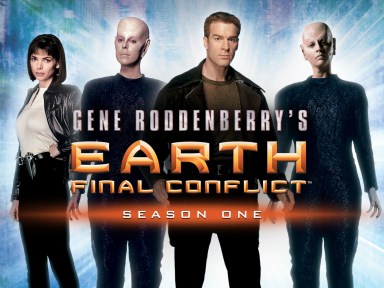 In the mid-late 1990s and after Gene Roddenberry’s untimely passing, Majel Barrett Roddenberry pitched a new Sci-Fi series which was conceived by the late Gene Roddenberry based entirely on Gene’s notes. That series? Earth: Final Conflict. Let’s take a retro dive and explore and review this series.
Premise of Earth Final Conflict
Aliens arrive on Earth bearing the promise of peace and gifts to humanity. It seems ideal. Yet, that’s where the series begins its subtext and subversion. After all, the series is called “Final Conflict”. Thus, there must be some level of “conflict” involved or the series isn’t correctly named.
Season 1
As the first season unfolds, it is clear that the concept and execution is both rough in some areas and polished in others. Much of the first season, then, seems to have been lifted almost directly from some of Gene’s notes; notes which crafted many of the episodes. Most of the episodes were, for the most part, well written. The pacing and situations unfolded in a logical and progressive manner. Every story tended to build upon the last, laying groundwork and foundation for what could make a very profound series. In this first season, there was hope for something positive. There was nothing given away in Season 1 to indicate the endgame, but the series itself was, as I said above, mostly well written.
With William Boon (Kevin Kilner), Lili Marquette (Lisa Howard), Ronald Sandoval (Von Flores), Augur (Richard Chevolleau) and to a lesser degree Jonathan Doors (David Hemblen) rounding out the “Human” cast of characters in this series, the stories worked reasonably well. The Taelon cast primarily consisted of Da’an (Leni Parker) and, later in the season, Zo’or (Anita La Selva). Majel Barrett Roddenberry also lent her acting hand as basically a “Doctor Chapel” to help implement the Taelon medical agenda on Earth. However, her character was effectively dropped before the end of season 1.
For the stories throughout season 1, the Taelons were mostly in agreement on how to move their agenda forward, with only differences in how the agenda would be implemented by specific companions.
That’s not to say the series was perfect at this point. There was definitely some inane writing involved at times. The most prominent writing problem was focusing on Da’an as the “primary” Taelon. To understand this further, it became understood that Da’an was the “North American Companion”. What about the South American Companion, the Asian Companion, the UK or even the Russian Companions? Where were those companions? Why did we never get to see those or, indeed, hear their sides of this agenda? Why weren’t their inputs as important as Da’an’s? There’s a big plot hole here which could have been rectified by season 2, but it wasn’t. Instead, the series attempted to capitalize on this disparity, instead of trying to explain it.
Season 1 wasn’t perfect, but it was a very first and important step in explaining why the Taelons had come to Earth, why a growing faction of “Resistance” had formed and how both parties would interact with one another as the series progressed.
Cast Changes
Unfortunately, by Season 2, the producers had introduced their own agenda. They wanted a younger (and hopefully larger) audience and in so doing began one in a series of rather odd personnel changes. Let’s stop right here and discuss this aspect.
Personnel changes in series can be the kiss of death for a series. While some series have been able to endure personnel changes to some degree, the series is never the same after. The most prominent personnel change in a series was in Charlie’s Angels. This series lost Farrah Fawcett after one season to her demand for more pay. Because the producers were unwilling to agree to her demands, but also because she was locked into a contract to complete a certain number of episodes, a compromise was met. Farrah would appear in fewer episodes over a longer amount of time, making it so she received the same pay as she did when working in every episode. Effectively, she got her raise, but worked less and made less money overall.
This change was the beginning of the Charlie’s Angels series tanking. Farrah’s departure opened the door to a revolving cast of wannabe actresses moving in and out of the series. From the progressively worse Cheryl Ladd to Shelley Hack to Tanya Roberts… with Cheryl Ladd being the one who was able to hold her own most of the time, but could be just as awkward at times. Even still, the amazing and iconic chemistry between Jaclyn Smith, Kate Jackson and Farrah Fawcett was undeniable and was entirely lost as a result of Farrah’s departure. The producers should have kept Farrah with the series at all costs, yes even agreeing to her higher salary. Yet, failed to do so.
Getting back to Earth Final Conflict, this same situation unfolded on this series. At the end of Season 1, the William Boone character was killed off. It is unknown why Kevin Kilner (who played Boone) left the series, but it has been theorized that the producers were looking for a younger face as a leading man. Apparently, at the time, Kevin Kilner was around the age of 40. He certainly didn’t look it on small lo-res TV screens, but apparently the producers may have thought so. To that end, William Boone was killed off, leading to a completely preposterous scenario to literally born a new character in Liam Kincaid for season 2.
In Season 4, probably due to cost cutting measures, Richard Chevolleau’s role as Augur was replaced by a new female lead in Juliette Street (played by Melinda Deines). Unfortunately, you get what you pay for. Deines was apparently so overjoyed that she landed this role that she incessantly smiled for the vast majority of her performances, as though she were some kind of EFC cheerleader. Her “better than Augur” technical persona was so overwhelmed by her scenery chewing deliveries, her character just didn’t work well for the vast majority of the episodes where she appeared.
I won’t even get into the inane naming of this “Street” character in replacement for Augur. While Richard Chevolleau’s performances steadily improved throughout the first 3 seasons to the point where his deliveries actually became more or less acceptable, the series producers forced us viewers to start all over with yet another very green actress to play yet another Augur character. So what was the point in all of this anyway?
These are by no means the only examples. Oh, no no no. Season 5 ushered in a nearly brand new cast of characters, replacing the Taelons and everything we had come to know about the series. Keep reading below for more details on that immense mistake.
Acting
Before I get into season 2, let’s discuss a hot topic that has been widely debated about this series. Yes, acting was a problem with this series. That’s to be sure. Not so much in Leni Parker or Anita La Selva (Taelons), but in the human actors. From Doors, to Augur to Marquette to Boone, the acting was fair. It was utilitarian enough to carry the stories forward, but there was nothing award winning about the acting. This is partly due to the directors. Some directors are able to draw out excellent performances from mediocre actors, but not in this series.
Kilner’s William Boone, for example, had a delivery that sounded like he was in dress rehearsal reading the lines for the first time. His delivery is so dry and unaffected, it’s occasionally difficult to watch. Augur, on the other hand, delivered lines like he was in a Saturday morning children’s show. With his clownish outfits and his near chewing the scenery, Richard Chevolleau’s Augur made for a difficult watch at times.
Howard’s Marquette delivery ranged from decent to excellent for most of her episodes. Her delivery worked well, mostly, and she was able to hold her own with the material. In fact, I’d say that Lisa Howard’s Marquette, being one of the strongest of the actors involved in the series, was the glue who more or less held the “human” cast together.
Leni Parker and Anita La Selva worked well within their “Alien” constraints as Da’an and Zo’or, respectively. From the the hand gestures to the head bobs to the constraining costumes to the prosthetic makeup, this left the acting constrained to specific “Alien” mannerisms. These constraints, when combined with the “Alien” attitudes, delivered a more stilted performance… which is more or less what we got. Whether this delivery was intentional or a product of the costumes and prosthetics remains unknown. For the sake of this article, I will assume that the alien mannerisms and stilted performances were all intentional, as the role demanded to sell the Taelons. I’ve not seen these two actresses work in other acting parts, so I can’t speak to their full range or abilities. However, as Taelons, their subtle and constrained delivery worked well… particularly Leni Parker, whose occasional smile said volumes about Da’an.
Speaking of smiles, well smirks actually, Robert Leeshock’s incessant smirk after delivering a line of dialog is not only annoying, you can’t even tell the seriousness of the delivery. In his own way, Leeshock replaced Kilner’s dry, flat affect with his own level of oddly smirky, but also dry, flat delivery.
Season 2
Here’s where things start to get rough. This sophomore season didn’t help the series much at all. The first thing to notice about Season 2 is the cast change from William Boone to Liam Kincaid. As I discussed earlier, Kincaid’s setup was entirely preposterous. At the end of Season 1, Ha’gel (a Kimera who looks like a Taelon) impregnates the Irish protector, Siobahn Beckett (played by Kari Matchett). The fetus and then the baby to child to adult grows at an astonishing rate. From birth to adult is no more than a couple of hours.
Because Ha’gel is Kimera, the baby (who becomes Liam Kincaid) is half human, half Kimera. Why this plot device was included is entirely unknown. However, the writers failed to explore Liam’s Kimera abilities the vast majority of the time in season 2 or even 3, eventually explaining it off as his “Kimera” side as slowly vanishing. Yeah, right, whatever… as if DNA genetics magically vanish over time? Whenever Liam is placed into a combat scenario, he reaches for a gun 90% of the time rather than using his innate Shaqarava… with the Shaqarava being primarily used as a palm embedded energy projectile weapon. Though, I believe the Shaqarava could be used for other purposes, like healing or as a telepathic instrument.
It gets worse. In the episode Hijacked, a reporter captures Liam’s use of his Shaqarava (palm energy organs) on camera. When confronted, she acts all surprised as if, while standing around on the mothership surrounded by literally tons of Taelons, Taelon implanted humans and Taelon technology, that it’s the most surprising thing she’s ever seen in a human. It’s such stupid and preposterous writing, I don’t even know how the showrunners thought we could swallow this trash.
Yet, this surprise is presented in all sincerity. The only thing Liam needed to explain to the reporter is that it is Taelon technology. It is actually Taelon in origin and he wouldn’t be lying by saying that. It’s just not Taelon technology from these specific Taelons. It was inherited Taelon technology back when the Taelons and Jaridians were one race… which is what and who Ha’gel is (an “old style Taelon”). Worse, why does it matter anyway? Liam acted like his being exposed for having Shaqarava is the worst thing ever. With literally thousands of Taelon implanted and enhanced humans running around, many using Skrill as weapons, Liam’s Shaqarava is something to be concerned over?
However, that’s not the worst of season 2. There were so many bad lines of dialog written, I can’t even document them all here. There were lines delivered by Zo’or that literally made no sense. Zo’or would ask questions of the humans that all Taelons should already know the answer. So then, why is Zo’or asking these questions? It would be one thing if Zo’or were asking the questions sarcastically, but the writers had Zo’or ask them in all seriousness, like Zo’or genuinely didn’t know the answer. It doesn’t make any sense. The Taelons are superior to the humans in practically every way and have vastly superior knowledge and intelligence. Why is Zo’or asking such basic and degrading questions of humans?
There were so many stupid lines of dialog in too many of the season 2 episodes, the writing felt cloddish. It’s clear, the writers had no finesse for the scripts or the source material. They didn’t understand where to take the Taelons and, indeed, attempted to rely on silly and foolish action scenes to carry the weight of the episodes rather on using the story to drive the overall narrative. While the first season was rough, it wasn’t cloddish. However, going into season 2, we began with the absurd and it gets even more inane as the season progresses.
In fact, some actions scenes are so out of place and come from nowhere, I’m at a loss to figure out what the writers were thinking. Is the only way out of a story dilemma to throw a chase and gunfire scene in? I don’t get it. There were so many unnecessary (and unproductive) shootouts, I eventually lost track. Worse, in all of those shootouts, Liam almost never uses his Shaqarava. There are so many times where he has no weapon on him, and yet he takes punches or gunfire like he’s unarmed. It’s like, come on writers, he has the Shaqarava. Let him use it to end the conflict. Yet, Liam almost always ends up on the floor face down unconscious without ever having used his Shaqarava.
The only time he ends up using his Shaqarava is when there’s a stupid plot device involved, like in Season 2, Episode 18’s Hijacked.
Let’s talk about Hijacked again in another way. This episode is so preposterous and absurd, I can’t even fathom why it was written. If the Taelon mothership is so vulnerable to takeover, why did it take this long for the human resistance to abscond with it? The dialog that “justifies” the episode is that, paraphrased, Taelons didn’t design with vulnerabilities in mind. If that were the case, then every Taelon technology is sufficiently vulnerable to takeover.
There is zero chance a dying race as advanced as the Taelons would be that naïve towards technology vulnerabilities. Claiming that and then writing an episode around the mothership being taken for a joy ride is jump-the-shark preposterous. It’s as preposterous as the first episode when Liam Kincaid comes into existence.
It’s like the showrunners for season 1 were fired and replaced. Then, new showrunners were allowed to retool the series to their own whims and desires. Season 2 felt like it was simply a playground for the “new” producers, not to tell a story, but for them to put up all action stories that the writers can devise, stupid or not.
Atavus
Before I get into season 3, let’s talk about this specific season 2 episode. The stupidity of this episode should be understood immediately. We need to understand this episode to further understand how it shaped seasons 4 and 5. The primary mistake the writers made with the Atavus episode is that the series had already established that Taelons don’t revert to an atavistic state upon severance from the Commonality (psychic bond to other Taelons). That fact was established by Ma’el thousands of years earlier. Ma’el didn’t have access to humans to “suck” their minds to keep from reverting. Either Ma’el figured out a way that has never been known to Taelons or Taelons simply don’t automatically revert. I’m betting on the latter.
When Ma’el came to Earth to learn about humans, he severed his ties to the Commonality. Yet, he didn’t have the luxury of near death humans to sustain him in Taelon form. He also didn’t revert to an Atavus. Or, if he did, he quickly figured out a way to revert back to Taelon form. However, it was never established that Ma’el ever became an Atavus or remained in that state after severing his ties to the Commonality. That means that Season 2, Episode 2 made no sense for when Bel’lie comes to Earth from a different Taelon colony strictly to become an Atavus.
That either means that Ma’el was immune to becoming an Atavus or this whole “become an atavus” thing was made up by the writers for sheer convenience strictly for this silly Season 2 episode.
Season 2 also employed one entirely questionable and throw-away episide in S2E8’s Redemption. This episode consisted almost entirely of flashbacks combined with maybe 5-8 minutes of “new” content to carry the segments. It wasn’t even handled by a primary character. It was handled by the tertiary character, Siobhan Beckett (Kari Matchett)… as if we actually cared about the fate of this character? This also wouldn’t be the first or last throw-away character that the writers would devote an entire episode to.
One other extremely bad episode to call out is the final episode of Season 2. The entire story is so dumb, I don’t even know why the idea was greenlit. The whole series up to this point had been grooming Jonathan Doors (played by David Hemblen) to become President of the United States. In fact, Zo’or was nearly ready to profess his loyalty to Doors. Yet, this episode sees Zo’or with his right hand man, Sandoval, lead the charge to assassinate Daniel Thompson, the then President of the United States in the series. The assassination was to be carried out during the presidential debate. In fact, what we come to find later was the plot intended to injure Thompson and pin it on Doors with the intention of discrediting him. Why is it bad? Because while the Taelons are malevolent in a very hands-off way, this plot shows the Taelons to be not only overt in their dangerousness, they’re fully willing to play with people’s lives to further their agenda, they hadn’t ever done this so overtly prior.
Honestly, the show would have been better had Doors won the election. This convoluted plot kept Thompson in office, an actor (Barry Flatman) whose bit parts were okay, but nothing to write home about. Now, we have to have more involved plots with this actor more and more. David Hemblen’s acting was far superior to Barry Flatman. Why the producers chose to sideline David Hemblen’s character in lieu of Barry Flatman’s character is beyond me. Yet more stupid showrunner decisions.
Season 3
More personnel changes. At the opening of Season 3, we come to find that the Season 2 prophetic vision of Augur’s holographic computer interface being pregnant and having a baby actually served a real life purpose. Lisa Howard was apparently pregnant and showing towards the tail end of season 2. Showing Augur’s computer character as pregnant and then having a child would have allowed Lisa Howard to continue her dual role, playing both Lili Marquette and Augur’s holographic computer assistant in the shape of Lili Marquette.
Going into Season 3, we come to find Lili has been killed… or at least, so we’re told. Behind the scenes, Lisa Howard had apparently requested maternity leave from the producers for the first half of Season 3. The producers were apparently somewhat obliging to her request and reduced her role significantly. Not only did Augur delete his holographic interface, so too did Lili Marquette mostly disappear from the series… appearing only in a few episodes in Season 3. This allowed Lisa Howard the time she wanted to be with her new family member.
Unfortunately, this personnel change put a hole in the series for a leading lady character. In that effort, they hired actress Jayne Heitmeyer to play Jonathan Door’s new right hand, Renee Palmer. Lisa Howard apparently claimed that Heitmeyer wasn’t intended to be a replacement for Lili Marquette. While that statement may have seemed true in some small way, that’s not really how the series turned out. In fact, by Seasons 4 and 5, Heitmeyer’s character, Renee Palmer, had become the primary lead character who carried the entire series (along side Sandoval). So, yes, Renee Palmer did eventually come to replace Lili Marquette and most of the rest of the “human” cast.
Season 3 is just as ludicrous, unfortunately, as season 2. This is mostly because of the newly introduced Renee Palmer character. When this character appears, there’s no questions, no background checks, nothing. She’s so readily accepted into the fold, it’s as if she’s been there all along. This is part of the reason I despise personnel changes in TV series. The writers could have at least had the Taelons perform some kind of fiduciary responsibility around Renee’s appearance. Yet, crickets.
As for Jayne Heitmeyer, her mostly flat affect left the series, once again, mostly without a strong actor to carry the series. The character was mostly utilitarian, just enough to carry the role. It’s the same problem with William Boone and again with Liam Kincaid. The producers kept trying to inject fresh blood into the series, yet kept failing at it so amazingly. While the series started out with a strong enough cast, particularly the Taelons, the “human” cast keeps changing as often as people change their socks.
The character changes don’t necessarily make a series bad all by itself, but when coupled with amazingly bad scripts and no way to properly use these characters, it most certainly does. As I said above, character changes are ultimately the kiss of death for a series… and Earth Final Conflict proves this out in spades. It’s really not solely the cast changes that made EFC bad, but also the bad, bad writing.
As a prime example of this extremely bad writing, in Season 3 Episode 14, Da’an opens the episode by saying, “The Jaridians carry within them the demon of violence which we removed from our species.” This stupid line of dialog is uttered to Liam Kincaid by Da’an one episode after Zo’or kills Ram, the “Latin American Companion” along with a human using an interdimensional portal and nearly kills T’Than, the war minister and another human the same way.
Liam Kincaid is well aware of what happened to Ram and nearly T’Than at Zo’or’s hand having almost been killed himself. Yet, Kincaid’s response? “What you call the demon of violence is the willingness to fight your own battles”. Kincaid was nearly killed because of Zo’or perpetuating violence against his own species, yet Kincaid makes no mention of this fact to Da’an? The Taelons have no more removed violence from the Taelon species than humans have. Yet, the writers aren’t willing to admit this.
In another episode, Season 3 Episode 9 “In Memory”, Lili wakes up and thinks she’s on Earth again. Yet, so many clues tell her strongly that she’s not where she thinks she is. Additionally, her hospital captors seem to forever press her to repair the interdimensional drive in her damaged shuttle, a very big clue in itself as to what’s going on. It’s not like the series hadn’t told both the audience and the characters repeatedly over many episodes that if the Jaridians manage to get their hands on a working interdimensional drive that that would allow the Jaridians to reach Earth much, much sooner.
You would have thought the Lili character was far smarter than this and had a brain in her head. Lili should have recognized these clues, especially those that continually press her to repair the drive system. It’s not like the Taelons haven’t repeatedly warned not only her, but every human around the Jaridian’s plan. Yet, there Lili sits, being asked to do the very thing that could help the Jaridians out majorly, all without a single suspicion? I figured out the ruse in under 5 minutes. Yet, Lili doesn’t figure it out until the very end? I don’t think so. Again, grossly bad tropes and horribly bad writing. Writers must treat characters as if they actually have brains in their heads, particularly when stories have previously demonstrated that they do. Barring that, the writers should have kept Lili drugged up and constantly in a brain fog so that she couldn’t put these pieces together. Yet, nothing in the episode unfolded in this way.
Seasons 4 and 5
I have chosen to lump both of these crap seasons together as one. With the beginning of Season 4, this effectively where Jayne Heitmeyer takes over as a lone character driving this series. By Season 5, the Tealons are fully gone (but even by Season 4, the Taelons are more-or-less already on the way out with that “core energy” stupidity). In Season 5, we see the Taelons replaced by the two Atavus: Juda (Guylaine St-Onge) and Howlyn (Alan Van Sprang). Even by Season 4, gone are most of the characters we had come to know and (ahem) love. By Season 5, we now have a nearly brand new cast of characters we don’t know and ultimately don’t care about. What TV show producer replaces nearly the entire cast and expects viewers to hang around? No offense, Juda and Howlyn.
Season 4 marks where the writers had truly lost their way and had no idea where to take this series. With Season 5, though, this is where the whole thing takes a completely sour turn. When Earth Final Conflict could have ended with an uplifting story, it instead attempted to turn itself into a competitor TV show to Buffy the Vampire Slayer (the series which was effectively in the #1 spot at the time). The producers and writers made a grave mistake with this series, one that ultimately turned the series into trash.
Instead of embracing the roots and uniqueness of what was setup in season 1, they choose to embrace a concept foreign to the series. Effectively, the series turned the Taelons into energy sucking creatures, similar to that campy and crappy 1985 movie “Lifeforce” in an attempt to compete with Buffy the Vampire Slayer on another network. In essence, the series became Renee the Vampire Slayer with Renee Palmer becoming the primary character who runs around slaying the Atavus, much like Buffy slays Vampires.
After the questionable choice of having Taelons merge into fewer characters, who then revert to becoming Atavus, the whole series takes a 180 degree turn. No longer is EFC about Taelons being a friend to Earth. Now it’s about the Atavus let loose on Earth to suck energy from humans to survive.
I can’t even fathom what the producers were thinking. Here you have a show about Tealons who come to Earth and who understand their fate is inexplicably linked to Humans. Then, the producers derail that premise entirely and effectively kill off the Taelons only to replace them with the Atavus; primitive creatures who look like vampires, act like vampires and kill like vampires. It’s then surprising to realize that the Atavus storyline managed to last a full season (and several “hint” episodes before that) before the series was cancelled.
Assignment Earth’s ties to Earth Final Conflict
It’s worth noting that Gene Roddenberry attempted to create a spinoff series at the time Star Trek: The Original Series was in production in 1968. This new series was to be called Assignment Earth. It featured an Alien, Gary Seven, who comes to Earth to study humans and human culture and intervene as necessary to keep humanity safe. However, one episode was made in the form of a Star Trek episode featuring Robert Lansing and Teri Garr as what is intended to be the series pilot. Unfortunately, this spinoff series failed to materialize and was not picked up.
How exactly is Earth Final Conflict related to Assignment Earth? Clearly, Gene Roddenberry wanted Assignment Earth to succeed. However, due to the feedback he received after Assignment Earth failed to get picked up, it appears Gene may have retooled the idea into what ultimately became Earth Final Conflict. In the 1960s, limited special effects were available. As Gene moved into the late 80s, computer effects were becoming available along with much better film effects by companies like Industrial Light and Magic (ILM). This allowed Gene to retool some of these previous ideas into concepts which could now be filmed properly with current effect technologies. Thus, the idea of using energy beings like the Taelons could now be realized on video or film.
Even the premise between Assignment Earth and Earth Final Conflict are similar enough to draw correlations between both. For example, Gary Seven is assigned to Earth for as yet unknown reasons, but he is an alien. He is accompanied by his metamorph companion, Isis, who could transform between a house cat and a human form. Clearly, the human forms of Gary Seven and Isis were not native to these Aliens. They are simply using these forms to allow for better interaction with humanity. This same can be said of the Taelons. Their human form was only created to better interact with humans. When Taelons are in their energy form, they only somewhat resemble a human form.
Additionally, the Taelons were effectively “assigned” to Earth to help humanity, the same goal as Gary Seven in Assignment Earth. The parallels between these two story ideas are more similar than they are dissimilar. I won’t dive into all of the parallels between these two series ideas. You simply need to watch both to understand them. These parallels have led this author to believe that Gene Roddenberry had ultimately retooled the original Assignment Earth ideas into what became Earth Final Conflict.
Additionally, the original series title for Earth Final Conflict was to be titled Battleground: Earth, similar to Assignment: Earth. At the time that Earth Final Conflict hit the airwaves, L. Ron Hubbard’s movie Battlefield Earth was showing in theaters. Because of the confusing naming similarities between Battlefield Earth and Battleground: Earth, it was decided to rename the TV series to Earth Final Conflict to avoid that confusion. Thus, it is this author’s opinion that Gene Roddenberry’s original Assignment Earth idea morphed into Battleground Earth, which ultimately became Earth Final Conflict. Thus, even though Assignment Earth was never realized into a series during the 60s, it did finally become a series, as Earth Final Conflict, in the mid to late 1990s.
I’ve seen many comments from fans who have wished that Assignment Earth had come to pass as a TV series. In effect, it did… in Earth Final Conflict.
Overall
It’s too bad that Majel Barrett Roddenberry didn’t retain enough control over the series to keep it from taking this direction. I would really liked to have seen the Taleons return. Then, have the humans help save the Taelons, at least in some small way. Earth Final Conflict should have been an uplifting series, not a dark depressing survival series.
If you ignore seasons 4 and 5 as if they don’t exist and focus on seasons 1-3 as if these are the only seasons that matter, it’s not a bad series. The inclusion of seasons 4 and 5 simply turns Earth Final Conflict into a throw away and worthless series in the annals of science fiction. I’m quite sure that if Gene Roddenberry had been alive to see his creation come to exist, it would have turned out much differently. I’m also surprised that both Majel Roddenberry and Rod Roddenberry allowed for this series to take this unusual and completely distasteful turn at the end.
↩︎
Did Elizabeth Holmes get the correct sentence?
 As we should already know, now-disgraced and convicted CEO Elizabeth Holmes operated Theranos. Theranos was to offer the world a fantastical new way of testing people’s health concerns for all manner of blood diagnostics all with the tiniest drop of blood. It’s fantastical because Elizabeth Holmes’s Theranos was never able to make this testing technology actually work (the entire basis for the fraud). Ms. Holmes has now been convicted of wire fraud and defrauding investors, a federal crime. More than this, Ms. Holmes has now been sentenced to serve 11 years in a federal prison.
NBC News Opinion
One NBC opinion piece, written by a former federal prosecutor and current attorney, Andrey Spektor, contends that Elizabeth Holmes’s 11 year sentence is too harsh. This author does not agree. Why? Because of the nature of and, more importantly, the real dangers posed by the device she failed to create.
Andrey’s contention is:
But that calculation was the least important component of determining Holmes’ sentence because the judge ultimately disagreed with the probation estimate and, anyway, no rational judge would have sentenced her to anything approaching life in prison. Among other things, she is a first-time, nonviolent offender whose crime did not lead to anyone’s death.
I contend that this highlighted statement is, at best, inaccurate and is, at its worst, false. There may actually have been illness and death as a result of Theranos’s deception, when the Theranos “Edison miniLab” machine (pictured) , did not work as purported and likely impacted medical treatments needed (or weren’t needed, as the case may be) for medical patients. For Andrey to contend that no one died (or by extension, weren’t injured or hurt), that’s incredibly wrong thinking.
Ms. Holmes’s deception impacted many people’s health; health which relied on accurate testing results from Theranos’s Edison miniLab machine. Without accurate testing results, the wrong medications could have been prescribed, the wrong treatment plans could be implemented, up to and including not prescribing medications which could save people’s lives… or indeed the opposite may have occurred; the wrong prescription may have been prescribed causing injury or potentially death. Claiming her fraudulent testing equipment couldn’t cause harm is fallacious and disingenuous. Worse, according to the whistleblowers, Ms. Holmes knew that her miniLab testing equipment didn’t work!
Dangers to Society
The fact that the Edison’s machine’s deception was “caught early” is of no consolation to those who received inaccurate test results from Theranos’s intentional equipment deception. In other words, you can’t just play “god” with people’s lives and health and expect to get away with it.
To claim that her defrauding and misleading and intentional deception about her alleged testing methodology, which clearly did not work properly (or at all), didn’t impact people’s health and lives is insulting to those who could have lost their lives to Theranos’s medical fraud. Even still, some still could lose their lives early because of Theranos.
That the fraud was caught early because of two conscientious whistleblowers within Theranos employee ranks is more a testament to those two individual’s forthright and upstanding conscience than of Elizabeth Holmes coming clean about the dangers the Theranos Edison ultimately posed to society. Elizabeth Holmes would likely have continued to play this dangerous game if those two whistleblowers hadn’t come forward. It wasn’t Elizabeth Holmes who “came clean” on the wrongness of her equipment. It was those two Theranos whistleblowers who put their careers in jeopardy to save the lives of others.
11 Year Sentence
For all of these reasons above, I vehemently disagree with Andrey Spektor’s opinion. Elizabeth Holmes’s 11 year sentence is not at all inappropriate or too long. In fact, I’d say her sentence was downright lenient considering the danger she, Theranos and her fraudulent testing equipment posed to society as a whole. If her equipment’s fraud had not been found early, we could have gone perhaps a year or two or longer without knowing how many people might have been misdiagnosed, given the wrong medical treatments or, indeed, given no treatments at all for preventable, but fatal illnesses if left untreated. In short, Elizabeth Holmes (and her fake testing equipment) was (and is) a danger to society.
I contend that 11 years is way too lenient for that level of danger and risk that she and Theranos posed to the world. She doesn’t deserve leniency for having committed this level of medical malfeasance against the public at large. While one can try and argue that the trial wasn’t about her medical malfeasance specifically, the fraud fully stemmed from that malfeasance. Thus, any malfeasance must be considered as part of the sentencing. It can’t be “distanced” or “separated” as though it didn’t exist. That malfeasance was the entire reason Elizabeth Holmes’s machine was found to have caused the defrauding of investors. Eye on the ball, people.
While a trial for the affected patients was not allowed to move forward, that doesn’t preclude the absolute sheer negligence and willful malfeasance Holmes performed against an unsuspecting public. Elizabeth Holmes knew her machine didn’t work. Yet she STILL went ahead with placing it into Walgreens knowing its problems. That’s not innocent happenstance; that’s willful malfeasance and, at worst, malevolence. Conscientious people don’t put other people in harm’s way intentionally. Elizabeth Holmes put people in harm’s way. One might want to call that blind ambition. Call it what you will. Blind ambition can still result in someone doing the wrong things for the wrong reasons, even knowing that the outcome might cause harm to others. That can’t be dismissed with an 18 month sentence (as Ms. Holmes has requested), a mere slap on the wrist.
No, the 11 year sentence by federal sentencing Judge Edward Davilla was definitely of a sufficient length as to give her pause AND send her a solid message for what Theranos and she had done to the public… even if not specifically stated by judge Davilla; this judge knew the stakes.
Babies as Shields?
One thing Elizabeth Holmes appears to also be shrewd at is trying to get out of her 11 year sentence. She’s now attempting this by getting pregnant. There’s absolutely nothing wrong with starting a family… but on the heels of beginning an 11 year federal criminal sentence? I get that her biological clock is ticking, but it primarily says she’s using an infant as a shield. That’s not a good look and it fully supports the above malfeasance. She’s putting her baby in harm’s way to protect herself from going to prison, or at least so she hopes. It’s a crude and crass way to begin prison… and it leaves her kids in the lurch without a parent for 11 years.
She knew she had been convicted, yet she chose to get pregnant anyway? A judge should have held her in contempt of court over that. When Holmes’s first child was born, her trial had not yet begun. Thus, there was no way to know which way her trial might go. Her second child, however, is simply being used as a pawn against incarceration. That’s both a nasty and very vile reason to have a child. It doesn’t show compassion for the child, it shows self-preservation by Holmes. It’s an incredibly uncaring and self-centered tactic, especially for a baby that’s now caught in her manipulative crossfire. As I said, distasteful.
She’s now delivered her second child, but it’s almost certain she’s working hard to conceive a third as yet another shield. Enough’s enough here. If she pops up pregnant again, cite her for contempt of court, let her carry that child to term in prison and give birth to that child behind bars. The sentence was issued and it must be carried out. Having a baby shouldn’t become a “get out of jail free” card… not for her, not for anyone. Worse, babies should never be used as incarceration blockers.
Judges should make it perfectly clear to any convicted felon who decides to conceive a baby after conviction means possible contempt of court and that neither the pregnancy nor the birth will stop the incarceration from occurring. Playing these games with the court should always mean contempt of court and possible longer incarceration time.
Did Elizabeth Holmes get the correct sentence?
No, but not for the reasons Andrey Spektor proposed. In fact, Ms. Holmes got a far more lenient sentence than she should have been given considering the real medical dangers both she and her testing machine imposed on society. Ms. Holmes should count herself lucky at receiving only 11 years. Let’s hope that when she gets out of prison, she doesn’t try to start yet another dangerous “medical testing” company.
As for those 11 years Ms. Holmes faces? This amount of incarceration also sends a clear message to other would-be CEOs not to play with people’s lives using untested medical technologies in the goal of gaining personal fame, wealth or for any other reason.
Editor’s Update: Elizabeth Holmes began her 11 year sentence as of May 30th, 2023 at the minimum security facility for females Federal Prison Camp (FPC) located in Bryan, Texas. Her final bid to remain out on appeal was denied. Elizabeth Holmes’s federal inmate register number is 24965-111.
↩︎


 Random Thoughts - Randocity!
leave a comment