Retro Review: Earth Final Conflict
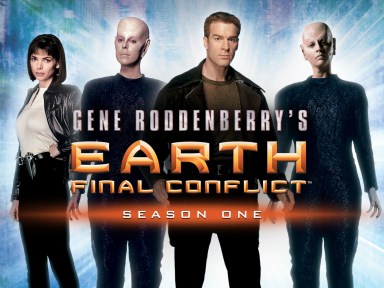 In the mid-late 1990s and after Gene Roddenberry’s untimely passing, Majel Barrett Roddenberry pitched a new Sci-Fi series which was conceived by the late Gene Roddenberry based entirely on Gene’s notes. That series? Earth: Final Conflict. Let’s take a retro dive and explore and review this series.
Premise of Earth Final Conflict
Aliens arrive on Earth bearing the promise of peace and gifts to humanity. It seems ideal. Yet, that’s where the series begins its subtext and subversion. After all, the series is called “Final Conflict”. Thus, there must be some level of “conflict” involved or the series isn’t correctly named.
Season 1
As the first season unfolds, it is clear that the concept and execution is both rough in some areas and polished in others. Much of the first season, then, seems to have been lifted almost directly from some of Gene’s notes; notes which crafted many of the episodes. Most of the episodes were, for the most part, well written. The pacing and situations unfolded in a logical and progressive manner. Every story tended to build upon the last, laying groundwork and foundation for what could make a very profound series. In this first season, there was hope for something positive. There was nothing given away in Season 1 to indicate the endgame, but the series itself was, as I said above, mostly well written.
With William Boon (Kevin Kilner), Lili Marquette (Lisa Howard), Ronald Sandoval (Von Flores), Augur (Richard Chevolleau) and to a lesser degree Jonathan Doors (David Hemblen) rounding out the “Human” cast of characters in this series, the stories worked reasonably well. The Taelon cast primarily consisted of Da’an (Leni Parker) and, later in the season, Zo’or (Anita La Selva). Majel Barrett Roddenberry also lent her acting hand as basically a “Doctor Chapel” to help implement the Taelon medical agenda on Earth. However, her character was effectively dropped before the end of season 1.
For the stories throughout season 1, the Taelons were mostly in agreement on how to move their agenda forward, with only differences in how the agenda would be implemented by specific companions.
That’s not to say the series was perfect at this point. There was definitely some inane writing involved at times. The most prominent writing problem was focusing on Da’an as the “primary” Taelon. To understand this further, it became understood that Da’an was the “North American Companion”. What about the South American Companion, the Asian Companion, the UK or even the Russian Companions? Where were those companions? Why did we never get to see those or, indeed, hear their sides of this agenda? Why weren’t their inputs as important as Da’an’s? There’s a big plot hole here which could have been rectified by season 2, but it wasn’t. Instead, the series attempted to capitalize on this disparity, instead of trying to explain it.
Season 1 wasn’t perfect, but it was a very first and important step in explaining why the Taelons had come to Earth, why a growing faction of “Resistance” had formed and how both parties would interact with one another as the series progressed.
Cast Changes
Unfortunately, by Season 2, the producers had introduced their own agenda. They wanted a younger (and hopefully larger) audience and in so doing began one in a series of rather odd personnel changes. Let’s stop right here and discuss this aspect.
Personnel changes in series can be the kiss of death for a series. While some series have been able to endure personnel changes to some degree, the series is never the same after. The most prominent personnel change in a series was in Charlie’s Angels. This series lost Farrah Fawcett after one season to her demand for more pay. Because the producers were unwilling to agree to her demands, but also because she was locked into a contract to complete a certain number of episodes, a compromise was met. Farrah would appear in fewer episodes over a longer amount of time, making it so she received the same pay as she did when working in every episode. Effectively, she got her raise, but worked less and made less money overall.
This change was the beginning of the Charlie’s Angels series tanking. Farrah’s departure opened the door to a revolving cast of wannabe actresses moving in and out of the series. From the progressively worse Cheryl Ladd to Shelley Hack to Tanya Roberts… with Cheryl Ladd being the one who was able to hold her own most of the time, but could be just as awkward at times. Even still, the amazing and iconic chemistry between Jaclyn Smith, Kate Jackson and Farrah Fawcett was undeniable and was entirely lost as a result of Farrah’s departure. The producers should have kept Farrah with the series at all costs, yes even agreeing to her higher salary. Yet, failed to do so.
Getting back to Earth Final Conflict, this same situation unfolded on this series. At the end of Season 1, the William Boone character was killed off. It is unknown why Kevin Kilner (who played Boone) left the series, but it has been theorized that the producers were looking for a younger face as a leading man. Apparently, at the time, Kevin Kilner was around the age of 40. He certainly didn’t look it on small lo-res TV screens, but apparently the producers may have thought so. To that end, William Boone was killed off, leading to a completely preposterous scenario to literally born a new character in Liam Kincaid for season 2.
In Season 4, probably due to cost cutting measures, Richard Chevolleau’s role as Augur was replaced by a new female lead in Juliette Street (played by Melinda Deines). Unfortunately, you get what you pay for. Deines was apparently so overjoyed that she landed this role that she incessantly smiled for the vast majority of her performances, as though she were some kind of EFC cheerleader. Her “better than Augur” technical persona was so overwhelmed by her scenery chewing deliveries, her character just didn’t work well for the vast majority of the episodes where she appeared.
I won’t even get into the inane naming of this “Street” character in replacement for Augur. While Richard Chevolleau’s performances steadily improved throughout the first 3 seasons to the point where his deliveries actually became more or less acceptable, the series producers forced us viewers to start all over with yet another very green actress to play yet another Augur character. So what was the point in all of this anyway?
These are by no means the only examples. Oh, no no no. Season 5 ushered in a nearly brand new cast of characters, replacing the Taelons and everything we had come to know about the series. Keep reading below for more details on that immense mistake.
Acting
Before I get into season 2, let’s discuss a hot topic that has been widely debated about this series. Yes, acting was a problem with this series. That’s to be sure. Not so much in Leni Parker or Anita La Selva (Taelons), but in the human actors. From Doors, to Augur to Marquette to Boone, the acting was fair. It was utilitarian enough to carry the stories forward, but there was nothing award winning about the acting. This is partly due to the directors. Some directors are able to draw out excellent performances from mediocre actors, but not in this series.
Kilner’s William Boone, for example, had a delivery that sounded like he was in dress rehearsal reading the lines for the first time. His delivery is so dry and unaffected, it’s occasionally difficult to watch. Augur, on the other hand, delivered lines like he was in a Saturday morning children’s show. With his clownish outfits and his near chewing the scenery, Richard Chevolleau’s Augur made for a difficult watch at times.
Howard’s Marquette delivery ranged from decent to excellent for most of her episodes. Her delivery worked well, mostly, and she was able to hold her own with the material. In fact, I’d say that Lisa Howard’s Marquette, being one of the strongest of the actors involved in the series, was the glue who more or less held the “human” cast together.
Leni Parker and Anita La Selva worked well within their “Alien” constraints as Da’an and Zo’or, respectively. From the the hand gestures to the head bobs to the constraining costumes to the prosthetic makeup, this left the acting constrained to specific “Alien” mannerisms. These constraints, when combined with the “Alien” attitudes, delivered a more stilted performance… which is more or less what we got. Whether this delivery was intentional or a product of the costumes and prosthetics remains unknown. For the sake of this article, I will assume that the alien mannerisms and stilted performances were all intentional, as the role demanded to sell the Taelons. I’ve not seen these two actresses work in other acting parts, so I can’t speak to their full range or abilities. However, as Taelons, their subtle and constrained delivery worked well… particularly Leni Parker, whose occasional smile said volumes about Da’an.
Speaking of smiles, well smirks actually, Robert Leeshock’s incessant smirk after delivering a line of dialog is not only annoying, you can’t even tell the seriousness of the delivery. In his own way, Leeshock replaced Kilner’s dry, flat affect with his own level of oddly smirky, but also dry, flat delivery.
Season 2
Here’s where things start to get rough. This sophomore season didn’t help the series much at all. The first thing to notice about Season 2 is the cast change from William Boone to Liam Kincaid. As I discussed earlier, Kincaid’s setup was entirely preposterous. At the end of Season 1, Ha’gel (a Kimera who looks like a Taelon) impregnates the Irish protector, Siobahn Beckett (played by Kari Matchett). The fetus and then the baby to child to adult grows at an astonishing rate. From birth to adult is no more than a couple of hours.
Because Ha’gel is Kimera, the baby (who becomes Liam Kincaid) is half human, half Kimera. Why this plot device was included is entirely unknown. However, the writers failed to explore Liam’s Kimera abilities the vast majority of the time in season 2 or even 3, eventually explaining it off as his “Kimera” side as slowly vanishing. Yeah, right, whatever… as if DNA genetics magically vanish over time? Whenever Liam is placed into a combat scenario, he reaches for a gun 90% of the time rather than using his innate Shaqarava… with the Shaqarava being primarily used as a palm embedded energy projectile weapon. Though, I believe the Shaqarava could be used for other purposes, like healing or as a telepathic instrument.
It gets worse. In the episode Hijacked, a reporter captures Liam’s use of his Shaqarava (palm energy organs) on camera. When confronted, she acts all surprised as if, while standing around on the mothership surrounded by literally tons of Taelons, Taelon implanted humans and Taelon technology, that it’s the most surprising thing she’s ever seen in a human. It’s such stupid and preposterous writing, I don’t even know how the showrunners thought we could swallow this trash.
Yet, this surprise is presented in all sincerity. The only thing Liam needed to explain to the reporter is that it is Taelon technology. It is actually Taelon in origin and he wouldn’t be lying by saying that. It’s just not Taelon technology from these specific Taelons. It was inherited Taelon technology back when the Taelons and Jaridians were one race… which is what and who Ha’gel is (an “old style Taelon”). Worse, why does it matter anyway? Liam acted like his being exposed for having Shaqarava is the worst thing ever. With literally thousands of Taelon implanted and enhanced humans running around, many using Skrill as weapons, Liam’s Shaqarava is something to be concerned over?
However, that’s not the worst of season 2. There were so many bad lines of dialog written, I can’t even document them all here. There were lines delivered by Zo’or that literally made no sense. Zo’or would ask questions of the humans that all Taelons should already know the answer. So then, why is Zo’or asking these questions? It would be one thing if Zo’or were asking the questions sarcastically, but the writers had Zo’or ask them in all seriousness, like Zo’or genuinely didn’t know the answer. It doesn’t make any sense. The Taelons are superior to the humans in practically every way and have vastly superior knowledge and intelligence. Why is Zo’or asking such basic and degrading questions of humans?
There were so many stupid lines of dialog in too many of the season 2 episodes, the writing felt cloddish. It’s clear, the writers had no finesse for the scripts or the source material. They didn’t understand where to take the Taelons and, indeed, attempted to rely on silly and foolish action scenes to carry the weight of the episodes rather on using the story to drive the overall narrative. While the first season was rough, it wasn’t cloddish. However, going into season 2, we began with the absurd and it gets even more inane as the season progresses.
In fact, some actions scenes are so out of place and come from nowhere, I’m at a loss to figure out what the writers were thinking. Is the only way out of a story dilemma to throw a chase and gunfire scene in? I don’t get it. There were so many unnecessary (and unproductive) shootouts, I eventually lost track. Worse, in all of those shootouts, Liam almost never uses his Shaqarava. There are so many times where he has no weapon on him, and yet he takes punches or gunfire like he’s unarmed. It’s like, come on writers, he has the Shaqarava. Let him use it to end the conflict. Yet, Liam almost always ends up on the floor face down unconscious without ever having used his Shaqarava.
The only time he ends up using his Shaqarava is when there’s a stupid plot device involved, like in Season 2, Episode 18’s Hijacked.
Let’s talk about Hijacked again in another way. This episode is so preposterous and absurd, I can’t even fathom why it was written. If the Taelon mothership is so vulnerable to takeover, why did it take this long for the human resistance to abscond with it? The dialog that “justifies” the episode is that, paraphrased, Taelons didn’t design with vulnerabilities in mind. If that were the case, then every Taelon technology is sufficiently vulnerable to takeover.
There is zero chance a dying race as advanced as the Taelons would be that naïve towards technology vulnerabilities. Claiming that and then writing an episode around the mothership being taken for a joy ride is jump-the-shark preposterous. It’s as preposterous as the first episode when Liam Kincaid comes into existence.
It’s like the showrunners for season 1 were fired and replaced. Then, new showrunners were allowed to retool the series to their own whims and desires. Season 2 felt like it was simply a playground for the “new” producers, not to tell a story, but for them to put up all action stories that the writers can devise, stupid or not.
Atavus
Before I get into season 3, let’s talk about this specific season 2 episode. The stupidity of this episode should be understood immediately. We need to understand this episode to further understand how it shaped seasons 4 and 5. The primary mistake the writers made with the Atavus episode is that the series had already established that Taelons don’t revert to an atavistic state upon severance from the Commonality (psychic bond to other Taelons). That fact was established by Ma’el thousands of years earlier. Ma’el didn’t have access to humans to “suck” their minds to keep from reverting. Either Ma’el figured out a way that has never been known to Taelons or Taelons simply don’t automatically revert. I’m betting on the latter.
When Ma’el came to Earth to learn about humans, he severed his ties to the Commonality. Yet, he didn’t have the luxury of near death humans to sustain him in Taelon form. He also didn’t revert to an Atavus. Or, if he did, he quickly figured out a way to revert back to Taelon form. However, it was never established that Ma’el ever became an Atavus or remained in that state after severing his ties to the Commonality. That means that Season 2, Episode 2 made no sense for when Bel’lie comes to Earth from a different Taelon colony strictly to become an Atavus.
That either means that Ma’el was immune to becoming an Atavus or this whole “become an atavus” thing was made up by the writers for sheer convenience strictly for this silly Season 2 episode.
Season 2 also employed one entirely questionable and throw-away episide in S2E8’s Redemption. This episode consisted almost entirely of flashbacks combined with maybe 5-8 minutes of “new” content to carry the segments. It wasn’t even handled by a primary character. It was handled by the tertiary character, Siobhan Beckett (Kari Matchett)… as if we actually cared about the fate of this character? This also wouldn’t be the first or last throw-away character that the writers would devote an entire episode to.
One other extremely bad episode to call out is the final episode of Season 2. The entire story is so dumb, I don’t even know why the idea was greenlit. The whole series up to this point had been grooming Jonathan Doors (played by David Hemblen) to become President of the United States. In fact, Zo’or was nearly ready to profess his loyalty to Doors. Yet, this episode sees Zo’or with his right hand man, Sandoval, lead the charge to assassinate Daniel Thompson, the then President of the United States in the series. The assassination was to be carried out during the presidential debate. In fact, what we come to find later was the plot intended to injure Thompson and pin it on Doors with the intention of discrediting him. Why is it bad? Because while the Taelons are malevolent in a very hands-off way, this plot shows the Taelons to be not only overt in their dangerousness, they’re fully willing to play with people’s lives to further their agenda, they hadn’t ever done this so overtly prior.
Honestly, the show would have been better had Doors won the election. This convoluted plot kept Thompson in office, an actor (Barry Flatman) whose bit parts were okay, but nothing to write home about. Now, we have to have more involved plots with this actor more and more. David Hemblen’s acting was far superior to Barry Flatman. Why the producers chose to sideline David Hemblen’s character in lieu of Barry Flatman’s character is beyond me. Yet more stupid showrunner decisions.
Season 3
More personnel changes. At the opening of Season 3, we come to find that the Season 2 prophetic vision of Augur’s holographic computer interface being pregnant and having a baby actually served a real life purpose. Lisa Howard was apparently pregnant and showing towards the tail end of season 2. Showing Augur’s computer character as pregnant and then having a child would have allowed Lisa Howard to continue her dual role, playing both Lili Marquette and Augur’s holographic computer assistant in the shape of Lili Marquette.
Going into Season 3, we come to find Lili has been killed… or at least, so we’re told. Behind the scenes, Lisa Howard had apparently requested maternity leave from the producers for the first half of Season 3. The producers were apparently somewhat obliging to her request and reduced her role significantly. Not only did Augur delete his holographic interface, so too did Lili Marquette mostly disappear from the series… appearing only in a few episodes in Season 3. This allowed Lisa Howard the time she wanted to be with her new family member.
Unfortunately, this personnel change put a hole in the series for a leading lady character. In that effort, they hired actress Jayne Heitmeyer to play Jonathan Door’s new right hand, Renee Palmer. Lisa Howard apparently claimed that Heitmeyer wasn’t intended to be a replacement for Lili Marquette. While that statement may have seemed true in some small way, that’s not really how the series turned out. In fact, by Seasons 4 and 5, Heitmeyer’s character, Renee Palmer, had become the primary lead character who carried the entire series (along side Sandoval). So, yes, Renee Palmer did eventually come to replace Lili Marquette and most of the rest of the “human” cast.
Season 3 is just as ludicrous, unfortunately, as season 2. This is mostly because of the newly introduced Renee Palmer character. When this character appears, there’s no questions, no background checks, nothing. She’s so readily accepted into the fold, it’s as if she’s been there all along. This is part of the reason I despise personnel changes in TV series. The writers could have at least had the Taelons perform some kind of fiduciary responsibility around Renee’s appearance. Yet, crickets.
As for Jayne Heitmeyer, her mostly flat affect left the series, once again, mostly without a strong actor to carry the series. The character was mostly utilitarian, just enough to carry the role. It’s the same problem with William Boone and again with Liam Kincaid. The producers kept trying to inject fresh blood into the series, yet kept failing at it so amazingly. While the series started out with a strong enough cast, particularly the Taelons, the “human” cast keeps changing as often as people change their socks.
The character changes don’t necessarily make a series bad all by itself, but when coupled with amazingly bad scripts and no way to properly use these characters, it most certainly does. As I said above, character changes are ultimately the kiss of death for a series… and Earth Final Conflict proves this out in spades. It’s really not solely the cast changes that made EFC bad, but also the bad, bad writing.
As a prime example of this extremely bad writing, in Season 3 Episode 14, Da’an opens the episode by saying, “The Jaridians carry within them the demon of violence which we removed from our species.” This stupid line of dialog is uttered to Liam Kincaid by Da’an one episode after Zo’or kills Ram, the “Latin American Companion” along with a human using an interdimensional portal and nearly kills T’Than, the war minister and another human the same way.
Liam Kincaid is well aware of what happened to Ram and nearly T’Than at Zo’or’s hand having almost been killed himself. Yet, Kincaid’s response? “What you call the demon of violence is the willingness to fight your own battles”. Kincaid was nearly killed because of Zo’or perpetuating violence against his own species, yet Kincaid makes no mention of this fact to Da’an? The Taelons have no more removed violence from the Taelon species than humans have. Yet, the writers aren’t willing to admit this.
In another episode, Season 3 Episode 9 “In Memory”, Lili wakes up and thinks she’s on Earth again. Yet, so many clues tell her strongly that she’s not where she thinks she is. Additionally, her hospital captors seem to forever press her to repair the interdimensional drive in her damaged shuttle, a very big clue in itself as to what’s going on. It’s not like the series hadn’t told both the audience and the characters repeatedly over many episodes that if the Jaridians manage to get their hands on a working interdimensional drive that that would allow the Jaridians to reach Earth much, much sooner.
You would have thought the Lili character was far smarter than this and had a brain in her head. Lili should have recognized these clues, especially those that continually press her to repair the drive system. It’s not like the Taelons haven’t repeatedly warned not only her, but every human around the Jaridian’s plan. Yet, there Lili sits, being asked to do the very thing that could help the Jaridians out majorly, all without a single suspicion? I figured out the ruse in under 5 minutes. Yet, Lili doesn’t figure it out until the very end? I don’t think so. Again, grossly bad tropes and horribly bad writing. Writers must treat characters as if they actually have brains in their heads, particularly when stories have previously demonstrated that they do. Barring that, the writers should have kept Lili drugged up and constantly in a brain fog so that she couldn’t put these pieces together. Yet, nothing in the episode unfolded in this way.
Seasons 4 and 5
I have chosen to lump both of these crap seasons together as one. With the beginning of Season 4, this effectively where Jayne Heitmeyer takes over as a lone character driving this series. By Season 5, the Tealons are fully gone (but even by Season 4, the Taelons are more-or-less already on the way out with that “core energy” stupidity). In Season 5, we see the Taelons replaced by the two Atavus: Juda (Guylaine St-Onge) and Howlyn (Alan Van Sprang). Even by Season 4, gone are most of the characters we had come to know and (ahem) love. By Season 5, we now have a nearly brand new cast of characters we don’t know and ultimately don’t care about. What TV show producer replaces nearly the entire cast and expects viewers to hang around? No offense, Juda and Howlyn.
Season 4 marks where the writers had truly lost their way and had no idea where to take this series. With Season 5, though, this is where the whole thing takes a completely sour turn. When Earth Final Conflict could have ended with an uplifting story, it instead attempted to turn itself into a competitor TV show to Buffy the Vampire Slayer (the series which was effectively in the #1 spot at the time). The producers and writers made a grave mistake with this series, one that ultimately turned the series into trash.
Instead of embracing the roots and uniqueness of what was setup in season 1, they choose to embrace a concept foreign to the series. Effectively, the series turned the Taelons into energy sucking creatures, similar to that campy and crappy 1985 movie “Lifeforce” in an attempt to compete with Buffy the Vampire Slayer on another network. In essence, the series became Renee the Vampire Slayer with Renee Palmer becoming the primary character who runs around slaying the Atavus, much like Buffy slays Vampires.
After the questionable choice of having Taelons merge into fewer characters, who then revert to becoming Atavus, the whole series takes a 180 degree turn. No longer is EFC about Taelons being a friend to Earth. Now it’s about the Atavus let loose on Earth to suck energy from humans to survive.
I can’t even fathom what the producers were thinking. Here you have a show about Tealons who come to Earth and who understand their fate is inexplicably linked to Humans. Then, the producers derail that premise entirely and effectively kill off the Taelons only to replace them with the Atavus; primitive creatures who look like vampires, act like vampires and kill like vampires. It’s then surprising to realize that the Atavus storyline managed to last a full season (and several “hint” episodes before that) before the series was cancelled.
Assignment Earth’s ties to Earth Final Conflict
It’s worth noting that Gene Roddenberry attempted to create a spinoff series at the time Star Trek: The Original Series was in production in 1968. This new series was to be called Assignment Earth. It featured an Alien, Gary Seven, who comes to Earth to study humans and human culture and intervene as necessary to keep humanity safe. However, one episode was made in the form of a Star Trek episode featuring Robert Lansing and Teri Garr as what is intended to be the series pilot. Unfortunately, this spinoff series failed to materialize and was not picked up.
How exactly is Earth Final Conflict related to Assignment Earth? Clearly, Gene Roddenberry wanted Assignment Earth to succeed. However, due to the feedback he received after Assignment Earth failed to get picked up, it appears Gene may have retooled the idea into what ultimately became Earth Final Conflict. In the 1960s, limited special effects were available. As Gene moved into the late 80s, computer effects were becoming available along with much better film effects by companies like Industrial Light and Magic (ILM). This allowed Gene to retool some of these previous ideas into concepts which could now be filmed properly with current effect technologies. Thus, the idea of using energy beings like the Taelons could now be realized on video or film.
Even the premise between Assignment Earth and Earth Final Conflict are similar enough to draw correlations between both. For example, Gary Seven is assigned to Earth for as yet unknown reasons, but he is an alien. He is accompanied by his metamorph companion, Isis, who could transform between a house cat and a human form. Clearly, the human forms of Gary Seven and Isis were not native to these Aliens. They are simply using these forms to allow for better interaction with humanity. This same can be said of the Taelons. Their human form was only created to better interact with humans. When Taelons are in their energy form, they only somewhat resemble a human form.
Additionally, the Taelons were effectively “assigned” to Earth to help humanity, the same goal as Gary Seven in Assignment Earth. The parallels between these two story ideas are more similar than they are dissimilar. I won’t dive into all of the parallels between these two series ideas. You simply need to watch both to understand them. These parallels have led this author to believe that Gene Roddenberry had ultimately retooled the original Assignment Earth ideas into what became Earth Final Conflict.
Additionally, the original series title for Earth Final Conflict was to be titled Battleground: Earth, similar to Assignment: Earth. At the time that Earth Final Conflict hit the airwaves, L. Ron Hubbard’s movie Battlefield Earth was showing in theaters. Because of the confusing naming similarities between Battlefield Earth and Battleground: Earth, it was decided to rename the TV series to Earth Final Conflict to avoid that confusion. Thus, it is this author’s opinion that Gene Roddenberry’s original Assignment Earth idea morphed into Battleground Earth, which ultimately became Earth Final Conflict. Thus, even though Assignment Earth was never realized into a series during the 60s, it did finally become a series, as Earth Final Conflict, in the mid to late 1990s.
I’ve seen many comments from fans who have wished that Assignment Earth had come to pass as a TV series. In effect, it did… in Earth Final Conflict.
Overall
It’s too bad that Majel Barrett Roddenberry didn’t retain enough control over the series to keep it from taking this direction. I would really liked to have seen the Taleons return. Then, have the humans help save the Taelons, at least in some small way. Earth Final Conflict should have been an uplifting series, not a dark depressing survival series.
If you ignore seasons 4 and 5 as if they don’t exist and focus on seasons 1-3 as if these are the only seasons that matter, it’s not a bad series. The inclusion of seasons 4 and 5 simply turns Earth Final Conflict into a throw away and worthless series in the annals of science fiction. I’m quite sure that if Gene Roddenberry had been alive to see his creation come to exist, it would have turned out much differently. I’m also surprised that both Majel Roddenberry and Rod Roddenberry allowed for this series to take this unusual and completely distasteful turn at the end.
↩︎
TV Review: Wayward Pines
 Note: *** Contains Spoilers ***
Here’s yet another M. Night Shyamalan thriller, this time in the form of a two season TV series. Let’s explore.
Comparisons
This show has a similar premise to Stephen King’s Under the Dome. However, it is based on novels by Blake Crouch. Basically, it’s a small town that’s been cut off from everything and everyone. As a result, the town must live by its own rules. These two premises pretty much match up.
The way in which the Wayward Pines diverges is how the plot unfolds. With Under the Dome we come to find that the town is encased in a huge dome that, when the dome wishes, allows some exchange of air with the outside. In the case of Wayward Pines, we come to find that it’s supposed to be set in the year 4028, after a great holocaust mutated the human population. Both Under The Dome and Wayward Pines have populations that are cut off from “the outside world”, but for differing reasons.
Both towns, however, fundamentally operate in very similar ways with the exception that Dome runs out of resources a whole lot faster since they were cut off from the world without any resource planning. The dome town’s resources wear thin much, much faster. Wayward Pines, on the other hand, has the benefactor, David Pilcher, who not only had foreseen this event, but seemingly planned for it well in advance by building infrastructure and storing limited food rations to sustain the small town. We’ll come to find that Pilcher didn’t quite think ahead much or have planned for all contingencies.
Characters
The Wayward Pines town is inhabited by a number of adults and children including a sheriff, a nurse, a doctor and several primary families who become part of the series. It’s a similar kind of makeup as there was in Under The Dome. There’s also a faction of disenchanted citizens looking to escape from the city… so they can get “back home”. The characters change over time, particularly in season 2.
Weak Opening Premise
The show starts off entirely on the wrong foot indicating the “making it up as we go” syndrome. Meaning, the show begins by making no sense. Burke wakes up near a creek, beat up, bruised and injured. The question is, why stage this 2000 years in the future? What purpose does it serve?
If he had just awakened from cryosleep, why take him out of his cryosuit, dress him back in business attire and place him in the woods? Is it simply stage his awakening as though he had just crashed from a car? Why not start the episode off with Burke in a hospital bed recovering from his car injuries. That’s just as easily explained and shows us the Wayward Pines hospital right from the start.
If they want Burke to accept his life in Wayward Pines, why spend that time and effort staging his awakening? Did they stage other reawakenings in this way? They didn’t do it for Burke’s wife and kid. Staging reawakenings like this also means that someone at Wayward Pines needed to be 100% up to speed on exactly how Burke (or anyone else) was abducted into cryosleep to know exactly how to restage the reawakening. There are so many better things to worry about in a burgeoning town than dealing with staged awakenings.
Trapped in the Past
As with the isolated town premise in Wayward Pines, I find that there are a lot of stupid ideas, particularly from the supposed creator of the town, David Pilcher. According to his telling, the first time Pilcher tried to set up Wayward Pines, he chose to reveal the 2000 year old truth to the residents. While the children seemed to accept their fate, the adults couldn’t face life in this way and eventually the town self-destructed. This forced Pilcher to commit genocide by using the indigenous mutated humans to clear the population. This idea is stupid from the go. If you’re trying to repopulate humanity from limited pool of people, why kill them? You’re going to need that genetic diversity to repopulate… as much of it as possible.
David Pilcher has his (very large) crew (including his sister Pamela Pilcher) clean up the town, only to reset it all and restart it for a second time with group B. For group B, instead of revealing the truth, this time Pilcher decides to only tell the children the whole truth and withhold that information from the adults. This led the adults to believe they are still in 2014 (or whatever time period they came from). It also meant the adults believed they could leave the town and get back to their families… the idea that would inevitably become the town’s undoing. This keeps the adults in the dark of the reality of the world. This second time up to bat, Pilcher decides to incorporate corporal punishment in the form of town center lynch justice as a means to control order in Wayward Pines. If someone gets out of line or breaks rules, they are summarily brought to town center and executed by slitting their throat in front of the town mob. This is called a reckoning.
Here’s where I dislike this plot idea, where I feel this part was entirely unnecessary and sent the story premise off the rails. Pilcher is indeed correct to be worried that his group B town is degrading into chaos and destruction, just has had group A. It is. There is an underground movement that is growing and sowing the seeds of a second town self-reckoning once again. However, the reason for this is primarily because of Megan’s ideas she fed Pilcher. Megan’s ideas were the poison seeds that fueled Wayward Pines’s destruction, every time. Megan is a cancer on Wayward Pines.
Cryonics and The Past
To give a bit of backstory here, Pilcher foresaw the destruction of the 2014 world due to a DNA mutation he found, a mutation that would lead to humanity’s destruction in the future. He tried to alert the attention of the scientific world, but failed. Instead, Megan Fisher (eventually becomes the teacher at Wayward Pines school), urges David Pilcher to take whatever means necessary to ensure survival. This was the primary piece of bad advice David Pilcher took in securing his vision and the piece of advice that single-handedly ensured Wayward Pines’s demise. Megan would go on to not only continue giving bad advice, but poison the children and jeopardize the entire project.
Anyway, Megan’s continual bad advice leads Pilcher (being all wealthy that he is) to use his great wealth to hire people to nab random folks off of highways and put them into cryosleep. One set of unwilling participants is our protagonist Ethan Burke, his wife Theresa Burke and his school age son Ben Burke (season 1). Ethan Burke was sent to the area by the secret service (?) to investigate the disappearance of two of his colleagues. Ethan becomes the eyes of the audience as the great mystery of Wayward Pines unfolds. Of course, the premise includes everyone else in Wayward Pines, who were all unwillingly abducted and cryofrozen. The only people willingly there are those that who David Pilcher hand picked to operate the mountain complex to keep Wayward Pines functional as a township.
The Philchers (Pam and David) call Wayward Pines the Ark.
Aberrations
In season 2, we find out more about the original awakening of group A via C.J. Mitchum. He was the advanced cryo engineer who was the first to awaken and who awakened group A. He was also the person who found the aberrations and alerted Pilcher to them. This is also where the story takes a bad turn. Instead of staying and killing off a bunch of indigenous humanoids, C.J. suggests heading back into the pods to wait more time for them to die off. In fact, there were so many ways this story could have been handled, Wayward Pines might have worked as a simple utopia. Pilcher decides not to wait… yet another dumb idea from someone who’s supposed to be very smart. Anyway, Pilcher clears the area and erects an electric fence.
Outside the electrified fence, the indigenous humanoids (called Abbys … short for aberrations) inhabit the countryside. They also inhabited the area where Wayward Pines has been built. This means that David Pilcher kicked them off of their land. The aberrations are the remnants of humanity left over after the DNA mutation and the event that David had predicted. The aberrations are vicious carnivores that eat any animal flesh they can find, including any 2014 humans that happen along the way.
However, we come to find in season 2 is that Pilcher cleared out the area where Wayward Pines was to built by killing all off the indigenous folks. This action effectively starts the war between the aberrations and the humans and ensures all of the problems for Wayward Pines going forward. A problem that could have been avoided had Pilcher taken CJ’s advice and waited longer.
Keep It Simple Stupid
The first problem I have with this premise is that Pilcher kidnapped folks without consent. He also didn’t vette them for suitability or compatibility for living in a utopia city project. He yanked them out of their life and put them into cryosleep. After unfreezing them in the year 4028, he has two options. Tell them their reality or make them think it’s still 2014. After all, the town looks like it did in 2014 so it’s not that hard to convince those who are unfrozen.
There are lots of reasons why this town won’t ultimately succeed. The primary reason it is doomed to fail is that these folks didn’t consent to be there, the problem treated by Megan. They still think it’s 2014 and they think they can leave and get back home. Yet, they are being told never to talk about that. That idea won’t work. You simply can’t tell people to suppress their desires to go back home to their families and loved ones. If he had explicitly kidnapped folks who didn’t have loved ones waiting, then perhaps he could have used that. David didn’t think the kidnapping idea through very well.
Another secondary reason why this township won’t work is limited food and medical supplies. While he did stockpile food to get the town started and maintain certain levels of conveniences like ice cream, liquor, fudge, toy shops, hair stylists and various amenities offered by the 2014 standards, that cannot possibly last. There is also simply not enough food resources to maintain a growing community of people. Pilcher also failed to foresee the need for medicines in the future. While he did bring some medicine forward in time, it simply wasn’t enough (season 2). Over time and with enough generations, there would be no way for 2014 humans to survive, particularly without access to modern medicines. It’s not like he also brought along a pharmaceutical company and people to run it.
This lack of foresight sows the seeds of destruction for any forced community at some point in the future. The corporate punishment only serves to double-down on this destruction by, along with microphones and cameras monitoring everything in the town, eventual dissent and violence. If David stays this course with each successive town reset and restart, he’ll eventually run out of people to inhabit the town. Thankfully, Pam puts a stop to that, but too late to really save Wayward Pines.
Survival
Even if there had not been any indigenous population to defend against, the community would still have failed. As I said above, Pilcher didn’t bring along enough medications, vitamins and food to last indefinitely.
If the town had been able to survive without the threat of attack, the population would have eventually overgrown the town. They would have had to either institute population controls or force people to leave and settle elsewhere. There were so many better and more horrifying story avenues than the aberrations, the aberrations simply ended up as a convenient copout distraction from all that was missing when actually trying to build a utopia.
Season 1 versus Season 2
Season 1 started out promising by offering hope that the town might survive and morph into something useful. By season 2, not only had the show jumped 3 years into the future, which robbed us of the internal struggles, we come to find that the first generation is now running the town. While this is a fairly stupid premise to begin with, it effectively turned the show into a Young Adult novel.
On so many levels for a TV series, this change doesn’t work. You can’t start out with adults running the show only to turn it into a teen fest. That, in and of itself, caused too many problems going from season 1 to season 2.
Additionally, season 2 introduces a lot of foreign concepts that take the show in a direction that really doesn’t make a whole lot of sense. While I have not yet read Crouch’s novels, I’m assuming that the two seasons follow the novels to some degree. Ultimately, I can see why this show was not renewed after season 2. It just wasn’t strong enough of a premise to survive such jarring changes between season 1 and season 2. By jarring changes, I not only mean the survival concepts, but also the never ending cast changes, particularly the teen fest.
Overall
This was not a great show. It had a lot of promise when it began, but it quickly degraded into a story place that couldn’t work. Additionally, there were so many unaddressed mistakes made by Pilcher, these made the show’s story entirely weak. For example, where was the livestock? If you can cryofreeze humans, why didn’t Pilcher cryofreeze cows, pigs and chickens? They will need protein and vegetables as food sources… particularly if they’re to repopulate the earth.
Also, if Megan’s population birthing initiative was so all fired important, then why didn’t they cryofreeze a bunch of babies or pregnant woman to immediately restart the repopulation process?
Additionally in season 1, it was never addressed where all of the food was coming from or how much food there was. By season 2 and three years later, the town was already running out of food and needed to build farms to sustain the population. However, the valley soil where Wayward Pines is situated is supposedly tainted and cannot grow food with no real explanation of this. If food was an important thing to consider, why didn’t Pilcher cryofreeze some farmers and botanists? Also, why wasn’t this idea addressed in season 1?
Also, if Pilcher wanted his Wayward Pines town to thrive as a small town circa 2014 style, he must have packed enough rations to last for well more than 3 years. I’d suspect he’d brought along enough to last 10 or 20. If you don’t bring along enough rations to last 10 or more years, then why lure people in with all of the ice cream and hot dogs when in 1-2 years they’ll be starving or subsistence farming? Also, ice cream is made from milk. Where was the livestock to keep it all going? What about clothing? What about making cloth? What about growing cotton to make yarn to make cloth? What about sheep to make wool for winter clothing?
Clearly, the show’s writers weren’t thinking ahead. They might be able to blame some of this on Blake Crouch, but the show’s writers should have been able to read the book material, see the problems and fix them in the series. Overall, it’s a generally weak show that appears better than it actually is. It’s easy to see why it was cancelled after 20 episodes. In addition to being only half-assed in concept, the stories were simply not thrilling enough. The story needs a whole lot more thought and work.
↩︎
Remembering the 80s: Moonlighting
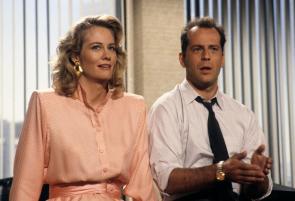 In 1985, Moonlighting began as a show TV viewers seemed to both love and hate. I personally became very fond of this show at the time. Today, it is simply a product of its time period. Let’s explore.
80s TV
After coming out of the 70s, where crime dramas tended to rule the roost, the 80s spawned more lighthearted comedy to balance out those 70s serials. In fact, the 80s spawned a lot of TV shows that are fondly remembered. One of these is the screwball romantic comedy Moonlighting produced by Glenn Gordon Caron.
Moonlighting hearkens back to screwball comedies of the 40s with a straight man (or woman) character Maddie Hayes (Cybill Shepherd) to the cuckoo character David Addison (Bruce Willis). At the time, Willis was an unknown. I’m sure the TV executives weren’t sure he could pull off the role at the time, but once the chemistry between Bruce and Cybill became palpable, all executive misgivings evaporated.
Moonlighting and Chemistry
Like Charlie’s Angels before Moonlighting, this cast was as tight on chemistry as they come. The on-screen chemistry between these two actors was amazing to behold. Unfortunately, what made the show a winner would also see to its demise. The quick and witty repartee between Maddie and David would become deeply symbolic of what went on behind the scenes. After the second season, the apparently deep and constant bickering between the two actors would ultimately end up in tabloids, tarnishing this series irrevocably. However, what ultimately did this series in was its writing, production in-fighting and Cybill’s pregnancy.
Biting off more…
The witty rapid fire repartee of the Moonlighting character dialogue wasn’t without peril. Oh, it was most certainly fun to watch. Apparently, each script required double the amount of written exposition found in a similar series. This meant writing double the amount of pages in a script. Effectively, each episode was two episodes worth of material. Instead of cranking out several episodes rapidly, writers were only able to produce half the number in the same period. Because of the quick witty interrupting repartee, sometimes with Maddie and David talking over one another simultaneously, this would only serve to delay how quickly an episode could be shot.
At the time, it was said that it took upwards of sometimes 10-14 days to complete one episode of Moonlighting when most series with half the dialogue took about 5-7 days.
For both filming and writing reasons, trying to reliably release one episode per week was a chore for the Moonlighting team. This meant that episodes didn’t reliably show up every week. Usually there was a rerun in between new episodes. This also meant you’d never know if the show that week would be a rerun or a new episode until it showed up in TV Guide. This didn’t happen during season one and two because these seasons had many episodes in the can by the time the show aired. However, once the series airings caught up to the currently filmed episode, they never could get ahead again.
For a viewer, this unknown led to a lot of disappointment after finding out that this week’s episode was a three or more weeks old rerun. That’s not to say that those episodes weren’t funny, but they were way too recent to rewatch. This problem stagnated the series and was Moonlighting’s first blemish. More blemishes would show as time progressed. Though, the reruns were helpful if you missed that episode.
First Two Seasons
For the first two seasons of this series, which encompassed a total of 24 episodes (6 in season one and 18 in season two), the series kept its chemistry entirely on track. The writers kept Maddie and David in check and at just the proper distance from one another as Maddie constantly played hard to get. The constant keeping-David-at-arms-length premise kept the sexual tension at just the right level. It’s what kept people coming back week after week to see if Maddie finally gets together with David. Between the magic of the witty repartee and keeping David and Maddie at arm’s length, this was the show’s mojo. However, the witty rapid dialog and sexual tension began to wear a little thin by season three. Viewers wanted to finally see David and Maddie get together. Careful what you wish for.
Season Three
In Season three, when Maddie and David finally hook up in the episode I am curious… Maddie, the series deflates like a balloon. That episode singlehandedly took the wind out of the sails of Moonlighting. Not only did the sexual tension vanish, the constant rumors of the on-set fighting between Cybill and Bruce began appearing in tabloids and only served as a major distraction to the series. This coupled with Cybill’s real life pregnancy and Bruce’s leave to be in Die Hard left the series in a quandary:
- Incorporate the pregnancy into the show or go on without her
- Go on with or without Bruce
This is also where the actor’s real lives intruded into the production of this fine series. This season also marks when the series ran off the rails.
Season Four
At this point in the series, had I been the producer, I might have opted to create episodes with other characters while Cybill takes maternity leave if Bruce had been available. However, because both lead actors were otherwise tied up with outside commitments, the choice should have been to delay any further production of the series. The network apparently didn’t want this which led to a bad decision.
After the series introduced Agnes DiPesto (Allyce Beasley) as more than just a charming rhyming receptionist and brought in Herbert Viola (Curtis Armstrong) as her love interest, the series tried expanding on these two characters in their own episodes while waiting on Bruce and Cybill to be available. This really didn’t work. Beasley and Armstrong had very little on-screen chemistry leaving the episodes flat and boring. Beasley was charming as the rhyming receptionist role, but she wasn’t in any way able to carry the series in an expanded role. Neither could Armstrong. Together, they simply had no chemistry together nor were the characters leading character material. They simply could not carry this series.
By this point, I felt that the series was way offtrack. At the time, I knew it was only a matter of time before Moonlighting was cancelled. Not only was the sexual tension lost, the series began focusing on forgettable side character arcs that didn’t matter. This all happened simply because the two lead actors were unavailable. You can’t run a series when your leads are missing in action. While I understand Cybill’s pregnancy, I can’t understand why the series allowed Bruce Willis to sign a contract to be in Die Hard while the series was still in production. This just makes no sense.
Without its leads, the series should have taken a hiatus. Coupled with the slow shooting schedule, the longer than typical scripts, the show just couldn’t make any headway. If this had had a normal filming schedule, they could have put a few (or many) episodes in the can in advance of both Cybill’s and Bruce’s departure and then had them to fill out the time slots when the actors were unavailable. Because of the size of the scripts, this was impossible. Though, they did get pre-work from Cybill before her maternity leave and before season four began. But, this pre-work was filmed before the full episodes were fully scripted or shot.
By the time Cybill went on leave with her pregnancy and Bruce was tied up with Die Hard, this meant that a lot of season four was created by the actors phoning in their parts. As stated above, Cybill had pre-shot her dialogue scenes separately which had to be worked into as yet uncreated episodes. Because the leads were never seen together in scenes, the series ratings continued to decline. You can’t exactly create sexual tension between two characters when they’re talking to each other over the phone and not in the same room.
The ratings didn’t improve when the series tried focusing on DiPesto and Viola in an attempt to carry the series. In season three, not only had Maddie and David come together and split, the series introduced Sam Crawford (Mark Harmon) as Maddie’s new love interest. By season four, Maddie gets pregnant (assumed to be by Sam, but could have been David), thus integrating her pregnancy (and the unnecessary Sam character) into season four. It was a horrible plot choice, particularly the ambiguity of the father of the baby.
There’s no way faster to lose the hot model image than by knocking up your main character, particularly if by a transient and unnecessary character. This third character also transformed the series from a twosome into a threesome, which also didn’t work. The chemistry between these three did not work at all. This further served to degrade this series into a train wreck about to crash. Not only had Maddie and David gotten together and split forever, Maddie takes on a new boyfriend which is assumed she consummates that relationship with a baby. It was the wrong play. It added a new character dynamic at the wrong time into a series that least needed it. It also implied that Sam, not David, was the father of the baby. As well, having characters phoning in their parts didn’t make the episodes great. It would have been a better choice not to incorporate the pregnancy or Sam at all. The best choice was hiatus.
By halfway through the season, I’d grown tired of seeing stories about DiPesto and Viola and Maddie and Sam. The series was originally about the detective agency and the relationship between Maddie and David. We lost that when the series began focusing stories away from Maddie and David and more on other characters. The magic, at this point, was irreparably lost and the ratings continued to reflect that change in creative direction.
As for Maddie’s baby, just think what would have happened to the Charlie’s Angels ratings had one of the main characters gotten pregnant on Charlie’s Angels? That series would have tanked harder than when Farrah Fawcett left the series. The Charlie’s Angels story is about hot female detectives performing detective work. Not about rearing children or getting knocked up. Same for Moonlighting. Moonlighting was about a hot model owning a detective agency. It’s not about getting knocked up and rearing babies.
By season four, the writers had lost their way with the plots. This was in part because, according to the tabloids, the actors were not only fighting with each other, they were also fighting over what they were being paid. It was also in part because of the lack of their lead actor’s availability to film episodes. It was also in part due to the writers strike. This led to poor story choices and a swirl of tabloid gossip.
Season Five
By this season and after the writers strike concluded, which cut short the final episode of season four, the writers and producers seemed to have realized the error of their ways with Maddie’s pregnancy and penned a season opener that sees Maddie miscarry and lose the baby. It was too little, too late. It was also a bad idea overall. Setting Maddie up to have a baby, see her carry it and then miscarry? This isn’t a topic for a comedy show. This topic on this show misfired. This is a detective show, not a home and family show. The damage was already done.
By season five, the show couldn’t get its mojo back for a number of reasons. The first reason is because of the lack of enthusiasm by the show’s stars. Bruce had further created a successful new franchise in Die Hard. Cybill now had twins and wanted out of the long working hours to be with them. The second reason is that the writing failed to go back to Blue Moon cases with Maddie and David in the office trying to rekindle the sexual tension spark with witty repartee instead of dealing with Maddie’s personal life. This change in show direction was due to Glenn Gordon Caron’s departure. The creative team was gutted. The episode that attempted to reignite the sexual tension spark failed and tanked the ratings further. Ultimately, season three showed it had entirely spent its mojo capital when it got Maddie and David together. Everything after that point couldn’t save the series from cancellation. If season four was the purchase of the coffin, season five nailed it shut.
Aresto Momentum…
Even still, the show did reach two more seasons after David and Maddie got together. That’s respectable, but not necessarily unexpected. Some of the episodes in seasons four and five were okay, if not a little tired. However, the show still had a lot of momentum going into into the fourth season if only the actors had been available to shoot every episode and keep that momentum going. Unfortunately, Moonlighting just couldn’t withstand the turmoil, chaos and the cast unavailability. The series eventually succumbed to its ratings slump and the eventual loss of Glenn Gordon Caron, the series creator by season five due to a rift between Cybill and Glenn. That change in the creative team didn’t help the stories in any way.
The Fourth Wall
By the third season, the shows regularly opened with David and Maddie staring directly at the camera offering some kind of message. Usually the message existed simply because the show ran short on time and they needed to fill it. These messages made no bones about it. These show opening messages would become the first salvo in fourth wall breaking that the series would begin exploring.
Personally, while I didn’t mind the show openers, I didn’t want to see fourth wall breaks within an episode. It is what it is. The show would take this to the extreme in the final episode. The series ending in season 5 shows the crew breaking down the entire set while David and Maddie are still trying to play their detective character roles while the producer states that the show has been cancelled. It was somewhat funny to watch, but it really dissed the show. Sure, it’s fun for shows to poke fun at themselves, but this went way beyond what I thought was appropriate for a professional series.
Everything that went wrong with the series was pretty much summed up in the series closing episode by breaking down that set.
A product of its time
Moonlighting was cute, funny and endearing when at its best. It was a hot mess when at its worst. However, it was also a product of the 80s in which it was spawned. Time has not been kind to this series. Producers today reference this series as something to avoid when creating new productions. They simply don’t want to revisit what happened when Maddie and David finally got together. That single episode is now considered the poster child of what not to do with characters in a TV series.
Because Moonlighting never went into syndication in the traditional way, it simply hasn’t had the power of reruns on its side. I don’t think syndication would have helped this series much, anyway. Unlike I Love Lucy, The Dick Van Dyke Show, Gilligan’s Island and The Brady Bunch, which saw continual and never ending reruns, Moonlighting never got that chance. It’s probably a good thing.
The series was fun to watch during its era, but today the show’s comedy and antics seem antiquated and pretentious. Where I Love Lucy is mostly timeless, Moonlighting is a time capsule out of time when watched today. This show was definitely a product of the 80s with its shoulder pads and dated hair styles and clothing. If you like 80s TV, it’s a must watch. However, if you’re looking for something modern and relevant, you won’t find that in Moonlighting. The stories are definitely dated to its era.
If you really want to watch this series at its absolute best, I suggest watching seasons one and two and season three up to I am curious… Maddie and stop there. The last episode of season 5 is fun to watch if for no other reason than to watch the cast break through the fourth wall. Though, you can watch season four and five, don’t expect much from these two final seasons. Season three is ultimately where the series should have ended.
↩︎


 Random Thoughts - Randocity!
5 comments