I’ve heard that song before!
 There comes a time when listening to new songs that you’ll hear a song and think, “I’ve heard that song before… or at least something very close to it.” You’re not wrong about that. There have been many songs that have either fully or partially ripped off aspects of previous hit songs. Some of these ripoff songs have landed some artists in court battles. Some ripoffs have been created at the blessing and permission of the previous artist. Some ripoffs have yet to be discovered. Let’s explore.
Rock, Pop, Country and even Classical works
No genre has been immune to these rip off works. Note that this author lumps all works whether by permission or not under ripoffs. Why? Because there’s no way to know WHEN the permission was obtained (i.e., before or after the fact). Some songs have only gotten permission when they’re found out. Others artists have attempted to hide the fact that their song is a ripoff of another artist.
A note to artists. When you’re caught at ripping off something from someone else, come clean and admit it. Don’t hide behind bogus arguments trying to gaslight fans and make them think yours was an original work. That’s so degrading, underhanded and disingenuous. Be honest and fess up.
Sampled Music?
This article won’t include artists who have intentionally sampled musical beats or sampled full out original recordings and then included those samples within their own works. This author classes sampled music as a direct form of plagiarism, one that is blatantly obvious to anyone who listens. Such notable sampled songs include, but are not limited to, Vanilla Ice’s Ice Ice Baby (vs Queen), Nicki Minaj’s Anaconda (vs Sir Mixalot) and The Verve’s Bittersweet Symphony (vs Rolling Stones). If you’re planning to sample someone else’s stuff, then you better get permission before you use that sample.
The songs included below are artists who either unintentionally rewrote a song they had heard in the past or intentionally ripped off portions from a past popular song, but rerecorded them again solely to improve the odds of having a radio hit. Sampling is obvious. Rerecording a backing track leaves ambiguous the interpretation of the artist’s ripoff intentions.
List of works?
Let’s get started. Below are some songs that this author is aware of, but these songs are not listed in any particular order.
Heart and Led Zeppelin
 It’s no mistake that Heart started out attempting to play and sound like Led Zeppelin (or at least a more pop-rockish version). However, Heart has ripped off Led Zeppelin on at least one occasion and landed a smash hit on the radio as a result. Unfortunately, Led Zeppelin’s original tune did not fare quite so well on the radio.
Led Zeppelin song: Achilles Last Stand (1976)
Heart Song: Barracuda (1977)
Heart wholesale lifted almost all of the entire backing track from Led Zeppelin’s Achilles Last Stand (from the 1976 album Presence) including drums, bass and guitar riff and placed it directly into Heart’s Barracuda (from the album Little Queen). Heart did at least update the sound quality and sonics to sound more like Heart and less like Led Zeppelin, but the backing track is unmistakable.
Status: Unknown. Since Heart has had some of Led Zeppelin members occasionally tour with them, it is assumed that the remaining members of Led Zeppelin may have given permission to Heart. Either that or Heart may be paying royalties to the Led Zeppelin boys.
The Beatles and The Sylvers
It took a decade for this ripoff to manifest, but here it stands. While the Sylvers song Boogie Fever was a chart topping disco success in 1976, it seems to have been thanks to the Beatles. With an almost identical opening guitar riff, this song’s undertone is unmistakable. While the production sound quality was somewhat better in 1976 when the Sylvers recorded this track when compared to the 1966 track from the Beatles, the near identical lifted guitar work most definitely hearkens back to Day Tripper.
Beatles song: Day Tripper (1966)
Sylvers song: Boogie Fever (1976)
Just have a listen to this one for yourself.
Status: Unknown
The Emotions and Mariah Carey
In 1991, a budding R&B singer, Mariah Carey, burst onto the scene with her chart topping success single Emotions. The odd thing is, this ripoff was hidden in plain sight. With Mariah’s song name being identical (Emotions) to the artist name from which the song was ripped (the Emotions), how could anyone NOT see this one.
Almost the entire backing track and melody including the background chorus was lifted from The Emotion’s Best of My Love to drive Mariah’s 1991 song Emotions.
The Emotions song: Best of My Love (1977)
Mariah Carey song: Emotions (1991)
It was later publicly revealed that the track borrowed from Maurice White’s “Best of My Love“, written for the band The Emotions. This situation led to an out-of-court settlement between both sides.[4]
Status: This one didn’t go unnoticed. In fact, it eventually became known that much of The Emotions’s 1977 song Best of My Love was lifted to craft Mariah’s 1991 Emotions. This act of plagiarism resulted in a lawsuit which was settled out of court for an undisclosed sum of money… which likely means The Emotions band not only got a windfall payment from Mariah, but they likely continue to receive royalties whenever Mariah’s song plays.
The Pointer Sisters and Journey
Even big named established pop rock acts can fall prey to ripping off the works of others. In 1986, Journey was involved in a number of various band personnel issues resulting in band lineup changes, along side Steve Perry’s own personal family medical issues involving his mother’s health. Unfortunately, this band trouble left the writing and recording of a big portion of Journey’s 1986 album Raised on Radio in a quandary.
One song that came out of this difficult recording period is the Journey song entitled Suzanne, with portions of this song sounding very much lifted from The Pointer Sister’s 1982 hit, I’m So Excited.
Pointer Sisters song: I’m So Excited (1982)
Journey song: Suzanne (1986)
The drums and some of the keyboard parts are almost identical. The guitar and Steve Perry’s vocals overlaid don’t sound much like I’m So Excited, but ripping the backing track is still ripping the backing track.
Status: Unknown
The Chiffons and George Harrison
When George Harrison (and the rest) split from the Beatles to go solo, one of George’s first radio hits was 1970’s My Sweet Lord. It later become apparent that much of the sound of this song could be attributed to (or was lifted from) a 1962 hit by the Chiffons entitled He’s So Fine.
The Chiffon’s Song: He’s So Fine (1962)
George Harrison song: My Sweet Lord (1970)
Status: This comparison didn’t go unnoticed. After being noticed, George Harrison attempted to buy out the Chiffon’s catalog from its then record label owner to quash the problem. When that purchase didn’t initially work out, George was found guilty of “subconscious plagiarism” and was fined around $1.5 million. Later, the amount was reduced to around $500k after George was finally able to acquire their music catalog and renegotiate the payment.
Andy Stone (Songwriter) and Mariah Carey
Once again, Mariah Carey is alleged to have ripped off material to produce her 1994 song “All I Want For Christmas Is You”. Mariah Carey collaborated on this song with Walter Afanasieff.
Andy Stone wrote a 1989 song of the same title “All I Want For Christmas Is You”. The melody and lyrics are somewhat different, but the “vibe” of the song is mostly the same as Mariah’s, at least so Andy Stone claims. It is possible that Mariah or Walter had heard this song and decided to collab on something similar for release in 1994, or at least so Andy Stone surmises. There’s really no way to know. Both Walter and Mariah argue the recollection of this song’s origination in a way that doesn’t include having heard Andy Stone’s version. Of course Mariah is going to say that. Why would any artist choose to freely admit to ripping off someone else?
Vince Vance and The Valiants: All I Want For Christmas Is You (1989)
Mariah Carey: All I Want For Christmas Is You (1994)
Status: Lawsuit is still in progress.
Marvin Gaye Estate and Robin Thicke + Pharrell Williams
Speaking of “vibe”, here’s the song that set the vibe precedent. No longer do songs have to have notes, chords and obvious plagiarized sounds, this song (and its court result) now allow lawsuits against artists who lift the overall vibe of a song. This is a slippery slope, but let’s vibe into this one.
Marvin Gaye song: Got To Give It Up (1977)
Robin Thicke and Pharrell Williams song: Blurred Lines (2013)
Status: The estate of Marvin Gaye argued that the vibe contained within Got To Give It Up was wholly reused within Thicke’s Blurred Lines. The court agreed and awarded the estate of Marvin Gaye $7.4 million, which was reduced down to $5.3 million and then reduced again on appeal to $4.9 million plus all future royalties.
This lawsuit and its subsequent court precedent opened the door allowing “vibe” (aka. similar sounding) music cases into court. This case’s court precedent, unfortunately, has opened the door to a whole lot more music plagiarism lawsuits.
Gustav Holst and John Williams
Star Wars was both a big blockbuster experience and a phenomenon. By the time The Empire Strikes Back released into the theaters in 1980, Star Wars had fully solidified itself as a pop phenomenon. The soundtrack music for this film was no exception. In fact, it would be Star Wars that would forever change the “summer blockbuster”, striking each into the stratosphere with each and every classical beat matched to film visual cues.
John Williams not only produced some of the most recognizable themes with Star Wars, these musical themes are so closely matched to each visual film beat, such film soundtracks would become the standard by which composers must comply if they choose to score a summer film blockbuster. Before Star Wars, music was mostly an afterthought for film, something that helped carry the film, but that remained loosely tied when compared to film visual beats. After Star Wars arrived, musical and visual beats became one-in-the-same. Not only do the musical themes need to be instantly recognizable, like Star Wars and Harry Potter, but the scores need to be perfectly married and timed to each scene to maximize that scene’s visual power.
Unfortunately, there’s always a fly in the ointment. The Empire Strikes Back introduced the Imperial March which, unfortunately, seems to have been almost wholesale lifted right from Gustav Holst’s Mars, part of Holst’s The Planets suite of music. When Holst released his symphonic suite in 1918, most audience members were flummoxed. They didn’t understand what they were hearing. Thus, it received mixed to negative reviews. In fact, Holst’s Planets suite was far, far ahead of its time. Listener’s couldn’t understand it because it needed a vehicle like Star Wars visuals to carry it. That wouldn’t happen until 1977.
Once again, nabbing a theme from a past space themed composition seems an almost obvious choice for a science fiction space film. Yet, there are still many who debate this fact. Seriously, you’re going to debate the fact that the John Williams’s Imperial March sounds like Holst’s Mars? It does. There’s no way around it. There is absolutely no debate involving this track.
Gustav Holst song: Mars (1918)
John Williams song: Imperial March (1980)
Status: Holst’s Planets Suite of music is now in the public domain in the United States (and most other countries) because it was published before January 1, 1928. Still, that doesn’t make ripping material from other artists “acceptable.” Plagiarism is still plagiarism.
Spirit and Led Zeppelin
One of the most iconic and popular rock songs to emerge from the early 1970s was Stairway to Heaven by Led Zeppelin. This song inspired many guitarists. In this Led Zeppelin song, the opening acoustic guitar riff and vocal ballad slowly gave rise to a rocking powerhouse of an ending in true Led Zeppelin form.
In 1968, a band named Spirit released a track entitled Taurus. This instrumental track opens to what sounds like violins followed by an acoustic guitar riff with an uncanny sameness to the riff that opens Stairway to Heaven. Unfortunately, the song Taurus never progresses beyond that mellow acoustic, almost symphonic track. Taurus also sports no vocals. Unlike Led Zeppelin’s multipart track which begins as an acoustic ballad and slowly progresses into a heavy rocking anthem complete with vocals, drums and lyrics, Taurus as a song doesn’t take on this extended structure.
Spirit song: Taurus (1968)
Led Zeppelin song: Stairway to Heaven (1971)
Status: While the estate of the late Randy Wolfe of Spirit claimed that Stairway to Heaven was ripped from Taurus, apparently the estate found that claim difficult to prove. Led Zeppelin won the case on appeal and the court found that Stairway to Heaven did not infringe on Taurus. The estate’s appeal to the Supreme Court was denied.
However, a discerning ear can definitely tell that the acoustic riff played in Taurus to be almost identical in structure to the riff played in the opening of Led Zeppelin’s Stairway to Heaven almost note for note. Either the court has a tone deaf ear or they intentionally chose to side with Led Zeppelin for some odd reason. Additionally, it is widely known that Led Zeppelin drew near plagiaristic inspiration from many rock and blues artists from the 50s, 60s and even from those directly around them to craft many of Led Zeppelin’s hits.
To compound matters over this situation, Led Zeppelin even opened shows for Spirit on Spirit’s 1968 tour, which would have allowed Led Zeppelin to see and hear how Spirit performed Taurus. The acoustic riff between these two songs being so uncannily similar and when combined with Led Zeppelin touring with Spirit, this being a coincidence is far too improbable. With that said, the fact that Led Zeppelin took Stairway to Heaven so far beyond where Taurus went musically is likely what confused the court. Still, a riff is a riff and plagiarism is plagiarism no matter how much or for how long it was used in a song.
Alexander Cardinale + Morgan Reid and Jake Owen
As stated earlier, even Country hits are not immune to plagiarism. In 2020, Jake Owen released his song Made for You, which became a hit country song on Billboard’s country charts in 2020.
Alexander Cardinale song: Made for You (2014)
Jake Owen song: Made for You (2020)
TMZ reports that songwriters Alexander Cardinale and Morgan Reid have filed suit in Nashville, alleging that Owen’s No. 1 hit “Made for You” lifted significant portions of its structure and lyrics from their song of the same name, which dates back to 2014.
Source: Taste of Country
Once again we see that the 2014 songwriters of their earlier release Made for You claim that Jake Owen ripped off significant portions of their 2014 song to drive his 2020 release, also entitled Made for You. The duo from the 2014 song are seeking a court trial.
Status: Unknown
References
- The Biggest Music Copyright Cases in History
- Mariah Carey sued for copyright infringement over All I Want for Christmas Is You
- Wikipedia for Mariah Carey Emotions
- Songs on Trial: 12 Landmark Music Copyright Cases
- Country Star Jake Owen Sued This Legal Mess is ‘Made For You’ !!!
This article is by no means a complete list. This is just a sampling of the most visible of many of these ripped off songs. Unfortunately, now with the “vibe” precedent firmly allowed in courts, many more lawsuits will commence claiming “vibe” theft. That “vibe” ideology is that a song “feels”, but does not necessarily sound or rip off notes or ideas from a previous song. Claimants simply need to show enough proof that “vibe” was a factor.
Allowing the “vibe” idea as a defense is now a big legal risk for the music business. Any Tom, Dick or Harry can claim their insignificant little track written 5 years ago and was barely even heard, but is now being infringed by a big name star who never even heard the track. There are only so many notes on the musical scale (12 major notes to be exact, with 5 more sharp/flat notes) and only so many ways to arrange all of these. Eventually, even coincidentally, it’s far too easy to arrange those limited numbers of notes in a similar fashion without even having heard anything prior. But, there are definitely unscrupulous and greedy people willing to capitalize on and at the expense of the the hard work of others.
↩︎
Facebook Puzzle: 6÷2(1+2)
Many puzzles that pop up on many social media networks are math problems. One of these older math “problems” is 6 ÷ 2(1 + 2). Let’s explore the difficulties and controversies surrounding this math problem.
PEMDAS, BODMAS, BIDMAS & BEDMAS
These are all acronyms for more or less the same ideology. This ideology is intended to help students solve math problems logically. Unfortunately, PEMDAS and its similar ilk all have problems when it comes to certain advanced mathematical constructs… constructs that are, in fact, intentionally ignored in PEMDAS for the sake of simplicity.
PEMDAS stands for Parenthesis, Exponents, Multiplication and Division, Addition and Subtraction. BODMAS, BIDMAS and BEDMAS all utilize this same ideology, using alternative words to describe these approaches to logical math problem solving. Interestingly enough, BODMAS, BIDMAS and BEDMAS all seem to place division before multiplication, unlike PEMDAS. However, multiplication and division, at least according these problem solving helpers are supposed to be equal and performed strictly in order from left to right. In effect, the ‘DM’ order in BODMAS (and similar) or ‘MD’ order in PEMDAS make no real difference because the math problem itself dictates the order in which to solve the problem, left to right. In other words, the order takes precedence, so the ‘DM’ or ‘MD’ order listed in these helpers don’t matter.
Why PEMDAS or similar?
The PEMDAS and similar helpers were created to help grade school students solve basic math problems. This would include simple math problems like 10 ÷ (5 – 3) or (5 + 2 – 1) x 2. For those unfamiliar, the ⇝ symbol should be read as “which leads to.”
For the first problem 10 ÷ (5 – 3) that would be solved by the helpers with the following:
Parentheses first: (5 – 3) = 2 ⇝ 10 ÷ (2)
Next drop the parentheses, then solve for MD/DM: 10 ÷ 2 = 5
Answer: 5
For the second problem (5 + 2 – 1) x 2
Parentheses solved first with + and – solved inside parens l-to-r: (5 + 2 – 1) = (6)
Drop parens, multiply 6 x 2 = 12
Answer: 12
These above are simple math problems that don’t involve one key concept included in the somewhat more advanced math problem 6 ÷ 2(1 + 2). The key math concept included is …
Multiplication by Juxtaposition (aka Implied Multiplication)
Multiplication by Juxtaposition adds a level of complexity that PEMDAS and BODMAS can’t always resolve. Let’s understand why.
Multiplication by juxtaposition is a concept that gets introduced during a student’s first Algebra class. Prior to taking algebra, the concept of implied multiplication isn’t involved. PEMDAS wasn’t designed to adequately support this advanced math concept. PEMDAS, thusly, isn’t the whole truth. PEMDAS is a ruleset that works for many math problems, but not for ALL math problems. This is why PEMDAS trips up many people when attempting to use it on problems like 6 ÷ 2(1 + 2).
Before getting into this specific math problem, let’s understand a few more implied multiplication examples. An implied multiplication example is 



The point here is not to get deep in the weeds of algebra, but instead to understand the intricacies of multiplication by juxtaposition when used in combination with PEMDAS. Juxtaposition is illustrated in problem like 
Juxtaposition is a method of writing equations without the need to include the * or x symbols which explicitly state multiplication. When choosing to use juxtaposition instead of explicit symbols, this is what is called using a “style guide” for mathematical equations.
Like map legends are used to describe such information as color coding and distances on maps, style guides in mathematics describe the proper order that an equation needs to solved. Why is a style guide important? Because of the ambiguities and disparities between PEMDAS and writing equations using these shorthand methods, such as juxtaposition.
Juxtaposition is intended to help simplify the printing of equations in printed texts as well as reduce the clutter when building such complex equations. When complex equations are written, then, a style guide reference discussing precedence, levels and order of operation is imperative. Without this information printed alongside a text book, this would leave the reader in the dark, forcing the reader to utilize their own knowledge to attempt to solve the written problem.
This is exactly the problem with the Facebook problem in 6 ÷ 2(1 + 2). Because no style guide is offered, this math problem has two valid solutions; solutions that depend on which style guide you are familiar. If you subscribe to only the PEMDAS helper style guide, the answer is 9. If you subscribe to the vast majority of scientific and technical literature style guides used by STEM professionals, the answer is 1.
Let’s understand why
6 ÷ 2(1 + 2) can be written in effectively two different ways depending on which style guide you choose. The PEMDAS style guide implies the following style should be applied:
6 ÷ 2 * (1 + 2), alternatively written as 
Mathematical professional style guides would apply the following:
6 / (2 * (1 + 2)) (adding another set of parentheses for clarification)
Let’s understand these styling differences.
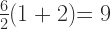
Under PEMDAS styling, the equation is understood as:
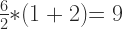
Using scientific and engineering style guide rules, the equation is understood as:

These two equations are markedly different both in their appearance, but also in how they are solved. Under PEMDAS styling, the answer is clearly 9. Under scientific styling the answer is obviously 1.
The question is, why are there two different style guides here?
Two Style Guides?
PEMDAS (et al) is a rudimentary style guide intended to teach grade school children mathematic basics. PEMDAS is not intended to carry the child’s mathematical knowledge all the way through their life. Think of PEMDAS like a set of training wheels on your bike. The training wheels keep you upright to get the hang of balancing on your bike. Once you’ve mastered the art of balancing, the training wheels are removed.
PEMDAS is simply a set of training wheels that eventually need to be removed.
To be perfectly fair, PEMDAS should really be written as 

This updated 4 component notation means MD are at the same level and equal priority, but evaluated in order left to right. AS follows the same logic as MD, but only after MD have been resolved.
The difficulty with PEMDAS is that it was designed to be used by students NOT working with either multiplication by juxtaposition (implied multiplication — an algebra concept) or by using a slash (/) in place of the division (÷) symbol (also an algebra concept). PEMDAS expects the primary four simple operators to be explicitly used: + – ÷ x. PEMDAS breaks down when advanced operators are used because PEMDAS has no proper solution when these advanced mathematical concepts are included.
The reason for these existence of these two style guides goes back to the history of order of operations, long before even PEMDAS was coined. Most engineering and mathematics texts define that multiplication by juxtaposition is to be handled BEFORE division. In PEMDAS terms, that means the acronym becomes 
instead of the PEMDAS understanding as
What does the division symbol ÷ mean exactly?
If you look at the ÷ symbol, it has a dot on the top and a dot on the bottom. As an abstract visual, it means “divide by”. As a literal symbol, it means move the left argument to the numerator and the right argument to the denominator. This turns 6 ÷ 2 into 

The ÷ symbol also has a sibling, the forward slash (/). This slash symbol can be used as a drop-in replacement for the ÷ symbol. When a slash is used, this then represents the two numbers as a sort of sideways or horizontal fraction, like 6/2. In STEM professional circles, both the ÷ and the x symbols are exchanged for alternatives when writing equations. Think of these changes as mature upgrades to mathematics. As we grow and learn, we adopt shortcuts which make life easier. In mathematics, juxtaposition and slash are two mature “shortcuts” in the way that equations get written. Instead of writing an equation as 6 ÷ 2(1+2), it would be written as 6/2(1+2) or if using TeX, it would appear more formally as 
Why are there TWO answers?
Good question. One that needs all of the above understanding to address. Style guides vary. The PEMDAS style guide given to early grade school students is intended to be used as a loose style guide only. Meaning, given our rudimentary understanding of mathematics at the time, PEMDAS is a helper tool that “guides” us in the right direction. PEMDAS isn’t an end-all be-all idea. It is simply a helper tool. If mathematical equations ended at the type given to us in grade school, PEMDAS is all that we would ever need.
However, moving into Algebra and higher mathematics like Trigonometry and Calculus, mathematical nomenclature must become more refined and mature… and so it does. In that goal, what PEMDAS taught us was basics. What we learn in advanced mathematics classes overrides what we learned with the basic PEMDAS logic.
Because math style guides acknowledge that there are more priority levels than the simple PEMDAS understands, our knowledge of PEMDAS must expand into that bigger understanding of more priority levels. We must take off the PEMDAS training wheels and let go of the past. We must acknowledge that there is more to mathematics than PEMDAS.
PEJMDAS is a good first step, but it doesn’t explain everything. For example, why does PEMDAS view the equation 6 ÷ 2(1+2) as 
The answer to this is really pretty simple. PEMDAS places ALL multiplication at the same level and priority as under the M. Because PEMDAS isn’t really aware of juxtaposition rules, it mistakenly moves even juxtaposed multiplication under M. PEMDAS then mistakenly turns the equation into
The problem is that PEMDAS is taught at a time in school when juxtaposed multiplication isn’t even a concept in mathematics. As a result of juxtapositioning not being understood at that moment in a student’s mathematical learning, the student would then assume, based on PEMDAS, that ALL multiplication must roll up under that M… that’s assuming the student even understands or had been previously explained about implied multiplication. Most students learning early mathematics would likely have to ask what 6 ÷ 2(1 + 2) means. More specifically, why is a 2 sitting directly next to the (1 + 2) parentheses without an operator symbol and also what it means in this equation? This is where juxtaposition multiplication would have to be explained to the student.
In reality, in many advanced academic mathematical style guides, something that a grade school student would not be aware of, these documents state that multiplication by juxtaposition must be calculated BEFORE division. With this academic rule in place, that changes 6 ÷ 2(1 + 2) into the more widely understood and accepted
Why is there even a question here?
Many insist that 9 is the correct answer. Yet, just as many insist that 1 is the correct answer. The disparity between these two camps comes because of one simple disagreement in math priority; a math priority that is defined by many academic and professional texts. Even many calculators have adopted this math priority rule as genuine and valid. The disparity whether multiplication by juxtaposition happens BEFORE division or whether it happens only when all general multiplication occurs in an equation is what gives rise to this equation’s dilemma.
When equations are not written in a left to right format, such as in
Why? Because many academic style guides adopt the rule that when using a slash (/) to describe division in an equation, equations like 6 / 2(1 + 2) become the same as
For example, 6 / 2 * (1 + 2) translates into 
Standards in Mathematics
What this article all boils down to is a failure to create a common ruleset of standards that everyone across all mathematical areas agree to. Thankfully, all areas of STEM professions agree by including style guide information when applicable. These style guide rules prevents confusion and misinterpretation on how to read and solve equations in a professional setting, such as in engineering, architecture and other critical areas.
What 6 ÷ 2(1+2) uncovers is the lack of generally agreed upon standards outside of professional environments. Grade school teachers and students believe that 9 is the correct answer because they’ve never been taught and have never used the style guides used by STEM professionals. On the flip side, STEM professionals don’t use PEMDAS as their leading style guide ever in their professional careers. Instead, because academia has defined specific priorities and rules regarding multiplication by juxtaposition, rules which many calculator manufacturers have adopted, this Facebook math problem only serves to uncover who was taught what.
Someone probably realized the disparity between the guide a STEM professional uses and the PEMDAS (et al) style guide(s) grade school teachers use. Then, this person decided to exploit this situation by creating this equation dilemma as a joke.
In reality, this equation only serves to show us all that consistent standards don’t exist even in mathematical circles. More than this, it shows that grade school math alone isn’t enough understand that there are two answers to this equation, with both answers being completely correct. In other words, this equation intentionally serves to disclose who follows PEMDAS and who follows more advanced mathematical style guides.
Calculator Dilemma
Some calculator manufacturers support PEMDAS, but many more support PEJMDAS as described above. As a result, unless you explicitly read the calculator user manual before you buy it, you may not understand why your calculator seems to be giving you the wrong results. In reality, it’s not giving you the wrong results. It’s giving you those results because of the disparity between the two differing style guides in use within different mathematical circles.
What does this all mean?
It means that there is no consistent teaching of the order of operations rules across all math classes across the globe. Because there are effectively two camps of people who were taught different orders of operation at differing priorities, your best bet is to write unambiguous math problems; problems that can’t have two potential answers. To do this, you’ll need to be aware of the above disparity in how order of operation is taught in mathematics in differing locations and under various instructors. Until you acknowledge that there is inconsistency in this area of mathematics, you can’t work around this problem.
The way to avoid such ambiguous problems as 6 ÷ 2(1 + 2), you can either write the problem more specifically like
If you are one of those stubborn folks who believes that there is and can only ever be once correct answer. Sorry to pop your bubble, but in this reality, there are technically two answers based entirely upon which style guide you adopt and/or which teacher taught you mathematics.
Are you a student?
A small disclaimer here for students. If you’re a student still in school reading this, know that there are two answers…. but also know that you need to follow your teacher’s lead. If your teacher is teaching you the “answer is 9” approach, always follow your teacher’s lead. The same goes for teachers who adopt “the answer is 1”. You want to get the best marks and that means catering to your math teacher’s approach. Know that there are two approaches that can work here, but don’t use the counter approach with your teacher unless you enjoy fighting with your teacher over your marks. As a general rule of thumb AND to make your school life a whole lot easier, always cater to your teacher’s wants, requests and whims to get the best marks and make them happy… even if you recognize those whims to be stupid.
As a student, be comfortable in your knowledge that you have recognized there are sometimes multiple ways of doing things. Know that there is absolutely nothing wrong in recognizing and booking this alternative knowledge. However, there is also no reason to fight with your instructors over knowing this information when it’s absolutely not necessary to get good marks in your class. Yes, you can be smart and know something your teacher may not. It’s also not necessary to pick a fight with your teacher over that knowledge. You never know how a teacher may respond when presented with information that’s contrary their lesson plans. You may find that many respond adversarially. It’s simpler to avoid this adversarial problem and go along with the lessons as written.
This is the trick to getting through school unscathed while also acknowledging the downsides and limitations of school curriculum. If you’re really interested in the above topic, wait until you’re in college to write and publish a paper on this very topic. Doing it this way, you can get college credit for disclosing such problems in your paper, but you can also get good grades from your teachers at the same time without being adversarial involving their teachings. Just make sure to write it for your English writing class and not as a paper for your math instructor, who might end up taking the paper far too personally or as an insult. It’s never a good idea to insult instructors, even if it’s through a well written, well researched paper.
Recap
To recap this article, the two answers for 6 ÷ 2(1 + 2) are 1 AND 9 respectively depending on which style guide you choose to adopt. Both style guides are entirely valid. Like map legends define what a map is telling you, a math style guide tells you how to solve any specific math problem.
If you are a student taking a mathematics class, only use the style guide your teacher permits. If you follow their style guide, you will always solve problems they give you with the correct answer. As for calculators, make sure the calculator you choose to buy also follows your instructor’s style guide. That means reading the calculator manual and, if possible testing the calculator. If the calculator doesn’t work as expected, return it for one that follows your teacher’s style guide.
↩︎


 Random Thoughts - Randocity!
leave a comment