Is Canola Oil Safe?
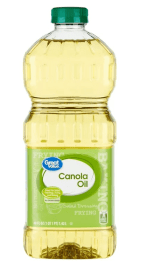 This question has been asked many times and in this article, we’ll seek to discover the unique qualities of this oil; an oil which is now quite frequently used in cooking and prepackaged products. We’ll also examine if this oil has any potentially unsafe aspects. Let’s explore.
Rapeseed Oil vs Canola Oil
Both Rapeseed and Canola Oils are derived from the same flowering plant; the Rapeseed plant. It is a yellow flowering plant that is became commonly planted in Canada, where Canola oil was discovered. Hence, the contraction of the two smaller wordlets “Can” for Canada and “ola” for oil.
From Wikipedia:
Rapeseed, also known as rapeseed oil, is a bright-yellow flowering member of the family Brassicaceae, cultivated mainly for its oil-rich seed, which naturally contains appreciable amounts of erucic acid.
Source: Wikipedia
 “What exactly is erucic acid”, you ask? Good question. According to Wikipedia, “Erucic acid is a monounsaturated omega-9 fatty acid.”
Among scholars and researchers, the debate rages whether erucic acid is toxic to humans. According to the FDA, the amounts of erucic acid in Canola oil have been sufficiently reduced to be labeled as GRAS (generally recognized as safe). Does that mean erucic acid is safe for human consumption? As stated above, the debate still rages.
For example, from Wikipedia’s erucic acid page:
Studies done on laboratory animals in the early 1970s show that erucic acid appears to have toxic effects on the heart at high enough doses. However, more recent research has cast doubt on the relevance of rat studies to the human health of erucic acid. Rats are unusual in their inability to process erucic acid, and the symptoms in rats caused by a diet with high levels of erucic acid have not been observed in pigs, primates, or any other animals. An association between the consumption of rapeseed oil and increased myocardial lipidosis, or heart disease, has not been established for humans. While there are reports of toxicity from long-term use of Lorenzo’s oil (which contains erucic acid and other ingredients), there are no reports of harm to people from dietary consumption of erucic acid.
Breaking the above down, there have apparently been multiple studies going as far back as the 1970s. However, apparently more recent studies have concluded that erucic acid may or may not be toxic to humans in the same way it has been shown to be toxic in rats. This is allegedly supported by the fact that pigs, primates and “any other animals” (left undefined in this Wikipedia article [and study?]) have not been associated with the same effects as those observed in rats.
Clinical Studies
The above clearly opens more cans of worms than it closes. Studies that conflict with one another generally mean something is up with one or more of the studies. What this generally means is that either the test conditions were not the same and/or the testing protocol was substantially altered between one study and the next. Studies, like many things in life, are created, implemented and, most importantly, paid for by humans with an agenda.
Many of these erucic acid studies are actually produced by money-making food producers with a vested interest in ensuring their products remain viable, saleable commodities in the marketplace. How that typically manifests in clinical studies is by performing clinical tests with extremely narrow constraints so as to eliminate potential conflicting data from surfacing during the testing protocol.
Specifically, new studies have learned from the older more broad studies, which the newer studies then typically exclude testing for factors that would conclude negative outcomes. In other words, it’s not what they’re saying to you about their test conclusions, it’s what they hide from you about the operation of that clinical test outcome. Excluding negative testing outcomes from the testing method only serves to mislead the public.
This hiding of information is tantamount to lying. Testing methods shouldn’t be so narrow focused that they allow consumers (and researchers) to jump to the wrong conclusions about the test results. Yet, that’s the state of clinical testing being performed today. It’s not about performing clinical tests that produce broad results, but about producing clinical tests that produce very specific, very narrow, but very beneficial test results to the benefactor. In other words, the buyer of the clinical test can game the test results in their favor.
Levels of Erucic Acid in Rapeseed vs Canola Oil
In life, all things in moderation. Generally, most consumables don’t kill you… at least not instantly. For example, minuscule amounts of lead and arsenic exist in our food supply. These very tiny amounts aren’t short-term toxic to humans. Thus, this is why the FDA can label foods with these tiny amounts as GRAS. The same likely holds true for erucic acid. In large quantities, erucic acid likely does become toxic to humans, in the same way as ingesting large quantities of arsenic and lead can.
The rapeseed plant contains between 20 to 54% erucic acid. This means that crushing the seeds and extruding the oil directly from the rapeseed plant will produce an oil that contains between 20% to at least 50% erucic acid.
Newer studies attempt to refute the earlier 1970s studies, which generally found that the levels of erucic acid in rapeseed oil was toxic to humans… extrapolated from their rat testing. The newer studies now believe, apparently, that erucic acid in the percentages found in rapeseed oil are not apparently toxic to humans, because it was not found to be toxic to pigs, primates or “other animals” (whatever those are) even though rats exhibit a different, apparently more toxic outcome.
Let me just say that erucic acid is an acid. Acids in larger quantities are generally not great for the human body when consumed. If you want to know erucic acid’s chemical formula or other sciency details, feel free to head on over to Wikipedia to check it out.
The Business of Science
Consumer products are a business; a very lucrative business to be specific. When that business falls into consumables such as foods, supplements and drugs, the United States government gets involved. Such oversight involvement includes agencies like the FDA (Food and Drug Administration), USDA (United States Department of Agriculture) and even such agencies as the CDC (Center for Disease Control). Each of these departments defines protocols for handling certain aspects of how businesses may operate safely with regards to human consumables within the United States.
The FDA, for example, defines specific requirements for food and drug producers when introducing new products to market. Many of these requirements include clinical testing and clinical trials. These clinical studies determine potentially ill effects as well as positive benefits from a food or drug consumption. The requirements of using clinical studies opens up a new business; the business of science.
You might be thinking, “Aren’t such narrow studies which choose to hide important details a form of gaming the system?” You’re not wrong. The problem is, as long as a study is performed in a technically complete way using proper scientific methods, the FDA must accept it as a genuine study. The FDA doesn’t determine if the study was gamed or if the person(s) paying for the study biased the study in a way that misled the FDA (and ultimately consumers).
It gets worse. If multiple studies are needed and each are gamed in the same way, this situation makes it even more difficult for the FDA to claim a problem. In other words, the FDA must accept all studies presented as genuine and valid so long as the studies employ proper protocols, including reaching conclusions… even when those conclusion are intended to mislead or are, indeed, invalid.
Yes, the FDA’s system can and has been gamed. We’ll need to understand how and why it happens. When millions, if not potentially billions of dollars are on the line, gaming the science is the least of that business’s worries. In other words, if a business doesn’t choose to game the science, their product might not ever be sold.
I can hear all of those who work in the scientific testing professions groaning now over “conspiracy theories” in these statements. To those people I say, look around more closely. Are you really that naïve and idealistic? While there are some businesses who actually intend to hold onto business ethics, there are many businesses that absolutely do not and will not. Even for those (plausibly deniable?) naïve CEOs of businesses that claim they are ethical, it only takes one bad actor in the management ranks to ruin all of that. Anyone who truly believes a CEO’s purported “rogue manager theory” did all the scummy business work alone is deluded. The orders for this kind of bad business comes from the top, but this scheme is simply a way to afford the CEO plausible deniability. Swallowing this plausible deniability junk from a CEO is stupid, actually. Who truly believes that any CEO doesn’t know exactly what their underlings are doing? If he or she doesn’t, then he or she shouldn’t be and isn’t a CEO.
Unfortunately, as businesses (or, more specifically, CEOs) put more pressure on managers to produce, managers find ways to cut corners to get things done quicker and faster. That can mean gaming systems to get past certain hurdles to complete processes faster and, more importantly, successfully. Thus, business ethics are entirely at the whim of various managers within an organization. If the pressures of getting something done fast and successfully outweighs the business ethics of the actual situation, then out the window go ethics. No employee wants to be the one to put their job on the line because they were the person who upheld business ethics, choosing to do something in the ‘right way’. When such an employee is slow in producing results, a CEO hears all about it.
In the science world, that likely means gaming a study (or set of studies) to get it (them) done faster and with the intended results. Instead of studying all aspects of a specific food product’s features and safety, the science might be geared to look at only a very tiny part of it. From here, it gets worse. Because study producers are PAID by businesses holding a conflict of interest, studies are likely to be rarely free of tampering and bias in the client’s favor. What service organization taking money for services rendered intentionally chooses to upset a buyer? That’s not good for a business reputation. This is the business of “buying” science.
Theranos as an Example
While Theranos’s tiny blood vial testing idea might seem like an outlier for medical business ethics, the reality is that Theranos simply got caught at it. Many other unethical businesses never get caught, primarily because they pay politicians (to hide their tracks well) to keep from getting caught. Theranos’s execs simply failed to understand the game they were playing; a game that led to their demise.
The one place where Theranos was exonerated was against the patients who had their lives put at risk by Theranos’s unethical and unsafe testing practices. The court said no on that charge, but instead caught Theranos’s executives in a web of fraud against investors. Oh no, mustn’t hold Theranos accountable to patient safety, but by all means let’s pay the investors back. America’s priorities are entirely screwed up. Again, money.
Money vs Safety
And that’s exactly where we are today. The food and drug area of business in the United States is all about making money at the expense of human safety. That’s clear. Watch any of the TV advertisements for any drug. You’ll notice somewhere in the middle of the advertisement, the announcer will list off a litany of dangerous side effects, many including death.
The same goes for foods and supplements. Because the supplement industry is entirely unregulated, anything can be placed into these supplements. There’s no efficacy or safety studies required at all for these products, yet more and more so-called MD doctors are advocating and even advertising for such supplements. Again, money.
As for food stuffs, they fall under the same pitfalls as drugs, but it all unfolds in a different way. For example, if a food contains only sugar alcohols, it can be claimed to be sugar free. That sugar free label is the way the game is played. Even though a sugar alcohol is still a type of sugar and is acted on the body as though it were sugar AND because the product does not specifically contain sucrose, the product, according to the FDA, can be labeled as sugar free. The FDA essentially doesn’t class sugar alcohols as “sugar”. THIS RIGHT HERE is the game.
Because the FDA allows for and endorses deceptive labeling, it allows food producers to play games with their ingredient labels, allowing them to place such deceptive labels that make their foods appear to be more healthy than they actually are.
There are many, many such labeling games available to food producers. Some of these labeling games make it seem like the food product is “organic” or “sugar free” or “healthy”, when in fact the product is none of those things, making the situation quite the opposite.
Why does this game exist? Again, money. Food producers stand to lose millions, if not billions, if these ambiguous labeling games were to become honest instead of snake oil. If the government were truly looking out for public’s safety, these labeling ambiguity games wouldn’t exist for manufacturers to play against consumers. Yet, they do exist… and here we are.
Is Canola Oil Safe?
Because conflicting studies exist, some of those studies conclude that one of Canola Oil’s ingredients, erucic acid, isn’t safe for human consumption. The conflicting studies choose to claim that because negative reactions have occurred only in rats and not in pigs, primates and “other animals”, that erucic acid should be safe for human consumption.
Of course, that conclusion is a leap. If limited human testing has been performed, then the studies are all best guess. Humans are not pigs, not apes, not “other animals” and definitely not rats. Studies tested on animals may suggest the possibility that a causal link exists, but there’s no definitive way to know until or unless adequate testing has been conducted on humans.
Though, testing has been conducted on humans, but not in a study. Because the FDA has granted GRAS status to Canola oil based on these conflicting studies, that means that we consumers of this oil are now a live, real world rats for a study. Unfortunately, because we’re consuming Canola oil without proper or adequate human studies, there’s no way to know how much, if any, erucic acid is safe for human consumption. Again, the previous animal studies only suggest that erucic acid MAY be safe for humans… potentially based on false logic.
For more answers on this topic, we’ll need to reach out to our friends in Australia to read a monograph on this subject:
Rats were fed rapeseed oils at up to 70% of the calorie content of their diet. The rats were reported to have developed myocarditis.
[…]
It has been suggested that the rat is not an appropriate model for determining whether erucic acid may pose a risk to human health (Corner 1983). A number of reasons have been put forward for this. Firstly, most of the rat studies involve feeding oils at a concentration of around 20% or more by weight in the diet. A level of 20% approximates human lipid consumption. It has been suggested that rats are physiologically incapable of metabolising such concentrations of oil in the diet (Grice and Heggtveit 1983).
But, then the monograph makes this assertion:
The toxicity of erucic acid is virtually always considered in the context of the toxicity of rapeseed and mustard seed oils, which can contain high levels of erucic acid. Most humans would be exposed to erucic acid by the inclusion of these oils in the diet.
What this states is that erucic acid is not a natural component of pretty much any other food in the human diet. Meaning, consuming Canola oil is the sole way to actually consume erucic acid. As a result, humans wouldn’t consume erucic acid in any way other than via consuming Canola oil. But, the monograph also goes on to make this sort-of disclaimer:
This, however, can complicate the interpretation of the study results, making it difficult to ascertain whether the observed effects are directly attributable to erucic acid, or to some other component (or combination of components) in the oil.
No, actually what this disclaimer is truly attempting to say, but doesn’t outright say, is that because the oil is consumed with many other foods at the same time as the oil, there’s no way to know what food may have caused any issue in any specific human. In other words, there’s no way to nail down that any specific malady is associated with the consumption of erucic acid.
It’s a standard disclaimer argument made by “scientific” people and more specifically, by businesses when they need to sell their product to consumers. Basically they use weak logic, “Our product is safe because even if you do choose to consume it, there’s no way to ascertain if our product actually caused your malady.” Why is that? Well duh… because it hasn’t been adequately tested on humans using similarly detailed studies applied to rats and other animals.
With that said, of the human testing that has been done, the monograph does state this:
In humans, the digestibility of erucic acid containing oils is 99% (Deuel et al 1949, Vaisey et al 1973). In the adult female rat, however, the digestibility of HEAR oil is only 77% (Deuel et al 1948).
Okay. Human digestion of oil containing erucic acid is 99%, way more than the 77% digestion in rats. That could be an overall bad thing. It would mean digesting more of this oil, faster. Digesting more of the Canola oil means that more erucic acid is now available for potential damage. BTW, the HEAR oil acronym means high erucic acid rapeseed oil. Canola oil is considered low erucic acid rapeseed or LEAR oil.
Canola oil should contain around 2% erucic acid by volume compared to rapeseed oil which contains 30-60% erucic acid by volume. Let’s keep going.
The paper goes on to state:
Erucic acid is poorly oxidised by the mitochondrial β–oxidation system (reviewed in Sauer and Kramer 1980).
[…]
In humans, it has been shown that isolated heart mitochondria metabolise erucic acid more slowly than oleic acid (Clouet et al 1974), confirming that rates of erucic acid oxidation are decreased in humans, similar to experimental animals.
[…]
In [the] liver, the presence of erucic acid appears to induce the peroxisomal β-oxidation system (Lazarow 1994).
What this portion is saying is that because erucic acid is poorly oxidised in some human tissues, particularly in the heart, the erucic acid can hang around longer and potentially cause more damage. Oxidation from tissues means that there are processes to break down and eliminate the component from the human body faster, such as this speed being faster in the liver than in heart tissues, according to this monograph.
The paper concludes, after a lot of discussion around rats, pigs and monkey research, which you can read for yourself, with the following statement:
The heart appears to be the principal target organ for toxic effects following short-term
exposure to edible oils containing erucic acid. The most common observed effect, among
rats, pigs and monkeys, is myocardial lipidosis.
Myocardial lipidosis is a condition where fats accumulate in the heart reducing the force by which the heart can contract… or, in essence, it weakens the heart muscle’s ability to pump blood through the system. Oils containing erucic acid, then, stick around longer in the heart muscle. How long it remains in the heart is a question unanswered by this paper. Some studies do suggest that it does oxidize over time and will eventually work its way back out of the heart. The question is, how long will that take
Is that weeks? Months? Years? Better testing would need to be done.
Fast and Junk Foods
Easy and quick bagged and boxed meals, such as potato chips or mac-and-cheese may contain small traces of Canola oil. Food manufacturers can and do use Canola oils as part of producing bagged, frozen and boxed meals and other grocery store foods.
For these types of prepackaged foods, you’ll need to read the label closely. Most labels are required to list Canola oil as an ingredient. However, because most potato chips today are manufactured with varying oils including soybean, corn, peanut, palm kernel or canola oils, you won’t know which oil was used when the bag or box says “vegetable oil with one of the following:”. Because manufacturers leave the door open to using multiple oils to craft such foods, you don’t know if Canola oil is in the bag.
If you’re buying a bottle labeled as “Vegetable Oil”, you should read the ingredients to find out what it contains. It’s most likely to be soybean oil, but it could be a mix of various oils including corn, soybean and/or canola.
The point is, when you see “vegetable oil” on any package label, you should avoid buying that product if you don’t want to potentially consume Canola oil.
Is Canola Oil Genetically Modified?
One final aspect which hasn’t been discussed as yet, besides the erucic acid potential toxicity, is that Canola oil also exists as a genetically modified organism (GMO) to be herbicide resistant and bug unfriendly. This allows for bigger crop yields and, of course, higher amounts of money when sold.
There is also another GMO aspect, but is used in limited manufacturing use cases. There is also a high laurate genetically modified rapeseed plant version. The high laurate component gives the oil a quality not unlike cocoa butter, which means this version of the Canola oil can be used in replacement where cocoa butter might be used as an ingredient, typically in confectionery uses. If you’re searching to buy candy and the ingredient list shows “Laurical” as an ingredient, the confection contains Canola oil and, by extension, erucic acid.
If you’re concerned over eating GMO based foods and wish to eliminate GMOs from your diet, Canola oil is worth removing for this reason alone, let alone that it also contains erucic acid.
Of course, Canola oils being placed into products for external use purposes, such as in body lotions or cosmetics, these don’t get internally consumed. It’s up to you whether you wish to apply such to your skin. Though, some people have found it very difficult to wash Canola oil out of stained clothing, which may have to do with the erucic acid.
Should I Eat Canola Oil? Is it safe?
As we circle back around to this article’s original question, these answers are really left up to you to decide. Should you choose to consume oils without erucic acid (i.e., peanut, corn, olive, avocado, soybean), you don’t need to worry about possible myocardial lipidosis consequences from erucic acid causing oil build up in the heart tissues. That doesn’t mean that peanut or corn or soybean oils don’t come with their own myocardial consequences. As said above, all things in moderation.
The question is, just how myocardial toxic is erucic acid? Studies are inconclusive. However, studies do suggest that oils containing erucic acid do build up in the heart, which is never a good thing. If your family has a known genetic predisposition to heart conditions, then avoiding Canola oil is probably your best long term health strategy involving Canola oil.
In addition to myocardial lipidosis, other heart affects may as yet be unknown. Building these lipids up in the heart could cause other later issues such as heart arrhythmia or other medical complications over time. There are not yet enough long term human studies on the affects of erucic acid in the body. The lack of these studies is partly due to the intentionally narrow-focused positive-benefit studies produced by Canola oil producers. These same producers have no incentive to produce negative studies; studies which might cause their products to be removed from the market. Thus, any further studies would have to be paid for independently of these food producers. Clearly, no one outside of these oil producers has any incentive to perform these additional erucic acid studies on behalf of the consuming public.
With that said, I choose to avoid Canola oil as much as possible because there are too many unknowns with this oil product, including the fact that can be a GMO product. In other words, if it has Canola oil on the ingredient list, I don’t buy the product. Unfortunately, many popular potato chip manufacturers these days list Canola oil as a possible ingredient. The same goes for many prepackaged food items found in the grocery store.
The best choice is to buy the oil you prefer to use, such as olive oil, and make your own foods from scratch at home using your own choice of oil. When I fry or bake, I prefer to use olive oil.
When buying from fast food restaurants, there’s no real way to know for sure if a food contains Canola oil. You can ask a staff person for the oils the restaurant uses to fry its foods, but there’s no way to know if Canola oil may used in other ways. For example, when you buy a salad and they hand you a packet of salad dressing or even when they hand you extra packets of mayonnaise. These packets might contain Canola oil. If the salad dressing comes already on the salad, then you really won’t know what’s in it. The ingredients lists on these packets are so small as to be practically unreadable without a magnifying glass. While fast food restaurants are now beginning to offer up calorie amounts, they are not yet listing ingredients for the foods they serve.
As non-Canola oils do not contain erucic acid, cooking with these oils is one less potential health problem to worry about. The issue, though, is that it can be difficult to avoid consumption of Canola oil entirely as it is becoming more and more ubiquitous, with prepackaged foods and with fast food restaurants. With that said, the less often you consume Canola oil containing products and then only in very small quantities, such long term health consequences may be drastically reduced or possibly even avoided.
Why risk your health over conflicting studies and a questionable oil when you don’t have to?
↩︎


 Random Thoughts - Randocity!
leave a comment